Procedia Computer Science 19 ( 2013 ) 920 – 925
1877-0509 © 2013 The Authors. Published by Elsevier B.V. Selection and peer-review under responsibility of Elhadi M. Shakshuki doi: 10.1016/j.procs.2013.06.126
International Workshop on Body Area Sensor Networks (BASNet-2013)
BEENISH: Balanced Energy E
ffi
cient Network Integrated
Super Heterogeneous Protocol for Wireless Sensor Networks
T. N. Qureshi1,, N. Javaid1, A. H. Khan1, A. Iqbal1, E. Akhtar2, M. Ishfaq31COMSATS Institute of Information Technology, Islamabad, Pakistan. 2University of Bedfordshire, Luton, UK.
3King Abdulaziz University, Rabigh, Saudi Arabia.
Abstract
In past years there has been increasing interest in field of Wireless Sensor Networks (WSNs). One of the major issue of WSNs is development of energy efficient routing protocols. Clustering is an effective way to increase energy efficiency. Mostly, heterogenous protocols consider two or three energy level of nodes. In reality, heterogonous WSNs contain large range of energy levels. By analyzing communication energy consumption of the clusters and large range of energy levels in heterogenous WSN, we propose BEENISH (Balanced Energy Efficient Network Integrated Super Heterogenous) Protocol. It assumes WSN containing four energy levels of nodes. Here, Cluster Heads (CHs) are elected on the bases of residual energy level of nodes. Simulation results show that it performs better than existing clustering protocols in heterogeneous WSNs. Our protocol achieve longer stability, lifetime and more effective messages than Distributed Energy Efficient Clustering (DEEC), Developed DEEC (DDEEC) and Enhanced DEEC (EDEEC).
c
2013 Published by Elsevier Ltd.
Keywords: CH, residual energy, heterogeneity, efficient, WSNs.
1. Introduction
Wireless Sensor Networks (WSNs) [1, 2, 3] have become popular in variety of applications such as military surveillance, environmental, transportation traffic, temperature, pressure and vibration monitoring. To achieve fault tolerance, WSNs consist of hundreds or even thousands of sensor randomly distributed with in the region [4, 5, 6]. All the nodes report sensed data to Base Station (BS) often called sink. Nodes in WSNs are power constrained due to limited battery resource, and they might be placed where they can not be accessed, so,impossible to recharge or replace. To save energy, regular and long distance communication should be avoided to prolong network lifetime [1]. Sensor nodes take self decisions to accomplish sensing tasks, constructing network topology and routing policy. Therefore, it become important to design energy efficient algorithm for enhancing robustness against node failures and extending lifetime of WSNs.
Efficiently Grouping sensor nodes in form of clusters is beneficial in minimizing the energy utilization. Numerous energy efficient protocols are made based on clustering structure[1, 7, 8]. In clustering, nodes
Email address:[email protected], [email protected](T. N. Qureshi) URL:http://www.njavaid.com(T. N. Qureshi)
© 2013 The Authors. Published by Elsevier B.V.
Selection and peer-review under responsibility of Elhadi M. Shakshuki
Open access under CC BY-NC-ND license.
assemble themselves in form of clusters with one node acting as the Cluster Head (CH). All cluster member nodes transmit sensed data to their CH, while the CH aggregate data received and forward it to the remote BS [9, 10]. Clustering can be formed in two kind of networks i.e., homogenous and heterogeneous. WSNs having nodes of same energy level are called homogenous WSNs. Low Energy Adaptive Clustering Hierar-chy (LEACH) [11], Power Efficient Gathering in Sensor Information Systems (PEGASIS) [12] and Hybrid Energy-Efficient Distributed Clustering (HEED) [13] are examples of cluster based protocols which are designed for homogenous WSNs. These algorithms poorly perform in heterogeneous regions. Nodes have less energy will expire faster than high energy nodes because these homogenous clustering based algorithms are incapable to treat every node with respect to energy. In heterogeneous WSNs, nodes are deployed with different initial energy levels. Heterogeneity in WSN may be the result of re-energizing of WSN in order to extend the network lifetime [14, 15, 16]. Stable Election Protocol (SEP) [14], Distributed Energy Efficient Clustering (DEEC) [17], Developed DEEC (DDEEC) [18], Enhanced DEEC (EDEEC) [19] are protocols for heterogenous WSNs.
2. Radio Dissipation Model
The radio energy model describes that l-bit message is transmitted over a distanced as in [10, 11] as shown in Fig. 1.
Fig. 1. Radio Energy Dissipation Model
ET x(l,d)=⎧⎪⎪⎨⎪⎪⎩lEelec+lεf sd
2, d<d 0
lEelec+lεmpd4, d≥d0
(1)
WhereEelecis energy used per bit to run transmitter or receiver circuit. Free space (f s) model is used if distance is in less than threshold otherwise multi path (mp) model. Now, total energy dissipated in the network during a round is given below, as supossed [10, 11].
Eround=L(2NEelec+NEDA+kεmpd4toBS +Nεf sd2toCH) (2)
Where,k=number of clusters,
EDA=Data aggregation cost expended in CH dtoBS=Average distance between CH and BS
dtoCH=Average distance between cluster members and CH
Assuming all nodes are uniformly distributed over network so,dtoBS anddtoCH can be calculated as following as in [10, 11]: dtoCH = M √ 2πk,dtoBS =0.765 M 2 (3)
By finding the derivative ofERoundwith respect tokto zero, we get thekoptoptimal number clusters as in [10, 11, 17].
kopt= √ N √ 2π ε f s εmp M d2 toBS (4)
3. The BEENISH Protocol
In this section, we present details of our BEENISH protocol. BEENISH implements the same concept as in DEEC, in terms of selecting CH which is based on residual energy level of the nodes with respect to average energy of network. However, DEEC is based on two types of nodes; normal and advance nodes. BEENISH uses the concept of four types of nodes; normal, advance, super and ultra-super nodes.
Letnishows the rounds for a nodesito become CH, we refer it as rotating epoch. CH has to consume more energy as compare to member nodes. In homogeneous networks, to ensure average poptN CHs in each round, LEACH let every nodesi(i=1,2, ....N) to become CH once in everyni= p1opt rounds. During operation of WSN all the nodes does not own the same remaining energy. So, if the epochniis kept equal for all nodes as in LEACH then energy is not efficiently distributed and nodes having low energy die before high energy nodes. BEENISH choose different epochnifor different nodes with respect to their remaining energyEi(r). High energy nodes are more often elected as CH as compare to low energy nodes. So, high energy nodes have smaller epoch ni as compare to high energy nodes . In BEENISH ultra-super nodes are largely elected as CH as compare to super, advance and normal nodes, and so, on. In this way energy consumed by all nodes is equally distributed.
Letpi=n1
i is probability of node to become CH during epochnirounds. When all the nodes have same
every level at each epoch, selecting the average probabilitypito bepoptcan ensure that there arepoptNCHs every round and approximately all nodes die at the same time. If nodes are having different energy then nodes with more energy havepilarger thanpopt.
In BEENISH, average energy ofrthround can be obtained as follows and as supposed in DEEC:
¯ E(r)= 1
NEtotal(1− r
R) (5)
Ris showing total rounds from the start of network to the all nodes die and can be estimated as in DEEC and given as under:
R= Etotal Eround
(6) Eround is the energy dissipated in a network during single round as given in 2.
To achieve the optimal number of CH at start of each round, nodesidecides whether to become a CH or not based on probability threshold calculated by expression in the following equation, and as supposed in [11, 17].
T(si)=⎧⎪⎪⎪⎨⎪⎪⎪⎩ pi
1−pi(rmodPi1) i f siG
0 otherwise (7)
WhereGis the set of nodes eligible to become CH. If a nodesihas not been CH in the most recentni then it belongs to setG. Random number between 0 and 1 is selected by nodes belonging to setG. If the number is less than thresholdT(si), the nodesiwill be CH for that current round.
In real scenarios, WSNs have more greater than two or three energy levels of nodes. In WSN due to random CH selection, large range of energy levels are created. So, as much more energy levels we quantize and define different probability for every energy level will lead to as much better results and lead to energy
efficiency. In BEENISH, we first time use concept of four level heterogeneous network having normal, advance, super and ultra-super nodes. The probabilities for four types of nodes are given below:
pi= ⎧⎪⎪ ⎪⎪⎪⎪⎪ ⎪⎨ ⎪⎪⎪⎪⎪ ⎪⎪⎪⎩ poptEi(r)
(1+m(a+m0(−a+b+m1(−b+u)))) ¯E(r) siis the normal node popt(1+a)Ei(r)
(1+m(a+m0(−a+b+m1(−b+u)))) ¯E(r) siis the advanced node popt(1+b)Ei(r)
(1+m(a+m0(−a+b+m1(−b+u)))) ¯E(r) siis the super node popt(1+u)Ei(r)
(1+m(a+m0(−a+b+m1(−b+u)))) ¯E(r) siis the ultra−super node
(8)
Threshold is calculated for CH selection of normal, advanced, super and ultra-super nodes by putting above values in equation below.
T(si)=⎧⎪⎪⎪⎨⎪⎪⎪⎩ pi
1−pi(rmodPi1) i f siG
0 otherwise
(9)
In the equation ofT(si), we find that nodes with greater remaining energyEi(r) at roundrare more possibly to become CH as compare to low energy nodes. The aim of this mechanism is to efficiently divide the energy consumption in the network and extend the stability period which is defined by first node die and network lifetime defined by last node die from the start of WSN.
Simulations show that BEENISH is more efficient protocol than DEEC, DDEEC and EDEEC for WSN containing four and multi level heterogeneity in terms of first node die and last node die.
4. Simulations and Results
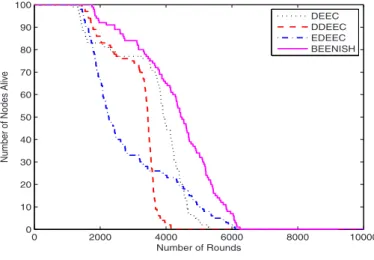
This section evaluates the performance of BEENISH protocol using MATLAB. We consider a WSN containing ofN=100 nodes randomly deployed inside 100m×100mfield. For simplicity, we assume that all nodes are either fixed or micro-mobile and ignore energy loss due to signal collision and interference between signals of different nodes that are due to dynamic random channel conditions. Our simulations use radio parameters mentioned in Table 1. Protocols compared with BEENISH include DEEC, DDEEC and EDEEC. We estimated performance for the case of four level and multi-level heterogeneous WSNs. We observe performance of DEEC, DDEEC, EDEEC and BEENISH for four level and multi-level heterogenous WSNs. We take the parameters;m=0.5, m0 =0.3, m1 =0.2, a =1.5, b=2.0and u=2.5, containing 50 normal nodes havingE0energy, 35 advanced nodes having 1.5 times more energy than normal nodes, 12 super nodes containing 2 times more energy than normal nodes and 3 ultra-super nodes containing 2.5 times more energy than normal nodes. First node for DEEC, DDEEC, EDEEC and BEENISH dies at 1103, 1367, 1421 and 1661 rounds, respectively. All nodes die at 5191, 3976, 6866 and 6903 rounds, respectively. Fig. 3 shows BEENISH sends more data to BS than DEEC, DDEEC and EDEEC. BEENISH is efficient as compare to all protocols in terms of stability period, network life time and packets sent to the BS.
0 2000 4000 6000 8000 10000 0 10 20 30 40 50 60 70 80 90 100 Number of Rounds
Number of Nodes Alive
DEEC DDEEC EDEEC BEENISH
Fig. 2. Alive Nodes During Network Lifetime
0 2000 4000 6000 8000 10000 0 0.5 1 1.5 2 2.5 3 3.5 4 4.5x 10 5 Number of Rounds
Number of Packets sent to BS
DEEC DDEEC EDEEC BEENISH
Fig. 3. Packets sent to BS
5. Conclusion
Our proposed BEENISH is energy-aware clustering protocol for heterogenous WSNs, with the concept of four types of nodes. Election of CH based on residual and average energy of the network. So, nodes with high energy have more chances to get selected as CH, as compare to the low energy nodes. BEENISH is proved to be the most efficient protocols as compared to DEED, DDEEC and EDEEC for all types of WSNs in terms of stability period, network lifetime and throughput.
References
[1] Qureshi, T.N.; Javaid, N.; Malik, M.; Qasim, U.; Khan, Z.A., “On Performance Evaluation of Variants of DEEC in WSNs,” Broadband, Wireless Computing, Communication and Applications (BWCCA), 2012 Seventh International Conference on , vol., no., pp.162,169, 12-14 Nov. 2012
[2] Tauseef Shah, Nadeem Javaid, Talha Naeem Qureshi, “Energy Efficient Sleep Awake Aware (EESAA) Intelligent Sensor Network
[3] Aslam. M, Javaid. N, Rahim. A, Nazir. U, Bibi. A, Khan. Z. A, “Survey of Extended LEACH-Based Clustering Routing Protocols for Wireless Sensor Networks”, 5th International Symposium on Advances of High Performance Computing and Networking (AHPCN-2012)in conjunction with 14th IEEE International Conference on High Performance Computing and Communications (HPCC-2012), 25-27 June, Liverpool, UK, 2012.
[4] I.F. Akyildiz, W. Su, Y. Sankarasubramaniam, E. Cayirci, “Wireless sensor networks: a survey, Computer Networks”, 38 (4) (2002) 393-422.
[5] Aslam. M, Shah. T, Javaid. N, Rahim. A, Rahman. Z, Khan. Z. A, “CEEC: Centralized Energy Efficient Clustering A New
Routing Protocol for WSNs”, Poster Session of 9th Annual IEEE Communications Society Conference on Sensor, Mesh and Ad Hoc Communications and Networks (SECON2012), Seoul, Korea, 2012.
[6] Latif. K, Jaffar. M, Javaid. N, Saqib. M. N, Qasim. U, Khan. Z. A, “Performance Analysis of Hierar- chical Routing Protocols in
Wireless Sensor Networks”, 5th International Workshop on Next Generation of Wireless and Mobile Networks (NGWMN 2012) in conjunction with 7th IEEE International Conference on Broadband and Wireless Computing, Communication and Applications (BWCCA 2012), Victoria, Canada, 2012.
[7] P. Krishna, N.H. Vaidya, M. Chatterjee, D. Pradhan, “A cluster-based approach for routing in dynamic networks, ACM SIGCOMM Computer Communication Review”, 27 (2) (1997) 49-65.
[8] B. McDonald, T. Znati, “Design and performance of a distributed dynamic clustering algorithm for Ad-Hoc networks”, in: Pro-ceedings of the Annual Simulation Symposium, 2001.
[9] V. Mhatre, C. Rosenberg, D. Kofman, R. Mazumdar, N. Shroff, “Design of surveillance sensor grids with a lifetime constraint”,
in: 1st European Workshop on Wireless Sensor Networks (EWSN), Berlin, January 2004.
[10] W.R. Heinzelman, A.P. Chandrakasan, H. Balakrishnan, “Energy efficient communication protocol for wireless micro sensor
networks”, in: Proceedings of the 33rd Hawaii International Conference on System Sciences (HICSS-33), January 2000. [11] W.R. Heinzelman, A.P. Chandrakasan, H. Balakrishnan, “An application- specific protocol architecture for wireless microsensor
networks”, IEEE Transactions on Wireless Communications 1 (4) (2002) 660-670.
[12] S. Lindsey, C.S. Raghavenda, PEGASIS: “power efficient gathering in sensor information systems”, in: Proceeding of the IEEE
Aerospace Conference, Big Sky, Montana, March 2002.
[13] O. Younis, S. Fahmy, HEED: “A hybrid, energy-efficient, distributed clustering approach for ad hoc sensor networks”, IEEE
Transactions on Mobile Computing 3 (4) (2004) 660-669.
[14] G. Smaragdakis, I. Matta, A. Bestavros,“SEP: A Stable Election Protocol for clustered heterogeneous wireless sensor network”, in: Second International Workshop on Sensor and Actor Network Protocols and Applications (SANPA 2004), 2004.
[15] Khan. A. A, Javaid. N, Qasim. U, Lu. Z, Khan. Z. A, “HSEP: Heterogeneity-aware Hierarchical Stable Election Protocol for WSNs”, 3rd International Workshop on Advances in Sensor Technologies, Systems and Applications (ASTSA-2012) in conjunc-tion with 7th IEEE Internaconjunc-tional Conference on Broadband and ireless Computing, Communicaconjunc-tion and Applicaconjunc-tions (BWCCA 2012), Victoria, Canada, 2012.
[16] Aasia Kashaf, Nadeem Javaid, Zahoor Ali Khan and Imran Ali Khan, “TSEP: Threshold-sensitive Stable Election Protocol for WSNs”, 10th IEEE International Conference on Frontiers of Information Technology (FIT 12), 2012, Pakistan.
[17] L. Qing, Q. Zhu, M. Wang, “Design of a distributed energy-efficient clustering algorithm for heterogeneous wireless sensor
network”, ELSEVIER, Computer Communications 29, 2006, pp 2230- 2237.
[18] Elbhiri, B. , Saadane, R. , El Fkihi, S. , Aboutajdine, D. “Developed Distributed Energy-Efficient Clustering (DDEEC) for
heterogeneous wireless sensor networks”, in: 5th International Symposium on I/V Communications and Mobile Network (ISVC),
2010.
[19] Parul Saini, Ajay.K.Sharma, “E-DEEC- Enhanced Distributed Energy Efficient Clustering Scheme for heterogeneous WSN”, in: