Mining User-Generated
Content for Incidents
Auswertung von nutzergenerierten Inhalten für Schadensereignisse
Zur Erlangung des akademischen Grades Doktor-Ingenieur (Dr.-Ing.)
genehmigte Dissertation von Dipl.-Wirtsch.-Inform. Axel Schulz aus Magdeburg Mai 2014 — Darmstadt — D 17
Department of Computer Science Telecooperation
Mining User-Generated Content for Incidents
Auswertung von nutzergenerierten Inhalten für Schadensereignisse
Genehmigte Dissertation von Dipl.-Wirtsch.-Inform. Axel Schulz aus Magdeburg 1. Gutachten: Prof. Dr. Max Mühlhäuser
2. Gutachten: Prof. Dr. York Sure-Vetter Tag der Einreichung: 01.05.2014
Tag der Prüfung: 23.06.2014 Darmstadt — D 17
”To leave the world a little better than you found it. That’s the best a man can ever do.” - Paul Auster
Erklärung zur Dissertation
Hiermit versichere ich, die vorliegende Dissertation ohne Hilfe Dritter nur mit den angegebenen Quellen und Hilfsmitteln angefertigt zu haben. Alle Stellen, die aus Quellen entnommen wurden, sind als solche kenntlich gemacht. Diese Arbeit hat in gleicher oder ähnlicher Form noch keiner Prüfungsbehörde vorgelegen.
Darmstadt, den 01. Mai 2014
Abstract
Social media changed human interaction by allowing people to connect to each other anytime and from anywhere, resulting in many valuable information shared about a variety of different domains. Because of the large amount of data created every day, social media analytics became an important topic to make use of this source of infor-mation. Most importantly, people contribute much valuable information about crisis events such as small-scale incidents, which is currently not taken into account by decision makers in emergency management. Reasons for this are the sheer amount of information as well as the heterogeneous and unstructured nature of the data, which hinder the use of this source of information.
In this dissertation, we try to answer the question ”How can user-generated content be made a usable and valuable source of information for situational awareness of de-cision makers?”. To answer this question, we present a framework consisting of the necessary steps to process a large amount of social media data in such a way that incident-related information is identified and aggregated to distinct incident clus-ters, each one containing information about an individual real-world incident. With the contributions presented in this dissertation, previously not usable user-generated content becomes a valuable source for decision making in emergency management. In the first part of the dissertation, we introduce the requirements of a system for small-scale incident detection, which are derived from the (1) spatial, (2) temporal, and (3) thematic dimensions defining an incident. Based on these dimensions, we develop a framework for processing a large amount of user-generated content. As a first step of the framework, we introduce how user-generated content is collected to create an initial information base, which is processed in the subsequent steps of the framework.
In the second part, we introduce several steps to preprocess unstructured social me-dia data so it can be used in the subsequent steps of the framework. We show how named entities and temporal expressions are identified and extracted so that they can be used as additional information when creating a machine learning model that is generalizable for data that stems from a different city. We introduce a set of adap-tations applied to standard techniques that allow us to extract named entities and temporal expressions from unstructured text. We also present how we make use of the temporal expressions to infer the point in time when an incident occurred. In that part, we also deal with the problem of how to infer the spatial dimensions of user-generated content. We contribute a novel approach for the geolocalization of tweets that is capable of inferring the home location of a Twitter user, the point of origin where a tweet was sent, as well as of inferring the location focus of a
tweet message. We show that the approach is able to locate 92% of all tweets with a median accuracy of below 30 km, thus outperforming related approaches. Fur-thermore, it predicts the user’s residence with a median accuracy of below 5.1 km. Finally, the same approach is able to estimate the focus of incident-related tweets within a median accuracy of below 250 m.
In the third part of the dissertation, we present approaches for inferring the thematic dimension. We contribute a general approach for applying crowdsourcing to manu-allyclassify and aggregate user-generated content according to the information need of the command staff in emergency management. With this approach, we are able to differentiate incident-related information from information not related to an inci-dent. Evaluation results with end users show that this approach is indeed valuable for the command staff.
As crowdsourcing is limited when it comes to the timely filtering of a large amount of information, we further contribute an approach forautomaticallydetecting incident-related information in user-generated content. Based on an extensive evaluation of different feature groups, we present a highly precise machine learning approach that is able to classify the incident type with an F-measure of more than 90%. We also deal with the dynamism and regional variation of user-generated content and contribute a concept that allows creating features that are not city-specific and support training a generalized model.
Based on the temporal, spatial, and thematic dimensions of each information item, we present a clustering approach that is able to detect incidents in a large amount of social media data. The approach clusters all information related to the same in-cident. Furthermore, it is able to cope with different organizational incident type vocabularies. Evaluation results show that the approach is able to detect more than 50% of real-world incidents published in an official emergency management sys-tem. Furthermore, 32.14% of the detected incidents are within a 500 m radius and within a 10 min time interval of the real-world incident, allowing precise spatial and temporal localization. With this recall, we outperform related approaches, which only detect about 5% of the real-world incidents. Also, more than 77% of the inci-dent clusters created with our approach are indeed related to inciinci-dents, thus signif-icantly reducing the quantity of irrelevant information. Furthermore, we underline the importance of incident-related tweets by conducting a user study of situational information shared in user-generated content, showing that valuable situational in-formation is indeed shared in social media.
Finally, we contribute an approach for reducing labeling costs of user-generated content. The presented algorithms make use of temporal, spatial, and thematic metadata to determine the most valuable instances to label. Our evaluation shows that the approach outperforms current state-of-the-art approaches. Furthermore, we show that labeling costs can indeed be reduced.
Zusammenfassung
Soziale Netzwerke, wie z.B. Twitter, ermöglichen es, sich von jedem Ort und zu jeder Zeit miteinander zu verbinden. Dies führt dazu, dass eine große Menge an Informa-tionen über vielfältige Themen erzeugt wird. Ein Teil dieser nutzergenerierten Inhal-te bezieht sich auf alltägliche Ereignisse, wie Autounfälle oder Brände. Obwohl diese Informationen zu Schadensereignissen potentiell nützlich für die Entscheidungsfin-dung im Krisenmanagement sein können, besteht momentan keine Möglichkeit diese zu verwenden. Dies liegt zum einen daran, dass eine manuelle und zeitnahe Verar-beitung der Menge an Informationen nur schwer durchführbar ist. Zum anderen ist eine automatisierte Verarbeitung dieser größtenteils unstrukturierten Daten bisher nicht möglich.
In der vorliegenden Dissertation soll die Frage behandelt werden, wie nutzergene-rierte Inhalte aufbereitet werden können, um diese zu einer nützlichen und wert-vollen Informationsquelle für Entscheidungsträger zu machen. Dazu wird in dieser Arbeit ein System vorgestellt, welches die notwendigen Verarbeitungsschritte durch-führt, um Informationen, die sich auf Schadensereignisse beziehen, zu erkennen und zu aggregieren.
Im ersten Teil der Dissertation werden zunächst die Anforderungen an ein System vorgestellt, welches Schadensereignisse auf Basis von nutzergenerierten Inhalten er-kennt. Diese Anforderungen werden von drei Eigenschaften, die ein Schadensereig-nis definieren, abgeleitet: der räumlichen, zeitlichen und thematischen Dimension. Basierend auf diesen Dimensionen wurde ein System entwickelt, um Schadensereig-nisse auf Basis großer Datenmengen zu erkennen.
Als erster Schritt des Systems wird beschrieben, wie eine initiale Informationsbasis aus sozialen Medien geschaffen wird. Als zweiter Schritt werden unterschiedliche Verfahren präsentiert, um nutzergenerierte Inhalte derart aufzubereiten, dass diese in den darauffolgenden Verarbeitungsschritten genutzt werden können. Dazu wird zunächst gezeigt, wie Eigennamen und zeitliche Ausdrücke erkannt und extrahiert werden können, um diese als zusätzliche Informationen für die Bestimmung der drei Dimensionen zu nutzen. Weiterhin werden zeitliche Ausdrücke dafür eingesetzt, um den genauen Zeitpunkt zu bestimmen, wann ein Schadensereignis stattgefunden hat.
In diesem Teil der Dissertation wird ebenfalls das Problem adressiert, wie die räumli-che Dimension eines Schadensereignisses ermittelt werden kann, d.h. wie nutzerge-nerierte Inhalte räumlich verortet werden können. Dafür wird ein Algorithmus vor-gestellt, welcher in der Lage ist, den Heimatort eines Twitternutzers, seinen Standort zum Zeitpunkt des Sendens einer Nachricht sowie den Bezugspunkt der Nachricht
zu ermitteln. Es wird gezeigt, dass dieser Ansatz in der Lage ist, 92% aller Tweets in einem Median von unter 30 km zu verorten. Weiterhin ist der Ansatz in der Lage den Heimatort mit einem Median unter 5.1 km sowie den Bezugspunkt einer Nachricht mit einem Median unter 250 m zu bestimmen. Mit dieser Genauigkeit werden die Ergebnisse bisheriger Ansätze übertroffen.
Im dritten Teil der Dissertation werden zunächst Ansätze präsentiert, um die thema-tische Dimension einer Information zu bestimmen. Es wird gezeigt, wie Crowdsour-cing eingesetzt werden kann, um nutzergenerierte Inhalte manuell zu klassifizieren und zu aggregieren, so dass die relevanten Informationen für die Entscheidungsfin-dung eines EntscheiEntscheidungsfin-dungsträgers gefiltert werden können. In einer Evaluation mit Entscheidungsträgern wurde gezeigt, dass dieser Ansatz in der tagtäglichen Ent-scheidungsfindung nützlich ist.
Da Crowdsourcing nur begrenzt einsetzbar ist, wenn zeitnah große Datenmengen gefiltert werden müssen, wird weiterhin ein Ansatz zur automatischen Klassifikati-on der thematischen DimensiKlassifikati-on beschrieben. Dafür wird ein präzises Modell zum maschinellen Lernen vorgestellt, um den Typ des Schadensereignisses mit einer Ge-nauigkeit von mehr als 90% zu klassifizieren. Weiterhin wird gezeigt, dass dieses Modell robust gegenüber regionalen Unterschieden in der Verwendung von Begrif-fen, wie z.B. der Verwendung von lokalen Straßennamen, ist.
Basierend auf den in den einzelnen Ansätzen ermittelten räumlichen, zeitlichen und thematischen Informationen, wird ein Ansatz zum Aggregieren zusammengehöri-ger Informationen beschrieben. In einer Evaluation auf Basis von Daten aus einem Krisenmanagementsystem wird gezeigt, dass dieser Ansatz in der Lage ist 50% der echten Schadensereignisse zu erkennen, sowie dass mehr als 32% der erkannten Er-eignisse innerhalb eines 500 m Radius und innerhalb eines 10 min Intervalls liegen. Mit diesem Ansatz wird daher eine präzise räumliche und zeitliche Verortung ermög-licht, die deutlich bestehende Ansätze übertrifft. Weiterhin wird gezeigt, dass 77% der erkannten Ereignisse tatsächlich Schadensereignisse sind, wodurch die Menge an irrelevanten Informationen deutlich verringert werden kann.
Da die automatische Klassifikation der thematischen Dimension eine manuelle Klas-sifikation voraussetzt, wird abschließend ein Ansatz beschrieben, um die Kosten die-ser manuellen Klassifikation zu senken. Dazu werden zwei Algorithmen zur Ereignis-basiertes Aggregation vorgestellt, welche bestmögliche Instanzen zum manuellen Klassifizieren auswählen. In einer Evaluation wird gezeigt, dass dieser Ansatz besse-re Ergebnisse erzielt als bisherige Ansätze.
Mit den in dieser Arbeit erbrachten Beiträgen ist es letzlich möglich, bisher nicht nutzbare Informationen aus sozialen Medien für die Entscheidungsfindung im Kri-senmanagement nutzbar zu machen.
Acknowledgments
This thesis would not have been possible without the support of my advisors, col-leagues, students, family, and friends.
In particular, I thank my professor and advisor Prof. Dr. Max Mühlhäuser (Technische Universität Darmstadt, Germany) for enabling me to do this disserta-tion. I am very thankful for his continuous support during the last three years. Furthermore, I thank Prof. Dr. York Sure-Vetter for being my co-referee.
Special thanks go to Florian Probst (SAP AG) and Immanuel Schweizer (TU Darmstadt) for mentoring and advising me during this time. Thanks Florian, for many ontological discussions and never-ending one pager writing, and thank you, Immanuel, for keeping the heavy workload away from me and taking care of my funding. Also, thanks go to my manager, Knut Manske, for helping me to focus on my dissertation at SAP.
Among the different colleagues that supported me throughout these years, I partic-ularly thank Daniel Bär, Markus Döhring, Christian Guckelsberger, Frederik Janssen, Kamill Panitzek, Heiko Paulheim, Benedikt Schmidt, Sebastian Döweling, and Thorsten Strufe. Also, I like to thank all of my students who contributed to my re-search projects, in particular, Max Bruchmann, Jakob Karolus, Felix Mayer, Johannes Nachtwey, Petar Ristoski, and Tung Dang Thanh. Further, I am immensely thankful for all the support I received from present and former members of the Telecoopera-tion Lab at Technische Universität Darmstadt and the SAP Research lab in Darmstadt. Working with all of you inspired my work and it was a pleasure.
Last but not least, I am deeply grateful for the support of my beloved wife, Jasmin, my family, and my parents-in-law.
Contents 1. Introduction 1 1.1. Motivation . . . 1 1.2. Research Questions . . . 2 1.3. Challenges . . . 3 1.4. Research Scope . . . 4
1.5. Contributions and Outline . . . 5
I.
Initial Foundations for Detecting and Clustering
Incident-Related Information in User-Generated Content
9
2. Design Considerations of a Framework for Detecting Incidents 11 2.1. Initial Definitions and Design Considerations . . . 112.2. Architecture of a Framework for Small-Scale Incident Detection . . . . 13
2.3. Conclusion . . . 16
3. Considerations of Collecting and Filtering User-Generated Content 17 3.1. Background on User-Generated Content and Twitter . . . 17
3.2. Data Collection and Filtering of User-Generated Content . . . 19
3.2.1. Data Sets . . . 19
3.2.2. Incident Types and Keyword Filtering . . . 20
3.3. Conclusion . . . 22
II. Automatic Preprocessing and Geolocalization of
User-Generated Content
23
4. Preprocessing of Unstructured Text 27 4.1. Natural Language Preprocessing . . . 284.2. Named Entity and Temporal Expression Recognition on Unstructured Text . . . 30
4.2.1. Definition of Named Entities and Temporal Expressions . . . 31
4.2.2. Named Entity Recognition and Replacement Using Linked Open Data . . . 32
4.2.3. Location Mention Extraction and Replacement . . . 33
4.2.4. Temporal Expression Recognition and Normalization on Un-structured Text . . . 34
4.2.5. Evaluation of Named Entity and Temporal Expression
Recog-nition . . . 36
4.3. Conclusion . . . 40
5. Geolocalization of User-Generated Content 41 5.1. Background . . . 42
5.1.1. Toponym Resolution . . . 43
5.1.2. Spatial Indicators in Tweets . . . 43
5.2. Related Work . . . 46
5.2.1. The Use of Spatial Indicators in Related Work . . . 46
5.2.2. Techniques Used in Related Work . . . 49
5.2.3. Focus of Geolocalization in Related Work . . . 49
5.2.4. Discussion of Related Work . . . 49
5.3. Approach . . . 50
5.3.1. Approach for Determining the Place of Origin of a Tweet and the Home Location of a Twitter User . . . 50
5.3.2. Approach for Estimating the Focus of Incident-Related Tweets . 56 5.4. Evaluation . . . 58
5.4.1. Data Set and Metrics . . . 59
5.4.2. Determining External Quality Measures . . . 61
5.4.3. Study 1: Evaluation of Single Spatial Indicators . . . 61
5.4.4. Study 2: Evaluation of Estimating the Place of Origin . . . 66
5.4.5. Study 3: Evaluation of Estimating the Home Location . . . 67
5.4.6. Study 4: Evaluation of Estimating the Focus of Incident-Related Tweets . . . 69
5.5. Conclusion . . . 70
III. Incident Detection and Clustering of Incident-Related
Infor-mation
73
6. Human-Based Classification and Aggregation of User-Generated Con-tent 79 6.1. Background . . . 80 6.2. Related Work . . . 83 6.3. Approach . . . 89 6.4. Prototypical Implementation . . . 94 6.5. Evaluation . . . 946.5.1. Study 1: Evaluation of Centered Sensing and Human-Based Classification in Emergency Management . . . 96
6.5.2. Study 2: Qualitative Evaluation of Human-based Classifications 100 6.6. Conclusion . . . 104
7. Machine-Based Classification of User-Generated Content 107
7.1. Background . . . 109
7.2. Related Work . . . 112
7.2.1. Incident Type Classification . . . 113
7.2.2. Approaches Training a Generalized Model For Classifying User-Generated Content . . . 116 7.2.3. Summary . . . 118 7.3. Approach . . . 118 7.3.1. Semantic Abstraction . . . 121 7.3.2. Feature Generation . . . 124 7.3.3. Classification . . . 128 7.4. Prototypical Realization . . . 128 7.5. Evaluation . . . 129
7.5.1. Data Sets, Metrics, and Methodology . . . 129
7.5.2. Study 1: Incident Type Classification Based on Keywords . . . . 133
7.5.3. Study 2: Incident Type Classification - Initial Feature Selection 134 7.5.4. Study 3: Incident Type Classification - Semantic Abstraction . . 142
7.5.5. Study 4: Evaluation of Generalizability Using Semantic Ab-straction . . . 151
7.6. Conclusion . . . 166
8. Machine-Based Aggregation of User-Generated Content 169 8.1. Related Work . . . 171 8.1.1. Type of Event . . . 175 8.1.2. Clustering Approach . . . 179 8.1.3. Metadata Used . . . 181 8.1.4. Summary . . . 182 8.2. Approach . . . 183
8.2.1. Incident Detection and Clustering of Related Information . . . . 183
8.2.2. Clustering Across Different Vocabularies . . . 188
8.2.3. Aggregation of Incident Reports to Incident Clusters . . . 189
8.3. Prototypical Realization . . . 189
8.4. Evaluation . . . 193
8.4.1. Study 1: Analysis of Incident Reports . . . 193
8.4.2. Study 2: Evaluation of Incident Detection . . . 201
8.5. Conclusion . . . 207
9. Refinement of the Framework for Detecting and Clustering Incident In-formation 209 9.1. Background . . . 211
9.2. Related Work . . . 214
9.2.2. Selection Strategies for Active Learning . . . 215
9.2.3. Active Learning and Noisy Labels . . . 216
9.2.4. Summary . . . 216
9.3. Approach . . . 217
9.3.1. Motivating Example . . . 218
9.3.2. Event-Based Clustering for Active Learning . . . 220
9.3.3. Initial Selection Strategy . . . 221
9.3.4. Query Selection Strategy . . . 222
9.4. Evaluation . . . 224 9.4.1. Experimental Setup . . . 225 9.4.2. Results . . . 228 9.4.3. Summary . . . 235 9.5. Conclusion . . . 235 10.Conclusions 237 10.1.Summary . . . 237
10.2.Future Research Directions . . . 239
A. Appendix 243 A.1. Evaluation of Semantic Abstraction in Addition to the Best Feature Groups . . . 243
A.2. Evaluation Results of Machine-Based Aggregation of User-Generated Content . . . 247
Bibliography 249
List of Figures 275
List of Tables 279
1 Introduction
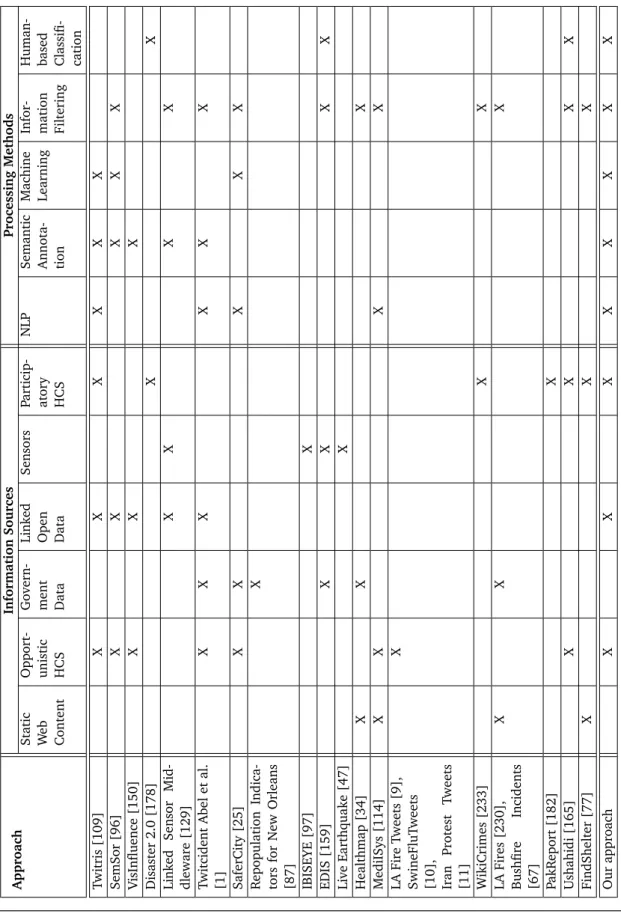
Social media changed the way of human interaction by allowing people to con-nect to each other anytime and from anywhere. Knowledge and information can be shared quickly on a variety of platforms. Because of the large amount of data cre-ated every day, social media analytics became an important topic to make use of this source of information. For instance, social media is used to share opinions regarding movies or products, which is valuable for market research [16, 189]. Political orien-tation [52, 53, 242] and medical conditions [223, 204] are expressed. Furthermore, information about events such as music festivals or soccer games is shared [167]. Recent research showed the relevance of social media for emergency management. With the increasing adoption of smartphones with multiple sensors and a constant Internet connection [35], humans act associal sensorsand become a valuable source of timely incident information. For instance, valuable information was shared during incidents like the Oklahoma grass fires and the Red River floods in April 2009 [236, 219] or the terrorist attacks in Mumbai [85, 164]. When the US Airways flight 1549 crashed into the Hudson River, four minutes after the crash, the first message was shared on Twitter, 15 minutes before the mainstream media [20]. Also, after a storm hit the Pukkelpop festival in Belgium in 2011, bystanders shared important situational information [227]. Furthermore, the analysis of social media showed its value for detecting earthquakes in real time or tracking diseases [192, 213].
In summary, user-generated content gained a steadily increasing relevance in differ-ent areas. Social media is a rich source of inciddiffer-ent-related information, especially for emergency management.
1.1 Motivation
Improving situational awareness (i.e., ”the perception of the elements in the envi-ronment within a volume of time and space, the comprehension of their meaning, and the projection of their status in the near future” [68]) is one of the main goals for efficient decision making in emergency management. Situational awareness is crucial for the success of the operation in the first 72 hours of a disaster [72]. At the beginning of a crisis, the emergency management staff begins to gather and analyze information from multiple sources. On the one side, current information provided by on-site rescue squads and information from internal emergency manage-ment systems are used. On the other side, with the changing information landscape in the World Wide Web, citizens submit their observations and inferences about real-world events more frequently using social media. Different situational information
that could contribute to detect incidents or that would help to understand the situa-tion at hand is already present. This informasitua-tion might help to improve situasitua-tional awareness.
Decision makers in crisis management could highly benefit from this new source of information, if appropriate, and reliable information from citizens could be retrieved in time. However, this information source remains unused. One reason for this is the sheer amount of information created every day, which results in aninformation over-loadthat is not manageable for humans. Also, automatic processing is not applied, because of the heterogeneous and unstructured nature of the data. Thus, inferences on all available information are not easily drawn and potentially valuable situational information remains unused.
Nevertheless, it is unquestioned that the massive stream of user-generated content contains pieces of highly relevant information that is not known to the decision maker. Harvesting this information can contribute to a better situational picture fi-nally leading to an improved situational awareness compared with a situation where this information is not available at all. But up to now, no reliable approach exists for retrieving high-quality information in the vast amount of available user-generated content.
This results in the key question to answer in this dissertation:
How can user-generated content be made a usable and valuable source of information for situational awareness of decision makers?
To answer this question, we follow the vision of a framework that supports a deci-sion maker by providing inferences about an incident based on information present in social media. These inferences can be used to increase situational awareness, lead-ing to more informed decisions, to shorter reaction times, and, finally, to a higher number of successful operations.
To realize this vision, several subordinated questions have to be answered (see Sec-tion 1.2) with respect to certain challenges (see SecSec-tion 1.3). The scope for this dissertation is set in Section 1.4. Finally, the structure and the contributions of this dissertation are provided in Section 1.5.
1.2 Research Questions
The goal of this dissertation is to answer How can user-generated content be made a usable and valuable source of information for situational awareness of decision mak-ers?. To answer this question, we aim to detect incident-related information in the vast amount of user-generated content. Thus, our goal is to develop a framework that enables(1) the detection of incidents based on user-generated contentand (2) the aggregation of incident-related informationin such a way that previously unused
user-generated content becomes a usable and valuable source of information for decision makers.
To achieve this, we have to tackle the following subordinated questions:
• How can incident-related information be manually and automatically detected in user-generated content?
One of the major issues is to identify incident-related information in the vast amount of user-generated content. For manual filtering, crowdsourcing may be applied, whereas data mining is suitable for automatic processing. In the first case, it is important to understand how to apply crowdsourcing on user-generated content. In the latter case, it needs to be investigated if it is possi-ble to build an automatic classification approach that is apossi-ble to classify user-generated content with high performance and accuracy. Furthermore, it needs to be understood which preprocessing steps are needed to convert unstructured information to structured information to enable automatic processing.
• How can information related to the same incident be manually and automatically aggregate?
As different information might refer to the same incident, a clustering of this information according to the incident it refers to is necessary. Thus, considering the impact of time and space is important as each incident has a fixed temporal and spatial extent. For this, it is essential to understand how to infer temporal and spatial information from user-generated content. Furthermore, new means are needed for aggregating related information to provide it in a way it can be used in emergency management.
1.3 Challenges
Social media data is rather different compared with other information sources. It has different characteristics that complicate answering the research questions. These characteristics are described in the following:
• Vast amount of information: The amount of social media data created every day is further increasing [6]. This results in an information overflow, which is difficult to handle. There is a lack of time to analyze the incoming flood of data, especially for time critical decisions.
• Heterogeneity: The types of social media data differ. Social media content might be audio or video files, images, or textual content. This content is not necessarily interlinked. Furthermore, it is shared across various platforms. • Dynamism: Information in social media is changing frequently. For instance,
inter-ests change rapidly as trends evolve. Thus, user-generated content has a very dynamic nature.
• Reliability: Social media platforms are used by companies, domain experts, as well as a variety of regular users. Also, these platforms are spammed by automatic bots and people alike. This results in a high variety of quality, which makes the identification of relevant and reliable information much harder. • Interconnectedness: Compared with traditional texts, textual data in social
me-dia is not independent and identically distributed (i.i.d.) [6]. For instance, peo-ple annotate their content with specific annotations such as hashtags, which are used to refer to a certain topic. Also, users share URLs that refer to external websites. Furthermore, users themselves are interlinked with each other via friendship or follower relationships.
In particular, textual content shared in social media has special properties that pose new challenges to our research goal:
• Unstructuredness of textual content: Text shared in social media is inherently unstructured. Users tend to use abbreviations or nonstandard vocabulary in their posted content. This is even increased through the diversity of authorship; thus, many different styles of writing can be found. Some users such as domain experts post information carefully, while other users do not.
• Length of textual content: In most social networks, the length of each posting is limited. For instance, messages on Twitter are limited to 140 characters. Thus, short messages consist of only few phrases or sentences.
• Regional variation: Words and phrases used in social media texts are intercon-nected to the location where a text was created. Thus, mechanisms that apply for one city may not necessarily apply just as precisely for data of a different city.
1.4 Research Scope
The scope of this dissertation is constrained by the following aspects:
• Small-scale incidents: Within this dissertation, only small-scale incidents are considered. Detecting small-scale incidents in the vast amount of user-generated content poses new challenges to algorithms in this area. The ab-solute amount of information available for an everyday small-scale event is low. Thus, the detection, analysis, and usage of information related to such small-scale incidents are much harder. During large-scale events, postings are usually plentiful, and missing a small-amount might be irrelevant. But with
only a small amount of postings available, this can make a world of difference for decision making in emergency management.
• Pool-based sampling: In this dissertation, we follow a pool-based approach [134] as we assume that all data used is already present for analysis. As a large amount of social media data can be collected in seconds, this is a valid restriction. However, approaches that are applicable in a pool-based setting can also be reused in a stream-based approach.
• Textual content: In this dissertation, we focus on textual content as there has been a rapid growth of text data in social media [6]. The approaches pre-sented in this disseration are general approaches; however, we mainly rely on data retrieved from the social network Twitter. Twitter was used as one very prominent platform on which information is shared every day and by a vari-ety of people. In 2013, Twitter had about 240 million active users [232], who shared more than 500 million messages per day [205]. This huge amount of data gives a wide base of information for a variety of topics. We decided to use tweets as one frequently updated source of user-generated content, which is easy to collect. Furthermore, it has been shown that tweets are created in real time and shortly after an incident occurred; thus, they provide a valu-able source of incident-related information. Additionally, Twitter provides rich metadata such as a time stamp or even GPS coordinates of a user. We expect that approaches that perform sufficiently on tweets also perform well on other social media texts.
1.5 Contributions and Outline
This dissertation is separated into three parts:
• Part I - A Framework for Detecting and Clustering Incident Information in User-Generated Content
– In Chapter 2, we introduce the definition of an event and an incident as a specific type of event. We show that an event can clearly be charac-terized by a temporal, spatial, and thematic dimension. Based on these definitions, we identify requirements of a system that is able to identify incident-related information in user-generated content. Based on these requirements, we present the general architecture of our framework that consists of the necessary steps to help us answer the question How can user-generated content be made a usable and valuable source of information for decision makers?.
– As a first step of the framework, user-generated content is collected. In Chapter 3, we describe how an initial information base is created, which
can further be processed in the subsequent steps of the framework. For this, we present background on user-generated content and Twitter as our major source of incident-related information. Furthermore, we give an overview of the data collection setup.
• Part II - Automatic Preprocessing of User-Generated Content
– As the texts shared in social media are unstructured, further processing is needed. Chapter 4 provides preliminaries needed for preparing text so it can be used for the subsequent steps of the framework. In the same chap-ter, we show how named entities and temporal expressions are identified and extracted so that they can be used as additional information when ap-plying automatic processing techniques. We present a set of adaptations applied to standard techniques that allow us to extract named entities and temporal expressions from unstructured text. We also present how we make use of the temporal expressions to infer the point in time when an incident occurred.
– In the second chapter of this part (see Chapter 5), we deal with the prob-lem how to infer spatial information from user-generated content. For this, we identify parts of tweets and their metadata suitable for geolocalization. In that chapter, we present the first major contribution of this dissertation. We propose a novel approach for the geolocalization of tweets that is ca-pable of inferring the home location of a Twitter user, the point of origin where a tweet was sent, as well as for inferring the location focus of a tweet message. We validate the accuracy of our approach and show that the approach is able to locate 92% of all tweets with a median accuracy of below 30 km. Furthermore, it predicts the user’s residence with a median accuracy of below 5.1 km. Finally, the same approach is able to estimate the focus of incident-related tweets within a median accuracy of below 250 m.
The contributions are partly published in [201, 200].
• Part III - Incident Detection and Clustering of Incident-Related Information
– In Chapter 6, we contribute a general approach for applying crowdsourc-ing to classify and aggregate user-generated content accordcrowdsourc-ing to the in-formation need of the command staff in emergency management. With this approach, we are able tomanuallydifferentiate incident-related infor-mation from inforinfor-mation not related to an incident. Also in this step, we present human-centered sensing as a means for collecting additional in-formation about an incident. Our evaluation shows that these approaches are indeed valuable for the command staff.
– As crowdsourcing is limited when it comes to the timely filtering of a large amount of information, we present an approach forautomatically detect-ing incident-related information in user-generated content (see Chapter 7). For this, we present an extensive evaluation for determining optimal feature sets for this task. We validate the performance of the best feature combination on different data sets and show that we are able to classify the incident type with an F-measure of more than 90%. Also, we deal with the dynamism and regional variation of user-generated content. For this, we introduce the novel concept of semantic abstraction, which allows the creation of features that are not city-specific and support training a gen-eralized model. We evaluate semantic abstraction on data sets from five different cities and show that it is indeed a valuable means.
– Based on the information inferred in the preceding chapters, we contribute a spatio-temporal-thematic clustering approach, which is able to detect in-cidents in a large amount of social media data (see Chapter 8). The ap-proach clusters all information related to the same incident and is able to deal with different organizational incident type vocabularies. We evalu-ate the approach and show that we are able to detect more than 50% of real-world incidents published in an official emergency management sys-tem. Furthermore, 32.14% of the detected incidents are within a 500 m radius and within a 10 min time interval of the real-world incident, allow-ing precise spatial and temporal localization. These results are more than five times better compared with related approaches. Also, more than 77% of the incident clusters created with our approach are indeed related to incident events. Furthermore, we evaluate the value of situational infor-mation shared in tweets posted in two North American cities. We show that a variety of individuals share information about small-scale incidents. Furthermore, we show that important situational information about af-fected objects, injured persons, and the location of an incident is shared, which is important information for decision making.
– As the last chapter in this part, we present an approach for refining the framework according to different information needs (see Chapter 9). This is important as the machine-based approaches need to be adapted to changing conditions such as different incident types or different infor-mation sources. Furthermore, we deal with the problem that refining the framework is costly as new information needs to be collected with extensive human effort. To manage these aspects, we present a novel event-based clustering approach that makes use of spatial, temporal, and thematic information. We validate the effectiveness of our approach on a data set of incident-related tweets compared with state-of-the-art ap-proaches and show that our approach outperforms related work.
Further-Part I.
Initial Foundations for
Detecting and Clustering
Incident-Related
Information in
2 Design Considerations of a Framework for Detecting Incidents and
Clustering Incident-related Information based on User-generated Content In this chapter, we present the general architecture of a framework that allows detecting incidents and clustering incident-related information based on user-generated content. The framework consists of the necessary steps to help us answer the question”How can user-generated content be made a usable and valuable source of information for situational awareness of decision makers?”
In the first section, we define and characterize events and refine them for incidents as specific types of event (see Section 2.1). Based on this, we derive requirements for the framework. In the subsequent Section 2.2, we provide an overview of the framework.
2.1 Initial Definitions and Design Considerations
To deal with the research question, we first need to define an event and incident as a specific type of event. Based on these definitions, we infer requirements of a system for small-scale incident detection.
Event Definition
Up to now, there is no consensus on the definition of an event [153]. Thus, for this dissertation, we follow the most basic and general definitions of the term ”event”. In the first Topic Detection and Tracking (TDT) challenge, Allan et al. [13] defined an event as ”some unique thing that happens at some point in time”. This definition was later refined by Yang et al. [250] to ”an event identifies something (non-trivial) happening in a certain place at a certain time”. Both definitions show that an event is clearly characterized by spatial and temporal dimensions. Furthermore, events can be regarded as ”instances of topics” [250]. In our case, a car crash that happened on March 12, 2014, on the highway A5 is an event, whereas ”car crash” is a topic. Thus, an event is also characterized by a thematic dimension.
Thus, we finally associate an event with three basic properties: • A topic (i.e., a thematic dimension)
• A location (i.e., a spatial dimension)
• A specific time period (i.e., a temporal dimension) Based on these properties, we define an event as follows:
Definition I.1. Anevent is something that is happening in the real world at a certain place, at a certain time, and which can be described by a topic.
Incident Definition
Throughout this dissertation, we focus onincidents (or accidents) as a specific type of event that share the same three properties. Following the definition of an incident by the Federal Emergency Management Agency (FEMA) [28], we define an incident as follows:
Definition I.2. Anincident is an unexpected event in the real world typically resulting in a damage or injury that happens at a certain place, at a certain time, and which can be described by a topic.
Furthermore, incidents can be further distinguished with respect to their impact. A disaster is a large-scale incident and has a different nature compared with a small-scale incident. According to the definitions presented by [28], large-small-scale incidents are extraordinary events resulting in an extensive involvement of organizations. This type of incident is likely to become a ”trending event” as this type of event is rather uncommon and may affect many people. Thus, the frequency of published infor-mation about ”trends” or ”trending events” is substantially higher [122] compared with everyday events such as small-scale incidents. Small-scale incidents happen every day and everywhere and are typically of low public interest. For instance, an earthquake is likely to be a large-scale event because of the high absolute amount of information about this incident. Compared with this, for small-scale incidents, the amount of messages is not significantly higher as there are usually few reactions in social media because of a car accident.
Furthermore, both incident types differ with respect to spatio-temporal localization. Small-scale incidents have a small spatial and temporal extent, whereas the location of a large-scale incident is large or may not be well defined. For instance, a car crash might last for one hour and is limited to an intersection or a lane of a highway. In contrast, in 2012, the hurricane Sandy lasted for several days and affected many people at different locations.
Requirements of a System for Small-Scale Incident Detection
The goal of this dissertation is to differentiate incident-related user-generated con-tent (i.e., every information item in user-generated content) from noise. According to the definition of an incident as a specific type of event, inferring the spatial, tem-poral, and thematic dimensions is necessary. As an information item is either related to a specific real-world incident or not, for detecting incidents and aggregating in-formation related to the same incident, the three dimensions need to be inferred.
Thus, a system for small-scale incident detection needs to suffice the following three requirements:
R[1]: The system needs to derive thethematicdimension of an information item.
R[2]: The system needs to derive thespatialdimension of an information item.
R[3]: The system needs to derive thetemporaldimension of an information item. Based on the information derived for each information item, it can clearly be related to an incident. In this dissertation, we define an information item related to an incident as incident report. Based on the individual information of each incident report, information for the whole incident can be inferred. Furthermore, incident reports related to the same event can be clustered accordingly.
2.2 Architecture of a Framework for Small-Scale Incident Detection
In the following section, a framework for (1) detecting small-scale incidents based on user-generated content and for (2) clustering information related to the same incident is presented.
The framework relies on two approaches for analyzing a large amount of data: crowdsourcing (i.e., the engagement of humans for manual filtering of user-generated content) and machine learning for automatic extraction of useful informa-tion. The combination of both approaches is necessary as on the one hand, manual analysis of user-generated content is prone to errors. Furthermore, crowdsourcing might result in untrustworthy information [226]. Also, applying crowdsourcing in such time-critical situations as emergencies is not always applicable. On the other hand, machine learning algorithms need to be trained and validated. For this, an-notated training data is needed. Also, one model trained on one city may not be applicable on data of a different city because of the nature of social media data. Thus, already trained models need to be refined to changing conditions. For the framework developed in this dissertation, we decided to combine both approaches to overcome the limitations of each individual one.
The six steps defined in the framework are summarized in the following:
1. Collection and Filtering: In the first and initial step, user-generated content is collected. Besides social media, where valuable information is directly pro-vided, additional information from on-site bystanders can be collected using mobile applications. Furthermore, as the amount of data is large, a prefiltering of the information base can be applied. As a result of this step, a large amount of unstructured information is collected, which needs to be further processed.
2. Automatic Preprocessing: As the information obtained in the previous step is
as machine learning is difficult. Thus, in the second step of the framework, several automatic preprocessing steps are conducted. First, the unstructured information base is converted to a structured information base. Second, named entities and temporal expressions are identified to be used in subsequent steps. Based on the resulting information, the temporal and spatial dimensions for each information item is derived automatically (R[2] and R[3]).
3. Human-Based Classification and Aggregation: In this part of the framework,
manual classification is applied to infer the thematic dimension of an incident (R[1]). Furthermore, manual classification is used to aggregate information related to the same incident. Also, additional information about an incident can be collected in this step. As a result, classified and aggregated incident reports are created.
4. Machine-Based Classification: As outlined before, crowdsourcing is limited
when it comes to timely information retrieval on a large amount of user-generated content. Thus, based on the preclassified information, machine learning models are trained. These can be used to automatically infer the the-matic dimension of an information item for a large amount of data (R[1]). As a result, incident reports are separated from information not related to incidents.
5. Machine-Based Aggregation: Finally, based on the spatial, temporal, and
the-matic information derived for each individual information item, incident re-ports can clearly be related to an incident. Based on this, new incidents can be detected. Also, reports related to the same incident are automatically clustered to provide a set of relevant information to a decision maker.
6. Refinement: As social media platforms are not static environments, the
infor-mation base needs to be adapted to changing conditions. For instance, data from a different city or new information sources are used. Also, the dynamism of user-generated content might result in adapting the pipeline according to the current needs. Furthermore, decreasing classification quality may result in refining the automatic processing models used in the framework. In the refinement step, these adaptations are supported.
7. Presentation and Usage: As a result of this framework, a structured
infor-mation base that enhances the situational awareness of a decision maker is created. The information can now be consumed and used for taking decisions. Furthermore, the resulting information can be fed again into the framework. In Figure 2, the connection of each of the steps is shown.
The refinement step is an iterative process that takes unlabeled data as input to select which information item is most valuable to annotate manually. Based on the manual annotation, the automatic classification in the machine-based classification step can be refined with new data. This process is continued until some stopping criteria such as a minimum level of classification accuracy is reached.
Finally, a large amount of previously unprocessed and unstructured data is now represented as a structured information base. This way, it can be used for decision making. Furthermore, data derived in the preceding steps can be used as new input for the framework. For instance, new information is collected in the human-based classification and aggregation step.
2.3 Conclusion
In this chapter, we defined and characterized an event and incident as a specific type of event. We showed that an incident is clearly defined by a spatial, temporal, and thematic dimension. Based on these dimensions, we identified requirements of a system that is able to identify incident-related information in user-generated content. We further presented the overall architecture of a framework sufficing the requirements and introduced the necessary processing steps.
In the following chapter, we present the first step of the pipeline, which is the collec-tion and filtering of user-generated content.
media data in the form of videos, audio files, or photos is shared on YouTube3 or Flickr4. Textual content is mostly shared in blogs such as Engadget5 or with limited content on microblogging sites such as Twitter6 or Tumblr7.
In this dissertation, we focus on textual content as there has been a rapid growth of text data in social media [6]. Furthermore, we focus on Twitter as one very prominent platform on which information is shared every day and by a variety of people. In 2013, Twitter had about 240 million active users [232], who shared more than 500 million messages per day [205]. This huge amount of data gives a wide base of information for a variety of topics.
On Twitter, users can post short messages called tweets of up to 140 characters in length. Thesemicropostsare either sent from mobile devices, from third-party appli-cations, or from web applications. For each user, a stream of microposts is displayed as amicroblog, which is the reason why Twitter is a microblogging platform. Twitter is also a social network as users are able to follow each other’s microblogs. Further-more, users can forward orretweeteach other’s messages.
While communicating, people use a variety of Twitter-specific symbols [125]. Place-names or user Place-names are referenced using the ”@” symbol. Also, Twitter allows to use the hashtag ”#” symbol to specify a number of keywords or a topic of a tweet. For instance, ”#swineflu” was introduced for the trending news event. However, there is no common convention on how to name these topics [44]. Furthermore, hashtags are not necessarily unique and are highly dependent on how they are used in the whole social network [188].
As outlined in the introduction, social media data such as tweets is inherently noisy and unstructured. In Listing 3.1, an example tweet that illustrates the unstructured-ness of textual information in social media is shown.
Listing 3.1:Example tweet showing the unstructuredness of textual information.
RT : @People 0 noe friday afternoon in heavy traffic , car crash on I -90 , right lane closed
First, Twitter-specific annotations such as @-mentions and retweet annotations are used. Second, abbreviations such as ”0noe” are present. Third, very short sentences are written due to the restricted length of a tweet. However, the information density is high as, for example, the position, and the type of incident is mentioned.
3 https://www.youtube.com/[Accessed: 15.01.2014]
4 https://www.flickr.com/[Accessed: 15.01.2014]
5 http://www.engadget.com/[Accessed: 15.01.2014]
6 https://twitter.com/[Accessed: 15.01.2014]
3.2 Data Collection and Filtering of User-Generated Content
In the following, we describe how user-generated content is collected. For this, we introduce two Twitter application programming interfaces (APIs) for gathering tweets.
Twitter provides two major APIs for collecting tweets. First, the Streaminig API8 allows the crawling of real-time Twitter data. This API gives a 1% real-time stream of all tweets created worldwide. Second, the Search API9 can be used to get tweets related to certain keywords or a location. It allows specifying a search query con-taining multiple keywords and GPS coordinates as well as a radius. Using this API, it is possible to collect a stream of tweets for a single city. The Search API provides not only explicitly geotagged tweets but also tweets that have been geocoded by Twitter (e.g., using the user profile). However, the results provided by this API are not complete sets of all tweets, but they are prefiltered by Twitter 10.
In the following, we give an overview of data sets created with both APIs. Further-more, as the amount of data is not applicable for manual analysis, it needs further filtering. For this, we present our approach for keyword filtering.
3.2.1 Data Sets
We collected four large tweet data sets, which are the base for our evaluations in this dissertation. In the following, we present the initial data sets that were col-lected. In each chapter, we provide a detailed description of how these data sets were adapted to suffice the specific needs of the respective evaluation. Also, in the following chapters, additional data sets that are only used in the respective chapters are introduced.
From September 2011 to February 2012, we crawled around 80 million tweets from the so-called Spritzerstream using the Twitter Streaming API. The data set that we collected was used as a worldwide data set for developing the approach for inferring the spatial dimension of an information item (see Chapter 5). The resulting data set is as follows:
• SET_GEO: 80 million worldwide tweets collected from September 2011 to
February 2012.
Furthermore, we collected several city-specific data sets using the Search API. These data sets were collected in a 15 km radius around the city centers of Seattle,
Wash-8 https://dev.twitter.com/docs/streaming-apis/streams/public[Accessed: 15.01.2014]
9 https://dev.twitter.com/docs/api/1.1/get/search/tweets[Accessed: 15.01.2014]
ington, Memphis, Tennessee, New York City, New York, Chicago, Illinois, and San Francisco, California. We focused on these cities as they have a huge regional distance, which allows us to evaluate our approaches with respect to geographi-cal variations. Furthermore, 15 km was chosen because with this radius, we are able to get data even for larger cities.
Though we know about the limitations of the Search API, using the Search API has been shown as the most appropriate means for analyzing tweets in prior work [236]. As the Search API provides not only explicitly geotagged tweets but also tweets that have been geocoded by Twitter, we assume that we retrieved a relevant sample for our experiments, although it is not a complete set for the cities.
We collected all tweets that were available using the Search API during certain time periods for the cities. This gave us three initial sets of tweets, which are used in several chapters of this dissertation:
• SET_CITY_1: 6M tweets collected from November 19, 2012 to December 19,
2012 for Memphis, Tennessee and Seattle, Washington.
• SET_CITY_2: 1.5M tweets collected from February 1, 2013 to February 7, 2013
for Memphis, Tennessee and Seattle, Washington.
• SET_CITY_3: 2.5M tweets collected from January 1, 2014 to March 11, 2014
for New York City, New York; Chicago, Illinois; and San Francisco, California. 3.2.2 Incident Types and Keyword Filtering
As we needed to restrict our research scope, we decided to focus on a subset of incident types. In the following, we present which types were chosen to be used in this dissertation. We decided to focus on three specific incident types because we identified them as the most common incident types in the city of Seattle, Washington using the Seattle Real Time Fire Calls data set11. The Fire Calls data set is a source of frequently updated official incident information and provides high-quality data about incidents.
Thus, in this dissertation, we focus on very common and distinct incident types and one neutral event type:
• Car incident • Fire incident • Shooting incident
• Not incident related or other type of incident
Whenever a manual analysis of data sets was applied, we needed to reduce the initial data sets to ensure high-quality ground truth data for our experiments. Thus, our approach used for filtering is to identify and extract tweets mentioning incident-related keywords. These keywords are derived from the incident types. Though keyword filtering significantly reduces the overall amount of data, it helps to build an initial set for developing and optimizing algorithms. The keyword filtering is applied on the complete set of tweets; thus, the keywords are identified after collecting all available tweets with the respective API. Compared with other approaches that completely rely on filtering using hashtags, we take the whole message into account for identifying incident-related keywords.
To build a set of incident-related keywords, we retrieved all incident types used in the ”Seattle Real Time Fire 911 Calls” data set. Based on these incident types, we manually identified those that matched our three incident types. This gave us a set of 11 incident types that stem from the real-world information retrieved from Seattle. For each of these incident types, we defined one general keyword set with keywords that are used in the name of the incident type. For instance, the keywords ”vehicle”, ”accident”, and ”vehicle accident” were assigned as general keywords for the incident type ”Motor Vehicle Accident”.
The general keywords were then further enhanced with a set of additional keywords. These specific keywords were identified by extending the general keywords with the direct hyponyms extracted from WordNet12. For instance, the keyword ”accident” was extended with the related words ”collision”, ”crash”, ”wreck”, ”shipwreck”, ”in-jury”, ”accidental in”in-jury”, ”fatal accident”, and ”casualty”.
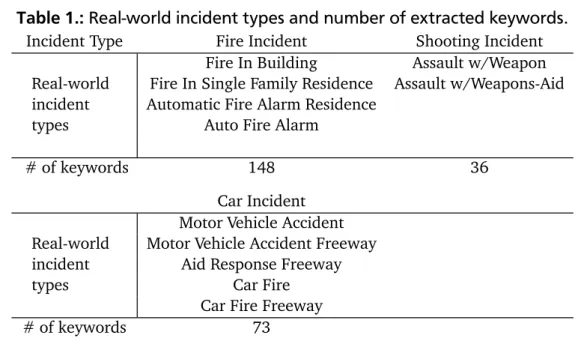
An overview of the incident types and the overall number of extracted keywords can be found in Table 1. Based on these 257 incident-related keywords, we are able to prefilter tweets to a set of information that is likely related to incidents.
Table 1.:Real-world incident types and number of extracted keywords.
Incident Type Fire Incident Shooting Incident
Real-world incident types
Fire In Building Assault w/Weapon Fire In Single Family Residence Assault w/Weapons-Aid Automatic Fire Alarm Residence
Auto Fire Alarm
# of keywords 148 36
Car Incident
Real-world incident types
Motor Vehicle Accident Motor Vehicle Accident Freeway
Aid Response Freeway Car Fire
Car Fire Freeway # of keywords 73
3.3 Conclusion
In this chapter, we presented the first step of our framework, which is the collection of user-generated content. We gave an overview of user-generated content and Twit-ter, as the platform that our analyses are based on. We further presented our data collection approach and introduced data sets that are used throughout this disserta-tion. Also, we introduced three specific incident types as well as a keyword-filtering approach to reduce incoming user-generated content to a set of manageable infor-mation. As a result of the collection step, an initial information base is created, which can further be processed in the subsequent steps of the framework.
As the data collected in this step is unstructured, the following part deals with the problem of how to preprocess user-generated content.
Part II.
Automatic Preprocessing
and Geolocalization of
The last part provided an overview of the framework for small-scale incident de-tection. Furthermore, we introduced the first step of the framework for collecting user-generated content. As the collected texts shared in social media are mostly un-structured, further processing is needed. The following part presents preliminaries needed for inferring the thematic dimension of an event in further processing steps (see Figure 4). Also, we show how we infer the temporal and spatial dimensions of a tweet.
As one of our requirements is to infer the thematic dimension of an event (R[1]), unstructured texts need to be preprocessed so they can be used as structured data for feature generation. The necessary preprocessing steps are presented in Chapter 4. In the same chapter, we show how named entities and temporal mentions are identified and extracted so that they can be used as additional features when applying data mining. For this, in Section 4.2, we describe how we adapted existing approaches for named entity and temporal expression recognition. We also present how we make use of the temporal expressions to infer the temporal dimension of a tweet (R[3]).
In the second chapter of this part (see Chapter 5), we deal with the problem of how we infer the spatial dimensions of a tweet (R[3]). In that chapter, we present the first major contribution of this dissertation, which is a novel approach for the geolocalization of user-generated content.
The contributions presented in this part are the following:
• We present which preprocessing steps are conducted to create structured text that can be used for feature generation.
• We present a set of adaptations applied to standard techniques that allow us to extract named entities and temporal expressions from unstructured text. Furthermore, these approaches are evaluated on data sets of Twitter messages. • We propose an adaptation of a standard approach for extracting temporal ex-pressions and show how we make use of the results for inferring the temporal dimension of an event mentioned in a tweet.
• We propose a novel approach for the geolocalization of tweets, suitable for inferring the home location of a Twitter user, the point of origin where a tweet was sent, as well as for inferring the location focus of a tweet message. In an evaluation, we show that the approach is able to locate 92% of all tweets with a median accuracy of below 30 km. Furthermore, it predicts the user’s residence with a median accuracy of below 5.1 km. Finally, the same approach is able to estimate the focus of incident-related tweets within a median accuracy of below 250 m.
Furthermore, named entities present in social media texts provide additional infor-mation about a geolocation and the point in time when an event occurred, which are important for incident detection ([R2] and [R3]). Also, named entities can be used to derive additional features for the text mining process in addition to the plain word-based approach (see Chapter 7). For this, temporal and spatial information need to be identified in the unstructured data, which is covered by the following two questions:
• How is spatial information identified in social media texts? • How are temporal expressions identified in social media texts?
Related to these questions, we show how we detect named entities and temporal expressions present in textual documents in Section 4.2. Furthermore, in the same section, we present how we infer the temporal dimension of a tweet based on the extracted temporal expressions.
In this chapter, we present several adaptations of standard techniques:
• We present which preprocessing steps are conducted to create structured text, which can be used for feature generation.
• We present a set of adaptations applied to standard techniques that allow us to extract named entities and temporal expressions from unstructured text. Furthermore, these approaches are evaluated on data sets of Twitter messages. • We propose an adaptation of a standard approach for extracting temporal ex-pressions and show how we make use of the results for inferring the temporal dimension of tweets.
Though the preprocessing steps are explained using tweets as examples, they are likewise applicable to different unstructured texts that stem from social media. In the first section of this chapter, we present which preprocessing steps are con-ducted on the unstructured text to convert it into a structured representation (see Section 4.1). In the second section, we show how we extract named entities and temporal expressions (see Section 4.2). Furthermore, we show how we infer the date of an event mentioned in a tweet. The results are summarized in Section 4.3. Parts of this chapter appeared in [201].
4.1 Natural Language Preprocessing
In this section, we discuss which Natural Language Processing steps must be applied on social media data to structure unstructured text to finally enable the creation of a feature vector. In Listing 4.1, an example of an unstructured text in a Twitter message is shown.
provided by the Internet Slang Dictionary & Translator13. For instance, in the example tweet, ”0noe” is replaced with ”oh no”.
• URLs are widely used in social media for linking to external websites. However, this results in a variety of different URLs that would be added as single features to the feature vector. Thus, we replace them with one, common token ”URL”. Whereas the value of Unicode conversion and stopword removal is obvious, in Chap-ter 7, we evaluate the advantage of the abbreviation resolution and URL replacement steps.
In Listing 4.2, the preprocessed example tweet after applying the preprocessing steps of Figure 6 is shown. Based on this preprocessed text, we are able to generate a fea-ture vector for text mining, which is applied in the following steps of the framework.
Listing 4.2:Preprocessed example tweet.
friday afternoon traffic car crash I -90 lane close
4.2 Named Entity and Temporal Expression Recognition on Unstructured Text
In the last section, we described an extended pipeline to generate structured from unstructured text. Additionally, we perform several problem-dependent preprocess-ing steps. Based on the unprocessed text, we identify named entities and expressions to use the extracted information (1) as additional features for text mining and (2) for incident detection. The results of these steps serve as input for the rest of the pro-cessing pipeline. First, named entities can be used for feature generation to finally detect the type of incident ([R1]). Second, we infer additional information about the spatial and temporal dimensions of an incident ([R2] and [R3]).
In the following, we present adaptations of standard approaches for identifying and classifying named entities and temporal expressions in tweets. These steps are per-formed on the unprocessed tweet in parallel to the preprocessing steps shown in the previous section.
1. We show how we use Linked Open Data (LOD) as a source of interlinked infor-mation about various types of entities (see Section 4.2.2). With the presented steps, we are able to generate new features for data mining.
2. Named Entity Recognition (NER) is applied to extract location mentions (see Section 4.2.3). Location mentions are used to generate new features. Also, they are valuable for the geolocalization of user-generated content.
3. We present a framework for temporal expression extraction (see Section 4.2.4). Temporal expressions are also used to generate new features for text mining. Also, they can be used to infer the point in time of the event mentioned in a tweet.
These preprocessing steps are finally evaluated in Section 4.2.5. 4.2.1 Definition of Named Entities and Temporal Expressions
Named Entity Recognition (NER) is the task of identifying and extracting expressions (or mentions) in text [158]. Furthermore, these mentions are classified according to predefined types (e.g., organization names, location names, or person names). Named entities were initially defined as ”unique identifiers of entities” [46]. How-ever, up to now, there is no common agreement on the definition of a named entity in the research community [147]. Thus, we use the following definition throughout this dissertation, which extends the definition of Petasis et al. [172]:
Definition II.1. An entity is a thing that can be uniquely identified by its properties (e.g., United Kingdom, Seattle, my university). Anamed entity is an entity that has been assigned a name (Technische Universität Darmstadt). Thus, the mention of a named entity in a text is defined asnamed entity mention.14
We further distinguish named entities of type location as a specific type of named entities:
Definition II.2. Aproper location mention (also calledtoponym) is defined as the
named entity mention of a location.
Typically, a location mention is a proper name (represented by a noun or noun phrase) was given to a location. In contrast, common location mentions are de-fined as follows:
Definition II.3. Common location mentions are location mentions for which no
indication of the name is given in a text.
For example, ”Seattle” is a proper location mention, whereas ”my university” in ”I go to my university.” gives no indication of the name of the university. Thus, the latter one is a (common) location mention.
Temporal expressions are another important part of texts. By definition, they are not named entities; thus, beside NER we apply Temporal Expression Recognition and Normalization (TERN) [8]. TERN copes with detecting and interpreting temporal