Received February 7, 2020, accepted February 15, 2020, date of publication February 28, 2020, date of current version March 11, 2020. Digital Object Identifier 10.1109/ACCESS.2020.2977114
KNN-Based Approximate Outlier Detection
Algorithm Over IoT Streaming Data
RUI ZHU 1, XIAOLING JI 1, DANYANG YU 2, ZHIYUAN TAN 3, LIANG ZHAO 1, JIAJIA LI 1, AND XIUFENG XIA 1
1College of Computer Science, Shenyang Aerospace University, Shenyang 110036, China 2Artificial Intelligence and Big Data College, He University, Shenyang 110000, China 3School of Computing, Edinburgh Napier University, Edinburgh EH10 5DT, U.K. Corresponding author: Liang Zhao ([email protected])
This work was supported in part by the National Natural Science Foundation for Young Scientists of China under Grant 61702344 and Grant 61701322, in part by the Young and Middle-Aged Science and Technology Innovation Talent Support Plan of Shenyang under Grant RC190026, in part by the Natural Science Foundation of Liaoning Province under Grant 2019-MS-253, and in part by the Liaoning Provincial Department of Education Science Foundation under Grant JYT19052.
ABSTRACT KNN-Based outlier detection over IoT streaming data is a fundamental problem, which
has many applications. However, due to its computational complexity, existing efforts cannot efficiently
work in theIoTstreaming data. In this paper, we propose a novel framework namedGAAOD(Grid-based
Approximate Average Outlier Detection) to supportKNN-Based outlier detection overIoTstreaming data.
Firstly,GAAODintroduces a grid-based index to manage summary information of streaming data. It can
self-adaptively adjust the resolution of cells, and achieve the goal of efficiently filtering objects that almost
cannot become outliers. Secondly, GAAOD uses a min-heap-based algorithm to compute the distance
upper-/lower-bound between objects and theirk-th nearest neighbors respectively. Thirdly,GAAODutilizes a k-skyband based algorithm to maintain outliers and candidate outliers. Theoretical analysis and experimental results verify the efficiency and accuracy ofGAAOD.
INDEX TERMS IoTstreaming data, KNN-based outliers, indexes, error guarantee.
I. INTRODUCTION
With the development of information science and technol-ogy [1]–[8], outlier detection [9] becomes more and more important. In this paper, we study the problem ofKNN-Based outlier detection overIoTstreaming data. It is a fundamen-tal problem in the domain of data mining, which has been paid more and more attention as manyIoTapplications need to detect anomalies as soon as they occur. The applica-tions range from forest fire protection system, mobile traffic monitoring to health-care monitoring and geological disaster prediction [10]. All these applications would benefit from identifying those critical events in real-time [11]–[17].
For example, as an important application in the domain of IoT[32]–[37], a forest fire protection system uses mul-titudes of sensors to monitor the temperature, humidity and air pressure in a given region. These sensors timely send collected data to the system. When a sensor returns an object which is different from others, it means the region that the The associate editor coordinating the review of this manuscript and approving it for publication was Yuyu Yin .
sensor located may have the risk of fire. Therefore, outlier detection is a key component of forest fire protection sys-tem. In addition, collected data are continuously send to the system, we regard this type of data asIoT streaming data. Therefore, in this paper, we study the problem of outlier detection overIoTstreaming data(short for streaming data).
Multitudes of methods could be used for evaluating whether an object in a data setD is an outlier. Among all of them, distance-based outlier detection is the most popular one [18]. The key behind it is if an object is far from most objects in the data set, this object is regarded as an outlier. Distance-based outlier detection could be further divided into two types:threshold-based and neighbour-based. For the first one, given two parametersk andr, an objecto is an outlier if the number of points within a distancer from o is smaller than k. For the second one, given another two parametersk andn, outliers are the top-n objects that have the largest distances to their k-th nearest neighbors in the dataset.
Due to the importance of outlier detection over stream-ing data, many scholars have studied this problem, but This work is licensed under a Creative Commons Attribution 4.0 License. For more information, see http://creativecommons.org/licenses/by/4.0/
most of them focus on the threshold-based outlier detection.
Yamanishi and Takeuchi [19] propose the frameworkSmart
Sifter. It uses the online discount learning algorithm to incrementally learn a probability model. In addition, it uses this model for outlier detection. Zhang et al.[20] propose
a framework namedSPOT(short for Stream Projected
Out-lier DeTector) for outOut-lier detection in high-dimensional data streams. Caoet al.[21] propose theThresh-LEAPalgorithm. Kontaki et al.[22] propose a micro-clustering based
algo-rithm namedMCOD.
Their key idea is maintaining the lastkarrived neighbours for each object, using maintenance results to evaluate which objects have chance to become outliers or cannot become outliers before they expire from the window. For objects that cannot become outliers, these algorithms need not to maintain any neighbour information for them. In other words, these algorithms only need to maintain the lastkarrived neighbours for a small number of objects in the window.
However, these efforts only can support threshold-based outlier detection. A serious issue of threshold-based outlier detection is that it is difficult to select a proper distance threshold, which requires users to have sufficient background
knowledge. By contrast, neighbour-based outlier
detec-tion uses distance reladetec-tionships among objects for evaluating which objects should be regarded as outliers. This kind of def-inition does not require users to have sufficient background knowledge [23]. However, its computational complexity is high, and can not efficiently work underIoTstreaming data environments.
To solve this problem, this paper studies the problem of approximate neighbour-based outlier detection over sliding window. Without loss of generality, the query window can be either time- or count-based. In both cases, the query window has a fixed window size or a fixed slide (either a time inter-val or an object count). Formally, in a count-based window, it returns the n outliers in the query window containingN objects whenever the window slides; in a time-based window, it returns thenoutliers in the lastN time units whenever the window slides [11]. Given an approximate outlier detection over sliding windowhN,s,n,k, ρi, it monitors the window, and returns approximate outliers to the system whenever the window slides. Let {o1,o2, . . . ,on} be the exact outliers, {a1,a2, . . . ,an}be the approximate outliers. We should
guar-antee that D(oi)
D(ai) ≤ ρ. Here, D(oi) refers to the distance betweenoi and its k-th nearest neighbour. We will discuss
the problem definition in details in Section II.
In order to efficiently support approximate neighbour-based outlier detection, this paper proposes a novel
frame-work named GAAOD(short for Grid-based Approximate
Average Outlier Detection).GAAODfirst learns the distance distribution among objects and theirk-th nearest neighbours.
Based on the learning result, GAAOD constructs a
grid-based index I to maintain streaming data in the window.
We want to highlight that a benefit ofGAAODis that it could self-adaptively adjust the resolution of grid file according to the distance relationship among objects, leading that it
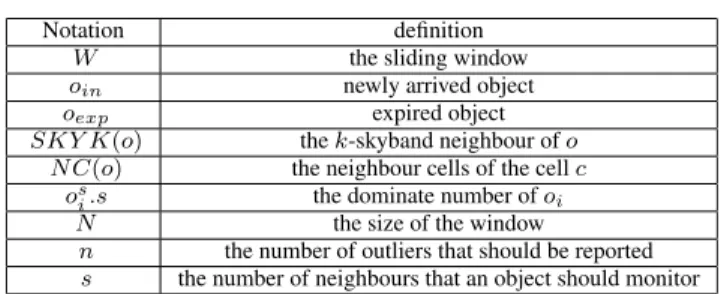
TABLE 1.The summary of notations.
can efficiently support approximate neighbour-based outlier detection. Secondly, we propose a novel outlier candidate algorithm. It uses the key ofk-skybands algorithm to evaluate which objects may become outliers in a relatively high prob-ability, and dynamic adjust candidate set accordingly. The main contributions of this paper are summarized as follows:
• A Self-Adaptive Index:We propose a grid-based index
to maintain streaming data. We find that the cost of maintaining each object in the index isO(1) per object. In addition, we propose a novel algorithm to self-adaptively adjust the cell size of the grid file according to the distribution of outliers. In this way, we could filter non-outliers as fast as possible when they arrive in the window.
• The Approximate K Nearest Neighbour Algorithm MAKN: Based on our proposed index, we propose a min-heap based algorithm to compute the approximate distance upper-bound/lower-bound between objects and theirk-th nearest neighbours. Compared with the exact algorithms, the cost overall could be reduced a lot.
• The Candidate Maintenance Algorithm: We propose
a k-skyband based method to maintain objects which
may become outliers. The benefit is, when some objects expire from the window, we could efficiently know which objects may become outliers. In addition, it could efficiently remove candidates which almost cannot become outliers.
SectionIIreviews the related work. SectionIIIintroduces the definition of KNN-based approximate outlier detection
over sliding window. Section IV describes the framework
GAAOD. SectionVgives the experimental results and analy-sis. SectionVIconcludes this paper.
II. RELATED WORK
This section reviews the algorithms about the problem of continuous outlier detection over streaming data. With the development of data management [24]–[28], this problem has been extensively studied.
Yamanishi et al.propose the algorithm named
Smart-Sifter. It uses an on-line discount learning algorithm to incre-mentally learn the probability hybrid model [19]. Considering the factor of drift, outliers are calculated according to the probability fitting value of learning hybrid model. In addition,
online discounts can also be used to mix attribute data streams to maintain the frequency of a set of attribute values [29].
Angiulli and Fassetti [30] propose an algorithm named STORM. It is used to detect outliers accurately. The algo-rithm maintains objects in the window via an index structure. In addition, when an objectoarrives in the window,STORM firstly insertsointo the index. Secondly, it searches theklast arrived neighbours of o. Thirdly, it deletes expired objects.
Last of all, STORMchecks which objects are outliers via
monitoring objects’ neighbours.
Yang et al. [31] suggest that maintaining neighborhood relationships among objects may spend relatively high cost. Therefore, they use an important feature of sliding windows, namely the ‘‘predictability’’ of the expiration objects to eval-uate which objects have chance(or have no chance) to become outliers. In particularly, given objects in the current window, they predict the pattern structure in subsequent windows by only considering objects in these windows (the objects in the current window). These predicted pattern structures can be abstracted as ‘‘predictive view’’ of each future window, and the outliers can be calculated by using predictive view.
Zhang et al. [20] propose the framework SPOT(short
for Stream Outlier DeTector) for outlier detection in high-dimensional data streams. The key behind it is capturing the statistical information such as relative density and reversely relative standard deviation of objects to support outlier detec-tion in the high-dimensional streaming data environment.
Kontakiet al.[22] propose a micro-clustering based algo-rithm namedMCOD. The key behind it is that if there existk objects contained in a circle with radius2r, the corresponding circle could be regarded as a micro-clustering. One important property is if the number of objects in a micro-clustering is more than k, these objects all cannot become outliers.
Compared with other algorithms, MCODcould effectively
reduce the cost of range query.
Cao et al. [21] propose the algorithm LEAP in 2014. It contains two optimization principles, that are, minimum detection and life-first. For the first one, it only searches for objects’ neighbors when necessary. In this way, it could effectively minimizes the number of neighbors that should be accessed. In addition, for each objecto, once the number of neighbors that should be monitored reduces to 0, the algo-rithm need not to monitoroany longer. For the second one, L. Cao et al. find that objects arrive later are more important than the ones arrive earlier. Through the above two principles, theLEAPalgorithm can effectively reduce both CPU cost and space cost.
Discussion: We find that most of these algorithms can only be used for supporting threshold-based outlier detection. However, they cannot be used for supporting neighbour-based outlier detection. The reason behind it is that, under neighbour-based outlier detection, objects’ score are timely changed when objects arrive in the window/expire from the window. All objects have chance to become outliers before they expire from the window.
III. PROBLEM DEFINITION
Definition 1 (Distance): Let o1 and o2 be two objects
in d-dimensional space. They are expressed as the
tupleho1[1],o1[2], . . . ,o1[d]iandho2[1],o2[2], . . . ,o2[d]i respectively. The distance between o1 and o2, denoted by D(o1,o2), equals topP(o1[i]−o2[i])2.
According to different evaluation methods, the following two definitions can be used to evaluate whether a given object is an outlier, which are threshold-based and neighbour-based. For simplicity, letobe an object in the data setD,ok be the k-th nearest neighbour ofo. We useD(o,ok) as the score of o, i.e., denoted byF(o).
Definition 2 (Threshold-Based Outliers):Letr andk be two parameters,Dbe a set ofd−dimensional objects. We call an objecto∈Das an outlier if the number of points within a distancerfromois smaller thank.
Definition 3 (Neighbour-Based Outliers): Let n and k be two parameters, D be a set of d−dimensional objects. Outliers are the top-nobjects that have the highest scores.
Definition 4 (Continuous Neighbour-Based Outlier Detec-tion):LetW be the query window,qhn,kibe the
neighbour-based outlier detection, q monitors the window, when the
window slides,qreturnsnobjects with the highest scores.
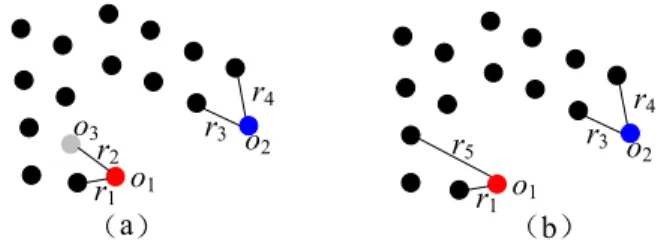
FIGURE 1. Neighbour-based outliers detection over sliding
window(k=2,n=1). (a) Under WindowWi. (b) Under WindowWi+1.
Take an example in Figure 1. Under the window
Wi, the distance between o1 and its 1-nearest neighbour (and 2-nearest neighbour) isr1(andr2). The distance between o2 and its 1-nearest neighbour (and 2-nearest neighbour) is r3(andr4). Sincek =2,n =1 andr4 ≥ r2,o2is regarded as a neighbour-based outlier underWi. By contrast, when the
window slides fromWitoWi+1,o3expires from the window. At that moment, the distance betweeno1 and its 2-nearest neighbour turns tor5. At that moment,o1is regarded as the neighbour-based outlier underWi+1.
Compared with neighbour-based outlier detection,
distance-based outliers detection uses the distance thresh-old to evaluate whether an object is an outlier, but it is difficult to find a suitable threshold r. Neighbour-based outliers detection uses distance relationships among objects to evaluate whether an object is an outlier. However, its com-putational complexity is high, and can not efficiently work under streaming data environments. Therefore, we attempt to propose an approximate algorithm to solve the neighbour-based outlier detection. It is rather surprising that such a small sacrifice of accuracy brings tremendous gain in running time.
For simplicity,{r1,r2, . . . ,rn}refers to thenexact
neighbour-based outliers, and {a1,a2, . . . ,an}refers to then
approxi-mate neighbour-based outliers.D(o,ok) refers to the distance betweenoand itsk−th nearest neighbour.
Definition 5 (Continuous Approximate Neighbour-Based Outlier Detection): LetW be the query window,qhn,k, ρi
be the approximate outlier detection,qmonitors the window, when the window slides,qreturnsnapproximate outliers. For eachriandai, they should satisfy that
D(ri,rik)
D(ai,aki)
≤ρ.
For example, let O{o1,o2, . . . ,on}be a set of objects in
the window,n=2, andk=2. Among all of them, the exact results are {oi,oj}, their corresponding scores are {20,18}.
If we setρto 2, we could use{o0i,o0j}as the approximate query results. Here, their corresponding scores are{15,12}.
IV. THE FRAMEWORK GAAOD
In this section, the frameworkGAAOD is proposed to
sup-port approximate neighbour-based outlier detection over
sliding window. Section IV-A is the framework overview.
In SectionIV-B, we propose a grid-based index to maintain streaming data. Section IV-C discusses the approximate k nearest neighbour searching algorithm. Last of this section, we discuss the candidate outliers maintenance.
A. THE FRAMEWORK OVERVIEW
When the window slides, a newly arrived objectoin flows
into the window, another objectooutexpires from the window.
At that moment, we first insertoininto the streaming data set
S, and remove the expired objectooutfromS. Next, we insert
oin into the grid-based index named GBOI(short for
grid-based outliers index).
Here,GBOImaintains the position information of objects. Specifically, we compute the number of objects in each cell. In addition, we use an inverted-list to maintain objects in each cell based on their arrived order. In order to find a suitable partition resolution forGBOI, the scores of historical outliers are considered. The benefit is once we know the distribution of outliers’ scores, we can associate cells’ size with a proper size. In this way, we can efficiently evaluate which objects
may become outliers viaGBOI. More important, GBOIcan
self-adaptively adjust grid file resolution according to the out-liers’ scores distribution. The index maintenance algorithm will be discussed in SectionIV-B.
When processing a newly arrived objectoin, we first find
the cellcthat containsoin. Next, we find all the neighbour
cells ofc. Here, we call a cellc0as the neighbour cell ofc if the minimal distance between these two cells is 0. Thirdly, we access these neighbour cells for finding approximatek -th nearest neighbours ofoin. In particularly, if the searching
results satisfy the following two conditions, we do not regard it as a candidate outlier. Otherwise, we regard it as a candidate outlier, and insert it into the candidate setC. Here,l refers to the cell size. The approximate algorithm details will be discussed in SectionIV-C.
Algorithm 1The Framework Overview
Input: IndexGBOIG, newly arrived objectoin,expired
objectoout Output: Candidate SetC
1 Streaming data setS←S∪oin,S ←S−oout; 2 insert(G,oin),delete(G,oout);
3 K(oin)←searchRange(oin); 4 if|K(oin)|≥kthen 5 CandidateC←C∪oin; 6 SKYK(oin)←searchSKY(oin); 7 ifKt(oin)≥Tn−N2 then 8 CandidateC←C∪oin; 9 SKYK(oin)←searchSKY(oin); 10 O←findImpact(oin); 11 fori from 1 to|O|do 12 oi.SKY ←update(); 13 ifoi.SKY = ∅then 14 C←C−oi; 15 if|C| =θmaxthen
16 C←remove(θmax−θmin); 17 τ ←reset();
18 return;
• there are at least k objects whose distance to oin are
smaller thanl √
d;
• leto.tbe the arrival order ofo. For each objectoin the query result set,oin.t−o.t ≤ N2 is satisfied;
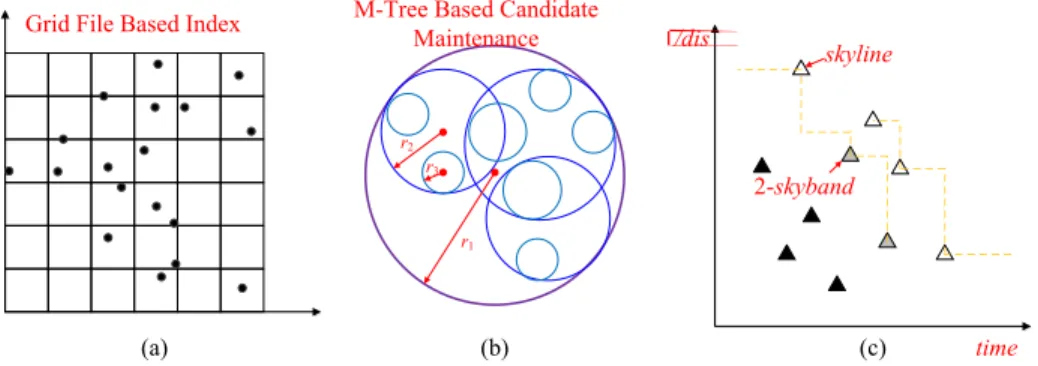
Candidates in C are maintained by an index named
M-Tree. In addition, we associate each object inC with an inverted-list, denoted bySKYK(o). It maintains thek-skyband neighbours ofo. Given two objecto1 ando2, if D(o,o1)≤ D(o,o2), ando1arrives later thano2, we sayo1dominateso2 undero. Ifo1cannot be dominated bykobjects, we regardo1 as ak−skyband neighbour ofo. The candidate maintenance algorithm will be discussed in SectionIV-D.
In particularly, after insertion, if the number of objects contained in the candidate set is larger than a parameter mmax, we re-construct the indexGBOIand the candidate set
respectively. When an objectoexpexpires from the window,
we should check which objects may become outliers via accessing the candidate setC.
B. THE GRID-BASED INDEX GBOI
This section discusses how to manage streaming data in the window. Compared with the traditional grid file, the key of GBOIis to find a suitable cell size, which helps us efficiently evaluate whether an object may become an outlier. Intuitively, if the cell size is small, we have to access many cells so as to find enough neighbours. By contrast, if the cell size is large, the error may turn to large, leading that the accuracy of our proposed algorithm will be reduced. Therefore, it is very important to select a proper cell size.
FIGURE 2. The framework overview. (a) The Grid-based index. (b) The M-Tree structure. (c) The 2-skybands.
Specifically, the algorithm uses the scores of historical outliers to find a suitable cell size. LetHbe the historical outlier set,U(H) refers to the |H|20-th highest score among all outliers inH. According to Theorem6, for each cellc∈ I, if we set the size ofctoU(H), we can efficiently evaluate whether an object could become an outlier in most cases. For simplicity, letobe an object,F(o) refers to its score,Fn(S) refers to then-th highest score among all objects inS.
Theorem 6: Let H be the historical outlier set, o be an object contained in the cellc, andN(c) be the neighbour cells ofc. If we set the cell size toU(H), and there existskobjects inN(c)∪cwhose distance toois smaller thanU(H), it cannot become an outlier with probability at least 0.95.
Proof:According to 3-sigma-rule, if data scale is large enough, data distribution obeys normal distribution. In other words, we could use normal distributionN(mp,√mp(1−p)) to approximate Pr(F(o) ≥ Fn(D)) according to demovire-laplace theorem. Here,m equals to |H|, p equals to 0.05. Since Pr(F(o) ≥Fn(D))≈8(√n−mp
mp(1−p)). If8(
n−mp √
mp(1−p)) ≥ 0.95, we could obtain a suitable threshold. Thus, if there existskobjects inN(c)∪cwhose distance toois smaller than l, it cannot become an outlier with probability at least 0.95.
Note, the distribution of streaming data may be timely changed, we should adjust the cell size, and re-construct
GBOI in some cases. Specially, after n objects flow into
the window and another nobjects expire from the window,
we compute how many outliers having scores higher than U(H). If the corresponding count is larger than 0.1 × |H|, it means the distribution of streaming data is changed. At that
moment, we should updateGBOIaccordingly.
C. THE APPROXIMATE K-NEAREST NEIGHBOR SEARCHING ALGORITHM
This section proposes the algorithm MAKS(short for
Max-heap based Approximate k-nearest Neighbor Searching) to
compute the score of an object, i.e., find the approximately k-th nearest neighbour for each object.
Letoin be a newly arrived objects. We first find the cell
cthat containsoin. Next, we find the neighbour cells of c,
i.e., N(c). Thirdly, we use objects incandN(c) for evalu-ating whetheroinmay become an outlier. For simplicity, let
{c1,c2, . . . ,cm}be a set of cells contained in the max-heapH.
Qibe a queue that maintains objects in the cellci.Qi[0] refers
to the element located at the head ofQi. In this paper, we use {Q1[0],Q2[0], . . . ,Qm[0]}as keys for constructing the
max-heapH.
In order to achieve this goal, we construct a max-heapH. Elements inH are objects contained incand the neighbour cells ofc. After constructing, we are going to find the approx-imatek-nearest neighbor foroin, i.e., compute the score of
oin. Specially, let ci be the cell located at the top of H.
We first accessQi[0], and then insert it into a setS. Next,
we update the key ofcitoQi[1], and updateH accordingly.
In particularly, if the size ofSachieves tok, the searching is terminated. In addition, if all elements inQiare all inserted
intoS, we removeQifromH. Finally, we compute the score
ofoinaccording to objects inS. Here, the score ofoinequals to
the distance betweenoinand itsk−nearest neighbour among
objects in the window. Lastly, we evaluate whetheroinshould
be regarded as an outlier or a candidate outlier via the rule discussed in SectionIV-A.
FIGURE 3. ApproximateK−nearest neighbour search. (a) The searching region. (b) The heap-based searching.
Take an example in Figure 3. Let D be a set of
2-dimensional data,obe a newly arrived object. After finding the cell that containso, we construct a max-heap with size 9. Among all objects contained in these cells, sinceo5arrives latest of all, it is located at the top ofH. In addition, since there is no object contained in the celle2 ande6, we only maintain 7 queues in the max-heapH. After constructingH, we first inserto5into the setS. Next, we updateH. Sincen equals to 5, when|S|achieves to 5, the searching algorithm is terminated.
Algorithm 2The Searching Algorithm
Input: IndexGBOIG, newly arrived objectoin Output: Candidate SetC
1 Cellc←search(oin,G);
2 Cell SetCS←neighbourCell(c,G) ;
3 Max-heapH←construction(CS); 4 whileH 6= ∅ ∨ |S| ≤kdo 5 S ←S∪Top(H); 6 ifTop(H )= ∅then 7 H ←H−Top(H); 8 update(H); 9 if|S| ≤k∨minT(S)≤TN −N2 then 10 C ←C∪oin; 11 return;
FIGURE 4. The error analysis.
The Error Analysis:We now discuss the error analysis. Let obe an object,cbe the cell that containsc. As is shown in Fig-ure 4, we only consider the objects incand the neighbour cells of c. Therefore, the maximal distance betweeno and objects inc∪N(c) is bounded by 2
√
d r. For each object out ofc∪N(c), the minimal distance betweenoando0is bounded by r. Therefore, the error ratio is smaller than 2
√ d r r , that is 2 √ d.
D. THE CANDIDATE MAINTENANCE ALGORITHM
In this section, we discuss how to maintain candidate outliers in the window. Before discussing the algorithm, we first propose the concept ofdominance.
Definition 7 (Dominance):LetW be the sliding window W,o,o1ando2be three objects contained inW. Ifo1arrives later than that of o2, and D(o,o1) ≤ D(o,o2), we say o1 dominateso2undero.
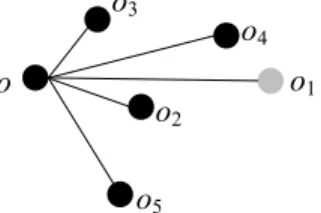
In particularly, if o2 is dominated by another k objects undero,o2have no chance to become aknearest neighbour of o. We call it as a non-k-skyband neighbour ofo. In this paper, we call SKYK(o) as the k-skyband neighbour set of o. As shown in Figure 5, assuming that they satisfy that o1.t <o2.t <o3.t <04.t <o5.t, sinceo2arrives later than that ofo1andD(o,o2)≤D(o,o1), we say thato2dominates o1undero. Similarly,o1is also dominated byo4, it can not become a k nearest neighbour ofo. By contrast,o5 arrives the latest of all. It also has chance to become an outlier ofo. Therefore,SKYK(o) is{o2,o3,o4,o5}.
FIGURE 5. ContinuousK−nearest neighbour query over sliding window.
Algorithm 3The SKYK Maintenance Algorithm
Input: IndexSKYMM, newly arrived objectoin Output: Candidate SetC
1 Q←search(M,oin,θ); 2 fori from 1 to|Q|do 3 whileD(Qi, Qi.oj)<D(Q[i].oj,oin)do 4 Qi.oj.s←Qi.oj.s+1; 5 ifQi.oj.s=kthen 6 Qi←Qi−Qi.oj; 7 ifF(Qi)≥θthen 8 C←C−Qi; 9 ifF(oin,k)≥θthen 10 construct(oin) 11 return;
After discussing the concept ofdominanceandSKYK(o), in the following, we will formally discuss the candidate main-tenance algorithm. Letobe a candidate outlier. We first insert ointo the candidate setC. Here, objects inCare maintained by an index named M-Tree. Next, we constructSKYK(o) foro. As is depicted in Algorithm 3, we first submit a range query to the system for finding objects contained in the query region. LetQbe the searching result set. We sort them according to their arrived order. Then, we scan Q to find k−skyband neighbours ofo. To be more specifically, letQs
be the scanned objects set. We use amax-heapto maintain the knearest neighbours ofoinQs. For each objecto0∈Q−Qs,
ifF(o0)≥max(H), we delete it directly. Otherwise, we insert it intoSKYK(o) andHrespectively. Next, we adjust the max-heap H. In addition, we compute the dominate number ofo0. Thirdly, we update thek−skyband based structure named SKYKfor other candidate outliers. As is shown in algorithm4, for each objecto0 ∈C, if it is contained in the query region, we first compute the distance betweenoando0, i.e.,D(o,o0). Next, we accessSKYK(o0). For each objectosi ∈SKYK(o0), if D(o,osi)≤ D(o0,osi), we set osi.s to osi.s +1. Here, osi.s refers to the dominate number ofosiundero0. After accessing SKYK(o0), if it satisfies the following two conditions dis-cussed as above, we remove it from the candidate set.
Discussion:If we cannot findnobjects with scores lower than 2
√
d l, it means other objects may become query results.
In these cases, we should re-construct the GBOI and the
FIGURE 6. Running time comparison under different window size.
Algorithm 4The SKY Construction Algorithm
Input: Objecto, newly arrived objectoin Output: SKYKSKYK(oin)
1 Q←search(I,oin,θ); 2 sort(Q); 3 fori from 1 to|Q|do 4 if|H|<k∨F(H)<D(Q[i],oin)then 5 H ←H∪Q[i]; 6 if|H| =k+1then 7 H ←H∪max(H); 8 whileH[i]<Q[i],oindo 9 Q[i]←Q[i]+1; 10 return;
details. In addition, when we re-construct the indexGBOI, since we have to re-map all objects in the window into the new index, the computational cost is high. We want to highlight that, in most applications, the distribution of streaming data is not timely changed, we need not to re-constructGBOIand candidate set in most cases.
V. EXPERIMENTAL EVALUATION
In this section, we conduct extensive experiments to demon-strate the efficiency of GAAOD. In the following, we first explain the settings of our experiments, and then report our findings.
A. EXPERIMENTAL SETTING 1) DATA SET
In this paper, three real data sets are used for
evaluat-ing our proposed framework. We call them asTAO,Stock
and HPC. Here, Stock contains 104,8575 records. It is a
1-dimensional data set.TAOandHPCcontain 57,5648 and
248,692 records respectively. They are a 3-dimensional data set and a 7-dimensional data set. ForHPC, we select 3 dimen-sions for evaluating.
TABLE 2.Parameter settings.
2) PARAMETERS SETTING
In our experiments, we evaluate algorithms differences via the following metrics, which are response time andspace cost. Here,response timeis the total running time we spend after processing all objects in a data set.Space costrefers to the average memory we consume. Besides, we evaluate algo-rithms differences via the following four parameters. They are the window sizeN, the numbersof new objects that slide into the window whenever the window slides. In addition, we also compare algorithms differences under different k andn. Table2with the default values are bolded. Specially, the parameterNranges from 1KBto 20KBwith default value 10KB. The parametersranges from 10−2NtoN5 with default value10N. The parameterkranges from 5 to 100 with default value 20. Similarly, the parameternranges from 5 to 100 with default value 20.
3) EXPERIMENT METHOD
When implementation, objects in the each data set are all inserted into the memory. Next, we use two pointers for simulating the sliding window. Since the method is simple, we skip the details for saving space. After processing all objects in the dataset, we compute the average CPU time and memory we consume. All the algorithms are implemented with C++, and all the experiments are conducted on a CPU i7 with 16GB memory, running Microsoft Windows 7.
B. ALGORITHM PERFORMANCE
In this section, we compare our proposed frameworkGAAOD with that ofKNN-LEAP. First of all, we evaluate their perfor-mance under different window sizes. The other parameters are default values.
FIGURE 7. Space cost comparison under different window size.
FIGURE 8. Running time comparison under differents.
FIGURE 9. Space cost comparison under differents.
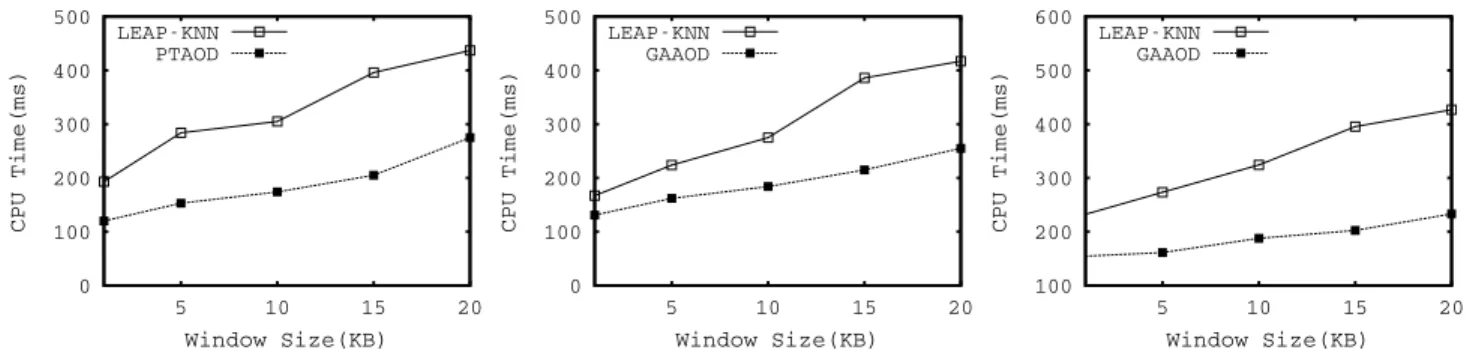
As is depicted in Figure 6, GAAOD performs the best
of all. The reason behind it is, for one thing, we use a grid-based index to manage streaming data in the window. Therefore, we can useO(1) cost to insert an object into the window, or delete an object from the window. In addition, in most cases, we can use O(klogk) cost for finding an object’s k-th nearest neighbour. In other words, we can use low cost for evaluating whether an object has relatively high chance to become an outlier. By contrast,KNN-LEAPshould spend relatively high cost to compute the distance between objects and their correspondingk-th nearest neighbour.
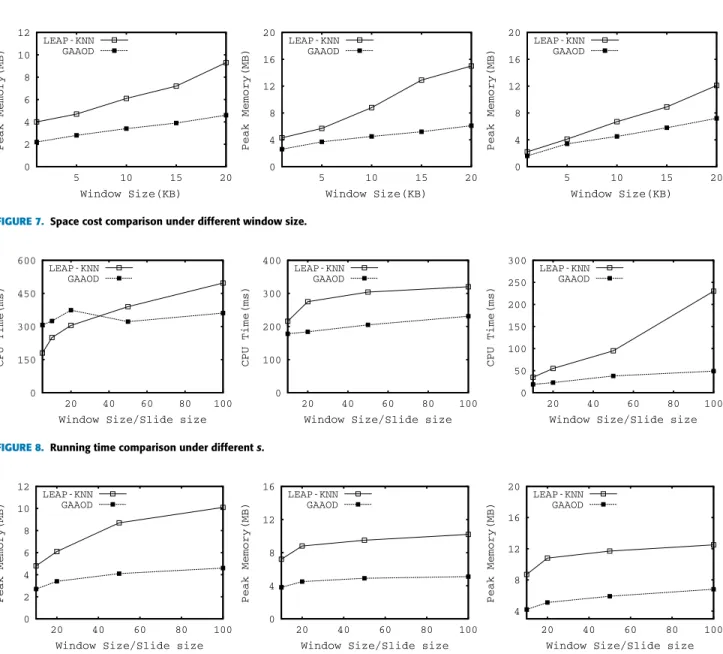
For the space cost, as is depicted in Figure7,GAAODalso performs best of all. The reason behind it is we only need to maintain theSKYKstructure for a small number of objects. For the others, we only maintain them in the index. Therefore, the space cost ofGAAODis the smallest of all.
Next, we compareGAAOD with other algorithms under
different parameter s. The experiment results are shown
in Figure 8. We find that GAAOD performs best of all.
In addition, our proposed framework is insensitive to the parameters. To be more specifically, with the increasing ofs,
the performance of bothGAAODandKNN-LEAPall turn to
better. The reason behind is the larger thes, the more objects having the same arrived order. It means we need to construct theSKYKstructure for fewer objects. Therefore, the CPU cost they spend all turn to small.
For the space cost, as is depicted in Figure 9, GAAOD
also performs better than that ofKNN-LEAP. Similarly, with the increasing of the parameter s, the space cost of both KNN-LEAPandGAAODall turn to small. The main reason behind it is whensturns to large, we only need to maintain SKYstructure for a small number of objects.
FIGURE 10. Running time comparison under differentk.
FIGURE 11. Space cost comparison under differentk.
FIGURE 12. Running time comparison under differentn.
FIGURE 13. Space cost comparison under differentn.
Thirdly, we compareGAAODwithKNN-LEAPunder
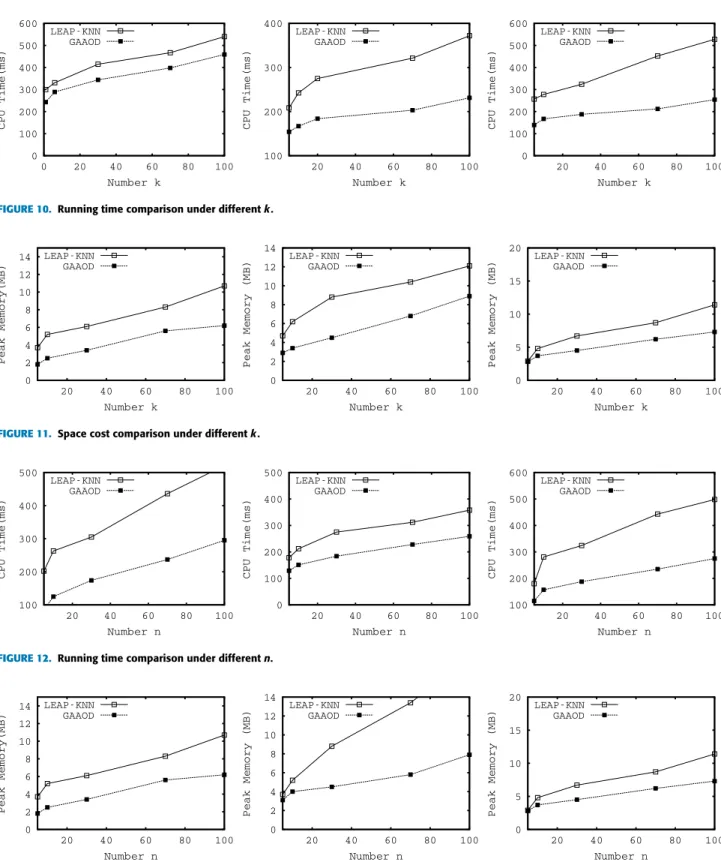
dif-ferent k. The experiment results are shown in Figure 10
and Figure 11. We find that the running time of these
algorithms all increases with the parameter k. However,
the running time of KNN-LEAPgoes up more rapidly than
that of GAAOD. The reason is GAAOD uses an
approx-imate algorithm to search k nearest neighbours for each
object. In this way, we can use lower computational cost for evaluating whether an object has no chance to become an outlier.
For the space cost, GAAOD also consumes smaller cost
than that of KNN-LEAP. Besides the reasons discussed as
above, another important reason is we use an important prop-erty of sliding window to enhance algorithm performance. That is, we can use the arrival order relationship among objects to predict which objects may(or not) become an out-lier. In this way, we only need to maintain a small number of candidates.
Next, we compareGAAODwithKNN-LEAPunder
differ-ent n. The experiment results are shown in Figure 12and Figure13. We find thatGAAODalso performs better than that ofKNN-LEAP. The reason isGAAODonly needs to maintain a smaller number of candidates. Another important reason is we use a more efficient method to maintainSKYKstructure. In this way, the CPU cost ofGAAODcould be reduced a lot. For the space cost, as is depicted in Figure 13,GAAOD also performs best of all. Similar with the reason discussed as above, we only need to maintain theSKYKstructure for a small number of candidates.
VI. CONCLUSION
In this paper, we study the problem ofKNN-based approxi-mate outlier detection overIoTStreaming Data. In order to solve this problem, we first propose a grid file based index to manage streaming data in the window. Next, we propose a novel algorithm to answer approximate KNN search. Thirdly, we propose ak−skyband based method to maintain candidate outliers in the window. Theoretical analysis and experiment verify the efficiency and accuracy of our proposed algorithms
REFERENCES
[1] L. Qi, R. Wang, C. Hu, S. Li, Q. He, and X. Xu, ‘‘Time-aware distributed service recommendation with privacy-preservation,’’Inf. Sci., vol. 480, pp. 354–364, Apr. 2019.
[2] L. Qi, Y. Chen, Y. Yuan, S. Fu, X. Zhang, and X. Xu, ‘‘A QoS-aware virtual machine scheduling method for energy conservation in cloud-based cyber-physical systems,’’World Wide Web J., May 2019.
[3] J. Yu, Z. Kuang, B. Zhang, W. Zhang, D. Lin, and J. Fan, ‘‘Leveraging content sensitiveness and user trustworthiness to recommend fine-grained privacy settings for social image sharing,’’IEEE Trans. Inf. Forensics Secur., vol. 13, no. 5, pp. 1317–1332, May 2018.
[4] J. Yu, C. Zhu, J. Zhang, Q. Huang, and D. Tao, ‘‘Spatial pyramid-enhanced NetVLAD with weighted triplet loss for place recognition,’’IEEE Trans. Neural Netw. Learn. Syst., vol. 31, no. 2, pp. 661–674, Feb. 2020. [5] J. Yu, M. Tan, H. Zhang, D. Tao, and Y. Rui, ‘‘Hierarchical deep click
fea-ture prediction for fine-grained image recognition,’’IEEE Trans. Pattern Anal. Mach. Intell., to be published.
[6] J. Yu, J. Li, Z. Yu, and Q. Huang, ‘‘Multimodal transformer with multi-view visual representation for image captioning,’’CoRR, 2019. [7] H. Gao, W. Huang, and X. Yang, ‘‘Applying probabilistic model checking
to path planning in an intelligent transportation system using mobility trajectories and their statistical data,’’Intell. Autom. Soft Comput., vol. 25, no. 3, pp. 547–559, 2019.
[8] H. Gao, W. Huang, Y. Duan, X. Yang, and Q. Zou, ‘‘Research on cost-driven services composition in an uncertain environment,’’J. Internet Technol., vol. 20, no. 3, pp. 755–769, 2019.
[9] J. Pu, Y. Wang, X. Liu, and X. Zhang, ‘‘STLP-OD: Spatial and tempo-ral label propagation for traffic outlier detection,’’IEEE Access, vol. 7, pp. 63036–63044, 2019.
[10] X. Qin, L. Cao, A. E. Rundensteiner, and S. Madden, ‘‘Scalable kernel density estimation-based local outlier detection over large data streams,’’ inProc. 22nd Int. Conf. Extending Database Technol. (EDBT), Lisbon, Portugal, Mar. 2019, pp. 421–432.
[11] R. Zhu, B. Wang, X. Yang, B. Zheng, and G. Wang, ‘‘SAP: Improving continuous top-K queries over streaming data,’’IEEE Trans. Knowl. Data Eng., vol. 29, no. 6, pp. 1310–1328, Jun. 2017.
[12] C. Zong, X. Xia, B. Wang, X. Yang, J. Li, X. Liu, and A. Zhu, ‘‘Answer-ing why-not questions on structural graph cluster‘‘Answer-ing,’’ inProc. 23rd Int. Conf. Database Syst. Adv. Appl. (DASFAA), Gold Coast, QLD, Australia, May 2018, pp. 255–271.
[13] R. Zhu, B. Wang, S. Luo, X. Yang, and G. Wang, ‘‘S-MRST: A novel framework for indexing uncertain data,’’World Wide Web, vol. 20, no. 4, pp. 697–727, Sep. 2016.
[14] B. Wang, R. Zhu, X. Yang, and G. Wang, ‘‘Top-K representative docu-ments query over geo-textual data stream,’’World Wide Web, vol. 21, no. 2, pp. 537–555, Jul. 2017.
[15] R. Zhu, B. Wang, S.-Y. Luo, X.-C. Yang, and G.-R. Wang, ‘‘Approximate continuous top-k query over sliding window,’’J. Comput. Sci. Technol., vol. 32, no. 1, pp. 93–109, Jan. 2017.
[16] B. Wang, R. Zhu, S. Luo, X. Yang, and G. Wang, ‘‘H-MRST: A novel framework for supporting probability degree range query using extreme learning machine,’’Cognit. Comput., vol. 9, no. 1, pp. 68–80, 2017. [17] B. Wang, R. Zhu, S. Zhang, Z. Zhao, X. Yang, and G. Wang, ‘‘PPVF:
A novel framework for supporting path planning over carpooling,’’IEEE Access, vol. 7, pp. 10627–10643, 2019.
[18] S. Yoon, J.-G. Lee, and B. S. Lee, ‘‘NETS: Extremely fast outlier detection from a data stream via set-based processing,’’Proc. VLDB Endowment, vol. 12, no. 11, pp. 1303–1315, Jul. 2019.
[19] K. Yamanishi and J.-I. Takeuchi, ‘‘A unifying framework for detecting outliers and change points from non-stationary time series data,’’ inProc. 8th ACM SIGKDD Int. Conf. Knowl. Discovery Data Mining (KDD), Edmonton, AB, Canada, Jul. 2002, pp. 676–681.
[20] J. Zhang, Q. Gao, and H. Wang, ‘‘SPOT: A system for detecting projected outliers from high-dimensional data streams,’’ inProc. IEEE 24th Int. Conf. Data Eng., Cancún, Mexico, Apr. 2008, pp. 1628–1631.
[21] L. Cao, D. Yang, Q. Wang, Y. Yu, J. Wang, and E. A. Rundensteiner, ‘‘Scalable distance-based outlier detection over high-volume data streams,’’ inProc. IEEE 30th Int. Conf. Data Eng., Chicago, IL, USA, Mar. 2014, pp. 76–87.
[22] M. Kontaki, A. Gounaris, A. N. Papadopoulos, K. Tsichlas, and Y. Manolopoulos, ‘‘Continuous monitoring of distance-based outliers over data streams,’’ inProc. IEEE 27th Int. Conf. Data Eng., Hannover, Germany, Apr. 2011, pp. 135–146.
[23] X.-T. Wang, D.-R. Shen, M. Bai, T.-Z. Nie, Y. Kou, and G. Yu, ‘‘An effi-cient algorithm for distributed outlier detection in large multi-dimensional datasets,’’ J. Comput. Sci. Technol., vol. 30, no. 6, pp. 1233–1248, Nov. 2015.
[24] Y. Cheng, Y. Yuan, L. Chen, C. Giraud-Carrier, and G. Wang, ‘‘Complex event-participant planning and its incremental variant,’’ inProc. IEEE 33rd Int. Conf. Data Eng. (ICDE), San Diego, CA, USA, Apr. 2017, pp. 859–870.
[25] Y. Cheng, Y. Yuan, L. Chen, C. Giraud-Carrier, G. Wang, and B. Li, ‘‘Event-participant and incremental planning over event-based social net-works,’’IEEE Trans. Knowl. Data Eng., to be published.
[26] Y. Cheng, Y. Yuan, L. Chen, G. Wang, C. Giraud-Carrier, and Y. Sun, ‘‘DistR: A distributed method for the reachability query over large uncertain graphs,’’IEEE Trans. Parallel Distrib. Syst., vol. 27, no. 11, pp. 3172–3185, Nov. 2016.
[27] Y. Cheng, L. Chen, Y. Yuan, and G. Wang, ‘‘Rule-based graph repairing: Semantic and efficient repairing methods,’’ inProc. IEEE 34th Int. Conf. Data Eng. (ICDE), Paris, France, Apr. 2018, pp. 773–784.
[28] B. Li, Y. Cheng, Y. Yuan, G. Wang, and L. Chen, ‘‘Three-dimensional stable matching problem for spatial crowdsourcing platforms,’’ inProc. 25th ACM SIGKDD Int. Conf. Knowl. Discovery Data Mining (KDD), Anchorage, AK, USA, Aug. 2019, pp. 1643–1653.
[29] A. Ghoting, M. E. Otey, and S. Parthasarathy, ‘‘LOADED: Link-based outlier and anomaly detection in evolving data sets,’’ in Proc. 4th IEEE Int. Conf. Data Mining (ICDM), Brighton, U.K., Nov. 2004, pp. 387–390.
[30] F. Angiulli and F. Fassetti, ‘‘Distance-based outlier queries in data streams: The novel task and algorithms,’’Data Mining Knowl. Discovery, vol. 20, no. 2, pp. 290–324, Jan. 2010.
[31] D. Yang, E. A. Rundensteiner, and M. O. Ward, ‘‘Neighbor-based pat-tern detection for windows over streaming data,’’ in Proc. 12th Int. Conf. Extending Database Technol. Adv. Database Technol. (EDBT), Saint Petersburg, Russia, Mar. 2009, pp. 529–540.
[32] L. Zhao, X. Li, B. Gu, Z. Zhou, S. Mumtaz, V. Frascolla, H. Gacanin, M. I. Ashraf, J. Rodriguez, M. Yang, and S. Al-Rubaye, ‘‘Vehicular com-munications: Standardization and open issues,’’IEEE Commun. Standards Mag., vol. 2, no. 4, pp. 74–80, Dec. 2018.
[33] L. Zhao, A. Al-Dubai, A. Y. Zomaya, G. Min, A. Hawbani, and J. Li, ‘‘Routing schemes in software-defined vehicular networks: Design, open issues and challenges,’’IEEE Intell. Transp. Syst. Mag., to be published. [34] J. Wu, L. Zou, L. Zhao, A. Y. Al-Dubai, L. Mackenzie, and G. Min,
‘‘A multi-UAV clustering strategy for reducing insecure communication range,’’Comput. Netw., vol. 158, pp. 132–142, Jul. 2019.
[35] R. Chaudhary and N. Kumar, ‘‘Detection scheme for software-defined networks,’’IEEE Trans. Veh. Technol., vol. 68, no. 12, pp. 12329–12344, Dec. 2019.
[36] W. Miao, G. Min, Y. Wu, H. Huang, Z. Zhao, H. Wang, and C. Luo, ‘‘Stochastic performance analysis of network function virtualization in future Internet,’’IEEE J. Sel. Areas Commun., vol. 37, no. 3, pp. 613–626, Mar. 2019, doi:10.1109/JSAC.2019.2894304.
[37] A. Hawbani, E. Torbosh, X. Wang, P. Sincak, L. Zhao, and A. Al-Dubai, ‘‘Fuzzy based distributed protocol for vehicle to vehicle communi-cation,’’ IEEE Trans. Fuzzy Syst., to be published, doi: 10.1109/ TFUZZ.2019.2957254.
RUI ZHU received the M.Sc. degree in com-puter science from the Department of Comcom-puter Science, Northeastern University, China, in 2008, and the Ph.D. degree in computer science from Northeastern University, in 2017. He is currently an Associate Professor with Shenyang Aerospace University. His research interests include design and analysis of algorithms, databases, data quality, and distributed systems.
XIAOLING JIreceived the master’s degree from Shenyang Aerospace University, in January 2019. Her research interests include design and analysis of algorithms, query processing over streaming data, and distribution of spatio-temporal data.
DANYANG YU received the Ph.D. degree in biomedical engineering from Beihang Univer-sity, in 2015. She is currently a Teacher with the Artificial Intelligence and Big Data Col-lege, He University. Her research interests include human physiological parameter detection, intelli-gent medical equipment, and the IoT applications.
ZHIYUAN TAN received the B.Eng. degree in computer science and technology from Northeast-ern University, China, the M.Eng. degree in soft-ware engineering from the Beijing University of Technology, China, and the Ph.D. degree in com-puter systems from the University of Technology Sydney, Ultimo, NSW, Australia. He is currently an Associate Editor of IEEE ACCESSand an Orga-nizer of Special Issues for theAd Hoc and Sensor Wireless Networksjournal.
LIANG ZHAOreceived the Ph.D. degree in com-puting from the School of Comcom-puting, Edinburgh Napier University, in 2011. He is currently an Associate Professor with Shenyang Aerospace University, China. Before joining Shenyang Aerospace University, he worked as an Associate Senior Researcher with Hitachi (China) Research and Development Corporation, from 2012 to 2014. His research interests include VANETs, SDN, and WMNs.
JIAJIA LIreceived the M.S. and Ph.D. degrees in computer science from Northeastern University, in 2010 and 2014, respectively. She is currently an Associate Professor with Shenyang Aerospace University. She undertakes one National Natu-ral Science Foundation of China and one Nat-ural Science Foundation of Liaoning Province of China. Her research interests include spatial-temporal database, uncertain data management, and machine learning.
XIUFENG XIAreceived the M.Sc. degree in com-puter science from the Department of Comcom-puter Science, Northeastern University, China, in 1991, and the Ph.D. degree in computer science from Northeastern University, in 2005. He is currently a Professor with Shenyang Aerospace University. His research interests include design and analysis of algorithms, databases, data quality, and dis-tributed systems.