Zurich Open Repository and Archive University of Zurich Main Library Strickhofstrasse 39 CH-8057 Zurich www.zora.uzh.ch Year: 2012
Fine-grained code changes and bugs: Improving bug prediction Giger, Emanuel
Abstract: Software development and, in particular, software maintenance are time consuming and require detailed knowledge of the structure and the past development activities of a software system. Limited resources and time constraints make the situation even more difficult. Therefore, a significant amount of research effort has been dedicated to learning software prediction models that allow project members to allocate and spend the limited resources efficiently on the (most) critical parts of their software system. Prominent examples are bug prediction models and change prediction models: Bug prediction models identify the bug-prone modules of a software system that should be tested with care; change prediction models identify modules that change frequently and in combination with other modules, i.e., they are change coupled. By combining statistical methods, data mining approaches, and machine learning tech-niques software prediction models provide a structured and analytical basis to make decisions.Researchers proposed a wide range of approaches to build effective prediction models that take into account multi-ple aspects of the software development process. They achieved especially good prediction performance, guiding developers towards those parts of their system where a large share of bugs can be expected. For that, they rely on change data provided by version control systems (VCS). However, due to the fact that current VCS track code changes only on file-level and textual basis most of those approaches suffer from coarse-grained and rather generic change information. More fine-grained change information, for instance, at the level of source code statements, and the type of changes, e.g., whether a method was renamed or a condition expression was changed, are often not taken into account. Therefore, investigating the development process and the evolution of software at a fine-grained change level has recently experienced an increasing attention in research.The key contribution of this thesis is to improve software prediction models by using fine-grained source code changes. Those changes are based on the abstract syntax tree structure of source code and allow us to track code changes at the fine-grained level of individual state-ments. We show with a series of empirical studies using the change history of open-source projects how prediction models can benefit in terms of prediction performance and prediction granularity from the more detailed change information.First, we compare fine-grained source code changes and code churn, i.e., lines modified, for bug prediction. The results with data from the Eclipse platform show that fine grained-source code changes significantly outperform code churn when classifying source files into bug-and not bug-prone, as well as when predicting the number of bugs in source files. Moreover, these results give more insights about the relation of individual types of code changes, e.g., method declaration changes and bugs. For instance, in our dataset method declaration changes exhibit a stronger correlation with the number of bugs than class declaration changes.Second, we leverage fine-grained source code changes to predict bugs at method-level. This is beneficial as files can grow arbitrarily large. Hence, if bugs are predicted at the level of files a developer needs to manually inspect all methods of a file one by one until a particular bug is located.Third, we build models using source code properties, e.g., complexity, to predict whether a source file will be affected by a certain type of code change. Predicting the type of changes is of practical interest, for instance, in the context of software testing as different change types require different levels of testing: While for small statement changes local unit-tests are mostly sufficient, API changes, e.g., method declaration changes, might require system-wide integration-tests which are more expensive. Hence, knowing (in advance) which types of changes will most likely occur in a source file can help to better plan and develop tests, and, in case of limited resources, prioritize among different types of testing.Finally, to assist developers in bug triaging we compute prediction models based on the
source code changes can improve software prediction models to provide more accurate results.
Posted at the Zurich Open Repository and Archive, University of Zurich ZORA URL: https://doi.org/10.5167/uzh-61703
Dissertation
Originally published at:
Giger, Emanuel. Fine-grained code changes and bugs: Improving bug prediction. 2012, University of Zurich, Faculty of Economics.
Fine-Grained Code Changes
and Bugs
Improving Bug Prediction
A dissertation submitted to the Faculty of Economics, Business Administration and Information Technology of the University of Zurich
for the degree of Doctor of Science
by
Emanuel Giger
from Zurich, ZH, Switzerland
Accepted on the recommendation of
Prof. Dr. Harald C. Gall, University of Zurich, Switzerland Prof. Dr. Andreas Zeller, Saarland University, Germany
dissertation without expressing any opinion on the views contained therein. Zurich, March 2012
Acknowledgements
During my PhD studies I had the opportunity to meet many great people who all contributed substantially to my work.
First of all, I would like to express my heartiest gratitude to my advisor Harald C. Gall for giving me the unique opportunity to pursue my PhD studies at the University of Zurich. I’m very grateful for his permanent support and kindness—from the beginning of my work until the very end— and in particular for creating such an outstanding team spirit. I was able to profit greatly from his support, knowledge, and experience.
Special thanks go to Andreas Zeller for accepting to be part of my com-mittee as an external examiner and for coming all the way to Zurich for my defense. Already during my PhD studies I had the pleasure to attend and enjoy some of his exceptional talks, which greatly influenced my research.
Many thanks go to Martin Pinzger who contributed (statistically ;) ) signif-icantly to this dissertation. Even after moving to Delft he still found time to discuss many research opportunities that resulted in publications that build the core foundation of my work. I also greatly enjoyed our surf session at the shores of Hawai’i.
Thanks go to Marco D’Ambros for sharing with me his extremely valuable and beneficial knowledge about bug prediction, and especially for taking us to some delicious restaurants in Lugano during the SVC project sessions.
Many many thanks go the my colleagues from the SEAL lab at the Univer-sity of Zurich. I truly appreciated their very helpful comments, suggestions, and discussions. They always encouraged me to go on with this long ”PhD-Quest”. It was an honor to be a member of such a heroic raid. The time was truly epic, and I could not think of any better group.
Abstract
Software development and, in particular, software maintenance are time con-suming and require detailed knowledge of the structure and the past develop-ment activities of a software system. Limited resources and time constraints make the situation even more difficult. Therefore, a significant amount of research effort has been dedicated to learning software prediction models that allow project members to allocate and spend the limited resources efficiently on the (most) critical parts of their software system. Prominent examples are bug prediction models and change prediction models: Bug prediction models identify the bug-prone modules of a software system that should be tested with care; change prediction models identify modules that change frequently and in combination with other modules, i.e., they are change coupled. By combining statistical methods, data mining approaches, and machine learning techniques software prediction models provide a structured and analytical basis to make decisions.
Researchers proposed a wide range of approaches to build effective predic-tion models that take into account multiple aspects of the software develop-ment process. They achieved especially good prediction performance, guiding developers towards those parts of their system where a large share of bugs can be expected. For that, they rely on change data provided by version control systems (VCS). However, due to the fact that current VCS track code changes only on file-level and textual basis most of those approaches suffer from coarse-grained and rather generic change information. More fine-coarse-grained change information, for instance, at the level of source code statements, and the type of changes, e.g., whether a method was renamed or a condition expression
was changed, are often not taken into account. Therefore, investigating the development process and the evolution of software at a fine-grained change level has recently experienced an increasing attention in research.
by using fine-grained source code changes. Those changes are based on the abstract syntax tree structure of source code and allow us to track code changes at the fine-grained level of individual statements. We show with a series of empirical studies using the change history of open-source projects how prediction models can benefit in terms of prediction performance and prediction granularity from the more detailed change information.
First, we compare fine-grained source code changes and code churn,i.e.,
lines modified, for bug prediction. The results with data from the Eclipse platform show that fine grained-source code changes significantly outperform code churn when classifying source files into bug- and not bug-prone, as well as when predicting the number of bugs in source files. Moreover, these results give more insights about the relation of individual types of code changes,e.g., method declaration changes and bugs. For instance, in our dataset method declaration changes exhibit a stronger correlation with the number of bugs than class declaration changes.
Second, we leverage fine-grained source code changes to predict bugs at method-level. This is beneficial as files can grow arbitrarily large. Hence, if bugs are predicted at the level of files a developer needs to manually inspect all methods of a file one by one until a particular bug is located.
Third, we build models using source code properties,e.g., complexity, to
predict whether a source file will be affected by a certain type of code change. Predicting the type of changes is of practical interest, for instance, in the context of software testing as different change types require different levels of testing: While for small statement changes local unit-tests are mostly sufficient, API changes,e.g., method declaration changes, might require system-wide
integration-tests which are more expensive. Hence, knowing (in advance) which types of changes will most likely occur in a source file can help to better plan and develop tests, and, in case of limited resources, prioritize among different types of testing.
Finally, to assist developers in bug triaging we compute prediction models based on the attributes of a bug report that can be used to estimate whether a bug will be fixed fast or whether it will take more time for resolution.
The results and findings of this thesis give evidence that fine-grained source code changes can improve software prediction models to provide more accurate results.
Zusammenfassung
Die Entwicklung und insbesondere die Wartung heutiger Software Systeme sind zeitintensiv und erfordern in hohem Masse detaillierte Kenntnisse über deren innere Struktur sowie über die historischen Änderungen und Desig-nentscheide solcher Systeme. Dieser Umstand wird zusätzlich erschwert durch strenge Zeitvorgaben und limitierte Entwicklungsressourcen. Die Forschung im Bereich der Softwareentwicklung konzentriert sich daher vermehrt auf die Erforschung von Methoden, die einen möglichst effizienten Einsatz der verfüg-baren Ressourcen erlauben und die Wartung bestehender Software Systeme als Ganzes vereinfachen und beschleunigen. Bekannte Beispiele für solche Methoden sind Fehler- und Änderungsvorhersagemodelle: Fehlervorhersage-modelle sollen mit möglichst hoher Zuverlässigkeit die fehlerhaften Module einer Software (im Voraus) identifizieren, damit diese eingehend getestet werden können. So können zum Beispiel Testkapazitäten von fehlerfreien Modulen hin zu besonders fehleranfälligen Modulen verlagert werden; Än-derungsvorhersagemodelle sollen möglichst genau die Module bestimmen, die mit hoher Frequenz geändert werden müssen. Da Änderungen am Pro-grammcode immer mit Kosten und potentiell mit Fehler verbunden sind, stellen solche Module Kandidaten für Gegenmassnahmen dar, um in Zukunft die Anzahl Änderungen tief zu halten.
In der Literatur existieren zahlreiche Ansätze für die Erzeugung solcher Vorhersagemodelle. Die meisten dieser Ansätze verwenden hierfür historische Daten der Entwicklungsgeschichte eines Systems. Diese Daten werden von speziellen Programmen für Versionierung von Programmcode, z.B. CVS, SVN oder Git, zur Verfügung gestellt. Heutige Versionierungsprogramme verwal-ten Änderungen am Programmcode jedoch nur auf der Ebene von einzelnen Dateien. Des Weiteren wird Programmcode als Text behandelt, und dessen implizite Struktur wird daher weitgehend ignoriert. Bestehende Vorhersage-modelle basieren daher auf relativ groben und generischen Änderungsdaten.
Änderungen auf fein granularer Ebene, z.B. auf der Ebene einzelner Instruktio-nen, sowie der Typ der Änderungen, z.B. wurde die Bedingung einer Schleife angepasst oder der Name einer Methode geändert, werden daher in der Regel nicht berücksichtig für solche Modelle. In jüngster Zeit wurde dieses Defizit erkannt, und die Forschung hat sich vermehrt auf die Analyse von Änderun-gen am Programmcode auf fein granularer Ebene konzentriert.
Ziel der vorliegenden Arbeit ist es, Vorhersagemodelle im Bereich der Softwareentwicklung durch den Einbezug von feinkörniger und strukturbed-ingter Änderungsinformation zu verbessern. Wir zeigen in einer Reihe von empirischen Studien die Vorteile solcher Modelle an Hand der Entwicklungs-geschichte bekannter Open-Source Systeme.
Im ersten Schritt vergleichen wir dazu die Genauigkeit von Vorhersage-modellen basierend auf feinkörniger Änderungsdaten und von solchen, die auf herkömmlichen Änderungsdaten basieren. Die Resultate zeigen, dass un-sere Modelle die fehlerhaften Module eines Systems statisch signifikant besser identifizieren können. Zusätzlich können explizit die empirischen Zusammen-hänge einzelner Änderungstypen und der Fehleranfälligkeit eines Moduls aufgezeigt werden.
In einem zweiten Schritt benutzen wir fein granularen Änderungsdaten, um Fehler auf der Ebene von Methoden anstatt auf der Ebene von Dateien zu identifizieren. Dies hat den Vorteil, dass anstatt ganzer Dateien nur gewisse Methoden inspiziert werden müssen, um einen Fehler zu lokalisieren und zu beheben. Dies insbesondere dann von Nutzen, wenn Dateien, die fehlerhaften Programmcode enthalten, sehr gross werden, da der Suchraum erheblich eingeschränkt wird.
Als dritten Schritt bilden wir Modelle, welche es uns erlauben die Typen von Änderungen vorherzusagen. Dies hat zum Beispiel für die Manager eines Software Projektes den Vorteil, dass sie ihre Testvorgänge besser planen können: Sind in erster Linie Änderungen an der Programmschnittstelle zu er-warten, können rechtzeitig genügend Ressourcen für aufwendige Schnittstellen-und Integrationstests mit anderen, abhängigen Modulen eingeplant werden. Kommen jedoch vor allem kleine Änderungen vor, sind in der Regel einfache Unit-Tests ausreichend.
Zum Abschluss entwickeln wir Modelle, die den Entwickler beim Beheben von Fehlern in seiner Software unterstützen sollen. Diese Modelle erlauben eine Einschätzung, ob ein bestimmter Fehler länger benötigen wird zur Behe-bung oder in relativ wenig Zeit behoben werden kann.
Die Resultate dieser Arbeit zeigen auf, dass feinkörnige Änderungen sowie die Information über den Typ bestimmter Änderungen Vorhersagemodelle für
vii
Contents
1 Synopsis 1 1.1 Introduction . . . 1 1.2 Bug Prediction . . . 5 1.2.1 Change Metrics . . . 6 1.2.2 Code Metrics . . . 8 1.2.3 Organizational Metrics . . . 111.3 The Need for Fine-Grained Change Information . . . 12
1.4 Foundation and Structure of the Thesis . . . 18
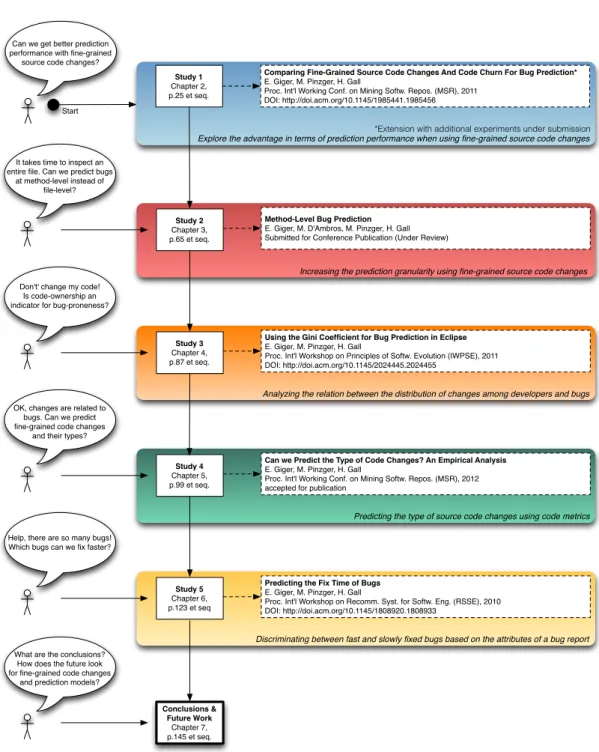
1.5 Thesis Roadmap . . . 26
2 Comparing Fine-Grained Source Code Changes And Code Churn For Bug Prediction 29 2.1 Introduction . . . 31
2.2 Approach . . . 32
2.3 Empirical Study . . . 35
2.3.1 Dataset and Data Preparation . . . 35
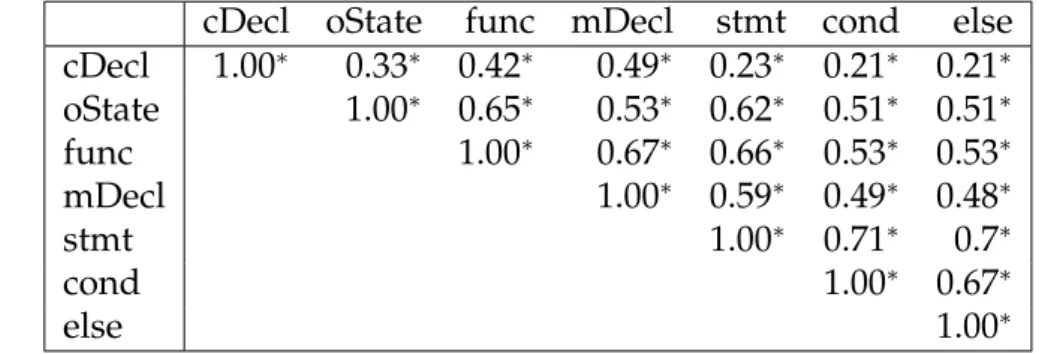
2.3.2 Correlation of SCC Categories . . . 38
2.3.3 Correlation of Bugs, LM, and SCC . . . 39
2.3.4 Predicting Bug- & Not Bug-Prone Files . . . 43
2.3.5 Predicting Bug-Prone Files using different Thresholds . . 56
2.3.6 Predicting the Number of Bugs . . . 59
2.3.7 Analyzing the Effect Size . . . 62
2.3.8 Summary of Results . . . 67
2.4 Discussion and Implications of Results . . . 68
2.5 Threats to Validity . . . 71
2.6 Related Work . . . 72
3 Method-Level Bug Prediction 77 3.1 Introduction . . . 79 3.2 Data Collection . . . 81 3.2.1 Dataset . . . 81 3.2.2 Code Metrics . . . 81 3.2.3 Change Metrics . . . 83 3.2.4 Bug Data . . . 87 3.3 Prediction Experiments . . . 87 3.3.1 Experimental Setup . . . 88 3.3.2 Prediction Results . . . 89
3.3.3 Prediction with Different Labeling Points . . . 91
3.3.4 Summary of Results . . . 94
3.4 Application of Results . . . 96
3.5 Threats to Validity . . . 99
3.6 Related Work . . . 101
3.7 Conclusions and Future Work . . . 103
4 Using the Gini Coefficient for Bug Prediction in Eclipse 105 4.1 Introduction . . . 106
4.2 Gini Coefficient . . . 107
4.3 Data Collection . . . 109
4.4 Study . . . 110
4.4.1 Correlation Analysis . . . 111
4.4.2 Predicting Bug-Prone Files . . . 113
4.4.3 Discussion of the Results . . . 116
4.5 Related Work . . . 117
4.6 Conclusions & Future Work . . . 118
5 Can we Predict Types of Code Changes? 121 5.1 Introduction . . . 123
5.2 Data Collection . . . 125
5.3 Empirical Study . . . 127
5.3.1 Dataset . . . 128
5.3.2 Correlation Analysis . . . 129
5.3.3 Predicting Change Type Categories . . . 133
5.3.4 Manual Analysis of Changes . . . 137
5.4 Discussion . . . 139
5.5 Threats to Validity . . . 141
Contents xi
5.7 Conclusions & Future Work . . . 144
6 Classifying Fast and Slowly Fixed Bugs 147 6.1 Introduction . . . 149
6.2 Analysis Approach . . . 150
6.2.1 Bug Report Attributes . . . 151
6.2.2 Analysis Method . . . 153
6.3 Experiments . . . 155
6.3.1 Distribution of Fix-Time . . . 156
6.3.2 Classifying Bugs with Initial Bug Data . . . 157
6.3.3 Classifying Bugs with Post-Submission Data . . . 160
6.3.4 Summary of Results . . . 165
6.3.5 Threats to Validity . . . 167
6.4 Related Work . . . 168
6.5 Conclusions & Future Work . . . 170
7 Conclusions 173 7.1 Summary of Results . . . 174
7.2 Implications of Results . . . 176
List of Figures
1.1 Schematic Overview of the Iterative Software Development Stages. The colored circles indicate the stages to which the results of this thesis contribute. . . 2 1.2 State-of-the-art overview of bug prediction models as classified
by their input data, selected related work, and the thesis’ chapters. 6 1.3 A schematic example of fine-grained change extraction based
on the AST comparison of two file revisions as proposed in [FWPG07]. . . 15 1.4 This figure shows the amount of lines changed (Text Diff) and
AST based fine-grained source code chances as well as the num-ber of bugs of the Eclipse jFace plugin per half-year (all numnum-bers are normalized between [0.0:1.0]. . . 17 1.5 Thesis Roadmap: Relation between the empirical studies, the
individual chapters, and their associated publications. Each colored box denotes the key subject of an empirical study and its publication. . . 27 2.1 Overview of the main phases of the data extraction process. . . 33 2.2 Plot of the logistic regression model of Debug Core using func
as independent variable andnot bug-proneas target class. . . 52 2.3 Scatterplot betweenBugsandSCCof source files of the Eclipse
CVS Core project. . . 60 2.4 Fit plots of theOveralldataset (left) and Debug Core (right) with
normalized residuals on the y-axis and the predicted values on the x-axis. Below are the corresponding histograms of the residuals. . . 63 3.1 A schematic example of the fine-grained code change extraction
based on the AST comparison of two file revisions as proposed in [FWPG07]. . . 85 4.1 Lorenz curve of the Eclipse Resource plugin project using
de-velopers and revisions . . . 108 6.1 Distribution of hToLastFix(log. scale) of bug reports of
Contents xiii
List of Tables
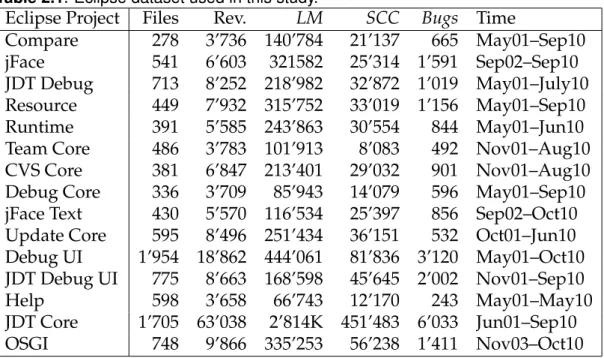
2.1 Eclipse dataset used in this study. . . 36
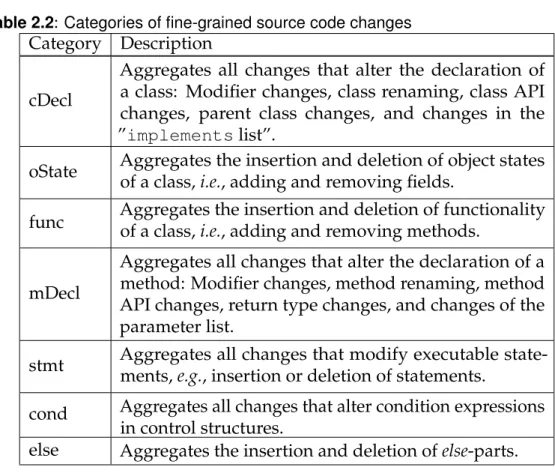
2.2 Categories of fine-grained source code changes . . . 37
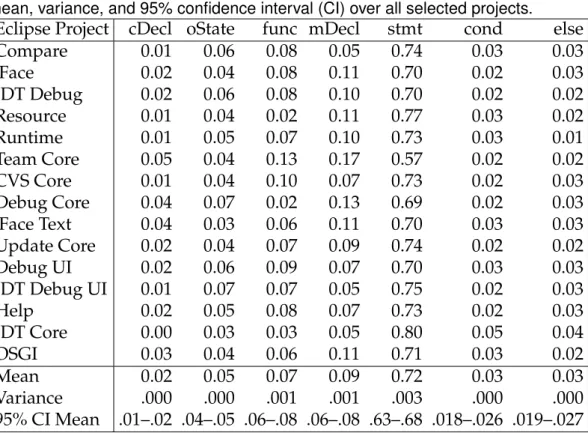
2.3 Relative frequencies ofSCCcategories per Eclipse project, plus their mean, variance, and 95% confidence interval (CI) over all selected projects. . . 38
2.4 Spearman rank correlation between SCC categories (*marks significant correlations atα= 0.01.) . . . 40
2.5 Spearman rank correlation between Bugs and LM, SCC, and SCCcategories (*marks significant correlations atα= 0.01). . . . 41
2.6 AUC, precision, and recall ofE 1using logistic regression with LMandSCCto classify source files intobug-proneornot bug-prone. 45 2.7 AUC ofE 2using different classifiers with theSCCcategories as predictors forbug-proneandnot bug-pronefiles (AUC of the best performing classifier per project is printed in bold). . . 46
2.8 Information Gain values of all change type categories measured with respect to the bugClass of a file (the category with the largest IG value per project is printed in bold). . . 50
2.9 Median AUC, precision, and recall values over all projects of the univariate logistic regression model. . . 52
2.10 AUC values of step 1–3 of theiterative Information Gain subsetting procedure using change type categories as predictor variables and the LibSVM learner. . . 53
2.11 Median and variance of AUC, precision (P), and recall (R) calcu-lated over all 210 cross-prediction pairs. . . 56
2.12 AUC, precision (P), and recall (R) using logistic regression with LMandSCCto classify source files into prone or not bug-prone. Models were trained using the 75%, 90%, and 95% per-centile as cut-points for the binning of source files. ∗indicates significantly higher values obtained by one of the models (either usingLMorSCC). . . 57
2.13 Results of the nonlinear regression in terms of R2and Spearman correlation usingLMandSCCas predictors. . . 61
2.14 Results of the effect Size calculation usingCohen’s d. . . 65
3.1 Overview of the projects used in this study . . . 82
3.2 List of source code metrics used for the SCM set . . . 83
3.4 Median classification results over all projects per classifier and
per model . . . 91
3.5 Median classification results for RndFor over all projects per cut-point and per model . . . 93
4.1 Eclipse dataset used in this study . . . 111
4.2 Non-parametric Spearman rank correlation between#Bugsand the Gini coefficients based on R,LM, and SCCon source file level. (* significant atα= 0.01) . . . 113
4.3 Median AUC, Precision, and Recall of prediction models com-puted with each machine learning algorithm (M-Learner) for the three Gini coefficients . . . 116
5.1 Description of Network centrality measures (SNA) . . . 127
5.2 Description of the Object-oriented metrics (OOM) . . . 128
5.3 Dataset used in this study (DB=Debug) . . . 129
5.4 Categories of change types used in this study. . . 130
5.5 Spearman rank correlation between directed network centrality measures and#SCCat the level of source files. * marks signif-icant correlations atα = 0.01. The largest value is printed in bold. . . 131
5.6 Spearman rank correlation between object-oriented metrics and #SCCat the level of source files. * marks significant correlations atα= 0.01. The largest value is printed inbold. . . 132
5.7 Median classification results over all projects per classifier and per model . . . 134
5.8 Median AUC, precision, and recall of across all projects and per category based on Neural Networks (NN) . . . 136
5.9 nOutDegree, CBO, their medians at project level, and the proba-bility by which BNet models usingSNAandOOMas predictors correctly classified a file aschange-prone. . . 138
6.1 Constant (I) and changing (C) bug report attributes. . . 152
6.2 Number of bugs and dates of first and last filed bug reports of subject systems. . . 156
6.3 Performance measures of prediction models computed with initial attribute values. . . 158
6.4 Median fix-time and performance measures of Eclipse JDT pre-diction models. . . 160
Contents xv
6.5 Median fix-time and performance measures of Eclipse Platform prediction models. . . 161 6.6 Median fix-time and performance measures of Mozilla Core
prediction models. . . 162 6.7 Median fix-time and performance measures of Mozilla Firefox
prediction models. . . 163 6.8 Median fix-time and performance measures of Gnome GStreamer
prediction models. . . 164 6.9 Median fix-time and performance measures of Gnome
1
Synopsis
1.1
Introduction
S
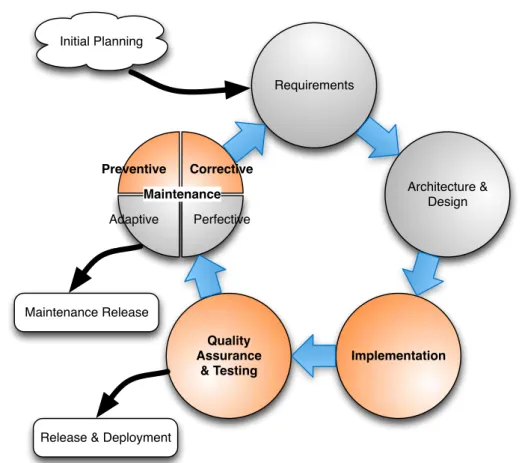
OFTWAREsystems are designed to support and automate (business)processes. Those processes are constantly adapted to meet changes in the business environment,e.g., new legal regulations, extensions of the current product line, or opening up new market segments. To remain useful to their stakeholders in such a dynamic context software systems have to be continuously adapted alongside to the underlying business processes. Furthermore, the (initial) requirements of a software system are never com-plete once it is released; new requirements and features are demanded over time, and they have to be integrated in running and productive systems— inducing a revisiting, iterative approach [Bro95] (see Figure 1.1). In reality, each stage in Figure 1.1 can be further divided in multiple non-sequential substeps as illustrated, for instance, bySoftware Maintenance. Moreover, often certain details and properties of a system become clear and concrete during the implementation itself making an adaption of the initial design of the software necessary [PC86].
Architecture & Design Quality Assurance & Testing Requirements
Release & Deployment Initial Planning Preventive Perfective Adaptive Corrective Maintenance Implementation Maintenance Release
Figure 1.1: Schematic Overview of the Iterative Software Development Stages. The colored circles indicate the stages to which the results of this thesis contribute.
that constitute an essential and critical business asset to their stakeholders through decades. Therefore, it is absolutely necessary that those software systems are supported and maintained in a disciplined, structured manner that allows for their continued and error free use.
Given this fundamental importance, the maintenance of legacy systems is an integral part of software development as it ensures the sustainability of those systems during their life-time [Pig96]. Moreover, Sommerville estimates that there are around 250 billion lines of code being maintained [Som00]. This number stresses the key role of software maintenance.
1.1 Introduction 3
software development. For instance, two third of the total software develop-ment effort is spent on existing software systems rather than impledevelop-menting new ones [McK84]. Moreover, as quantified in [RN78] the costs spend on maintenance account for one third of the total development costs; other stud-ies state that those costs exceed 50% of the total costs and are continuously increasing,e.g., [Boe76, PA06]. Consequently, more recent studies claim that maintenance constitutes for up to 90% of the entire software life-cycle costs,
e.g., [Erl00].
To better cope with software maintenance and, hence, to reduce its costs research proposed a wide range of approaches that support developers. Exam-ples are, methods to quickly understanding and visualizing the architecture of a legacy software, models to bridging the gap between the design and the implementation of a software system, methods for identifying thehot spotsin a system, tools that support automated refactoring and track the corresponding changes, approaches to handle change coupled modules, tools to facilitate regression testing, and empirical models that make use of data analytics to provide decision support. Some research venues, such as the International Conference on Software Maintenance1, theEuropean Conference on Software Mainte-nance and Reengineering2, and theWorking Conference on Reverse Engineering3, focus especially on software maintenance and evolution.
An important part of software maintenance iscorrective maintenance(see Figure 1.1), i.e., maintenance related to fixing and correcting software bugs [Swa76]. According to a study presented in [Tas02] software errors cost the U.S. industry up to 60 billion dollars a year. This problem is even worse as the relative costs of software bugs are of a magnitude higher if bugs are discovered and fixed at a later stage in the development process,e.g., after the software is released [Boe81, Tas02]. Therefore, it is crucial to identifybug-prone
modules as early as possible. For that, Quality assurance (QA) mechanisms are required [KFN99]. One part of QA is to establish disciplined testing procedures
1http://selab.fbk.eu/icsm2012/ 2http://csmr.eu/
that rigorously test all components of a software system. The goal is to fix as many bugs as possible before the software is released and distributed to
customers,i.e., to reduce the defect rate.
Like software maintenance, QA is an expensive and resource costly task since team members need to spend a significant amount of their time to inspect the entire software in detail rather than, for example, implementing new features. Additionally, if bugs are detected the fixing of those consumes further development time.
However, time pressure is a constant issue in software engineering; there is a strong demand for short release cycles and fast deployed patches pro-viding bug fixes. This opposes certain restrictions to QA that intensify the
bug-proneness of a system. In particular, today’s software systems are large and complex, and, hence, are difficult to change. This level of increasing com-plexity requires that a developer, in order to make changes, possesses detailed knowledge about the internal structure of her software. Furthermore, she needs to be aware of all prior design and implementation decisions before any changes to the system are carried out. However, limited time and upcoming deadlines inhibit a developer to spend the full amount of time necessary to acquire that knowledge. As a consequence, a developer might not completely understand the software she is supposed to change. This particular lack of knowledge can lead toignorant surgeryand deteriorates the maintainability of a system,i.e., future changes are more difficult, and therefore, are more likely to introduce new bugs [Par94]. Even changes that are intended to fix existing bugs are sometimes bug-prone themselves. According to [PP05], 40% of all
changes to correct bugs introduced more bugs. In such a case any new bug in turn needs to be fixed causing additional workload [CH96]. This particular problem is intensified, for example, as software ages and repeatedly undergoes
ignorant surgery; or if novice developers that have even fewer knowledge of the system are assigned with change tasks. Eicket al. refer to this phenomena asCode Decay[EGK+01]: Source code becomes more difficult to change during its life-time because previous changes decreased the maintainability.
1.2 Bug Prediction 5
and complexity, as well as time pressure in addition with limited resources prevents development teams from rigorously testingallparts of their software.
In other words, if there are not enough resources available to testing the entire system the resources need to be allocated most efficiently,i.e., to finding as
many bugs as possible. Therefore, the available resources must be focused on those components where most of the bugs are expected. This leads to the question: How to identify those parts of my software that are affected by most of the bugs?
To address this problem research has developed and proposedbug prediction models. Bug prediction models combine statistical methods, machine learning techniques, and business data analytics to support an efficient handling of bugs. Having access to such a structured and analytical approach that supports allocating QA resources with maximum efficiency can make an advantageous difference for a development team, in particular, when considering the fact that at present a large portion of all decisions made in companies are still based on a manager’s personal perspective and ”guts” [Vuj08].
Bug prediction models are a major focus of this thesis, and therefore, will be discussed in depth in Section 1.2.
1.2
Bug Prediction
The purpose of bug prediction models is to support development teams in identifying thebug-prone parts of a system. Those are the critical parts of a system where resources are needed the most and should be tested with care. Building accurate bug prediction models is considered as one of the holy grails in software engineering and has received much attention in research [DLR11]. A variety of approaches were proposed that leverage a multitude of statistical models and machine learning algorithms, each based on its own set of input data for training.
Despite the diversity of existing prediction models in literature they can be described by the type of their input data: historical change metrics,source code
Bug Prediction Organizational Metrics Change Metrics Code Metrics
Previous Bugs Code Churn Source ChangesFine-Grained Function LevelMetrics OO-Metrics ContributionStructure
Method-Level Bug Prediction Chapter 3 Chapter 4 Change Prediction Conceptual Relation Methodological Classification Chapter 6 Bug Triaging Team Structure Chapter 5 Chapter 2 [HH05] [NB05] [Has09] [KZWZ07] [MPS08] [OWB05] [KZWZ07] [KR11] [RD11] [ZWDZ04] [BBM96] [EBGR01] [GFS05] [BNM+11] [RD11] [PNM08] [BND+09] [NMB08] [ZPZ07] [LBSP08] [MGF07]
Figure 1.2:State-of-the-art overview of bug prediction models as classified by their input data, selected related work, and the thesis’ chapters.
metrics, ororganizational metrics—or any combination of these metric families. Figure 1.2 gives an overview of the basic bug prediction approaches as classified by their input data, selected related work, and the chapters of this thesis.
1.2.1
Change Metrics
Change metrics (also referred to as process or code churn metrics) represent the development history of a software system. The rationale for using past changes as indicators for bugs (and to build bug prediction models) is that bugs are introduced by recent changes [KZPW06],e.g., due toignorant surgery
(see Section 1.1). Thus, the more changes are done to a particular part of the source code the more likely it will contain bugs. The change history of a software is usually stored and managed in version control systems (VCS),e.g., CVS, SVN, GIT, or Mercurial. Prominent change measures used for prediction
1.2 Bug Prediction 7
model training arefile revisionsandlines added/deleted/changedthat are obtained
by applying atext-diff algorithm on two subsequent versions of a source code
file.
The emergence of open-source projects in the past decade made a large amount of such data publicly accessible to a wide audience. Moreover, bug-tracking systems, e.g., Bugzilla, mailing lists, and online discussion boards
provide additional information regarding the development process of a partic-ular project. The increased availability of those data sources opened up the opportunity for a new research field calledMining Software Repositories(MSR)4
(see [KCM07] for a survey of current MSR approaches). The general purpose of MSR is to leverage the data extracted from software repositories to analyze the software engineering process, support software maintenance, and understand how software evolves over time. Bug prediction is only one discipline (but probably the most active) of MSR; others are, for example, studying the struc-ture of open-source communities, understanding the communication between project members, automated generation of test-cases, empirical studies, data visualization, or tool support.
Among the first to use past changes for bug prediction model building were Khoshgoftaaret al.[KAG+96]. By using the change history of a legacy software system for telecommunications the authors showed that a high code churn,i.e., a high amount of lines added and deleted, is a good indicator for
bug-pronemodules. In [GKMS00], Generalized Linear Models were built based on several change metrics,e.g., number of changes or average age of the code. The best model used the sum of the contributions of all changes made to a module as predictor.
Nagappan and Ball showed that relative change metrics,e.g., code churn weighted by lines of code, are better indicators than absolute values when predicting the defect density of Windows Server 2003 binaries [NB05]. Hassan and Holt presented aTop Ten Listof those directories that most likely contain bugs [HH05]. The list is dynamically adapted based on the most recent change
and bug data. Their algorithm was validated on several open-source system. Hassan quantified the complexity of source code changes using Shannon’s entropy[Has09]. The more complex source code changes are, the more likely
they are bug-prone.
Moreover, research investigated how measuring source code changes over different timeframes affects the accuracy of bug prediction models. For in-stance, Nagappan et al. found that the number of subsequent, consecutive changes (called change bursts) rather than the total number of changes is a strong predictor for bugs [NZZ+10]. Furthermore, Ekanayake
et al. showed with a dataset of the change history of several Eclipse plugins that temporal features, such as thenumber of file revisions measured within a 1 month timeframe before the release, improves prediction performance [ETGB].
Typically, the goal of bug prediction models is to identify the bug-prone modules of a software system, i.e., the location of bugs. Whether a module is labeled asbug-proneis determined by a pre-defined threshold,e.g.,”at least
one bug” [MGF07], or the lower bound [NB05] and the median [GPG11] of the distribution of bugs.
A different goal is to predict the actual number of bugs in a software system. In its simplest form this is achieved by linear regression models. However, studies showed that due to the nature and distribution of software data linear regression models are not optimal ,e.g., [BEP07]. Hence, several non-linear models based on the change and fault history of a system were proposed. Examples are, generalized linear models (GLM) [GKMS00], regression tree models [BEP07], asymptotic regression models [GPG11], and negative bino-mial regression [OWB05].
1.2.2
Code Metrics
Code metrics (also referred to as product metrics) are directly computed on
the source code itself. Hence, in contrast to change metrics (see Section 1.2.1) code metrics do not require access to the change history. Using code metrics to predict bugs assumes that a more complex and larger component of a system
1.2 Bug Prediction 9
is more difficult to understand and to change. Therefore, such a component is likely to contain more bugs and changing such a component is more likely to introduce further bugs [DLR11]. In the literature, two traditional suites of code metrics exist.
First, theCK metrics suiteas defined by Chidamber and Kemerer [CK94].
This suite consists of six metrics that measure the size and complexity of various aspects of object-oriented source code and are calculated at the class level. Basiliet al. investigated the impact of the CK object-oriented metrics suite on software quality [BBM96]. El Emam et al. showed that class size is a confounding effect when examining the relation between the CK suite and the bug-proneness of a class [EBGR01]. In [GFS05], the metricCoupling Between Object classes(CBO) of the CK suite performed the best in predicting
the bug-proneness of classes of the Mozilla project. In contrast, theNumber of Children(NOC) metric cannot be used as indicator for the bug-proneness of
a class. The same suite was applied to Java and C++ source code to predict bugs in a commercial e-commerce application [SK03]. The CK suite can be extended by additional (class-level) object-oriented metrics,e.g., number of static methods [ZPZ07] or inheritance based coupling [BWIL99].
The second suite consists of metrics that are not limited to object-oriented source code but are calculated on method/function level, e.g., lines of code (LOC) or complexity. When applied to files, these metrics are typically av-eraged, summed up over all methods that belong to a particular file, or the highest value in the file is selected [ZPZ07, LBSP08].
In [OA96], a set of control flow graph based metrics and McCabe’s Cy-clomatic Complexity were used to predict bug-prone modules. Binkley and Schach proposed a coupling dependency metric (CDM) in [BS98]. In a case study with systems written in different languages CDM outperformed sev-eral other metrics,e.g., LOC, when predicting run-time failures. Naggapan et al. applied a set of function level metrics to predict post-release bugs in
Microsoft systems [NBZ06]. A set of complexity and size metrics was used to predict post-release bugs in releases of Eclipse [ZPZ07]. The dataset of this particular study was made publicly available by the authors and served as
baseline for further studies,e.g., [MPS08]. The usefulness of code metrics to
build prediction models was demonstrated using the NASA dataset [MGF07]. In [LBSP08], an extensive study was conducted with the same dataset, focusing on evaluating different machine learning algorithms. The authors state the conclusion that the difference between those algorithms is mostly not (statis-tically) significant. The practicability, in particular, of lines of code (LOC) to predict defects was demonstrated in [Zha09].
Software metrics—both change and code metrics—are rarely used in isola-tion but instead are often combined for building bug predicisola-tion models. The goal is to either achieve (significantly) higher prediction results or to study which of the metrics are better predictors for bugs. For instance, Nagappan
et al. found out that there is no single set of metrics that stably predicts bugs over several projects [NBZ06]. In [KPB06], the J48 decision tree algorithm was used with a combination of product and process measures to predict the defect density of Mozilla releases. The results showed that process measures are good predictors. Similarly, Graves et al. found out that the number of
changes and the age of a module yield better prediction models than prod-uct measures [GKMS00]. In a comparative study of several Eclipse releases change metrics were more efficient bug predictors than code metrics [MPS08]. Moreover, Kameiet al. found out that change metrics achieve better prediction performance in the case of effort aware prediction models, i.e., bug predic-tion models that take into account the effort required for testing and code reviews [KMM+10]. Denaro and Pezzè computed multivariate prediction models using 38 different code metrics. The models were trained with data from the Apache 1.3 project and validated on the Apache 2.0 project [DP02].
A critique on bug prediction approaches can be found in [FN99]. An extensive comparison and evaluation of the most common approaches to build bug prediction model is presented in [DLR11].
1.2 Bug Prediction 11
1.2.3
Organizational Metrics
Work on this subject investigates the organizational and social context of the software development process. Moreover, it takes into account the emerging perception that todays software projects are complex networks in which people, technologies, and artifacts show manifold interactions. The idea is to shift from a pure technical point of view to the more socio-technial characteristics of a project.
Birdet al.found out that sub-communities can emerge among the members
of open-source (OS) projects [BPD+08]. In particular, project members have more files in common with other members from the same sub community. Social network analysis was applied to CVS information to investigate the structure and evolution of OS projects [GBR04]. Xuet al.studied the social net-work properties of the Sourceforge development community. They discovered thesmall worldphenomena for software projects. In this world co-developers and active users are sustainable factors. Other studies focused on the question how to identify and characterize team members regarding their importance, expertise, and knowledge of a given project. Huanget al. used aLegitimate Peripheral Participationmodel to describe the interactions between developers
in OS projects and divided them into core and peripheral teams [HmL05]. OS teams often consist of a small number of developers who seek knowledge beyond their own. Ohiraet al.used collaborative filtering and social network analysis to locate expertise and knowledge across different projects [OOOM05]. Duchenaut investigated the process of newcomers becoming a core member in the Python project [Duc05]. The success of this socialization process is de-termined by two factors: (1) An individual learning process where newcomers acquire technical skills and project related knowledge. (2) A political process where newcomers have to gain reputation among the senior developers by demonstrating their skills and following certain established rites within the project. A study about the process of people joining OS projects and becoming active contributors was shown in [BGD+07].
under-standing the coordination and characteristics of the development process of open-source projects [MFH02]. For instance, ”How many people wrote code for new functionality?”. The authors investigate those questions with data collected
from the software repositories of the Apache web-server and Mozilla browser projects.
Rather than understanding the (latent) social mechanisms, the purpose of using organizational measures for bug prediction is to analyze how the socio-technical context of software development affects its quality.
Pinzgeret al. related social-network techniques to the developer contribu-tion network of Windows Vista binaries [PNM08]. They found that if more developers contribute to a certain binary it will more likely be affected by post-release defects. Moreover, removing minor contributors from such a network affects prediction performance negatively [BNM+11]. Somewhat surprisingly, distributed development does not seem to affect software quality [BND+09]. Nagappanet al.defined a catalogue of metrics that quantify the organizational
complexity of the development process [NMB08]. A study with data from the Windows Vista development showed that, for example, a more complex and fragmented contribution structure increases the likelihood of post-release bugs. Moreover, the results indicate that their organizational metrics are better predictors than traditional change, e.g., code churn, and code metrics, e.g., complexity.
1.3
The Need for Fine-Grained Change
Information: Motivation and Thesis
Statement
The approaches presented in Section 1.1 achieve remarkably good prediction results. Using systematic data analytics they reliably identify thebug-prone, and hence, the most critical parts of a software system. This provides a valuable help for development teams for allocating their resources efficiently to those
1.3 The Need for Fine-Grained Change Information 13
parts—especially when facing time constraints.
As previously discussed, they make use of the change data collected from Version Control Systems (VCS). However, VCS treat and manage source code as pure text and track changes on file-level,i.e., file revisions. Therefore, as
argued in [FWPG07] those approaches potentially suffer from two problems:
Too coarse-grained change informationandLack of change semantics.
Coarse-grained change information. This problem is due to the fact that files
represent the atomic change units in current VCS. On the one hand, a source code file can be arbitrarily large. On the other hand, often only small changes are committed between two file revisions. For instance, Purushothaman and Dewayne found out that 10% of all file changes involved the change of a single line of code, and 50% of all file changes involved changing<= 10lines of code [PP05]. Moreover, in Eclipse a substantial amount of bugs is fixed inside a single method [FZG08]. Similarly, change data from this thesis shows that the major share of all changes concerns individual source code statements (see Table 2.3), and that around 8 different source code entities were changed per each revision. These numbers illustrate that tracking changes on file-level is rather imprecise as it does not capture all the detailed changes. Thus, there is a need to extract source code changes on a finer-grained level.
Lack of change semantics. VCS handle source files purely as text. Hence, all
changes between two versions of a file are then calculated as lines added/delet-ed/changed. Such textual differences ignore the implicit structure of source code and do not differentiate between individual types of code changes,i.e., they do not capture the semantic meaning of source code changes. For ex-ample, renaming a local variable and changing the name of a method will both likely result in ”+1 line changed” but are different source code changes. Moreover, such textual changes can falsely indicate code changes although no source code entities were modified. For instance, Fluriet al.showed that a
substantial amount of change couplings are not caused by structural source code changes [FGP05]. In [FG06], the same authors conducted a study with the change history of the Azureus project. The results revealed that a high number of lines added/deleted are due to non source code changes,e.g., text
inden-tations and license header updates. Therefore, the amount of lines changed in a source file may not fairly represent the actual substance of source code changes.
To overcome these shortcomings of traditional change metrics, the idea of measuring and analyzing code changes at a fine-grained level recently received an increasing attention in research on software evolution and maintenance. For example, the ROSE tool suggests change-coupled source code entities to developers at a fine-grained level, e.g., instance variables [ZWDZ04]. Kimet al. used changes at the level of block-wise grouped lines of code to train bug
prediction models [KZWZ07]. Robbeset al.used fine-grained source changes
at key-stroke level to detect several kinds of distinct logical couplings between files [RPL08]. Most recently, work showed that investigating code-ownership and interactions between developers at a fine-grained level can substantially contribute to defect prediction [RD11, LNH+11]. Kawrykow and Robillard observed that a substantial amount of source code chances are non-essential,
i.e., are not related to feature modifying change tasks [KR11]. They suggest that taking into account that distinction is beneficial when analyzing change histories of software projects. For instance, prepending the keywordthisto
field access statements can cause several files to be change coupled. However, inferring such changes as part of a high-level development activity,e.g., adding
a new feature, might lead to inaccurate interpretations.
Fluriet al.proposed a tree differencing algorithm to extract fine-grained source code changes down to the level of single source code statements [FWPG07]. Their algorithm is based on the idea of comparing two differ-ent versions of the abstract syntax tree (AST) of the source code. This has several benefits: One can exactly determine which particular source entities were changed,i.e.,inserted,deleted,changed, ormoved. Moreover, one knows
the exact location and the type of every changed source code entity within the AST. For example, as depicted in Figure 1.3 it is possible to determine that (1) the condition expression obj!=nullin the body of methodfoo()
ofClass Awas updated toobj!=null && !obj.equals(this), and (2)
1.3 The Need for Fine-Grained Change Information 15
obj != null
Class A
void foo() int sum(int a) ...
... ... File A.java @ Rev 1.2 obj != null && !obj.equals (this) Class A
void foo() int sum(int a, int b) ...
...
... File A.java @
Rev 1.3
condition expression update
parameter insert
/**Copyright 2010*/
/**Copyright 2011*/
API license header update
Figure 1.3: A schematic example of fine-grained change extraction based on the AST comparison of two file revisions as proposed in [FWPG07].
revision 1.2 to 1.3 of the corresponding fileA.java. This AST based approach
allows to clearly distinguish license header and API modifications from other code changes.
In this thesis we claim that measuring change data at a fine-grained level of the AST structure,i.e., statement-level, and including the type semantics of
source code changes is important to improving software prediction models, and hence, to provide better decision support to development teams.
To give a motivating example for how prediction models can benefit from fine-grained source code changes consider Figure 1.4. It shows the number of lines changed (Text Diff) and the number fine-grained source code chances based on AST comparison as well as the number of bugs of the Eclipse jFace plugin per half-year between 2002–2010 (numbers are normalized between [0.0:1.0]). In particular, one can see that the number of lines changed increased significantly and reached its peak during the second half of 2004 (denoted
as 2004_2in Figure 1.3). Consequently, when predicting bugs on the basis
However, as a matter of fact, the number of bugs decreased by 0.2 from 0.4 to 0.2 compared to the first half of 2004 (denoted as 2004_1 in Figure 1.3).
In contrast to code churn, the of number fine-grained source code changes exhibits a behavior likewise to the normalized number of bugs,i.e., a decrease
by 0.2.
A look at the revisions and commit messages of that period revealed that the high amount of lines changed is mostly caused by textual formatting and re-organization of import statements rather than by actual source code changes. Therefore, such formatting changes can potentially interfere with bug prediction models operating on textual code churn and may yield inaccurate prediction results. Fine-grained source code changes, on the other hand, can differentiate between this kind of trivial text changes and ”real” source code changes.
Similarly, during the years 2006 and 2007 both bugs and fine-grained source code changes stayed at a high level while code churn remained fairly low. Again, when relating bugs only to textual changes in source code files we then might wrongly predicted a low number of bugs in that particular period, too.
In general, the plot in Figure 1.4 shows that the line representing the normalized numbers of fine-grained source code changes runs much closer to the number of bugs over the development history, especially since 2006. Therefore, we are convinced that structural,i.e., AST based, fine-grained source
code changes are the better indicator of bugs.
Moreover, the knowledge regarding the semantics of code changes enables an explicit quantification of the empirical relation between a particular type of change,e.g., declaration changes, and the bug-proneness of a file. This allows for systematic refactorings to prevent specifically such declaration changes in the future rather than (textual) changes in general.
By building prediction models using the semantics of changes managers can further prioritize different types of testing,e.g., integration tests for dec-laration changes, branch testing when changing conditional expressions, or localized unit tests for statement changes.
1.3 The Need for Fine-Grained Change Information 17 0 0.2 0.4 0.6 0.8 1 1.2 2002 _2 2003 _1 2003 _2 2004 _1 2004 _2 2005 _1 2005 _2 2006 _1 2006 _2 2007 _1 2007 _2 2008 _1 2008 _2 2009 _1 2009 _2 2010 _1 2010 _2 N o rm a li ze d Me a su re [ 0 .0 :1 .0 ] Half-‐Year
Change History of the jFace Plugin
Text Diff Fine-‐Grained Source Code Changes Bugs
Figure 1.4: This figure shows the amount of lines changed (Text Diff) and AST based fine-grained source code chances as well as the number of bugs of the Eclipse jFace plugin per half-year (all numbers are normalized between [0.0:1.0].
In particular, our thesis is:
Using fine-grained source code changes allows us to build prediction models that take into account the semantics of changes and are more accurate in terms of prediction performance and prediction granularity.
1.4
Foundation and Structure of the
The-sis
The foundation and contributions of this thesis consist of five empirical studies each containing a series of prediction experiments. We quantitatively study prediction models that are based on (fine-grained) source code changes and bug data extracted from the development history of several popular open-source projects,e.g., Eclipse5. The selected projects are well known in the field
of Mining Software Repositories and have been subject to numerous studies before. In particular, many studies on bug prediction models rely on their change and bug data.
The key focus of our empirical studies is on how software prediction models can benefit from measuring code changes at a fine-grained level and from the type semantics of changes. For that, a set of research hypotheses is formulated in each study.
In the remainder of this section we summarize for each empirical study (1) how the research hypotheses are embedded in this thesis, (2) how they add to the overall thesis statement (see Section 1.3), and (3) how they advance the current state of the art,i.e., the contributions. Furthermore, we briefly give an overview of the results of the prediction experiments of each individual study and discuss their implications. The complete studies themselves are presented in Chapter 2–6 (see Section 1.5).
Study 1 Comparing Fine-Grained Source Code Changes And Code Churn For Bug
Prediction: Code churn in terms of lines modified (LM) and past changes turned out to be significant indicators of bugs. However, as discussed in Section 1.3 these measures are rather imprecise and do not reflect all the detailed changes of particular source code entities during maintenance activities. Moreover, those change measures suffer from the fact that they do not capture the semantics of code changes.
1.4 Foundation and Structure of the Thesis 19
For example, the file BinaryCompareViewerCreator.java of the
Eclipse plugin Compare had 8 revisions and in total 81 lines were changed. None of these changes affected any source code entity since only license header or indentation updates have been performed. Be-tween revision 1.1 and 1.2 of the source file CompareEditorSelec-tionProvider.javaof the same plugin a single if-statement was
re-moved. Between revisions 1.2 and 1.3 a nested if-statement was added, import statements were updated, and two methods were added.
This study is the first step at verifying our thesis statement,i.e., improving bug prediction models using fine-grained source code changes (SCC). We explore with a series of prediction experiments using data from the Eclipse platform how SCCrelates to bugs and to what extent bug prediction models benefit from having more detailed information about source code changes. The research hypotheses (H) of the study are:
H 1: SCCexhibit a stronger correlation with the number of bugs thanLM.
H 2: SCCachieves better performance to classify source files into bug-proneandnot bug-prone.
H 3: SCCachieves better performance when predicting the number
of bugs in source files thanLM.
Results of Study 1 The results can be summarized as follows: SCC
outperformsLMfor learning bug prediction models to classify source
files into bug- and not bug-prone, as well as to predict the number of bugs in source files. In particular, with an average AUC value of 0.9 compared to 0.85SCCachieved a significantly better classification
per-formance thanLM. Moreover, SCC improved the number of successful pair-wise cross-project prediction runs to 10% (out of 210 runs) compared to 1% obtained with LM. However, experiments with different binning
cut-points showed that the better classification performance of models computed withSCCdiminishes as the predictive target class becomes
smaller. Asymptotic regression models usingSCCas independent
vari-ables exhibited significantly better explanatory power than the same models based onLM,i.e., median R2 of 0.79 versus 0.7.
An analysis based on the Information Gain criteria showed that a subset of all change types exhibit a relatively large predictive power. This leads to more compact prediction models that explicitly quantify the relation between a certain type of source code change and bugs.
Study 2 Method-Level Bug Prediction: Most of the current bug prediction
ap-proaches predict bugs at the level of source files (or binaries, modules, Java packages). However, since a file can be arbitrarily large, a developer needs to invest a significant amount of time to examine all methods of a file in order to locate a particular bug. Moreover, considering that larger files are known to be among the most bug-prone, the effort required for code inspection and review is even larger.
While we used fine-grained change data inStudy 1to build more accu-rate prediction models in terms of prediction performance, we leverage fine-grained source code changes in the experiments of this study to predict bugs at a finer granularity,i.e., at method-level. In particular, the hypothesis ofStudy 2is:
Hypothesis: The concept of fine-grained source code changes
en-ables predicting bugs at method-level.
We investigate the above hypothesis based on the source code and change history of 21 Java open-source projects.
Results of Study 2 The results of this study show that we can build
1.4 Foundation and Structure of the Thesis 21
and AUC of 0.84, 0.88, and 0.95, respectively. Furthermore, our experi-ments indicate that change metrics significantly outperform source code metrics for method-level bug prediction.
We argue that being able to narrow down the location of bugs to method-level can save manual inspection steps and significantly improve testing effort allocation. This is especially important in the omnipresent case of limited quality assurance resources.
For instance, in our dataset a class has on average 11 methods out of which 4 (~32%) are bug-prone, i.e., are affected by at least one bug. Assuming that there is only knowledge that a file is bug-prone, but not which particular method contains the bug—as given by a file-level prediction model—a developer needs to inspect all methods one by one until the bug is located. Given the median precision of 0.84 achieved by one of our method-level based prediction models, a developer has roughly the same chance of picking a bug-prone method by randomly guessing after ”eliminating” 6 out of those 11 methods (4/5 = 0.8). In other words, one needs to manually reduce the set of possible can-didates by more than half of all methods until chance is as good as our prediction models in terms of retrieving a bug-prone method.
Study 3 Using the Gini Coefficient for Bug Prediction: Prior work showed that
not only properties of the source code itself, e.g., size and complexity,
and the development process,e.g., change frequency, but also the social
context of the development process affects the quality of a system (see Section 1.2.3). For instance, the number of authors and the contribution structure,i.e., who modified a certain part of the source code, are related to bugs.
In this study we analyze the relationship between code ownership and bugs in source files. We understand code ownership by the fact that a relatively small subgroup of developers accumulates a major share of all changes done to a system (or to parts of it). For that, we apply the Gini
coefficient [Gin12]—a well known measure in the field of economy to express the disparity of a good’s distribution among the individuals of a population. Analogously we measure how source code changes are distributed among developers. For instance, a high Gini coefficient for a given source code file means that a relatively small group of developers is responsible for a large amount of changes,i.e., there is a high degree of code ownership for that file with respect to changes. We formulate and investigate the following research hypotheses in this study:
H 1: The Gini coefficient based on change data correlates negatively
with the number of bugs.
H 2: The Gini coefficient based on change data can classify source files intobug-proneandnot bug-pronefiles.
These hypotheses are motivated by the rationale that when a few devel-opers contribute a major portion of all changes possibly less bugs occur as there is a clear responsibility and ownership. Whereas the case of the ”too many cooks-situation” results in more uncoordinated, fragmented,
and bug-prone changes.
Results of Study 3 The results using change data from the Eclipse
development history suggest that focusing code changes on a relatively small group of dedicated developers is beneficial with respect to bugs. Moreover, based on the prediction models from H 2 we can output a certain threshold of the Gini coefficient that should be kept as otherwise the likeliness of a file to be bug-prone rises above, for example, 90%.
Study 5 Predicting the Types of Code Changes: The results of the previous studies
showed that past changes, especially, fine-grained source code changes
(seeStudy 1& 2), as well as the degree of the distribution of the code
1.4 Foundation and Structure of the Thesis 23
Therefore, to better cope with software maintenance, in particular with changes, researchers investigated the use of source code metrics to train prediction models, which can guide developers towards the change-prone parts of a software system. The main motivation for these ap-proaches is that developers can better focus on these change-prone parts in order to take appropriate counter measures to minimize the number of future changes, and consequently, minimize the number of future bugs. However, similarly to bug-prediction models, most of those approaches measure, and hence, predict changes in terms of revisions and textual dif-ferences. For instance, they do not provide detailed information whether a method invocation has been added, a condition expression of an if-statement has changed, or the type of a method parameter has changed. We explore to which extent data-mining models can predict if a source file will be affected by a certain category of source code change types,
e.g., declaration changes. To compute those prediction models we focus on object-oriented metrics (OOM) and centrality measures from social network analysis (SNA) computed on the static source code dependency graph. The research hypotheses of this study are:
H 1: OOMandSNAmeasures correlate positively with fine-grained source code changes.
H 2: OOMandSNAmeasures can predict categories of source code changes.
Being able to predict not only if a file will most likely be affected by changes but additionally by what types of changes has practical bene-fits. For example, if a developer is made aware that there will be API changes,i.e., declaration changes, she can plan accordingly and allocate
resources for systemwide integration tests with dependent modules and, furthermore, she might account for additional time to update the API and design documents, and to synchronize with other developers using
the particular API. In contrast, if only small statement changes are pre-dicted localized unit tests will be sufficient and no further change impact can be expected.
Results of Study 4 The results of our prediction experiments in this
study show that OOM and SNA metrics can be used to compute models to predict the likelihood that a source file will be affected by a certain category of source code changes. For instance, the models for predicting changes in the method declarations of Java classes obtained a median precision of 0.82 and a recall of 0.77.
In all our models, the complexity of classes as well as the number of out-going method invocations showed the highest correlation and predictive power for our change type categories. This finding was sustained by a manual analysis of a subset of changes.
Study 5 Classifying Fast and Slowly Fixed Bugs in Open Source Projects: Once
a bug has been found or reported it needs to be fixed. However, the huge number of bugs that are reported for a large software system raises the problem that not enough resources and time are available to fix all existing bugs. Therefore, two important questions concerning the coordination of development effort is which bugs to fix first and how long it takes to fix them. This is analogous to the situation that drives and motivates bug prediction models as there are limited resources to test the entire system.
In this study we investigate prediction models which support develop-ers in the cost/benefit analysis by giving recommendations which bugs should be fixed first. We address the question whether we can classify incoming bug reports into fast and slowly fixed. In particular, we investi-gate whether certain properties of a newly reported bug have an effect on how long it takes to fix that bug. For instance, intuitively one would expect that some of the properties, such as priority or severity,
1.4 Foundation and Structure of the Thesis 25
have a significant influence on the fix time of a bug. Moreover, we analyze whether prediction models can be improved by including post-submission information within 1 to 30 days after a bug was reported. The two research hypotheses are:
H 1: Incoming bug reports can be classified into fast and slowly fixed.
H 2: Post-submission data of bug reports improves prediction
mod-els.
We investigate these two hypotheses with bug report data of six software systems taken from the three open source projects Eclipse, Mozilla, and Gnome. Decision tree analysis with 10-fold cross validation is used to train and test prediction models.
Results of Study 5 Summarized, the results of

![Figure 1.3 : A schematic example of fine-grained change extraction based on the AST comparison of two file revisions as proposed in [FWPG07].](https://thumb-us.123doks.com/thumbv2/123dok_us/475065.2556160/35.892.143.748.179.491/figure-schematic-example-grained-extraction-comparison-revisions-proposed.webp)
![Figure 1.4 : This figure shows the amount of lines changed (Text Diff) and AST based fine-grained source code chances as well as the number of bugs of the Eclipse jFace plugin per half-year (all numbers are normalized between [0.0:1.0].](https://thumb-us.123doks.com/thumbv2/123dok_us/475065.2556160/37.892.148.746.158.602/figure-figure-changed-grained-chances-eclipse-numbers-normalized.webp)