Toward Privacy in High-Dimensional Data Publishing
Rui Chen
A Thesis in The Department ofComputer Science and Software Engineering
Presented in Partial Fulfillment of the Requirements for the Degree of Doctor of Philosophy at
Concordia University Montr´eal, Qu´ebec, Canada
September 2012
c
CONCORDIA UNIVERSITY SCHOOL OF GRADUATE STUDIES This is to certify that the thesis prepared
By: Entitled:
and submitted in partial fulfillment of the requirements for the degree of
complies with the regulations of the University and meets the accepted standards with respect to originality and quality.
Signed by the final examining committee:
Chair External Examiner External to Program Examiner Examiner Thesis Supervisor Approved by Chair of Department or Graduate Program Director
Dean of Faculty
Rui Chen
Toward Privacy in High-Dimensional Data Publishing
Dr. A. Kishk
Dr. D. Lee
Dr. P. Valizadeh
Dr. C. Constantinides
Dr. R. Witte
Drs. B. C. Desai and B. C. M. Fung
ABSTRACT
Toward Privacy in High-Dimensional Data Publishing
Rui Chen, Ph.D.
Concordia University, 2012
Nowadays data sharing among multiple parties has become inevitable in var-ious application domains for diverse reasons, such as decision support, policy de-velopment and data mining. Yet, data in its raw format often contains person-specific sensitive information, and publishing such data without proper protection may jeopardize individual privacy. This fact has spawned extensive research on
privacy-preserving data publishing (PPDP), which balances the fundamental trade-off between individual privacy and the utility of published data. Early research of PPDP focuses on protecting private and sensitive information in relational and statistical data. However, the recent prevalence of several emerging types of high-dimensional data has rendered unique challenges that prevent traditional PPDP techniques from being directly used. In this thesis, we address the privacy concerns in publishing four types of high-dimensional data, namelyset-valued data,trajectory data, sequential data and network data. We develop effective and efficient non-interactive data publishing solutions for various utility requirements. Most of our solutions satisfy a rigorous privacy guarantee known as differential privacy, which has been the de facto standard for privacy protection. This thesis demonstrates that our solutions have exhibited great promise for releasing useful high-dimensional data without endangering individual privacy.
Dedication
ACKNOWLEDGEMENTS
I would like to express my deepest gratitude to my supervisors, Dr. Bipin C. Desai and Dr. Benjamin C. M. Fung, for their constant guidance, support, care, un-derstanding and patience. The Ph.D. program is a long journey. Without their continuous encouragement, I might have quit halfway. I could not have asked for better advisors than them. I am greatly indebted to Dr. Claude Castelluccia for giving me the invaluable research internship opportunity at INRIA and helping me shape my future career. His guidance has substantially contributed to this thesis.
I would like to express my sincere gratitude to my research collaborators, Dr. Gergely Arcs, Dr. Li Xiong, Dr. Xiaoqian Jiang and Dr. Philip S. Yu. I owe my sincere gratitude to my colleagues, Dr. Noman Mohammed, Mr. Wenming Liu, Mr. Ming Lu and Mr. Kunsheng Zhao. In the past four years, I greatly benefited from their helpful suggestions, great research ideas, and effective discussions. Thanks also to my entire thesis committee: Dr. Constantinos Constantinides, Dr. Ren´e Witte, Dr. Pouya Valizadeh and Dr. Dongwon Lee.
I am thankful for all faculty members and staff at Concordia University. Spe-cial thanks to Mr. Steven Shi and Ms. Pauline Dubois for providing me valuable work opportunities, which allow me to support my family during the program. I am also grateful to Ms. Halina Monkiewicz for her administrative support.
Thanks to my beloved parents. Their insightful, selfless decision of sending their only child to Canada is the very first step of this thesis. Most of all, thanks to my wife, Yuya, for her love and faith. Her courage to go abroad to be with me is the greatest encouragement to accomplish my degree.
I acknowledge financial support from Concordia University and the NSERC Canada Graduate Scholarship, which made this thesis possible.
TABLE OF CONTENTS
FIGURES . . . x
TABLES . . . xii
1 Introduction 1 1.1 Contributions . . . 5
1.1.1 Set-Valued Data Sanitization . . . 6
1.1.2 Trajectory Data Sanitization . . . 6
1.1.3 Sequential Data Sanitization . . . 7
1.1.4 Network Data Sanitization . . . 8
1.2 Organization of the Thesis . . . 9
2 Background 11 2.1 Privacy Models . . . 11 2.1.1 k-Anonymity . . . 14 2.1.2 -Diversity . . . 15 2.1.3 Confidence Bounding . . . 17 2.1.4 -Differential Privacy . . . 18 2.2 Anonymization Mechanisms . . . 19 2.2.1 Generalization . . . 19 2.2.2 Suppression . . . 21 2.2.3 Bucketization . . . 22 2.2.4 Perturbation . . . 23 Laplace Mechanism . . . 23 Exponential Mechanism . . . 24 2.3 Utility Metrics . . . 25
2.3.1 General Purpose Metrics . . . 25
2.3.3 Trade-off Purpose Metrics . . . 26
3 Literature Review 27 3.1 Sanitizing Statistical Data . . . 27
3.2 Sanitizing Relational Data . . . 29
3.3 Sanitizing Set-Valued Data . . . 32
3.4 Sanitizing Trajectory and Sequential Data . . . 34
3.5 Sanitizing Network Data . . . 36
3.6 Applications of Differential Privacy . . . 37
4 Set-Valued Data Sanitization 40 4.1 Introduction . . . 40
4.2 Preliminaries . . . 43
4.2.1 Set-Valued Data . . . 43
4.2.2 Context-Free Taxonomy Tree . . . 43
4.2.3 Utility Metrics . . . 44 4.3 Sanitization Algorithm . . . 45 4.3.1 Partitioning Algorithm . . . 45 4.3.2 Analysis . . . 54 4.4 Experimental Evaluation . . . 59 4.4.1 Data Utility . . . 60 4.4.2 Scalability . . . 67 4.5 Summary . . . 68
5 Trajectory Data Sanitization 69 5.1 Introduction . . . 69
5.2 Problem Definition . . . 75
5.2.1 Trajectory Database . . . 75
5.2.3 Privacy Requirement . . . 77
5.2.4 Utility Requirement . . . 78
5.2.5 Problem Statement . . . 79
5.3 Anonymization Algorithm . . . 80
5.3.1 Identifying Violating Sequences . . . 80
5.3.2 Removing Violating Sequences . . . 83
5.3.3 Complexity Analysis . . . 89
5.4 Experimental Evaluation . . . 90
5.4.1 Utility Loss . . . 91
5.4.2 Scalability . . . 94
5.5 Summary . . . 96
6 Sequential Data Sanitization 97 6.1 Introduction . . . 97 6.2 Preliminaries . . . 102 6.2.1 Sequential Data . . . 102 6.2.2 Prefix Tree . . . 103 6.2.3 N-Gram Model . . . 104 6.2.4 Utility Requirements . . . 106
6.3 Publishing Sequential Data via Prefix Tree . . . 107
6.3.1 Sanitization Algorithm . . . 107
Noisy Prefix Tree Construction . . . 108
Private Release Generation . . . 113
Analysis . . . 115 Extensions . . . 116 6.3.2 Experimental Evaluation . . . 117 Utility . . . 118 Scalability . . . 122 6.3.3 Summary . . . 123
6.4 Publishing Sequential Data via N-Grams . . . 123 6.4.1 Sanitization Algorithm . . . 123 Terminology . . . 125 Detailed Descriptions . . . 125 6.4.2 Privacy Analysis . . . 135 6.4.3 Performance Analysis . . . 136 Error Analysis . . . 136 Experimental Evaluation . . . 137 6.4.4 Summary . . . 146
7 Network Data Sanitization 148 7.1 Introduction . . . 148
7.2 Preliminaries . . . 152
7.2.1 Network Data and Adjacency Matrix . . . 152
7.2.2 Utility Requirement . . . 153
7.3 (, k)-Differential Privacy . . . 154
7.4 Sanitization Algorithm . . . 158
7.4.1 Dense Region Exploration . . . 159
7.4.2 Edge Arrangement . . . 167 7.4.3 Privacy Analysis . . . 172 7.5 Experimental Evaluation . . . 173 7.5.1 Data Utility . . . 174 7.5.2 Efficiency . . . 178 7.6 Summary . . . 179 8 Conclusions 181 Bibliography 183
FIGURES
2.1 Taxonomy trees for J ob, Sex,Age. . . 15
4.1 A context-free taxonomy tree of the sample data. . . 44
4.2 The partitioning process. . . 48
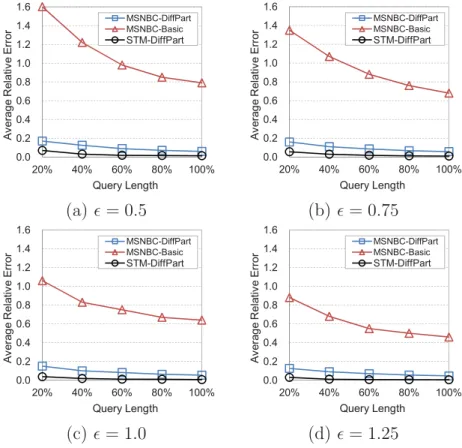
4.3 Average relative error vs. privacy budget. . . 61
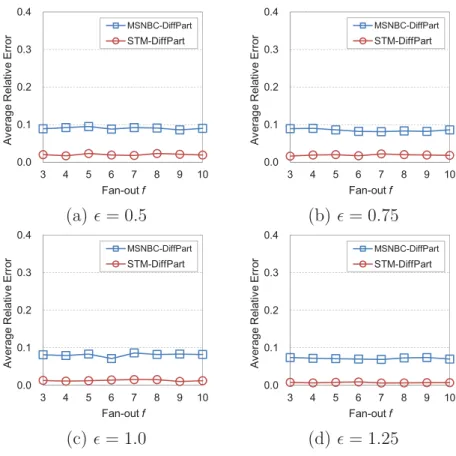
4.4 Average relative error vs. fan-out. . . 62
4.5 Average relative error vs. universe size. . . 63
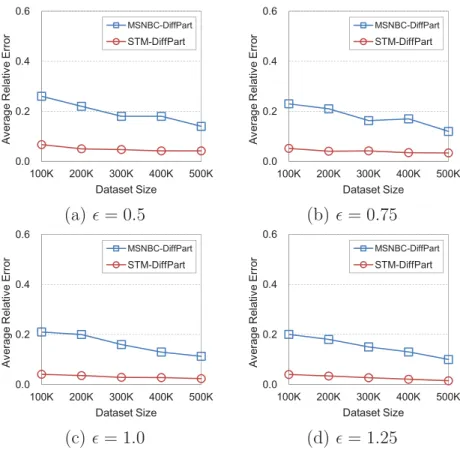
4.6 Average relative error vs. dataset size. . . 64
4.7 Utility for frequent itemset mining. . . 65
4.8 Runtime vs. different parameters. . . 67
5.1 MFS-tree for efficient Score updates . . . 89
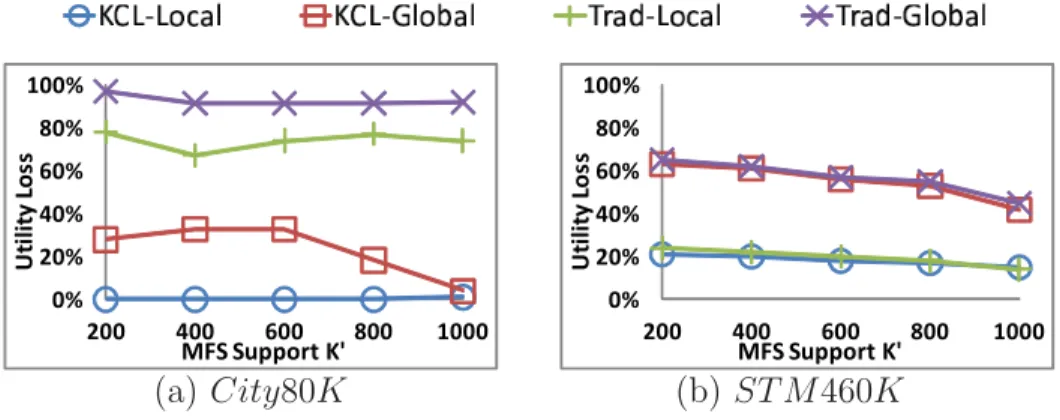
5.2 Utility loss vs. K (L= 3, C = 60%, K = 800) . . . 92
5.3 Utility loss vs. C (L= 3, K = 30, K = 800) . . . 93
5.4 Utility loss vs. K (L= 3, K = 30, C = 60%) . . . 94
5.5 Scalability . . . 95
6.1 The prefix tree of the sample data in Table 6.1 . . . 104
6.2 The noisy hybrid-granularity prefix tree of the sample data . . . 112
6.3 Average relative error vs. privacy budget. . . 119
6.4 Average relative error vs. prefix tree height. . . 120
6.5 Runtime vs. different parameters. . . 122
6.6 The exploration tree of the sample data in Table 6.2 . . . 127
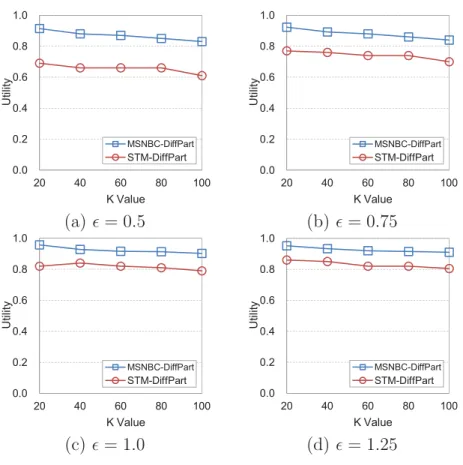
6.7 Average relative error vs. on MSNBC . . . 139
6.8 Average relative error vs. on STM . . . 139
6.9 Average relative error vs. max (= 1.0) . . . 141
6.11 Effect of node count approximation. . . 142
6.12 Utility loss vs. K on MSNBC . . . 145
6.13 Utility loss vs. K on STM . . . 145
6.14 Utility loss vs. max (= 1.0) . . . 146
6.15 Utility loss vs. nmax (= 1.0) . . . 146
7.1 k-isomorphism is insufficient for preventing edge disclosure. . . 149
7.2 A sample graph and its adjacency matrix. . . 152
7.3 Average relative error vs. query size. . . 175
7.4 Average relative error vs. . . 176
7.5 Average relative error vs. k. . . 177
7.6 Degree distribution vs. . . 178
7.7 Degree distribution vs. k. . . 179
TABLES
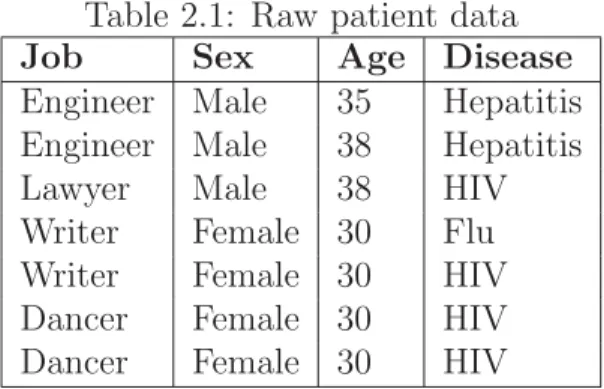
2.1 Raw patient data . . . 13
2.2 3-anonymous patient data by generalization . . . 14
2.3 2-anonymous patient data by suppression . . . 21
2.4 Bucketized patient data . . . 22
4.1 A sample set-valued dataset . . . 43
4.2 Experimental dataset statistics. . . 60
5.1 Raw trajectory database T . . . 70
5.2 (2,50%)2-privacy preserved databaseT . . . 72
5.3 Experimental dataset statistics . . . 91
6.1 Sample sequential database . . . 102
6.2 Another sample sequential dataset . . . 105
6.3 1-grams . . . 105
6.4 2-grams . . . 105
6.5 Experimental dataset statistics. . . 117
6.6 Utility for frequent sequential pattern mining vs. k . . . 121
6.7 Utility for frequent sequential pattern mining vs. . . . 121
6.8 Utility for frequent sequential pattern mining vs. h . . . 121
6.9 Experimental dataset characteristics. . . 137
6.10 True positive ratio vs. K value on M SN BC . . . 143
6.11 True positive ratio vs. K value on ST M . . . 144
7.1 Experimental dataset statistics . . . 173
Chapter 1
Introduction
With the current trend of digitalization, individual privacy is more subject to intru-sions than ever before. Various personal information is being collected in different application domains, for example, retailing business, healthcare departments, public transit agencies, and online social networks. Such personal information in its raw format often contains person-specific sensitive information. Therefore, improper in-formation sharing among different parties may jeopardize individual privacy. This is exemplified by several real-life privacy incidents given below.
Massachusetts voter list. Sweeney [107] successfully re-identified the former governor of Massachusetts by linking a public voter list with a medical database pub-lished by the Massachusetts Group Insurance Commission through the combination of zip code, date of birth and gender (called thequasi-identifier [33]). Sweeney [107] further indicated that for 87% of the U.S. population such characteristics had been recorded and available, which would likely make them identifiable based on only such quasi-identifiers.
AOL search queries. On August 4, 2006, AOL published approximately 20 mil-lion search queries collected from 650,000 users over a 3-month period. User identity information (e.g., such as name or SSN) had been replaced by some pseudonymous user IDs before release, but three days later, it had to remove the release due to the
re-identification of a user [56].
Netflix prize data. Netflix, the largest on-demand Internet streaming media service provider, released the anonymized movie ratings of 500,000 subscribers for a contest with the purpose of improving the accuracy of its recommendation system. However, Netflix had to cancel the contest because Narayanan and Shmatikov [94] revealed that when combining with the information in the public Internet Movie Database (IMDb), users in the released Netflix dataset could be re-identified with high probability.
These real-world privacy concerns have stimulated strong demands for privacy protection in data sharing. The current practice of information sharing primar-ily relies on policies and guidelines on the types of data that can be released and agreements on the proper use of published data. For example, theHealth Insurance Portability and Accountability Act (HIPAA) [96] has become the standard privacy rule for medical data sharing. However, this approach alone may lead to either excessive data distortion or insufficient privacy protection. Comprehensive tech-nological solutions are indispensable for providing formal, provable privacy guar-antees. Consequently, extensive research has been conducted on privacy-preserving data publishing (PPDP) [46] with the goal of publishing useful data while protecting individual privacy even in a hostile environment. The essential trade-off between data utility and individual privacy forms the foundation of PPDP.
Early works on PPDP focus on protecting private and sensitive information in relational data, which is of a fixed schema with a small number of dimensions. In the context of relational data, various traditional privacy models (referred to as
partition-based privacy models [49] in the sequel), such as k-anonymity [104], [108], -diversity [85] and confidence bounding [114], and many anonymization approaches have been proposed. These efforts have successfully shown their strength of privacy protection in publishing relational data, and have also raised expectations of effective privacy-preserving techniques for more complex data types.
In recent years, several emerging types of high-dimensional data, including
set-valued data, trajectory data, sequential data and network data, have become prevalent. While they have become important sources of data analysis, they have simultaneously posed novel technical challenges that prevent traditional PPDP ap-proaches from being directly used. The solutions developed in the context of rela-tional data are useful for thwarting identity linkage and attribute linkage privacy attacks [46] in the case of small numbers of dimensions, however, they cannot be used effectively in the high dimensional case. Aggarwal [3] pointed out that with the increase of dimensionality one has to face with a choice of either undesirable data utility or insufficient privacy protection, known as thecurse of high dimensionality. From the perspective of data utility, increasing dimensionality requires more infor-mation to be suppressed, rendering the released data useless; from the perspective of privacy, increasing dimensionality makes each record more distinctive from others, leaving the target victim easier to identify and therefore harder to protect. Further-more, high dimensionality naturally poses challenges on computational complexity. Therefore, more effective and efficient solutions must be developed so that real-life high-dimensional data could be successfully handled.
In this thesis, we concentrate on developing practical technical solutions for these types of high-dimensional data under rigorous privacy models while provid-ing meanprovid-ingful data utility for various data analysis tasks. In addressprovid-ing privacy concerns in high-dimensional data publishing, the first effort is to identify an appro-priate privacy model. Recently, new types of privacy attacks, such as composition attack [49], deFinetti attack [67] and foreground knowledge attack [118], have been identified on the approaches derived using partition-based privacy models, demon-strating their vulnerability to an adversary’s background knowledge. Due to the deterministic nature of partition-based privacy models, it is foreseeable that more types of privacy attacks could be discovered on these privacy models in the future. Consequently, over the last few years differential privacy [37] has become the
de facto successor to partition-based privacy models. Differential privacy, stemming from the field of statistical disclosure control, provides strong privacy guarantees independent of an adversary’s background knowledge, computational power or sub-sequent behavior. It, in general, requires that the outcome of any analysis should not overly depend on a single data record. It follows that even if a user had opted to be included in the database, there would not be a significant change in any compu-tation based on the database. Therefore, this assures every record owner that any privacy breach will not be a result of participating in a database.
However, the strong privacy guarantee provided by differential privacy does not come without cost. There are two natural settings of data sanitization under differential privacy: interactive and non-interactive. In the interactive setting, a sanitization mechanism sits between the users and the database. Queries posed by the users and/or their responses must be evaluated and may be modified by the mechanism in order to protect privacy; in the non-interactive setting, a data pub-lisher computes and releases a sanitized version of a database, possibly a synthetic database, to the public and hence it could be used for any analysis. There have been some lower bound results [34], [37], [38] of differential privacy, indicating that only a limited number of queries could be answered; otherwise, an adversary would be able to precisely reconstruct almost the entire original database, resulting in a serious compromise of privacy. Therefore, most recent works have concentrated on designing various interactive mechanisms that answer only a sublinear number, in the size of the underlying database, of queries in total, regardless of the number of users. Once this limit is reached, either the database has to be shut down, or any further query would be rejected. This limitation has greatly hindered their applica-bility, especially in the scenario where a database is made available to many users who legitimately need to pose a large number of queries. Naturally, one would favor a non-interactive release that could be used to answer an arbitrary large number of queries or for various data analysis tasks.
Blum et al. [12] pointed out that the aforementioned lower bounds could be circumvented in the non-interactive setting at the cost of preserving usefulness for
only restricted classes of queries. However, they did not provide an efficient algo-rithm. A series of subsequent works [39], [125], [126] aimed to propose more efficient non-interactive sanitization mechanisms. However, all these works are of runtime complexityat least linear in theoutput domain size. These progresses, however, are still not sufficient to handle high-dimensional data, because the output domain sizes of high-dimensional data are typically exponentially large. To tackle this technical challenge, in this thesis, we initiate a line ofdata-dependent solutions, which adap-tively narrows down the output domain by using noisy information obtained from the underlying database. These data-dependent solutions not only achieve reason-able runtime complexity (e.g., linear in the input data size) but also have a positive impact on the resulting utility as there is no need to add noise to every possible entry in the output domain, which accumulates noise quickly.
Protecting individual privacy is one aspect of the problem of PPDP. Another equally important aspect is preserving utility in sanitized data for data analysis. In this thesis, we preserve data utility of different data types for various data analy-sis tasks, ranging from more general tasks, such as counting query and cut query, to more concrete tasks, such as frequent sequential pattern mining and frequent itemset mining. We theoretically and experimentally demonstrate that useful high-dimensional data could be released even under rigorous privacy models.
1.1
Contributions
In this thesis, we study the problem of privacy-preserving data publishing over four emerging types of high-dimensional data, namely set-valued data, trajectory data, sequential data and network data. The key contributions of this thesis are summarized below.
1.1.1
Set-Valued Data Sanitization
Set-valued data, such as transaction data, web search queries, and click streams, has become a major source for various data mining tasks. All existing sanitiza-tion techniques [17], [50], [62], [110], [111], [128], [129] developed for publishing set-valued data are dedicated to partition-based privacy models, which are vulnerable to privacy attacks based on background knowledge. In contrast, differential pri-vacy provides strong pripri-vacy guarantees independent of an adversary’s background knowledge, computational power or subsequent behavior. Existing data publishing approaches for differential privacy, however, are not adequate in terms of both utility and scalability in the context of set-valued data due to its high dimensionality.
This thesis is the first study of publishing set-valued data via differential pri-vacy. Our work initiates the line ofdata-dependentsolutions for achieving differential privacy, which allows differential privacy to be efficiently and effectively applied to different types of data. In particular, we propose a probabilistic top-down partition-ing algorithm to generate a differentially private release for set-valued data, which scales linearly with the input data size. We prove that our result is (δ, β)-useful for the class of counting queries, the foundation of many data mining tasks. We show that our approach maintains high utility for counting queries and frequent item-set mining and scales to large dataitem-sets through extensive experiments on different real-life set-valued datasets.
1.1.2
Trajectory Data Sanitization
With the increasing prevalence of location-aware devices, trajectory data has been generated and collected in various application domains. Trajectory data carries rich information that is useful for many data analysis tasks. Yet, improper publishing and use of trajectory data could jeopardize individual privacy. In this thesis, we ac-knowledge the emerging data publishing scenario, in which trajectory data needs to
be published with sensitive attributes, and consequently propose the (K, C)L-privacy model, which takes into consideration not only identity linkage attacks on trajectory data, but also attribute linkage attacks via trajectory data. This is the first work to introduce local suppression to trajectory data sanitization. Our framework allows the adoption of various data utility metrics for different data mining tasks. As an illustration, we aim at preserving both instances of location-time pairs and frequent sequences in a trajectory database, both being the foundation of many trajectory data mining tasks. Our experiments on both synthetic and real-life datasets sug-gest that the framework is both effective and efficient to overcome the challenges in trajectory data sanitization. In particular, compared with the previous works in the literature, our proposed local suppression method can significantly improve the data utility in sanitized trajectory data.
1.1.3
Sequential Data Sanitization
As a simplified form of trajectory data, sequential data is being increasingly used in a variety of applications, spanning from genome and web usage analysis to location-based recommendation systems. Publishing sequential data is important, since it enables researchers to analyze and understand interesting patterns. In particular, we are motivated by the data sharing scenario at theSoci´et´e de transport de Montr´eal
(STM), the public transit agency in Montreal area. In this thesis, we propose two alternative solutions for publishing sequential data under the rigorous differential privacy model.
Publishing sequential data via prefix tree. We propose an efficient data-dependent yet differentially private sequential data sanitization approach based on a hybrid-granularity prefix tree structure. Moreover, as a post-processing step, we make use of the inherent consistency constraints of a prefix tree to conduct con-strained inferences, which lead to better utility. To our best knowledge, this is the
first work to introduce a practical solution for publishing large volume of sequential data under differential privacy. We examine data utility in terms of two popular data analysis tasks conducted at the STM, namely counting queries and frequent sequential pattern mining. Extensive experiments on real-life STM datasets confirm that our approach maintains high utility and is scalable to large datasets.
Publishing sequential data via n-grams. Due to its inherent sequentiality and high-dimensionality, it is challenging to apply differential privacy to sequential data. As an alternative, we address this challenge by employing a variable-length n-gram model, which extracts the essential information of a sequential database in terms of a set of variable-length n-grams. Our approach makes use of a carefully designed exploration tree structure and a set of novel techniques based on the Markov as-sumption in order to lower the magnitude of added noise. The published n-grams are useful for many purposes. Furthermore, we develop a solution for generating a synthetic database, which enables a wider spectrum of data analysis tasks. Exten-sive experiments on real-life datasets demonstrate that our approach substantially outperforms the state-of-the-art techniques.
1.1.4
Network Data Sanitization
With the increasing popularity of information networks, research on privacy-preserving network data publication has received substantial attention recently. Most existing works focus on preventing node re-identification from adversaries with structural background knowledge. In contrast, research on thwarting edge disclosure (e.g., in-ferring if there is a direct link between two individuals) is less fruitful, largely due to lack of a formal privacy model. The recent emergence of -differential privacy
has shown great promise for rigorous edge disclosure protection. Yet -differential privacy is vulnerable to data correlation, which hinders its application to network data that may be inherently correlated.
In this thesis, we propose a stronger variant of -differential privacy, known as (, k)-differential privacy, which provides privacy guarantee even when a record is correlated to at most k−1 other records. We present the concept of correlated sensitivity, which allows Laplace mechanism and exponential mechanism to be used for achieving (, k)-differential privacy. We subsequently provide a holistic solution fornon-interactivenetwork data publication. The basic idea is to adaptively identify dense regions of the adjacency matrix of a network dataset by a data-dependent partitioning process, and then reconstruct a noisy adjacency matrix by a novel use of exponential mechanism, which is of independent interest. To our best knowledge, this is the first work providing an efficient and effective solution for publishing real-life network data in the spirit of differential privacy. Extensive experiments demonstrate that our approach performs well on different types of real-life network datasets.
1.2
Organization of the Thesis
The rest of this thesis is organized as follows:
• Chapter 2 introduces four important privacy models, the common anonymiza-tion mechanisms and popular utility metrics.
• Chapter 3 provides an in-depth literature review of the state-of-the-art tech-niques in PPDP for different data types. In particular, we summarize the recent applications of differential privacy. Our survey of recent developments of privacy-preserving data publishing has been published in [46].
• Chapter 4 studies the problem of publishing set-valued data for data mining tasks under the differential privacy model. We propose a probabilistic top-down partitioning algorithm that is scalable to high-dimensional set-valued data while providing guaranteed utility. The results of this chapter have been
published in [25].
• Chapter 5 studies the problem of privacy-preserving trajectory data publish-ing under a realistic heterogeneous data publishpublish-ing scenario. We develop a generic sanitization framework for trajectory data, which accommodates var-ious utility metrics. The results of this chapter have been published in [23]. • Chapter 6 proposes two alternative solutions to publishing sequential data
under differential privacy. The results of this chapter have been published in [22], [20].
• Chapter 7 presents a stronger variant of-differential privacy, known as (, k )-differential privacy, for correlated data, and provides a holistic solution for non-interactive network data publication under (, k)-differential privacy. The results of this chapter are currently under review in [24].
Chapter 2
Background
In privacy-preserving data publishing, there is a fundamental trade-off between pri-vacy and utility [66]. At one extreme, the data holder may publish nothing so that privacy can be perfectly protected, but the resulting data utility is zero. At the other extreme, the data holder may directly publish the raw data without any anonymiza-tion attempt so that the data utility can be maximized, but no privacy protecanonymiza-tion can be guaranteed. Thus, it is of importance for the data holder to find a reason-able trade-off between privacy and utility. This requires the following concepts to be defined: privacy model, anonymization mechanism, and utility metric.
2.1
Privacy Models
In 1977, Dalenius [32] provided a very stringent definition of privacy protection: “access to the published data should not enable the attacker to learn anything extra about any target victim compared to no access to the database, even with the presence of any attacker’s background knowledge obtained from other sources”. In real-life applications, such an absolute privacy protection is impossible due to the presence of an attacker’s background knowledge [36]. For this reason, most literature on privacy-preserving data publishing considers more relaxed, but more
practical notions of privacy protection by assuming that an attacker has limited background knowledge. With his background knowledge, the attacker can perform different kinds of privacy attacks. Accordingly, different kinds of privacy models have been proposed. In this section, we will focus on four most fundamental privacy models, namely,k-anonymity [104], [108], -diversity [85], confidence bounding [114] and differential privacy [37].
In general, a privacy threat occurs when an attacker is able to link a record owner to a record in a published data table, to a sensitive attribute in a published data table, or to the published data table itself. We call these identity linkage,
attribute linkage, and membership linkage, respectively. In the most basic form of PPDP, the data holder has a table of the form
D(Explicit Identif ier, Quasi Identif ier, Sensitive Attributes, N on−Sensitive Attributes), where Explicit Identif ier is a set of attributes containing information that
ex-plicitly identifies record owners such as name and social security number (SSN); Quasi Identif ier (QID) is a set of attributes that could potentially identify record owners;Sensitive Attributesconsist of sensitive person-specific information such as disease, salary, and disability status; and N on−Sensitive Attributes contain all attributes that do not fall into the previous three categories [16]. The four sets of attributes are disjoint. Furthermore, most works assume that each record in the table belongs to a distinct record owner, known as microdata. Previous works have indicated that simply removing explicit identifiers is insufficient to protect individ-ual privacy. Based on quasi-identifiers, an attacker is still able to perform several types of privacy attacks, as explained below.
Identity linkage attack. In an identity linkage attack, some value qid on QID identifies a small number of records in the released table T, called a group. If the target victim’s QID matches the valueqid, the victim is vulnerable to being linked
Table 2.1: Raw patient data
Job Sex Age Disease
Engineer Male 35 Hepatitis Engineer Male 38 Hepatitis Lawyer Male 38 HIV Writer Female 30 Flu Writer Female 30 HIV Dancer Female 30 HIV Dancer Female 30 HIV
to the small number of records in the group. In this case, the adversary faces only a small number of possibilities for the victim’s record, and with the help of background knowledge, there is a chance that the adversary could uniquely identify the victim’s record from the group.
Example 2.1.1. Suppose that a hospital wants to publish patients’ records in Ta-ble 2.1 to a research center. The explicit identifiers have been removed. If an adversary knows that the record of Bob, a male lawyer who is 38 years old, is in the table, he can infer that Bob is infected with HIV because there is only one record withqid=Lawyer, M ale,38.
Attribute linkage attack. In an attribute linkage attack, the adversary may not need to precisely identify the record of the target victim, but could still infer his sensitive values from the published dataset T based on the set of sensitive values associated with the group to which the victim belongs. In case some sensitive values predominate in the group, a successful inference becomes relatively easy.
Example 2.1.2. From Table 2.1, an adversary can observe that the sensitive at-tribute of all records with qid =Dancer, F emale,30 is of the same value, HIV. Therefore, the adversary can easily infer that the target victim Emily, a 30-year-old female dancer, has HIV with 100% confidence provided that he knows that Emily’s record is in Table 2.1, even though he cannot uniquely identify her record.
Table 2.2: 3-anonymous patient data by generalization
Job Sex Age Disease
Professional Male [35-40) Hepatitis Professional Male [35-40) Hepatitis Professional Male [35-40) HIV Artist Female [30-35) Flu Artist Female [30-35) HIV Artist Female [30-35) HIV Artist Female [30-35) HIV
Membership linkage attack. Both identity linkage and attribute linkage assume that an adversary already assures that the victim’s record is in the released table T. However, in some cases, the presence (or the absence) of the victim’s record inT already reveals the victim’s sensitive information. Suppose a hospital releases a data table with a particular type of disease. Identifying the presence of the victim’s record in the table is already damaging. A membership linkage occurs if an adversary can confidently infer the presence or the absence of the victim’s record in the released table.
2.1.1
k-Anonymity
To prevent identity linkage attacks through QID, Samarati and Sweeney [104], [108] proposed the notion of k-anonymity: if a record in the table has some value qid, then at least k−1 other records should also have the value qid. In other words, the minimum group size on QID is at leastk. A table satisfying this requirement is calledk-anonymous. In a k-anonymous table, each record is indistinguishable from at least k−1 other records with respect to QID. Consequently, the probability of linking a victim to a specific record throughQID is at most 1/k.
Example 2.1.3. Table 2.2 shows a 3-anonymous table by generalizing QID = {J ob, Sex, Age} from Table 2.1 using the taxonomy trees in Figure 2.1. It has two distinct QID groups: P rof essional, M ale,[35 −40) and Artist, F emale,[30 −
Engineer
ANY
Professional Artist
Lawyer Dancer Writer
ANY Male Female Sex Job [30-33) [30-40) [30-35) [35-40) [33-35) Age
Figure 2.1: Taxonomy trees for J ob, Sex,Age.
35). Since each group contains at least 3 records, the table is 3-anonymous. The k-anonymity model assumes that QID is known to the data publisher. Most works consider a single QID containing all attributes that can be potentially used to launch a privacy attack. The more attributes included in QID, the more protection k-anonymity would provide. On the other hand, this also implies that more information distortion is needed to achieve k-anonymity because the records in a group have to agree on more attributes.
2.1.2
-Diversity
k-anonymity protects identity linkage attacks, but fails to prevent attribute linkage attacks. Consequently, Machanavajjhala et al. [85] proposed the diversity principle, called-diversity, to thwart attribute linkage attacks. The-diversity model requires every qid group to contain at least “well-represented” sensitive values. Based on different interpretations of well-representedness, there are several instantiations of this principle. The simplest understanding of “well-represented” is to ensure that there are at least distinct values for the sensitive attribute in each qid group. This distinct -diversity privacy model automatically satisfies k-anonymity, where k=, because eachqidgroup contains at leastrecords. Distinct-diversity cannot prevent probabilistic inference attacks because some sensitive values are naturally more frequent than others in a group, enabling an adversary to conclude that a record in the group is very likely to have those values. For example, F lu is more
common thanHIV. This motivates the following two stronger notions of-diversity. A table isentropy -diverse if for every qid group
−
s∈S
P(qid, s) log(P(qid, s))≥log() (2.1)
where S is a sensitive attribute, P(qid, s) is the fraction of records in a qid group having the sensitive values. The left-hand side, called the entropy of the sensitive attribute, has the property that more evenly distributed sensitive values in a qid group produce a larger value. Therefore, a larger threshold value implies less certainty of inferring a particular sensitive value in a group. Note that the inequality does not depend on the choice of the log base.
Example 2.1.4.Consider Table 2.2. For the first groupP rof essional, M ale,[35− 40), −13log 13 − 31log13 = log(1.9), and for the second group Artist, F emale,[30− 35), −34log 34 − 41log14 = log(1.8). So the table satisfies entropy -diversity if ≤ 1.8.
One limitation of entropy -diversity is that it does not provide a probability based risk measure, which tends to be more intuitive to a human data publisher. For example, being entropy 1.8-diverse in Example 2.1.4 does not convey the risk level that the attacker has 75% probability of succeeding in inferring the sensitive value HIV where 3 out of the 4 record owners in the qid group have HIV. Also, it is difficult to specify different protection levels based on varying sensitivity and frequency of sensitive values.
Therecursive (c, )-diversity makes sure that the most frequent value does not appear too frequently, and the less frequent values do not appear too rarely. Letm be the number of sensitive values in aqidgroup. Let fi denote the frequency of the ithmost frequent sensitive value in a qidgroup. A qidgroup is (c, )−diverseif the frequency of the most frequent sensitive value is less than the sum of the frequencies of them−+1 least frequent sensitive values multiplying by some publisher-specified
constant c, i.e., f1 < cmi=fi. A table is said to have recursive (c, )-diversity if all of its groups have (c, )-diversity. Similarly, the recursive (c, )-diversity is not intuitive for a data publisher to specify the desired level of privacy protection.
2.1.3
Confidence Bounding
Wang et al. [114] proposed an alternative privacy model to protect attribute linkage attacks. They considered bounding the confidence of inferring a sensitive value from aqidgroup by specifying one or moreprivacy templates of the form,QID→ s, h, where s is a sensitive value, QID is a quasi-identifier, and h is a threshold. Let Conf(QID → s) be maxconf(qid→s) over all qid groups on QID, where conf(qid → s) denotes the percentage of records containing s in the qid group. A table satisfiesQID→s, hif Conf(QID→s)≤h. In other words,QID→s, h bounds the attacker’s confidence of inferring the sensitive value s in any group on QIDto at most h.
For example, with QID = {J ob, Sex, Age}, QID → HIV,10% states that the confidence of inferringHIV from any group on QID is no more than 10%. For the data in Table 2.2, this privacy template is violated because the confidence of inferringHIV is 75% in the group Artist, F emale,[30−35).
The confidence measure has two advantages over recursive (c, )-diversity and entropy-diversity. First, the confidence measure is more intuitive because the risk is measured by the probability of inferring a sensitive value. The data publisher relies on this intuition to specify the acceptable maximum confidence threshold. Second, it allows the flexibility for the data publisher to specify a different threshold h for each combination of QID and s according to the perceived sensitivity of inferring sfrom a group on QID. The recursive (c, )-diversity cannot be used to bound the frequency of sensitive values that are not the most frequent. Confidence bounding provides greater flexibility than -diversity in this aspect.
2.1.4
-Differential Privacy
All aforementioned privacy models are calledpartition-based models. They provide privacy protection by enforcing certainsyntactic requirements on the released data. Recent research indicates that partition-based privacy models are vulnerable to an adversary’s background knowledge. In contrast, differential privacy [37] is a more
semantic definition, which provides strong privacy guarantees independent of an adversary’s background knowledge. Differential privacy requires that the removal or addition of a single database record does not significantly affect the outcome of any analysis. It ensures a data record owner that any privacy breach will not be a result of participating in the database since anything that is learnable from the database with his record is also learnable from the one without his record. Formally, differential privacy [37] is defined as follow. Here the parameter, , specifies the degree of privacy offered.
Definition 2.1 (-differential privacy). A privacy mechanismA gives -differential privacy if for any dataset D1 and D2 differing on at most one record, and for any possible sanitized datasetD ∈ Range(A),
P r[A(D1) =D]≤e×P r[A(D2) = D] (2.2) where the probability is taken over the randomness ofA.
One salient merit of differential privacy is its composition properties, which provide privacy guarantees in case of sequential release. Any sequence of compu-tations that each provides differential privacy in isolation also provides differential privacy in sequence, which is known assequential composition [87]. The implication is that differential privacy is robust to collusions among adversaries.
Theorem 2.1. Let Ai each provide i-differential privacy. A sequence of Ai(D)
In some special cases, in which a sequence of computations is conducted on
disjoint datasets, the privacy cost does not accumulate, but depends only on the worst guarantee of all computations. This is known as parallel composition [87]. This property could and should be used to obtain good performance.
Theorem 2.2. Let Ai each provide i-differential privacy. A sequence of Ai(Di)
over a set of disjoint datasets Di provides (max(i))-differential privacy.
2.2
Anonymization Mechanisms
Normally, a given raw dataset is very unlikely to satisfy a specified privacy model. Certain anonymization mechanisms need to be applied to the raw dataset, making it less precise, in order to achieve the privacy model. This is usually done by applying a sequence of anonymization operations, which naturally leads to the trade-off between privacy and utility. It is worth mentioning that there may exist more than one anonymization mechanism to achieve a specific privacy model. However, in many cases, it is important to choose a right anonymization mechanism in order to obtain a better trade-off. So far, four kinds of anonymization mechanisms have been widely used, namelygeneralization, suppression, bucketization and perturbation.
2.2.1
Generalization
The generalization mechanism generates anonymous releases by replacing some at-tribute values by more general values. For a categorical atat-tribute, a specific value can be replaced with a general one according to a given taxonomy; for a numerical attribute, exact values can be replaced with an interval that covers the exact values. Usually, no-predetermined taxonomy is given for a numerical attribute. We have seen taxonomy trees for both categorical and numerical attributes in Figure 2.1. In Example 2.1.3, we achieved 3-anonymity by generalizing QID according to the taxonomy trees in Figure 2.1.
Generalization can be performed using either global recoding scheme or local recoding scheme. The global recoding scheme further includes full-domain general-ization scheme, subtree generalization scheme and sibling generalization scheme as explained below.
Full-domain generalization scheme[74], [104], [108]. In this scheme, all values of an attribute are generalized to the same level of the taxonomy tree. For example, in Figure 2.1, if Lawyer and Engineer are generalized to Professional, then it also requires generalizingDancer andWriter toArtist. The search space for this scheme is much smaller than the search spaces for the other schemes below, but the data distortion is the largest because of the same granularity level requirement on all paths of a taxonomy tree.
Subtree generalization scheme[9], [47], [48], [64], [115]. In this scheme, at a non-leaf node, either all child values or none are generalized. For example, in Figure 2.1, ifEngineer is generalized toP rof essional, this scheme also requires the other child node, Lawyer, to be generalized to P rof essional, but Dancer and W riter, which are child nodes ofArtist, can remain ungeneralized.
Sibling generalization scheme [74]. This scheme is similar to the subtree gen-eralization, except that some siblings may remain ungeneralized. A parent value is then interpreted as representing all missing child values. For example, in Figure 2.1, if Engineer is generalized to P rof essional, and Lawyer remains ungeneralized, P rof essionalis interpreted as all jobs covered byP rof essional except forLawyer. This scheme produces less distortion than subtree generalization scheme because it only needs to generalize the child nodes that violate the specified threshold.
Cell generalization scheme [74], [120], [127]. In all of the above schemes, if a value is generalized, all its instances in the raw dataset are generalized. Therefore, such schemes are called global recoding. In cell generalization, also known as local recoding, some instances of a value may remain ungeneralized while other instances
Table 2.3: 2-anonymous patient data by suppression
Job Sex Age Disease
* Male * Hepatitis
* Male * Hepatitis
* Male * HIV
Writer Female 30 Flu Writer Female 30 HIV Dancer Female 30 HIV Dancer Female 30 HIV
are generalized. For example, in Table 2.1Engineerin the first record is generalized to P rof essional, while Engineer in the second record can remain ungeneralized. Compared with global recoding schemes, this scheme is more flexible; therefore, it produces a smaller data distortion. Nonetheless, it is important to note that the utility of data could be adversely affected by this flexibility, which causes a data exploration problem: most standard data mining methods treatEngineer and P rof essional as two independent values, but, in fact, they are not. For example, building a decision tree from such a generalized table may result in two branches, P rof essional→class1 and Engineer→class2. It is unclear which branch should be used to classify a new engineer. Though very important, this aspect of data utility has been ignored by all works that employed the local recoding scheme. Data produced by global recoding does not suffer from this data exploration problem.
2.2.2
Suppression
Suppression is a straightforward anonymization mechanism. Unlike generalization, the suppression mechanism does not require any given taxonomy. It produces a release candidate by replacing some attribute values by a special symbol (e.g., “*” or “Any”), which indicates that the value has been suppressed. Table 2.3 presents a 2-anonymous table from Table 2.1 using suppression, in which certain values are
Table 2.4: Bucketized patient data
Job Sex Age BID
Engineer Male 35 1 Engineer Male 38 1 Lawyer Male 38 1 Writer Female 30 2 Writer Female 30 2 Dancer Female 30 2 Dancer Female 30 2 BID Disease 1 HIV 1 Hepatitis 1 Hepatitis 2 HIV 2 Flu 2 HIV 2 HIV
replaced by wildcard values, “*”. Analogous to generalization, there are also dif-ferent schemes for suppression. Record suppression [9], [64], [74], [104] refers to the operation that suppresses an entire record. Value suppression [113], [114] refers to the operation that suppresses every instance of a given value in a table. Cell sup-pression (orlocal suppression) [31], [92] refers to the operation that suppresses some instances of a given value in a table. Cell suppression results in less data distortion, but usually requires greater computational complexity.
2.2.3
Bucketization
The basic idea of the bucketization mechanism is to break the correlation between quasi-identifiers and sensitive values. It first partitions the records in the original data table into non-overlapping buckets, each of which is assigned a unique BID. For each bucket, it randomly permutes the sensitive attribute values, and then publishes its projection on the quasi-identifier attributes and also its projection on the permuted sensitive attribute. Table 2.4 presents a release candidate of the bucketization mechanism from Table 2.1. After bucketization, the sensitive value of a victim becomes indistinguishable from the rest in the same bucket.
The main limitation of this mechanism is that its application requires clearly defined sensitive attributes and non-overlapping buckets. This requirement prevents it from being applied to certain types of data, for example, set-valued data and
trajectory data. Moreover, since the quasi-identifiers are published without any modification, an adversary is likely to be able to perform an identity linkage by joining some external tables.
2.2.4
Perturbation
Perturbation mechanisms have been used for a long period of time in the field of statistical disclosure control. Adam and Wortmann [2] have provided a complete summary of perturbation mechanisms that have been widely employed. In this sec-tion, we focus on two standard perturbation mechanisms that are used for achieving differential privacy, namelyLaplace mechanism andexponential mechanism. A fun-damental concept of both mechanisms is theglobal sensitivity of a function [37] that maps underlying datasets to (vectors of) reals.
Definition 2.2 (Global Sensitivity). For any function f :D → Rd, the sensitivity of f is
GS(f) = max
D1,D2||f(D1)−f(D2)||1 (2.3) for all D1,D2 differing in at most one record.
Roughly speaking, functions with lower sensitivity are more tolerant towards changes of a dataset and, therefore, allow more accurate differentially private mech-anisms.
Laplace Mechanism
For the analysis whose outputs are real, a standard mechanism to achieve differential privacy is to add Laplace noise to the true output of a function. Dwork et al. [37] propose the Laplace mechanism which takes as inputs a database D, a function f, and the privacy parameter . The noise is generated according to a Laplace
distribution with the probability density function (pdf)p(x|λ) = 2λ1 e−|x|/λ, where λ is determined by both GS(f) and the desired privacy parameter.
Theorem 2.3. For any function f :D → Rd, the mechanism A
A(D) =f(D) +Laplace(GS(f)/) (2.4)
gives -differential privacy.
For example, for a single counting queryQover a dataset D, returningQ(D) + Laplace(1/) maintains -differential privacy because a counting query has a sensi-tivity 1.
Exponential Mechanism
For the analysis whose outputs are not real or make no sense after adding noise, McSherry and Talwar [89] propose the exponential mechanism that selects an output from the output domain, r ∈ R, by taking into consideration its score of a given utility function q in a differentially private manner. The exponential mechanism assigns exponentially greater probabilities of being selected to outputs of higher scores so that the final output would be close to the optimum with respect to q. The chosen utility function q should be insensitive to changes of any particular record, that is, has a low sensitivity. Let the sensitivity ofqbeGS(q) = max∀r,D1,D2 |q(D1, r)−q(D2, r)|.
Theorem 2.4. Given a utility function q : (D × R) → R for a database D, the mechanism A,
A(D, q) =
return r with probability∝exp
q(D, r) 2GS(q)
(2.5)
2.3
Utility Metrics
Privacy is one aspect of privacy-preserving data publishing; utility is the other. In general, each anonymization operation increases privacy, but decreases utility. To obtain a better trade-off between privacy and utility, we prefer the anonymization operations that increase more privacy at the cost of less utility loss. This requires the quantification of data utility. Consequently, some utility metrics have been pro-posed for measuring either the usefulness of the anonymized data or the information loss due to the anonymization process. Such utility metrics roughly fall into three categories: general purpose metrics, special purpose metrics and trade-off purpose metrics.
2.3.1
General Purpose Metrics
In many cases, the data publisher does not know how the published data will be analyzed by the recipient. In this case, general purpose metrics are needed. The basic idea of general purpose metrics is to measure the “similarity” between the original data and the anonymized data, which underpins the principle of minimal distortion [104], [108]. One of the most intuitive general purpose information met-rics is the number of anonymization operations (e.g., generalization or suppression) performed on a dataset [104]. For example, generalizing 10 instances ofEngineerto P rof essionalcauses 10 units of distortion, and further generalizing these instances to AN Y J ob causes another 10 units of distortion. In addition, ILoss [124] and
discernibility metric (DM) [106] are two examples of general purpose metrics that are widely used. ILoss charges a penalty for generalizing a value in a record in-dependently of other records, while the discernibility metric addresses the notion of loss by charging a penalty to each record for being indistinguishable from other records with respect to QID.
2.3.2
Special Purpose Metrics
If the purpose of the data is known at the time of publication, it can be taken into account during the anonymization process to better preserve data utility. For example, if the data is published for modeling the classification of a target attribute in the table, then it is important not to generalize the values whose distinctions are essential for discriminating the class labels in the target attribute. This intuition is reflected in theclassification metric. Iyengar [64] proposed the classification metric or CM to measure the classification error on the training data. The idea is to charge a penalty for each record suppressed or generalized to a group in which the records class is not the majority class. The intuition is that a record having a non-majority class in a group will be classified as the majority class, which is an error because it disagrees with the record’s original class. Special purpose metrics are especially important for differential privacy, under which we can guarantee utility for only restricted classes of data analysis tasks.
2.3.3
Trade-off Purpose Metrics
All above information metrics aim at preserving maximum data usefulness, but the problem is that the anonymization operation that gains maximum information may also lose so much privacy that no other anonymization operation can be performed. The idea of trade-off metrics is to consider both the privacy and information re-quirements at every anonymization operation and to determine an optimal trade-off between the two requirements [47], [48].
Chapter 3
Literature Review
The privacy concern in data publishing was first arisen in the field of official statis-tics in the 1960s. In the context of statistical databases, the objective of privacy protection is to protect confidentiality of any individual entity in the database while allowing its users to retrieve aggregate statistics [2]. Recently, with the fast develop-ment of data mining techniques, there are increasing demands on publishing entire database records, instead of just aggregate statistics [46]. Such demands obviously present greater challenges to privacy protection, and have spawned a new wave of research on PPDP towards data mining purpose. In this section, we present an in-depth literature review on the recent developments of PPDP.
3.1
Sanitizing Statistical Data
Statistical databases are maintained by various organizations to support their short-term and long-short-term planning activities. The users of statistical databases are entitled to submit interactive queries for aggregate statistics. The aggregate statistics may disclose an individual’s sensitive information that is stored in the database, such as income, disease, and credit rating. Therefore, the problem of sanitizing statistical data, also known asstatistical disclosure control [2], [13], is to protect confidentiality
based on the interactive query model.
Perturbation is the most important sanitization approach used in statistical disclosure control due to its simplicity, efficiency, and ability to preserve statistical information. The general idea of perturbation is to replace the original data val-ues with some synthetic data valval-ues so that the statistical information computed from the perturbed data does not differ significantly from the statistical information computed from the original data. The perturbed data records do not correspond to real-world record owners, so the attacker cannot perform the sensitive linkages or recover sensitive information from the published data. Following the general idea, three concrete sanitization methods have been widely used, namely additive noise, data swapping, and synthetic data generation. Additive noise [2], [13] is often used for hiding sensitive numerical data (e.g., salary). The basic idea is to replace the original sensitive value s with s+r where r is a random value drawn from some distribution. Privacy is measured by how closely the original values of a modified attribute can be estimated [5]. Two papers [44], [70] showed that some simple statis-tical information, like means and correlations, can be preserved by adding random noise. Data swapping can be used to protect both numerical attributes [102] and categorical attributes [101]. It sanitizes a data table by exchanging values of sensi-tive attributes among individual records while maintaining the low-order frequency counts or marginals. Synthetic data generation builds a statistical model from the raw data and then samples points from the model. These sampled points form the synthetic data for data publication instead of the original data.
Recently, Dwork et al. [37] proposed an insightful privacy notion based on the principle that the risk to a record owner’s privacy should not substantially increase as a result of participating in a statistical database. Instead of comparing the prior and posterior probabilities before and after accessing the published data, Dwork et al. proposed to compare the probability change of an adversary on databases with and without the record owner’s data. Consequently, Dwork et al. [37] proposed
a privacy model called -differential privacy to ensure that the outcome of any analysis is insensitive to the removal or addition of a single database record. It follows that even if a user had opted to be included in the database, there would not be a significant change in any computation based on the database. Therefore, this assures every record owner that any privacy breach will not be a result of participating in a database.
Differential privacy lies on a rigorous mathematical foundation, and has been shown to guarantee formal, provable privacy protection independent of an adver-sary’s background knowledge and computational power. These days, differential privacy has gained substantial attention and become the de facto standard for pri-vacy protection. We review the recent applications of differential pripri-vacy in Sec-tion 3.6.
3.2
Sanitizing Relational Data
The traditional k-anonymity model [104], [108] and its extensions [75], [120], [85], [95], [77], [114] were originally proposed to protect private and sensitive informa-tion in the context of relainforma-tional data. All these privacy models are based on the common assumption that an adversary may use any or even all attributes in the quasi-identifier (QID) to launch identity and attribute linkage attacks. k -anonymity [104], [108] prevents identity linkage attacks by requiring every qid group in a table to contain at least k records. Most works on k-anonymity focus on anonymizing a single data table; however, a real-life database usually contains mul-tiple relational tables. Nergiz et al. [95] proposed a privacy model called MultiR
k-anonymity to ensure k-anonymity on multiple relational tables. Their model as-sumes that a relational database contains a person-specific table P T and a set of tables T1,· · · , Tn, where P T contains a person identifier P id and some sensitive attributes, and Ti, for 1 ≤ i ≤ n, contains some foreign keys, some attributes in
QID, and sensitive attributes. The general privacy notion is to ensure that for each record owner o contained in the join of all tables P T T1 · · · Tn, there exist at leastk−1 other record owners who share the same QID witho.
-diversity [85] and confidence bounding [114] aim to prevent attribute linkage attacks. -diversity requires every qid group to contain at least “well-represented” sensitive values, while confidence bounding limits an adversary’s confidence of infer-ring a sensitive value in any qid group to a certain threshold. (α, k)-anonymity [120] incorporates bothk-anonymity and confidence bounding into a single privacy model, requiring every qid in a tableT to be shared by at least k records andconf(qid→ s)≤α for any sensitive value s, wherek and s are data publisher specified thresh-olds. Li et al. [77] observed that when the overall distribution of a sensitive attribute is skewed,-diversity does not prevent attribute linkage attacks. Consider a patient table where 95% of records haveFlu and 5% of records haveHIV. Suppose that a qid group has 50% ofFlu and 50% of HIV and, therefore, satisfies 2-diversity. However, this group presents a serious privacy threat because any record owner in the group could be inferred as having HIV with 50% confidence, compared to 5% in the overall table. To prevent skewness attacks, Li et al. [77] proposed a privacy model, called t-closeness, that requires the distribution of a sensitive attribute in any qid group to be close to the distribution of the attribute in the overall table. t-closeness uses the
earth mover’s distance (EMD) to measure the closeness between two distributions of sensitive values, and requires the closeness to be withint. (, δ)k-dissimilarity [116] thwarts both identity and attribute linkage attacks for a much wider range of data models, where the proximity of sensitive values is defined by an arbitrary function. In the above privacy models, only very limited background knowledge is con-sidered. Yet, recent works have shown the importance of integrating an adversary’s background knowledge in privacy quantification. A common challenge faced by all research on integrating background knowledge is to determine what and how much knowledge should be considered. Li and Li [78] modeled an adversary’s background
knowledge by mining negative association rules from the data and then using them in the anonymization process. Chen et al. [19] argued that since it is infeasible for a data publisher to anticipate the background knowledge possessed by an adver-sary, the interesting research direction is to consider only the background knowledge that arises naturally in practice and can be efficiently handled. In particular, three types of background knowledge are considered in [19]: knowledge about the target individual, knowledge about other individuals, and knowledge about the group of individuals having the same sensitive value as that of the target individual. The three-dimensional knowledge is quantified as a (, k, m) triplet, which indicates that an adversary knows: (1) sensitive values that the target individual t does not have, (2) the sensitive values of other k individuals, and (3) m individuals having the same sensitive value as that oft. Then, the authors proposed theskyline privacy criterion, which allows the data publisher to specify a set of incomparable (, k, m) triplets, called a skyline, along with a set of confidence thresholds for a sensitive value δ in order to provide more precise and flexible privacy quantification. The major shortcoming of privacy skyline is its limited expressive power of background knowledge. For example, it fails to express probabilistic background knowledge.
Du et al. [35] specifically modeled an adversary’s background knowledge in the form of probabilities, for example, P(OvarianCancer|M ale) = 0. The primary privacy risks in PPDP come from the linkings between the sensitive attributes (SA) and the quasi-identifiers (QI). Quantifying privacy is, therefore, to deriveP(SA|QI) for any instance of SA and QI with the probabilistic background knowledge. Du et al. [35] formulated the derivation of P(SA|QI) as a non-linear programming prob-lem. Currently, the paper is limited in handling only equality background knowl-edge constraints. Since both papers [19], [35] are unaware of the exact background knowledge possessed by an adversary, Li et al. [79] proposed a generic framework to systematically model different types of background knowledge an adversary may possess. Yet, in this paper the authors limit their scope to background knowledge
that is consistent with the original dataset T. Then, modeling background knowl-edge is to estimate the adversary’s prior belief of the sensitive attribute values over all possible QI values. This can be achieved by identifying the underlying prior belief function that best fitsT using a kernel regression estimation method.
3.3
Sanitizing Set-Valued Data
Due to the nature ofhigh dimensionality in set-valued data, the extensive research on privacy-preserving data publishing (PPDP) for relational data does not fit well with set-valued data [46]. Some recent papers have started to address the problem of anonymizing set-valued data for the purpose of data mining [17], [50], [62], [110], [111], [128], [129]. These existing works can be broadly divided into two categories according to whether they distinguish the items betweensensitiveandnon-sensitive. Ghinita et al. [50] and Xu et al. [128], [129] deliberately divided all items in the universe into either sensitive or non-sensitive, and further assumed that an ad-versary’s background knowledge is strictly confined to non-sensitive items, which are considered quasi-identifiers for launching privacy attacks. In [50], an adversary is modeled with background knowledge of arbitrary number of non-sensitive items. They proposed a bucketization-based approach that limits the probability of infer-ring a sensitive item to a specified threshold, while preserving correlations among items for frequent pattern mining. In addressing the high dimensionality of set-valued data, Xu et al. [129] bounded the background knowledge of an adversary to at most p non-sensitive items, and intended to prevent both identity attacks and attribute attacks. Specifically, global suppression was employed with the goal of preserving as many item instances as possible. Xu et al. [128] improved the ap-proach proposed in [129] in two ways: instead of preserving item instances, they aimed to preserve frequent itemsets; they presented a border representation, which avoids enumerating an exponential number of moles and nuggets.
All these works suffer from two main drawbacks. First, when an adversary is aware of some, even few, sensitive items, other sensitive items could be learned. Second, in many cases there does not exist a consensus of “sensitive”. Items sensitive to someone may not be sensitive to others. Cao et al. [17] addressed the first concern by assuming that an adversary may possess background knowledge on sensitive items and proposed a privacy notionρ-uncertainty, which bounds the confidence of inferring a sensitive item from any subset of items (sensitive or non-sensitive) to ρ. They employed both global suppression (for both sensitive and non-sensitive items) and global generalization (for only non-sensitive items).
In addressing the second concern, He and Naughton [62] and Terrovitis et al. [110], [111] eliminated the distinction between sensitive and non-sensitive. Any item could be both sensitive and non-sensitive at the same time. Incorporating both k-anonymity and confidence bounding in such a setting is a challenging, if not impossible, task due to the inherent conflicting requirements of the two privacy models. As a result, these authors considered only identity attacks. Similar to the idea of [128] and [129], Terrovitis et al. [110] proposed to bound the background knowledge of an adversary by the maximum number m of items and proposed a new privacy model,km-anonymity, a relaxation ofk-anonymity. They achievedkm -anonymity by a bottom-up global generalization solution. To improve the utility, recently Terrovitis et al. [111] provided a local recoding method for achieving km -anonymity. He and Naughton [62] pointed out thatkm-anonymity provides a weaker privacy protection than k-anonymity and proposed a top-down local generalization solution underk-anonymity. We argue that even k-anonymity provides insufficient privacy protection for set-valued data. Consider an extreme case in which all records are identical. If an adversary assures the presence of the victim in the table, he learns every item of the victim withoutany background knowledge.
3.4
Sanitizing Trajectory and Sequential Data
More broadly, sequential data can be considered as a special kind of trajectory data. Due to the ubiquitousness of trajectory data and sequential data, some re-cent works [1], [109], [100], [130], [63], [93] have started to study privacy-preserving trajectory data p