and system protection
Hu, L., Wang, Z., Han, Q., & Liu, X. (2018). State estimation under false data injection attacks: Security analysis and system protection. Automatica, 87, 176-183. https://doi.org/10.1016/j.automatica.2017.09.028
Published in: Automatica
Document Version: Peer reviewed version
Queen's University Belfast - Research Portal:
Link to publication record in Queen's University Belfast Research Portal
Publisher rights
© 2017 Elsevier Ltd. This manuscript version is made available under the CC-BY-NC-ND 4.0 license http://creativecommons.org/licenses/by-nc-nd/4.0/,which permits distribution and reproduction for noncommercial purposes, provided the author and source are cited.
General rights
Copyright for the publications made accessible via the Queen's University Belfast Research Portal is retained by the author(s) and / or other copyright owners and it is a condition of accessing these publications that users recognise and abide by the legal requirements associated with these rights.
Take down policy
The Research Portal is Queen's institutional repository that provides access to Queen's research output. Every effort has been made to ensure that content in the Research Portal does not infringe any person's rights, or applicable UK laws. If you discover content in the Research Portal that you believe breaches copyright or violates any law, please contact [email protected].
State Estimation under False Data Injection Attacks:
Security Analysis and System Protection
Liang Hu, Zidong Wang and Xiaohui Liu
Abstract
In this paper, the security issue in the state estimation problem is investigated for networked control systems. The communication channels between the sensors and the remote estimator are vulnerable to attacks from malicious adversaries. The false data injection attacks (FDIAs) are considered. We aim to find the so-calledinsecurityconditions under which the estimation system is insecure in the sense that there exist FDIAs that can bypass the anomaly detector but still lead to unbounded estimation errors. In particular, anewnecessary and sufficient condition for the insecurity is derived in the case that all communication channels are compromised by the adversary. Furthermore, a specific algorithm is proposed for generating attacks with which the estimation system is insecure. Moreover, for the insecure system, we propose a system protection scheme through which only a few (rather than all) communication channels require protection against FDIAs. A simulation example is utilized to demonstrate the usefulness of the proposed conditions/algorithms in the secure estimation problem for a flight vehicle.
Index Terms
False data injection attacks; State estimation, Security analysis, Networked control systems
I. INTRODUCTION
The first-ever cyber-attack in real-world control systems was reported in 2010 [4]. Specifically, the Stuxnet worms were injected in the programming logic controllers leading to subsequent modifications of the control systems and eventual damages of nearly 1000 centrifuges. Since then, the cybersecurity of NCSs has been a hot topic of research that stirs considerable interest. In general, two kinds of attacks have been studied in NCSs [23], one is the denial-of-service (DoS) attack that violates data availability through blocking information flows between different components of NCSs, and the other is the deception attack that violates data integrity through modifying the data packets. Compared with DoS attacks, deception attacks are more difficult to detect because the adversary could keep the deception attacks stealthy to the anomaly detector in NCSs through deliberately designing the attack sequences. The deception attacks have been first considered in [12] for the state estimation problems of power systems modelled by static system models. Some attack detection methods have been proposed in [7], [10] from the defenders’ perspective, and the minimum number of comprised sensors that needed to launch deception attacks has been investigated in [22] from attackers’ points of view. As fordynamicsystems, when the system model is unknown to the adversary, a specific type of deception attack called replay attack has been proposed and analysed in [15], [18], [25]. In the case that the dynamic model is known to the adversary, another type of deception attack, namely, false data injection attack (FDIA), has recently been put forward. For deterministic systems without stochastic noises, fundamental issues such as detectability and identifiability for FDIAs have been analysed in [5], [6], [20]
This work was supported in part by the Engineering and Physical Sciences Research Council (EPSRC) of the U.K., the Royal Society of the U.K., and the Alexander von Humboldt Foundation of Germany.
L. Hu, Z. Wang and X. Liu are with the Department of Computer Science, Brunel University London, Uxbridge, Middlesex, UB8 3PH, United Kingdom. (Email:[email protected])
and efficient control/estimation algorithms have been developed against FDIAs [21]. In [19], the data encryption scheme (together with time-stamp techniques) has been adopted to detect the deception attacks and compensate the side-effects.
As is well known, stochastic models have come to play a more and more important role in characterizing noisy phenomena from real-world systems. Accordingly, it is of practical significance to investigate the cybersecurity of stochastic dynamic systems. As pointed in [9], the detection task of malicious behaviours for stochastic systems (with external noises) is more difficult than that for deterministic (without stochastic noises) because of the fact that the injected attack by the adversary could be mistaken as a type of noises by the protection devices. A secure state estimation algorithm has been proposed in [13] for stochastic dynamic systems where a key assumption of sparse observability has been made. This assumption implies that only a part of (rather than all) sensors are attacked and the system is still observable using the set of unattacked sensors. While the results reported in [13] are indeed interesting, it is quite possible that the adversary attacks at a large number of (or even all) sensors, in which case the system cannot be guaranteed to be “sparsely observable”. Motivated by the above observation, we aim to examine the system vulnerability under cyber-attacks without the assumption of sparse observability. More specifically, we investigate the case where the attacker could inject false data into measurements from any sensor and, accordingly, the main results obtained would constitute one of the main contributions of our paper.
In this paper, we focus on the remote state estimation problem for a class of stochasticsystems under possible FDIA attacks where aχ2detector is employed to monitor the state estimates. Note that FDIAs have been considered in [11], [14], [16], [17] for state estimation problems, and in [24] for distributed control problems of stochastic systems equipped with χ2 detectors. In particular, an approximation method has been proposed in [16], [17] to analyse the cybersecurity of the system by calculating the estimation error bound caused by the FDIA attacks, and some insecurity conditions have been derived in [11], [14] to determine whether or not there exists FDIA attacks which can cause unbounded estimation error for the state estimation system. Nevertheless, a thorough investigation reveals that 1) there is still room to improve the existing insecurity conditions; and 2) there is also an engineering need to develop system protection scheme by using only necessary number of communication channels requiring protection against FDIAs.
In this paper, we aim to propose new insecurity conditions for state estimation problems under FDIAs. Specifically, for the case when all communication channels are compromised by the adversary, we propose a newnecessary and sufficient condition under which the system is insecure in the sense that the estimation error caused by FDIAs is unbounded. Such a new condition is shown to be concise that simplifies the existing results. For the case when only parts of the communication channels are compromised by the adversary, a sufficient condition is proposed as well. Furthermore, to protect the overall NCSs from FDIAs, we propose a criterion which determines a sufficient number of communication channels that require protection. According to the criterion, only necessary number of (rather than all) communication channels need to be protected in order to make the overall system secure against the FDIAs. The contributions of the paper are summarized as follows: 1) new security criteria are proposed for state estimation systems under FDIAs and, in the case that all communication channels are compromised by the adversary, our criteria are shown to be necessary and sufficient that simplify the existing ones; 2) an effective protection scheme is proposed for the system which is insecure under FDIAs; and 3) the developed criteria are applied to security analysis and system protection in the state estimation system of a flight vehicle.
The remainder of this paper is organized as follows. The security problem of state estimation system under cyber-attacks are formulated in Section II. In Section III, we analyse the system security under FDIAs for two cases and further propose the system protection scheme. Examples for illustration are given in Section IV and we conclude the paper in Section V.
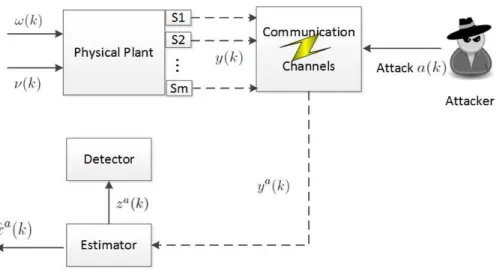
Fig. 1. Diagram of state estimation problem under cyber-attacks
Notation:N, RandCdenote, respectively, the set of non-negative integers, the set of all real numbers, and the
set of all complex numbers. {x(k)} denotes an infinite sequencex(1), x(2),· · · , x(k),· · ·. Rn×m (Cn×m) denotes
the set of all n×m real (complex) matrices, and Rn denotes the n dimensional Euclidean space. For α ∈ C,
Re(α)and|α|denote its real part and its modulus, respectively. Fora∈Rn, kak denotes itsl
2 norm. For a matrix
P ∈Rn×m,PT, P−1, Tr{P} and Rk{P} represent its transpose, inverse, trace, and rank, respectively. For square matrix A, det(A) stands for the determinant of A, and ρ(A) stands for the spectral radius of A. diag{· · · } and I
denote a block-diagonal matrix and identity matrix of compatible dimension, respectively, and Im (0m) denotes the
m×m-dimensional identity (zeros) matrix. Ims denotes thes-th column ofm×m-dimensional identity matrixIm,
e.g, Is m = s−1 z }| { 0, . . . ,0,1,0, . . . ,0 | {z } m T .
II. PROBLEM FORMULATION
In this section, we describe the model of false data injection attack (FDIA) and analyse how the injected attacks affect the estimation system. The structure of the state estimation system under cyber-attacks is shown in Fig. 1. For presentation convenience, we first introduce the estimation system without cyber-attacks (i.e., ya(k) =y(k) in Fig. 1).
A. State estimation without cyber-attacks
Let the physical plant be given by:
P :
(
x(k+ 1) =Ax(k) +ω(k)
y(k) =Cx(k) +ν(k) (1) where x(k) ∈Rn is the system state, y(k) = [y
1(k), . . . , ym(k)]T ∈Rm is the measurement output, and yi(k) is
the output of the ith sensor (labelled asSi in Fig. 1) at time instant k. The initial state x(0) has meanx¯(0) and
covarianceΣ(0), the process noiseω(k)∈Rn and the measurement noiseν(k)∈
Rm are assumed to be mutually
uncorrelated zero-mean random signals with known covariance matrices W and R, respectively. It is assumed that (A, C) is observable.
The following time-invariant state estimator is proposed: E : ( ˆ x(k+ 1) =Axˆ(k) +Kz(k+ 1) z(k+ 1) =y(k+ 1)−CAxˆ(k) (2)
where xˆ(k+ 1)and z(k+ 1) are the state estimate and the estimation residual at time instant k+ 1, respectively. Throughout this paper, we assume that the estimator converges to its steady state.
Defining the estimation errorx˜(k+ 1),x(k+ 1)−xˆ(k+ 1), the dynamics of the estimation error follows from (1) and (2) as follows:
˜
x(k+ 1) = (I−KC)(Ax˜(k) +ω(k))−Kν(k+ 1). (3) It is well known that the estimator is stable if and only if the matrix (I −KC)A is stable [8]. In this paper, it is assumed that the estimator is stable by choosing appropriate estimator gain K.
Failure detectors are often used to detect abnormal operations. In this paper, we assume that aχ2failure detector is deployed. At each time instant k, theχ2 failure detector first computes the valueg(k) =zT(k)(CΣCT+R)−1z(k) where Σ is the steady estimation error covariance, and then compares g(k) with a prescribed threshold α. If
g(k)> α, then an alarm will be triggered. When the system operates normally (i.e. without attacks),g(k)satisfies a χ2 distribution implying low probability of a large g(k) [1].
B. False data injection attack
In this subsection, we introduce the model of false data injection attack (FDIA) and then investigate how it affects the estimation dynamics. Assume that the adversary has perfect knowledge about the system model, that is, the values of all the matrices A, C, K,W andR described in Subsection II-A are known by the attacker. We also assume that the attacker has the ability to inject false data over the communication channels between the sensors and the estimator. Under FDIAs, the measurement output received by the estimator is given as follows:
ya(k) =Cx(k) +a(k) +ν(k) =Cx(k) +Baa0(k) +ν(k) (4)
where a(k)∈Rm represents the false data injected by the attacker at time instant k. The attack vector is described
by a(k) =Baa0(k)where the injection matrixBa=diag{γ1, . . . , γm}. Here,γi = 1if the attacker is able to inject
false data into the ith communication channel, otherwise γi = 0. The matrix Ba reflects which communication
channels can be compromised by the attacker. Specifically, Ba= 0 means that no FDIAs can be injected into any
communication channel, andBa=Im implies that the attacker has the ability to inject FDIA into all communication
channels.
With the compromised measurement ya(k), based on the estimator E in (2), the dynamics of state estimation can be derived as follows:
ˆ
xa(k+ 1) =Axˆa(k) +Kza(k+ 1)
za(k+ 1) =ya(k+ 1)−CAxˆa(k) (5)
where xˆa(k+ 1) and za(k+ 1) are the state estimation and the estimation residual of system (1) at time k+ 1
using the compromised measurement (4), respectively. Without loss of generality, we assume that the attack begins at time instant 1 andxˆa(0) = ˆx(0).
To take into account the effect of FDIAs on the state estimation of system (1), we define the difference between the state estimates and estimation residual of system (1) (without FDIAs) and system (4) (with FDIAs) as
For convenience, we call ∆ˆx(k+ 1) and∆z(k+ 1)as the state estimation difference and the estimation residual difference, respectively. The dynamics of ∆z(k+ 1)and ∆ˆx(k+ 1)can be derived from (2) and (5) as follows:
∆z(k+ 1) =−CA∆ˆx(k) +a(k+ 1), (6)
∆ˆx(k+ 1) =A∆ˆx(k) +K∆z(k+ 1)
= (I−KC)A∆ˆx(k) +Ka(k+ 1) (7)
where ∆ˆx(0) = ˆxa(0)−xˆ(0) = 0.
In the considered FDIA model, the purpose of the attacker is to launch a “special” FDIA sequence under which the state estimation difference ∆ˆx(k) will diverge to ∞ without any alarm triggered by the χ2 detector. In other words, the attacker aims to inject false data which would largely degrade the estimation performance without being detected by the detector.
It is known from the triangular inequalitykza(k)k ≤ kz(k)k+k∆z(k)k that, ifk∆z(k)k is small, then the χ2
detector cannot distinguish between za(k) and z(k) with high probability. As such, to make the attack sequence stealthy, the attacker launching the FDIA should avoid causing a large change in estimation residual difference ∆z(k) [14], which means that the inequality k∆z(k)k ≤ M should hold all the time, where M represents the tolerant level of the χ2 detector. Obviously, a smaller value of M would result in a higher probability for the corresponding attack to be undetected. We assume that M is predetermined by the attacker. On the other hand, the attacker should design the attack sequence deliberately such that the sequence {∆ˆx(k)} becomes unbounded, i.e, limk→∞∆ˆx(k) =∞.
Throughout the paper, the definition on system security is given as follows.
Definition 1: The system P in (1) with estimator E in (2) is called insecure if there exists at least one FDIA sequence {a(k)} such that the following two conditions are satisfied simultaneously:
1) for the state estimation difference∆ˆx(k), lim
k→∞k∆ˆx(k)k → ∞; (8)
2) for the estimation residual difference∆z(k),
k∆z(k)k ≤M, (9)
where M is a prescribed small positive constant scalar.
In case that (8)-(9) do not hold simultaneously under FDIAs (4), the system P in (1) with estimator E in (2) is called secure under FDIAs (4).
The aim of the addressed system security problem is to analyse under what conditions there exists an FDIA that is undetectable by the fault detector but drives the bias in state estimation to infinity.
III. SECURITY ANALYSIS
In this section, we investigate the security of systemP in (1) with estimatorE in (2) for the following two cases: 1) the attacker is able to inject FDIAs into all communication channels, i.e., Ba = Im; and 2) the attacker can
inject FDIAs into only part of the communication channels, i.e., Ba6=Im.
Assume that the system matrix A in (1) has p independent eigenvectors and its Jordan form J is given by
where J = J1 0 0 . . . 0 0 J2 0 . . . 0 0 0 J3 . . . 0 .. . ... ... . .. ... 0 0 0 0 Jp , Ji = λi 1 λi 1 . .. ... . .. 1 λi ,
the Jordan block Ji ∈ Cni×ni (i = 1, . . . , p) with |λ
1| ≥ |λ2| ≥ · · · ≥ |λp| and Pii=1=pni = n. Denote P = h P1, . . . , Pp i and Q=P−1 = h QT 1, . . . , QTp iT , wherePi ∈Cn×ni and Q i∈Cni×n.
If ρ(A) ≥1, there exists a positive integer l satisfying 1 ≤l≤ p such that the inequality |λ1| ≥ · · · ≥ |λl| ≥
1>|λl+1| ≥ · · · ≥ |λp|is true. Furthermore, defining ¯l=Pli=1ni, we have
A=P J Q=Po Pc Λ1 0 0 Λ2 "Q o Qc # , (11)
where block matrices Λ1 =diag{J1, . . . , Jl} ∈C¯lׯl, Λ2 =diag{Jl+1, . . . , Jp} ∈C(n−l¯)×(n−¯l), Po=
h P1, . . . , Pl i , Pc= h Pl+1, . . . , Pp i , Qo= h QT 1, . . . , QTl iT andQc= h QT l+1, . . . , QTp iT
are of appropriate dimensions.
A. Case 1: Ba=Im
To introduce our main results, we need the following lemmas.
Lemma 1: [3] For two matricesM, N ∈Cn×n, det(M N) =det(M)det(N). Moreover, matricesM N andN M
have the same non-zero eigenvalues.
Lemma 2:For the system (1) with estimator (2), if ρ(A)≥1, the following matrix equation
PcX=K (12)
has no solution, where matrix K is the estimator gain of state estimator (2) and matrixPc is given in (11). Proof: It is known from Lemma 1 that the matrices (I−KC)A andA(I−KC) have the same eigenvalues. Then, it follows from ρ((I−KC)A)<1 that the inequalityρ(A(I−KC))<1 holds.
Let us prove the lemma by contradiction. Assume that there exists a matrix solution X˜ to equation (12), then we have A(I−KC) =Po Pc Λ1 0 0 Λ2 "Q o Qc # (I−PcXC˜ ),
and it follows from QoPc= 0 andQcPc=I that
A(I−KC) =Po Pc Λ1 0 0 Λ2 " Q o Qc−XC˜ # .
Accordingly, the characteristic polynomial of matrix A(I−KC), denoted by det(λI−A(I−KC)), can be given as follows: det(λI−A(I−KC)) =det Po Pc λI " Qo Qc # − Po Pc Λ1 0 0 Λ2 " Q o Qc−XC˜ #! =det Po Pc " (λI−Λ1)Qo (λI−Λ2)Qc+ Λ2XC˜ #! =det(P)det " (λI−Λ1)Qo (λI−Λ2)Qc+ Λ2XC˜ #! .
Algorithm 1 The algorithm for generating FDIAs
1: Initialize:
Decompose matrixAin (1) as the Jordan normal form (10), Choose arbitrarily a scalar σ∈(0,1) and the positive scalarM;
2: Determine the integers t,randq according to Lemma 3, (17) and (18), respectively; 3: Set ¯tr(0) = 0;
4: while k≥0 do
5: ifRe{λq¯tr(k)} ≥0 then
6: Set σ(k+ 1) =σ;
7: Set the attacka(k+ 1) =CA∆ˆx(k) +σ(k+ 1)M Imt ; 8: else
9: Set σ(k+ 1) =−σ;
10: Set the attacka(k+ 1) =CA∆ˆx(k) +σ(k+ 1)M It m; 11: end if 12: Calculate∆ˆx(k+ 1)according to (7); 13: Calculatet¯r(k+ 1)according to (20); 14: k=k+ 1; 15: end while
Setting λ=λi (i∈ {1, . . . , l}), we can see that the last row of matrix λI−Ji is a zero row, which implies that
there is at least a zero row in the sub-matrix (λI−Λ1)Qo and hence det(λI−A(I−KC)) = 0. In other words,
we conclude that λi (i= 1, . . . , l) is the eigenvalue of matrixA(I−KC). Noting that |λi| ≥1(i= 1, . . . , l), this
conclusion contradicts the inequality ρ(A(I−KC))<1. As a result, there is no solution to the matrix equation (12) and the proof is complete.
From Lemma 2, the following lemma can be easily obtained.
Lemma 3: For the system (1) with estimator (2), letρ(A)≥1andEs,t represent the element of matrixE in the
sth row and tth column. Define matrix E =P−1K. Then, there exists at least one non-zero component in matrix
E, that is, there exist integers s∈ {1, . . . ,¯l} andt∈ {1, . . . , m} with ¯l,Pl
i=1ni such that Es,t6= 0.
Proof: Let us prove the lemma by contradiction. Assume that Es,t = 0, ∀s ∈ {1, . . . ,¯l}, ∀t ∈ {1, . . . , m}.
That is, E = 0 ¯ E
where E¯∈C(n−¯l)×m is the sub-matrix forming by the lastn−¯l rows ofE. Then, the equation
K =P E can be rewritten as follows:
K=P E= Po Pc 0 ¯ E =PcE.¯
The above equation implies that E¯ is the solution of equation (12), which contradicts the statement in Lemma 2 that equation (12) has no solution. The proof is now complete.
Before we present the necessary and sufficient condition under which the system (1) with estimator (2) isinsecure, a procedure for generating a certain sequence of FDIAs is outlined in Algorithm 1.
Theorem 1:Assume that the attacker is able to attack all communication channels, that is,Ba=Im. The system
(1) with state estimator (2) is insecure if and only if ρ(A)≥1.
Proof: (Sufficiency) We start by proving that, if ρ(A) ≥ 1, the system (1) state estimator (2) is insecure. According to Definition 1, we need to prove that there exists at least one FDIA sequence satisfying both (8) and (9) if ρ(A)≥1. In the following, we prove that (8) and (9) are true under the attacks generated by Algorithm 1.
According to Algorithm 1, it is known that
where σ(k+ 1) takes value on either σ or −σ with σ ∈(0,1).It follows from (6) and (13) that
∆z(k+ 1) =σ(k+ 1)M Imt , (14)
from which we can easily see that k∆z(k+ 1)k=σM < M, and this implies that condition (9) is satisfied. To show that the condition (8) is satisfied, we define vector t(k) =Q∆ˆx(k) where t(k) = [tT
1(k), . . . , tTp(k)]T
with ti(k) ∈ Cni (i ∈ {1,2, . . . , p}). Based on (7), (11) and Lemma 3, the dynamics of t(k) can be derived as follows:
t(k+ 1) =J t(k) +QK∆z(k+ 1) =J t(k) +E∆z(k+ 1). (15) Substituting (14) into (15) gives
t(k+ 1) =J t(k) +σ(k+ 1)M EImt . Definet¯(k) =ht1T(k), . . . , tTl(k) iT and t(k) =htTl+1(k), . . . , tTp(k) iT . Noting that J = Λ1 0 0 Λ2 , one has ¯ t(k+ 1) = Λ1¯t(k) +σ(k+ 1)M d, (16) where d=hI¯l,0¯l×(n−¯l) i EIt
m, i.e., vectordis formed by the first ¯l elements of the tth column of matrixE. From
Lemma 3, it is known that d6= 0. Defined= h d1, . . . , d¯l iT and r= argmax 1≤j≤¯l (dj 6= 0), (17)
that is, dr is the non-zero element of vector dwith the maximal index. Since 1≤r ≤¯l, there exists an integer q
(1≤q≤l) such that q X i=1 ni−nq < r≤ q X i=1 ni. (18)
It follows from (16) that ¯ tr(k+ 1) ¯ tr+1(k+ 1) .. . ¯ tnq(k+ 1) = λq 1 λq . .. . .. 1 λq ¯ tr(k) ¯ tr+1(k) .. . ¯ tnq(k) +σ(k+ 1)M 1 0 .. . 0 , (19)
where t¯j(k) is the jth element of vector¯t(k),j ∈ {r, r+ 1, . . . , nq}.
Noting the initial condition ¯tr+1(0) = 0, it can be easily derived from (19) thatt¯i+1(k) = 0 and ¯
tr(k+ 1) =λq¯tr(k) +σ(k+ 1)M, (20)
and therefore
|¯tr(k+ 1)|2 =|λq|2|t¯r(k)|2+σ2(k+ 1)M2+ 2σ(k+ 1)MRe{λq¯tr(k)} (21)
According to Algorithm 1, it is known thatσ(k+ 1)Re{λqt¯i(k)} ≥0andσ2(k+ 1) =σ2. Furthermore, noticing
that |λq| ≥1, we have
|¯tr(k+ 1)|2 ≥ |λq|2|¯tr(k)|2+σ2M2 ≥ |¯tr(k)|2+σ2M2. (22)
Based on the inequality |¯tr(k+ 1)|2 ≥ |¯t
r(k)|2+σ2M2 and the initial condition ¯tr(0) = 0, it can be inferred
that|¯tr(k+ 1)|2 ≥(k+ 1)σ2M2, which implies thatlim
k→∞|¯tr(k+ 1)|=∞ and thereforelimk→∞t(k+ 1) =∞. Since t(k+ 1) =Q∆ˆx(k+ 1), it can be deduced that at least one component of vector ∆ˆx(k+ 1) is unbounded,
and limk→∞k∆ˆx(k+ 1)k=∞. To this end, the condition (8) is satisfied and we finally reach the conclusion that the system is insecure under the attacks generated by Algorithm 1 if ρ(A)≥1.
(Necessity). To prove the necessity, we just need to show that the system P in (1) with estimator E in (2) is
secure if matrix ρ(A) < 1. Again, let us prove by contradiction. Assume that the system (1) with estimator (2) is insecure, that is, there exist attacks sequences satisfying (8) and (9). It follows from (9) that ∆z(k+ 1) is norm-bounded. Since ρ(A) <1, based on the equation ∆ˆx(k+ 1) = A∆ˆx(k) +K∆z(k+ 1), it can be inferred that ∆ˆx(k+ 1) is norm-bounded as well. That is, condition (8) is violated and the proof is now complete.
Remark 1: In the main results of [11], [14], it has been stated that the necessary and sufficient conditions for the state error by FDIAs to be unbounded are that a) the system matrix A should be unstable; and b) at least one eigenvector v corresponding to the unstable system mode satisfiesv∈Qoa where Qoa is the controllability matrix
associated with the pair(A−KCA, KBa). Note that whenBa=Im, condition b) is actually unnecessary and has
been removed in Theorem 1 of this paper.
B. Case 2: Ba6=Im
In this case, we assume that the attacker is able to inject false data toonly a part of(rather than all) communication channels, i.e., Rk{Ba}< m. It can be easily seen from Theorem 1 that, ifρ(A)<1, the system (1) with estimator
(2) is secure no matter how many communication channels the attacker could hijack. As such, in this subsection, we only consider the case when ρ(A)≥1.
The following lemmas are useful in subsequent analysis.
Lemma 4: [3] Let A ∈ Cn×m, B ∈
Cm×l and C ∈ Ck×n. Assume that B has full row rank and C has full
column rank. Then, Rk{AB}=Rk{A}=Rk{CA}.
Lemma 5: If the system P in (1) with estimator E in (2) is insecure, then 1) the attack sequence{ak} leading
to the insecurity is unbounded, and 2) the state estimation difference ∆ˆx(k) can be represented in the following form:
∆ˆx(k) =Poζ1(k) +Pcζ2(k) (23) for some ζ1(k) ∈ C¯l satisfying limk→∞ζ1(k) =∞ and some bounded vector sequence ζ2(k) ∈Cn−¯l, where Po
and Pc are defined in (11).
Proof:Assume that the attack sequence{ak}leading to the insecurity is bounded. Noting thatρ((I−KC)A)<
1, it follows from the dynamics of ∆ˆx(k) in (7) that ∆ˆx(k+ 1) is bounded. According to Definition 1, the boundedness of ∆ˆx(k+ 1)contradicts the insecurity assumption of this lemma. As such, the attack sequence{ak}
is unbounded.
Next, we proceed to prove that ∆ˆx(k) can be represented as (23) and we use the same notations for P,Q, Po,
Pc, Qo and Qc as defined in (10)-(11). Similar to the proof of Theorem 1, we define vector t(k),Q∆ˆx(k) and
write t(k) = h
tT1(k), . . . , tTp(k) iT
with ti(k) ∈ Cni (i ∈ {1,2, . . . , p}). According to (11), the dynamics of t(k) can be given by t(k+ 1) = " ¯ t(k+ 1) t(k+ 1) # = Λ1 0 0 Λ2 "¯t(k) t(k) # + " QoK QcK # ∆z(k+ 1), (24) where t¯(k), h tT1(k), . . . , tTl(k) iT and t(k), h tTl+1(k), . . . , tTp(k) iT .
As ρ(Λ2) < 1 and ∆z(k) is norm-bounded, it can be inferred that t(k) is norm-bounded. On the other hand, it is easy to see that ∆ˆx(k) = P t(k) = Po Pc
" ¯ t(k) t(k) #
limk→∞∆ˆx(k) =∞, it follows thatlimk→∞¯t(k) =∞ and therefore expression (23) holds for ζ1(k) = ¯t(k) and
ζ2(k) =t(k), which completes the proof.
Theorem 2: For the system P in (1), assume that ρ(A) ≥ 1, Rk{CPo} = s and the attacker is able to inject
FDIAs to a part of (but not all) communication channels, i.e., Rk{Ba} < m, where Po is defined in (11). The
system P in (1) with estimator E in (2) is secure if the following condition holds:
Rk(I−Ba)CPo =s. (25)
Proof:Again, we prove the theorem by contradiction. Suppose that the system isinsecurewhen condition (25) holds. It follows from Lemma 5 that (23) is true. Furthermore, noting that ∆z(k+ 1) is bounded, it follows from (6) and (23) that
a(k+ 1) =CA∆ˆx(k) + ∆z(k+ 1) =CPoΛ1ζ1(k) +O(k), (26)
where O(k),CPcΛ2ζ2(k) + ∆z(k+ 1) which is bounded.
Define matrix Φ = h
φ1, . . . , φ¯l i
= CPo where the vector φi is equal to the ith column of the matrix CPo
(1 ≤ i ≤ ¯l). Since Rk{CPo} = s, there exists a matrix Ψ =
h
φi1, φi2, . . . , φis i
satisfying Rk{Ψ} = s where 1≤i1 < i2≤. . . < is≤¯l. Moreover, the matrix CPo can be represented as CPo= ΨX where X∈Csׯl. It can
be easily found that Rk{X}=s, i.e., matrixX has full row rank. As a result, (26) can be represented as follows
a(k+ 1) = Ψξ(k) +O(k), (27)
where ξ(k) =XΛ1ζ1(k).
According to Lemma 5, the attack sequence{a(k)}is unbounded, the sequence{O(k)}is bounded, and therefore the vector sequence {ξ(k)} is unbounded.
Left-multiplying both sides of (27) by I−Ba gives rise to
(I−Ba)a(k+ 1) = (I−Ba)Ψξ(k) + (I−Ba)O(k),
and then it follows from a(k+ 1) =Baa0(k+ 1) and (I−Ba)Ba= 0 that
(I −Ba)Ψξ(k) + (I−Ba)O(k) = 0. (28)
Since(I−Ba)CPo= (I−Ba)ΨX andX is full row rank, it is known from Lemma 4 that Rk
(I−Ba)Ψ =
Rk(I−Ba)ΨX =Rk
(I−Ba)CPo . Note the fact Rk
(I−Ba)Ψ =sin (25) or, in other words, the matrix
(I−Ba)Ψ has full column rank. As limk→∞ξ(k) = ∞, we have limk→∞(I −Ba)Ψξ(k) = ∞ that contradicts
(28), and the proof is now complete.
It is known From Theorem 1 that the systemP in (1) with estimatorE in (2) is insecurewhenρ(A)≥1. In this case, it is important to ensure the security by protecting some communication channels. The following corollary provides an efficient method on which communication channels need to protected.
Corollary 1:For the system (1), assume that ρ(A)≥1 and Rk{CPo}=s. The system P in (1) with estimator
E in (2) is secure if
1)s communication channels are protected; 2) Rk
n h
ϕTi1,· · · , ϕTis
iT o
=s, where i1, . . . , isare the indexes of the protected communication channels andϕj
is the jth row of matrixCPo (i1 ≤j ≤is).
Proof: Since the communication channels i1, . . . , is are protected (i.e., free from cyber-attacks), according to
the definition of matrix Ba, it is known that γi1 =. . .=γis = 0 and (I−Ba)CPo = h
γ1ϕT1, . . . , γmϕTm
iT
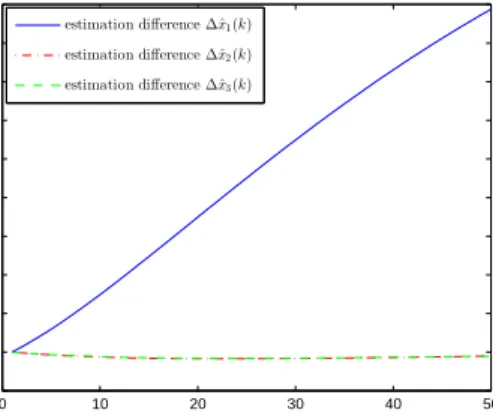
0 10 20 30 40 50 −0.5 0 0.5 1 1.5 2 2.5 3 3.5 4 4.5 estimation difference∆ˆx1(k) estimation difference∆ˆx2(k) estimation difference∆ˆx3(k) 0 10 20 30 40 50 0 0.05 0.1 0.15 0.2 0.25 residule difference ˆz(k)
(a) The estimation difference. (b) The residual difference.
Fig. 2. The estimation and residual differences under FDIAs
On one hand, Rkn hϕTi1,· · · , ϕTis
iT o
= s implies that Rk
(I −Ba)CPo ≥ s. On the other hand, we have
Rk(I−Ba)CPo ≤Rk{CPo}=s. As a result, Rk
(I−Ba)CPo =sand it follows from Theorem 2 that the
system (1) with state estimator (2) is secure, which completes the proof.
Remark 2: It is clear that Rk{CPo} = s ≤ ¯l and it can be found from (11) that ¯l is the number of unstable
eigenvalues of matrixA(counted up to multiplicity). As such, Corollary 1 implies that the number of communication channels that should be protected is not more than the number of unstable eigenvalues of matrix A (counted up to multiplicity).
IV. SIMULATION RESULTS
In this section, we consider the state estimation system of a flight vehicle. The system consists of a moving vehicle installed with three sensors and a remote estimator. Our purpose is to 1) analyse the security of the system, and 2) protect the system from cyber-attacks if it is insecure. The linearised discrete-time model of a simplified longitudinal flight control system is described by (1) with the following system parameters:
A= 0.9944 −0.1203 −0.4302 0.0017 0.9902 −0.0747 0 0.8187 0 , B= 0.4252 −0.0082 0.1813, , C =I3,
and both the system and measurement noises are assumed to be uncorrelated zero-mean white noises with covariance
W = diag{0.12,0.12,0.012} and R = 0.1I3, respectively. A stationary Kalman filter is employed in the remote estimator and a χ2 fault detector is employed as well.
It can be computed that the eigenvalues of system matrix are1,0.9177, and0.0669. According to Theorem 1, the estimation system of the flight vehicle is insecure. To confirm this conclusion via simulation, a specific deceptive FDIA sequence is generated according to Algorithm 1 where the parameters are chosen as σ= 0.1, M = 2.
Fig. 2 depicts the state estimation difference ∆ˆx(k) and the estimation residual difference ∆ˆz(k) under the designed attack sequences {a(k)}. From fig. 2, it can be seen that the sequence{∆ˆx(k)}diverges to ∞ while the sequence {k∆ˆz(k)k} is always less the prescribed scalar M. Here, the estimated trajectory of the vehicle under the designed FDIA attacks deviates significantly from its nominal one but this cannot be detected by the χ2 fault detector.
Next, let us consider how to protect the system from cyber-attacks. It can be computed that the eigenvector corresponding to the unstable system eigenvalue 1 is Po =
h
50.9530 1.2214 1.0000 iT
according to Corollary 1, it is known that the state estimate system of the flight vehicle is secure if the communication channel between sensor 1 and the estimator is protected.
V. CONCLUSION
In this paper, we have considered the security issues in state estimation of networked control systems, where the adversary can inject false data into the communication channels between sensors and a remote estimator. For the case that the adversary can compromise all communication channels, a necessary and sufficient condition has been derived under which the estimation error caused by the attacks is unbounded all the time. For the case that the adversary can only compromise a part of the communication channels, a sufficient condition ensuring the security is derived as well. Moreover, a criterion on protecting a sufficient number of channels such that the estimation error is kept bounded under FDIAs has been proposed. A simulation example has been proposed to demonstrate the usefulness of the developed results and algorithms. The concept of estimation residual difference has been used to measure the stealthiness of the cyber-attacks in our paper. Note that KL divergence has recently been used as an alternative measure for residual changes under cyber-attacks in [2]. One of the future topics for our research would be the analysis of cybersecurity using the new measure of KL divergence.
REFERENCES
[1] B. D. Anderson and J. B. Moore,Optimal Filtering. Courier Dover Publications, 2005.
[2] C.-Z. Bai, F. Pasqualetti, and V. Gupta, “Security in stochastic control systems: Fundamental limitations and performance bounds,” in
2015 American Control Conference (ACC). IEEE, 2015, pp. 195–200.
[3] D. S. Bernstein,Matrix Mathematics: Theory, Facts, and Formulas. Princeton University Press, 2009. [4] T. Chen, “Stuxnet, the real start of cyber warfare?[editor’s note],”IEEE Network, vol. 24, no. 6, pp. 2–3, 2010.
[5] M. S. Chong, M. Wakaiki, and J. P. Hespanha, “Observability of linear systems under adversarial attacks,” in2015 American Control
Conference (ACC). IEEE, 2015, pp. 2439–2444.
[6] H. Fawzi, P. Tabuada, and S. Diggavi, “Secure estimation and control for cyber-physical systems under adversarial attacks,” IEEE
Transactions on Automatic Control, vol. 59, no. 6, pp. 1454–146, 2014.
[7] J. M. Hendrickx, K. H. Johansson, R. M. Jungers, H. Sandberg, and K. C. Sou, “Efficient computations of a security index for false data attacks in power networks,”IEEE Transactions on Automatic Control, vol. 59, no. 12, pp. 3194–3208, 2014.
[8] J. P. Hespanha,Linear Systems Theory. Princeton university press, 2009.
[9] O. Kosut, “Malicious data attacks against dynamic state estimation in the presence of random noise,” inProc. Global Conference on
Signal and Information Processing. IEEE, 2013, pp. 261–264.
[10] O. Kosut, L. Jia, R. J. Thomas, and L. Tong, “Malicious data attacks on the smart grid,” IEEE Transactions on Smart Grid, vol. 2, no. 4, pp. 645–658, 2011.
[11] C. Kwon, W. Liu, and I. Hwang, “Security analysis for cyber-physical systems against stealthy deception attacks,” in Proc. American
Control Conference (ACC). IEEE, 2013, pp. 3344–3349.
[12] Y. Liu, P. Ning, and M. K. Reiter, “False data injection attacks against state estimation in electric power grids,” inProc. the 16th ACM
conference on Computer and Communications Security. ACM, 2009, pp. 21–32.
[13] S. Mishra, Y. Shoukry, N. Karamchandani, S. Diggavi, and P. Tabuada, “Secure state estimation against sensor attacks in the presence of noise,”arXiv preprint arXiv:1510.02462, 2015.
[14] Y. Mo and B. Sinopoli, “False data injection attacks in cyber physical systems,” inFirst Workshop on Secure Control Systems, 2010. [15] Y. Mo, R. Chabukswar, and B. Sinopoli, “Detecting integrity attacks on scada systems,” IEEE Transactions on Control Systems
Technology, vol. 22, no. 4, pp. 1396–1407, 2014.
[16] Y. Mo, E. Garone, A. Casavola, and B. Sinopoli, “False data injection attacks against state estimation in wireless sensor networks,” in
Proc. IEEE Conference on Decision and Control (CDC). IEEE, 2010, pp. 5967–5972.
[17] Y. Mo and B. Sinopoli, “On the performance degradation of cyber-physical systems under stealthy integrity attacks,”IEEE Transactions on Automatic Control, in press.
[18] Y. Mo, S. Weerakkody, and B. Sinopoli, “Physical authentication of control systems: designing watermarked control inputs to detect counterfeit sensor outputs,”IEEE Control Systems, vol. 35, no. 1, pp. 93–109, 2015.
[19] Z.-H. Pang and G.-P. Liu, “Design and implementation of secure networked predictive control systems under deception attacks,”IEEE
[20] F. Pasqualetti, F. Dorfler, and F. Bullo, “Attack detection and identification in cyber-physical systems,”IEEE Transactions on Automatic
Control, vol. 58, no. 11, pp. 2715–2729, 2013.
[21] Y. Shoukry and P. Tabuada, “Event-triggered state observers for sparse sensor noise/attacks,”IEEE Transactions on Automatic Control, vol. 61, no. 8, pp. 2079–2091, 2016.
[22] A. Teixeira, S. Amin, H. Sandberg, K. H. Johansson, and S. S. Sastry, “Cyber security analysis of state estimators in electric power systems,” inProc. IEEE Conference on Decision and Control (CDC). IEEE, 2010, pp. 5991–5998.
[23] A. Teixeira, I. Shames, H. Sandberg, and K. H. Johansson, “A secure control framework for resource-limited adversaries,”Automatica, vol. 51, pp. 135–148, 2015.
[24] S. Weerakkody, X. Liu, S. H. Son, and B. Sinopoli, “A graph theoretic characterization of perfect attackability for secure design of distributed control systems,”IEEE Transactions on Control of Network Systems, in press.
[25] M. Zhu and S. Mart´ınez, “On the performance analysis of resilient networked control systems under replay attacks,”IEEE Transactions