D
OCTORALT
HESISHandshape Recognition using Principal
Component Analysis and Convolutional
Neural Networks applied to Sign Language
Author:
Marlon OLIVEIRABSc. MSc.
Supervisor: Dr. Alistair SUTHERLAND
A thesis submitted in fulfilment of the requirements for the degree of Doctor of Philosophy
in the
School of Computing
I hereby certify that this material, which I now submit for assessment on the programme of study leading to the award of Doctor of Philosophy is entirely my own work, that I have exercised reasonable care to ensure that the work is original, and does not to the best of my knowledge breach any law of copyright, and has not been taken from the work of others save and to the extent that such work has been cited and acknowledged within the text of my work.
Signed:
ID No.: 13211361
trees and value them. Knowing the cold to enjoy the heat. And the opposite. Feel the distance and absence of shelter to be well under his own roof. A man must travel to places that he does not know to break this arrogance that makes us see the world as we imagine it, and not simply as it is or can be. That makes us teachers and doctors of what we have not seen, when we should be students, and simply go see ”
Throughout and before this process called PhD God put some people in my way, thank God I concluded my studies and have a chance to say thank you out loud:
My parents Leodovina and Donirio (in memoriam) for all the support in my educational process. None of this would be possible without their guidance.
My supervisor, Dr. Alistair Sutherland who gave me this opportunity providing me with the support to guide my research, for agreeing with my crazy ideas for papers and research visits to different parts of the planet.
My former supervisors Christine Scarpato (undergraduate) and Pedro Serranho (master) for helping me in previous projects and for showing me the research path.
All my friends, especially Cristiani Eccher, Dr. Plamen Petkov, and Dongyun Nie (Robin) who helped me recording the dataset; Adline Peres (who paid my Spotify during the PhD), Ademar Crotti Junior (always up to help), Samuel Brognoli (always up to a new trip), Cristiani Eccher (at this time for the coffees and chats at The Helix), Luana Muller (walking the master and PhD ways together), for sure every single friend along the way has a special space in my heart.
My colleagues and former colleagues, Dr. Houssem Chatbri, Dr. Dexmont Pena, Dr. Alireza Deghani, Dr. Mohamed Farouk, Dr. Dahai Yu and Ms. Fiona Dermody, your example and suggestions were very important for improving my work. As well as all guys in DCU, for sharing moments together: Dr. Jim, Manoj, Conor, Fouad, Michael, Viviana, Suzanne, Aleksas, Dr. Zohreh, Dr. Marija, Liting Zhou (Tingting), Qishan Yang, Rashmi, Dr. Giovanni, Andr´e, Barbara, Jonathan, Fl´avio and Thayse. Staff and lectures who always supported me with paper works, tutoring and findings; Patricia Lacey, Dr. Rory O’Connor, Dr. Liam Tuohey and Dr. Andrew Way.
Last but certainly not least, THANK my wife Paula, for all the support throughout these years and years of studies and difficulties, for always having a nice word to keep me up, a warm hug to relieve the stress and amazing food always waiting for me at home.
This research was funded by CAPES/Science without Borders - Brazilian Program - Pro-cess: 9064-13-3
Declaration of Authorship i
Acknowledgements iii
Contents iv
List of Figures viii
List of Tables xii
List of Publications xiii
Abstract xiv
1 Introduction 1
1.1 Research Review . . . 1
1.2 Motivation. . . 3
1.3 Research Questions . . . 5
1.4 Significance and Contributions . . . 6
1.5 Thesis Outline. . . 7
2 Literature Review 8 2.1 Introduction . . . 8
2.2 Non-Vision-based Approaches . . . 10
2.2.1 Glove-based Handshape Recognition . . . 10
2.3 Vision-based Gesture Recognition . . . 13
2.3.1 Example-based Approaches . . . 13 2.3.2 Model-based Approaches. . . 15 2.3.3 2D Methods. . . 16 2.3.4 Feature Extraction . . . 17 2.3.5 Mobile-based Methods . . . 19 2.3.6 3D Sensors . . . 20 2.3.6.1 Infrared Cameras . . . 20 2.3.6.2 Nimble VR. . . 20 2.3.6.3 Leap Motion . . . 21 2.3.6.4 Time-of-flight Cameras . . . 22
2.3.6.5 SoftKinetic . . . 23
2.3.6.6 Stereoscopic Cameras . . . 24
2.3.6.7 Kinect-based Methods . . . 25
2.4 Considerations about Vision and Non-vision Approaches . . . 27
2.5 Pattern Recognition Techniques . . . 29
2.5.1 Principal Component Analysis . . . 29
2.5.2 Linear Discriminant Analysis . . . 30
2.5.3 Multidimensional Scaling . . . 31 2.5.4 k-Nearest Neighbour . . . 31 2.5.5 Perpendicular Distance . . . 31 2.5.6 Manifolds . . . 32 2.5.7 Image Blurring . . . 34 2.5.8 Data Pyramids . . . 36 2.5.9 Multi-Dimensional Grids . . . 37 2.5.10 Coarse-to-fine Search. . . 37
2.5.11 Support Vector Machines. . . 38
2.5.12 Neural Network. . . 39
2.5.13 Multilayer Perceptron . . . 41
2.5.14 Deep Learning . . . 42
2.5.15 Convolutional Neural Network . . . 42
2.5.16 Recurrent Neural Network . . . 44
2.5.17 Long Short Term Memory . . . 44
2.5.18 PCA Network . . . 45
2.5.19 Non-linear Manifold Learning Techniques. . . 46
2.5.19.1 Non-linear Principal Component Analysis . . . 47
2.5.19.2 Kernel Principal Component Analysis . . . 48
2.5.19.3 Laplacian Eigenmaps . . . 49
2.5.19.4 Locally Linear Embedding . . . 50
2.5.19.5 Isometric Feature Mapping . . . 52
2.5.19.6 Comparison between Non-linear Methods . . . 53
2.5.20 Interpolation . . . 53
2.6 Discussion of the Literature Review . . . 55
3 Irish Sign Language Dataset 57 3.1 Introduction . . . 57
3.2 The Irish Sign Language Handshape (ISL-HS) Dataset . . . 59
3.2.1 Redundant Frame Filtering . . . 61
3.2.1.1 Feature Extraction . . . 62
3.2.1.2 Iterative Image Selection using the Diversity Score. . . 63
3.2.2 Dense Dataset. . . 64
3.2.2.1 Variations of the Dataset . . . 65
3.2.2.2 Blurred Images Dataset . . . 66
3.2.2.3 Different Persons Dataset . . . 66
3.2.4 Training Dataset . . . 69
3.2.5 Testing Dataset . . . 70
4 PCA for Sign Language Recognition 72 4.1 Introduction . . . 72
4.2 Principal Component Analysis . . . 73
4.2.1 First Stage PCA - Global Eigenspace . . . 78
4.2.2 Second Stage PCA - Subsets of the First-stage . . . 79
4.2.3 Interpolating Angles in the Second Stage PCA . . . 80
4.2.4 Back Projection from the Second Stage PCA to the First . . . 81
4.2.5 Second Stage PCA - Rotation Subspaces . . . 82
4.2.6 Interpolating Rotation Sub-manifolds . . . 83
4.2.7 Interpolating Rotation Sub-eigenspaces . . . 84
4.2.8 Results with Interpolated Rotation Sub-eigenspaces . . . 86
4.3 Finding the interval . . . 86
4.3.1 Perpendicular Distance . . . 87
4.3.1.1 Influence of the Number of Eigenvectors . . . 88
4.3.1.2 Time for Perpendicular Distance . . . 89
4.3.1.3 Influence of the Interval Size . . . 89
4.3.1.4 Influence of the Blurring Level . . . 90
4.3.2 k-NN . . . 91
4.3.2.1 Influence of the Number of Eigenvectors and the Blurring Level . . . 91
4.3.2.2 Influence of the Interval Size . . . 92
4.3.2.3 Classification Time for k-NN . . . 92
4.3.3 Conclusion of Results in Finding the Interval . . . 93
4.4 Back Projection . . . 94
4.5 Handshape Classification with k-Nearest Neighbour . . . 95
4.5.1 Knowing the Correct Interval . . . 95
4.5.2 Not Knowing the Correct Interval . . . 95
4.5.3 Classification Time for Known and Unknown Interval . . . 96
4.5.4 Influence of the Interval Size . . . 96
4.5.5 Influence of the Blurring Level . . . 97
4.6 Translation Interpolation . . . 97
4.6.1 Sub-dataset for Missing Translations. . . 97
4.6.2 Interpolating Missing Translations . . . 98
4.6.3 Results for Classifying Shapes with Missing Translations . . . 99
4.6.4 Shape Classification in the First-stage . . . 101
4.6.5 Subspaces for Shapes . . . 102
4.7 Discussion and Conclusion . . . 103
5 Deep and Shallow Methods 106 5.1 Introduction . . . 106
5.2.1 End-to-end Approaches . . . 108
5.2.1.1 Support Vector Machines . . . 108
5.2.1.2 Convolutional Neural Network . . . 109
5.2.1.3 Linear Discriminant Analysis . . . 114
5.2.1.4 Other Classifiers . . . 115
5.2.2 Feature-based Approaches . . . 115
5.2.2.1 PCA-based approach . . . 115
5.2.2.2 Other approaches . . . 116
5.2.2.3 Outputs of the PCA Approach. . . 116
5.3 Experimental Results . . . 120
5.3.1 End-to-end Classification. . . 122
5.3.1.1 SVM Classifier . . . 127
5.3.2 Feature-based Classification . . . 128
5.3.2.1 PCA+SVM Approach . . . 133
5.3.3 Analogy between PCA and CNN . . . 134
5.3.4 Results for Missing Persons in the Training Stage . . . 136
5.3.5 Kernel PCA . . . 138 5.4 Conclusions . . . 141 6 Conclusions 144 6.1 Summary . . . 144 6.2 Conclusions . . . 145 6.3 Research Contributions . . . 146
2.1 Examples of static and dynamic hand gestures . . . 9
2.2 A data glove scheme with sensors . . . 11
2.3 A Cyberglove with sensors by Wang et al. (2006) . . . 11
2.4 A sensor glove by Bui and Nguyen (2007) . . . 12
2.5 Histograms of oriented gradients in an example-based approach . . . 14
2.6 A typical model-based tracking system design . . . 16
2.7 A Leap Motion connected to a laptop by Khademi et al. (2014) . . . 21
2.8 A SoftKinetic camera DS525 . . . 23
2.9 A SoftKinetic embedded in a BMW car . . . 23
2.10 Perpendicular distance from a point pto an eigenspacevwith origino . . . . 32
2.11 Example of manifolds, (a) point clouds in spaces with categorical attributes, (b) manifold for handshapes of the ISL projected into a PCA space . . . 33
2.12 One dimensional curve for Gaussian filter blurring . . . 34
2.13 A circle image and the same image blurred by a Gaussian filter . . . 35
2.14 A surface plot of a circle image and the same plot for the blurred image . . . 35
2.15 PCA manifolds for blurred and non-blurred images, note that for blurred im-ages manifolds are flatter . . . 36
2.16 Multistage Hierarchy Using MDGs proposed by Farouk (2015) . . . 37
2.17 Example of neural network architecture with one hidden layer . . . 39
2.18 Illustration of a sigmoid activation function . . . 40
2.19 ANN multistage hierarchy proposed by Farouk (2015) . . . 41
2.20 CNN architecture with different convolutional layers (c), max pooling layers (MP), fully-connected and output layers; proposed by Nagi et al. (2011) . . . 43
2.21 Architecture of PCANet with 2 stages of PCA instead of convolution layers, proposed by Chan et al. (2015) . . . 47
2.22 Auto-encoding Neural Network example . . . 48
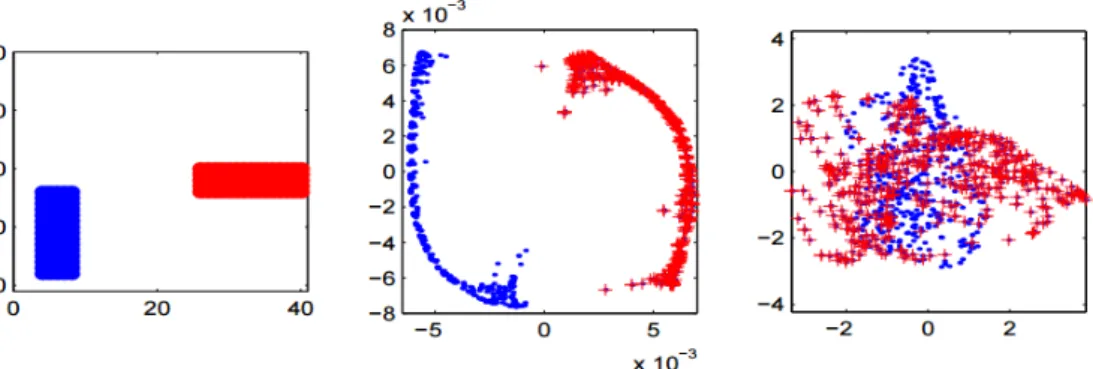
2.23 Comparison between PCA and Laplacian Eigenmaps for vertical and horizon-tal bar images . . . 50
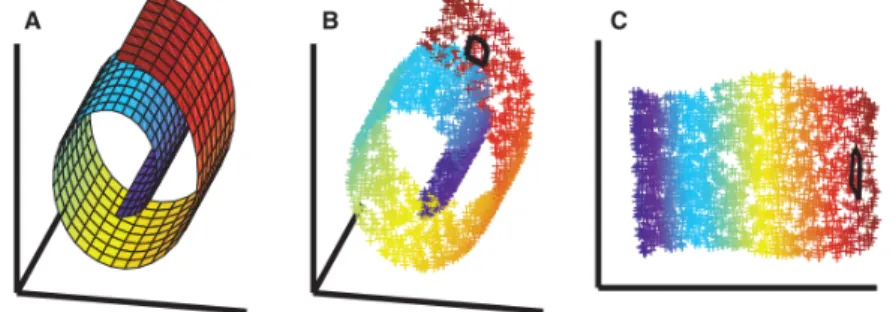
2.24 Example of swiss roll manifold with dimensionality redu by LLE . . . 51
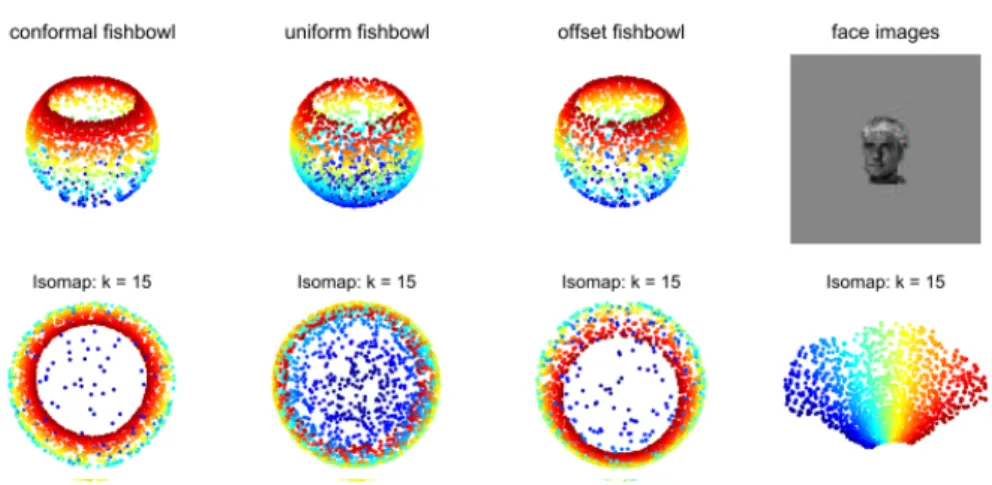
2.25 Example of dimensionality reduction for different manifolds by Isomap . . . 53
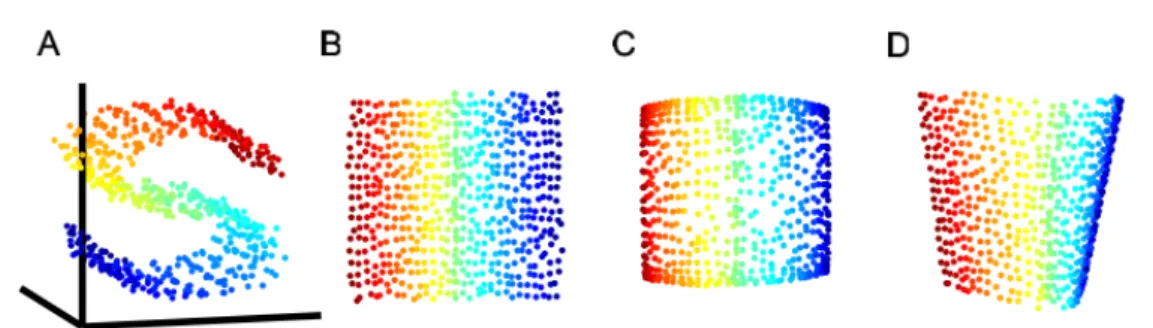
2.26 Comparison between Isomap, Laplacian Eigenmaps and LLE dimensionality reduction . . . 54
2.27 Illustration of interpolation in 3 dimensions . . . 54
3.2 Cropped images from the new Irish Sign Language handshapes alphabet . . . 61
3.3 Ocurrence of the different handshapes in the new ISL dataset . . . 61
3.4 (a) a sample image from the ISL-HS dataset, and (b) the feature extraction grid 63
3.5 The curve of image diversity score, note the steep descent after 50,000 frrames 65
3.6 Rate of occurrence by shape, after filtering (50,000 frames) . . . 66
3.7 Images of shape A, non-blurred and blurred with Gaussian filters of different kernel sizes . . . 67
3.8 Cropped images from the Irish Sign Language static handshapes . . . 69
3.9 Images of shape A, non-blurred and blurred with different kernel sizes, see Table 3.2. . . 70
3.10 Illustration of the training and testing datasets according to d, note each d produces a different number of subsets; two subsets are used for testing for eachd . . . 71
4.1 Illustration of an eigenspace showing the direction of 2 eigenvectors . . . 74
4.2 Eigenvalues in descending order, each eigenvalue represents one eigenvector, the higher the eigenvalue the higher its significance . . . 75
4.3 Example of data projected into a PCA space in 3 dimensions . . . 77
4.4 Projection of training dataset images into the first-stageS1and second
stage-PCAS2, note that the same data is represented with fewer points when
pro-jected intoS2 . . . 80
4.5 Missing angles interpolated by splines, red, green and blue symbols represent the landmark points and grey points the interpolated data, each axis represents one dimensionD2 . . . 81 4.6 Projection of images into interpolated space (blue) and into real space (red),
note they are very similar . . . 85
4.7 Interpolation of 3 elements of the first eigenvector, black dots are the land-marks and green dots the interpolated points . . . 85
4.8 Accuracy of shape classification within interpolated spaces and interpolated manifolds, according to the number of eigenvectors . . . 87
4.9 Accuracy according to different number of eigenvectors for the first and the second-stage PCA . . . 88
4.10 Average time to classify one image according to the number of eigenvectors in the first-stage PCAD1 . . . 89 4.11 Average time to classify one image according to the number of eigenvectors in
the second-stage PCA, givenD1=25 . . . 90 4.12 Average accuracy and standard deviation according to the interval sized, the
longer the interval, the higher the accuracy . . . 90
4.13 Average accuracy according to blurring level, level two showed the highest accuracy . . . 91
4.14 Accuracy according to the number of eigenvectors and blurring level, using k-NN, for first-stage PCA . . . 92
4.15 Average accuracy and standard deviation according to the interval sized, using k-NN, the variation in accuracy is low, varying more the standard deviation . 93
4.16 Average time to find the correct interval for one image by k-NN according to
the number of eigenvectors . . . 93
4.17 Quality of manifolds back projected according to the number of eigenvectors 94 4.18 Projection of training (red dots) and testing (blue dots) sub-datasets into PCA space for translation interpolation . . . 98
4.19 Manifold of the training sub-dataset (red) and interpolated translations (cyan) 99 4.20 Average accuracy for subspace classification using Perpendicular Distance and K-NN with Euclidean distance according to the number of eigenvectors . . . 100
4.21 Shape classification with different values forD2, different values ofnand with-out interpolation. . . 100
4.22 Flowchart for the overall process for shape classification with missing transla-tions, with perpendicular distance followed by k-NN . . . 101
4.23 Projection of images into first-stage PCA (manifold) with different colours for different shapes . . . 102
4.24 Second-stage PCA subspace manifolds with different colours for different sub-space shapes (each colour is the projection into one different sub-space) . . . 103
4.25 Comparison of accuracy with only real data (without interpolation) and inter-polated data, according to the number of eigenvectors . . . 105
5.1 An example of a simple SVM with a linear function . . . 109
5.2 Example of an input layer being convolved by a kernel and creating an convo-lutional layer . . . 111
5.3 Example of an input layer, convolutional layer and feature maps . . . 111
5.4 ReLu activation function . . . 112
5.5 Example of max pooling layer (4x4) to (2x2) . . . 113
5.6 Architecture of the convolutional neural network used in this thesis, with 1 input layer, 4 convolutional layers, 3 max pooling layers, 1 fully connected layer and 1 output layer; adapted from Krizhevsky et al. (2012) architecture . 114 5.7 Projection of training dataset (DBi) images into the PCA space in 2D. . . 116
5.8 Different manifold shapess of the PCA approach according to the person, graph (e) shows an outlier probably because one shape was performed in a different position . . . 117
5.9 Visualization of the first 3 eigenvectors for the full training dataset, including all persons and all rotations . . . 118
5.10 Visualization of the first 3 eigenvectors for the non-rotated sub-dataset, includ-ing only the 9 first frames of each person/shape/shot. . . 118
5.11 Plot of the images projected into PCA space (3 first eigenvectors) for the 3,304 images of the 9 first frames of each person/shape/shot . . . 119
5.12 Visualization of the images corresponding to the variation along the first eigen-vector (see Figure 5.11) . . . 119
5.13 Visualization of the images corresponding to the variation along the second eigenvector (see Figure 5.11) . . . 120
5.14 Visualization of the images corresponding to the variation along the third eigenvector (see Figure 5.11) . . . 120
5.16 Manifolds with different colours for different shapes (6 shapes only) for all people . . . 121
5.17 Training and testing curves of the CNN model, with 100 iterations, for theDBi
dataset, recognition accuracy reaches 90% after only 3 iterations . . . 123
5.18 Sample of image used to show the result of the layers of the CNN approach, see Figures 5.19 and 5.20 . . . 123
5.19 Feature maps of the CNN’s first convolutional layer from the image shown in Figure 5.18 . . . 124
5.20 Feature maps of the first max pooling layer of the CNN’s model, from the Figure 5.18 . . . 125
5.21 Accuracy according to dataset (DBiandDBr) and classifiers for the end-to-end
approaches, note that the best accuracy is given by CNN, followed by SVM and k-NN . . . 126
5.22 Average time to classify one image according to the classifier for end-to-end approaches, note that the slowest classifier was SVM followed by CNN . . . 127
5.23 Projection of training data into LDA space, each colour represents one shape, in this case blurring does not help to separate the classes . . . 128
5.24 Recognition accuracy according to the number of eigenvectors forDBr, note
that 40 or more eigenvectors give a improved accuracy . . . 129
5.25 Accuracy according to the blurring level and number of eigenvectors forDBi
andDBrusing PCA+k-NN . . . 131
5.26 Accuracy according to dataset (DBiandDBr) and classifiers for feature-based
approaches, 100 eigenvectors for PCA and non-blurred images; the highest accuracy was with MLP and SVM . . . 133
5.27 Average time to classify one image according to the classifier for feature-based approach; the slowest classifier was PCA+SVM followed by k-NN . . . 133
5.28 Accuracy for PCA+SVM according to the value of Gamma for Gaussian kernel 134
5.29 Comparison of accuracy, PCA with number of eigenvectors (blurred and non-blurred images) and CNN iteration number, both forDBi; note the accuracy for
CNN reaches a very high value with just 3 iterations, whereas PCA depends on certain number of eigenvector for approximate CNN curve . . . 134
5.30 Comparison of time to recognise 100 images (one at each time) using PCA+k-NN and CPCA+k-NN, note time for PCA is considerable shorter . . . 136
5.31 Classification accuracy for persons out of the training (DB1, DB2 andDB3) using CNN approaches, even with low results CNN still performs better than PCA+k-NN (Figure 5.32) . . . 137
5.32 Accuracy for persons out of the training dataset (DB1, DB2 andDB3) using PCA+k-NN approach, note accuracy is lower than CNN (Figure 5.31) . . . . 137
5.33 PCA manifolds for different persons out of the training set, variations ofDB1 138 5.34 Illustration of linear PCA and Kernel PCA . . . 139
5.35 Comparison of manifolds for different dimensional reduction approaches, PCA and KPCA with different kernel functions . . . 140
5.36 Accuracy according to the value of gamma for Gaussian kernel in KPCA. . . 141
5.37 Accuracy according to the kernel function in KPCA and traditional PCA + k-NN, PCA performed the highest accuracy . . . 141
2.1 Comparison among devices available for depth images . . . 27
2.2 Comparison among non-vision gesture recognition types, SL = Sign Language 28
2.3 Comparison among vision gesture recognition types, SL = Sign Language . . 28
3.1 Frame distribution (occurrence) per person. . . 65
3.2 Gaussian filter blurring levels with different kernel sizes. . . 68
4.1 Average accuracy and standard deviation according toD2 using k-NN when the correct interval is known and unknown . . . 96
4.2 Average accuracy and standard deviation according to the interval sized . . . 96
4.3 Average accuracy and standard deviation according to the blurring level . . . 97
4.4 Average accuracy according to the interval size, and for each intermediate ro-tation angle . . . 102
4.5 Accuracy according toD2using k-NN for shape subspaces classification . . . 104 5.1 Recognition techniques for end-to-end and feature-based approaches used in
this chapter . . . 107
5.2 SVM classifier for end-to-end approach with different kernel functions for DBr, the best accuracy is given by polynomial kernel and blurred images . . . 127
5.3 Classifier performances using PCA with 100 eigenvectors and k-NN according tokin theDBi,k=1 has the highest accuracy . . . 130
5.4 Classifier performances in theDBr, 100 eigenvectors for PCA and kernel
blur-ring size (15,15), polynomial kernel for SVM and 100 iterations for CNN; the best accuracy is given by CNN and SVM . . . 132
5.5 Classifier performances in the DBi, 100 eigenvectors for PCA and blurring
size (15,15), polynomial kernel for SVM and 100 iterations for CNN; the best accuracy is given by SVM followed by CNN. . . 132
5.6 Classifier performances in theDB1,DB2 andDB3 according to person(s) out (PCA with 100 eigenvectors, non-blurred images and PCA+k-NN . . . 138
5.7 Classifier performances forDBiandDBrwith KPCA, blurred and non-blurred
This section introduces the publications where this work has been published:
Marlon Oliveira, Houssem Chatbri, Suzanne Little, Noel E. O’Connor, and Alistair Sutherland. A comparison between end-to-end approaches and feature extraction based approaches for sign language recognition. In Image and Vision Computing New Zealand (IVCNZ), 2017 International Conference on (in press).
Marlon Oliveira, Houssem Chatbri, Ylva Ferstl, Suzanne Little, Noel E. O’Connor, and Al-istair Sutherland. Irish sign language recognition using principal component analysis and convolutional neural networks. In2017 International Conference on Digital Image Com-puting: Techniques and Applications (DICTA) (in press), 2017a.
Marlon Oliveira, Houssem Chatbri, Ylva Ferstl, Mohamed Farouk, Suzanne Little, Noel E. O’Connor, and Alistair Sutherland. A dataset for irish sign language recognition. InIrish Machine Vision & Image Processing Conference, 2017b.
Marlon Oliveira, Alistair Sutherland, and Mohamed Farouk. Manifold interpolation for an efficient hand shape recognition in the irish sign language. InInternational Symposium on Visual Computing, pages 320–329. Springer, 2016a.
Marlon Oliveira, Alistair Sutherland, and Mohamed Farouk. Two-stage pca with interpolated data for hand shape recognition in sign language. InApplied Imagery Pattern Recognition Workshop. IEEE, 2016b.
Marlon Oliveira and Alistair Sutherland. Interpolating eigenvectors from second-stage pca to find the pose angle in handshape recognition. InIrish Machine Vision & Image Processing Conference, pages 114–117, 2015.
Handshape Recognition using Principal Component Analysis and
Convolutional Neural Networks applied to Sign Language
by Marlon OLIVEIRA
Under the supervision of Dr. Alistair SUTHERLAND
Submitted in partial fulfilment of the requirement for the degree of Doctor of Philosophy at theSchool of Computing,Dublin City University
Handshape recognition is an important problem in computer vision with significant so-cietal impact. However, it is not an easy task, since hands are naturally deformable objects. Handshape recognition contains open problems, such as low accuracy or low speed, and de-spite a large number of proposed approaches, no solution has been found to solve these open problems. In this thesis, a new image dataset for Irish Sign Language (ISL) recognition is in-troduced. A deeper study using only 2D images is presented on Principal Component Analysis (PCA) in two stages. A comparison between approaches that do not need features (known as end-to-end) and feature-based approaches is carried out.
The dataset was collected by filming six human subjects performing ISL handshapes and movements. Frames from the videos were extracted. Afterwards the redundant images were filtered with an iterative image selection process that selects the images which keep the dataset diverse.
The accuracy of PCA can be improved using blurred images and interpolation. Interpola-tion is only feasible with a small number of points. For this reason two-stage PCA is proposed. In other words, PCA is applied to another PCA space. This makes the interpolation possible and improves the accuracy in recognising a shape at a translation and rotation unknown in the training stage.
Finally classification is done with two different approaches: (1) End-to-end approaches and (2) feature-based approaches. For (1) Convolutional Neural Networks (CNNs) and other classifiers are tested directly over raw pixels, whereas for (2) PCA is mostly used to extract fea-tures and again different algorithms are tested for classification. Finally, results are presented showing accuracy and speed for (1) and (2) and how blurring affects the accuracy.
Introduction
This chapter introduces the central concept of the research and provides an explanation of the motivation and approach for the research. In Section 1.1 this field of research is reviewed briefly. Then, the motivation behind this thesis is presented in Section 1.2. The research questions are raised in Section1.3. The significance and contributions presented in this work are summarised in Section1.4. Finally, Section1.5outlines the thesis contents.
1.1
Research Review
Human Computer Interaction depends strongly on the new developments in Computer Vision (CV), and handshape recognition is an active research area in this field.
Handshape or gesture recognition is a challenging task, because hands are deformable objects. This means that depending on many facts, such as rotation, scale, translation and illumination, every single detail can make a hand look like a different object.
According toMitra and Acharya(2007) some applications of handshape recognition are listed as follows:
• enabling very young children to interact with computers
• designing techniques for forensic identification
• recognizing sign language
• medically monitoring patients’ emotional states or stress levels
• lie detection
• navigating and/or manipulating in virtual environments
• communicating in video conferencing
• distance learning/tele-teaching assistance
• monitoring automobile drivers’ alertness/drowsiness levels, etc
This thesis focuses on handshape recognition applied to sign language. CV plays an im-portant role in this matter by helping people who use sign language with systems for everyday life problems, e.g. automatic transcription, human-machine interaction and machine transla-tion.
Irish Sign Language (ISL) is an indigenous language that is used by around 5,000 Deaf people in the Republic of Ireland and 1,500 in Northern Ireland. In addition, it is known by 50,000 non-Deaf peopleLeeson and Saeed(2012). ISL is not based on English or Irish, it is a language in its own right.
ISL contains more than 5,000 signs. Each sign consists of a handshape and a motion in 3D space. There are around 23 basic, most common handshapes in ISL and each of them is labelled with a different letter of the alphabet. These handshapes can be seen in a wide range of possible angles in 3D space. The remaining three letters of the alphabet, ’J’, ’X’ and ’Z’ are used to label gestures involving motion and actually use one of the 23 handshapes.
There are basically two different ways to recognise handshapes, glove-based approaches and vision-based approaches. Glove-based uses a physical glove (hardware) with sensors at-tached to the human arm/hand. This kind of method is very precise because they can provide
precise information about the hand configuration. However, it implies wearing a mostly un-comfortable device which does not allow a natural interaction. Vision-based approaches pro-vide a natural interaction since they use only cameras to obtain hand configuration information. Nonetheless, this kind of approach is more complex and might not be very precise.
Vision-based approaches are highly studied and there are several manners to obtain hand configuration from cameras/images. Sensors, multiple cameras and depth cameras are exam-ples of these manners. Nevertheless, this thesis focuses only on a 2D vision-based approach with a single camera.
1.2
Motivation
A proof of how tough handshape recognition is that it has been researched for years and still there is not an usable application for this matter. Many different theories have been proposed and studied. Each of these theories uses a different approach, e.g. gloves, sensors, lasers, cameras, depth cameras, 3D cameras, or just the most difficult one, a single regular camera.
The idea of using just a regular camera is important because these cameras are inexpen-sive. Everyone nowadays has easy access to a camera. Thus, if people have these cameras easily accessible, why not focus on research for this kind of device? In addition, there are a huge number of videos uploaded every day to the internet, e.g. YouTube, Vimeo. YouKu. These videos are 2D and contain no depth information.
The key question is how to make computers recognise hands from 2D images? There are several technologies and approaches to do it. Therefore, all of them use basic steps, i.e. train a classifier and then classify. The training and testing stages can be either done with features extracted from images (known as a feature-based approach) or straight from pixels (known as an end-to-end approach).
CV provides the technology to assist people who use sign language with tools such as automatic transcription, human-machine interaction, machine translation, etc. In order to de-sign such tools, large amounts of data are necessary for training and testing the system. In this thesis, a new image dataset for ISL recognition is introduced.
Working with a dataset of images of real hands is challenging because the exact pose angle is unknown. It makes the task of classifying the new object difficult because when working with more than one shape, each shape can be slightly rotated with respect to the others.
Principal Component Analysis (PCA) is an efficient technique for dimensionality reduc-tion and feature extracreduc-tion Han and Liu(2014). It uses the covariance matrix of the data to create a space called an eigenspace. Each dimension in this space is represented by one eigen-vector. The number of eigenvectors used to represent the full data is always considerably lower than the dimensionality of raw data.
Convolutional neural networks (CNNs) specialise in recognising patterns. They are widely known for robustness to distortion and having minimal or no preprocessing. They have been used for detection and recognition of different objects, including handsNagi et al.(2011) and
LeCun et al.(2015).
Some approaches to gesture recognition extract features from images and use these fea-tures to train the classifier. Several techniques are used to extract feafea-tures e.g. edge detectors, contours, corners, Haar-like features, interest points, Fourier transform, PCA and more. These approaches are called feature-based approaches. In contrast to feature-based, the approaches that do not use features are called end-to-end approaches.
The final step is always the classification. In order to classify an image either from raw pixels or from features a classification algorithm has to be applied. Machine Learning is widely used in this process. Techniques such as CNN, linear discriminant analysis (LDA), sup-port vector machines (SVM), a multilayer perceptron (MLP), decision trees, and a k-Nearest Neighbour (k-NN) are examples of classifiers.
Among the large number of techniques to extract features or/and classify objects, this thesis focuses mainly on Principal Component Analysis and Convolutional Neural Networks. In addition, interpolation over PCA manifolds and eigenspaces are proposed.
One big challenge in this work is a considerable quantity of parameters. For PCA: the level of blurring, the size of each image, the number of eigenvectors in each PCA level, the number of dimensions used in the interpolation, the quantity of points to be interpolated and used in the reconstruction. For CNN: the size of the filters, the number of feature maps, the number of hidden layers, the activation function, etc. Every single parameter affects the accuracy of the recognition.
1.3
Research Questions
The research proposed in this thesis raises the following main questions:
• RQ1: Is it possible to use two-stage PCA and interpolation to generate artificial data which can augment a sparse dataset?
• RQ2: Does the use of interpolated data increase the recognition accuracy on a sparse dataset?
• RQ3: How do parameters such as blurring level, number of eigenvectors or sampling interval affect the accuracy?
• RQ4: How do feature-based and end-to-end algorithms compare in recognition accu-racy on a dense dataset?
– RQ4(a):Should features be extracted?
– RQ4(b):Which classifier is the most accurate for the ISL dataset?
1.4
Significance and Contributions
In this thesis three different contributions are presented to the field of handshape recognition applied to Irish Sigh Language (ISL). The first contribution is a new dataset for ISL with a redundancy filter. The second is the use of interpolation over PCA manifolds and PCA eigenspaces. The third contribution is a comparative study between feature-based approaches and end-to-end approaches.
• New Irish Sigh Language alphabet datasetThe new ISL dataset contains 468 videos, filmed from 6 different human subjects, resulting in more than 58,000 frames represent-ing the 26 alphabet letters. Frames in this dataset were filtered with a proposed redun-dancy filter resulting in 50,000 images for the 23 static gestures in ISL. This dataset builds on a previous dataset with only 20 handshapes and a rather smaller number of images.
• PCA with interpolationPCA is used to represent data in a space with a reduced number of dimensions. This representation of the data allows us to select subsets and apply PCA for the second time. Having the dimensionality of the data reduced twice it is possible to interpolate in order to create synthetic data from the original data. PCA data can be interpolated by fitting a cubic spline in N-dimensions. This raises the question: Can the interpolated data be used to improve the recognition of an unknown object in asparse
dataset?
• Comparison between CNN (and other algorithms) and PCA approaches A deep study is proposed with end-to-end approaches (mainly CNN) and feature extraction based (PCA and Kernel PCA), and other different classifiers. The most important ques-tions are: Should features be extracted? Which classifier is the best for the data avail-able? Which are the faster? Experiments done in this thesis try to answer these ques-tions.
1.5
Thesis Outline
Following on from the above, the thesis is organised as follows:
• Chapter2discusses the concepts in different areas related to handshape recognition as well as the state-of-the-art approaches in this field.
• Chapter3presents a new dataset for Irish Sign Language and a filter to remove frames with high similarity. Finally, it is shown how datasets are split into asparsedataset and adensedataset.
• Chapter4discusses two-stage Principal Component Analysis and interpolation by splines, including the influence of blurring, applied to thesparsedataset.
• Chapter5explores mainly Convolutional Neural Networks and Principal Component Analysis, applied to adensedataset, including recognition accuracy, speed and influence of blurring. In addition, other classifiers are tested and results for accuracy and speed are shown as well.
• Chapter6summarises the implications and contributions, and discusses the possibili-ties for future work
Literature Review
As stated earlier in Chapter1, handshape recognition is an important topic in computer vision, which has been discussed for a long time. The importance and popularity of this field of research, as well as the number of published papers are surveyed in this chapter.
2.1
Introduction
Humans can easily recognize handshapes using their eyes. Size, shape, colour, angle, distance, and other aspects of the human hand, generally, do not prevent a human matching a hand gesture. However, for computers it is completely different; every single detail turns a hand image into a different image. This is the main challenge in this field: how to make hand gestures be correctly classified by computers?
This chapter presents the state-of-the-art in handshape recognition. There are different forms of recognition in the field of pattern recognition. Basically they are divided into two sub-areas: vision and non-vision based approaches.
Non-vision-based approaches include all the techniques that use gloves and/or sensors to obtain information about the shape of the hand. In these approaches data gloves equipped with sensors and/or accelerometers are normally used to capture the rotation and movement of the
hand and fingers. These gloves use hardware that usually obtains information about the hand through electrical signals or electromagnetic interferenceNaoum et al.(2012). In Section2.2
in this chapter some non-vision-based methods are described.
Vision-based approaches are those that use cameras to obtain information about the hand. The Kinect camera, web-cams and time-of-flight cameras are examples of cameras used in this kind of approach.
A significant quantity of vision-based hand gesture recognition techniques have been in-troduced in the literature, where images of different kinds and from different numbers of cam-eras are used to achieve gesture recognition.
Hand gestures can be classified into two main categories: static and dynamic. Dynamic gesture are those that include movement of the hand, e.g. turning palm up and down. Static gestures are those that do not need movement to be recognised, e.g. an open hand. Figure2.1, fromWolf et al.(2013), shows examples of static gestures2.1(a), and dynamic gestures2.1(b).
(a) Static gestures (b) Dynamic gestures
FIGURE2.1: Examples of static and dynamic hand gestures
Beyond the methods of how images are obtained, most of the researches includes a clas-sification stage. k-Nearest Neighbour, Support Vector Machines and Deep Learning are some examples of classifiers used in hand gesture recognition. The following sections explain some of the theories behind gesture recognition and related works in the field.
2.2
Non-Vision-based Approaches
Non-Vision-based approaches are those that usually use data-gloves and/or sensors to map the human hand. In this section some examples of these hardwares and what sort of pattern recognition algorithms are used to recognise the gestures are presented.
2.2.1 Glove-based Handshape Recognition
Glove-based handshape recognition normally involves the user wearing some device and a certain quantity of cables to connect this device to a computer. This makes these methods a difficult and non-natural way to interact with the computerMitra and Acharya(2007). Data glove devices use electricity or electromagnetic interference to obtain information about the hand, which is sufficient to provide a description of a hand gestureNaoum et al.(2012). Re-searchers refer to data gloves in different ways, e.g. CyberGlove and Accele Glove.
Figure2.2shows the location of the sensors in a data glove proposed by Bedregal et al.
(2007). Basically a sequence of frames can represent any movement. Thus, a sequence of hand configurations represents a hand movement using a data glove. InBedregal et al.(2007) a random generated hand configuration was used to simulate the data transfer. Each instant of the handshape is represented by a tuple of interval angles from each sensor. The recognition was applied to Brazilian Sign Language (LIBRAS), using Fuzzy logic. As shown in Table
2.2the accuracy rate and the number of gestures/persons was not provided byBedregal et al.
(2007).
Another kind of glove to extract gesture features is called the CyberGlove. This method was applied to American Sign Language (ASL) inWang et al.(2006) as in Figure2.3. The Cy-berglove is a glove equipped with strain gauges for detecting finger bending, abductions1/adductions and shape. These gloves have been used to obtain the joint values which are then digitised to 8 bits. It has 18 sensors based on a linear, resistive bend sensing technologySahoo et al.(2014).
FIGURE2.2: A data glove scheme with sensors
FIGURE2.3: A Cyberglove with sensors byWang et al.(2006)
Bui and Nguyen(2007) developed a similar device called the Accele Glove. These gloves use a microelectronic mechanical system (MEMS) to extract hand configuration. They have been applied to Vietnamese Sign Language for 23 gestures with Fuzzy logic. As shown in Table2.2the accuracy was divided by handshape, with an overall 98% accuracy. The relative angles between fingers and the palm is the data obtained from the sensing device. The glove contains six accelerometers and a BASIC Stamp microcontroller as in Figure2.4 Sahoo et al.
FIGURE2.4: A sensor glove byBui and Nguyen(2007)
The Polhemus FASTRAK provides 6 degrees-of-freedom trackingSahoo et al.(2014) and it is used to collect a sequence of positional co-ordinates of both hands which are measured with the magneto metric sensor at 60 samples per second. It has been used to collect data inMaebatake et al.(2008) for American Sign Language recognition. Polhemus FASTRAK is highly reliable and has near non-latency, what makes it useful for virtual reality interfacing and simulators. It converts the obtained data into the most common computer graphics software formatSahoo et al.(2014).
Abdulla and Manaf(2016) proposed a system for a sign-to-speech/text for deaf people, applied to Arabic Sign Language. This system includes the design and implementation of a smart glove. One of the advantages of this glove is that it does not depend on light conditions, which means it works even in dark environments. These gloves are low cost, low power and have full mobility as well. Another advantage of these gloves is that they have flex sensors which have a wireless interface to a microcontroller.
Zhang et al.(2011) have created their own sensor and applied it to Chinese Sign Language recognition. This sensor uses an accelerometer (ACC) placed at the wrist and electromyogra-phy (EMG) placed at the forearm (close to the elbow), that provide two potential technologies for gesture sensing. ACC can measure both dynamic acceleration and static acceleration such as gravity. EMG measures the electrical potentials generated by muscle cells. Thus, the main goal was a framework for hand gesture recognition using decision trees and Hidden Markov Models (HMM) for fusion of the ACC and EMG sensors.
2.3
Vision-based Gesture Recognition
In this section vision-based approaches are presented. Vision-based approaches use cameras to obtain information about the hand. The Kinect, web-cams, time-of-flight cameras and stereo-cameras are examples of stereo-cameras used in these kind of approaches.
2.3.1 Example-based Approaches
Example-based methods depend on a large set of examples for which the parameter values are knownFarouk(2015). They deduce the label values for the input example (or image) from the known values in similar examples. This approach does not need to model the global structure of the input data, which is just assumed to be sufficient to make such inference. Therefore, example-based approaches are efficient for parameter estimation problems when the system is not complex and/or the dimensionality of the input is not high. However, for complex and high-dimensional problems the number of required examples and the computational complexity become exhaustively highShakhnarovich et al.(2003).
As with any other classification technique, example-based applications involve two phases: training and testing. In the training stage, the user feeds into the system one or more examples of a specific handshape. For instance in the work ofNaoum et al.(2012) the system forms and stores the corresponding orientation histogram. In the testing stage, the system compares the orientation histogram of the current image with each of the training images and picks the category of the best matches. This method can be robust to small information changes such as difference in the size of the hand. However, it would be sensitive to changes in hand orientation. Other common metrics systems are Euclidean distance, interest point matching, moments, Fourier Descriptors, etc.
Some characteristics of example-based learners are as follows:
• They capitalise on the availability of a large set of examples for which the parameter values are knownShakhnarovich et al.(2003)
• They compare the observed image with a database of samplesMoeslund et al.(2006)
• The set of typically interesting poses is far smaller than the set of anatomically possible ones, which is good for robustnessden Bergh et al.(2009)
• They represent the mapping between image and pose space providing a powerful mech-anism for directly estimating 3D poseMoeslund et al.(2006)
• They do not involve domain-specific knowledgeMitra and Acharya(2007)
• They can easily be used to locate any object composed of distinct identifiable parts that are arranged in a well-defined configurationMohan et al.(2001)
Some classic examples of example-based approaches are k-NN and locally-weighted re-gression (LWR). These methods are widely used because of their simplicity and the excellent results provided Shakhnarovich et al. (2003). However, these techniques have a high com-putational complexity due to the similarity search. When working with large datasets the high-dimensional spaces can make it infeasible. Shakhnarovich et al.(2003) proposed a new example-based approach using Locality-Sensitive Hashing (LSH) to overcome this problem. In this case the training examples are indexed by a number of hash tables.
Figure2.5shows handshapes followed by the orientation histograms. This is one example of how example-based approaches can be used for gesture recognitionFreeman et al.(1998).
2.3.2 Model-based Approaches
Model-based methods utilise an explicit 2D or 3D kinematic hand model to detect hands in imagesLi and Jain(2011). The 2D or 3D model used has to have enough degrees of freedom (DoF) in order to adapt to different dimensions of the hand(s)Zabulis et al.(2009). In addition,
Zabulis et al. (2009) states that full 3D methods may allow view-independent detection in contrast to a 2D model of the hand that only works when the hand is in a certain pose e.g. with the palm facing the camera.
The feature-model correspondence depends on which features and which type of models are used. Point and line features are part of the kinematic models to recover the shape of the hand. Thus, hand gestures are estimated according to the correspondence between the model and the observed image featuresZabulis et al.(2009).
A considerable number of model-based gesture recognition techniques use successive approximation methods to estimate parameters. Gesture recognition should be invariant to rotation, and for this reason intrinsic parameters such as joint angles are most utilisedZabulis et al.(2009). In addition, model-based methods enable tracking whilst maintaining estimates of model parameters and features not directly observable at a certain momentRautaray and Agrawal(2012).
In gesture recognition, a set of gesture patterns composed of sequences is modeled by a generative or discriminative dynamic probabilistic model, i.e. HMM (Huang and Jeng(2001)) or a Hidden Conditional Random Field.Turk and Hua(2013).Ren and Zhang(2009) proposed a hand gesture recognition system using SVM combined with minimum enclosing ball (MEB).
Huang and Jeng(2001) state that model-based vision is an efficient approach for locat-ing and recognizlocat-ing objects in motion in the real scene with a significant number of spatial-temporal variations.Erol et al.(2007) concluded that 3D model-based approaches have a high computational cost and this cost depends on the DoF. In Figure2.6,Erol et al.(2007) proposed a block diagram where a search is executed at each frame, in order to set the best parameter to minimise the error rate.
FIGURE2.6: A typical model-based tracking system design
2.3.3 2D Methods
The methods that do not use depth images (3D) are considered 2D methods. They are more challenging than 3D, because they have less detail in the image. However, they are more appropriate for real time applications since they are less computationally expensive. Basically 2D methods directly use image pixels or features derived from image pixelsLi and Jain(2011).
Chen et al.(2007) proposed one of the first hand gesture recognition systems. Haar-like features and the AdaBoost learning algorithm were applied over 2D images. This system was able to recognise only 4 hand gestures, such as two-fingers, palm, fist posture and little finger. Dataset images were acquired by a low-cost Logitech QuickCam web-camera that provides video capture with the resolution of 320×240, 15 frames-per-second. Images at different scales were used in the training phase. The average accuracy was over 90%.
Cui and Weng (2000) proposed an approach to recognizing hand signs using motion recognition merged with spatial recognition. Multidimensional discriminant analysis was used to automatically choose the most discriminant feature of each gesture for classification. Classi-fication is made by a recursive partition tree approximator. This system was able to recognise 28 hand gestures with 93.2% accuracy. A regular web-cam was used for the input of ASL handshapes images.
Mistry et al.(2009) introduced WUW - wear Ur world, a wearable gestural interface. This system attempts to project information out into the real world. A tiny projector and a camera attached to a hat or in a pendant are used. WUW can project onto any surface, such as walls and physical objects, and allows the user to interact with the projected information by natural hand gestures. WUW is able to recognize gestures such as ”zoom in”, ”zoom out” or ”pan” in a map application or to flip though documents or images using the movements of the hand or index finger. In addition, users can draw on any surface using the movement of the index finger.
Naoum et al.(2012) proposed a new Arabic Sign Language recognition system using k-Nearest Neighbour. They proposed a system able to recognise 28 Arabic hand gestures. Naked hand and different colour gloves were tested. The accuracy was 50% for naked hand, 75% for red glove, 65% for black glove and 80% for white colour glove.
Kim et al.(2017) proposed a dataset for ASL fingerspelling, recorded with 2 cameras. They tested different approaches for handshape recognition using videos and deep neural network-based features. Accuracy was about 92% for letters and single-signer and 83% for letters and multi-signer.
2.3.4 Feature Extraction
Some of the 2D methods for handshape recognition rely on features. Feature extraction is related to dimensionality reduction, since the idea is to classify an image by a set of features instead of the entire image (raw pixels). There are several ways to extract features from an image, e.g. contours, corners, Haar-like features, interest points, Fourier transform and more.
Contours are one way to extract features from images. It consists of selecting salient edges in an image. It assumes that the contour is the most salient, or maximum gradient edge in the imageChen et al. (2010). Liu and Kehtarnavaz(2016) used finger spelling contours using a morphological approach for hand gesture recognition.
Mokhtarian and Suomela(1998) state that corner detection is important in various com-puter vision systems. Applications are not limited to motion tracking, object recognition, and stereo matching. Corner points of an image are defined as points where edges have their max-ima of absolute curvature. Some corner detector techniques depend on contours and edges.
Haar-like features focus more on the information of a certain area of the image instead of each pixel. Haar-like feature-based systems are generally faster than a pixel-based system. In addition, these approaches are robust to noise and lighting changes because the grey level difference is computed between the sums of the pixel intensities in each adjacent rectangular regionChen et al.(2007).
Interest points (IPs) have their origin in the notion of corner detection, where authors were looking for features in order to have a robust, stable and well-defined set of features for object recognition. However, most of the corner detectors are actually sensitive to local image regions with a high level of variation. IPs aim to detect a point of interest in the image for later analysis or classification. The main characteristic of IPs is that they can be selected regardless of scale, illumination, translation, rotation or noise. Two important techniques to select IPs are SIFT (Lowe(2004)) and SURF (Bay et al.(2008)), both have demonstrated high precision for this purpose with many successful applicationsLindeberg(2013) andLindeberg(2015).
Charfi et al.(2017) applied SIFT to handshape and palmprint modalities on two databases: the Indian Institute of Technology of Delhi (IITD) hand database (1,150 hand images from 230 different subjects, number of handshapes was not informed) and the Bosphorus hand database (615 subjects, two training images and 1 testing image per subject). The results showed the method yielded high accuracy (99.57%) compared to other popular bimodal hand biometric methods.
The Fourier Transform is an image processing technique widely used to decompose an image into sine and cosine components. The transformation output represents the image in the Fourier domain, whereas the input image is in the corresponding spatial domain. In the Fourier domain, each point represents a frequency contained in the spatial domain image Eas-ton(2010).
Harding and Ellis(2004) proposed a system to recognise a hand gesture trajectory. Fourier Descriptors (FD) were used to recognize 5 subjects performing the same sequence of 6 gestures using neural networks for classification obtaining 90% accuracy. FDs are a manner of encoding the shape taking the Fourier transform of the boundary and every point is mapped to a complex number.
Finally, Principal Component Analysis can be considered as a kind of feature extraction. This is because it reduces the dimensionality and the classification stage is made over the reduced data instead of the entire image.
2.3.5 Mobile-based Methods
Song et al. (2014) have proposed one of the first gesture recognition systems running on a mobile device. Song et al. (2014) uses only a RGB unmodified mobile camera to obtain the shapes for classification. The idea was not to replace the touch screen, instead the idea was to boost it. Basically this system is able to recognize five hand gestures and no-gesture, such as pinch, point, gun, splayed hand and flat hand. The classification phase was made in stages, first the hand is classified into three different coarse depth bins (using depth classification forest), next the handshape is classified into 6 classes, finally, the fingertip parts are detected by a part classification forest. Twenty users were used to test the efficacy and the mean accuracy was 98%.
Lahiani et al.(2015) introduced a real time hand gesture recognition system for Android devices. The system was designed to recognise 10 hand gestures, corresponding to the num-bers from 0 to 9. The average accuracy reported was 93%. However, it was only tested with 100 images, with 10 images for each gesture. Images were captured from five different people in different lightning conditions and different backgrounds. The classifier used was SVM.
Several mobile applications for gesture recognition can be found on the internet, e.g. YouTube. Most of them are apply to Android devices. The majority are unpublished works
and exploratory, then meaning it was coded by amateurs or even by experiment programmers just for curiosity. Only a few papers can be found published on this context.
2.3.6 3D Sensors
In this section studies related to 3-dimensions (3D) techniques, applied to handshape recog-nition, are presented. The 3D methods are those that do not rely in a single camera, rather a sensor (or more than one) and/or multiple cameras are used.
Taylor et al.(2017) used an Intel SR300 depth camera to detect 24 handshapes of ASL performed by 10 individuals. They used the publicly available Sphere-Mesh (Tkach et al.
(2016)) hand tracking algorithm to collect and recognize the handshapes. The classifier used was a simple na¨ıve Bayesian. The classification accuracy reported was in average 69.9%.
2.3.6.1 Infrared Cameras
Some studies have been done in applying hand gesture recognition for cars Althoff et al.
(2005). The BMW group is the pioneer. InAlthoff et al. (2005) they use an infrared cam-era to detect the hand in an intcam-eraction area. The main gestures are applied to control a music player. The system is able to classify 17 different hand gestures using HMM and getting 90% accuracy, Table2.3. Althoff et al.(2005) do not mention the brand or the technical specifica-tion of the camera.
2.3.6.2 Nimble VR
Nimble VR, previously known as 3Gear Systems, is a relatively new vision-based system. It consists of the Microsoft Kinect sensor and estimates the hand gesture via queries to a preprocessed database that relates the detected contour of the hand to its 3D shapeArkenbout et al.(2015). The main goal of Nimble VR was to create a comfortable hand interaction with virtual reality. However, it focuses only on a few hand poses and gestures, e.g. pinching and
pointing. Gestures outside of the database might be poorly classified. In addition,Arkenbout et al.(2015) mixes the use of the Nimble VR, Kinect and data gloves.
Nimble VR was bought by Oculus2, that is now owned by Facebook3.
2.3.6.3 Leap Motion
The Leap Motion controller is a compact device that can be connected to a personal computer via USB. It can sense hand movements in the space above it, and these movements are recog-nised and translated into actions for the computer to perform. The Leap Motion controller is known to be highly sensitive to small movements, and is able to map movements of the full handPotter et al.(2013), Figure2.7shows a leap motion sensor being used to play Fruit Ninja game by an individual with strokeKhademi et al.(2014).
Quesada et al.(2017) used Leap Motion and Intel RealSense to recognise fingerspelling for ASL. Accuracy was reported up to 100% for shape classification, using SVM and data from 50 individuals.
FIGURE2.7: A Leap Motion connected to a laptop byKhademi et al.(2014) 2http://nimblevr.com/
The Leap Motion controller can be classified as optical tracking system based on Stereo Vision. This is given by the fact that the controller uses three IR (Infrared Light) emitters and two IR camerasWeichert et al.(2013). The maximum distance from which the controller can capture the hand is about one metre. It runs at around 200 frames per second with 0.7 millimetres accuracyWeichert et al.(2013).
This controller has been applied to Australian Sign Language (Auslan) inPotter et al.
(2013). An artificial Neural Network was used to classify Auslan shapes. However, some weaknesses have been discovered as well, e.g. difficulty in recognising a gesture when hands move into a place that is not seen by the controller. In addition, the detection does not work when fingers are brought together.
2.3.6.4 Time-of-flight Cameras
Time-of-flight (ToF) cameras produce depth and reflectance images4 at significant frames per second. These cameras have sensors that compute the distance based on the speed of the light, by measuring the time of the light signal from the camera until it is received by a CCD/CMOS chip, for each pixel Droeschel et al. (2011). It is a non-invasive way of obtaining sensory information about a scene. This kind of camera is more robust than other sensors because it is not sensitive to illuminationGanapathi et al.(2010).
ToF cameras have been successfully used for real-world applications, e.g. robotics to identify human pointing gesturesDroeschel et al.(2011). In addition, they have shown a good performance when applied to hand gesture recognition. Oprisescu et al.(2012) were able to recognise 9 hand gestures with over 93% accuracy. Malawski (2014) used ToF cameras for 3D medical data analysis using a Support Vector Machine (SVM) classifier.
Even before Kinect and Leap Motion come to dominate the market, ToF cameras were considered a low-cost device and widely used in HCICheng et al.(2015).
2.3.6.5 SoftKinetic
SoftKinetic is a Sony group company leading in 3D vision technology. SoftKinetic develops hardware and software for gesture recognition in real-time, e.g. time-of-flight cameras. They offer DepthSenseR sensors, cameras and modules. In addition, SoftKinetic offer an IISUR
middleware. This platform tracks full body and hands precisely. IISU is part of DepthSenseR
LibrariesSoftkinetic(2017).
SoftKinetic is the first company to implement gesture recognition in a car. BMW now allows drivers to operate some functions using hand movements. Gestures such as ’swiping’ or ’pointing’ are identified in the recognition area above the centre console and trigger functions such as accepting or rejecting an incoming telephone call. In addition, circular motions of the index finger can adjust volume, and simple two-finger pointing can be configured for more functionsSoftkinetic(2017). Figure2.8 shows a SoftKinetic camera DS525 and Figure2.9
shows a SoftKinetic embedded in a BMW car. It is not possible to identify if this system is the same as the showed in Section2.3.6.1becauseAlthoff et al.(2005) do not mention the brand and specific kind of camera used.
FIGURE2.8: A SoftKinetic camera DS525
A study has been conducted bySafaei and Wu(2015) in order to evaluate 3D hand mo-tion with SoftKinetic. Hidden Markov Models were used to conduct the classificamo-tion. The proposed method uses a framework to capture RGB and depth data from a SoftKinetic camera and a UV map5generated to merge the RGB image with the depth image to create a 3D model.
Chaczko and Alenazy (2016) discuss modelling and simulation of gesture recognition technologies. The initial plan was to use a Kinect camera. However, this plan was changed to use the SoftKinetic DepthSense 325 camera due to ease of use and compatibility with the IISU middleware. The goal was the development of a web application that can monitor users, who are making gestures in front of the camera(s), and that can provide controls for other possible applications. However, it is not clear what kind of gestures the web application is able to recognise nor how the process of classification is made.
In video-based techniques one of the problems to be addressed is locating the hands and segmenting them from the background. Suarez and Murphy(2012) have researched how depth images can help in solving these problems, specially when there are occlusions, lighting changes or rapid motion. Some of the hardware available are Microsoft Kinect, ASUS Xtion, or Mesa SwissRanger, or as an alternative any image taken from stereo video cameras.
One solution for low complexity hand skeleton tracking without calibration has been proposed by the company called Gestigon6 Coleca et al.(2015). The idea is to apply self-organizing maps (SOM) for hand and full body tracking. The proposed algorithms proved efficient and robust with good tracking results. In addition, they can be easily adapted to any depth image supplied, such as Kinect, since it provides enough accuracy.
2.3.6.6 Stereoscopic Cameras
Stereoscopic or stereo camera systems consist of two or more standard cameras capturing the images of the same object form different angles at the same time. Image matching methods
5UV mapping is the 3D modelling process of projecting a 2D image onto a 3D model’s surface for texture
mapping
are used to create the disparity map that approximates per-pixel depth. These cameras need to be calibrated and produce lower-fidelity depth images than ToF cameras. In addition, this kind of system requires a computational overhead to solve the image registration problem for each pair of images. However, it works well in good illumination conditions and it is financially inexpensiveSuarez and Murphy(2012).
Cerlinca and Pentiuc (2011) have used stereo cameras for gesture recognition. When using a 3D approach an object can be correctly identified even if it shows an uneven distribution of colour components. TheCerlinca and Pentiuc(2011) idea was to detect the hand and then grow a 3D region. It showed that the hand could be detected in almost any illumination and scale condition. However, the accuracy was not mentioned nor were gesture classifications computed.
Liu and Kehtarnavaz(2016) proposed a robust real-time hand gesture recognition using stereo images. Stereo cameras were used to increase the robustness of hand detection, because they are inexpensive and provide a faster detection leading to a real-time application. Merging the information from the left and the right camera madeLiu and Kehtarnavaz(2016) obtain an average of 93% accuracy for seven motion hand gestures and 92% average for finger spelling. All images were obtained with real illumination conditions and different backgrounds.
Konda(2012) have created a system for directing robots using stereo images. These stereo images are used to feed into a Convolutional Neural Network in order to detect the gestures. The basic gestures that the robot was able to recognise were forward, backwards, right, left, follow me and stop.
2.3.6.7 Kinect-based Methods
The Microsoft Kinect has two versions. The fist version, Kinect V1, was released in 2010 and it is composed of a QVGA (320x240) depth camera and a VGA (640x480) video camera, both cameras capture at 30 frames per second (fps). The depth camera, developed by PrimeSense (nowadays part of Apple Inc.), is composed of an Infrared (IR) light emitter and works on
the principle of structured lightSuarez and Murphy(2012). The second version, Kinect V2, was released in 2013 and is composed of a 1920x1080 pixels camera, and a time-of-flight sensor developed by MicrosoftAhmed et al.(2016). Kinect V1 can detect 20 bones of human skeleton (1 in the hand). However, Kinect V2 can sense 26 bones including 2 more bones in each hand (3 in total: hand, hand-tip, thumb).
Since the Kinect has been made available a large amount of research has been done on gesture recognition using Kinect.
Pedersoli et al.(2014) proposed the first open source package for the Kinect sensor for hand pose and gesture recognition. American Sign Language was the goal of this work. Clas-sification was done in two stages: one with a Support Vectors Machine and the other with Hidden Markov Models. The classifiers come already trained on ASL alphabet and 16 uni-stroke dynamic gestures. The average accuracy for hand gesture classification was above 70% for 16 gestures.
Marin et al.(2014) proposed a system that combines the use of Leap Motion with Kinect. In this work a comparison of the two devices is shown. In addition, accuracy of the combina-tion of the two devices into the same system is shown. A Support Vector Machine was consid-ered for classification. Accuracy when using only Leap Motion is around 80% and 89.7% for only Kinect. However, the accuracy increases to 91.2% when using the combination.
Yao and Fu(2014) have used Kinect to achieve more reliable and accurate tracking under unconstrained conditions in hand gesture recognition. However, colour gloves for colour-based motion tracking were used and a hand contour model is used to simplify the gesture matching process, in order to reduce the computational complexity of gesture matching. The average accuracy of hand parts classification was 74.65% for four hand gestures.
Ren et al.(2011) created two interesting applications using Kinect V1. The first applica-tion was the rock-paper-scissors game and the second was the for basic arithmetic computa-tion (+-*/). Finger-Earth Mover’s Distance (FEMD) was used to distinguish between different handshapes. The mean accuracy showed was 90.6% for 10 different gestures.
Biswas and Basu(2011) have used Kinect V1 to detect a human hand from a depth image and classify eight handshapes. The eight shapes consist of clapping, call someone, greeting with folded hands, waving hand, shaking head sideways – “NO”, tilting head up and down – “YES”, clasped behind head and chin resting on hand. The training and classification stages were done using an SVM. The mean accuracy was 80.87%, the lowest being 54.22% and the highest 95.56%.
Kinect V2 has been used for gesture recognition inAhmed et al.(2016). They proposed a method for converting sign language to speech. The accuracy shown was 84%. Unfortunately
Ahmed et al.(2016) do not describe what kind of gestures the system is able to recognise nor how many.
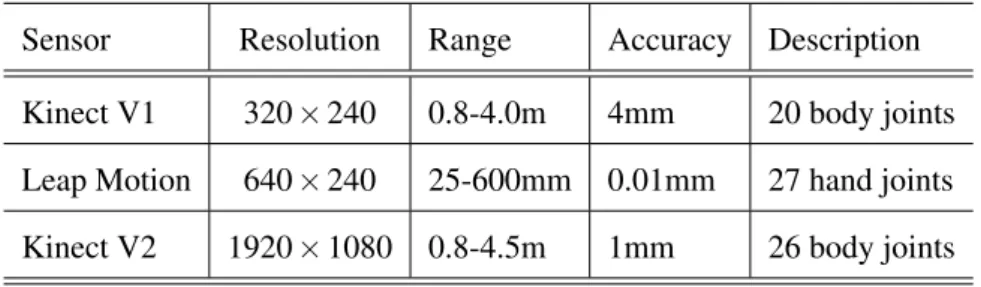
Table2.1shows a comparison among Kinect V1, Leap Motion and Kinect V2, adapted fromCheng et al.(2015). In addition,Weichert et al.(2013) stated that Leap Motion has the best accuracy.
TABLE2.1: Comparison among devices available for depth images
Sensor Resolution Range Accuracy Description Kinect V1 320×240 0.8-4.0m 4mm 20 body joints Leap Motion 640×240 25-600mm 0.01mm 27 hand joints Kinect V2 1920×1080 0.8-4.5m 1mm 26 body joints
2.4
Considerations about Vision and Non-vision Approaches
Table2.2 summarises the works cited until here for non-vsion based approaches, including sensor used, classifier, application, accuracy number of persons and number of gestures. Table
2.3show the works cited for vision based approaches. It shows a lack of works using only one regular camera.