CRITICAL READIND ACTIVITIES TO DEVELOP CRITICAL
THINKING IN SCIENCE CLASSES
Begoña Oliveras1; Conxita Márquez2and Neus Sanmartí3
1, 2, 3Department of Science and Mathematics Education, University Autonoma of Barcelona,
Bellaterra, Barcelona, Spain
Abstract: The aim of this research is to identify the difficulties experienced by secondary school students (aged 15 to 16) with the critical reading of newspaper articles with scientific content. Two newspaper critical reading activities in relation to the study of various scientific contents were designed and carried out in two schools (61 students in total), one with a student population from a medium to high social and economic bracket (school 2) and the other with students from a medium to low social and economic bracket (school 1), and both with different teaching methods. In school 1, the students usually worked in cooperative groups and discussion and self-regulation by students were encouraged. The methodology could be considered to be "student-centred-oriented" according to the classification devised by Kember (1997). In school 2 particular emphasis was placed on reading comprehension and on writing abilities across all areas but, on the other hand, the students never worked in cooperative groups. The teaching was based on the transfer of information by the teacher and the methodology could be considered to "teacher-centred-oriented". The two schools were characterised by the importance placed on experimental work. In order to analyse the difficulties “Elements of Science Critical Reading” were identified on the basis of the “Elements of Reasoning” of Paul & Elder (2006) and the categories proposed by Bartz (2002) in his C.R.I.T.I.C. questionnaire and a scale was drawn up.
Keywords:Critical thinking, literacy, high schools, abilities and critical reading.
INTRODUCTION
Background and rationale
Reading is a fundamental process in science learning since it is not only one of the most often used resources during the school years but can also become a basic tool for ongoing learning throughout life. The media and particularly the written press provide the main sources of scientific information for most adults (Jarman & McClune, 2002). In these media, opinions and actions are often based on scientific knowledge which the reader needs to know how to analyse critically.
Reading means understanding, interpreting, analysing and criticising texts. This is the basic meaning of literacy (Norris & Phillips, 2003). Critical reading and, therefore critical thinking, depend on the context and culture in which they are situated (Yore, Craig & Maguire, 1998). In this research we have focused on assessing critical thinking abilities based on the proposal by Paul and Elder (2005) and Bartz (2002) in the form of the C.R.I.T.I.C acronym. Based on these two approaches, we identified certain “Elements of science critical reading” that we
considered useful to guide the critical reading of newspaper articles with scientific content and also to analyse students’ difficulties (see Table 1).
Objectives of the research
The specific objectives of the research are as follows:
1) To analyse students’ difficulties in applying the “Elements of science critical Reading” defined in the reading of press articles.
2) Identify in relation to which “Elements of science critical Reading” differences are detected in the two samples analysed (school 1 and school 2).
3) Identify how the content of the readings and the types of questions raised in the activities affect the students’ answers.
METHODOLOGY
Project description
The first phase of the research consisted of selecting two newspaper texts with scientific content. The subject of the first article was the difficulty involved in removing graffiti on glass. According to the author of the new report, graffiti on glass is so difficult to remove because graffiti writers mix acid with the paints they use. This article was chosen so that the students could apply their knowledge of chemical change. Since the information in the text was not completely correct, because acids (apart from hydrofluoric acid) do not react with glass, the students were able to question the scientific basis of the news story. The second article contained opinions for and against whether the swimsuits used by swimmers had helped improve the latest Olympic records. In this case the article was chosen so that the students could apply their knowledge of cynematics and dynamics to the analysis of an actual event.To encourage critical reading of the articles and reflection, two critical reading activities were proposed (activity 1_ Grafittis and activity 2_ Swimsuits) which included questions relating to those shown in Table 1. There were other methodological strategies related to cooperational learning and group discussion (Márquez & Prat, 2005; Oliveras, Márquez & Sanmartí, 2011).
“Elements of Science Critical Reading” Examples of question types posed in classroom activities 1. Identify the main ideas of the text -What problem does the text present? What is the main idea?
2. Identify the writer’s purpose -Who wrote this document?-Why must he or she have written it? 3. Identify the writer’s assumptions and viewpoints - What assumptions does the writer make in the text? Are they justifiable? 4. Formulate a scientific question which the writer -Could an experiment or test be carried out to verify the
answers in the article or design a scientific experiment credibility of the main assumption?
to verify the information in the text What question would a scientist ask to investigate this problem? 5. Identify data and evidence given in the text -Are there any arguments or scientific evidence in the text that support
the initial assumption? Write them down.
Table 1. “Elements of science critical reading
Research population
The research was conducted in two secondary schools in Catalonia (Spain). School 1 is situated in Barcelona and its students come from a low social and economic bracket, with 30% of them being immigrants. School 2 is in a town, near Barcelona with a population of 4,000 and its students are from a medium to high social and cultural bracket, with 9% being immigrants. A total of 61 students took part (15 to 16 years of age), 30 in school 1 and 31 in school 2.
Data analysis
Based on the “Elements of critical reading” we defined six categories used to analyse the data collected in this study. Depending on the students’ answers, a scale of 1 to 5 was devised. The scale and the classification of the students’ answers were validated by two experienced teachers.
The average scores in each category between the two schools and the two activities were compared, together with the interaction between them, using a two-way analysis of variance (ANOVA). All statistical tests were assessed as significant when the p values obtained were less than 0.05.
Codes Categories
C1 Identification of the main ideas of the text
C2 Identification of the writer’s purpose
C3 Identification of the writer’s assumptions and viewpoints
C4 Formulation of a scientific question which the writer answers (article 1) or Design of a scientific experiment to verify the information in the text (article 2)
C5 Identification of data and evidence given in the text
C6 Arguing conclusions based on evidence
Table 2: “Codes and Categories”
RESULTS AND DISCUSSION
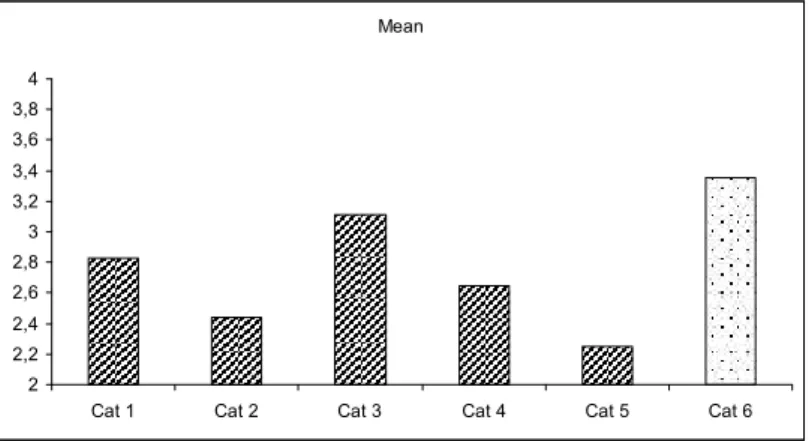
To achieve objective 1 of the research we focused on the means in each category. The results (see Figure 1) show that category 2 (identify the writer’s purpose) and category 5 (identify data and evidence given in the text) were those that students found the most difficult overall.
Mean 2 2,2 2,4 2,6 2,8 3 3,2 3,4 3,6 3,8 4
Cat 1 Cat 2 Cat 3 Cat 4 Cat 5 Cat 6
“Fig1. Average scores in each category”
In relation to category 2 the results can be explained by the fact that most of the students were convinced that the purpose of the text was to inform and that this information is always neutral and unbiased. Very few students detected that there could be a particular intention in their written work.
With respect to category 5, the difficulties detected related to the assumption by the students that a journalist is an informed and qualified person. If, in addition, the text contained a word that they considered to be scientific (acid, floatability, concentration, etc.), they considered this to be a sufficient indicator to support the scientific basis of the news story and, therefore, they saw it as proof of what the writer said.
To achieve objective 2 of the research we compared the results of the two schools according to the various categories. The results in Table 3 show that there was a significant difference between them with respect to categories 1, 4 and 6.
School 1 School 2 p C1 2.23+1.0 3.43+1.2 <0.01 C2 2.20+1.0 2.69+1.2 0.184 C3 2.78+1.3 3.41+1.3 0.069 C4 2.31+1.0 3.00+1.4 <0.05 C5 2.30+1.2 2.21+1.0 0.128 C6 4.26+1.1 2.44+.5 <0.001
“Table 3. Means plus standard deviation (mean+ SD) for each school (N=61)” Table 3 shows that the results in categories 1 and 4 were better in school 2 in the two activities whereas the results in category 6 were better in school 1 in the two activities. To explain the results we took into account the differences in the teaching methods used at the two schools.
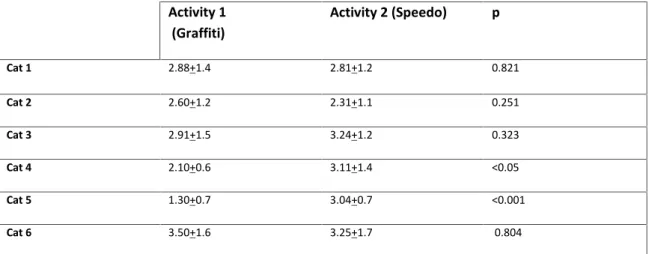
In relation to objective 3 of the research the results of the activities carried out were compared according to the various categories (Table 4).
Activity 1 (Graffiti) Activity 2 (Speedo) p Cat 1 2.88+1.4 2.81+1.2 0.821 Cat 2 2.60+1.2 2.31+1.1 0.251 Cat 3 2.91+1.5 3.24+1.2 0.323 Cat 4 2.10+0.6 3.11+1.4 <0.05 Cat 5 1.30+0.7 3.04+0.7 <0.001 Cat 6 3.50+1.6 3.25+1.7 0.804
Table 4.Means plus standard deviation (mean+ SD) for each activity (N=61)”
The results show that there are significant differences in categories 4 and 5, but not in the rest. As for category 4, activity 1 (graffiti) required the students to formulate a problem that could be scientifically investigated, without the text giving any clues. In contrast, in activity 2 (swimsuits) the problem was presented and the students were asked to think of a scientific experiment to prove whether or not the swimsuits contributed to improving swimmers’ speed. As could be expected, the results showed that the students found it more difficult to think of problems that could be scientifically investigated than scientific experiments that could be performed to answer a question.
Category 5 was also very different in the two activities. It was shown that the information provided in the text had an influence on recognising the evidence. If the texts contained information with a scientific basis, the students who understood the scientific model then recognised it. On the other hand, students invented evidence or made unfounded assumptions since, initially, they were completely confident that the writer’s statements were true.
CONCLUSIONS AND IMPLICATIONS
The students’ answers show that it is not easy to apply critical thinking to the analysis of texts. We identified that there are aspects of critical thinking where students have greater difficulties: identifying the writer’s purpose (C2) and looking for evidence in a text (C5) (Figure 1). Significant differences were detected between the two schools (Table 3). The students at school 2 showed greater reading comprehension abilities and written expression (C1) but, on the other hand, they had more problems with the critical analysis of the texts (C6). We can assume that the social and cultural level of these school’s students helps them achieve better reading comprehension and writing skills. As for the problems with critical analysis of the information, we believe that these could be due to the different teaching methods used in science classes in the two schools (Kember, 1997). In school 1, the students work on science in a more reflective way, interaction between students and between the students and teachers is encouraged.
In this study we put forward a proposal for working critically with newspaper articles but we think that without a belief in the importance of class discussion (Paul, 1992) on the
interpretation of facts with a scientific basis it is difficult for students to develop critical thinking. Authors such as Osborne (2010) and Hayes & Devitt (2008) take the view that collaborative discourse between students represents the ideal means to help students improve the quality of their thinking, always taking into account that discussions need to be regulated and guided by the teacher.
We also detected significant differences in some categories depending on the activities involved (Table 4). Specifically in category 4 and in category 5. In relation to category 4, the students had more difficulties formulating a scientific question relating to a subject than in designing a scientific experiment to verify specific information in the text. As for category 5, if the text does not contain scientific arguments, data or evidence to support the information, the students make unfounded assumptions and consider them as such, since they are
convinced that information always has a basis.
We can conclude that the critical reading activities analysed helped to connect different concepts studied in science classes and apply them to the analysis of a real-life problem. After carrying out the activities, the students asked to do more of them which means we can say that they encouraged an interest in reading current texts and analysing them critically, besides applying the scientific knowledge they had learnt. This suggests that students find this type of activity motivating (Nolen, 2003).
Lastly, it is important to state that the objectives associated with critical reading cannot be achieved in a single activity and, therefore, they must be included regularly throughout the students' school career.
Acknowledgments
Based on work supported by Spanish MCYT grant EDU-2009-13890-C02-02) and Catalan PRI 2009SGR1543.
REFERENCES
Bartz, W. R. (2002). Teaching Skepticism via the CRITIC Acronym and the Skeptical Inquirer.The Skeptical Inquirer, 26(5), 42-44.
Hayes, K.D., & Devitt, A. A. (2008). Classroom Discussions with Student-Led Feedback: a Useful Activity to Enhance Development of Critical Thinking Skills. Journal of Science Education Research, 7, 65-68.
Jarman, R., & McClune, B. (2002). A survey of the use of newspapers in science instruction by secondary teachers in Northern Ireland. International Journal of Science Education, 24(10), 997-1020.
Kember, D. (1997). A reconceptualisation of the research into university academics conceptions of teaching.Learning and Instruction, 7(3), 255-275.
Márquez, C., Prat, A. (2005). Leer en clase de ciencias. Enseñanza de las Ciencias, 23(3), 431-440.
McClune, B., & Jarman, R. (2010). Critical Reading Science-Based News Reports:
Establishing a knowledge, skills and attitudes framework. International Journal of Science Education, 1–26
Nolen, S.B. (2003). Learning environment, motivation, and achievement in high school science.Journal of research in science teaching, 40, 4 , 347 - 442.
Norris, S. P., & Phillips, L. M. (2003). How literacy in its fundamental sense is central to scientific literacy.Science Education, 87, 224-240.
Oliveras, B., Márquez & Sanmartí, N. (2011) ( in press). The use of newspaper articles as a tool to develop critical thimking in science classes. International Journal of Science Education, 1–21.
Osborne , J. (2010). Arguing to Learn in Science: The role of collaborative, critical discourse. Science, 328, 463-466.Paul, R., & Elder, L. (2006).The Miniature Guide to Critical Thinking
Concepts and Tools, Foundation for critical thinking. Retrieved May 20, 2010 from http://www.criticalthinking.org/files/Concepts_Tools.pdf.
Paul, R. C. (1992).Critical thinking: What every person needs to survive in a rapidly
changing world. (2ndrevised ed.). Santa Rosa, CA: Foundation for Critical Thinking.
Yore, L. D., Craig, M. T., & Maguire, T. O. (1998). Index of science reading awareness: An interactiveconstructive model, text verification, and grades 4–8 results.Journal of Research in
Science Teaching,35, 27–51.
Wellington, J., & Osborne, J. (2001).Language and literacy in science education. Buckingham, Open University Press.