Security Target
Status
Rédaction Sébastien Gelgon
Validation Pierre-Jean Aubourg
Classification Diffusion restreinte
Statut du document Version finale
Version actuelle 1.2
Référence EVALCC-MPKI-ST-01
History of revisions
Date Version Commentaire
06/06/2010 0.1 Création
30/06/2010 0.2 TOE overview complétée Intégration des SFR
25/09/2010 0.3 Instanciation des SFR suite à réunion de travail 29/10/2010 0.4 Version revue pour diffusion au client
25/11/2010 0.5 Version revue pour diffusion ANSSI. 13/01/2011 0.6 Prise en compte des remarques de l’ANSSI.
Compléments dans les sections 7, 8 et 9. 24/01/2011 0.7 Version après validation interne
11/02/2011 0.8 Mise à jour
- PP Claim et argumentaire
- Ajout du rôle d’administrateur système (hors contrôle de la TOE) 28/04/2011 0.9 - Ajout des références HSM, client LDAP et SGBDs
- Ajout paragraphe 1.3.1.2
04/05/2011 0.9.1 - prise en compte remarque évaluateur.
10/05/2011 0.9.2 Intégration d’une partie de IAIK dans la TOE (modification Fig. 3: TOE bundaries) 23/06/2011 0.10 Prise en compte des remarques suite à RE0 et RTE ASE :
- Add components identification and version of MetaPKI Pre-requisites - IAIK component out of the scope of TOE
- supress Operator role
- TOE does not use TSF secret keys
- Certificate Rights are not automatically propagate when certificate renewal. 28/09/2011 0.11 - Mise à jour version MetaPKI et pré-requis
- Ajout de la fonctionnalité Syslog de MetaPKI hors périmètre de la TOE - Ajout argumentaire de non applicabilité de FMT_MTD_CIMC.5 12/12/2011 1.0 Version finale
27/02/2012 1.1 Modification version de la TOE 29/11/2012 1.2 Version finale pour diffusion publique
Contents
1 SECURITY TARGET IDENTIFICATION ... 5
1.1 IDENTIFICATION ... 5
1.2 TOEOVERVIEW ... 5
1.2.1 Usage and Major Security Features ... 6
1.2.2 TOE Type ... 8 1.3 TOEDESCRIPTION ... 9 1.3.1 Functional architecture ... 9 1.3.2 Technical Architecture ... 11 1.3.3 TOE Boundary ... 12 1.3.4 Evaluated configuration ... 12 2 CONFORMANCE CLAIM ... 15 2.1 CCCONFORMANCE CLAIM ... 15 2.2 PPCONFORMANCE CLAIM ... 15 2.3 CONFORMANCE RATIONALE ... 15
3 SECURITY PROBLEM DEFINITION ... 17
3.1 SECURE USAGE ASSUMPTIONS ... 17
3.1.1 Personnel ... 17 3.1.2 Connectivity ... 18 3.1.3 Physical ... 18 3.2 THREATS ... 19 3.2.1 Authorized users ... 19 3.2.2 System ... 19 3.2.3 Cryptography ... 20 3.2.4 External attacks ... 20
3.3 ORGANIZATIONAL SECURITY POLICIES ... 20
4 SECURITY OBJECTIVES ... 21
4.1 SECURITY OBJECTIVES FOR THE TOE ... 21
4.1.1 Authorized users ... 21
4.1.2 System ... 21
4.1.3 Cryptography ... 21
4.1.4 External attacks ... 22
4.2 SECURITY OBJECTIVES FOR THE ENVIRONMENT ... 22
4.2.1 Non-IT security objectives for the environment ... 22
4.2.2 IT security objectives for the environment ... 23
4.3 SECURITY OBJECTIVES FOR BOTH THE TOE AND THE ENVIRONMENT ... 24
4.4 SECURITY OBJECTIVES RATIONALE ... 26
5 EXTENDED COMPONENTS DEFINITION ... 27
6 SECURITY REQUIREMENTS ... 28
6.1 TOESECURITY FUNCTIONAL REQUIREMENTS ... 28
6.1.1 Security Audit ... 28
6.1.2 Roles... 32
6.1.3 Backup and recovery ... 36
6.1.4 Access Control ... 37
6.1.5 Identification and Authentication ... 39
6.1.6 Remote Data Entry and Export ... 41
6.1.7 Key Management ... 43
6.1.9 Certificate revocation list profile management ... 46
6.1.10 Online Certificate Status Protocol (OCSP) Profile Management ... 46
6.1.11 Certificate Registration ... 47
6.1.12 Certificate Revocation ... 48
6.2 TOESECURITY ASSURANCE REQUIREMENTS ... 49
6.3 SECURITY REQUIREMENTS RATIONALE ... 50
6.3.1 SFR Dependencies ... 50
6.3.2 SFR from PP CIMC unapplicable to this ST ... 52
7 TOE SUMMARY SPECIFICATIONS ... 54
7.1 TOESECURITY FUNCTIONS ... 54
7.1.1 Security Audit ... 54
7.1.2 Roles... 54
7.1.3 Backup and recovery ... 55
7.1.4 Access control ... 55
7.1.5 Identification and authentication ... 55
7.1.6 Remote Data Entry and Export ... 55
7.1.7 Key Management ... 56
7.1.8 Certificate Profile Management ... 57
7.1.9 Information on Certificates statuses and Related Management ... 57
7.1.10 Registration Authority ... 57
7.2 TOESUMMARY SPECIFICATIONS RATIONALE ... 58
8 ACCESS CONTROL POLICIES ... 64
8.1 CIMCITENVIRONMENT ACCESS CONTROL POLICY ... 64
8.2 CIMCTOEACCESS CONTROL POLICY ... 64
9 GLOSSARY OF TERMS AND ACRONYMS ... 66
9.1 GLOSSARY OF TERMS ... 66
Chapitre 1 - Security Target Identification
1 Security Target Identification
The Security Target (ST) introduction section presents introductory information on the Security Target, the Target of Evaluation (TOE) referenced in this Security Target, and a basic introduction to the TOE.
1.1 Identification
ST Title Bull MetaPKI – Security Target ST reference EVALCC-MPKI-ST-01/v1.2
TOE Identification MetaPKI v9.2.5
CC Conformance Common Criteria for Information Technology Security Evaluation, Version 3.1 R3 PP Conformance Based on Certificate Issuing and Management Components (CIMC) Security Level 3
Protection Profile, Version 1.0, October 31, 2001
Assurance Level Evaluation Assurance Level 3 augmented with ALC_FLR.3 and AVA_VAN.3
1.2 TOE Overview
Information System (IS) security is an essential issue for organizations moving to paperless exchanges, whether for internal communications or for relationships with partners and customers. Electronic certificates respond to this need as they allow applications to support security services such as user authentication, non-repudiation of transactions, and confidentiality of data exchanges.
Bull, a European actor in IS security, provides MetaPKI, a complete solution to create electronic certificates and manage their life cycle.
Keeping control of security
For all the use cases mentioned above, Users and applications are provided with one or more key pairs (a public key and a private key) and public key certificates, generated by a Certification Authority (CA), that associate the registered user or application with the public key.
MetaPKI supports one or more Certification Authorities, that may be independent, or subordinate CAs.
A whole range of certificates profiles is supported by MetaPKI. For each profile, the registration process may be adopted to the specific needs of the organization and integrated with the existing IS. A workflow manager handles the registration process in order to minimize the time to produce and manage the certificates through the use of one or more Local Registration Authorities (LRA).
Chapitre 1 - Security Target Identification
Accompanying growth
MetaPKI’s modularity and sales conditions enable the smooth deployment of a solution according to the organisation’s needs: new types of certificate, new management processes, new organisational units, new Certification Authorities may be added as required. The solution includes key escrow and key recovery for confidentiality keys.
Bull, European actor in IS security
Bull provides consultancy services for defining the best way to integrate MetaPKI into the IS, as well as for making use of certificates in applications (e.g. SSO-Single Sign On). Bull provides the training and the support.
MetaPKI components may be hosted in secure data centres managed by Bull.
1.2.1 Usage and Major Security Features
1.2.1.1 TOE Usage
MetaPKI supports the following features:
- Certification authority: support of multiple certification authorities in a same instance of the PKI; support of multiple certificate profiles in a same CA
- Registration Authorities and/or Local Registration Authority (RA and/or LRA): customizable requests and validation workflows for certificate/renewal/revocation; web service interface; support of multiple RAs
- Publication Services: support of HTTP and LDAP/ActiveDirectory publication for CRLs and Certificates
- OSCP Responder
- Generation of key pairs in centralized or decentralized mode, depending on the usage of the associated certificates and on the client’s need
- Key Escrow and Key Recovery Services
- Management services: management of the internal users of the PKI; management of the rights, management of the functional modules; management of the certificate profiles, … - Audit
MetaPKI may optionally support the following entities (out of the scope of the TOE) - Card Management System (GesCard)
Chapitre 1 - Security Target Identification
1.2.1.2 TOE security services
MetaPKI includes strong internal security mechanisms:
Security Audit (FAU)
Security Audit includes a chronological logging of events that occur in a system to act as a deterrent against security violations.
All actions related to the management of certificates are recorded in a database only accessible by authorized operators (Administrators, Officers or Auditors). All events are logged.
Communication (FCO)
Communications between functional entities and information stored in the database are all protected. Sensitive information is enciphered.
Cryptographic Support (FCS)
Private keys and public keys are protected (i.e., generated and operated) using Hardware Security Modules (HSM). Bull supports different kinds of HSMs, either provided by Bull or by third parties.
User Data Protection (FDP)
User Data Protection relates to the protection of user data including certificate issuance, revocation, backup and recovery, and profile management of certificates, Certificate Revocation List (CRL), and Online Certificate Status Protocol (OCSP).
Access to all MetaPKI functional entities is controlled (see FIA bellow).
Identification and Authentication (FIA)
Identification and Authentication supports the administration and enforcement of the CIMC access control policies to unambiguously identify the person and/or entity performing functions in a CIMC. Officers, Auditors and administrators must be authenticated using a X.509 certificate. Strong authentication is supported as far as the private key is held by a smart card or USB token.
Security Management (FMT)
Security Management specifies several aspects of management of security functions including distinct roles to maintain the security of the CIMC.
Protection of the TOE Security Functions (FPT)
Protection of the TOE Security Functions (TSF) includes functions that manage and protect the integrity, resp. the confidentiality, of TSF data from modification, resp. disclosure. This is carried out through the use of various means such as encryption, reliable time stamps, backup and recovery procedures, self-tests and audit logs.
The access to the TOE services is generally done through a front office server. The sensitive functions are isolated and performed on a separated back office server, only accessible from the front office server.
Chapitre 1 - Security Target Identification
1.2.1.3 Norms and standards supported for interfaces and protocols
- Certificate format compliance with ITUT X.509v3 and RFC 5280.
- Certificate profile compliance with ETSI TS 101 862, Netscape and Microsoft.
- Revocation information compliance with ITU-T X.509v2 CRL and OCSP Protocol (RFC 2560).
- Certification request format: PKCS#10, SPKAC. - Key exchange format: PKCS#12.
- Connectivity: LDAP, HTTPS, SMTP. - HSM interface: PKCS#11.
The TOE can be configured to be compliant with the certificates templates defined in Annex A14 of the French general frame of references for security of information systems (RGS)
1.2.2 TOE Type
Bull MetaPKI is a certificate issuance and management software (CIMS).
This software solution can be fully parameterized by the customer to implement any type of Public Key Infrastructure, from the simpler one to the most complex.
Bull MetaPKI can manage several certification authorities in a single occurrence of the software. Different types of certificates can be managed by MetaPKI in a same CA.
Chapitre 1 - Security Target Identification
1.3 TOE Description
1.3.1 Functional architecture
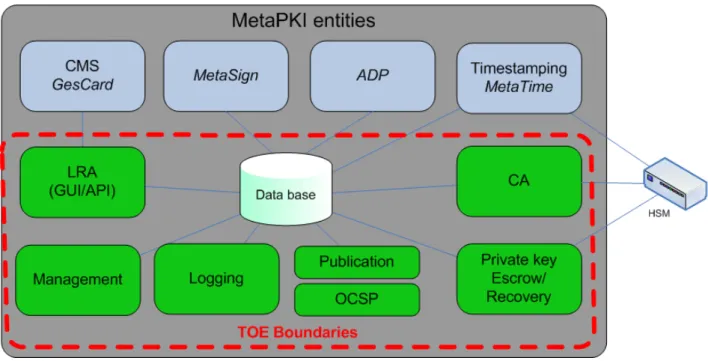
The functional architecture of the TOE is depicted in the following figure:
Figure 1: TOE functional architecture
1.3.1.1 Functional entities included in TOE scope
CA - Certification Authority
A Certification Authority entity is in charge of the generation of the public key certificates based on predefined profiles in accordance with the corresponding certification policies.
A certification authority is also in charge of:
- the management of the certificates data base, including certificates life cycle (e.g., certificate status),
- the constitution (from identified certificate profiles), signature and automated publication of the user certificates
- the constitution, signature and automated publication of the CRLs
Registration Authority and/or Local Registration Authority (RA and/or LRA)
The Registration Authority and/or the Local Registration Authority (RA and/or LRA) takes in charge the registration of certificate holder. The RA or the LRA allows the management of a face to face meeting enabling the officer to verify the identity and the credentials of the certificate holder.
RA and LRA may be implemented either through a web interface, or through an API (Access2MetaPKI or Access2GescardCmd).
Chapitre 1 - Security Target Identification
The registration authority may record different kinds of requests from the user (the final user or the RA Officer, depending on the certification policy.
The supported requests are certification, renewal and revocation requests; They requests are transmitted to the Certification Authority for treatment.
Publication Service
The Publication Service allows the distribution of certificate(s) (optionally the key pair, when it has been generated in centralized mode) to the holders. Optionally a publication service may make the certificate(s) available to Relying Parties (RP).
Key Escrow and Key Recovery Services
These two services allow:
- the escrow of the private keys associated to certificated used for confidentiality purposes (this service can be configured to be used automatically)
- the secure recovery of an escrowed private key: The deployment of these services is optional.
Management services
These services allow managing the internal users of the PKI and their roles. Management services also allow managing the configuration of the different entities composing the TOE.
The access to the configuration of each functional entity is controlled through the use of roles.
Logging
The TOE supports logging services recording the certificate management and TOE configuration management events.
1.3.1.2 Optional functional entities
MetaPKI supports the following optional entities which are out of the scope of the TOE
Card Management System (GesCard)
Card Management System (GesCard) for managing smart cards: customization, PIN unblocking, etc...
MetaTime
MetaTime is a Time Stamp Service which delivers Timestamps conforming to the RFC3161.
MetaSign
MetaSign is offering functionalities to generate and to verify advanced electronic signatures conforming to the CAdES and XAdES standards.
ADP
Chapitre 1 - Security Target Identification
SysLog
MetaPKI integrates a Syslog service wich allows to redirect all logs produced by MetaPKI to Syslog server. This functionality is out of scope of TOE.
1.3.2 Technical Architecture
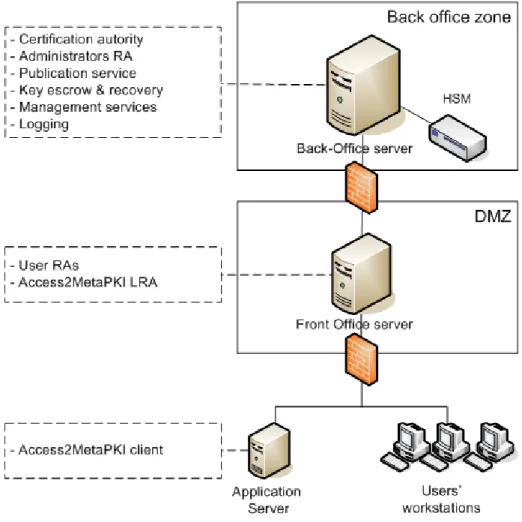
The TOE design is very modular and flexible, the functional entities may possibly be deployed on several physical or logical servers, for instance to allow a separation of the services between a back office and front office and to implement a highly available infrastructure.
The figure bellow depicts a possible deployment mode with two physical servers:
Chapitre 1 - Security Target Identification
1.3.3 TOE Boundary
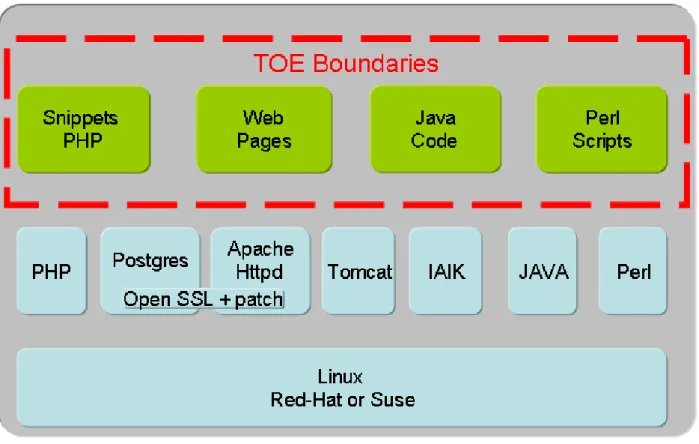
The following figure shows the different components needed for the TOE to operate. The green ones are part of the TOE boundary; the blue ones are open source software prerequisites that are out of the scope of the TOE.
Figure 3: TOE Boundaries
1.3.4 Evaluated configuration
The evaluated configuration is a single server architecture composed of hardware and software parts. The evaluated configuration is described in the sections below.
1.3.4.1 Server side
Hardware
Component Identification Comment Physical server 32 or 64 bit platform with :
- at least 4 GB of RAM - at least 10 GB disk available - 2 Ethernet link adaptor
Minimum configuration for physical server where are hosting the virtual machine
HSM TrustWay Box
Chapitre 1 - Security Target Identification
Software
The TOE is evaluated in a configuration including the following software:
Component Identification Comment Virtual Machine for Front
office functionalities VMWare virtual machine Virtual Machine for Back
office functionalities VMWare virtual machine
Operating system Red Hat 6 ES Hardened version
MetaPKI Pre-requistes 4.8.0 Linux additional components requested for MetaPKI
usage
MetaPKI 9.2.5
SGBDs PostgreSQL v9.0.6
LDAP openldap client v2.4.29
MetaPKI Pre-requisites include the following components:
Identification Version apache-ant 1.8.2 ant-contrib 1.0b3 java_secure_channel 0.1.46 httpd 2.2.22 awstats 7.0 bison 2.5 curl 7.24.0 export_policy file 5.10 File_Find 1.3.1 flex 2.5.35 fpdf 17 freetype 2.4.8 jce_policy-6 6 jdk 6u31 libjpeg 6b libpng 1.5.9 ibxml2 2.7.8 local_policy mhash 0.9.9.9 mpki_p11_engine net_useragent_detect 2.5.2 opencryptoki 2.4 openldap 2.4.29 openssl 1.0.0g postgresql 9.0.6 php 5.2.17
Chapitre 1 - Security Target Identification readline 6.2 smarty 3.1.8 tomcat 6.0.35 xml_util 1.2.1 xml_parser 1.3.4 xml_serializer 0.20.0 1.3.4.2 Client side
Client workstation configuration (out of the scope of the TOE)
Component Identification Comment Operating system Windows XP SP3
Browser Internet explorer 8.0 Middleware Classic Client 6.1_005 Smart card Gemalto IAS ECC TPC
Chapitre 2 - Conformance Claim
2 Conformance Claim
2.1 CC Conformance Claim
The TOE conforms to:
- Common Criteria for Information Technology Security Evaluation, Version 3.1 R3, part 2 extended.
- Common Criteria for Information Technology Security Evaluation, Version 3.1 R3 , part 3 conformant.
- Evaluation Assurance Level 3 augmented with AVA_VAN.3, and ALC_FLR.3.
Note: the EAL chosen for this security target is conformant with French Standard Qualification level.
2.2 PP Conformance Claim
This ST is based on the following Protection Profile (PP):
- Certificate Issuing and Management Components (CIMC) Security Level 3 PP, version 1.0, October 31, 2001.
2.3 Conformance Rationale
This ST is globally conformant with PP CIMC Level 3:
This ST includes all of the assumptions, threats, policies, objectives and security requirements defined in CIMC PP to meet Security Level 3. The security requirements have been adapted for CC v3.1. Furthermore this ST does not include additional assumption, threat, policy or objective, except one assumption and one objective that are identified as changes in the text below.
All operations performed on the security requirements for the TOE are within the bounds set by the CIMC PP for Security Level 3, except those mentioning the use of FIPS 140 validated HSMs that are changed by mentions to the French RGS. All the assignment and selection operations on security requirements are indicated in Section 6.1.
Some changes have been made regarding the referenced PP:
- An assumption (A.No Abusive System administrators) and a security objective (O.No Abusive System Administrators) from level 2 have been kept to cover system administrators’ trustworthiness: this category of administrator is not under the scope of control of the TOE. A rationale for these additions is provided in section 4.4.
Chapitre 2 - Conformance Claim
- The system backup role is fulfilled by the Administrator; the system recovery role is fulfilled by the system administrator.
- Some security functional requirements that were defined as SFRs for the environment in PP CIMC have been included as SFRs applicable to the TOE in this ST. The main reason is that these security requirements make the TSF more consistent and actually reinforce the product’s security. These SFRs are:
o FIA_ATD.1 User attribute definition
o FMT_MSA.1 Management of security attributes o FMT_MSA.3 Static attribute initialisation
o FMT_MTD.1 Management of TSF data
o FMT_SMR.2 Restrictions on security roles
- The assurance level for this ST is EAL 3 augmented with ALC_FLR.3 and AVA_VAN.3. This assurance level is consistent with the French regulation for qualified IT products at Standard level.
Chapitre 3 - Security Problem Definition
3 Security Problem Definition
This section includes the following: - Secure usage assumptions, - Threats, and
- Organizational security policies.
3.1 Secure Usage Assumptions
The usage assumptions are organized in three categories: personnel (assumptions about administrators and users of the system as well as any threat agents), physical (assumptions about the physical location of the TOE or any attached peripheral devices), and connectivity (assumptions about other IT systems that are necessary for the secure operation of the TOE).
3.1.1 Personnel
A.Auditors Review Audit Logs
Audit logs are required for security-relevant events and must be reviewed by the Auditors.
A.Authentication Data Management
An authentication data management policy is enforced to ensure that users change their authentication data at appropriate intervals and to appropriate values (e.g., proper lengths, histories, variations, etc.) (Note: this assumption is not applicable to biometric authentication data.)
A.Competent Administrators, Officers and Auditors
Competent Administrators, Officers and Auditors will be assigned to manage the TOE and the security of the information it contains.
A.CPS
All Administrators, Officers, and Auditors are familiar with the certificate policy (CP) and certification practices statement (CPS) under which the TOE is operated.
A.Disposal of Authentication Data
Proper disposal of authentication data and associated privileges is performed after access has been removed (e.g., job termination, change in responsibility).
A.Malicious Code Not Signed
Chapitre 3 - Security Problem Definition
A.Notify Authorities of Security Issues
Administrators, Officers, Auditors, and other users notify proper authorities of any security issues that impact their systems to minimize the potential for the loss or compromise of data.
A.Social Engineering Training
General users, administrators, officers and auditors are trained in techniques to thwart social engineering attacks.
A.Cooperative Users
Users need to accomplish some task or group of tasks that require a secure IT environment. The users require access to at least some of the information managed by the TOE and are expected to act in a cooperative manner. (Security Levels 1–3).
A.No Abusive System administrators
System administrators are trusted not to abuse their authority.
PP conformity note: This assumption is kept from PP CIMC for levels 1 and 2, and only addresses system administrators, meaning, administrators in charge of the management of the operating system and of the basic services on which the TOE relies. This assumption constitutes an addition with respect to PP CIMC Level 3. Other administrators and users mentioned in this ST operate through the TOE human interfaces.
3.1.2 Connectivity
A.Operating System
The operating system has been selected to provide the functions required by this CIMC to counter the perceived threats for the appropriate Security Level identified in this family of PPs. Although the family of PPs does not specifically address the operating system, functions/requirements traditionally attributed to an operating system are distributed throughout this family of PPs in appropriate sections. PKIs incorporating CIMC components that rely on operating systems to provide/enforce these functions/requirements must utilize operating systems with features that counter the perceived threats for the appropriate Security Level identified in this family of PPs
3.1.3 Physical
A.Communications Protection
The system is adequately physically protected against loss of communications i.e., availability of communications.
A.Physical Protection
The TOE hardware, software, and firmware critical to security policy enforcement will be protected from unauthorized physical modification.
Chapitre 3 - Security Problem Definition
3.2 Threats
The threats are organized in four categories: - authorized users,
- system,
- cryptography, and - external attacks.
3.2.1 Authorized users
T.Administrative errors of omission
Administrators, Officers or Auditors fail to perform some function essential to security.
T.User abuses authorization to collect and/or send data
User abuses granted authorizations to improperly collect and/or send sensitive or security-critical data.
T.User error makes data inaccessible
User accidentally deletes user data rendering user data inaccessible.
T.Administrators, Officers and Auditors commit errors or hostile actions
An Administrator, Officer or Auditor commits errors that change the intended security policy of the system or application or maliciously modify the system’s configuration to allow security violations to occur. (Addressed at Security Levels 3 and 4)
3.2.2 System
T.Critical system component fails
Failure of one or more system components results in the loss of system critical functionality.
T.Malicious code exploitation
An authorized user, IT system, or hacker downloads and executes malicious code, which causes abnormal processes that violate the integrity, availability, or confidentiality of the system assets.
T.Message content modification
A hacker modifies information that is intercepted from a communications link between two unsuspecting entities before passing it on to the intended recipient.
T.Flawed code
A system or applications developer delivers code that does not perform according to specifications or contains security flaws.
Chapitre 3 - Security Problem Definition
3.2.3 Cryptography
T.Disclosure of private and secret keys
A private or secret key is improperly disclosed.
T.Modification of private/secret keys
A secret/private key is modified.
T.Sender denies sending information
The sender of a message denies sending the message to avoid accountability for sending the message and for subsequent action or inaction.
3.2.4 External attacks
T.Hacker gains access
A hacker masquerades as an authorized user to perform operations that will be attributed to the authorized user or a system process or gains undetected access to a system due to missing, weak and/or incorrectly implemented access control causing potential violations of integrity, confidentiality, or availability.
T.Hacker physical access
A hacker physically interacts with the system to exploit vulnerabilities in the physical environment, resulting in arbitrary security compromises.
T.Social engineering
A hacker uses social engineering techniques to gain information about system entry, system use, system design, or system operation.
3.3 Organizational security policies
P.Authorized use of information
Information shall be used only for its authorized purpose(s).
P.Cryptography
FIPS-approved or NIST-recommended cryptographic functions shall be used to perform all cryptographic operations.
Cryptographic functions used to perform all cryptographic operations shall be compliant to [RGS] requirements.
Chapitre 4 - Security objectives
4 Security objectives
This section includes the security objectives for the CIMC PPs including security objectives for the TOE, security objectives for the environment, and security objectives for both the TOE and environment.
4.1 Security Objectives for the TOE
This section includes the security objectives for the TOE, divided among four categories: - authorized users, - system, - cryptography, and - external attacks. 4.1.1 Authorized users O.Certificates
The TSF must ensure that certificates, certificate revocation lists, and certificate status information are valid.
4.1.2 System
O.Preservation/trusted recovery of secure state
Preserve the secure state of the system in the event of a secure component failure and/or recover to a secure state.
O.Sufficient backup storage and effective restoration
Provide sufficient backup storage and effective restoration to ensure that the system can be recreated.
4.1.3 Cryptography
O.Non-repudiation
Prevent user from avoiding accountability for sending a message by providing evidence that the user sent the message.
Chapitre 4 - Security objectives
4.1.4 External attacks
O.Control unknown source communication traffic
Control (e.g., reroute or discard) communication traffic from an unknown source to prevent potential damage.
4.2 Security Objectives for the Environment
This section specifies the security objectives for the environment.
4.2.1 Non-IT security objectives for the environment
O.Administrators, Officers and Auditors guidance documentation
Deter Administrator, Officer or Auditor errors by providing adequate documentation on securely configuring and operating the CIMC.
O.Auditors Review Audit Logs
Identify and monitor security-relevant events by requiring auditors to review audit logs on a frequency sufficient to address level of risk
O.Authentication Data Management
Ensure that users change their authentication data at appropriate intervals and to appropriate values (e.g., proper lengths, histories, variations, etc.) through enforced authentication data management (Note: this objective is not applicable to biometric authentication data.)
O.Communications Protection
Protect the system against a physical attack on the communications capability by providing adequate physical security.
O.Competent Administrators, Officers and Auditors
Provide capable management of the TOE by assigning competent Administrators, Officers and Auditors to manage the TOE and the security of the information it contains.
O.No Abusive System Administrators
Use trustworthy System Administrators.
PP conformity note: This objective is kept from PP CIMC for levels 1 and 2, and only addresses system administrators. Please refer to §3.1.1 for more explanations of this particular role.
O.CPS
All Administrators, Officers and Auditors shall be familiar with the certificate policy (CP) and the certification practices statement (CPS) under which the TOE is operated.
Chapitre 4 - Security objectives
O.Disposal of Authentication Data
Provide proper disposal of authentication data and associated privileges after access has been removed (e.g., job termination, change in responsibility).
O.Installation
Those responsible for the TOE must ensure that the TOE is delivered, installed, managed, and operated in a manner which maintains IT security.
O.Malicious Code Not Signed
Protect the TOE from malicious code by ensuring all code is signed by a trusted entity prior to loading it into the system.
O.Notify Authorities of Security Issues
Notify proper authorities of any security issues that impact their systems to minimize the potential for the loss or compromise of data.
O.Physical Protection
Those responsible for the TOE must ensure that the security-relevant components of the TOE are protected from physical attack that might compromise IT security.
O.Social Engineering Training
Provide training for general users, Administrators, Officers and Auditors in techniques to thwart social engineering attacks.
O.Cooperative Users
Ensure that users are cooperative so that they can accomplish some task or group of tasks that require a secure IT environment and information managed by the TOE..
O.Lifecycle security
Provide tools and techniques used during the development phase to ensure security is designed into the CIMC. Detect and resolve flaws during the operational phase.
O.Repair identified security flaws
The vendor repairs security flaws that have been identified by a user.
4.2.2 IT security objectives for the environment
O.Cryptographic functions
The TOE must implement approved cryptographic algorithms for encryption/decryption, authentication, and signature generation/verification; approved key generation techniques and use validated cryptographic modules. (Validated is defined as FIPS 140-1 validated conformant to [RGS] requirements).
Chapitre 4 - Security objectives
O.Operating System
The operating system used is validated to provide adequate security, including domain separation and nonbypassability, in accordance with security requirements recommended by the National Institute of Standards and Technology.
O.Periodically check integrity
Provide periodic integrity checks on both system and software.
O.Security roles
Maintain security-relevant roles and the association of users with those roles.
O.Validation of security function
Ensure that security-relevant software, hardware, and firmware are correctly functioning through features and procedures.
O.Trusted Path
Provide a trusted path between the user and the system. Provide a trusted path to security-relevant (TSF) data in which both end points have assured identities.
4.3 Security Objectives for both the TOE and the Environment
This section specifies the security objectives that are jointly addressed by the TOE and the environment.
O.Configuration Management
Implement a configuration management plan. Implement configuration management to assure identification of system connectivity (software, hardware, and firmware), and components (software, hardware, and firmware), auditing of configuration data, and controlling changes to configuration items.
O.Data import/export
Protect data assets when they are being transmitted to and from the TOE, either through intervening untrusted components or directly to/from human users.
O.Detect modifications of firmware, software, and backup data
Provide integrity protection to detect modifications to firmware, software, and backup data.
O.Individual accountability and audit records
Provide individual accountability for audited events. Record in audit records: date and time of action and the entity responsible for the action.
Chapitre 4 - Security objectives
O.Integrity protection of user data and software
Provide appropriate integrity protection for user data and software.
O.Limitation of administrative access
Design administrative functions so that Administrators, Officers and Auditors do not automatically have access to user objects, except for necessary exceptions. Control access to the system by Administrators who troubleshoot the system and perform system updates.
O.Maintain user attributes
Maintain a set of security attributes (which may include role membership. access privileges, etc.) associated with individual users. This is in addition to user identity.
O.Manage behavior of security functions
Provide management functions to configure, operate, and maintain the security mechanisms.
O.Object and data recovery free from malicious code
Recover to a viable state after malicious code is introduced and damage occurs. That state must be free from the original malicious code.
O.Procedures for preventing malicious code
Incorporate malicious code prevention procedures and mechanisms.
O.Protect stored audit records
Protect audit records against unauthorized access, modification, or deletion to ensure accountability of user actions.
O.Protect user and TSF data during internal transfer
Ensure the integrity of user and TSF data transferred internally within the system.
O.Require inspection for downloads
Require inspection of downloads/transfers.
O.Respond to possible loss of stored audit records
Respond to possible loss of audit records when audit trail storage is full or nearly full by restricting auditable events.
O.Restrict actions before authentication
Restrict the actions a user may perform before the TOE authenticates the identity of the user.
O.Security-relevant configuration management
Manage and update system security policy data and enforcement functions, and other security-relevant configuration data, to ensure they are consistent with organizational security policies.
Chapitre 4 - Security objectives
O.Time stamps
Provide time stamps to ensure that the sequencing of events can be verified.
O.User authorization management
Manage and update user authorization and privilege data to ensure they are consistent with organizational security and personnel policies.
O.React to detected attacks
Implement automated notification (or other responses) to the TSF-discovered attacks in an effort to identify attacks and to create an attack deterrent.
4.4 Security Objectives Rationale
The security problem definition and the security objectives are directly extracted from the CIMC protection profile; the rationale from the PP is directly applicable.
The only exceptions to this are the addition of the assumption A.No Abusive System administrators and of the corresponding security objective for the non-IT environment O.No Abusive System Administrators. The rationale for the additional elements is the following:
A.No Abusive System administrators is fully covered by O.No Abusive System Administrators.
A.No Abusive System administrators establishes that system administrators have a great deal of authority. This is addressed by O.No Abusive System Administrators, which ensures that individuals hired to be system administrators are deemed to be trustworthy.
Chapitre 5 - Extended Components Definition
5 Extended Components Definition
Extended components have been defined in the CIMC Protection Profile. Extended security requirements are explicitly identified in the table below:
Component Reference to the PP Instantiation in this ST
FCO_NRO_CIMC.3 Enforced proof of origin and verification of origin §6.6 §6.1.6 FCO_NRO_CIMC.4 Advanced verification of origin §6.6 §6.1.6 FCS_CKM_CIMC.5 CIMC private and secret key zeroization §6.7.4 §6.1.7.4 FDP_ACF_CIMC.2 User private key confidentiality protection §6.7.1 §6.1.7.1 FDP_ACF_CIMC.3 User secret key confidentiality protection §6.7.3 §6.1.7.3 FDP_CIMC_BKP.1 CIMC backup and recovery §6.3 §6.1.3
FDP_CIMC_BKP.2 Extended CIMC backup and recovery §6.3 §6.1.3 FDP_CIMC_CER.1 Certificate Generation §6.11 §6.1.11
FDP_CIMC_CRL.1 Certificate revocation list validation §6.12.1 §6.1.12 FDP_CIMC_CSE.1 Certificate status export §6.6.1 §6.1.7.1 FDP_CIMC_OCSP.1 OCSP basic response validation §6.12.2 §6.1.12.2 FDP_ETC_CIMC.5 Extended user private and secret key export §6.7.5 §6.1.7.5 FDP_SDI_CIMC.3 Stored public key integrity monitoring and action §6.7.2 §6.1.7.2 FMT_MOF_CIMC.3 Extended certificate profile management §6.8 §6.1.8 FMT_MOF_CIMC.5 Extended certificate revocation list profile management §6.9 §6.1.9 FMT_MOF_CIMC.6 OCSP profile management §6.10 §6.1.10 FMT_MTD_CIMC.4 TSF private key confidentiality protection §6.7.1 §6.1.7.1 FMT_MTD_CIMC.5 TSF secret key confidentiality protection §6.7.3 §6.1.7.1 FMT_MTD_CIMC.7 Extended TSF private and secret key export §6.7.5 §6.1.7.1 FPT_CIMC_TSP.1 Audit log signing event §6.1 §6.1.1
Chapitre 6 - Security Requirements
6 Security Requirements
6.1 TOE Security Functional Requirements
6.1.1 Security Audit
FAU_GEN.1 Audit data generation
Hierarchical to: No other components. Dependencies:
FPT_STM.1 Reliable time stamps
FAU_GEN.1.1 The TSF shall be able to generate an audit record of the following auditable events:
a) Start-up and shutdown of the audit functions;
b) All auditable events for the minimum level of audit; and
c) The events listed in the Table 1 – Auditable Events and Audit Data bellow.
FAU_GEN.1.2 The TSF shall record within each audit record at least the following information:
a) Date and time of the event, type of event, subject identity, and the outcome (success or failure) of the event; and
b) For each audit event type, based on the auditable event definitions of the functional components included in the PP/ST, [additional audit relevant information]. Additionally, the audit shall not include plaintext private or secret keys or other critical security parameters.
Section/Function Component Event Additional Details
6.1.1 Security Audit FAU_GEN.1 Audit data
generation Any changes to the audit parameters, e.g., audit frequency, type of event audited
Any attempt to delete the audit log
FPT_CIMC_TSP.1 Audit
log signing event Audit log signing event Digital signature, keyed hash, or authentication code shall be included in the audit log.
Chapitre 6 - Security Requirements
Section/Function Component Event Additional Details
Local Data Entry All security-relevant data that is entered in the system
The identity of the data entry individual if the entered data is linked to any other data (e.g., clicking an “accept” button). This shall be included with the accepted data. Remote Data Entry All security-relevant
messages that are received by the system Data Export and Output All successful and
unsuccessful requests for confidential and security relevant information (Security Levels 2, 3, 4) Private Key Load The loading of
Component private keys Private Key Storage All access to certificate
subject private keys retained within the TOE for key recovery purposes 6.1.7.2: Public key storage All changes to the trusted
public keys, including additions and deletions
The public certificate associated with the key 6.1.7.3: Secret key storage The manual entry of
secret keys used for authentication (Security Levels 3 and 4)
6.1.7.5: Private and secret
key export FDP_ETC_CIMC.5 Extended user private and secret key export FMT_MTD_CIMC.7 Extended TSF private and secret key export
The export of private and secret keys (keys used for a single session or message are excluded) 6.1.11: Certificate
Registration FDP_CIMC_CER.1 Certificate Generation All certificate requests If accepted, a copy of the certificate. If rejected, the reason for rejection (e.g., invalid data, request rejected by Officer, etc.). Certificate Status Change
Approval All requests to change the status of a certificate Whether the request was accepted or rejected. CIMC Configuration Any security-relevant
changes to the
configuration of the TSF Certificate Profile
Management FMT_MOF_CIMC.3 Extended certificate profile management
All changes to the
Chapitre 6 - Security Requirements
Section/Function Component Event Additional Details
6.1.9: Certificate revocation list profile management
FMT_MOF_CIMC.5 Extended certificate revocation list profile management
All changes to the certificate revocation list profile
The changes made to the profile
6.1.10: Online Certificate Status Protocol (OCSP) Profile Management
FMT_MOF_CIMC.6 OCSP profile
management
All changes to the OCSP
profile The changes made to the profile
Table 1 – Auditable Events and Audit Data
FAU_GEN.2 User identity association
Hierarchical to: No other components. Dependencies:
FAU_GEN.1 Audit data generation
FAU_GEN.2.1 For audit events resulting from actions of identified users, the TSF shall be able to
associate each auditable event with the identity of the user that caused the event.
FAU_SEL.1 Selective audit
Hierarchical to: No other components. Dependencies:
FAU_GEN.1 Audit data generation
FMT_MTD.1 Management of TSF data
FAU_SEL.1.1 The TSF shall be able to select the set of events to be audited from the set of all
auditable events based on the following attributes: a) user identity, subject identity
b) date, user’s group, event status, message contents
Application note:
Some of the terms used in this requirement have a specific meaning in the context of MetaPKI. The mapping between the CC term and the context of MetaPKI is the following:
user identity = identifier of the user at the origin of the event
user’s group = identifier of the group to which the user belongs
subject identity = identifier of the functional entity that generated the audit record
Chapitre 6 - Security Requirements
FAU_STG.1 Protected audit trail storage
Hierarchical to: No other components. Dependencies:
FAU_GEN.1 Audit data generation
FAU_STG.1.1 The TSF shall protect the stored audit records in the audit trail from unauthorised
deletion.
FAU_STG.1.2 The TSF shall be able to detect unauthorised modifications to the stored audit
records in the audit trail.
FAU_STG.4 Prevention of audit data loss
Hierarchical to:
FAU_STG.3 Action in case of possible audit data loss Dependencies:
FAU_STG.1 Protected audit trail storage
FAU_STG.4.1 The TSF shall prevent audited events, except those taken by the authorised
user with special rights and no other action if the audit trail is full.
PP Conformity note: In the sentence above, the term “authorized user with special rights” is equivalent to “Auditor”.
FPT_STM.1 Reliable time stamps
Hierarchical to: No other components. Dependencies: No dependencies.
FPT_STM.1.1 The TSF shall be able to provide reliable time stamps.
FPT_CIMC_TSP.1 Audit log signing event
Hierarchical to: No other components. Dependencies:
FAU_GEN.1 Audit data generation
FMT_MOF.1 Management of security functions behavior
FPT_CIMC_TSP.1.1 The TSF shall periodically create an audit log signing event in which it computes a
digital signature, keyed hash, or authentication code over the entries in the audit log.
FPT_CIMC_TSP.1.2 The digital signature, keyed hash, or authentication code shall be computed over,
at least, every entry that has been added to the audit log since the previous audit log signing event and the digital signature, keyed hash, or authentication code from the previous audit log signed event.
Chapitre 6 - Security Requirements
FPT_CIMC_TSP.1.3 The specified frequency at which the audit log signing event occurs shall be
configurable.
FPT_CIMC_TSP.1.4 The digital signature, keyed hash, or authentication code from the audit log signing
event shall be included in the audit log.
6.1.2 Roles
The ability to perform many of the functions specified in this ST will be allocated to distinct roles to maintain the security of MetaPKI. This subsection defines a set of roles that will be used throughout this document when allocating responsibilities.
A single identity may be assigned multiple roles except where prohibited by the CIMC requirements. Multiple individuals may be assigned to a specific role, as required by the CIMC implementation. The role definitions are listed below:
- Administrator – role authorized to install, configure, and maintain the CIMC; establish and maintain user accounts; configure profiles and audit parameters; and generate Component keys.
- Officer – role authorized to request or approve certificates or certificate revocations. - Auditor – role authorized to view and maintain audit logs.
Application note: An additional role of “system administrator” is defined in section 3.1.1; this role is beyond the scope of control of the TOE.
It is important that one individual cannot perform all the functions specified for a CIMC. One mechanism to deter abuse of power is the separation of CA duties.
FMT_SMR.2 Restrictions on security roles
Hierarchical to: FMT_SMR.1 Security roles Dependencies:
FIA_UID.1 Timing of identification
FMT_SMR.2.1 The TSF shall maintain the roles: Administrator, Auditor, and Officer. FMT_SMR.2.2 The TSF shall be able to associate users with roles.
FMT_SMR.2.3 The TSF shall ensure that the conditions listed above are satisfied.
a) no identity is authorized to assume both an Administrator and an Officer role ; b) no identity is authorized to assume both an Auditor and an Officer role; and c) no identity is authorized to assume both an Administrator and an Auditor role. Coverage rationale of PP CIMC: this SFR was applicable to the TOE environment in PP CICM. For consistency reasons, it has been included as applicable to the TOE in this ST.
Chapitre 6 - Security Requirements
FMT_MOF.1 Management of security functions behavior
Hierarchical to: No other components. Dependencies:
FMT_SMR.2 Restrictions on security roles
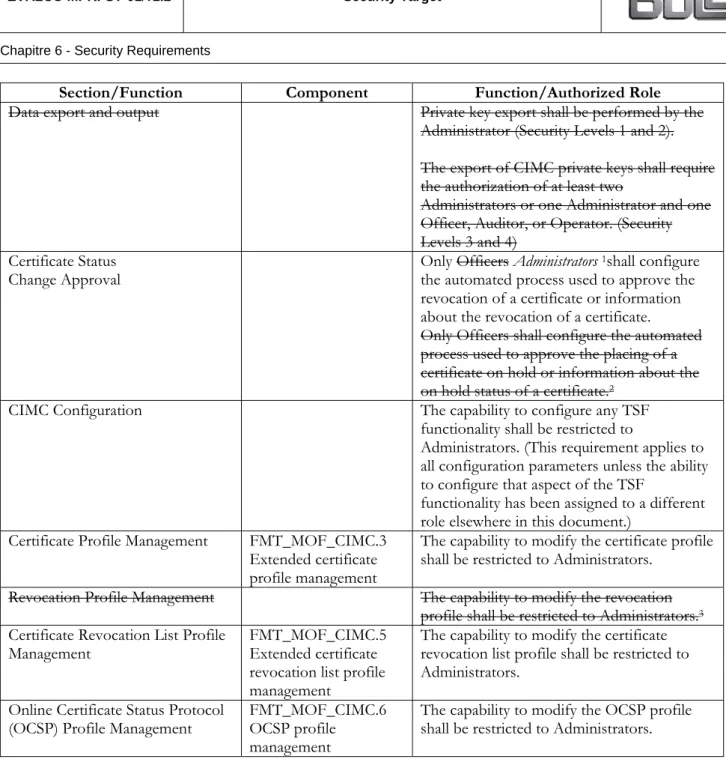
FMT_MOF.1.1 The TSF shall restrict the ability to modify the behavior of the functions listed in
Table 2 – Authorized Roles for Management of Security Functions Behavior
to the authorized roles as specified in Table 2 – Authorized Roles for Management of Security Functions Behavior.
Section/Function Component Function/Authorized Role Security Audit The capability to configure the audit
parameters shall be restricted to
Administrators. The capability to change the frequency of the audit log signing event shall be restricted to Administrators.
Backup and Recovery The capability to configure the backup parameters shall be restricted to Administrators.
The capability to initiate the backup or recovery function shall be restricted to Administrators.
Certificate Registration The capability to approve fields or extensions to be included in a certificate shall be
restricted to Officers.
If an automated process is used to approve fields or extensions to be included in a certificate, the capability to configure that process shall be restricted to Officers.
Chapitre 6 - Security Requirements
Section/Function Component Function/Authorized Role Data export and output Private key export shall be performed by the
Administrator (Security Levels 1 and 2). The export of CIMC private keys shall require the authorization of at least two
Administrators or one Administrator and one Officer, Auditor, or Operator. (Security Levels 3 and 4)
Certificate Status
Change Approval Only Officers Administrators 1shall configure the automated process used to approve the revocation of a certificate or information about the revocation of a certificate.
Only Officers shall configure the automated process used to approve the placing of a certificate on hold or information about the on hold status of a certificate.2
CIMC Configuration The capability to configure any TSF functionality shall be restricted to
Administrators. (This requirement applies to all configuration parameters unless the ability to configure that aspect of the TSF
functionality has been assigned to a different role elsewhere in this document.)
Certificate Profile Management FMT_MOF_CIMC.3 Extended certificate profile management
The capability to modify the certificate profile shall be restricted to Administrators.
Revocation Profile Management The capability to modify the revocation profile shall be restricted to Administrators.3 Certificate Revocation List Profile
Management FMT_MOF_CIMC.5 Extended certificate revocation list profile management
The capability to modify the certificate revocation list profile shall be restricted to Administrators.
Online Certificate Status Protocol
(OCSP) Profile Management FMT_MOF_CIMC.6 OCSP profile management
The capability to modify the OCSP profile shall be restricted to Administrators.
Table 2 – Authorized Roles for Management of Security Functions Behavior
Coverage rationale of PP CIMC: in table above some rows have been kept but have been bared in this ST since they are not applicable to this TOE (MetaPKI does not allow the export of CIMC private keys, and only support one revocation profile).
1
The ability to configure validation process of the revocation requests is restricted to the Administrators, through the configuration of the validation workflows.
Chapitre 6 - Security Requirements
FMT_MSA.1 Management of security attributes
Hierarchical to: No other components. Dependencies:
FDP_ACC.1 Subset access control
FMT_SMR.2 Restrictions on security roles
FMT_SMF.1 Specification of Management Functions
FMT_MSA.1.1 The TSF shall eSnforce the CIMC TOE Access Control Policy to restrict the
ability to change_default, query, modify, delete the security attributes entities, users,certificate profiles, workflows to Administrators.
Coverage rationale of PP CIMC: this SFR was applicable to the TOE environment in PP CICM. For consistency reasons, it has been included as applicable to the TOE in this ST.
FMT_MSA.3 Static attribute initialisation
Hierarchical to: No other components. Dependencies:
FMT_MSA.1 Management of security attributes
FMT_SMR.2 Restrictions on security roles
FMT_MSA.3.1 The TSF shall enforce the CIMC TOE Access Control Policy to provide
restrictive default values for security attributes that are used to enforce the SFP.
FMT_MSA.3.2 The TSF shall allow the Administrators to specify alternative initial values to
override the default values when an object or information is created.
Coverage rationale of PP CIMC: this SFR was applicable to the TOE environment in PP CICM. For consistency reasons, it has been included as applicable to the TOE in this ST.
FMT_MTD.1 Management of TSF data (Iteration 1)
Hierarchical to: No other components. Dependencies:
FMT_SMR.2 Restrictions on security roles
FMT_SMF.1 Specification of Management Functions
FMT_MTD.1.1 The TSF shall restrict the ability to query, modify, delete, import / export the
entities, users,certificate profiles to Administrators.
Coverage rationale of PP CIMC: this SFR was applicable to the TOE environment in PP CICM. For consistency reasons, it has been included as applicable to the TOE in this ST.
Chapitre 6 - Security Requirements
FMT_MTD.1 Management of TSF data (Iteration 2)
Hierarchical to: No other components. Dependencies:
FMT_SMR.2 Restrictions on security roles
FMT_SMF.1 Specification of Management Functions
FMT_MTD.1.1 The TSF shall restrict the ability to query, delete and export the audit logs to
Auditors.
Coverage rationale of PP CIMC: this SFR was applicable to the TOE environment in PP CICM. For consistency reasons, it has been included as applicable to the TOE in this ST.
6.1.3 Backup and recovery
Backup and recovery includes reconstructing a system in the event of a system failure or other serious error.
In order to be able to recover from failures and other unanticipated undesired events, CIMCs must be able to back up the system. The backup will be used to restore the CIMC to an operational status at a previous point in time. The frequency of performing backups (e.g., hourly, daily, or weekly) is based on the criticality of the application or system.
FDP_CIMC_BKP.1 CIMC backup and recovery
Hierarchical to: No other components. Dependencies:
FMT_MOF.1 Management of security functions behavior
FDP_CIMC_BKP.1.1 The TSF shall include a backup function.
FDP_CIMC_BKP.1.2 The TSF shall provide the capability to invoke the backup function on demand. FDP_CIMC_BKP.1.3 The data stored in the system backup shall be sufficient to recreate the state of the
system at the time the backup was created using only:
a) a copy of the same version of the CIMC as was used to create the backup data; b) a stored copy of the backup data;
c) the cryptographic key(s), if any, needed to verify the digital signature, keyed hash, or authentication code protecting the backup; and
d) the cryptographic key(s), if any, needed to decrypt any encrypted critical security parameters.
FDP_CIMC_BKP.1.4 The TSF shall include a recovery function that is able to restore the state of the
system from a backup. In restoring the state of the system, the recovery function is only required to create an “equivalent” system state in which information about all relevant CIMC transactions has been maintained.
Chapitre 6 - Security Requirements
FDP_CIMC_BKP.2 Extended CIMC backup and recovery
Hierarchical to: No other components. Dependencies:
FDP_CIMC_BKP.1 CIMC backup and recovery
FDP_CIMC_BKP.2.1 The backup data shall be protected against modification through the use of digital
signatures, keyed hashes, or authentication codes.
FDP_CIMC_BKP.2.2 Critical security parameters and other confidential information shall be stored in
encrypted form only.
6.1.4 Access Control
FDP_ACC.1 Subset access control
Hierarchical to: No other components. Dependencies:
FDP_ACF.1 Security attribute based access control
FDP_ACC.1.1 The TSF shall enforce the CIMC TOE Access Control Policy on.
Subjects (human users / external entities) Administrators
Officers
Auditors
Final user / certificate holder
Security attributes for subjects: subject identifier, subject internal reference number, membership to a group
Objects
Certificates (operations: request for a certificate, revocation of a certificate, publication / export of a certificate)
Private Key (operations: request for the generation of a key pair, private key escrow/recovery)
CRLs (operations: request generation and export/publication (=1 op))
Audit logs (operations: view/export, delete)
FDP_ACF.1 Security attribute based access control
Hierarchical to: No other components. Dependencies:
Chapitre 6 - Security Requirements
FMT_MSA.3 Static attribute initialisation
FDP_ACF.1.1 The TSF shall enforce the CIMC TOE Access Control Policy to objects based
on the following: the identity of the subject and the set of roles that the subject is authorized to assume.
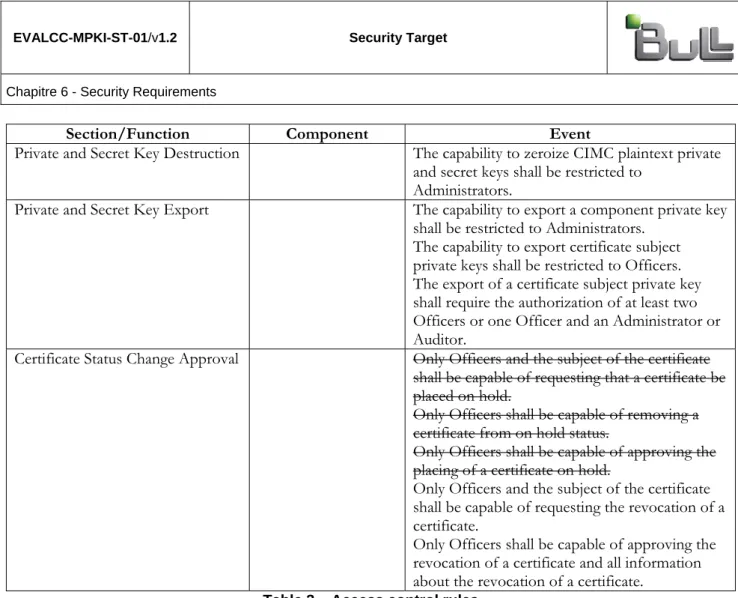
FDP_ACF.1.2 The TSF shall enforce the following rules to determine if an operation among
controlled subjects and controlled objects is allowed: rules specified in Table 3 – Access control rules.
FDP_ACF.1.3 The TSF shall explicitly authorise access of subjects to objects based on the
following additional rules: no additional rule.
FDP_ACF.1.4 The TSF shall explicitly deny access of subjects to objects based on the following
additional rules: no explicit denial rule.
Section/Function Component Event
Certificate Request Remote and Local Data Entry
The entry of certificate request data shall be restricted to Officers and the subject of the requested certificate.
Certificate Revocation Request
Remote and Local Data Entry The entry of certificate revocation request data shall be restricted to Officers and the subject of the certificate to be revoked.
Data Export and Output The export or output of confidential and security-relevant data shall only be at the request of authorized users.
Key Generation The capability to request the generation of Component keys (used to protect data in more than a single session or message) shall be restricted to Administrators.
Private Key Load The capability to request the loading of Component private keys into cryptographic modules shall be restricted to Administrators. Private Key Storage The capability to request the decryption of
certificate subject private keys shall be restricted to Officers.
The TSF shall not provide a capability to decrypt certificate subject private keys that may be used to generate digital signatures.
At least two Officers or one Officer and an Administrator, Auditor, or Operator shall be required to request the decryption of a certificate subject private key.
Trusted Public Key Entry,
Deletion, and Storage The capability to change (add, revise, delete) the trusted public keys shall be restricted to Administrators.
Secret Key Storage The capability to request the loading of CIMC secret keys into cryptographic modules shall be restricted to Administrators.
Chapitre 6 - Security Requirements
Section/Function Component Event
Private and Secret Key Destruction The capability to zeroize CIMC plaintext private and secret keys shall be restricted to
Administrators.
Private and Secret Key Export The capability to export a component private key shall be restricted to Administrators.
The capability to export certificate subject private keys shall be restricted to Officers. The export of a certificate subject private key shall require the authorization of at least two Officers or one Officer and an Administrator or Auditor.
Certificate Status Change Approval Only Officers and the subject of the certificate shall be capable of requesting that a certificate be placed on hold.
Only Officers shall be capable of removing a certificate from on hold status.
Only Officers shall be capable of approving the placing of a certificate on hold.
Only Officers and the subject of the certificate shall be capable of requesting the revocation of a certificate.
Only Officers shall be capable of approving the revocation of a certificate and all information about the revocation of a certificate.
Table 3 – Access control rules
FPT_RVM.1 Non-bypassability of the TSP
This requirement does not exist anymore in CC V3.1; it is covered by assurance component ADV_ARC.1
6.1.5 Identification and Authentication
FIA_UAU.1 Timing of authentication
Hierarchical to: No other components. Dependencies:
FIA_UID.1 Timing of identification
FIA_UAU.1.1 The TSF shall allow download the CRL, CA and code signing certificates
download and OCSP request processing on behalf of the user to be performed before the user is authenticated.
FIA_UAU.1.2 The TSF shall require each user to be successfully authenticated before allowing
Chapitre 6 - Security Requirements
FIA_UID.1 Timing of identification
Hierarchical to: No other components. Dependencies: No dependencies.
FIA_UID.1.1 The TSF shall allow the download of the CRL, CA and code signing
certificates and OCSP request processing on behalf of the user to be performed before the user is identified.
FIA_UID.1.2 The TSF shall require each user to be successfully identified before allowing any
other TSF-mediated actions on behalf of that user.
FIA_USB.1 User-subject binding
Hierarchical to: No other components. Dependencies:
FIA_ATD.1 User attribute definition
FIA_USB.1.1 The TSF shall associate the following user security attributes with subjects acting
on the behalf of that user: user certificate hash.
FIA_USB.1.2 The TSF shall enforce the following rules on the initial association of user security
attributes with subjects acting on the behalf of users: [no rules].
FIA_USB.1.3 The TSF shall enforce the following rules governing changes to the user security
attributes associated with subjects acting on the behalf of users:
Upon renewal of the user certificate, the new certificate does not automatically grant the same rights than the previous one; if it is still valid and non-revoked, the former certificate is kept and continues granting the same rights. The same rights have to be propagated by an Administrator. FIA_ATD.1 User attribute definition
Hierarchical to: No other components. Dependencies: No dependencies.
FIA_ATD.1.1 The TSF shall maintain the following list of security attributes belonging to
individual users:
Identifier
Certificate Hash
Reference number (optional) Role
Application note: MetaPKI implements roles through groups of rights.
Coverage rationale of PP CIMC: this SFR was applicable to the TOE environment in PP CICM. For consistency reasons, it has been included as applicable to the
Chapitre 6 - Security Requirements
6.1.6 Remote Data Entry and Export
FCO_NRO_CIMC.3 Enforced proof of origin and verification of origin
Hierarchical to: FCO_NRO.2 Dependencies:
FIA_UID.1 Timing of identification
FCO_NRO_CIMC.3.1 The TSF shall enforce the generation of evidence of origin for certificate status
information and all other security-relevant information at all times.
FCO_NRO_CIMC.3.2 The TSF shall be able to relate the identity and [no other attributes] of the
originator of the information, and the security-relevant portions of the information to which the evidence applies.
FCO_NRO_CIMC.3.3 The TSF shall verify the evidence of origin of information for all security-relevant
information.
FDP_ITT.1 Basic internal transfer protection
Hierarchical to: No other components. Dependencies:
FDP_ACC.1 Subset access control
FDP_ITT.1.1 The TSF shall enforce the CIMC TOE Access Control Policy to prevent the
disclosure and modification of user data when it is transmitted between
physically-separated parts of the TOE.
Coverage rationale of PP CIMC: PP CIMC which was drafted in CC version 2.1 includes two iterations of FDP_ITT.1. The present formulation of the requirement covers these two former iterations:
iteration 1 : was intended to prevent modification of security relevant user data
iteration 2 : was intended to prevent disclosure of confidential user data
Coverage rationale of PP CIMC: This requirement is only kept in this ST for the record. It is not applicable to the TOE since the TOE is not made of physically-separated parts.
FDP_UCT.1 Basic data exchange confidentiality
Hierarchical to: No other components. Dependencies:
[FPT_ITC.1 Inter-TSF confidentiality during transmission, or FTP_TRP.1 Trusted path]
FDP_ACC.1 Subset access control
FDP_UCT.1.1 The TSF shall enforce the CIMC TOE Access Control Policy to transmit user