Universität Stuttgart
Institute of Parallel and Distributed Systems (IPVS) Universitätsstraße 38 D-70569 Stuttgart
DEBS Tutorial: Software-defined Networking
“Event-based systems meet SDN”
Boris Koldehofe, Frank Dürr, Muhammad Adnan Tariq University of Stuttgart
Universität Stuttgart IPVS Research Group
“Distributed Systems”
Overview
1.
Event-based System view on SDN2.
Introduction into Software-Defined Networks (SDN)3.
Illustrating the Power of SDN in the context of Event-Based Systems4.
Implementation & Testing of SDNOverview
1.
Event-based System view on SDN•
Requirements•
Shaping the network•
How SDN helps2.
Introduction into Software-Defined Networks (SDN)3.
Illustrating the Power of SDN in the context of Event-Based SystemsUniversität Stuttgart IPVS Research Group “Distributed Systems”
Event-Based Systems
•
Large-scale deployment◦
Integrates many consumer and producers◦
Intelligent bus that allows for processing events in real-time•
Many critical applications◦
Traffic monitoring, smart grid, logistics4
Factory Transporter warehouse
Basic events
Requirements
•
Efficient resource utilization◦
bandwidth◦
Processsing•
High Throughput•
Low latency◦
Processing and communication◦
Soft Real-Time RequirementsFactory Transporter warehouse
Universität Stuttgart IPVS Research Group
“Distributed Systems”
Typical problems impacting efficiency
•
Matching algorithms◦
Filter, Aggregation, Sequence•
Routing◦
Best path from publisher to consumer•
Placement◦
Minimize bandwidth utilization◦
Low latency response6 Network Filter, Operator Input Streams Output Streams
P
C
How event-based systems deal with networks
•
Most event-based systems realized as acommunication middleware
◦
Builds on transport protocols: TCP, UDP◦
Network topology is transparent•
Middleware observes characteristics of the network and reacts to it◦
Monitor network characteristic◦
Dynamic network map▪
E.g. Vivaldi Communication Middleware Network B2 B1 Low/High Latency MonitoringUniversität Stuttgart IPVS Research Group
“Distributed Systems”
Naive Idea: Shape the network
Determine routes of packets at the network layer to match demand of services
Key benefits:
•
Increase resource usage and performance◦ Services at lower cost possible
◦ Switching in
•
Improve predictability of performance◦ Verification, Stability
•
Benefit from network operations◦ Built-in operations of routers and switches
◦ Processing of packets
Example: Publish/Subscribe
•
Overlay network◦
Messages are transmitted multiple times◦
Increased path length•
Forwarding implemented in software◦
Reduces throughput, increases latencyPublisher:
Notification(stock value = $500)
Subscriber:
stock value > $450
Universität Stuttgart IPVS Research Group
“Distributed Systems”
Example: Publish/Subscribe
•
Shaping the network◦
Reduces number of messages◦
Faster filtering in Hardware◦
Shorter paths 10 Publisher: Notification(stock value = $500) Subscriber: stock value > $450 Subscriber: stock value > $420 No Duplicates!B
Hardware Fitering!Many obstacles
•
Accessing the hardware and utilizing different protocols•
Configuration of the network•
Dynamic Network managementHigh inflexibility currently has prevented advancements in efficiency and robustness of networked applications
Universität Stuttgart IPVS Research Group
“Distributed Systems”
Limited Flexibility: Access to hardware
Raises Two Concerns:
1.
No direct access to the network devices→ Requires new abstractions to access switches
◦
Google Compute Engine provides access to a simple router◦
Network Virtualization2.
Black box design of switches◦
Standard and proprietary protocols (hardcoded)◦
No changes without support of the manufacturer◦
Switches and routers become more open and programmableLimited Flexibility: Programming
•
What if the switch/router hardware is open?Adding new protocols or network control logic is complex
•
Have you ever written a Linux kernel module?◦
Compare this to programming a user-space application•
Have you ever used VERILOG?◦
Compare this to C/C++, Java, Python, …•
Have you ever targeted an embedded device?Universität Stuttgart IPVS Research Group
“Distributed Systems”
Limited Flexibility: Automated Management
•
Networked systems became highly dynamic◦
Event-based systems▪
Dynamic data sources, changes in interest, load variations◦
Datacenter network▪
Dynamic set of VMs with dynamic locations (hosts), variable traffic patterns, heterogeneous QoS demands, etc.•
Manual configuration not possible anymore◦
Automatic configuration and provisioning of network resources•
Fixed set of policies to configure the network does not sufficientanymore
Overcoming these Problems with
Software-defined Networking (SDN)
Software defined-networking leverages increased flexibility
•
Easy modification of the network control logic◦
From “hard-coded” logic to exchangeable software•
High-level programming languages◦
For implementation of logic◦
To benefit from powerful integrated developing environments•
API to “program” the networkUniversität Stuttgart IPVS Research Group
“Distributed Systems”
Software-defined Networking: Features
•
Reduced switch complexity◦
Remove control logic from switch and host it on servers◦
Preserve same forwarding performance!▪ Switch still supports forwarding in hardware
•
Integrated system view: application & network◦
Global view onto the system▪ Application state and network state
•
Reducing the complexity of implementing control logic◦
Distribution transparency 16 Intelligence Network Compute ServerSDN in a nutshell
•
SDN is a paradigm to program networks at a high-level◦
Utilzes pradigm of centralized control to program the switches and routers of the network“Think of it as a general language or an instruction set that lets me write a control program for the network rather than having to
Universität Stuttgart IPVS Research Group
“Distributed Systems”
Historic Notes
•
Flexible network management tools◦
E.g. for ATM switches◦
Failed to involve vendors of switches◦
Not targeted at IP•
OpenFlow standard key driver◦
Evolved from Stanford University◦
Currently developed by Opennetwork Foundation◦
Defines the interface to control a network of switches◦
Expected to be supported by most of next generation switches•
Real-world deployment◦
Datacenter, Internet-Service ProviderTremendous Industrial Interest
•
>100 members and many key players•
Manufacturer of switches, telecommunication operators•
Supporter and operator of data centerUniversität Stuttgart IPVS Research Group
“Distributed Systems”
Supports dealing in a flexible manner with a
huge number of protocols and standards
SDN is already in use
•
Google◦
Isolate user and data replication services▪ Famous talk by Urs Hölzl
•
Network virtualization◦
Establish independent flows for services•
Reduce overhead in large data center◦
Address resolution protocol (ARP)◦
Avoid frequent flooding by movingUniversität Stuttgart IPVS Research Group
“Distributed Systems”
Not everything solved by SDN straight away
Although Control is logically centralized many issues involved in achieving consistent control
•
Requires revisiting key results of Distributed Systems research◦ Consistent scalable reconfigurations (recall the famous CAP theorem)
•
Methods and protocols for efficient networked applications◦ Utilize the benefits of SDN to achieve high performant middleware
◦ E.g. line-rate publish/subscribe with matching in
•
Networking abstractions◦ leverage SDN to wide area networks
•
Methods for design and verification of networked applications22
Gaining scientific impact
0 100 200 300 400 500 600 700 800 900 2000 2001 2002 2003 2004 2005 2006 2007 2008 2009 2010 2011 2012 2013 P2P SDN Publish/SubscribeUniversität Stuttgart
Institute of Parallel and Distributed Systems (IPVS) Universitätsstraße 38 D-70569 Stuttgart
Overview
1.
Event-based System view on SDN2.
Introduction into Software-Defined Networks (SDN)3.
Illustrating the Power of SDN in the context of Event-Based SystemsUniversität Stuttgart IPVS Research Group
“Distributed Systems”
Overview
1.
A view on networks from EBM2.
Introduction into Software-Defined Networks (SDN)•
Concepts•
Architecture•
Northbound Interface: Control•
Southbound Interface: OpenFlow3.
Illustrating the Power of SDN in the context of Event-Based Systems4.
Implementation & Testing of SDNBasic concepts
Key problems addressed by SDN:
•
Simple definition of communication relations between hosts•
Control and data plan separation•
Logically centralized controlUniversität Stuttgart IPVS Research Group
“Distributed Systems”
Flow-based Forwarding
Forwarding defined on flows rather than only IP or MAC addresses
•
Theoretically: any information of a packet that identifies a communication relation•
Practically: combinations of selected layer 2 to 4 header fields◦ Example: IP + Ports + TCP/IP protocol ids
•
Fine-grained forwarding of selected flows or coarse-grained aggregationElephant flow of backup service
All other traffic from H1 to H2 H1
Control Plane and Data Plane Separation
•
Control plane: defines routes, manages network graph•
Data plane: forwarding of packetsControl Plane Data Plane Data Plane Data Plane Data Plane Data Plane Control Logic Control Logic Control Logic
Universität Stuttgart IPVS Research Group
“Distributed Systems”
Control Plane
Logically Centralized Controller
30 Data Plane Data Plane Data Plane Data Plane Data Plane Control Logic Control Logic Control Logic physically distributed logically centralized
Architecture of an SDN System
Controller Control Logic Northbound Interface Southbound Interface Control Logic Control LogicUniversität Stuttgart IPVS Research Group “Distributed Systems”
Components (1)
Switches/Routers• Implement data plane: packet forwarding
◦ Manages forwarding information base • Typically multi-layer switches
◦ Forwarding based on layer 2-4 headers • Hardware switches
◦ Hardware support for fast matching
▪ Ternary content-addressable memory (TCAM)
• Software switches
◦ Used in datacenters to connect multiple virtual machines to physical interface of host
◦ Example: Open vSwitch [http://openvswitch.org/]
• Hybrid switches: Implement SDN & standard L2/L3 forwarding
Components (2)
SDN Controller
• Process executed on external host • Implements control plane
◦ Routing information base / Routing table
◦ Management of network graph (topology, traffic) • Implements southbound interface to switches
◦ Configuration of forwarding tables
◦ Events from switch (packet-in)
◦ Collection of traffic statistics
• Interfaces with control logic via northbound interface(s)
◦ No standard, but dedicated controller exist for high-level programming
◦ NOX (C/Python), Beacon (Java; OSGi, HTTP/REST), Floodlight (Java, Controller Northbound Interface Southbound Interface
Universität Stuttgart IPVS Research Group “Distributed Systems”
Components (3)
Control Logic•
Defines routes◦
Proactive and reactive routing•
Might interface with other information sources◦
Example: Virtual machine manager (locations of VMs on hosts)34 Control Logic Control Logic Control Logic
Control Plane Distribution
•
Controller can be physically distributed in various ways◦
No standard way of distribution defined•
Logical centralization: distribution transparent to control logic◦
Allows global view onto the system•
Goal:◦
Deal with failures◦
Increase scalabilityUniversität Stuttgart IPVS Research Group
“Distributed Systems”
Control Plane Distribution: Replication
36
Primary (Master)
Secondary (Slave, on standby)
Reduces downtime for reconfigurations
- e.g. deploy new subscriptions
Control Plane Distribution: Partitioning
Part 1 Part 2 coordination Support large-scale deployment - Raises issues similar to P2P networks - Knowledge about neighborhood - Coordination and consistencyUniversität Stuttgart IPVS Research Group
“Distributed Systems”
Southbound Interface: The OpenFlow Protocol
38 Controller Control Logic Northbound Interface Southbound Interface Control Logic Control Logic OpenFlow
The OpenFlow Protocol: Overview
•
OpenFlow de facto standard for southbound interface•
Defined by Open Networking Foundation◦
Major vendors(Cisco, IBM, NEC, HP, Alcatel-Lucent, VMWare, …)
•
Interface to a single switch◦
No aspects of control plane distribution defined•
Basic functionality◦
Modification of flow tables (adding, removing, modifying entries)◦
Events for receiving packets (reactive routing)Universität Stuttgart IPVS Research Group
“Distributed Systems”
OpenFlow: A mature standard?
Note: That OpenFlow is still quickly evolving
•
Many switches and controller still only implement OpenFlow 1.0!◦
No support for IPv6 addresses, limited matching capabilities, …•
The following descriptions are based on OpenFlow 1.3.◦
New development most likely to focus on 1.3Architecture of an OpenFlow System
OpenFlow Switch Channel Controller Group Table Flow Table Flow Table … Southbound Interface Channel OpenFlow Protocol pipeline TCP optional: TLS/SSL for authentication & encryption Switch connects to standard port: 6633Universität Stuttgart IPVS Research Group
“Distributed Systems”
OpenFlow Switch
The Way of a Packet through a Switch
42
Flow Table 0
Packet Table 1Flow Table Flow ExecuteActions
n Packet … packet, ingress port, actions = {} ingress port, packet, meta data, actions packet, actions in out
Flow Tables & Flow Entries
• Flow tables consist of a list of flow entries
• Flow entry:
◦ Match field: Defines matching packets
◦ Priority: Precedence of matching if multiple
entries match
◦ Counters: Counts matches
◦ Instructions:
▪ Modify action set and meta data
▪ Forward to other tables (or stop)
◦ Timeouts: Removes entry after a certain (idle)
time
◦ Cookie: filtering of flow modifications and
statistics; not used in packet processing
Flow Table
Entry Entry
Entry
Universität Stuttgart IPVS Research Group
“Distributed Systems”
One Step in the Pipeline
1.
Find highest priority matching entry, say e2.
Apply instructions of e:◦
Update packet◦
Update action set◦
Update meta data3.
Goto next tableif defined by instructions or execute action set
44 Flow Table Entry Entry Entry … ingress port, packet, meta data, actions ingress port, packet’, meta data’, actions’
Match Fields
Subset of L2-4 header fields
•
10 tuple (must be supported)◦
More (optional) fields existNote: hardware switches might only support
hardware-accelerated matching on some combinations!
◦
Rest goes the “slow path“Ingress Port
Ether Src Ether Dst VLAN ID Ether Type
IP SRC IP DST IP PROTO
TCP/UDP SRC TCP/UDP SRC
• Specifies layer 3
protocol
• E.g, 0x0800 = IPv4
• Specifies layer 4 protocol
Universität Stuttgart IPVS Research Group
“Distributed Systems”
Wildcard Matching (1)
•
Not all fields need to be specified: Wildcard *◦
Matches any value•
For IP addresses, bitmasks can be specified (CIDR)◦
Example: Subnet mask of IPv4 address 192.168.1.1/24 (netmask 255.255.255.0) In Port Eth Src Eth Dst Eth Type VLAN ID IP SRC IP DST IP Proto Src Port Dst Port * * * 0x0800 (IPv4) * * 10.2.3.4 6 (TCP) * 80 2 * * * 42 * * * * * * * * 0x0800 (IPv4) * * 10.1.2.3 * * *All traffic to a certain web server (port 80) Traffic of a certain VLAN from a certain port
Wildcard Matching (2)
•
Hardware switches can perform very fast matching using Content Addressable Memory (CAM)◦
Parallel matching of all entries in one cycle•
Two types of CAM◦
Binary CAM (BCAM): ordinary bits 0, 1▪ Good for exact match
◦
Ternary CAM (TCAM): ordinary bits + wildcard (don‘t care) 0,1, *▪ Implementation of longest prefix match on IP addresses
•
Drawbacks: Consumes significant energy, silicon space◦
Limited memory size in switchesUniversität Stuttgart IPVS Research Group
“Distributed Systems”
Actions
•
Output: output packet on the specified port•
TTL modifications◦
Decrement TTL, copy TTL outwards/inwards•
Push and pop tags◦
Add or remove VLAN/MPLS/PBB tags to/from the packet•
Set header fields◦
Example: IP-address re-writing•
Group actions◦
Example: MulticastOrder of execution of actions is well-defined by action type
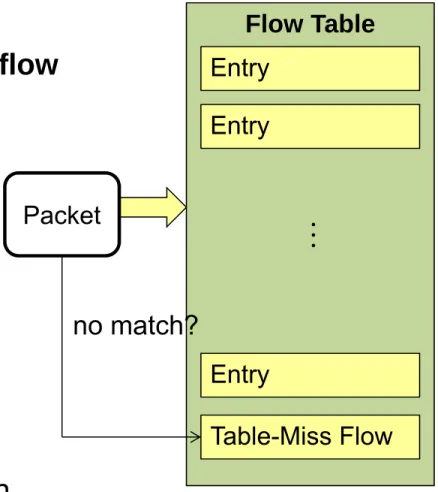
Table Misses
Important for reconfigurations
•
Each table supports a table-miss flow entry◦
Lowest priority◦
Matches all packets•
Possible actions (at least):
◦
Drop
◦
Send to controller
•
If no table-miss entry is defined◦
Drop packet (default)◦
Or define another default actionFlow Table Entry Entry Entry … no match? Table-Miss Flow Packet
Universität Stuttgart IPVS Research Group
“Distributed Systems”
Proactive vs Reactive Routing
•
Routes defined by a set of flow table entries◦
Along the path of packets•
So far, we know what a flow table entry contains•
Question now: When to set up flow table entries?•
Two options:◦
Proactively: before the flow starts◦
Reactively: as soon as the flow starts50
Controller
Proactive Routing
Controller proactively “pushes“ flow table entries onto switches
•
Advantage: Reduces controller load◦
No reactive handling of packets•
Disadvantage: Occupied space in flow table◦
Even without traffic◦
Size of flow table is limited!▪ thousands to hundred thousand entries
Controller
add entry add entry
Universität Stuttgart IPVS Research Group
“Distributed Systems”
Proactive Routing Example
Pub/Sub middleware
•
Sender sends advertisements to controller•
Receiver sends subscriptions to controller•
Controller calculates distribution tree◦
Before notifications are flowing•
Relieves controller from bursts of notifications!52
Publisher:
Will send stock values
Subscriber:
Want stock values > $450
Subscriber:
Want stock values > $420
Controller
Reactive Routing (1)
•
Switch receives a packet without matching flow table entry•
Switch redirects packet (header) to controller◦
Open flow packet_in event at controller◦
Forwarded to control logic•
Controller calculates route◦
Option 1: Install flow table entries along path▪
Further packets of flow don‘t involve controller◦
Option 2: Just forward packet (no flow table entry set)▪
Next packet of flow is again redirected to controllerController
Missed packets
New flows + packets
Universität Stuttgart IPVS Research Group
“Distributed Systems”
Reactive Routing (2)
•
Advantage: Saves flow table space•
Disadvantage: Puts load onto controller and control network◦
Bottleneck for reconfigurations▪
May vary for TCP and UDP▪
TCP: Sender blocked until connection setup is done▪
UDP can send at full rate immediately (without warning)!Reactive Routing: Use Cases
Reactive calculation of dissemination tree
•
Controller executes Dijkstra‘s algorithm on demand•
Sets up source-based multicast treeController
sender
Universität Stuttgart IPVS Research Group
“Distributed Systems”
Reactive Routing: Use Cases
Reactive calculation of dissemination tree
•
Controller executes Dijkstra‘s algorithm on demand•
Sets up source-based multicast tree56
Controller
sender
receiver
Summary
Key concepts and benefits of SDN:
• Flow-based forwarding
◦ Enables fine-grained treatment of flows • Control/data plane separation
◦ High flexibility without sacrificing performance
▪ Ease of adding and changing control logic via dedicated controller
▪ Fast forwarding in hardware by switches
◦ Simpler switches through “outsourcing“ of control logic • Logically centralized view
◦ Ease of implementation through distribution transparency
◦ Global optimization
Universität Stuttgart
Institute of Parallel and Distributed Systems (IPVS) Universitätsstraße 38 D-70569 Stuttgart
Towards high per formant event-based
systems
Overview
1.
A view on networks from EBM2.
Introduction into Software-Defined Networks (SDN)3.
Illustrating the Power of SDN in the context of Event-Based Systems◦
Motivation◦
Reference Architecture for Content Routing in the Future Internet◦
Line-Rate Publish/Subscribe in OpenFlow◦
Research Challenges and ConclusionsUniversität Stuttgart IPVS Research Group “Distributed Systems”
Event-based communication
•
Applications react asynchronously to events•
Selective interest in information•
Minimize communicationand processing load in brokering events
•
Offer high responsivenessFactory Transporter warehouse
Basic events
Traffic Jam
Publish/Subscribe Systems
•
Selective dissemination of information•
Broker overlay for disseminationTopic based
Information divided into topics
Content based
Restrictions on message content { Traffic = any ^ Distance < 100km }
P P P S S S Traffic M81? Traffic M6? Traffic M8? Danger in Danger in Mannheim Broker Overlay S S S P P P
Universität Stuttgart IPVS Research Group “Distributed Systems”
Publish/Subscribe vs IP-Multicast
•
Content-Routing+
Minimize network utilization-
Matching overhead in each hop at application layer-
Unawareness of network topology•
IP-Multicast+
Line-rate processing in the routers+
Good adaptation to network topology-
no large diversity in streams62
bandwidth
responsiveness
BUT: Multicast can provide far better responsiveness
vs.
Trends towards Line Rate Publish/Subscribe
•
Improve QoS by network monitoring◦
Improves network awareness and responsiveness•
Specific Hardware + network Configurations◦
Net FPGA◦
LIPSINBut no Interoperability at Internet-scale!
•
No standards expected to be available soonUniversität Stuttgart IPVS Research Group “Distributed Systems”
Outline
•
Motivation•
Reference Architecture for Content Routing in the Future Internet•
Line-Rate Publish/Subscribe in OpenFlow•
Challenges and ConclusionsNew technologies with impact on approaches
Potential to change middleware deployment in the Future
Internet
1.
Software-defined Networking
◦
Supported by next generation switches▪
Massive interest by industry, e.g. Cisco featuring OpenFlow◦
Switches become configurable by separation of control and data plane2.
Network Virtualization
◦
Allows application-centric configuration of networks◦
Isolation between multiple applicationsUniversität Stuttgart IPVS Research Group “Distributed Systems”
Network Virtualization
◦
Dimensioned according to application needs,◦
E.g. bandwidth, latency•
OpenFlow perfect abstractionto configure virtual networks
◦
Easy mapping of flows to physical switches⇒ Preserve performance also for virtual switches
66 Internet Service Provider Virtual Network S P P S P P S S P Publisher S
Subscriber Virtual Switch
offer virtual Network resources
Universität Stuttgart IPVS Research Group “Distributed Systems”
Outline
•
Motivation•
Reference Architecture for Content Routing in the Future Internet•
Line-Rate Publish/Subscribe in OpenFlow•
Research Challenges & ConclusionApproache Overview
Channelization
•
Form dynamically clusters•
A separate flow is created foreach cluster
Filtering
•
Filtering of events within the switch network•
Flows are created according to similarities between subscriptions and advertisements S3 S2 S1 S4 S2 S1 S4 S3 Queries Cluster … … P S1 S2 S7 S6 S6Universität Stuttgart IPVS Research Group
“Distributed Systems”
Modeling Filters in OpenFlow
70
Map subscriptions and events to fields in a flow table
•
Events:◦ Attribute value pairs
◦ Binary string for point in the multi-dimensional event space
•
Advertisement/Subscriptions:◦ Binary string for a subspace
•
String generation based on Spatial Indexing1 10 1010
What fields in a flow table to choose from?
Avoid conflicts with other Internet applications and protocols
In Port VLAN ID Ethernet IP TCP SA DA Type SA DA Proto Src Dst
•
Cannot overwrite whole IP-address range•
Restriction to parts of Multicast ranges (our target to improve)•
IPv6 (ff0e::/8)
•
E.g. Prefix of 28bits leaves
•
100 bits for encoding advertisements,
subscriptions and events
Universität Stuttgart IPVS Research Group “Distributed Systems”
How it works
Subscription/Advertisement1.
Any new subscription/ advertisement is send to IPfix2.
Controller optimizes topology:◦
establishes path to all covered subscribersSending event:
•
Encode event accodring: Ipprefix ∘ BitstringUniversität Stuttgart IPVS Research Group
“Distributed Systems”
Latency dependent on number of suberiber
74
Measured with OpenVSwitches in Data Center Topology
Conclusion and challenges
•
We have shown that it is possible to map content routing to OpenFlows◦
Contribute both bandwidth reduction◦
Responsiveness of event-based applications▪ Switching cost < 4
•
Many research challenges remain◦
Minimizing flow table size◦
Scalable controller, decentralized control and coordination◦
Correct operation and verification◦
Quality of Service (QoS)◦
Virtual network abstractionsUniversität Stuttgart
Institute of Parallel and Distributed Systems (IPVS) Universitätsstraße 38 D-70569 Stuttgart
Testing, Implementation, and Evaluations
Overview
1.
A view on networks from EBM2.
Introduction to Software-Defined Networks (SDN)3.
Illustrating the Power of SDN in the context of Event-Based Systems4.
Implementation & Testing of SDN◦
Evaluation goals◦
Evaluation methodology◦
Setup & Initial ExperienceUniversität Stuttgart IPVS Research Group
“Distributed Systems”
SDN Evaluation
Typical Evaluation Goals:
•
Bandwidth Utilization•
False positive/ False negative rate•
Throughput•
End-to-end latency•
Control overhead•
Reconfiguration timeTesting and evaluation methods
Possibilities:
•
Simulation•
EmulationUniversität Stuttgart IPVS Research Group
“Distributed Systems”
Simulation
•
Many network simulation tools are available◦
NS3, OMNET, …•
Alllow to define large-scale topologies◦
Learn about bandwidth utilization of a concrete network topologies•
Integration of controller not straight forward◦
Own controller•
Hard to evaluate latency related requirements◦
E.g. effects of control in combination with low latency data for•
Controller can later not be utilized for real-world software◦
That‘s why we aimed for a simple programming interfaceEmulation
•
Network emulation◦
Execute protocols as if in a real environment◦
Time-scale for execution can be longer•
OpenFlow supported by Mininet◦
Can model explicit interactions with the controller◦
Ideal for testing control logic•
Drawbacks:◦
Not suitable for throughput and end-to-end latency◦
Not suitable to measure reconfiguration timeUniversität Stuttgart IPVS Research Group
“Distributed Systems”
Testbed
Best to understand real-world scenarios
•
Requires◦ Investment in hardware
◦ Building up a physical topology of switches
•
Hardware determines◦ Number of flows
◦ Support for IPv4 vs IPv6
◦ Switch performance
•
Topology◦ Depends on use-cases, e.g. Data Center
◦ May restrict generality of results
◦ Hard to dertermine scalable scenarios
Design of testbed
•
Significant investment:◦
ca 40.000€ for small data center topologies•
Alternative external providers of testbed◦
European Euphelia Testbed◦
At lower cosrUniversität Stuttgart IPVS Research Group Distributed Systems 84 Switch Host … Frontend OpenFlow controller Topology manager VM manager 4-port NIC Client Host Open vSwitch
Patch panel switch
(managed switch (48 x 1 Gbps port)
VM VM VM VM
4-port NIC
12 hosts (PCs)
Overview Stuttgart Testbed
• Build on comodity hardware
◦ 12 PCs : hosts and vSwitch
◦ Patch panel switch: connectivity between hosts and vSwitches
Client Host Client Host
VM VM VM VM VM VM VM VM
OF controller (on frontend)
control network
Switch Host
Switch Host
Switch Host Switch Host
Switch Host Switch Host
Switch Host Switch Host Switch Host Switch Host
links through patch-panel switch
Universität Stuttgart IPVS Research Group Distributed Systems 86
Role of a controler
Determines• Programming language to write controller
• Supports in aggregating statistics
Many controller implementations are available
• Floodlight (currently most stable)
◦ Java, Python, HTTP/Rest
• Daylight
◦ The potential successor
Many Counters for statistics
Supports many things you want to find out to optimize routes: e.g.
- Number of bytes per flow,
- Number of bytes and dropped messages per port - Link utilization and find bottlenecks
- Errors (e.g., CRC checksum errors) - Find and avoid “bad” links
Universität Stuttgart IPVS Research Group
“Distributed Systems”
Summary
SDN most likely more than a hype:
•
SDN provides high flexibility to program networked applications•
Industry is investing significantly in OpenFlow•
High potential to improve performance of event-based systems◦
delays for delay sensitive applications•
Many interesting research problems◦
Efficient and consistent control algorithms◦
Optimization◦
Design, Modeling and verification◦
Network abstractionsQuestions?
Muhammad Adnan Tariq, Boris Koldehofe, Gerald Koch, and Kurt Rothermel. Distributed spectral cluster management: A method for building dynamic publish/subscribe systems. In Proceedings of the 6th ACM International
Conference on Distributed Event-Based Systems (DEBS 2012).
M. Adnan Tariq, Boris Koldehofe, Gerald Koch, Imran Khan, and Kurt Rothermel. Meeting subscriber-defined QoS constraints in
publish/subscribe systems. In Journal on Concurrency and Computation: Practice and Experience, John Wiley & Sons, Inc., 2011
Boris Koldehofe, Frank Dürr,Muhammad Adnan Tariq and Kurt Rothermel. The Power of Software-defined Networking: Line-rate Content-based Routing Using OpenFlow. In Proceedings of the 7th MW4NG Workshop of the 13th For more info:
http://www.ipvs.uni-stuttgart.de/abteilungen/vs/forschung/projekte/sdn