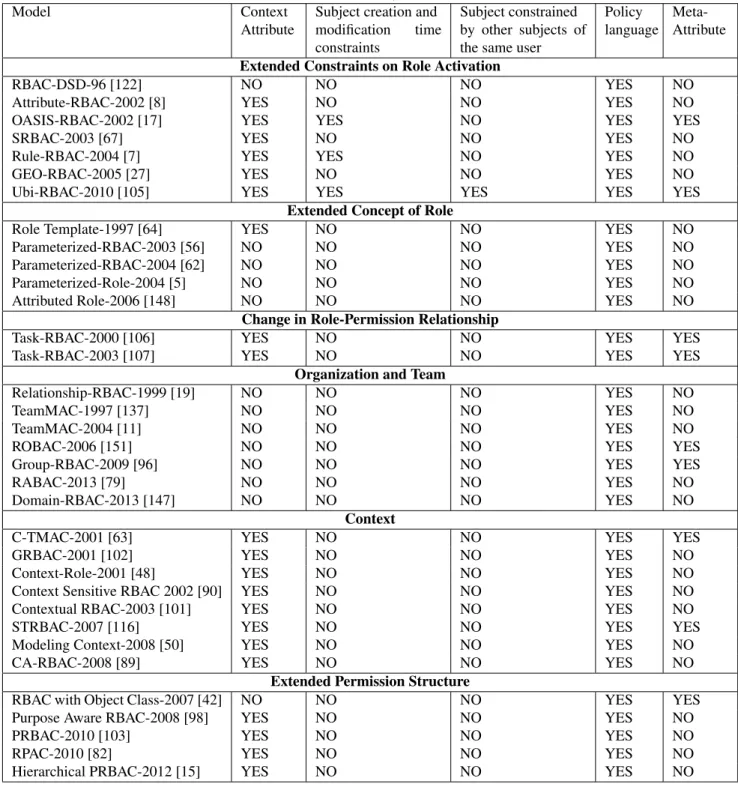
ATTRIBUTE-BASED ACCESS CONTROL MODELS AND IMPLEMENTATION IN CLOUD INFRASTRUCTURE AS A SERVICE
APPROVED BY SUPERVISING COMMITTEE:
Ravi Sandhu, Ph.D., Co-Chair
Ram Krishnan, Ph.D., Co-Chair
Rajendra V. Boppana, Ph.D.
Hugh Maynard, Ph.D.
Jianwei Niu, Ph.D. Accepted:
Copyright 2014 Xin Jin All rights reserved.
DEDICATION
This dissertation is dedicated to all my family, particularly to my wife, Xiaoyan, who patiently support me all the way. I must also thank all my friends.
ATTRIBUTE-BASED ACCESS CONTROL MODELS AND IMPLEMENTATION IN CLOUD INFRASTRUCTURE AS A SERVICE
by
XIN JIN, M.Sc
DISSERTATION
Presented to the Graduate Faculty of The University of Texas at San Antonio
In Partial Fulfillment Of the Requirements
For the Degree of
DOCTOR OF PHILOSOPHY IN COMPUTER SCIENCE
THE UNIVERSITY OF TEXAS AT SAN ANTONIO College of Sciences
Department of Computer Science May 2014
ACKNOWLEDGEMENTS
First, I would like to thank my advisors Prof. Ravi Sandhu and Prof. Ram Krishnan for their professional guidance. Without their help, I could not accomplish my research. They have pro-vided guidance on how to do research and also propro-vided great research topics which motivate me to grow and learn faster. They taught me to learn not only how to find and solve practical technical problems but also how to be a better person in life. They always emphasized that contributing to real world problems is more important than just submitting paper to top conferences, which is one of the most important takeaways from Ph.D life.
Second, I would like to express gratitude to my other committee members Prof. Rajendra V. Boppana, Prof. Hugh Maynard and Prof. Jianwei Niu for their valuable comments and suggestions. Third, I would like to thank my colleagues and friends in the lab. We learned the tools for implementation together and they’ve provided great help when I got stuck in programming issues. Especially, I want to thank Farhan Patwa, director of our lab. Without him, I could not finish the implementation project, which is a crucial part of my dissertation. During this period, I gain industry level experience from which further benefit me in job hunting.
ATTRIBUTE-BASED ACCESS CONTROL MODELS AND IMPLEMENTATION IN CLOUD INFRASTRUCTURE AS A SERVICE
Xin Jin, Ph.D.
The University of Texas at San Antonio, 2014
Supervising Professors: Ravi Sandhu, Ph.D. and Ram Krishnan, Ph.D.
Recently, there has been considerable interest in attribute-based access control (ABAC) to over-come the limitations of the classical access control models (i.e, discretionary-DAC, mandatory-MAC and role based-RBAC) while unifying their advantages. The general idea of ABAC is to determine access control based on the attributes of involved entities. Example user attributes are
department,clearanceandroleand example object attributes aresize,createT imeandowner. Authorization results are computed based on subject and object attributes and authorization poli-cies. As attributes can be engineered to reflect appropriately detailed information about users, subjects and objects, ABAC ensures great flexibility in expressing fine-grained policies which are increasingly required by applications.
There has been considerable prior work for ABAC in various aspects such as formal models, enforcement models, implementation standards, policy composition languages and so on. How-ever, there is no consensus on precisely what is meant by ABAC or the required features of ABAC. There is no widely accepted formal ABAC model as there are for DAC, MAC and RBAC. Ques-tions such as what are the core components and configuration points of ABAC, and how are at-tributes assigned and modified remain to be fully investigated.
In this dissertation, we conduct a systematic study of ABAC models. Based on the sizable related work on ABAC and on existing classical access control models, we design models that cover operational and administrative ABAC. More specifically, the contributions are summarized into two parts. In the formal model part, we first define the ABACαmodel that has “just sufficient”
features to be “easily and naturally” configured to do DAC, MAC and RBAC. We understand DAC to mean owner-controlled access control lists, MAC to mean lattice-based access control
with tranquility and RBAC to mean flat and hierarchical RBAC. We design basic components, configuration points and configuration languages for this model and give ABACα configurations
for DAC, MAC and RBAC. To further extend the expressive power, we develop ABACβ model
based on ABACα. The basic motivation is to cover advanced features of the standard RBAC model
as well as RBAC extensions. We show that without additional configuration points, ABACβis able
to unify numerous well-documented extended features for RBAC. We conjecture that ABACβ can
serve as the most general ABAC model excluding attribute mutability as defined in usage control models. Secondly, based on the operational model, we design an administrative model called generalized user-role assignment model (GURA) to manage user attributes using administrative roles. We carry out comprehensive complexity analysis for the user-attribute reachability problem in GURA.
In the proof of concept part, we demonstrate the advantage of ABAC by applying it as an access control model in Infrastructure as a Service (IaaS) cloud, building upon the theoretical models enumerated above. We show the flexibility of our ABAC model by comparing it with existing IaaS models, which are primarily role-based. We design operational and administrative models for cloud IaaS. We define different enforcement models and implement them on a widely deployed open-source cloud platform OpenStack. Performance evaluation is provided to reflect the cost incurred by enforcing ABAC.
TABLE OF CONTENTS
Acknowledgements . . . iv
Abstract . . . v
List of Tables . . . xi
List of Figures . . . xiii
Chapter 1: Introduction and Motivation . . . 1
1.1 Motivation . . . 1
1.2 Research Challenges . . . 5
1.3 Contribution . . . 7
1.4 Organization . . . 8
Chapter 2: Related Work . . . 10
2.1 Classical Access Control Models . . . 10
2.1.1 Discretionary Access Control . . . 10
2.1.2 Mandatory Access Control . . . 10
2.1.3 Role based Access Control Model . . . 11
2.2 Related Work of ABAC Model . . . 12
2.2.1 Formal Model . . . 12
2.2.2 Policy Specification Language . . . 13
2.2.3 Enforcement Model . . . 14
2.2.4 Attribute-based Encryption . . . 14
Chapter 3: Attribute Based Access Control Models . . . 17 3.1 Scope . . . 17 3.2 ABACαModel . . . 19 3.2.1 Model Requirement . . . 20 3.2.2 Model Overview . . . 21 3.2.3 Formal Model . . . 23
3.2.4 Configurations for Classical Models . . . 29
3.2.5 Formal Proof of Equivalence . . . 31
3.3 ABACβ Model . . . 38
3.3.1 Scope of RBAC Models . . . 38
3.3.2 Brief Overview of Covered RBAC Extensions . . . 39
3.3.3 Summary of Required Features . . . 44
3.3.4 Model Overview . . . 47
3.3.5 Formal Model . . . 48
3.3.6 Configuration Examples . . . 53
3.3.7 Expressive Power Discussion . . . 59
3.4 Conclusion . . . 61
Chapter 4: Role based User Attribute Administrative Model and Policy Analysis . . . . 63
4.1 Scope . . . 63
4.2 User-Role Assignment Model . . . 64
4.2.1 The URA97 Grant Model . . . 65
4.2.2 The URA97 Revoke Model . . . 66
4.3 Generalized User-Role Assignment Model (GURA) . . . 66
4.3.1 Preliminaries . . . 67
4.3.2 GURA Models . . . 70
4.4.1 Motivation for Reachability Analysis . . . 72
4.4.2 rGURA Scheme . . . 75
4.4.3 User Attribute Reachability Problem Definition . . . 77
4.4.4 Analysis Result . . . 80
4.4.5 Formal Proofs . . . 83
4.4.6 Experimental Results . . . 96
4.5 Conclusion . . . 99
Chapter 5: ABAC for Cloud Infrastructure as a Service in Single Tenant . . . 100
5.1 Motivation . . . 100
5.2 Access Control Approach for Cloud IaaS for Single Tenant . . . 104
5.3 Related Work . . . 105
5.3.1 Access Control Models in Cloud IaaS . . . 105
5.3.2 Other IaaS Models in the Literature . . . 108
5.4 Requirements of Access Control in IaaS Cloud . . . 109
5.5 Formal IaaS Models . . . 111
5.5.1 The Operational Model IaaSop . . . 113
5.5.2 The Administrative Model IaaSad . . . 117
5.6 Openstack Based Proof Of Concept . . . 124
5.6.1 Access Control in OpenStack . . . 125
5.6.2 Enforcement Models . . . 126
5.7 Performance Evaluation . . . 128
5.7.1 Experiment Content . . . 128
5.7.2 Experiment Environment and Results . . . 129
5.7.3 Conclusion . . . 131
Chapter 6: Conclusion and Future Work . . . 132
6.2 Future Work . . . 132
Bibliography . . . 135 Vita
LIST OF TABLES
Table 3.1 ABACα Intrinsic Requirements . . . 20
Table 3.2 Basic Sets and Functions of ABACα . . . 23
Table 3.3 Policy Configuration Points and Languages of ABACα . . . 25
Table 3.4 Definition ofCPL . . . 25
Table 3.5 Functional Specification. . . 27
Table 3.6 DAC (Owner-controlled Access Control Lists) Configuration . . . 29
Table 3.7 MAC Configuration . . . 30
Table 3.8 RBAC Configurations . . . 31
Table 3.9 Additional Features Required forABACβ to Cover RBAC and Extended Models . 46 Table 3.10 Basic Sets and Functions ofABACβ . . . 49
Table 3.11 Policy Configuration Points ofABACβ . . . 50
Table 3.12 Definition of EnhancedCPL . . . 50
Table 3.13 ABACβ Configuration for OASIS-RBAC Without Role Membership Rule . . . . 53
Table 3.14 ABACβ Configuration for ROBAC . . . 54
Table 3.15 ABACβ Configuration for Role Template . . . 55
Table 3.16 ABACβ Configuration for Spatial and Temporal RBAC . . . 56
Table 3.17 ABACβ Configuration for Task-RBAC 2003 . . . 57
Table 3.18 ABACβ Configuration for Ubi-RBAC . . . 58
Table 3.19 ABACβ Configuration for RBAC_ARE . . . 60
Table 4.1 Role Range Notation . . . 65
Table 4.2 can_assignwith Prerequisite Roles . . . 66
Table 4.3 Examples ofcan_revoke . . . 66
Table 4.4 Example User Attributes . . . 70
Table 4.6 State Transition Functionδ : Γ×Request→Γ . . . 76
Table 5.1 Requirements for Cloud IaaS Access Control . . . 109
Table 5.2 Basic Sets and Functions forIaaSop Model . . . 115
Table 5.3 Complete List of Operations for Tenant Regular Users . . . 117
LIST OF FIGURES
Figure 1.1 Access Control Example . . . 2
Figure 1.2 Timeline of Classical Access Control Models [120] . . . 2
Figure 1.3 Current Status of ABAC [120] . . . 5
Figure 1.4 Structure of RBAC Model . . . 6
Figure 1.5 Dissertation Contribution . . . 7
Figure 2.1 The Structure of NIST-RBAC Model [57] . . . 12
Figure 3.1 Unified ABAC Model Structure . . . 22
Figure 3.2 RBAC Extesions Covered byABACβ . . . 39
Figure 3.3 ABACβ Model Structure . . . 47
Figure 4.1 Example Role and Administrative Role Hierarchies . . . 64
Figure 4.2 Example User Attribute Reachability Problem . . . 73
Figure 4.3 Complexity Results for Different Classes of Reachability Problems . . . . 82
Figure 4.5 Performance Evaluation of Algorithm 1 With Various Parameters . . . 97
Figure 4.6 Performance Evaluation of Algorithm 2 With Various Parameters . . . 98
Figure 5.1 Access Control in IaaS Cloud . . . 101
Figure 5.2 Access Control Challenges In IaaS Cloud . . . 103
Figure 5.3 Amazon Web Service Access Control in Single Tenant . . . 106
Figure 5.4 OpenStack Access Control in Single Tenant . . . 107
Figure 5.5 IaaSopandIaaSad For Single Tenant Access Control . . . 112
Figure 5.6 Components of OpenStack . . . 125
Figure 5.7 OpenStack Authorization Using Asymmetric Keys . . . 126
Figure 5.8 Proposed ABAC Enforcement Model I . . . 127
Figure 5.10 OpenStack Installation On Physical Machines . . . 130 Figure 5.11 Average Time for Token Generation in Keystone . . . 130 Figure 5.12 Average Time for Nova Communicating with PolicyEngine . . . 131
Chapter 1: INTRODUCTION AND MOTIVATION
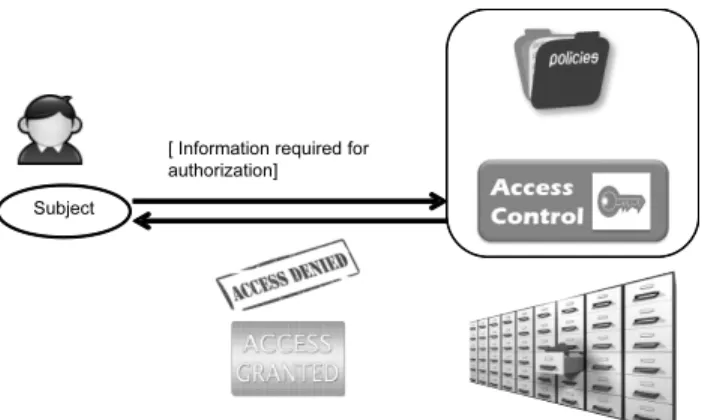
Access control is one of the earliest problems in computer security and remains a continuing chal-lenge. Access control component determines whether requests to access resources are granted. The entity making the request is typically called a subject, which is usually a program or process operating on behalf of a user. A user is an entity who interacts with the system and accesses re-sources. As shown in figure 1.1, a subject requests to access objects which are resources (e.g., mp3 file, documents, networks) on behalf of users. Objects are protected by access control. After authenticating the user and receiving the request information from the subject, the access control component either grants or denies the request based on the provided information and the authoriza-tion policy. Depending on the informaauthoriza-tion required for authorizaauthoriza-tion and the process of making decisions, different access control models can be implemented for various purposes.
1.1
Motivation
Starting with Lampson’s access matrix in the late 1960’s, dozens of access control models have been proposed. Only three have achieved success in practice: discretionary access control (DAC) [123], mandatory access control (MAC, also known as lattice based access control or multilevel secu-rity) [121] and role-based access control (RBAC) [57, 122] (see figure 1.2). DAC controls access based on the identity of subjects and MAC makes access control decision based on the security level of subjects and objects. In RBAC, permissions are encapsulated in roles which are further assigned to users. Users activate assigned roles to get the permissions associated with the roles. These three models have deep conceptual, theoretical and intuitive foundations, and demonstrably address real-world practitioners’ concerns.
In DAC, information may be accessed by unauthorized users because there is no control on copies of objects. MAC deals with information flow and solves this problem by attaching security levels on both users and objects. All users are required to obtain certain clearance to access objects. Security labels propagate to derivative objects, including copies. However, the policies in DAC and
Figure 1.1: Access Control Example
Figure 1.2: Timeline of Classical Access Control Models [120]
MAC are fixed and there is no room for flexible access control. RBAC emerged due to increasing practitioner dissatisfaction with the then dominant DAC and MAC paradigms, inspiring academic research on RBAC. Since then RBAC has become the dominant form of access control in practice. While DAC and MAC emerged in the early 1970’s it took another quarter century for RBAC to develop robust foundations and flourish.
Recently there has been growing practitioner concern with the limitations of RBAC. For exam-ple, role explosion is caused by the situation where each role requires different sets of permissions and large number of roles have to be defined. Role engineering also delays the deployment of RBAC as it is the most costly process before deployment. Those limitations have been met by re-searchers in two different ways. On one hand rere-searchers have diligently and creatively extended RBAC in numerous directions. For examples, role activation process has been extended to be con-strained by contextual information such as time and location [67, 81], prerequisite roles [17] and
so on. Users are associated with additional information besides role, such as organization [151], group [96] and team [11, 137]. Permission is also extended to include purpose and conditions to support privacy aware RBAC [103]. More examples can be found in section 2.2. However, those extensions are proposed for specific purpose where customized RBAC is required. There is no framework which can combine the advantages of these extensions. Further extension to this model is not possible unless a new model is designed. The lack of inherent extendability of RBAC dis-courages deployment of its extensions since they are not general purpose. Beside extensions to RBAC, other models are proposed to overcome the limitations of traditional models. Examples are organization based access control [83], task based access control [136], and relationship based access control [58]. However, they too are developed for specific application context such as social networks and organizations, rather than for general purpose.
There is growing appreciation that a more general model, specifically attribute-based access control (ABAC), could encompass the demonstrated benefits of DAC, MAC and RBAC while transcending their limitations. Intuitively, an attribute is a property expressed as a name:value pair associated with any entity in the system, including users, subjects and objects and even at-tributes themselves. Appropriate atat-tributes can capture identities and access control lists (DAC), security labels, clearances and classifications (MAC) and roles (RBAC). Languages for specifying permitted accesses based on the values and relationships among these attributes provide policy flexibility and customization. As such ABAC supplements and subsumes rather than supplants these currently dominant models. Moreover any number of additional attributes such as location, time of day, strength of authentication, departmental affiliation, qualification, and frequent flyer status, can be brought into consideration within the same extensible framework of attributes. Thus the proliferation of RBAC extensions might be unified by adding appropriate attributes within a uniform framework, solving many of these shortcomings of core RBAC. At the same time we should recognize that ABAC with its flexibility may further confound the problem of role design and engineering. Attribute engineering is likely to be a more complex activity, and a price we may need to pay for added flexibility. As shown on the left hand side of figure 1.2, ABAC provides
richer policy expressive power compared with traditional models. However, the proliferation and flexibility of policy configuration points in ABAC leads to greater difficulty in policy expression and comprehension relative to the simplicity of DAC, MAC and RBAC. It will require strong and comprehensive foundations for ABAC to flourish. As shown on the right hand side of figure 1.2, ABAC provides automation in access control compared to human administration in classical mod-els. For example, in RBAC role has to be manually assigned to users before authorization while in ABAC, once the authorization policy is composed, authorization can be computed at the time of the request and permissions do not need to be pre-assigned to users.
Although considerable related research has been published and even formal models have been proposed for ABAC, there is still lack of a comprehensive model which precisely describes the constituent components and operations of ABAC. The related work mainly falls into the follow-ing four categories: authorization process, policy specification language, enforcement models and implementations. For example, UCON [111] and [141] mainly focus on the rich features in au-thorization process. The problem addressed by UCON is how to process auau-thorization given the attributes and values from subject1and object. UCON specifies mutable attributes and continuous
enforcement. [149] focuses on how to enforce ABAC based on the web infrastructure. This work is not at policy level rather based on certain ABAC enforcement models. [51, 75] focus on languages for specifying interesting and useful policies and propose features of languages such as richer decision (e.g., grant, deny, not applicable, error) and policy compliance (e.g., HIPPA). This ad-dresses only one component of ABAC. XACML [2] provides a standardized mechanism to specify ABAC authorization policy, request and policy evaluation. Many authors following XACML have focused on conflict resolution (e.g., deny-override), policy integration and redundant resolution. Further discussion of related work can be found in section 2.
While it is generally accepted that ABAC provides flexible access control and supplements the limitations of traditional models, there is yet no agreement on a formal ABAC model. Fundamen-tal questions such as components of core models lack authoritative answers, let alone a widely
Figure 1.3:Current Status of ABAC [120]
accepted ABAC model. Formal and systematic study are needed to enhance the concept of ABAC. The ABAC situation today is analogous to RBAC in its pre-1992 pre-RBAC and 1992-1996 early-RBAC periods [61]. The development of early-RBAC model is illustrated in figure 1.3 which shows the state of RBAC model during the years 1992 to 2008. This figure is adopted from a survey paper of RBAC [61]. The y-axis shows the number of the related publications and the x-axis shows the year and publication numbers of RBAC-related paper. Much as RBAC concepts were around for decades (from early 1970s to 1996) before their formalization as shown in figure 1.3, nascent ABAC notions have been around for a while (see related work). This dissertation focuses on the formal model of ABAC, providing foundations towards a widely agreed formal ABAC model.
1.2
Research Challenges
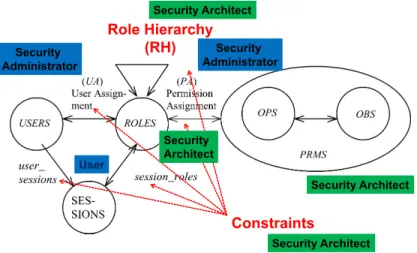
In order to define a formal ABAC model, we start by looking at the development path of the successful RBAC model from 1992 to date. Firstly, what should a formal model look like and what are the core features. For this purpose, we review the successful RBAC model in figure 1.4. This formal model defines the core components and configuration points.
the required information for all authorization decisions. In the case of RBAC, user, roles, objects and operations are defined.
• Model configuration. The green box represents security architects who can configure the model using configuration points. In RBAC, roles are the only configuration point (other than defining the basic sets).
In this dissertation we define the similar parts for ABAC models.
Figure 1.4: Structure of RBAC Model
Secondly, administrative model needs to be defined to manage the operational model. In the context of RBAC, this deals with issues such as user-role assignment, role-permission assignment, role hierarchy design and so on. The blue box in figure 1.4 represents security administrators who can decide user-role assignment and role-permission assignment. Similarly, a corresponding model is required to deal with attribute administration in ABAC.
The above motivation focuses on the need to develop a systematic investigation on formal ABAC models. However, another challenge is to demonstrate that the ABAC model defined in this dissertation is well suited to practical applications. Thus, we need to present a concrete example where an ABAC model satisfies the specific requirements of that application.
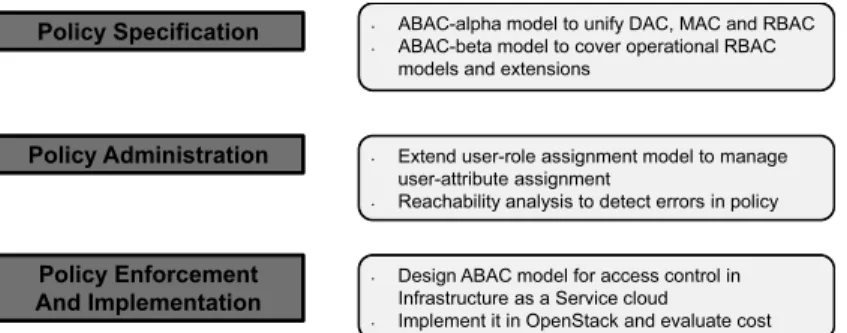
Figure 1.5: Dissertation Contribution
1.3
Contribution
We summarize the contribution in figure 1.5 and we explain them as follows:
• ABAC Models. Two ABAC models are proposed with increasing expressive power.
– ABACαModel. With the widely deployment of the classical models in many different areas, an ABAC model that cannot configure these models would not be acceptable as it will discourage users from adopting ABAC. Thus, an initial ABACα model is
defined with the purpose of establishing the connections between classical models and ABAC. ABACαis designed with the “least” features to cover DAC, MAC and RBAC.
It provides four configuration points. With proper specifications, this framework can simulate those classical models. This basic ABAC model serves as the starting point of our ABAC research.
– ABACβ Model. To further enhance the expressive power of ABAC model, we build
an extended model by exploring the required features of ABAC to express RBAC-related extensions. We choose this direction because of the wide adoption of RBAC and proliferation of RBAC-extended models.
• – User attribute administrative model. The assumption in ABAC models is that user attributes are administered by separate administrative models. In this part, we define an administrative model GURA (generalized role assignment) by extending user-role administration model. It provides ARBAC97 style user attributes administration. It
takes advantages of RBAC to manage user attributes. The core idea is that permissions to modify user attributes are associated with administrative roles. Administrators are made members of these roles, thus obtaining associated permissions. It is also possible to use ABAC to administer ABAC. However, the model we provide here is sufficient for this purpose and serves as the starting point for future research.
– User attribute reachability analysis. This topic studies the user-attribute reachability problems in a restricted version of the GURA model called rGURA. For this purpose, we formalize the model as a state transition system. We show that the reachability problems for general cases of rGURA are PSPACE-complete. However, we do find polynomial-time solutions to reachability problems for limited versions of rGURA that are still useful in practice. The algorithms not only answer reachability problem but also provide a “plan” of sequential attribute updates by different administrators in order to reach particular values for user attributes. Some open questions and future research directions are discussed.
• ABAC model for access control in cloud infrastructure as a service. We demonstrate proof of concept by utilizing ABAC in the area of access control for Infrastructure as a Ser-vice cloud. We analyze the requirement of access control in IaaS cloud and motivate the advantages of ABAC by showing that ABAC satisfies these requirements. More specifically, we design operational and administrative model for IaaS cloud and implement proof-of-concept based on widely deployed open-source platform OpenStack. Performance evalua-tion is carried out to evaluate the cost of enforcing ABAC.
1.4
Organization
Related work is discussed in chapter 2. We introduce formal ABAC models in chapter 3. Chapter 4 introduces administrative model for ABAC. These chapters complete our formal policy level contributions. Chapter 5 provide proof-of-concept by motivating ABAC as a suitable access control model for single tenants in cloud IaaS. Our implementation use the widely deployed cloud platform
OpenStack. We provide an evaluation of the performance. Chapter 6 concludes the dissertation and discusses future work.
Chapter 2: RELATED WORK
2.1
Classical Access Control Models
2.1.1 Discretionary Access Control
We understand DAC as user-discretionary access control [123]. DAC governs the access of users to the information on the basis of the user’s identity and authorizations that specify, for each user and object in the system, the access modes (e.g., read, write, execute) the user is allowed on the object, i.e., access list for each object. Each request of a user to access an object is checked against the specified authorization. If there is an authorization specifying that the user can access the object in the specific mode, the request is granted, otherwise, denied. In user-discretionary access control, the users become the owner of an object created by them and they are the only one who can specify the authorization policy on those objects and destroy the object. While some models allow transfer and sharing of ownership, for the most part ownership cannot be transferred to another user in DAC models. For example, Alice creates object A in the system and thus becomes the owner. If user Alice requests to read object A, it is authorized because Alice is the creator of object A. Alice is the only one who can grant and revoke the access on object A for other users. Alice then can grant Bob to read and write object A.
DAC has been widely used in industrial and commercial environments. One drawback of DAC is that the information flow is not enforced. For example, a user who is authorized to read the data can bypass access controls by creating a copy and sharing it with other users without the cognizance of the owner. The reason is that DAC does not impose any restriction on copies of objects.
2.1.2 Mandatory Access Control
Mandatory access control (MAC) [121] governs access based on the classification of subjects and objects in the system. Each user, subject and object in the system is assigned a security level. The
security level associated with an object reflects the sensitivity of the information contained in the objects, i.e., the potential damage that could result from unauthorized disclosure of the information. The security level associated with a user also called clearance reflects the user’s trustworthiness not to disclosure sensitive information to users not cleared to see it. Request from users to object is granted only if some relationship is satisfied between the security levels associated with the two. In particular, the following properties hold, where γ signifies the security label of the indicated subject or object.
• Simple Security Property. Subjects can read objectoif the security level of s is equal or higher than that of the objecto, i.e.,γ(s)≥γ(o).
• Liberal?-Property. Subjects can write objectoif the security level of subject is equal or lower than that of the object, i.e.,γ(s)≤γ(o).
• An alternative to liberal star property isStrict ?-Property. Subject can write object if the security level of subject is the same of that of the object, i.e.,γ(s)=γ(o).
However, many practical requirements are not covered by MAC as it rises from rigid environ-ment (e.g., military, national intelligence, civilian governenviron-ment) and it does not satisfy requireenviron-ments of commercial enterprises.
2.1.3 Role based Access Control Model
The basic structure of role based access control (RBAC) [57] is shown in figure 2.1. It regulates user access control on the basis of the activities the users execute in the system. Roles define the meanings of the activities and are associated with a set of permissions which are operations on objects. Users are then assigned to certain set of roles and get the permissions associated with the roles. Users can activate any subset of the assigned roles in any sessions. A request made by users with certain roles is authorized if the user has currently activated a role which contains the permission. Advanced features of RBAC include role hierarchy and constraints. Role hierarchy defines partial order between roles. Senior roles inherit all permissions from junior roles. This
Figure 2.1:The Structure of NIST-RBAC Model [57]
feature in RBAC provides ease in system administration. Many security assurance can be achieved using RBAC such as least privilege, static and dynamic separation of duties and so on.
2.2
Related Work of ABAC Model
There are a large number of related research and they can be categorized into four classes discussed as follows.
2.2.1 Formal Model
The first category is theoretical access control models. Role based trust management (RT) [95] provides a set of role assignment credentials. The only attribute is role and the authorization policy is the same as that in role based access control and is not configurable. Policy Machine (PM) [70] is proposed to provide a unified framework to support a wide range of attribute-based policies or policy combinations through a single mechanism that requires changes only in its data configuration. The National Institute of Standards and Technology (NIST) recently released a first draft ABAC model [69]. This draft provides detailed guidelines in various aspects of enterprise ABAC while no formal model is provided. The UCON usage control model [111] focuses on usage control where authorizations are based on the attributes of the involved components. It is attribute-based but, rather than dealing with core ABAC concepts, it focuses on advanced access control features such as mutable attributes, continuous enforcement, obligations and conditions.
UCON more or less assumes that an ABAC model is in place on top of which the UCON model is constructed. [141] models authorization policy of access control using logic programming with set constraints of a computable set theory. Similarly with UCON, this work focuses only on one component in ABAC which is authorization. It is based on the assumption that users and objects are associated with sets of attributes.
2.2.2 Policy Specification Language
The second category is on authorization policy specification languages. SecPAL [21, 24] has a concrete syntax consisting of simple statements close to natural language. DYNPAL [23] and SMP [22] enable specifying modifications to the system state in authorization. [141] proposes to specify authorization policies using set theory to ensure consistency and completeness. Binder [54] is an extension to the datalog logical-programming language. In Soutei [112] policies and cre-dentials are written in a declarative logic-based security language. [28] proposes a formal frame-work based on C-Datalog language. Rule-based policy specification [12] enables authorization policy specification based on system behavior. Other examples are SPKI/SDSI [55], extensi-ble access control markup language (XACML) [2] and enterprise privacy authorization language (EPAL) [85]. There has been considerable research based on XACML. [114] simplifies XACML policies by providing an ontology-based attribute management facility. Other examples are pol-icy integration [99, 115], polpol-icy evaluation [97], conformance checking [71] and polpol-icy deriva-tion [143]. Xu et al [146] propose authorization policy mining. PolicyMorth [92] proposes a framework to support interactive ABAC policy specification and maintenance. In summary, all these work focus on how authorization policy can be specified and evaluated. While authorization policy is an important component of ABAC, these authors do not present comprehensive formal models for ABAC.
2.2.3 Enforcement Model
The third category is about concerns on enforcement of ABAC systems. This class deals with problems such as how to represent, store, transfer and authenticate attributes. In credential based access control [91], attribute assertions of subject and environment are encoded in verifiable digital credentials issued by trusted third-party certifiers. [46] demonstrates that ABAC can be used as a primary authorization and authentication mechanism for legacy or modern enterprise systems, but it is based only on RT model. Akenti [138] is an authorization service based on X.509. Information communication between service requester and service provider are investigated. PolicyMaker [32] proposes an approach to trust management. KeyNote [31] and SPKI/SDSI [47] use credentials to delegate permissions. Automated trust negotiation [34, 35, 142] deals with credential disclosure before authorization evaluation. [60] presents an efficient protocol that protects both sensitive cre-dentials and policies. [13,37,128] deal with privacy concerns in requester attribute release. [86,149] discusses general ABAC implementation architecture for web service. Although these works pro-vide tools for enforcing ABAC, they do not present the full picture of theoretical aspect of ABAC such as subject and user distinction.
2.2.4 Attribute-based Encryption
The fourth category is attribute based encryption (ABE). It is proposed to support fine-grained sharing of encrypted data. In this kind of systems, cipher-texts are labeled with sets of attributes and private keys are associated with access structures. The decryption of a ciphertext thus is possible only if the set of attributes of the user key matches the attributes of the ciphertext. [117] allowed for decryption when at leastk attributes overlap between a cipher-text and a private key. Key-Policy Attribute-Based Encryption (KP-ABE) [65] extends the above work to associate policy tree instead of lists of attributes with private keys. Ciphertext-Policy Attribute-Based Encryption (CP-ABE) [30] on the other hand enables encryptor to associate policy trees with cipher-text. [109] extends KP-ABE so that private keys can represent non-monotone access formula over attributes.
[45] enables multiple authorities to monitor attributes and distribute secret keys. In summary, ABE is a method for securely enforcing ABAC policies on data sharing and access control. Due to the complexity and cost, the access control policies (logicalAND,OR,NOT, etc.) included in these techniques are very limited in expressive power.
2.3
Related Work for Attribute Administrative Model
Firstly, we introduce the related work to user-attribute administration model. There are very limited number of models proposed for this purpose. However, we find that the administrative model for user-role assignment is highly related. Administrative role based access control (ARBAC97) [118] manages user-role assignment, permission-role assignment and role-hierarchy for RBAC. The major concept for user-role assignment is that users need to be previously assigned to certain roles in order to get new roles. Role based trust management [95] defines credentials for delegating user-role assignment to third parties to support distributed user-role assignment. However, these work focus on a single attribute which is role and the connection between attributes of the same user is not covered.
Secondly, we introduce the related work for reachability analysis for user attributes. The clos-est category of this work is the role reachability analysis on the role based administrative model ARBAC97. Li et al [94] presented algorithms and complexity results for analysis of two restricted versions of ARBAC97–AATU and AAR. However, this work did not consider negative precon-ditions. Sasturkar et al [124] and Jha et al [76] presented algorithms and complexity results for analysis of ARBAC policies subject to a variety of restrictions on how the policy can be specified. Stoller et al [129] proposed the first fixed-parameter-tractable algorithm for analyzing ARBAC policies. However, the algorithm only applies to rules with one positive precondition and uncon-ditional role revocation. Stoller et al [130, 131] analyzed security on parameterized RBAC and ARBAC97. Although the parameters of role can be considered as user attributes, all parameters are treated as atomic-valued and are only changed together with the modification of role. Simi-lar works are [9, 14] which presented symbolic analysis for attribute RBAC models. Our work is
fundamentally different from these in consideration of administration of multiple attributes includ-ing atomic valued attributes, whereas the ARBAC97 analysis only deals with a sinclud-ingle set-valued attribute called role. The second category is policy analysis in attribute-based models. Gupta et al [66] proposed rule-based administrative policy model that controls addition and removal of both rules and facts, and a symbolic analysis algorithm for answering reachability queries. The facts of users may be termed as attributes. However, the model does not distinguish atomic and set valued attributes and the current version of the algorithm is incomplete. Li et al [93] discussed security analysis in role based trust management (RT). It is different from our work in that the focus is on delegation and trust. In addition, only one attribute, i.e. role, is considered. Jajodia et al [75] pro-posed a policy language to express positive and negative authorizations and derived authorizations, and they give polynomial-time algorithms to check consistency and completeness of a policy. [20] showed how to eliminate policy mis-configurations using data mining. [53] presented security con-straint patterns for modelling security system architecture and verifying whether required security constraints are correctly enforced. However, this framework facilitates design and deployment of security polices rather than run-time security analysis. [74] developed a graphical constraint expression model to simplify constraints specification and make safety verification practical, but does not ensure polynomial time safety checking.
Chapter 3: ATTRIBUTE BASED ACCESS CONTROL MODELS
3.1
Scope
Our eventual goal is to develop an authoritative family of foundational models for attribute-based access control. We believe this goal is best pursued by means of incremental steps that advance our understanding. ABAC is a rich platform. Addressing it in its full scope from the beginning is infeasible. There are simply too many moving parts. A reasonable first step is to develop a formal ABAC model, which we call ABACα, that is just sufficiently expressive to capture DAC, MAC and
RBAC. This provides us a well-defined scope while ensuring that the resulting model has practical relevance. There have been informal demonstrations, such as [41, 111], of the classical models using attributes. Our goal is to develop more complete and formal constructions.
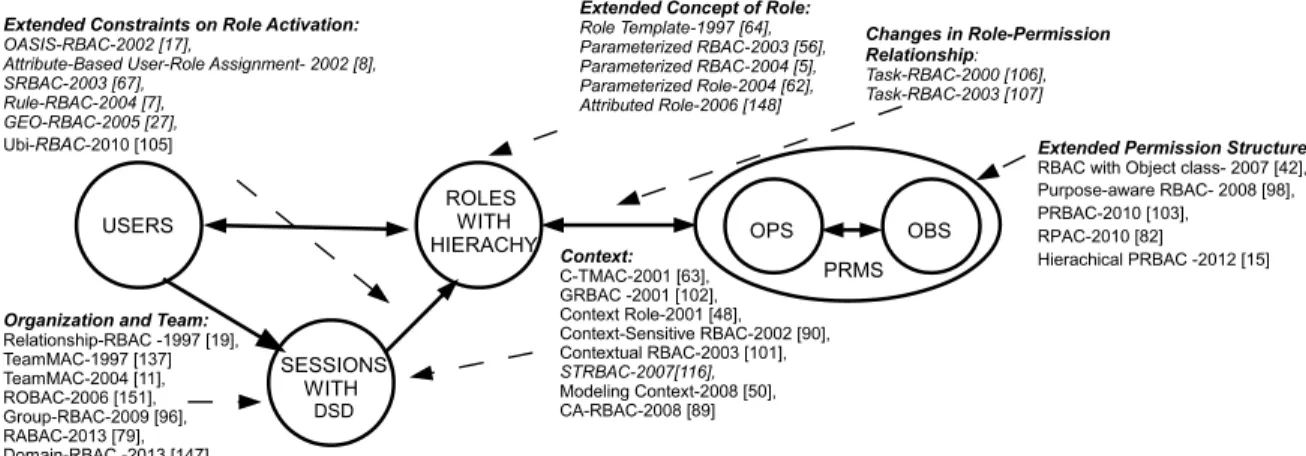
In the second step, we develop the ABACβ model based on the observation that RBAC has
been dominant in access control in both industry and academia. Extensions of RBAC have been proposed in many directions to meet the different requirements of various systems. These systems are potential applications of ABAC because their practical applications are well-documented in the literature. ABACβ helps understand the capability of ABAC in expressing different policies. It
also unifies numerous RBAC extensions in a single model.
ABACα and ABACβ are developed based on extensive prior research where practical
moti-vations are well-defined. We believe that ABACα model contains the core features of a future
standard ABAC model. Many extensions can be proposed based on ABACα with ABACβ
be-ing one important example. These models strongly indicate what needs to be provided as core features of ABAC and the method to make extensions for ABAC. A standard family of ABAC models analogous to the NIST standard family of RBAC models [57, 122] must include ABACα
and ABACβ as particular instances. Moreover it is likely to incorporate the policy configuration
and administration points identified in these two models.
DAC
There are many variations of DAC models [68, 123]. The DAC we define for our purpose is user-discretionary access control and features the following properties.
• Each user in the system is assigned a uniqueuserID which can uniquely distinguish the user in the system.
• The user can create a subject which can only be assigned with the sameuserIDas the user. The creating user becomes the only owner of the subject and only the owner can terminate the subject. Each subject can create objects in the system. The owner of the creating subject becomes the only owner of an object and ownership cannot be transferred.
• Each object is associated with access control lists which contain theuserIDs who can access the object in the corresponding access mode. For example, the readlist and writelist of objects contain lists of users who can read and write the object respectively.
• Only the owner of an object can modify the access control list. The owner can add or remove anyuserIDs from the access control list of the objects he or she owns. Only the owner can destroy the object.
MAC
We understand MAC as lattice based access control (LBAC) [121] with tranquility. More specifi-cally, we have the following characterizations.
• Each user and subject are labelled with a clearance level. Each object is labelled with a sensitivity level. Clearance and sensitivity are from the same partially ordered set of security levels.
• A user can create subjects at his own or lower levels than his assigned clearance and access resources using the subject. The creating user becomes the only owner of the created subject and is the only one who can destroy the subject.
• The sensitivity of objects cannot be changed after creation and users cannot modify the clearance level of the subjects they own.
As for authorization policy, we will discuss simple security property, liberal star property and strict star property in developing ABACα.
RBAC
The RBAC models we consider are RBAC0and RBAC1from NIST definition [57] and the RBAC96
model [122]. RBAC0has the following features.
• There exists a set of roles defined by system architects and there is no partial order among those roles. Each user is associated with a set of roles which are assigned by administrators. Each role is associated with a set of permissions which are in the format of operations on objects.
• Users can create sessions in the system and activate any subset of the assigned roles in a session. The creating user thus becomes the owner of the session and is the only one who can delete the session. When a user deletes a session, the association between the session and activated role is also deleted. A session is essentially equivalent to a subject.
• The owner of a session can activate and deactivate the roles that he is assigned in that ses-sion. User permissions in each session is determined by the set of activated roles within that session.
The only difference between RBAC1 and RBAC0 is that the role set in RBAC1 is a partially
ordered where the senior roles inherit all permissions from the junior roles. In addition, users can activate junior roles of their assigned roles in their sessions.
3.2
ABACα
Model
In this section, we present the ABACα model developed to have the “least” features to cover DAC,
3.2.1 Model Requirement
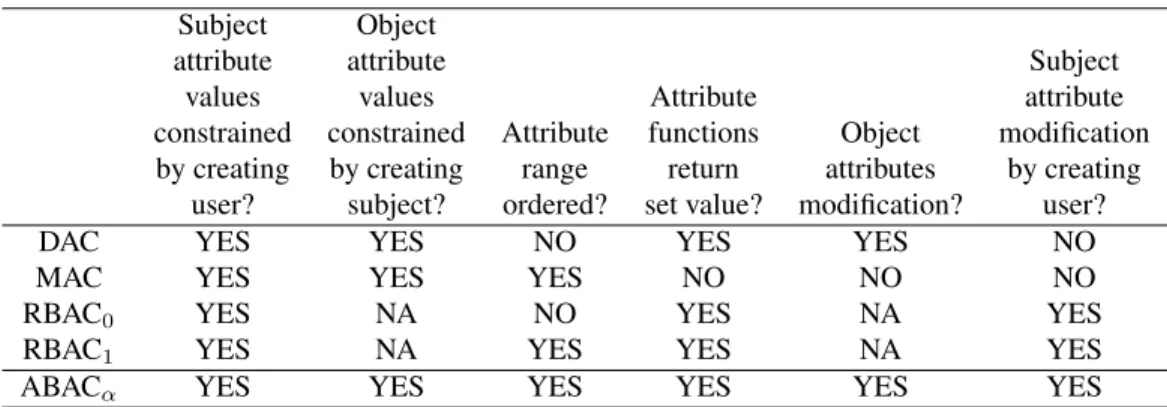
The intrinsic features of ABACα that follow from the above interpretation of DAC, MAC and
RBAC are highlighted in table 3.1. This table recognizes three kinds of familiar entities: users, subjects (or sessions in RBAC) and objects. Each user, subject and object has attributes associated with it. The range of each attribute is either atomic valued or set valued, with atomic values partially ordered or unordered and set values ordered by subset.
Table 3.1: ABACα Intrinsic Requirements
Subject Object
attribute attribute Subject
values values Attribute attribute
constrained constrained Attribute functions Object modification
by creating by creating range return attributes by creating
user? subject? ordered? set value? modification? user?
DAC YES YES NO YES YES NO
MAC YES YES YES NO NO NO
RBAC0 YES NA NO YES NA YES
RBAC1 YES NA YES YES NA YES
ABACα YES YES YES YES YES YES
Let us consider each column in turn.
Column 1. In all cases subject attribute values are constrained by attributes of the creating user. In MAC, users can only create subjects whose clearance is dominated by that of the user. In RBAC, subjects can only be assigned roles assigned to or inherited by the creating user. In DAC, MAC and RBAC, the subject’s creator is set to be the creating user. Interestingly this is the only column with YES values for all rows.
Column 2.For object attributes in MAC a subject can only create objects with the same or higher sensitivity as the subject’s clearance. In DAC there is no constraint on the access control list associated with a newly created object. It is up to the creator’s discretion. However, we recognize that DAC has a constraint on newly created objects in that root user usually has all access rights to every object and the owner cannot forbid this. RBAC does not speak to object creation.
Column 3. In MAC clearances are values from a lattice of security labels. In RBAC1 roles are
values.
Column 4. In MAC the clearance attribute is atomic valued as a single label from a lattice.1 In RBAC0 and RBAC1 attributes are sets of roles, and in DAC each access control list is a set of user
identities.
Column 5.In DAC the user who created an object can modify its access control lists. MAC (with tranquility) does not permit modification of an object’s classification. RBAC0 and RBAC1 do not
speak to this issue.
Column 6. Modification of subject attributes by the creating user is explicitly permitted in RBAC0
and RBAC1 to allow dynamic activation and deactivation of roles. DAC and MAC do not require
this feature.
Each column imposes requirements on ABACα so we have YES across the entire row. Table
3.1 is, of course, not a complete list of all required features to configure the classical models, but rather highlights the salient requirements that stem from each classical model.
3.2.2 Model Overview
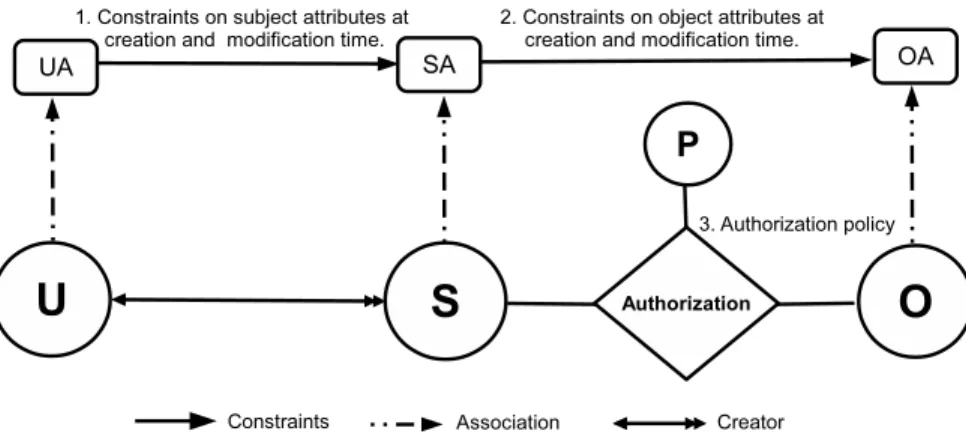
The structure of the ABACαmodel is shown in Figure 3.1. The core components of this model are:
users (U), subjects (S), objects (O), user attributes (U A), subject attributes (SA), object attributes (OA), permissions (P), authorization policies, and constraint checking policies for creating and modifying subject and object attributes.
Anattributeis a function which takes an entity such as a user and returns a specific value from its range. An attribute range is determined by its scope and type. The scope of an attribute is given by a finite set of atomic values. An atomic valued attribute will return one value from the scope, while a set valued attribute will return a subset of the scope. In other words, the range of an atomic valued attribute is equal to its scope while for a set valued attribute the range is the powerset of the scope. Each user is associated with a finite set of user attributefunctions whose values are assigned by security administrators (outside the scope of the ABACα model). These attributes
1In the military lattice the lattice labels are constructed as a pair of hierarchical levels and a set of categories. If the pair is represented as two attributes then MAC attributes can also be regarded as set valued.
Figure 3.1: Unified ABAC Model Structure
represent user properties, such as name, clearance, roles and gender. Subjectsare created by users to perform some actions in the system. For the purpose of this model, subjects can only be created by a user and are not allowed to create other subjects. The creating user is the only one who can terminate a subject. Each subject is associated with a finite set ofsubject attributefunctions which require an initial value at creation time. Subject attributes are set by the creating user and are constrained by policies established by security architects. For example, a subject attribute value may be inherited from a corresponding user attribute. This is shown in Figure 3.3 as an arrow from user attributes to subject attributes. Objectsare resources that need to be protected. Objects are associated with a finite set ofobject attribute functions. Objects may be created by a subject on behalf of its user. At creation, the object’s attribute values may be set by the user via the subject. The values may be constrained by the corresponding subject’s attributes. For example, the new object may inherit values from corresponding subject attributes. In Figure 3.3, the arrow from subject attributes to object attributes indicates this relationship.
Constraintsare functions which return true when conditions are satisfied and false otherwise. Security architects configure constraints via policy languages. Constraints can apply at subject and object creation time, and subsequently at subject and object attribute modification time.
Permissions are privileges that a user can hold on objects and exercise via a subject. Permis-sions enable access of a subject to an object in a particular mode, such as read or write. PermisPermis-sions definition is dependent on specific systems built using this model.
Table 3.2:Basic Sets and Functions of ABACα
U, S and O represent finite sets of existing users, subjects and objects respectively.
UA, SA and OA represent finite sets of user, subject and object attribute functions respectively. (Henceforth also referred to as simply attributes.)
P represents a finite set of permissions.
For eachattin UA∪SA∪OA, SCOPEattis a constant finite set of atomic values. SubCreator: S→U. For each subject SubCreator gives its creator.
attType: UA∪SA∪OA→{set,atomic}. Specifies attributes assetor atomic valued. Each attribute function maps elements in U, S and O to atomic or set values.
∀ua∈UA. ua:U→
SCOPEua if attType(ua) =atomic 2SCOPEua if attType(ua) =set
∀sa∈SA. sa:S→
SCOPEsa if attType(sa) =atomic 2SCOPEsa if attType(sa) =set
∀oa∈OA. oa:O→
SCOPEoa if attType(oa) =atomic 2SCOPEoa if attType(oa) =set
Authorization policies are two-valued boolean functions which are evaluated for each access decision. An authorization policy for a specific permission takes a subject, an object and returns true or false based on attribute values. More generally, access decision may be three-valued, pos-sibly returning “don’t know” in addition to true and false. This is appropriate in multi-policy systems. It suffices for our purpose to consider just two values. Security architects are able to specify different authorization policies using the languages offered in this model.
3.2.3 Formal Model
The basic sets and functions in ABACαare given in Table 3.2. U is the set of existing users and UA
is a set of attribute function names for the users in U. Each attribute function in UA maps a user in U to a specific value. This could be atomic or set valued as determined by the type of the attribute function (attType). We specify similar sets and functions for subjects and objects. SubCreator is a distinguished attribute that maps each subject to the user who creates it (an alternate would be to treat this attribute as a function in SA). Finally, P is a set of permissions.
constant time independent of the size of U, S and O. Since the sets S and O are unbounded due to creation of subjects and objects respectively, the overall storage for maintaining attribute values will also grow in proportion to the number of subjects and objects. Note that the SCOPE of an attribute must be a constant finite set, so it cannot be S or O but is permitted to be U since the set of users remains fixed in ABACα. The latter capability is required to accommodate DAC.
We define four policy configuration points as shown in Table 3.3. The first is for authorization policies (item 1 in table 3.3). The security architect specifies one authorization policy for each permission. The authorization function returns true or false based on attributes of the involved subject and object. The second configuration point is constraints for subject attribute assignment (item 2 in table 3.3). The third is constraints for object attributes assignment at the time of object creation (item 3 in table 3.3). The fourth is constraints for object attribute modification after the object has been created (item 4 in table 3.3). Note that we have not provided separate configuration points for subject attribute assignment at creation and at modification after it has been created. Instead a single constraint covers both cases. For objects, however, we have found it is necessary to have separate constraints in these two cases.
Policy Configuration Languages. Each policy configuration point is expressed using a spe-cific language. The languages specify what information is available for the functions that configure the four points discussed above. For example, inConstrSubfunction, only attributes from the user who wants to create the subject as well as the proposed subject attribute values are allowed. Since all specification languages share the same format of logical structure while differing only in the values they can use for comparison, we define a template called Common Policy Language (CPL). CPL is not a complete language since the symbols setandatomicare left unspecified. It can be instantiated differently for each configuration point by further specifying these two symbols. CPL is defined in table 3.4.
LAuthorizationis a CPL instantiation for specifying authorization policies in which setand
atomicare specified as follows.
Table 3.3:Policy Configuration Points and Languages of ABACα
1. Authorization policies.
For each p∈P, Authorizationp(s:S,o:O) returns true or false.
Language LAuthorization is used to define the above functions (one per permission), where s and o are formal parameters.
2. Subject attribute assignment constraints.
LanguageLConstrSubis used to specify ConstrSub(u:U,s:S,saset:SASET), where u, s and saset are formal parame-ters. The variable saset represents proposed attribute name and value pairs for each subject attribute. ThusSASETis a set defined as follows:
SASET=S
∀sa∈SAOneElement(SASETsa) where
SASETsa=
(
{sa} ×SCOPEsaifattType(sa) = atomic {sa} ×2SCOPEsaifattType(sa) = set
We define OneElement to non-deterministically return a singleton subset from its input set.
3. Object attribute assignment constraints at object creation time.
LanguageLConstrObjis used to specifyConstrObj(s:S,o:O,oaset:OASET), where s, o and oaset are formal param-eters. The variable oaset represents proposed attribute name and value pairs for each object attribute. ThusOASETis a set defined as follows:
OASET=S
∀oa∈OAOneElement(OASEToa) where
OASEToa =
(
{oa} ×SCOPEoaifattType(oa) = atomic {oa} ×2SCOPEoaifattType(oa) = set
4. Object attribute modification constraints.
LanguageLConstrObjMod is used to specifyConstrObjMod(s:S,o:O,oaset:OASET), where s, o and oaset are formal parameters.
Table 3.4:Definition ofCPL
ϕ::=ϕ∧ϕ|ϕ∨ϕ|(ϕ)| ¬ϕ| ∃x∈set.ϕ| ∀x∈set.ϕ|set setcompare set|atomic∈set
|atomic atomiccompare atomic setcompare ::=⊂ | ⊆ |*
atomic ::=atomicsa(s)|atomicoa(o) setsa∈{sa|sa∈SA∧attType(sa) =set} setoa∈{oa|oa∈OA∧attType(oa) =set}
atomicoa∈{oa|oa∈OA∧attType(oa) =atomic} atomicsa∈{sa|sa∈SA∧attType(sa) =atomic}
LAuthorizationallows one to specify policies based only on the attribute values of the involved subject and object. Parameters such assandoin this and following languages are formal parame-ters as introduced in table 3.3.
LConstrSubis a CPL instantiation for specifyingConstrSubwhere: set ::=setua(u)|value
atomic ::=atomicua(u)|value
setua∈{ua|ua∈UA∧attType(ua) =set}
atomicua∈{ua|ua∈UA∧attType(ua)=atomic} value∈{val|(sa, val)∈saset∧sa∈SA}
In this case in the constraint function for subject attributes, only the attributes of the user who wants to create the subject and the proposed values for subject attributes are allowed.
LConstrObjis a CPL instantiation for specifyingConstrObjwhere: set ::=setsa(s)|value
atomic ::=atomicsa(s)|value
setsa∈{sa|sa∈SA∧attType(sa) =set}
atomicsa∈{sa|sa∈SA∧attType(sa)=atomic} value∈{val|(oa, val)∈oaset∧oa∈OA} Here we use subject attributes instead of user attributes.
LConstrObjMod, used to specifyConstrObjMod, is a instance of CPL where the symbols set and atomic are defined as follows:
set ::=setsa(s)|setoa(o)|value
Table 3.5:Functional Specification
Functions Conditions Updates
Administrative functions:Creation and maintenance of user and their attributes. UASET is a set containing name and value pairs for each user attribute.
uaset=S
∀ua∈U AOneElement(UASETua) where
UASETua=
(
{ua} ×SCOPEuaifattType(ua) =atomic
{ua} ×2SCOPEuaifattType(ua) =set
AddUser u /∈U U0=U∪{u}
(u:NAME,uaset:UASET) forall(ua,va)∈uasetdo
ua(u)=va
DeleteUser(u:NAME) u∈U S0=S\{s|SubCreator(s)=u}
/*delete all u’s subjects*/ U0=U\{u}
ModifyUserAtt u∈U forall(ua,va)∈uasetdo
(u:NAME,uaset:UASET) ua(u)=va
/*delete all u’s subjects*/ S0=S\{s|SubCreator(s)=u}
System functions:User level operations.
CreateSubject u∈U∧s /∈S∧ S0=S∪{s};SubCreator(s)=u
(u:NAME,s:NAME,saset:SASET) ConstrSub(u, s, saset) forall(sa,va)∈sasetdo
sa(s)=va
DeleteSubject s∈S∧u∈U∧ S0=S\{s}
(u:NAME,s:NAME) SubCreator(s)=u
ModifySubjectAtt s∈S∧u∈U∧ forall(sa,va)∈sasetdo
(u:NAME,s:NAME,saset:SASET) SubCreator(s)=u∧ sa(s)=va
ConstrSub(u, s, saset)
CreateObject s∈S∧o /∈O∧ O0=O∪{o}
(s:NAME,o:NAME,oaset:OASET) ConstrObj(s, o, oaset) forall(oa,va)∈oasetdo
oa(o)=va
ModifyObjectAtt s∈S∧o∈O∧ forall(oa,va)∈oasetdo
(s:NAME,o:NAME,oaset:OASET) ConstrObjMod(s, o, oaset) oa(o)=va
∀p∈P. Authorizationp;
ConstrSub; ConstrObj; /*Left to be specified by security architects*/
ConstrObjMod
Note that this language allows one to compare proposed new attribute values with current attribute values of an object unlike LConstrObj, where the newly created object has no current attribute values as such.
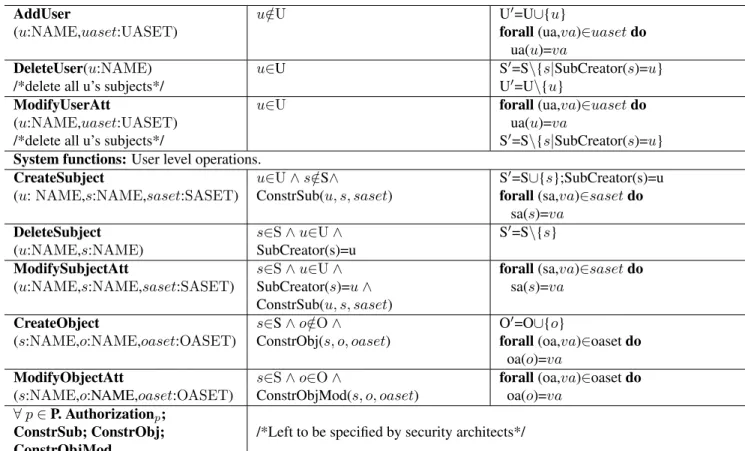
Functional Specifications. The ABACα functional specification, as shown in Table 3.5,
out-lines the semantics of various functions that are required for creation and maintenance of the ABACα model components. The first column lists all the function names as well as required
parameters. The second column represents the conditions which need to be satisfied before the updates, which are listed in the third column, can be executed. N AM E refers to set of all names
for various entities in the system.
The first kind of functions are administrative in nature which are designed to be invoked only by security administrators. We do not specify the authorization conditions for administrative functions which are outside the scope of ABACα. They mainly deal with user and user attribute management
and will be discussed in chapter 4. One important issue with user management is that the subjects created by the user are affected because of the user attributes’ change or deletion of the user. We discuss the various options as follows.
• All subjects created by the user are forced to be terminated whenever user attributes are modified or the user is deleted. This is required in security critical applications where the modification to user attributes reflect urgent administrative response to the user’s future per-missions in the system. Keeping all subjects of the user would be dangerous because all permissions are actually not authorized any more while the existence of these subjects grants the permission anyhow.
• A relaxed response is that all subjects are kept if the user is deleted. At this time, the user who does not exist in the system lost control over the subjects and will not be able to terminate them. They are kept until the system starts a garbage collection-like process where they are terminated by the system process. They can be resumed if the user is added again and the attributes constraints is satisfied. If the user’s attributes are modified, the subjects are still under control of the user. While at the same time, the permission sets of the subjects are restricted by the new sets of permissions of the user.
• An alternative of the above response is that the active subjects of the user are kept in the system till the completion of the task (or for certain length of time after the change) if the user is not deleted, i.e., only the attributes are changed. Otherwise, they are forced to be destroyed if the user is deleted.
We understand that the above options are not a complete list and it’s up to the system to choose an appropriate response. The second kind of functions are system functions which can be invoked
Table 3.6: DAC (Owner-controlled Access Control Lists) Configuration Basic sets and functions
UA={}, SA={}, OA={reader,writer,createdby}
P={read,write}
SCOPEreader = SCOPEwriter= SCOPEcreatedby=U
attType(reader)=attType(writer)=set attType(createdby)=atomic
Thus,reader:O→2U,writer:O→2U,createdby:O→U The function SubCreator is defined in Table 2.
Configuration points 1. Authorization policy
Authorizationread(s o)≡SubCreator(s)∈reader(o)
Authorizationwrite(s,o)≡SubCreator(s)∈writer(o)
2. Constraint for subject attribute is not required
Note that SubCreator is implicitly captured in function CreateSubject in table 3.2.
ConstrSub(u,s, {})≡return true.
3. Constraint for object attribute at creation time
ConstrObj(s,o, {(reader,val1), (writer,val2), (createdby,val3)})≡val3=SubCreator(s)
4. Constraint for object attribute at modification time
ConstrObjMod(s, o, {(reader,val1), (writer,val2), (createdby,val3)})≡ createdby(o)=SubCreator(s) ∧ val3 =
createdby(o)
by subjects and users. By default, the first function parameter is the invoker of each function. For example, CreateSubject is invoked by user u and ModifyObjectAtt is invoked by subject s. The third kind of functions are authorization policies and subject and object attribute constraint functions which are left to be configured by security architects.
3.2.4 Configurations for Classical Models
In this section, we show the capability of ABACαin configuring DAC, MAC and RBAC. For this
illustration, we set P ={read, write}.
• DAC (Table 3.6). Each object is associated with the same number of set-valued attributes as the number of permissions and there is a one-to-one semantic mapping between them. An object attribute returns the list of users that hold the permission indicated by the object attribute name. Object attributecreatedbyis set to be the owner of this object.
Table 3.7: MAC Configuration Basic sets and functions
UA={uclearance}, SA={sclearance}, OA={sensitivity} P={read, write}
SCOPEuclearance= SCOPEsclearance= SCOPEsensitivity=L Lis a lattice defined by the system.
attType(uclearance)=attType(sclearance)=attType(sensitivity)= atomic Thus,uclearance:U→L,sclearance:S→L,sensitivity:O→L.
Configuration points 1. Authorization policies
Authorizationread(s,o)≡sensitivity(o)≤sclearance(s)
Liberal Star: Authorizationwrite(s,o)≡sclearance(s)≤sensitivity(o) Strict Star: Authorizationwrite(s,o)≡sclearance(s)=sensitivity(o)
2.ConstrSub(u,s, {(sclearance,value)})≡value≤uclearance(u)
3.ConstrObj(s,o, {(sensitivity, value)})≡sclearance(s)≤value
4.ConstrObjMod(s,o, {(sensitivity, value)}) returns false.
• MAC (Table 3.7). Each user is associated with an atomic-valued attribute uclearance. Each subject is also associated with an atomic-valued attributesclearance. Each object is associated with an atomic-valued attributesensitivity. Similar to MAC, the user and subject attributes represent their clearance in the system. Thesensitivityattribute of the object rep-resents the object’s classification in MAC. The three attributes share the same range which is represented by a system maintained lattice L.
• RBAC (Table 3.8). Each user and subject is associated with set-valued attributesuroleand
srolerespectively. Each object is associated with the same number of set-valued attributes as the number of permissions and there is a one-to-one semantic mapping between them. Each attribute returns the roles that are assigned the corresponding permission on this specific object. For example,rroleof objectobj returns the roles which are assigned the permission of reading obj. The ranges of all attributes are the same as that of a system defined set of role namesR which are unordered for RBAC0 and partially ordered for RBAC1. Note that
Table 3.8: RBAC Configurations
RBAC0configuration
Basic sets and functions
UA={urole}, SA={srole}, OA={rrole, wrole} P={read, write}
SCOPEurole= SCOPEsrole= SCOPErrole= SCOPEwrole=R Ris a set of atomic roles defined by the system.
attType(urole)=attType(srole)=attType(rrole)=attType(wrole)=set Thus,urole:U→2R,srole:S→2R,rrole:O→2R,wrole:O→2R
Configuration points 1. Authorization policy
Authorizationread(s,o)≡∃r∈srole(s).r∈rrole(o)
Authorizationwrite(s,o)≡∃r∈srole(s).r∈wrole(o)(same as above)
2.ConstrSub(u,s, {(srole,val1)})≡val1⊆urole(u)
3.ConstrObj(s,o, {(rrole,val1),(wrole,val2)}) returns false.
4.ConstrObjMod(s,o, {(rrole,val1),(wrole,val2)}) returns false.
RBAC1configuration
Basic sets and functions
The basic sets and functions are the same as RBAC0except:
Ris a partially ordered set defined by the system.
Configuration points 1. Authorization policy
Authorizationread(s,o)≡∃r1∈srole(s).∃r2∈rrole(o).r2≤r1
Authorizationwrite(s,o)≡∃r1∈srole(s).∃r2∈wrole(o).r2≤r1(same as above)
2.ConstrSub(u,s, {(srole,val1)})≡∀r1∈val1.∃r2∈urole(u).r1≤r2
3.ConstrObj(s,o, {(rrole, val1),(wrole, val2)}) returns false.
4.ConstrObjMod(s,o, {(rrole, val1),(wrole, val2)}) returns false.
3.2.5 Formal Proof of Equivalence
In this section, we provide formal proof for the equivalence of the original model and its ABACα
configuration. We only show the formal proof for RBAC0 here. The proofs for other models can
be similarly developed. To show equivalence, we adopt the state-matching reduction method [139] which was developed to formally compare the expressive power of various access control models. Before we formally present the proof, we define the following schemes.
Scheme RBAC0.
user-role assignment and thus the administrative model for RBAC0. In this dissertation, we model
the changes caused by user activating and deactivating their roles in a session. Thus, the scheme for RBAC0is formally defined as follows.
• State Γ. They are summarized as the following well-known sets of RBAC0: U (users),
R (roles), URA (user-role assignment), S (sessions), SRA (session-role assignment), USA (user-session assignment), PRA (permission-role assignment), OP (operations) and O (ob-jects).
• State transitionΨ. The state can only change by users creating and deleting sessions, and activating and deactivating roles in a session. The precondition for activating roles is that those roles are assigned to the user, i.e., there exists appropriate user-role assignment. For-mally, the possible operations, their preconditions and their effects are defined as follows.
CreateSession(u, s)
Precondition: None
Effect: S0 =S∪ {s}, U SA0 =U SA∪ {(u, s)} DeleteSession(u, s)
Precondition: (u, s)∈U SA
Effect: ∀(s, r)∈SRA, SRA0 =SRA\{(s, r)}, S0 =S\{s}, U SA0 =U SA\{(u, s)}
ActivateRole(u, s, r)
Precondition: (u, s)∈U SA∧(u, r)∈U RA
Effect: SRA0 =SRA∪ {(s, r)}
DeactivateRole(u, s, r)
Precondition: (u, s)∈U SA∧(s, r)∈SRA
Effect: SRA0 =SRA\{(s, r)}
• QueryQ. On each state in this scheme, the query is whether their exists a session s with role r. We write a query as r. Other more general queries can be similarly considered.
![Figure 1.3: Current Status of ABAC [120]](https://thumb-us.123doks.com/thumbv2/123dok_us/9443399.2424574/20.918.288.694.130.441/figure-current-status-of-abac.webp)
![Figure 2.1: The Structure of NIST-RBAC Model [57]](https://thumb-us.123doks.com/thumbv2/123dok_us/9443399.2424574/27.918.258.737.130.355/figure-the-structure-of-nist-rbac-model.webp)