Sensitivity Analysis for Search-Based
Software Project Management
Francisco de Jose
King’s College London
MSc Computing And Internet Systems 2007/2008
School of Physical Sciences and Engineering Computer Science Deparment
Supervised by Mark Harman
“Live as if your were to die tomorrow. Learn as if you were to live forever”
Abstract
This paper introduces a new perspective in the field of Software Engineering in pur-suance of a feasible alternative to the classical techniques of Software Project Man-agement through the use of Genetic Algorithms (GAs) in Sensitivity Analysis (SA). A beneficial solution is important from the point of view of the manager as a result of the increasing complexity of the software projects. The use of GAs in SA can provide new means to improve the initial schedule of a project and thereby tackle the classi-cal Project Scheduling Problem (PSP). The proposed implementation will develop an answer to the managers in their necessity to identify the most sensitive tasks as well as new ways to optimize their project in terms of duration. This paper describes the application of GAs in a process of resource allocation. Moreover, it analyses the impact of breaking dependencies within the definition of a project. The alternative detailed in this paper indicates the suitable direction of future work to achieve a proper results for an implementation of SA through the use of GAs to all the parameters of a project. In so doing that, the biggest negative impact due to the smallest alteration in one of the parameters can provide the most sensitive factors of the entire project.
Key words: search-based, software engineering, genetic algorithms, sensitivity analysis, project management.
Acknowledgements
First I wish to convey my sincere gratitude to my supervisor, Prof. Mark Harman who offered invaluable assistance, support and guidance. Without whose knowledge and counsel this study would not have been successful. I appreciate his direction, technical support and supervision at all levels of the research project.
I must also acknowledge special thanks to my colleges from the University of Malaga Juan Jose Durillo and Gabriel Luque for their suggestions and advise which have been inestimable help in the development of this project.
The author would like to recognise to Simon Poulding from the University of York for proving valuable advice and assistance in the statistical analysis of this dissertation, for which I am really grateful.
Most of all I would like to express my deepest love to my family, my parents Francisco and Maria Del Carmen and my sister Irene. Their endless support, motivation and encouragement through this Master and my life has contributed notably to this project, I owe them my eternal gratitude.
Contents
Abstract i Acknowledgements ii List of Figures iv List of Tables v Abbreviations vi Symbols vii 1 Introduction 1 1.1 Simple Example . . . 2 1.2 Roadmap . . . 4 2 Problem Statement 5 2.1 Problem Definition . . . 52.2 Task Precedence Graph . . . 6
2.2.1 Task Precedence Graph (TPG) . . . 6
2.2.2 Critical Path Method (CPM) . . . 7
2.2.3 Project Evaluation and Review Technique (PERT) . . . 8
3 Literature Survey 9 3.1 Search-based Software Engineering . . . 9
3.2 Search-Based Software Project Management . . . 11
3.2.1 Genetic Algorithms. . . 12
3.2.2 Sensitivity Analysis . . . 17
3.3 Validation of the work . . . 20
4 The Model Introduced by this Thesis 21 4.1 Specific Details of the Model . . . 24
4.1.1 Scenario . . . 24
4.1.2 Evaluation (Fitness Function). . . 24
Contents iv
5 Resource Allocation 26
5.1 Non-Classical GA. . . 26
5.1.1 Features . . . 27
5.1.2 First Version . . . 28
5.1.2.1 Individuals and Populations . . . 28
5.1.2.2 Evaluations . . . 28 5.1.2.3 Method of Selection . . . 29 5.1.2.4 Recombination . . . 29 5.1.2.5 Mutation . . . 29 5.1.2.6 Results . . . 29 5.1.3 Second Version . . . 32 5.1.3.1 Method of Selection . . . 32 5.1.3.2 Results . . . 32 5.2 Classical GA . . . 36 5.2.1 First Version . . . 36 5.2.1.1 Features . . . 36
5.2.1.2 Individuals and Populations . . . 36
5.2.1.3 Evaluation . . . 37 5.2.1.4 Method of Selection . . . 37 5.2.1.5 Recombination . . . 37 5.2.1.6 Mutation . . . 37 5.2.1.7 Results . . . 37 5.2.2 Second Version . . . 40 5.2.2.1 Features . . . 40
5.2.2.2 Individuals and Populations . . . 41
5.2.2.3 Evaluation . . . 41 5.2.2.4 Method of Selection . . . 41 5.2.2.5 Recombination . . . 41 5.2.2.6 Mutation . . . 42 5.2.2.7 Results . . . 42 5.2.3 Third Version . . . 44 5.2.4 Features . . . 44 5.2.5 Evaluation . . . 45
5.2.5.1 New Parent population . . . 45
5.2.5.2 Results . . . 45
5.3 Conclusion . . . 47
6 SensitivityAnalysis 48 6.1 Methodology to adapt data . . . 49
6.2 Project defintions . . . 50
6.2.1 Project 1: CutOver. . . 51
6.2.2 Project 2: Database . . . 51
6.2.3 Project 3: QuotesToOrder . . . 51
6.2.4 Project 4: SmartPrice . . . 51
6.3 Sensitivity Analysis Methodology . . . 52
6.4 Sensitivity Analysis Results . . . 52
Contents v
6.4.2 Results Project 2 . . . 56
6.4.3 Results Project 3 . . . 60
6.4.4 Results Project 4 . . . 64
6.5 Statistical Analysis . . . 68
6.5.1 Statistical Techniques and Methodology . . . 68
6.5.2 Statistical Tools . . . 69
6.5.3 Statistical Results . . . 69
6.5.3.1 Statistical Results Project 1 . . . 70
6.5.3.2 Statistical Results Project 2 . . . 71
6.5.3.3 Statistical Results Project 3 . . . 71
6.5.3.4 Statistical Results Project 4 . . . 72
6.6 Threats to Validity . . . 73 6.7 Discussion . . . 74 7 Conclusions 76 8 Future Work 78 A Appendix 80 B Appendix 97 Bibliography 118
List of Figures
1.1 Example 1 . . . 2 1.2 Example 2 . . . 3 1.3 Example 3 . . . 3 2.1 TPG . . . 6 2.2 CPM . . . 73.1 GA’s methodology. Evolutionary Testing. . . 13
4.1 Two-point crossover operator method . . . 25
5.1 TPG Example . . . 27
5.2 Sony Results Non-Classical GA V1 . . . 32
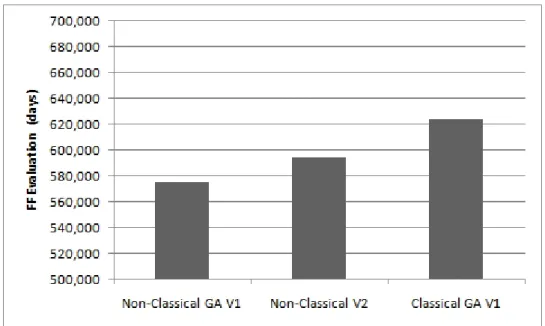
5.3 Comparison Non-classical GA V1 and V2 with 1000 evaluations . . . 34
5.4 Comparison Non-classical GA V1 and V2 with 10000 evaluations . . . 34
5.5 Comparison Non-classical GA V1 and V2 with 100000 evaluations . . . . 35
5.6 Average comparison Non-classical GA V1 and V2 . . . 35
5.7 Comparison Non-classical GA V1 and V2 and Classical GA V1 . . . 38
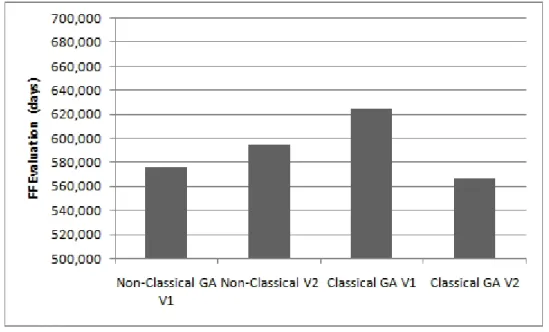
5.8 Comparison Average Non-classical GA V1 and V2 and Classical GA V1 . 40 5.9 Comparison Average Non-classical GA V1 and V2 and Classical GA V1 and V2. . . 42
5.10 Comparison Average Non-classical GA V1 and V2 and Classical GA V1, V2, and V3 . . . 47
6.1 Projec 1. Normalisation Test 1. . . 54
6.2 Projec 1. Normalisation Test 2. . . 54
6.3 Projec 1. Normalisation Test 3. . . 55
6.4 Projec 1. Normalisation Test 4. . . 55
6.5 Projec 2. Normalisation Test 1. . . 57
6.6 Projec 2. Normalisation Test 2. . . 57
6.7 Projec 2. Normalisation Test 3. . . 58
6.8 Projec 2. Normalisation Test 4. . . 58
6.9 Projec 3. Normalisation Test 1. . . 61
6.10 Projec 3. Normalisation Test 2. . . 61
6.11 Projec 3. Normalisation Test 3. . . 62
6.12 Projec 3. Normalisation Test 4. . . 62
6.13 Projec 4. Normalisation Test 1. . . 65
6.14 Projec 4. Normalisation Test 2. . . 65
List of Figures vii
List of Tables
5.1 TPG representation . . . 27
5.2 Duration representation . . . 27
5.3 Resource representation . . . 28
5.4 Resource allocation representation . . . 28
5.5 Sony project resource allocation . . . 30
5.6 Sony project results for Non-classical GA V1 . . . 31
5.7 Sony Average Results Non-Classical GA V1 . . . 31
5.8 Sony project results for Non-classical GA V2 . . . 33
5.9 Average comparison Non-classical GA V1 and V2 . . . 34
5.10 Sony project resource allocation. . . 38
5.11 Sony project results for Classical GA V1 . . . 39
5.12 Average Non-classical GA V1 and V2 and Classical GA V1 . . . 39
5.13 Resource allocation representation Classical GA V2. . . 40
5.14 Sony project results for Classical GA V2 . . . 43
5.15 Average Non-classical GA V1 and V2 and Classical GA V1 and V2. . . . 43
5.16 TPG Representation Second Version . . . 44
5.17 Sony project results for Classical GA V3 . . . 46
5.18 Average Non-classical GA V1 and V2 and Classical GA V1, V2, and V3 . 46 6.1 Original project definition . . . 49
6.2 Transformation project definition table . . . 50
6.3 Adapted project definition . . . 50
6.4 Final project definition. . . 50
6.5 Projects definition . . . 51
6.6 Top 10 dependencies Project 2 . . . 59
6.7 Top 10 dependencies Project 3 . . . 63
6.8 Top 10 dependencies Project 4 . . . 67
6.9 Top 10 dependencies Project 1 . . . 70
6.10 P-value Rank Sum test Top 10 dependencies Project 1 . . . 70
6.11 P-value Rank Sum test Top 10 dependencies Project 2 . . . 71
6.12 P-value Rank Sum test Top 10 dependencies Project 3 . . . 72
6.13 P-value Rank Sum test Top 10 dependencies Project 4 . . . 72
A.1 Top 10 Results Project 1 Test 1 . . . 81
A.2 Top 10 Results Project 1 Test 2 . . . 82
A.3 Top 10 Results Project 1 Test 3 . . . 83
A.4 Top 10 Results Project 1 Test 4 . . . 84
List of Tables ix
A.6 Top 10 Results Project 2 Test 2 . . . 86
A.7 Top 10 Results Project 2 Test 3 . . . 87
A.8 Top 10 Results Project 2 Test 4 . . . 88
A.9 Top 10 Results Project 3 Test 1 . . . 89
A.10 Top 10 Results Project 3 Test 2 . . . 90
A.11 Top 10 Results Project 3 Test 3 . . . 91
A.12 Top 10 Results Project 3 Test 4 . . . 92
A.13 Top 10 Results Project 4 Test 1 . . . 93
A.14 Top 10 Results Project 4 Test 2 . . . 94
A.15 Top 10 Results Project 4 Test 3 . . . 95
Abbreviations
AEC Architecture, Engineering and Construction BRSA BroadRangeSensitivity Analysis
CPD CriticalPathDiagram CPM CriticalPathMethod DOE Designof Experiments
FAST Fourier AmplitudeSensitivity Test
GA Genetic Algorithm
PERT Project EvaluationReviewTechnique PSP Project SchedulingProblem
SA Sensitivity Analysis
SD System Dynamic
Symbols
Chapter 1
Introduction
The main goal of this project is the development of an implementation able to provide an improvement over the original schedule in software project management by the use of search-based software engineering techniques. The first phase aims to the deployment of a solution for the process of resource allocation in the definition of the project by the application of genetic algorithms (GAs). At the same time, this work supplements this first goal by a second aspect of improving planning in software project management by breaking dependencies and performing sensitivity analysis (SA). Software project management is a significant up to date area with increasing complexity and demand from almost every sector in the industry and not only in the field of New Technologies. Nowadays, projects in every engineer or industrial sector such as architecture, energy, aeronautic, aerospace, and much more involve the use of specific software and therefore the Project Scheduling Problem (PSP) is more present than ever. As a result, the de-mand for new tools and techniques by companies and their managers to improve the cost and duration, variables which define the PSP, of software projects is a visible concern. Hence, the idea highlighted of contributing with new means to advance, enhance, and improve the solutions in software project management is significant enough to justify this paper.
The remainder of the paper is organised as follows. The next section starts setting out the problem covered in this research in general terms. Thereafter, it is mentioned the previous related work and the main background material, analyzing the ideas proposed in that material and the main differences regarding the focus of this research. Then this paper introduces a section with the main foundations which support it and present the base of the model developed. The next section explains the work that was performed during this research, specifying the main techniques used during its approach as well as the methodology adopted. In this sense, this section concretely states the implications
Introduction
in software project management of this paper. Likewise, the first subsection describes an accurate specification of the technical details. Straight afterwards, the following section details the two different algorithms developed and the results obtained in the application of those GAs to diverse scenarios constructed from data of real projects. Next, a complete section explains the process of SA performed as well as the process of breaking dependencies in addition to the results obtained. The following section fully details the conclusions obtained after analysing the results. The last section of this paper details which could be the next steps and the future work in the development of this research.
1.1
Simple Example
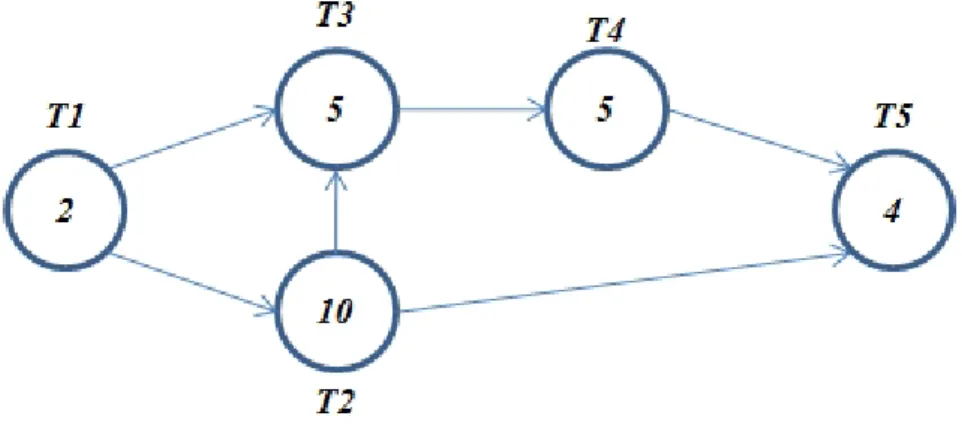
The idea behind this paper is exemplified in Figure1.1, Figure1.2, and Figure1.3. The first figure represents the task precedence graph of a simple project definition. In this project definition there are five tasks with their duration as well as the dependencies between those tasks. For this simple example it is assumed that the resource allocation for those tasks has been made producing the duration indicated in the number inside the octagons, which represent the tasks. In addition, it is also assumed that every task can be at any time due to the resource allocation. This part would correspond to the first phase of this research.
Taking into consideration all the premises detailed in the previous paragraph and ac-cording to the information revealed in Figure 1.1, the optimal completion time for this project definition would be 26 units of time.
Figure 1.1: TPG + Duration. Example 1.
The second phase of this research rests in the process of breaking dependencies and performing sensitivity analysis to evaluate whether it is possible to optimise the overall completion time for the project definition. If this idea is applied to this particular
Introduction
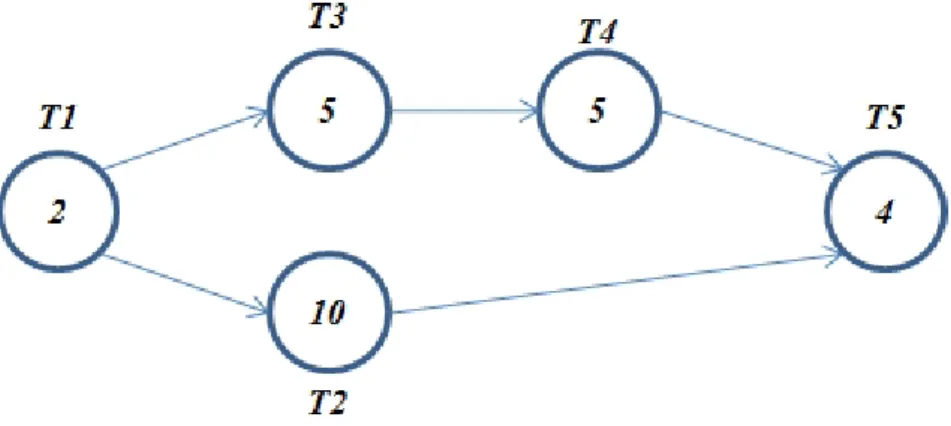
example, it is feasible to reduce considerable the schedule. As it can be observed in Figure1.2, if the dependence between the task 2 and the task 3 is removed the scenario represented in Figure 1.3 would allow new completion times. In this case, the new optimal completion time would be 16 units of time. Hence, it would be possible to decrease the original schedule by ten units of time which is a significant improvement.
Figure 1.2: TPG + Duration. Example 1. Breaking dependencies.
Figure 1.3: TPG + Duration. Example 1. Resulting TPG after breaking
dependen-cies.
Furthermore, it is necessary to indicate that by removing dependencies the process of resource allocation it would be performed again and therefore, the number of possible combinations is considerable yet not always desirable.
The process explained and illustrated in the previous figures is a simplification of the model developed. The purpose of this example is to provide a general idea of the main goal aimed in this research.
Introduction
1.2
Roadmap
The project first developed an algorithm able to cover the considered parameters of the PSP in order to provide an accurate benchmark for the resource allocation in the project definition. This algorithm worked on different combinations, understanding by combinations the different possibilities of the assignment between the resources available and the tasks defined. This part corresponds to the first phase the research, and as it shows the section 5 of this paper various alternatives were considered and several scenarios were tested.
The second phase of the project carried out the process of breaking dependencies and re-running the algorithm developed in the first part in order to evaluate whether it is possible to produce improvements by reducing the benchmark or original optimal completion time. In order to produce trustworthy results, the model developed was applied to different scenarios based on real data projects. Thus, the input data set which fed the model produced valuable output since the possible spectrum of scenarios is infinite whereas the real framework might be limited. The results obtained are evaluated performing sensitivity analysis over the solutions provided by the model. This procedure measures the relative impact of every modification introduced in the original scenario. The data analysed is the effect produced on the original completion time by removing dependencies and altering the resources available. This method tries to identify whether the dependencies which produce improvement are always the same and how they behave in the different scenarios.
In addition, based on the results collected in the sensitivity analysis statistics analysis was performed to add reliability to the data produced by the model developed.
Chapter 2
Problem Statement
2.1
Problem Definition
In the discipline of software project management the main objective is to successfully achieve the project goals within the classical constraints of time and budget utilizing the available resources. In order to be able to accomplish this aim in the best way, companies and managers desire to optimize the allocation of the resources in the tasks, which define the project, to meet the objectives. Based on this distribution, tasks have a specific start and completion time, and the whole set defines the schedule of the project. This plan is classically illustrated using Gantt charts, which is the most common technique for representing the phases of a project.
Nevertheless, this assignment is not straightforward since the group of tasks might have dependencies between them. Therefore, it might be necessary to first finish one or more tasks to be able to start a next one. The Task Precedence Graph is the main technique used to represent the tasks of the project and their dependencies.
This method of representing for a project should not be mistaken with the other two main techniques, the Project Evaluation and Review Technique (PERT) and the Critical Path Method (CPM), used to analyse and represent the schedule of the set of activities which composes the definition of the project. This difference is explained in detail in the section 2.2of this paper.
The scope of this research is clearly defined within the context of developing new tech-niques in software project management to improve the optimal solutions of the PSP. In pursuance of this aim, this research focuses on resource allocation and breaking depen-dencies between tasks to find a new schedule which improves the completion time of the original optimal one. In the interest of this objective, the main technique fully detailed
Problem Statement
in the section 3.2.1 of this paper is GAs with the use of SA. In consequence, the idea highlighted of optimizing completion times, probably the most complicated concern in software project management as PSP, reasonably validates this paper.
2.2
Task Precedence Graph
This section establishes the differences between the the Task Precedence Graph (TPG), which is a method of representation, and the Project Evaluation and Review Technique (PERT) and the Critical Path method (CPM), which are techniques or methods for project management. The main reason in so doing that is that the similarity in terms of concepts and patterns used to represent in schemas these procedures could lead to confusion.
Usually, specifying the tasks and identifying dependencies between them is the first step in definition of a project, and the TPG is the best approach to depict this early stage. After this point, it is common in the management of a plan to decide the time that it is necessary to spend in every task in order to complete it. Here, it lays the key point which distinguishes the TPG from the PERT and CPM.
2.2.1 Task Precedence Graph (TPG)
The TPG is just a method of illustrating the definition of a project by representing two different features:
1. Tasks
2. Dependencies
Figure 2.1: Example of Task Precedence Graph.
This methodology only represents the two features mentioned and it does not take into consideration measures about the duration of each task and therefore, cannot establish
Problem Statement
the known Critical Path Diagram (CPD) neither the minimum time required to complete the whole project. Hence, the exercise of determining the time necessary to finalised a task is a complete different activity. This fact allows establishing a separate list of durations for the tasks calculated in terms of ”unit of time / person” or other kind of measure. As a result the completion time of every task can vary depending on the resources assigned to it.
2.2.2 Critical Path Method (CPM)
The CPM is a mathematical method to schedule the definition of a project which is able to calculate the completion time. Although the management of a project involves the consideration of many factors which can be added enhancing the CPM, the basic representation entails the three main features:
1. Tasks
2. Dependencies 3. Duration
Figure 2.2: Example of Critical Path Method
In this sense, it is understood that the CPM shows a representation where the duration of the task is fixed due to different reasons such as that the resources which perform the tasks have been already assigned or the estimation in terms of duration do not depends on the allocation of resources. The CPM is able to demarcate which tasks are critical and which not regarding the finalisation of the project, and as a result, construct the Critical Path Diagram in addition to the best completion time using the information of the duration of the tasks and their dependencies. Furthermore, this methodology determines the earliest and latest time in which every task can start and finish.
Problem Statement
New developed versions and tools of the CPM allow introducing the concepts of resources producing variation in the schedule of the project, this fact can lead to misunderstanding between CPM and TPG.
2.2.3 Project Evaluation and Review Technique (PERT)
The PERT is second technique used for analysing and scheduling the definition of a project. This method has common similarities in its approach to the CPM, but it is also a technique used in project management for planning the completion time and not just for representing tasks and dependencies as the TPG. The features considered and the means used to displays the information is almost analogue to the CPM; nevertheless, this technique has some differences with respect to. PERT is considered a probabilistic methodology due to its technique of estimating the duration of each task, whereas CPM is considered a deterministic technique.
Chapter 3
Literature Survey
This chapter introduces the theoretical foundation for the implementations developed, which tries to provide an improvement in the process of planning software project man-agement in a first stage, and a further evolution of breaking dependencies through the use of genetic algorithms (GAs) in sensitivity analysis (SA). Therefore, the aim of this section is to settle the theoretical base of the main techniques and methodologies used in the development of this paper. In so doing that, definitions are given for the key concepts necessaries in the different approaches followed throughout the implementations. In addition, the aim of this chapter is a comprehensive identification of the most relevant literature whose information has direct impact on supporting the background area over this paper is built on. In so doing that, we meet one basic requirement for deploying a remarkable thesis.
3.1
Search-based Software Engineering
Search-based software engineering is a field inside software engineering whose approach is based on the utilization and application of metaheuristic search techniques such ge-netic algorithms, hill climbing algorithm, tabu search, and simulated annealing. These techniques aim to produce exact or approximate solutions to optimization and search problems within software engineering. Its application has been successfully accomplished in different areas of software engineering which were reviewed in the literature survey section.
Search-based software engineering and its metaheuristic techniques are mainly repre-sented and based on mathematical data and representation. This fact, as a result,
Literature Survey
requires the reformulation of the software engineering problem as a search problem by means of three main stages [1]:
• Problem’s representation
• Fitness Function
• Operators
However, it has to be taken into consideration that particular search-based techniques may need specific necessities due to their intrinsic theoretical definition.
The representation of the problem allows the application of the features of the search-based technique. Furthermore, it usually entails the description of the framework by expressing the parameters, which are involved in the definition of the software engineer-ing problem and the search-based technique applied, in a numerical or mathematical system. In addition, this manner allows an exhaustive statistical analysis of the results. Fitness function is a characterization in terms of the problem’s representation of an ob-jective function or formula able to measure, quantify, and evaluates the solution domain provided by the search-based technique.
Operators define the method of reproduction to create candidate solutions. A consider-able variety of operators can be applied depending of the search-based technique chosen, and the way in which it is applied is subject to the features of that technique.
The scheme divided in the three key stages proposed by Harman and Jones in [1] is the main base of the model developed in this thesis. Therefore, the main contribution of this paper is the supply of the basic structure necessary in the application of search-based techniques to the problem stated in the section 2.1 of this paper. However, the model developed differs from this work offering its own implementation of a GA as well as the application of SA to tackle the problem.
The recent development in search-based software engineering and its different techniques as well as its successful application in different areas has been exhibited in a significant variety of papers. It is important highlighting certain articles such as [2] which states the benefits of the techniques of this particular area of software engineering and provides an overview of the requirements for their application. Moreover, it denotes a set of eight software engineering application domains and their results. The relevance of these tech-niques is demonstrated by their application in a wide variety of areas with encouraging results [3][4][5][6][7].
Literature Survey
[2] stated that search-based optimization techniques have been applied widely to a large range of software activities. The list mentioned covers different areas of the life-cycle such as service-oriented software engineering, project planning and cost estimation, com-piler optimization, requirements engineering, automated maintenance, and quality as-sessment.
Furthermore, [2] offered a broad spectrum of optimization and search techniques for this purpose such as genetic algorithms and genetic programming. In addition to the allusion to GAs the same paper also remarked one key point that is directly related to interest of this research. It cited the crucial importance of the fitness function as the main difference between obtaining good or poor solutions no matter the search technique. Harman in [2] analysed different optimization techniques by dividing them into two main groups: classical techniques such as linear programming; and metaheuristic search such as Hill Climbing, Simulated Annealing, and GAs. Moreover, Harman [2] showed a special concern about the role of sensitivity analysis in search-based software engineering. It turned the focus of the approach of the software engineering problems from global optimum to the impact of the input values in different questions such as the shape of the landscape and the location of the search space peaks.
This thesis is influenced by the work done by Harman in [2] because it also states motivation for metaheuristics techniques, particularly GA. However, this work developed an implementation of that particular technique to cope with the PSP. In addition, it performs an SA which is enhanced by the use of statistical tests. Therefore, this thesis does not raise SA as a future work, but it produces it as an essential part of the model.
3.2
Search-Based Software Project Management
Currently, software project management is a major concern software engineering. This fact is proof by the considerable amount of techniques that are being applied in this field. One of the areas that is making a special effort is search-based software engineer-ing. Within this area, diverse authors use techniques such as hill climbing, GAs, and simulated annealing. The main technique used in this thesis is GAs. As a result, despite successful application of other techniques in search-based software engineering problems such as hill climbing, the literature survey of this thesis is mainly based on GAs. There is considerable amount of information related to the field of software project management and more recently in the application of new techniques such as GAs [3][4][5][6][7][8][9][10].
The use of SA in project management is relatively new in terms of application. Hence, the literature survey mentions not only papers with the basic notions of SA, but also
Literature Survey
different works where this technique was applied with interesting results in areas not related to software project management. The main reason is to show the capacity of this technique particularly measuring input factors of a model. This contributed significantly to the idea of establishing which dependencies produce a bigger impact and therefore reduce the completion time in a greater proportion when they are removed.
3.2.1 Genetic Algorithms
Genetic algorithms are a stochastic search-based technique and a particular class of evolutionary algorithms which performs an iterative optimization method based on the processes of natural genetics to resolve or approximate a solution. The foundation of GAs is to extrapolate the Charles Darwin’s evolution theory to an algorithm which is able to evolve possible candidate solutions in a process of optimization in the pursuance of the solution of a problem. It is generally agreed that genetic algorithms have application in a significant variety of areas such engineering, computer science, mathematics, physics and so on.
In the development of the GAs it can be distinguished three main points:
• Definition of the process. Evolutionary testing is going to be used as a technique. Which procedure is shown in Figure 3.1.
• Definition of the Fitness Function. The Fitness Function is the objective function used in the process of evaluation of the candidate solution or individuals.
• Definition of the genetic operator. The election of the operator will define the way in which a population of chromosomes or individuals is recombined to generate a new individual.
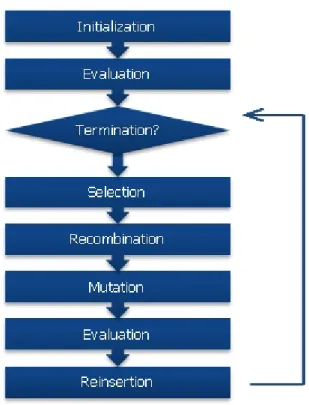
The methodology of GAs consists in a sequence of actions explained following and il-lustrated in Figure 3.1. In the first one, a population of individuals also known as chromosomes is generated randomly. Each of those individuals represents a candidate solution and therefore the initial search space of the algorithm. The next step consists in the evaluation of every possible candidate solution through the use of the fitness function and verifying whether the problem has been resolved or not. The fitness function has been previously defined for the particular problem and it is able to assess the genetic representation of the individual. The third action in the algorithm specifies a sequence of steps included within a loop looking for an evolution in the candidate solutions or individuals by recombining and mutating them. The sequence continuously performs a selection whose main purpose is to choose the individuals to generate a new population.
Literature Survey
Figure 3.1: GA’s methodology. Evolutionary Testing.
Individuals with better fitness function evaluation are likely to be elected, although not in an exclusively way, since this fact would incur in a problem of non-diversity within the population. There is a considerable diversity of methods of selection. A case in point, used in the implementation of this paper, is the tournament selection [11]. The next step is the process of recombination of the individuals previously selected by the methodology defined by the genetic operator agreed. In the same way that with the method of selection, there is a considerable variety of genetic operators, a good and rel-evant example deployed in the implementation of this paper in the two point crossover operator [12]. The intention of this action is to combine different candidate solutions in order to generate the new individuals of the regenerated population. After that, the sequence performs the step of mutation whose main purpose is to try to introduce ge-netic diversity by randomly mutating the individuals. In so doing that, the algorithm attempts to keep the process of evolution. The last two steps of the loop consist in evaluating the new candidate solutions generated by the algorithm and reinserting them into the new population.
In the use of GAs this research is significantly inspired by the work done by Massimiliano Di Penta, Mark Harman, and Giuliano Antoniol [3][5] about software project manage-ment in a search-based approach. In addition, [4] reinforce the application of GAs in Search-based technique for optimizing the project resource allocation. Likewise, the work of this research is encouraged by the concerned shown by Shin Yoo in his work [10]
Literature Survey
about data sensitivity in the application of a Novel Semi-Exhaustive Search Algorithm. In [3][5], based on previous work [4], is declared the application of GAs, which obtains significant better results than random search, to implement the search-based approach. This methodology provides empirical evidences of the variance in the completion time and the allocation of the resources by the overhead communication produced in the Brook’s law. Moreover, this approach is able to evaluate the impact of Brook’s law in the completion time of the project providing a prudent technique to improve software project management scheduling.
The work done by Antoniol et al in [3][4][5] contributed to this thesis in the idea of using search-based approach to face the resource allocation in the project management and the scheduling. However, those papers are orientated in complete different direction. [3] was particularly interested in attempting to evaluate the effect of communication overhead on software maintenance project staffing. It analysed the impact of different factors such as the dependencies between tasks on project completion time, which is also related to this thesis, and on staff distribution. The base of this work is to disclose the influence or effect of Brook’s law on the two goals previously mentioned. The empirical study presented an evaluation of the relation between the tasks and the effort (person-s/month). Whereas the main focus of this paper is to apply search-based techniques to decrease the completion time by removing dependencies and performing SA.
The paper [4] primary compares different search-bases techniques, using queuing simu-lation in the fitness function evaluation. This similarity can be also appreciated in [3] , where the use of GAs and a queuing system is part of the model. The use of GAs to analyse the resource allocation is common in the approach of this thesis and [4][3], yet its use is different. The GA implemented in this thesis does not use this queuing system and it was developed to cover the parameters considered for the duration aim of the PSP in order to allow the process of altering the TPG and study its impact over the project completion time.
In the case of [5], it contributed to this thesis in its demonstration of the capacity of the GAs to tackle resource allocation. This is essential part of the model generated in this work. However, the main effort of [5] is concentrated on a search-based approach over undesirable but frequent situations in project management, such as rework or abandon-ment of the tasks, uncertain estimations, and errors. The idea behind this thesis also implies resource allocation, yet it focuses on offering alternatives to the project manager by approaching the PSP in a new way, breaking dependencies. Hence, the robustness of the initial scheduling offered and the possible setbacks or issues arisen during the project are not considered.
Literature Survey
The second main source of previous related work in GAs, which is considered as signifi-cant valuable background, is the material of Enrique Alba and Francisco Chicano [8][9] in the application of GAs to software project management. In this work, the application of GAs to different scenarios to resolve the PSP provides significant results in terms of the sensitivity of the classical variables: number and duration of tasks, skills, available resources, dedication, and cost. These results are obtained through the use of an instance generator developed specifically by this purpose, which automatically creates different project scenarios based on the customize file configured. As it is always done in the exercise of GAs, a fitness function calculates the achievement of a successful result. This work states interesting details of the fitness function, the different considerations within the algorithm developed, and the behaviour the of the instance generator which are fully detailed in [8]. Yet, the most remarkable attainments are the results obtained and de-scribed in the section 6 about the experimental study. This study could be considered a sensitivity analysis of the different parameters, accurately represented in various tables and an absolutely complete set of figures. Moreover, the study concludes the variable importance the parameters. A case in point is the number of tasks, which considerably increases the difficulty to obtain a solution in the application of the GAs.
This work done in [8] exhibited the ability of the genetic algorithms to face the Project Scheduling problem. Nevertheless, this work also evidences certain level of incapacity to offer solutions when the number of possible combinations is increased by the rise of the input values which feed the model. The algorithm developed follow the classical convention for the GAs as can be appreciated in Algorithm1.
Algorithm 1 GA Pseudocode. Adopted from [8] Initalize Evalute while do Select Recombine Mutate Evaluate Replace end while
The model produced by Alba and Chicano in [8] has one primary strength and one main weakness. The major positive point of this work is its competence to deal with the parameters of the two goals in conflict that define the PSP the cost and the duration of the project. This work takes into consideration tasks, duration and dependences be-tween those tasks, resources, skills of those resources, effort bebe-tween tasks and resources, salaries, and dedication of the resources to the tasks. However, the method of repre-sentation for the dedication within the algorithm could generate non-feasible solutions.
Literature Survey
This important fact is the main disadvantage of the model. By non-feasible solution it is understood those where one resource has overwork and therefore the dedication assigned to multiple resources is impossible to be reproduce in the real work environment. In ad-dition, the model could generate non-feasible solutions in two more situations. First, if one of the tasks has no resource assigned. The last one, when the resource assigned does not have the necessary skils to perform the tasks. As a result, the authors of the paper introduced a fitness function able to discern the viability of the solutions by adding a variable of penalty. Forming the fitness function 3.1, adapted from [8]. The term (q) measures the quality of the solutions generated and the second term (p) calculates the penalty.
f(x) =
(
1/q if f easiblesolution
1/(q+p) otherwise (3.1)
Alba and Chicano in [9] demonstrated the capacity of the search-based technique to approach the Project Scheduling Problem. This paper exhibited the ability of the meta-heuristics techniques and the genetic algorithms in particular to manage optimally the time and the cost in the project management. Alba and Chicano perform an incredible realistic work by considering the most classical parameters in the PSP. This fact and the different scenarios processed allow them to exercise a precise analysis of the influence of the attributes in the solutions of the problem. Both authors mentioned the difference between the application of GAs in software engineering and other fields such as bioin-formatics, mathematics, telecommunications, and so on. This metaheuristics technique is not so intensively used in software project management. Nevertheless, their results and conclusion proved the capacity and accuracy of the genetic algorithms to help the managers addressing the project management.
The work done by Alba and Chicano in [8][9] significantly inspired the model developed in this thesis contributing with the idea of using GAs to face the resource allocation in the PSP. Nevertheless, the focus between those papers and this work is completely different. In [8][9] Alba and Chicano studied the behaviour of the model developed in order to produce an optimal resource allocation in diverse scenarios facing both goals of the PSP, cost and duration. For this purpose, they took into consideration parameters which affect both aspects such as skills of the resources, for instance. Whereas the main aim of this thesis is to provide new means and methods to improve the overall completion time of a project by removing dependencies and performing sensitivity analysis in this action. All the efforts done in this work is only focus on the improving only one of the goals of the PSP, duration. Therefore, despite both works attempt to help managers
Literature Survey
in software project management by the use of GAs the ultimate targets are completely different.
3.2.2 Sensitivity Analysis
This section briefly and concisely defines sensitivity analysis and the main concepts surrounding its study. In addition, it analyses the main previous related work in the field of sensitivity analysis and in the area of software project management in particular. Sensitivity analysis (SA) is the study of the impact in the output model value due to variation in the input model source parameters. Therefore, sensitivity analysis is mainly used in the study of the sensitivity of a model or a system in changing the input value parameters which define that model or system [13]. This kind of analysis is generally known as parameter sensitivity. Despite other authors also mention structure sensitivity, that study is not matter of interest to the main purpose of this paper. Consequently, sensitivity is the statistical measure of the effect in the outcome in comparison with the modification in the parameters that determine it. Ergo, the greater in the variation of the result per unit the greater the sensitivity is.
A key point in this research is a comprehensive, complete and thorough related back-ground documentation of SA, which is necessary as a base. The general introduction done by Lucia Breierova and Mark Choudhari for the MIT [13], as well as the definition of Global Sensitivity Analysis proposed by Andrea Saltelli [14] provide a good support for the understanding of the topic, giving premises and hints to carry out this method-ology. As it is mentioned in the introduction of this paper project management and software development are present in all the engineering areas, and the application of SA has already been experimented in fields such as planning process in architecture, engi-neering and construction (AEC) [15] and detecting and elimination errors in software development [16].
The research done by Breierova and Choudhari in [13] and the one done by Saltelly in [14] guided this thesis towards the concept of parameters sensitivity. Within sensitivity analysis, it is the action of analysing, evaluation and measuring the impact of variations in the input of the model to examine the behaviour responds of it. These two sources mentioned, helped to understand the force of this theory providing a consistent base, precise definitions and relevant examples. However, this thesis uses all this established knowledge in the specific application of software project management, evaluating the impact of removing in turns all the dependencies that compose the TPG in the PSP.
Literature Survey
[15] does not have a significant similarity with the work developed in this thesis. How-ever, the work done by Lhr and Bletzinger was beneficial to exemplify the capacity and the application of sensitivity analysis in different areas. Furthermore, the idea of eval-uating the impact of diverse factors on the development of the planning process and therefore, on the goal of time for optimal planning join the focus of this thesis in a certain level. Since, it also performed sensitivity analysis to factors which have direct impact in the duration of the PSP for software project management.
The work produced by Wagner in [16] coincided with the area of this thesis. It proposed a model able to evaluate the quality costs in software development by deploying an an-alytical model and performing sensitivity analysis. This work is also partially based on the concept of global sensitivity analysis arisen by Saltelly in [14]. Therefore, Wagner contributed notably to the idea of applying SA to software project management. Nev-ertheless, this thesis differs from this work since the scenario and the factors which feed the model and the model indeed are completely different. In general terms, the research of Wagner focused on costs whereas this thesis tackled the other main goal of the PSP, the duration. In addition, in [16] faced defect-detection techniques and its quality cost associated. Thus, it did not approach the PSP directly.
Sensitivity analysis helps to identify the critical parameters which have more reper-cussion or influence in the output of the model or system. The current relevance of performing SA in the development of model or system is stated by Saltelli in [17] where it is supported by the allegation of the adequate advance of its theoretical methods. A good example of its application and its positive results collecting information of the impact of the input parameters is [18]. Furthermore, SA can alleviate the problem of uncertainty in input parameters [19].
The papers [17] [18] [19] assisted significantly in the generation of this thesis, although there are substantial differences. The work of Saltelli in [17] did not contribute to the model developed in this thesis to a particular specific part. Yet, it was considerably helpful to understand the concept behind the sensitivity analysis. Furthermore, it con-tributed to comprehend the importance of the factors which determine a model in order to reveal information in the context of model-based analysis.
In the case of [18], despite the work was a clear sensitivity analysis within the context of project management, its focus lay in analysing uncertainty and risk to justify or not investment in projects. By contrast, in this thesis, sensitivity analysis is performed to offer the manager different options to approach the PSP. In conclusion, both models the one developed by Jovanovi in [18] and the one developed in this thesis work over parameters which usually are involved in project management. Nevertheless, the final aim of this analysis is completely different.
Literature Survey
Johnson and Brockman in [19] demonstrated the capacity of sensitivity analysis to iden-tify and reveal the mechanisms that have the greatest impact on design time in design process. Thus, the idea behind this paper is not related at all with the PSP in project management. However, it added the concept of using sensitivity analysis to measure im-provements in completion time when this is an essential factor of the model or problem that wants to be faced.
In addition, it exists the application of SA in project management with different ap-proaches such as Hybrid Models over Design of Experiments [20], MonteCarlo method [21], and Fourier Amplitude Sensitivity Test (FAST) [16][22]. The main contribution of these papers was its extensive use of SA to different aspects of software project man-agement or software engineering. However, there are relevant differences with the main focus of this thesis. All these paper used specialised techniques of SA to their particu-lar issues. Whereas, the study done this thesis, produced a detailed evaluation of the behaviour of the model in the different tests performed in common SA. Furthermore, the scenario of application for this thesis, which is the classical PSP, was tackle in none the papers mentioned. Particularly, the action of removing dependencies and measuring its impact in the completion time of the project entailed a complete new are of survey. Consequently, despite there is a common field of research between theses works, their kernel of experiment is entire different.
First, Hybrid Model over Design of Experiments (DOE) [20], which is based on previous models: System Dynamic (SD) Models, to obtain the dynamic behaviour of the project elements and their relations; State Based Models, which reproduces process activities and represents the dynamic processes all over the state transitions initiated by events; and Discrete Models, to reproduce the development process. This hybrid model consists in associating the discrete model and a process of continuous simulation able to reproduce tasks which are affected by the constant changes of the parameters, and using the state based model to express the changes of the states. Thus, Hybrid Models are able to analyse the impact of changes in a dynamic project environment. Furthermore, the most interesting affirmed aspect of this paper [20] is the possibility to show non-linearities not discovered by the common sensitivity analysis using DOE in combination with Broad Range Sensitivity Analysis (BRSA).
The second main approach in the use of SA is Montecarlo method and its software covered in the research of Young Hoon Kwak and Lisa Ingall [21]. This paper applies software based in MonteCarlo method to plan the project by the analysis, identification and assessment of the possible problems and their circumstances within the context of the development. This methodology has not been totally accepted in project management for a real use although it has been used in several areas which have connections to
Literature Survey
modelling systems in biological research, engineering, geophysics, meteorology, computer applications, public health studies, and finance.
The last approach is mentioned by Stefan Wagner [16] in his research of defect-detection techniques in SA. The pillars of this work are the use of Fourier Amplitude Sensitivity Test (FAST) based on the performance of Fourier functions and Simlab software. Ac-cording to Wagner this method is able to provide a quantification and qualification of the influence of the parameters. Again, although the Simlab and its capacity due to its features seem to be very interesting, the FAST method may be not as appropriate as BRSA for the purpose of this research.
3.3
Validation of the work
There is a considerable amount of material where a visible concerned about project management is exposed. Furthermore, the use of techniques such as GAs and SA is widely accepted and used in tackling a significant variety of issues as it has been described in among this section of the paper. Nonetheless, there are significant differences from existing work related and the main objective of this research. Next, it is made a brief, yet clear and explicit comparison with the closest previous related work that undoubtedly distinguishes this research.
[3][4][5] attempt to improve the completion time based on the application of search-based over different formulations of Brook’s law. Which means, increasing the number of employees, whereas the main focus of this paper is breaking dependencies between tasks. The second main related source is [8][9], where the kernel is the analysis of the differences of applying GAs taking into consideration the mentioned parameters of a project in the pursuance of the optimal solution for the plan. The focus of this paper, on the other hand, is to improve the optimal solution breaking the dependencies of the TPG.
Thus, it is possible to state that although this research is thoroughly based on differ-ent works already done in this field such as software project managemdiffer-ent with GAs [8] and search-based approach on software maintenance project [3][4][5], as well as, plan-ning process in architecture, engineering and construction (AEC) [15] and Detecting and Elimination Errors in Software Development [21]. Indeed, it does not comprise an extension or validation of earlier work. The framework of this research is defined within the scope of relevant researchers in this field, yet it deploys an area in the pursuance of a new solution with the application of GAs and sensitivity analysis.
Chapter 4
The Model Introduced by this
Thesis
The main aim of this chapter is to describe the technical specification that is going to be adopted for the purpose of this work. This means the methodology as well as base over which is going to be built on. Hence, taking into consideration all the information described in the introduction of this paper as well as the detailed previous related work, the context of this research is defined within the classical PSP and the use of GAs in the scope of SA.
In this empirical study the principal goal is to obtain a better completion time based on the optimal schedule for a particular project. In order to fulfil this purpose, the key point proposed is the action of breaking dependencies of the TPG and evaluating the completion time with the parameters of the PSP through the use of GAs. The ambi-tion of this research is to offer the manager a range of alternatives with the maximum improvement over the initial optimal schedule with the minimum modification. The individual in this role will be then in a position to estimate whether the choice proposed by the run of the model can be carry out or not.
In the furtherance of a successful culmination of this work, the first step necessary to perform is the definition of the scenario, premises, variables, and constraints that are going to be considered. The proposed scenario will be one able to enclose the model of the PSP described in the introduction of this paper. As a result, the scenario will cover a task precedence graph that will represent the dependencies between the tasks that compound the project. In addition to this representation, the scenario will be defined by: number and size of resources which perform the tasks; duration of every task; and assignment or allocation between resources and tasks. Note that the information related to the cost is not going to be considered, since the main objective of this research is to improve
The Model Introduced by this Thesis
the completion time. Therefore, variables of the cost of every resource are beyond the scope of the work proposed. Nevertheless, if a positive result is obtained in a fully implementation of the problem presented, the opportunity of enhancing it considering the parameters related to the cost would allow to have a complete improvement to the PSP. Since, cost and duration of the project are the two principal factors which define the solution to the PSP. The constraints of this work are mainly imposed by the parameters considered and developed in the implementation, as a consequence of the impossibility of adapting the model to all particular features of every single project. However, it is generally agreed that the set of parameters already listed are powerful enough to represent the main aspects of a project and at the same time provide a complete solution.
The next step in the approach of this research is the definition to the methodology that is going to be used. In the methodology adopted for the implementation of this research the first main technique used is GAs. The election of this search technique is due to the fact that it outperformed other techniques such as random search in finding or approximating a solution in an optimization or search problem. This fact is corroborated for example in [3] where it is stated a considerable improvement regarding the use of Hill Climbing.
The second and most relevant method within this research is the use of sensitivity anal-ysis, mainly focus on parameter sensitivity. The essential idea is to perform a series of tests using the developed GA and evaluate the impact on the project completion time response. In this sense, the principal aim is to break the dependencies between tasks in a minimum way to obtain the biggest impact and therefore the greatest improvement in the completion time of the schedule’s project. Nevertheless, this basic approach can be enhanced with the application of more sophisticated techniques of sensitivity analysis. These techniques were mentioned in the section3of this paper as Broad Range Sensitiv-ity Analysis (BSRA) combined with Hybrid Models over Design of Experiments (DOE), MonteCarlo method and Fourier Amplitude Sensitivity Test (FAST). Yet, these tech-niques have an intrinsic complexity and their effectiveness is more difficult to measure. According to the documentation researched and mentioned in the section 3, probably BSRA is the one which best link with the direction of this research.
The last step in the methodology is the evaluation of the model, its implementation, and the results collected. The aim was clearly defined as the greatest reduction in the completion time, which can be easily measure using a unit of time such as days. How-ever, the establishment of the minimum variation in the initial schedule regarding the action of breaking dependencies is more difficult to measure. Likewise, it is significantly complicated to endow a benchmark in the measurement. The first logical consideration
The Model Introduced by this Thesis
is that if fewer dependencies are broken the impact is minor, yet this way does not face the fact that the importance or weight of the dependencies within the project can be dissimilar. Ergo, the ideal scenario would be taken into consideration both aspects in a unique formula.
Consequently, the process of the model developed within this project has five different phases clearly differenced:
1. Definition of the initial scenario. In this phase of the model, the parameters already detailed which define a project within a PSP are taken into consideration to expose the start point.
2. Best schedule algorithm. The second phase consists in the execution of the GA to provide the best resource allocation for the initial scenario considering the variables entertained in the previous phase.
3. Establishment of the optimal resource allocation. This best optimal solution pro-duced in the preceding phase is settled as benchmark for comparing the results obtained in the next stage of the model.
4. Process of breaking dependencies. The aim of this phase is producing results using the same GA developed for the second phase of this model but feed it with a different project definition. The new project definition will be the same TPG but omitting in turn every of the dependencies which conform it.
5. Sensitivity Analysis. In this last stage of the process in the model, sensitivity analysis is performed to obtain a list with the most potential sensitive dependencies as well as the possible explanation of the impact produced.
In spite of the fact that time and the scope of this research does not allow to extent the sensitivity analysis further. It would be extremely interesting to consider the possibility of a section to identify the most critical parameters in combination with tasks using the same concept of GAs and sensitivity analysis. Developing an algorithm able to measure the maximum variance in the optimal schedule produced as a result of a minimum variance in one of the parameters which define the tasks and the project.
The Model Introduced by this Thesis
4.1
Specific Details of the Model
4.1.1 Scenario
In the pursuance of this goal all the algorithms and implementations tried so far are based on scenarios which are defined by the following features:
• TPG
• Duration (unit: days)
• Resources (teams: people)
The TPG was defined in the section 2.2.1of this paper and is considered as the basic definition of the project. This basic definition presents exclusively the list of tasks which conforms the project as well as the dependencies between those tasks. Therefore, there is absolutely no mention about the duration of those tasks neither minimum completion time for the project nor critical path diagram.
The next step in the definition of the scenario is the establishment of the duration of each tasks measured in ”unit of time / unit of resource” which is specified as ”day / person”. This action and the precedent one of defining the TPG demarcated this framework for a specific project.
Lastly, it is necessary to delimit the amount of resources available to perform the project. The definition of this parameter is subject to the way in which the duration of the tasks where set. As a result, it is possible to characterize a project depending on the resources, expressed in terms of teams composed by different number of people, and its assignment to the tasks. This fact leads to different specific durations for each task.
Throughout the diverse implementations developed different scenarios with different compositions have been tested and are fully detailed and explained in the sections 5.1
and 5.2of this paper.
4.1.2 Evaluation (Fitness Function)
The fitness function of this model evaluates the completion time of the project definition. This consists on calculating the duration of the project based on the TPG and the duration of each tasks plus the resource allocation generated by the GA. Thus, the fitness function obtains the start time for each of the tasks, by assigning the latest end time of all the tasks which depends on and the latest end time of all the possible
The Model Introduced by this Thesis
previous assignments of the same resource to other tasks in a slot time which could overlap. Finally, it obtains the end time by diving the duration of the task -measured in ”day / person”- by the composition of the resources -measured in number of people- and adding to the start time. Hence, the latest time of all the tasks will be the completion time of the project.
It has to be taken into consideration that this fitness function in addition to the struc-tures of representation of the model, later describe in the section5of this paper, as well as the methodology of the GAs and evolutionary testing explained in the section3.2.1do not always produce the real unique and absolute solution. This fitness function always evaluates the individuals in the same order from 1 to the number of tasks. Therefore, two tasks which are not dependant between themselves are always performed in the same order. A better possible solution could be achieved if the order is swapped, since they can have different duration releasing a resource in a different time as a result. The number of possible alternatives to this problem is considerable, it could be estab-lished a queue to store the order in which the tasks are performed, for example. However, they main focus of this research is the sensitivity analysis process by breaking dependen-cies. Thus, the method of evaluation developed satisfied the necessities of this research. Moreover, it rational and legitimate to use and consider this fitness function, because the solutions provided by the model implemented using this methodology of evaluation, ensures computing the solutions in the same way when the sensitivity analysis is per-formed. As a result, the complete process of removing dependencies and measuring their impact in the overall completion time of the project has not been compromised.
4.1.3 Recombination (Operator)
The operator for the recombination process of this implementation is the two-point crossover. The method implemented is common to all the different versions the algorithm developed. An example of this mode of recombination is displayed in Figure4.1.
Figure 4.1: Two-point crossover operator method.
The methodology consists in choosing randomly two points of the individuals that are going to be recombined and swap the composition of those candidate solutions in both sides of each point.
Chapter 5
Resource Allocation
The main aim of this chapter is to explain the process performed in order to obtain the most appropriate GA to provide the resource allocation between teams and tasks. In so doing that, it was possible to establish a benchmark to compare the results in the procedure of sensitivity analysis and breaking dependencies.
The number of possible combinations in this process of resource allocation is consider-able, overall when the number of tasks and dependencies exceed 40 in each case. As a result, the following section details the effort done in developing different versions of GAs with different techniques to obtain the best approximation. By the best approxi-mation it was considered that version of the GA that after 30 runs is able to produce the shortest completion time for the project definition in average of all these executions. This average was used as the benchmark to compare with the results obtained in the process of breaking dependencies.
All the features of the GA, the method of representation as well as the project definitions which compose the complete scenario tested are thoroughly described in the following sections of the paper.
5.1
Non-Classical GA
This section explains the features and the results obtained using a non-classical genetic algorithm developed. The main characteristic which lead to this non-classical denom-ination is that instead of having a new population generated in every iteration of the loop of the GA, there is only one in which two new individuals are added. Thus, the process of selection is always performed over one only population which increases in size in every iteration of the loop.
Resource Allocation with GAs
5.1.1 Features
This subsection describes the method of representation for the main structures of the implementation used, which are common to the different scenarios, as well as other relevant features of non-classical GA’s implementation. The first part cited in the section
4.1.1of this paper was the task precedence graph. For the representation of the TPG a simple binary matrix is used, where the pair between the column and the row represents the dependency between the tasks named by those indexes. An example is illustrated in Figure 5.1and Table 5.1.
Figure 5.1: TPG Example. T1 T2 T3 T4 T1 0 0 0 0 T2 1 0 0 0 T3 1 0 0 0 T4 0 1 1 0 Table 5.1: TPG Representation.
For the second part which defines a scenario the structure used is an array that contains the duration of every task as it is shown in Table5.2.
T1 10
T2 7
T3 15
T4 12
Table 5.2: Duration representation.
The last part that is necessary to represent in a scenario according the section 4.1.1
of this paper is the resources which are going to perform the tasks. The structure of representation implemented is an array that indicates the size of the resource in terms of number of members which conform the team. An example can be appreciates in Table
5.3.
In addition to the structures necessaries for the representation of the scenario it is also needed one more to express the resource allocation. For this version of the non-classical genetic algorithm the structure used is a binary matrix where rows describe tasks and columns resources. Therefore, a 1 in the row 2 and column 3 indicates that the task 2 in
Resource Allocation with GAs
R1 3
R2 4
R3 5
Table 5.3: Resource representation.
assigned to be performed by the resource 3. An illustrative example is shown in Table
5.4. R1 R2 R3 T1 0 1 0 T2 1 0 0 T3 1 0 0 T4 0 1 0
Table 5.4: Resource allocation representation.
In the development of this implementation has been considered that only one resource can be assigned to one task at the same time. Thus, the population of the genetic algorithm will be composed by individuals or candidate solutions with this architecture of representation.
The last relevant structure to complete the configuration necessary to develop the com-plete implementation is the representation of the population. This population is an array of individuals and therefore, and array of binary matrixes.
5.1.2 First Version
5.1.2.1 Individuals and Populations
In this first version of the non-classical genetic algorithm the implementation generates one only population which is initialised with 100 individuals generated randomly. As a result, there is no parent and children population. In the iterations of the evolutionary testing process of the algorithm, two individuals of the population are chosen to generate two new ones. This action increases in each step the size of the population without discarding individuals generated previously. This leads to immortal individuals and it is the key point in which this algorithm differs from the classical implementations of the GAs.
5.1.2.2 Evaluations
Taking into consideration the previous section 5.1.2.1 the number of evaluations cor-responds to the number of individuals generated inside the population. Therefore, the
Resource Allocation with GAs
algorithm works all the time over only one population until it reaches the number of eval-uations previously indicated in a variable. The method of evaluation is the application of the fitness function specified in the section4.1.2to the different individuals.
5.1.2.3 Method of Selection
The method of selection implemented in this first version of the non-classical algorithm is a non-orthodox one. This method always takes the two individuals with the best FF in order to generate the next two individuals.
5.1.2.4 Recombination
The method of recombination used is the two point crossover operator detailed in the section 4.1.3 of this paper. Although the representation of the individuals of the pop-ulation is a matrix as it is explained in the section 5.1.1, in terms of programming is treated as an array linking one after other all the different rows that compounds the matrix.
5.1.2.5 Mutation
The process of mutation developed in this version of the algorithm does not follow the classical standards of the GAs. First, random number of mutation between zero and the number of tasks is generated. After that, for every of this mutation a position of the binary matrix, which represents the candidate solution for the resource allocation or individual of the population, is generated randomly. The mutation of the position consists in producing a random number between 0 and 1. If the position mutates from 0 to 1 a check modify the previous resource assigned to perform that task to 0. In case the mutation is from 1 to 0, another resource is randomly assigned to that task.
5.1.2.6 Results
The results of this section shows the solutions obtained in the application of this version of the non-classical genetic algorithm. In a first approach the algorithm was applied to an example project with only 7 tasks and 3 resources with different composition with satisfactory results. The optimal resource allocation obeying the dependencies could be calculated by hand.