Dongmyung Lee1, Jeonghoon Mo2, Jean Walrand3, and Jinwoo Park1 1
Dept. of Industrial Engineering, Seoul National University, Seoul, Korea
{leoleo333,autofact}@snu.ac.kr 2
Dept. of Information and Industrial Engineering, Yonsei University, Seoul, Korea
3 Dept. of EECS, University of California, Berkeley, CA, USA [email protected]
Abstract. Flat-rate pricing has been the dominant scheme for tariff-ing Internet services due to its popularity and simplicity. However, this scheme does not provide incentives for users to use network resources efficiently. As the demand for wireless video and other resource-intensive services grows faster than the providers’ ability to expand the network capacity, this inefficiency becomes critical. This situation has led numer-ous researchers and practitioners to explore new pricing schemes. In this spirit, we introduce a pricing scheme calledToken Pricing that is both practical and efficient. As in flat-rate pricing, the users face a fixed price. However, users consume tokens when they want a higher quality of ser-vice while the network is congested. This mechanism encourages users to congest the network only when they have a high utility for the service. As a result, users make a better use of the resources and the social welfare increases.
Keywords: Internet pricing, Flat-rate pricing, Token pricing, Quality of Service
1
Introduction
Researchers have proposed many pricing schemes for the Internet [1–3]. Flat-rate pricing is the most widely used scheme. The users pay a fixed monthly fee and get an unmetered access. The main advantages of this model are its low administrative and billing costs for the ISP as well as predictability for the users [4, 5].
Anusage-based pricing scheme charges users based on the amount of data they use [5]. Rates may vary depending on the time of day to encourage a smoother utilization of the available bandwidth resources [4]. However, such a scheme requires ISPs to monitor accurately each user’s utilization and to im-plement a detailed billing scheme based on these measurements. Users face a variable bill and may get discouraged to use the network.
As more and more Internet services require a different level of quality of service (QoS), numerous techniques have been proposed to provide differentiated service levels [6, 7]. Some of these proposals use pricing mechanisms to improve
the economic efficiency [1, 8]. However, many of these schemes are complicated and/or involve substantial costs in both development and operations [2].
In their recent analysis, Schwartz et. al. [9] show that the transition to mul-tiple service classes is socially desirable but may increase the cost for some users for the same level of service. To limit this undesirable effect, they propose a regulation which sets an upper bound on the fraction of the network capacity reserved for high priority service. They show that this regulation can limit the distributional consequences while enabling providers to increase their revenue. However, this scheme uses differentiated pricing, which requires traffic monitor-ing and may face resistance from users and providers.
In this paper, we propose a pricing scheme called ‘Token Pricing’ that has the advantages of flat-rate pricing, yet promotes a more efficient usage of the network resources.
2
Token Pricing Scheme
When usingtoken pricing, users pay a fixed monthly fee for Internet access. Each user receives a number of tokens. The provider offers a high-quality Service 1 and a normal-quality Service 2. For instance, the services could correspond to different “bearers” (GBR or non-GBR) in an LTE network [13].
Service 2 requires no tokens but may become congested. On the other hand, Service 1 requires some tokens and, consequently, is likely to be less congested than Service 2, thus offering a better quality by a Paris Metro pricing effect [2]. Since the number of tokens is limited, users have an incentive to use Service 1 when they derive a sufficiently higher utility from that service. Consequently, we can expect the social welfare of the network to increase since valuable resources get used for more valued applications.
A secure agent in the user’s browser can monitor the token usage so that the provider does not face much additional complexity. Also, the provider does not need additional billing mechanisms.
Below, we model the token pricing scheme and the behavior of users and we analyze the improvement in social welfare. For simplicity, the analysis proceeds in three steps. Sections 2.1 and 2.2 consider discrete time models and explores the optimal strategy for a user who maximizes his total discounted utility. Section 2.1 ignores the effect of users on the congestion of the network. Section 2.2 extends the analysis to include the congestion effect. Section 2.3 studies a continuous time model for a user who maximizes his long-term average utility. That section builds on the results of the previous two.
2.1 Fixed Congestion
This section studies the behavior of a user facing token pricing. For simplicity, the model is in discrete time. Time is divided in epochs, such as ten-minute intervals for instance. During each epoch, the user accesses the Internet once for an application such as a file download, a voice or video call, an email session or
web browsing. The added value for the user of using the high-quality Service 1 compared to using Service 2 depends on the application.
With the token pricing scheme, each user can use Service 1 only once every Kepochs, on average. The user must choose when to use Service 1. The intuition is that the user will use Service 1 only when he benefits sufficiently from that valuable service. For instance, the user may choose Service 1 for an important video call instead of wasting his tokens for a file download that can be delayed. Consequently, for a given level of congestion of Service 1, one may expect the users to benefit more from that service than under a flat pricing scheme. The analysis confirms that intuition.
Every epoch n, each user gets 1 token and faces some application whose utility is xn higher for Service 1 than for Service 2. The xn’s are independent and identically distributed random variables. It costsKtokens per epoch to use Service 1.
Assume that the user hasstokens. The maximal total expected discounted value V(s) for the user of having s tokens satisfies the following dynamic pro-gramming equation:
V(s) =E[max{βV(s+ 1), x+βV(s+ 1−K)}]
where V(s) =−∞ fors < 0 (so that the user cannot use tokens when he has fewer thanK). In this expressionβ∈(0,1) is the discount factor.
The optimal policy is then to useK tokens if and only if x+βV(s+ 1−K)> βV(s+ 1), i.e., if and only if
x > a(s) :=β[V(s+ 1)−V(s+ 1−K)].
Thus, as expected, the user chooses to use Service 1 only for applications that benefit sufficiently from that service. As the next result shows, the user is more likely to use Service 1 when he has accumulated many tokens, which is not surprising. The proof is given in Appendix A.
Theorem 1. a(s)is nonincreasing.
2.2 Variable Congestion
In this section, we consider that the value of Service 1 for an application charac-terized byxas before isg(x, p), wherepis the congestion level of Service 1. The interpretation is that, as it gets more congested, Service 1 becomes less valuable compared to Service 2. Thus,g(x, p) is decreasing inpand nondecreasing inx.
The maximal total expected discounted value V(s, p) for a user facing a Service 1 with congestion level p when he has s tokens satisfies the following dynamic programming equations:
The congestion levelpis the fraction of users who use Service 1. Thus, the value of pis a function of the behavior of the users and we will consider that pis the probability that a given user uses Service 1. The interpretation is that there are many users in the system and that each user faces the congestion that many other users generate for Service 1. By himself, one user has a negligible influence on the congestion level of Service 1. Thus, this model can be thought of as a mean-field limit of the system when the number of users increases.
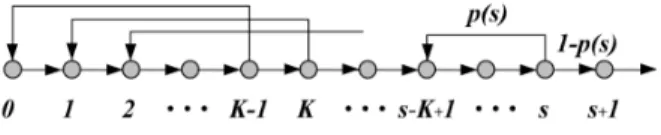
To analyze this model numerically, we need an estimate ofp. This requires an estimate of the distribution ofs. Now, sis a Markov chain that increases by 1 with probability 1−pand decreases byK−1 otherwise. The state-transition diagram of this Markov chain is shown in Figure 1.
Fig. 1.The Markov chain{sn, n≥0}
The transition probability matrix of this Markov chain is such that, fors≥
K,
p(s, p) =P(s, s−K+ 1, p) = 1−P(s, s+ 1, p)
=P[βV(s+ 1, p)< g(x, p) +βV(s+ 1−K, p)] =:P[x > a(s, p)].
Also, fors≤K−1,
P(s, s+ 1, p) = 1.
The following result is similar to Theorem 1. It is proved in Appendix B.
Theorem 2. a(s, p)is nonincreasing ins.
As we discussed earlier, p is the probability that a user uses Service 1. If we knewp, we could calculate the transition probabilities. These correspond to some stationary distribution fors. One could then determinepfrom the following fixed point equation:
p=E[p(s, p)] (1)
The following theorem shows that the fixed point exists and is unique. The proof is in Appendix C.
2.3 Continuous Time
In this section, we consider that a user gets M tokens per day and it costs 1 token for using Service 1. Applications arrive as a Poisson process with rate λ during the day where each has a utility that is higher by xfor using Service 1 instead of Service 2. We assume that xis an exponentially distributed random variable with mean 1 and is independent across applications.
The user can hold his tokens and use them whenever he wants. To maximize the long-term average value of his tokens, the user adopts a stationary Markov policy that is of a threshold type. This follows from the fact that the optimal policy for a total discounted cost is of that type and that the policy converges to the optimal long-term average cost policy as the discount factorβ goes to 1, as shown in [14].
As a result, the user uses one token ifg(x, q1)> γwhere P[g(x, q1)> γ] =
M
λ = exp{−γb} whereq1=M/cis the congestion level in Service 1, andbγ=g
−1 q1 (γ).
The value per token (i.e., the expected value of a single application in token scheme) is then
R(M, λ) :=E[g(x, q1) :g(x, q1)> γ] =E[g(x, q1) :X >bγ]. Then the total value generated by the token scheme is
M R(M, λ).
3
Numerical Analysis
In this section, we provide some numerical results to see how the value of the token scheme changes with respect to the variablesK orM that determine the cost of Service 1.
3.1 Discrete Epochs
To see how the value differs with respect to the number of tokens required to use Service 1, we set up a numerical experiment with a two specific utility functions as follows:
g1(x, p) =x−ηp, g2(x, p) = x
η(p+ 1)−.
In these expressions,η denotes the number of users in a given network. In other words, since p denotes the fraction of users using service 1, ηp represents the actual congestion in the network that affects the user utility. Here, >0 makes the utility negative when the congestion is severe. Without that term, the utility g2 would always be positive, independently of the congestion level.
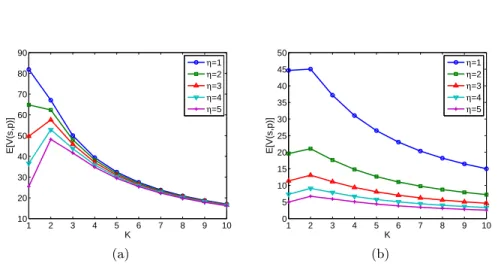
1 2 3 4 5 6 7 8 9 10 10 20 30 40 50 60 70 80 90 K E[V(s,p)] η=1 η=2 η=3 η=4 η=5 (a) 1 2 3 4 5 6 7 8 9 10 0 5 10 15 20 25 30 35 40 45 50 K E[V(s,p)] η=1 η=2 η=3 η=4 η=5 (b)
Fig. 2.Values of Token pricing scheme with respect toK: (a)g1(x, p), (b)g2(x, p).
0 5 10 15 0 1 2 3 4 5 6 7 8
M (# of tokens) per day
MR(M, λ ) λ=3 λ=6 λ=9 λ=12
Fig. 3.Values of Token pricing scheme with respect toM.
Figure 2 shows the expected value of the token pricing scheme with 5 different congestion levels (η). We see that when the number of users in the network is low the overall value is high since the congestion disutility is low. Also there exists some K =K∗ that produces the highest value when the network is not under-utilized. However, when ones increasesKbeyondK∗, the value decreases since users get to use Service 1 for fewer applications.
3.2 Continuous Time
For the continuous time model we consider the following utility functiong3(x, q): g3(x, q) =x−q. Then we have R(M, λ) = 1−M c + max{0,log λ M}.
c
(a) Flat-rate pricingα
c
(1-
α
)c
Service 1
Service 2
(b) Token pricing
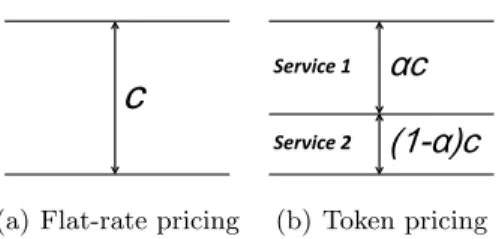
Fig. 4.Network capacity for Flat-rate and Token pricing scheme
Figure 3 illustrates the valueM R(M, λ) of the token scheme with respect to M for various demand values λ. We observe that there is an optimal number M of tokens that maximizes the user utility. In addition, we see that when user demand increases it is better to let users use premium service more (higher optimal M) as long as the total utility surplus produced by using multiple of files in service 1 is larger than the disutility due to congestion. Therefore, if the provider increasesM larger than the optimal value given fixed demand (λ), the value tends to decrease as the disutility coming from congestion increases. Thus operators who adopt the token scheme should adjust the number of tokens.
4
Flat vs Token
In the previous section, we have analyzed the proposed token pricing scheme and illustrated its characteristics. We observed that it is simple for both the provider and the users. In addition, we have seen that the token scheme increases user welfare by letting users accumulate tokens and use them only for relatively more valuable applications.
In this section we validate our proposed scheme by comparing it with flat-rate pricing. Each day, the user uses λapplications, on average, and each is of typex, an exponentially distributed random variable with meanκ, independent across applications. In all cases, we use the same model for the increaseg(x, q) in utility of using Service 1 instead of Service 2 when the congestion level of Service 1 isqand the application is of typex:
g(x, q) =A−xq.
In this expression, A denotes a positive benefit for receiving Internet service, which is independent of the pricing scheme.
First, consider rate pricing. Assume that the congestion level of the flat-rate network isqf. The total average daily value created by flat-pricing is
W(λ) =λE[g(x, qf)] =λ(A−κqf)
For the token scheme, the operator chooses the portionαof capacity to be allocated for Service 1 (respectively, 1−αfor Service 2). The user decides whether to use Service 1 or Service 2 depending on the application typex. Assume that the congestion level of Serviceiisqi, fori= 1,2, withq1< q2. Then, as we saw in Section 2.3, the user uses Service 1 if
g(x, q1)−g(x, q2) =x(q2−q1)> γ (2)
where the thresholdγis such that
P[x(q2−q1)> γ] = exp{− κγ q2−q1
}=M λ. Solving this equation allows to deriveγ. We find
γ=−q2−q1
κ log{ M
λ }.
Note thatγdecreases with the fractionM/λof applications that can use Service 1.
Since the value of the token scheme comes from two services, the total average value is given by S(M, α, λ) =M.E[g(x, q1)|x(q2−q1)> γ] | {z } Service1utility + (λ−M)E[g(x, q2)|x(q2−q1)< γ] | {z } Service2utility .
The provider using the token scheme chooses the numberM of tokens per day and the capacity ratio αthat maximizes the value to users. Thus the total valueR(λ) of using the token scheme is as follows:
R(λ) = max
M,αS(M, α, λ).
The value of any pricing scheme would depend upon the service type the users are using. The service types could be classified into two categories [11]: capacity-sharing service and latency-based service.
4.1 Capacity-Sharing Service
First, we consider a generic class of services, in which the total demand in a network is distributed among the processors with some fixed total capacity (per user)c. Thus, we define the congestion functions as:
qf= λ c, q1= M αc, q2= λ−M (1−α)c
This type of congestion function is considered in prior work [10]. The interpre-tation is that if N applications share a capacityC, then each application faces a congestion disutilityN/C. Accordingly, the value of the token scheme is
0 2 4 6 8 10 12 0 3 6 9 12 15 λ Token Flat 10*(Token−Flat)/(Flat)
(a) Capacity Sharing Service
0 2 4 6 8 10 12 0 5 10 15 20 25 30 λ Token Flat 10*(Token−Flat)/(Flat)
(b) Latency Based Service
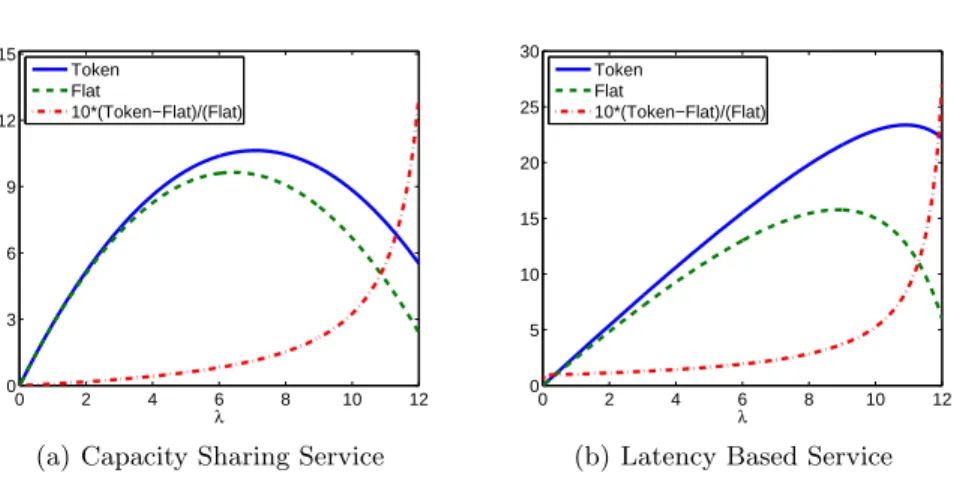
Fig. 5.Comparison of Flat and Token pricing scheme (A=3)
SCS(M, α, λ) =M E[g(θ, q1)|Π] + (λ−M)E[g(θ, q2)|Πc] =M A−λκ αc M λ κ 1 + log λ M κ + (λ−M) A− λκ (1−α)c 1− M λ κ 1 + log λ M κ . whereΠ is the event that a user uses Service 1 as in (2).
4.2 Latency-Based Services
In other services, latency may be a major concern. A simple model to capture the latency is by using an M/M/1 queue model [11]. Using this model, we define a congestion function for latency-based services as follows:
Total expected delay = 1 µ−λ
where λis the arrival rate and µis the service rate. This function captures the fact that when the network utilization gets close to the whole capacity, the delay goes to infinity. Then, assuming the service rate is the available capacity, the congestion functions for each of the services (Flat and Token) are
qf = 1 c−λ, q1= 1 αc−λ/M, q2= 1 (1−α)c−λ(1−1/M).
This type of congestion has been considered in prior work [12] as well. Hence the value of Token scheme in this type of service is
SLB(M, α, λ) =M E[g(θ, q1)|Π] + (λ−M)E[g(θ, q2)|Πc] =M A−q1 λκ M M λ κ 1 + log λ M κ + (λ−M) A− q2λκ λ−M 1− M λ κ 1 + log λ M κ
Figure 5(a) and 5(b) show the numerical results for capacity sharing service and latency based service respectively. From the comparison, we see that, irre-spective of service types, the token scheme always produces higher revenue than flat-rate pricing. Moreover, we observe that the surplus created by the token scheme should become more advantageous for future wireless Internet tariffing since, in the future, we expect (1) a drastic increase in wireless data traffic and (2) a much higher portion of delay-sensitive multimedia services.
5
Conclusions
The design of tariff schemes for packet-based network services should not only take into account various aspects to make it technologically feasible but also consider social issues from the perspective of users to be actually used in practice. Researchers have proposed numerous pricing schemes to provide QoS since, in the future, we expect a rapid increase in the applications that require high QoS. Nevertheless, most of the schemes are too complicated and, above all, unfavored by users. In this spirit, we proposed a novel scheme called, Token pricing scheme, in a way that is simple and predictive to be well appreciated by users, and also efficient to provide QoS requirements. We have shown that, comparing with the current dominant Flat-rate pricing, our proposed scheme gives higher utility to the users, and especially significant increase of utility surplus for Latency based services, with relatively low cost of implementation.
6
Appendices
A
Proof of Theorem 1
Let
Vn+1(s) =E[max{x+βVn(s+ 1−K), βVn(s+ 1)}] withV0= 0. Then one can show thatVn(s)→V(s) for allsas n→ ∞.
We want to show that
∆n(s) :=Vn(s+ 1)−Vn(s+ 1−K)
is nonincreasing in s.
Note that Vn+1(s) =βVn(s+ 1−K) +E[max{x, βVn(s+ 1)−βVn(s+ 1−K)}] =βVn(s+ 1−K) +E[max{x, β∆n(s)}]. Thus, ∆n+1(s) =βVn(s+ 2−K) +E[max{x, β∆n(s+ 1)}] −βVn(s+ 2−2K)−E[max{x, β∆n(s+ 1−K)}] =β∆n(s+ 1−K) +E[max{x, β∆n(s+ 1)} −max{x, β∆n(s+ 1−K)}] Now, assincreases, the∆ns in this expression do not increase. Consider, for a≤b,
φ(a, b, x) :=b+ max{x, a} −max{x, b}
= a, ifx < a x, ifa≤x≤b b, ifb < x.
Leta0 ≤aandb0≤b. It is clear from the above that φ(a0, b0, x)≤φ(a, b, x), ∀x Hence,
E[φ(a0, b0, x)]≤E[φ(a, b, x)]. Consequently, for anys < s0, by letting
a=β∆n(s+ 1), b=β∆n(s+ 1−K) a0=β∆n(s0+ 1), b0 =β∆n(s0+ 1−K) we conclude that
∆n+1(s0)≤∆n+1(s)
B
Proof of Theorem 2
Letgp(x) =g(x, p). We assume the functiongp is nondecreasing inxand non-increasing inp. For a fixedp, ifgp is monotonically increasing
P[βV(s+ 1, p)< g(x, p) +βV(s+ 1−K, p)]
=P[g(x, p)> βV(s+1, p)−βV(s+1−K, p)] =P[gp(x)> τ(s, p)] =P[x > gp−1(τ(s, p))] =P[x > a(s, p)].
where, τ(s, p) =βV(s+ 1, p)−βV(s+ 1−K, p).
Hencea(s, p) =g−1p (τ(s, p)). Since τ(s, p) is nonincreasing insfor a fixedp (Theorem 1) andg−1p is an increasing function,a(s, p) is nonincreasing in s.
Next ifgp is nondecreasing but not monotonically increasing we have P[gp(x)> τ(s, p)] =P[x >max{x|gp(x) =τ(s, p)}] Hence a(s, p) = max{x|gp(x) =τ(s, p)}. Then we see that fors1< s2
C
Proof of Theorem 3
Let π(s, p) be the stationary distribution of the Markov chain for a given con-gestionp. Assume that the Markov chain starts in some states0 and letτn be then-th time that the Markov chain returns tos0. The numberηn of times that the user usesKtokens during{0,1, . . . , τn}must be such thatKηn =τn. Thus, ifηn(s) is the number of times during{0,1, . . . , τn}that the Markov chain is in statesand that the user uses tokens, then
1 K = ηn τn = X s ηn(s) τn → X s π(s, p)p(s, p) =E[p(s, p)] as n→ ∞
where the limit follows from the ergodicity of the Markov chain.
References
1. J. MacKie-Mason and H. Varian, “Pricing congestible network resources,” IEEE Journal on Selected Areas in Communications, vol. 13, no. 7, pp.1141-1149, 1995. 2. A. Odlyzko, “Paris metro pricing and for the Internet,”AT&T Labs, Research, New
Jersey, U.S.A., May 1999.
3. C. Joe-Wong, S. Ha, and M. Chiang, “Time-dependent Broadband pricing,” Infor-mation Theory and Applications Workshop, February 2011.
4. R.H. Chowdhury, “Internet pricng,”TKK T-110.5190 Seminar on Internetworking, 2006.
5. J. Altmann and K. Chunen, “How to charge for network services - flat-rate or usage-based?”Computer Networks, vol. 36, pp.519-531, 2001.
6. P. Ferguson,Quality of Service: Delivering QoS on the Internet and in Corporate Networks, 1st ed. John Wiley & Sons, 1998.
7. S. Blake, D. Black, M. Carlson, E. Davies, Z. Wang, and W. WeissAn architecture for differentiated services, Internet Engineering Task Force, RFC 2475, December 1998.
8. N. Semret, R.R.-F. Liao, A.T. Campbell, and A.A. Lazar, “Pricing, provisioning and peering: dynamic markets for differentiated Internet services and implications for network interconnections,”IEEE Journal on Selected Areas in Communications, vol. 18, pp.2499-2513, 2000.
9. G. Schwartz, N. Shetty, and J. Walrand, “Impact of QoS on Internet user welfare ”
LNCS, vol. 5385, pp.716-723, 2008.
10. R. Gibbens, R. Mason, and R. Steinberg, “Internet Service Classes under Compe-tition,”IEEE Journal on Selected Areas in Communications, vol. 18, pp.2490-2498, 2000.
11. C-K. Chau, Q. Wang, and D-M. Chiu, “On the Viability of Paris Metro Pricing for Communication and Service Networks,” inProc. INFOCOM, 2000.
12. D. Ros and B. Tuffin, “A mathematical model of the Paris Metro pricing scheme for charging packet networks,” Computer Networks, vol. 46, pp. 73-85, 2004. 13. H. Ekstrom, “QoS Constrol in the 3GPP Evolved Packet System,”IEEE
Commu-nications Magazine, vol. 47, pp. 76-83, 2009.
14. S. Ross. An Introduction to Stochastic Dynamic Programming. Academic Press, 1983.