SOFT COMPUTING: INFERENTIAL STATISTICS OF 3D
RAINFALL-RUNOFF MODELLING IN PENINSULA MALAYSIA
Lloyd Ling and Zulkifli Yusop
Centre for Environmental Sustainability and Water Security, Research Institute for Sustainable Environment, Faculty of Civil Engineering Department, Universiti Teknologi Malaysia, Skudai, Johor, Malaysia
E-Mail: [email protected]
ABSTRACT
Thorough understanding of the rainfall-runoff processes that influence watershed hydrological response is important and can be incorporated into the planning and management of watershed resources. Soft computing techniques and inferential statistics were used to assess 2 rainfall-runoff models and their runoff predictive accuracy in this article. The 1954 simplified SCS runoff model was found to be statistically in-significant under two Null hypotheses rejection and paved way for the model calibration study to produce regional specific runoff model through calibration according to regional hydrological conditions in Peninsula Malaysia. The new runoff model out-performed non-calibrated SCS runoff model and reduced its RSS by 27%. A 3D runoff difference model was created as a collective visual representation between the (SCS) non-calibrated and calibrated new model, it also showed that both under and over design risks were less significant at high CN (urban) area and more profound under higher rainfall depths. On average, rural and forest catchments of Peninsula Malaysia faced 7% (lower CN area as much as 22%) CN down scaling adjustment due to regional hydrological calibration in order to achieve better runoff predictions.
Keywords: soft computing, inferential statistics, SCS, initial abstraction coefficient ratio.
INTRODUCTION
SCS runoff model
In 1954, the United States Department of Agriculture (USDA), Soil Conservation Services (SCS), Natural Resources Conservation Service (NRCS) agency proposed a rainfall-runoff prediction model under Watershed Protection and Flood Prevention Act to address issues in flood management. It also led to the derivation
and development of curve number (CN) methodology. The
model was incorporated into many official hydro design manuals but many researchers around the world reported inconsistent results using the model (Hawkins et al., 2009), (Ling and Yusop, 2013), (Hawkins, 2014). The base rainfall-runoff model was proposed as:
S I P
I P Q
a a
2 (1)
Q = Runoff amount (mm)
P = Rainfall depth (mm)
Ia = the initial abstraction (mm)
S = maximum potential water retention of a
watershed (mm)
where P > Ia, else Q = 0. The initial abstraction is also known as the event rainfall depth required for the initiation of runoff. SCS also hypothesized that Ia = λ S = 0.20S. The value of 0.20 was referred to as the initial abstraction coefficient ratio (λ), a correlation parameter between Ia and S. The value of 0.20 was proposed as a constant (λ value falls within 0 to 1 only). The substitution of Ia = 0.20S simplified equation (1) into a common runoff prediction model which was adopted by textbooks, design manuals and being incorporated into many design software
and programmes after its inception in 1954. The simplified SCS runoff prediction model is:
28 . 0.2 0
S
P S
P
Q (2)
Equation (2) is subjected to a constraint that P > 0.2S, else Q = 0. However, there were increasing evidential study results leaning against the prediction accuracy of equation (2) and the hypothesis that Ia = 0.20S. The literature review of fifty-one worldwide studies showed inconsistent runoff results using equation (2), many researchers urged to perform regional hydrological conditions calibration instead of blindly adopting it as proposed by SCS (Hawkins et al., 2009), (Ling and Yusop, 2013). This study was inspired by a developed
methodology from US researchers (Hawkins et al., 2009)
and utilised numerical analysis algorithm guided by inferential statistics to calibrate and derive a new rainfall-runoff model based on equation (1). New model was calibrated according to regional hydrological conditions as pertain to the given dataset in Peninsula Malaysia (DID, 1994).
DATA AND METHODOLOGY
Methodology
different rural catchments in Peninsula Malaysia (DID, 1994). Inferential non-parametric statistics was employed for two claim assessments set forth by the 1954 SCS proposal with two Null hypotheses (Wright, 1997), (Howell, 2007), (Rochoxicz, 2011):
Null Hypothesis 1 (H01): Ia = 0.20S globally.
Null Hypothesis 2 (H02): The value of 0.20 is a constant in
H01.
The rainfall (P) and runoff (Q) data pairs from DID HP11 were used to derive Ia in order to calculate S and λ using a developed methodology by US researchers (Hawkins et al., 2009), (Ling and Yusop, 2013). The difference of rainfall depth (P) and initial abstraction (Ia) is the effective rainfall depth (Pe) to initiate runoff (Q) thus Pe =P – Ia. Substitute this relationship into equation (1), the model can be re-arranged in order to calculate S and λ for each P-Q data pair. Bootstrapping, Bias corrected and accelerated (BCa) procedure was used to aid numerical optimisation technique in the selection of the optimum λ value within the 99% confidence interval and to assess both hypotheses. Rejection of H01 implies that
equation (2) is invalid and not applicable for the dataset, while H02 rejection indicates that λ is not a constant as
initially proposed by SCS in 1954 but a variable. Rejection of both hypotheses will pave way to derive new λ value. The selection of the optimum λ and S value will formulate a new calibrated runoff prediction model of Peninsula Malaysia. Since optimum λ value is derived from a different mathematical scale than the conventional λ = 0.2, a correlation must be identified among them (Hawkins, 2014). The correlation will re-express new derived λ
runoff model in common parameters used by the conventional SCS equation (2) in order to compare and assess both models.
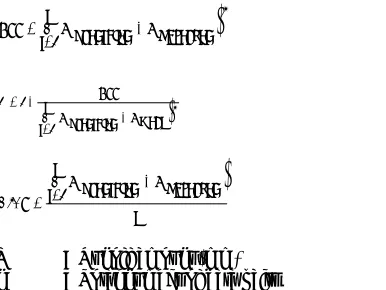
Equation (1) can be rearranged to solve for S (P, Q, λ). Different λ will yield different S value, denotes by Sλ. New derived λ value will have a corresponding Sλvalue which is different from S0.2 (where λ = 0.2). By re-arranging equation (1), the general Sλformula solved by this study was:
2
2 1 2
2 1
Q P P PQ Q P
S (3)
Q = Runoff amount (mm)
P = Rainfall depth (mm)
λ = the initial abstraction coefficient ratio
The correlation between Sλ and S0.2 will re-express new derived Sλin term of S0.2 (S0.2 is represented by S throughout this report). A 3D runoff difference model can then be created as a collective visual representation of multiple scenarios to reflect the runoff difference between equation (2) and the new calibrated runoff model in order to study the runoff prediction difference between the
un-calibrated SCS model and the new un-calibrated runoff model. Although the 3D runoff difference model can be expressed with closed form mathematical equation, it is difficult and impossible to solve for the minimum or maximum runoff difference equations under multiple rainfall and CN scenarios as it requires long and tedious calculus solving technique on a complex mathematical equation. However, with the visual aid of the 3D runoff difference model and soft computing technique, data mining of this vital information can be achieved.
STATISTICS AND HYPOTHESES ASSESSMENT
Calibrated SCS runoff model
Ninety-seven λ values were derived from the dataset using the methodology as discussed in previous section. The study will identify a best collective representation of λ value for the dataset in order to formulate a new runoff prediction model and benchmark it against the empirical model equation (2) where λ was assumed to be 0.2 by SCS. The descriptive statistics of the of Ninety-seven derived λ values was tabulated in Table-1. Stringent bootstrapping technique, bias corrected and accelerated (BCa) procedure (2000 samples) was conducted at a 99% confidence level on the λ dataset to include confidence intervals and aid the selection of an
optimum λ value (Wright, 1997), (Howell, 2007),
(Rochoxicz, 2011).
Table-1. BCa results of λ dataset.
Statistics 99% BCa lower Upper
Mean 0.081 0.052 0.123
Median Skewness
Kurtosis Std. Deviation
0.041 4.535 24.075
0.137
0.032 0.056
λ optimization study was conducted via numerical analyses approach on equation (2). The least square fitting algorithm was set to identify an optimum λ value by minimizing the residual sum of squares (RSS) between final runoff model’s predicted Q and its observed values. Due to the skewed λ dataset of this study, the optimized numerical analyses procedure focused on λ variation within the median confidence interval in order to obtain the optimum λ value with 99% significancy. BCa results from Table-1 consist of confidence intervals for λ, which can also be used to assess Null hypotheses. The span of λ confidence intervals (both mean and median) will be used to asses H01 while the assessment of H02 will
be based on the standard deviation of the derived λ dataset (Rochoxicz, 2011), (Ling and Yusop, 2014, 2014b).
2 945 . 0 055 . 0 055 . 0 055 . 0 055 .0 P S
S P
Q (4)
Equation (4) is subjected to a constraint that P>0.055S0.055, else Q0.055 = 0. As mentioned before, S0.055
was derived with λ = 0.055 which requires a correlation conversion into S on the same scale as λ = 0.2 before drawing any further comparison. Given rainfall-runoff data pairs, each P-Q pairs will derive different S values under λ = 0.055 and 0.2 respectively through equation (3). The best statistical significant correlation between those two groups was identified by using IBM PASW version 18 as: 097 . 1 055 .
0 1.055S
S (5)
S0.055 = S value (mm) when λ is 0.055
S = S value (mm) when λ is 0.2
Equation (5) has adjusted R2 = 0.989, Standard
error = 0.084, p<0.000. SCS also developed a correlation equation between S and CN in 1954, the SI unit version of the formula was proposed as:
254
25400
CNS
(6)S = S value (mm) when λ is 0.2
CN = Curve Number
Substitute equation (5) and (6) into (4) will re-express equation (4) as:
2 1 07 . 434 1 51 . 25 055 .0 100 1.097 097 . 1 100
CN CN P PQ
(7)for P > 25.51
10011.097CN , else Q0.055 = 0
Substitute equation (6) into (2) will re-express equation (2) as:
2 1 2 . 203 1 8 . 50 2 . 0 100 100
CN CN P PQ
(8)for P > 50.8
1001CN , else Q0.2 = 0
where P and CN are as defined before, Q0.2
represents the simplified SCS runoff model and Q0.055
represents the calibrated runoff new model for Peninsula Malaysia. Through the correlation conversion of equation (5), optimum λ (0.055) model was re-expressed with equation (7) in common term of rainfall depth (P) and CN as equation (8) which permits further comparison analyses.
3D RUNOFF DIFFERENCE MODEL
As stated in the introduction, simplified SCS equation (2) or (8) gained popularity in many sectors, and therefore it is imperative to quantify the runoff difference between equation (7) and (8) in order to analyse the runoff predictions of the non-calibrated conventional equation (8) against the calibrated equation (7). Given P values from the dataset (DID, 1994), a 3D runoff difference model (Appendix-B) can be constructed with different CN values to capture the runoff difference between equation (7) and (8) under multiple rainfall depths and CN scenarios. The 3D runoff difference mathematical model is:
2 1 07 . 434 1 51 . 25 2 1 2 . 203 1 8 . 50 097 . 1 100 097 . 1 100 100 100
CN CN CN CN P P P P vQ
(9)where P and CN are as defined before, Qv is the
runoff difference between two models (between Q0.2 and
Q0.055). When Qv>0, SCS equation (8) over-predicted
runoff in comparison to calibrated new runoff equation (7) and vice versa.
The 3D runoff difference model (Appendix-B) is demarcated into three major zones. The (light blue) flat area until the edge of the outer boundary represents the area prior to the initiation of runoff where the condition of initial abstraction (Ia) has not been fulfilled thus there is
neither runoff amount nor any runoff difference between equation (7) and (8) yet. The Red colour zone (the valley) represents the area where the non-calibrated SCS runoff model (8) under-predicted runoff amount as compared to the calibrated new runoff model (7) while the coloured zones (the hilly slope region) within the inner boundary represents runoff over-prediction scenarios.
The 3D runoff difference model provides a clear overview of the runoff prediction difference between equation (7) and (8) under different P and CN scenarios. One can refer to the 3D runoff difference model and extract useful information such as: the minimum under-prediction amount and the maximum over-under-prediction runoff amount between two models. This vital information is almost impossible to be obtained by taking the long and tedious second derivative of equation (9) and solving for the results. The minimum under-prediction amounts indicated by the light dash-line on the 3D runoff difference model (Appendix-B) represented the worse under-design case incurred by non-calibrated SCS runoff model equation (8). On the contrary, the heavy dash line represents the worse over-design case. In a nutshell, the 3D runoff difference model presents the runoff prediction errors of the un-calibrated SCS model equation (8) against calibrated runoff model (7) under multiple scenarios in Peninsula Malaysia.
New derived λ = 0.055 (alpha=0.01) is a significant lower value than the conventional SCS model where λ = 0.2 thus P > Ia or P > 0.055 S0.055 will initiate
can be derived. The initial abstraction constraint of equation (4) can be re-expressed to represent the outer boundary with the following equation:
097 . 1 1 100 51 .
25
CN
P (10)
where P and CN are as defined before. Substitute all possible CN values (between 1 and 100) into equation (10), a series of P values can be derived and connected to represent the outer boundary on the 3D runoff difference model before the red colour zone (valley). Equation (10) is also known as the “Outer Boundary” equation of the 3D runoff difference model.
The second boundary marked as the “Inner Boundary” on the 3D runoff difference model is the boundary line where the runoff under-prediction (red colour or the valley) zone meets the over-prediction (coloured or the hilly region) zone. At the cross over boundary line, the runoff difference is equal to zero (negative prediction numbers must reach zero point before becoming positive prediction numbers). As such, when Qv=0 in equation (9), the form can be re-expressed as:
2
1 07 . 434
1 51 . 25 2
1 2 . 203
1 8 . 50
097 . 1 100
097 . 1 100
100 100
CN CN CN
CN
P P
P P
(11)
where P and CN are as defined before. Equation (11) is also known as the “Inner Boundary” equation of the 3D runoff difference model.
MODELS COMPARISON
Calibrated new runoff model (with λ=0.055) equation (7) was benchmarked against non-calibrated SCS runoff model equation (8) in several ways in order to assess their model predictive accuracy. Runoff model’s prediction efficiency index (E), residual sum of squares (RSS) and the predictive model BIAS were calculated with following formulas in order to draw further comparison.
21
n
i Qpredicted Qobserved
RSS (12)
n
i Qpredicted Qmean RSS E
1
2
1 (13)
n n
i Qpredicted Qobserved BIAS
1 (14)
Q = Runoff amount (mm)
n = Total number of data pairs
RSS value indicates the residual spread from a model. Lower RSS indicates a better predictive model.
[image:4.612.76.269.550.695.2]where index value = 1.0 indicates a perfect predictive model. When E<0, the predictive model performs worse than using the average runoff value to predict the dataset. Predictive model BIAS shows the overall model runoff prediction error calculated by the summation of predictive model’s residual to indicate the overall model prediction pattern. Zero value indicates a perfect overall runoff model prediction with no error, negative value indicates the overall model tendency of under-prediction and vice versa. Predictive model runoff prediction comparison results were tabulated in Table-2:
Table-2. Runoff predictive models comparison.
Model Calibrated SCS model (7) Non-calibrated SCS model (8)
E 0.68 0.57
RSS
Model BIAS 6,116 -0.63 8,405 -0.29
CURVE NUMBERS ADJUSTMENT
Curve number is a dimensionless figure developed and proposed by SCS to describe a runoff condition of a watershed. Curve number value is mostly whole number within the range from 1 to 100. The value of 100 describes a highly impervious area where 100% of rainfall becomes surface runoff and vice versa.
It is noteworthy to emphasize that as SCS
developed CN methodology with the hypothesis that
λ=0.2, equation (6) is only applicable when λ=0.2. Any λ value other than 0.2 requires a correlation conversion between Sλ and S0.2 (S0.2 is represented by S throughout this report) prior to the CN calculation with equation (6).
Given P-Q data pairs (DID, 1994) of this study, CN values can be calculated with equation (6) after finding S values through equation (3). Under SCS methodology (when λ=0.2), CN values were calculated while new optimum λ=0.015 yielded another series of CN values through equation (3), (5) and (6). These CN values are known as adjusted CN values. Adjusted CN values show CN values adjustment due to λ variation away from the initial λ value proposed by SCS (where λ=0.2). The optimum λ value is almost 75% less than that proposed by SCS, and therefore adjusted CN values are all below than
CN values calculated under SCS methodology. CN
adjustment percentage was calculated and plotted against SCS CN values (where λ=0.2) in Figure-1 to depict the CN adjustment percentage trend in Peninsula Malaysia.
This study identified a CN adjustment percentage
trend equation between two λ groups in Peninsula
Malaysia as pertain to the dataset to be:
CNAdj (%) = 48.562 LN(CN) – 223.008 (15)
CN = Curve number of a watershed (when
λ=0.2)
Equation (15) has adjusted R square = 0.999, Standard error = 0.168, p< 0.000.
Figure-1.CN adjustment percentage as per CN value.
SOFT COMPUTING AND DATA MINING
As mentioned earlier, it is almost impossible to solve for the maxima and minima by taking the second derivative of equation (9) in order to obtain the worse under and over runoff prediction amounts between two runoff models. However, with the visual aid of the 3D runoff difference model, it is possible to extract all minimum and maximum runoff prediction difference and construct statistical significant equations to estimate and represent both scenarios. The numerical table in Appendix-A used equation (9) to construct the 3D runoff difference model (Appendix-B). The bold figures within the red colour zone are the minimum runoff prediction difference amounts from equation (9) under different CN and P scenarios while the bold and yellow highlighted figures represent the maximum runoff prediction difference amounts. The minimum and maximum amounts were extracted and highlighted as shown in Appendix-A. The statistical significant correlation equations were determined by using the IBM, PASW version 18 and proposed as:
Min Qv = 8.817E-5 P2 - 0.04 P - 0.217 (16)
Max Qv = 1.80E-4 P2 + 0.038 P - 0.772 (17)
Min Qv = minimum under-predicted runoff amounts
(mm)
Max Qv = maximum over -predicted runoff amounts
(mm)
P = Rainfall depth (mm)
Equation (16) has an adjusted R2 = 0.997,
standard Error = 0.069, p<0.000 while equation (17) has an adjusted R2 = 1, standard Error = 0.062, p<0.000 .
Equation (16) represents the worse under-estimated runoff scenarios from non-calibrated SCS equation (8) compared to new calibrated runoff model equation (7) while equation (17) represents the worse over-estimated runoff predictions. Equation (16) can describe the runoff difference between two models (light dash line) on the 3D
runoff difference model while equation (17) describes the heavy dash line.
US researchers first termed “critical rainfall amount” (Pcrit) to describe a point where runoff difference
is zero between two different runoff models (Hawkins et al., 2009). The solution of Pcrit was suggested to be
obtained through numerical analysis solving technique or by trial and error procedure (Hawkins, 2014). Through algebraic manipulation, we successfully re-arranged equation (9) and solved the closed-form equation of Pcrit in
term of CN (when Qv=0).
a ac b b crit
P
2 42
(18)A = 100 11.0974
51 .
25
CN
B =
1001 8 . 50
CN
A = 4B – 2A+ 2B – (1889/111)A
b = A2 – 8AB – B2 + 2 (1889/111)AB
c = 4BA2 – (1889/111)AB2
The technique has proven to be applicable to solve for Pcrit of any pairing runoff models. Equation (18)
solves for the critical rainfall depth amount on the “inner boundary”. Critical rainfall depth (mm) satisfies equation (11) which is also the rainfall depth amount where equation (8) crosses from runoff under-prediction toward over-prediction when compared against equation (7). In another word, un-calibrated (SCS) runoff model (8) will under-predict runoff amount of any rainfall depth from a specific CN area below critical rainfall depth amount and vice versa.
In order to further imply from our 3D runoff difference model, we are proposing a new conjugate term “Critical Curve Number” (CNcrit) to estimate CN area
where runoff is indifferent between two runoff models under a specific P scenario. CNcrit also derives from
equation (11) as Pcrit. Un-calibrated runoff model (8) will
under-predict runoff amount in any CN area below critical Curve Number value and vice versa.
Unlike the success with the derivation of closed-form equation (18), the effort to realise the closed-closed-form equation of CNcrit in term of P is still un-fruitful.
Therefore, soft computing technique was again applied to estimate CNcrit value with visual aid from the 3D runoff
difference model and its numerical table (Appendix-A).
For example, when P = 160mm, runoff difference between
two models crosses from runoff under-prediction toward over-prediction between CN 42 and 46 (Appendix-A). Numerical analysis technique estimated the CNcrit around
45 to satisfy equation (11) thus using non-calibrated runoff model (8) will under-predict runoff amount in any CN area below 45. Contrary, any CN area greater than 45 will induce runoff over-prediction errors.
‐30%
‐20%
‐10%
0%
60 70 80 90 100
Adj
(%
)
CN
CN adjustment curve
RESULTS AND DISCUSSIONS
This study assessed two hypotheses as well as model efficiencies of non-calibrated conventional SCS model equation (8) and the modified (calibrated) runoff prediction model equation (7). A 3D runoff difference model was created to capture multiple scenarios of rainfall depth and CN. It also reflects runoff prediction errors from the non-calibrated SCS runoff model. Researchers across the world concluded that SCS runoff prediction model had to be calibrated according to regional specific characteristics while the conventional SCS runoff prediction form of equation (2) or (8) cannot be blindly adopted for study use.
The initial SCS hypothesis of the λ value of 0.2 (the value was used to simplify SCS base runoff model) as a constant was rejected at alpha = 0.01 level because the 99% BCa confidence interval span does not include the value of 0.2 (Table 1) and as such, equation (2) or (8) became invalid and not applicable to the dataset of this study. H02 was also rejected (at alpha = 0.01 level) because
the BCa results showed the standard deviation of λ (Table 1) which indicated its fluctuation nature thus λ is not a constant as proposed by SCS in 1954 but a variable. The rejection of both Null hypotheses in this study paves the way for SCS model calibration.
This study introduced numerical analysis approach guided by non-parametric inferential statistics to identify the best collective representation of λ value from the dataset for the formulation of a better runoff predictive model. The common pitfall in the least square fitting algorithm is to wrongly identify local minima as optimum solution thus producing inconsistent results. The initial guess point for least square fitting algorithm to commence an optimization search played an influential role to end results. Researchers often started the initial guess point with a wild guess which could lead to a wrong conclusion. Inferential statistics can be an effective guide to narrow the search and identify a statistical significant optimum solution in swift and precise manner. Inferential statistics narrowed the optimum search band while optimization study pin-pointed an optimum value within the BCa confidence interval range; both methods supplemented each other in this regard. The optimum λ value was identified as 0.055 to model rainfall-runoff in this study at alpha = 0.01. The rejection of both hypotheses deduced that the optimum λ value of 0.055 is a statistical significant best collective representation of the dataset. The formulation of a calibrated runoff prediction model equation (7) using the optimum λ value will have the same inherent significant level (at alpha = 0.01).
CONCLUSIONS
The rejection of both hypotheses concluded that equation (2) or (8) is invalid and not statistical significant for this study. Therefore, it is imminent to model the runoff difference between equation (7) and equation (8) in order to produce an adjustment equation to improve and adjust the runoff predictability of equation (8) in order for
SCS practitioners or its software users to perform runoff results adjustment.
The 3D runoff difference model is an effective visual aid to study the runoff error distribution of the non-calibrated SCS runoff model. It is also the collective visual presentation of the mathematical equation (9) under multiple rainfall depths and CN scenarios. The “Outer” and “Inner” boundaries were described by equation (10) and (11) respectively. The model also allows swift data extraction of the minimum and maximum runoff prediction difference between two models to formulate equation (16) and (17) in order to estimate the under and over design worse risks incurred from non-calibrated SCS runoff model. Both design risks were almost impossible to be obtained through the long and tedious mathematical solution by solving for the second derivative of equation (9).
The 3D runoff difference model also showed that both design risks were less significant at high CN area and more profound under high rainfall depths. CN adjustment
percentage increased in lower CN area (as much as 22%)
which indicated that forested watershed in Peninsula Malaysia has largest runoff prediction error with un-calibrated SCS runoff model. The dataset of this study showed that on average, rural catchments of Peninsula Malaysia faced 7% CN down scaling adjustment due to regional hydrological calibration in order to achieve better runoff predictions.
Pcrit demarcates runoff under predictions from
over predictions between two runoff models. It also provides insight to any return period base design work. SCS practitioners can apply equation (16) or (17) to estimate worse runoff prediction amounts case of a specific rainfall depth scenario and refer to equation (18) to determine if the return period base design work is either under or over designed and perform as needed corrections. The introduction of critical curve number (CNcrit)
and the closed form equation of the critical rainfall depth amount (Pcrit) supplement equation (16) and (17) to enable
design engineers and SCS practitioners to perform as needed runoff prediction results adjustment on the non-calibrated SCS runoff model (8). Design engineers and users of the conventional SCS runoff prediction model are encouraged to conduct regional specific calibration for this model as proposed and adopt correction equations for this particular dataset.
ACKNOWLEDGEMENTS
The author would like to thank Universiti
Teknologi Malaysia, Centre for Environmental
Sustainability and Water Security, Research Institute for
Sustainable Environment of UTM, vote no.
Arizona, USA). The calibration analyses of DID, HP27 was completed and reported in a different article.
REFERENCES
DID, Hydrological Procedure no. 11 1994: Design Flood Hydrograph Estimation for Rural Catchments in Peninsula Malaysia.
Hawkins, R. H., Ward, T., Woodward, D. E. and Van Mullem J. 2009: Curve Number Hydrology: State of the Practice. Reston, Virginia, ASCE.
Hawkins, R. H. 2014 e-mail communication.
Howell, D.C. 2007. Statistical methods for psychology (6th
Ed.). CA: Thomson Wadsworth, Belmont.
Ling, L. and Yusop, Z. 2013. A micro focus with macro impact: Exploration of initial abstraction coefficient ratio
(λ) in Soil Conservation Curve Number (CN) methodology. IOP Conf. Ser.: Earth Environ. Sci. 18 012121, issue 1.
Ling, L. and Yusop, Z. 2014. Inferential Statistics of Claim assessment. AIP Conference Proceedings: ISBN: 978-0-7354-1274-3.
Ling, L. and Yusop, Z. 2014b. Inferential Statistics Modelling and Claim re-assessment. ICCEMS Conference Proceedings: ISBN: 978-967-11414-7-2; 835-840.
Rochoxicz, John A. Jr. 2011. Bootstrapping Analysis, Inferential Statistics and EXCEL. Spreadsheets in Education (eJSiE). 4(3).
Wright, D.B. 1997. Understanding statistics: an introduction for the social sciences. London, Sage.
APPENDIX
A. Numerical table of equation (9)
B. 3D Runoff Difference Model between non-calibrated SCS model and calibrated runoff model
CN
P (mm) 26 30 34 38 42 46 50 54 58 62 66 70 74 78 82 86 90 94 98 1 0.000 0.000 0.000 0.000 0.000 0.000 0.000 0.000 0.000 0.000 0.000 0.000 0.000 0.000 0.000 0.000 0.000 0.000 ‐0.059
2 0.000 0.000 0.000 0.000 0.000 0.000 0.000 0.000 0.000 0.000 0.000 0.000 0.000 0.000 0.000 0.000 0.000 ‐0.025 ‐0.184
4 0.000 0.000 0.000 0.000 0.000 0.000 0.000 0.000 0.000 0.000 0.000 0.000 0.000 0.000 0.000 ‐0.004 ‐0.068 ‐0.267 ‐0.241
6 0.000 0.000 0.000 0.000 0.000 0.000 0.000 0.000 0.000 0.000 0.000 0.000 0.000 0.000 ‐0.016 ‐0.097 ‐0.302 ‐0.431 ‐0.213
8 0.000 0.000 0.000 0.000 0.000 0.000 0.000 0.000 0.000 0.000 0.000 0.000 0.000 ‐0.023 ‐0.111 ‐0.304 ‐0.514 ‐0.484 ‐0.163
10 0.000 0.000 0.000 0.000 0.000 0.000 0.000 0.000 0.000 0.000 0.000 0.000 ‐0.025 ‐0.112 ‐0.290 ‐0.545 ‐0.633 ‐0.469 ‐0.111
12 0.000 0.000 0.000 0.000 0.000 0.000 0.000 0.000 0.00000 0.000 0.000 ‐0.020 ‐0.102 ‐0.265 ‐0.533 ‐0.711 ‐0.684 ‐0.413 ‐0.062
14 0.000 0.000 0.000 0.000 0.000 0.000 0.000 0.000 0.000 0.000 ‐0.013 ‐0.084 ‐0.230 ‐0.478 ‐0.736 ‐0.814 ‐0.682 ‐0.332 ‐0.018
16 0.000 0.000 0.000 0.000 0.000 0.000 0.000 0.000 0.000 ‐0.004 ‐0.060 ‐0.188 ‐0.407 ‐0.710 ‐0.883 ‐0.867 ‐0.643 ‐0.235 0.022
18 0.000 0.000 0.000 0.000 0.000 0.000 0.000 0.000 0.000 ‐0.035 ‐0.142 ‐0.333 ‐0.630 ‐0.894 ‐0.982 ‐0.877 ‐0.574 ‐0.130 0.056
20 0.000 0.000 0.000 0.000 0.000 0.000 0.000 0.000 ‐0.014 ‐0.095 ‐0.257 ‐0.516 ‐0.848 ‐1.035 ‐1.040 ‐0.853 ‐0.483 ‐0.022 0.087
22 0.000 0.000 0.000 0.000 0.000 0.000 0.000 ‐0.001 ‐0.052 ‐0.183 ‐0.405 ‐0.736 ‐1.026 ‐1.136 ‐1.062 ‐0.801 ‐0.375 0.088 0.115
24 0.000 0.000 0.000 0.000 0.000 0.000 0.000 ‐0.018 ‐0.113 ‐0.298 ‐0.584 ‐0.950 ‐1.168 ‐1.203 ‐1.054 ‐0.726 ‐0.256 0.198 0.140
30 0.000 0.000 0.000 0.000 0.000 0.000 ‐0.044 ‐0.188 ‐0.438 ‐0.803 ‐1.196 ‐1.396 ‐1.405 ‐1.230 ‐0.884 ‐0.398 0.142 0.511 0.200
35 0.000 0.000 0.000 0.000 0.000 ‐0.038 ‐0.192 ‐0.464 ‐0.861 ‐1.305 ‐1.545 ‐1.580 ‐1.426 ‐1.098 ‐0.621 ‐0.051 0.494 0.748 0.239
40 0.000 0.000 0.000 0.000 ‐0.020 ‐0.165 ‐0.443 ‐0.857 ‐1.362 ‐1.667 ‐1.748 ‐1.626 ‐1.323 ‐0.862 ‐0.285 0.333 0.845 0.963 0.270
45 0.000 0.000 0.000 ‐0.002 ‐0.113 ‐0.378 ‐0.793 ‐1.349 ‐1.750 ‐1.899 ‐1.826 ‐1.557 ‐1.120 ‐0.549 0.101 0.736 1.186 1.156 0.296
50 0.000 0.000 0.000 ‐0.051 ‐0.279 ‐0.676 ‐1.239 ‐1.774 ‐2.020 ‐2.017 ‐1.798 ‐1.394 ‐0.839 ‐0.178 0.520 1.144 1.512 1.331 0.317
55 0.000 0.000 ‐0.005 ‐0.162 ‐0.516 ‐1.056 ‐1.710 ‐2.093 ‐2.187 ‐2.036 ‐1.679 ‐1.152 ‐0.495 0.234 0.958 1.552 1.822 1.488 0.335
60 0.000 0.000 ‐0.054 ‐0.333 ‐0.824 ‐1.515 ‐2.087 ‐2.315 ‐2.260 ‐1.969 ‐1.483 ‐0.845 ‐0.103 0.678 1.407 1.952 2.115 1.630 0.351
65 0.000 0.000 ‐0.154 ‐0.564 ‐1.201 ‐1.958 ‐2.373 ‐2.450 ‐2.250 ‐1.825 ‐1.220 ‐0.484 0.327 1.142 1.861 2.343 2.390 1.758 0.365
70 0.000 ‐0.025 ‐0.305 ‐0.854 ‐1.645 ‐2.319 ‐2.578 ‐2.506 ‐2.166 ‐1.615 ‐0.901 ‐0.080 0.787 1.621 2.314 2.722 2.650 1.875 0.376
75 0.000 ‐0.091 ‐0.505 ‐1.202 ‐2.088 ‐2.602 ‐2.707 ‐2.489 ‐2.016 ‐1.346 ‐0.534 0.360 1.269 2.108 2.763 3.087 2.893 1.982 0.387
80 0.000 ‐0.200 ‐0.755 ‐1.606 ‐2.459 ‐2.813 ‐2.766 ‐2.407 ‐1.806 ‐1.026 ‐0.126 0.830 1.768 2.599 3.205 3.440 3.123 2.080 0.396
85 ‐0.015 ‐0.350 ‐1.053 ‐2.055 ‐2.761 ‐2.956 ‐2.760 ‐2.265 ‐1.544 ‐0.662 0.316 1.323 2.279 3.091 3.639 3.778 3.338 2.170 0.405
90 ‐0.063 ‐0.541 ‐1.398 ‐2.460 ‐2.999 ‐3.037 ‐2.696 ‐2.069 ‐1.234 ‐0.259 0.788 1.834 2.798 3.581 4.063 4.103 3.541 2.253 0.412
95 ‐0.146 ‐0.772 ‐1.790 ‐2.803 ‐3.177 ‐3.060 ‐2.577 ‐1.824 ‐0.881 0.178 1.284 2.360 3.321 4.066 4.477 4.415 3.732 2.330 0.419
100 ‐0.262 ‐1.042 ‐2.225 ‐3.089 ‐3.298 ‐3.028 ‐2.407 ‐1.534 ‐0.491 0.645 1.801 2.897 3.846 4.547 4.880 4.714 3.913 2.401 0.425
110 ‐0.594 ‐1.701 ‐2.984 ‐3.497 ‐3.380 ‐2.815 ‐1.932 ‐0.836 0.385 1.651 2.882 3.993 4.896 5.487 5.653 5.275 4.244 2.528 0.436
120 ‐1.055 ‐2.509 ‐3.541 ‐3.706 ‐3.272 ‐2.424 ‐1.299 ‐0.004 1.369 2.733 4.007 5.104 5.932 6.393 6.380 5.790 4.540 2.639 0.445
130 ‐1.644 ‐3.256 ‐3.912 ‐3.733 ‐2.993 ‐1.880 ‐0.532 0.938 2.435 3.871 5.160 6.216 6.948 7.263 7.064 6.264 4.807 2.737 0.453
140 ‐2.357 ‐3.830 ‐4.112 ‐3.598 ‐2.564 ‐1.201 0.349 1.971 3.567 5.048 6.327 7.319 7.937 8.094 7.706 6.701 5.048 2.823 0.460
150 ‐3.153 ‐4.243 ‐4.154 ‐3.314 ‐2.000 ‐0.405 1.326 3.077 4.748 6.250 7.497 8.407 8.897 8.888 8.309 7.105 5.267 2.900 0.466