Interpersonal Distances are the Consequence of the
Self-organization of Human Spatial Behavior: A
Theoretical Study Based on Synergetics
T.D. Frank
Department of Psychology, Center for the Ecological Study of Perception and Action, University of Connecticut, 406 Babbidge Road, Storrs, 06269, Connecticut, United States
∗Corresponding Author: [email protected]
Copyright c⃝2014 Horizon Research Publishing All rights reserved.
Abstract
It is well documented that humans position themselves at preferred distances with respect to others. The distances characterizing human spatial behavior are known to depend on the social interactions between the actors and their dyadic partners. A quantitative model that predicts interpersonal distances and is based on the concept of the self-organization of human spatial behavior has been missing in the literature. In the present study such a model is derived within the framework of synergetics, a theory of self-organization. The model corresponds to an evolution equation for the variations of interpersonal distance over time. In line with the equilibrium point hypothesis of interpersonal distances discussed in the literature, preferred distances are represented by the fixed points of the proposed evolution equation. In this context, it is argued that the adjustment of an actor from a personal to an intimate inter-personal distance can be considered as a subcritical pitchfork bifurcation. As a by-product of the proposed theoretical approach, the notion is supported that interpersonal distances are body-scaled.Keywords
Interpersonal Distance, Body-scheme, Self-organization, Subcritical Pitchfork Bifurcation1
Introduction
A fundamental question in psychology and the neuro-sciences is whether human behavior is determined by the particular structure and organization of the human body and brain or is determined by so-called first principles that hold not only for humans but also for other systems of the ani-mate and inaniani-mate world. In social psychology, the exis-tence of certain interpersonal distances has been established by experimental research [1, 2]. However, current research does not provide an answer why interpersonal distance as a phenomenon exists at all and whether the phenomenon re-quires a mechanistic explanation or allows for an explana-tion in terms of first principles. Research on interpersonal distances has primarily focused on the conditions that affect
interpersonal distances [3, 4, 5]. For example, gender ef-fects [6, 7] and body-size efef-fects [8] have been found. Body-size effects provide a hint that interpersonal distances can be understood from a fundamental first principle: the self-organization of perception-action systems [9, 10, 11]. The reason for this is that a key concept in the theory of self-organization is the notion of control parameters. Control pa-rameter in turn are variables that are scaled to various system properties. In the context of human perception and action the scaling might be with respect to body-dimensions [12]. For example, transitions between walking and running are governed by the Froude number which (roughly speaking) measures the locomotion speed of an actor relative to the leg length of the actor [12]. Likewise, in the context of human grasping, a body-scaled parameter (namely, the size of a to-be-grasped object measured in units of the hand size of an actor) has been established as a control parameter govern-ing the transition from one-handed graspgovern-ing to two-handed grasping [13, 14]. Therefore, in what follows, we will pro-pose a top-down approach to understand the phenomenon of interpersonal distances from the theory of self-organization. In particular, we will show that the experimental observa-tion that preferred interpersonal distances differ for personal and intimate social interactions follows from the principles of self-organizing systems.
2
Synergetic order-parameter model
for interpersonal distances
2.1
Function expansion of order-parameter
model determined by system constraints
Under these conditions, the principles of synergetics [16], a theory of pattern formation and self-organization, apply. Accordingly, the self-organized patterns can be character-ized by an order parameter. In principle, the order param-eter can be dparam-etermined from the underlying neurobiological evolution equations using a mechanistic approach (bottom-up approach) [16]. In practice, the relevant evolution equations are not well known. Even if the relevant evolution equations were given it is not a-priori clear whether explicit analyti-cal expressions can be derived because the problem at hand might be mathematically involved. Therefore, in what fol-lows we will derive an order parameter equation for inter-personal distances using a top-down approach. To this end, we assume that the interpersonal distanceyis an appropriate characteristic variable of the postulated self-organization pro-cess and can serve as order parameter. The evolution equa-tion ofy is the order parameter equation of interest. Stable stationary solutions of the order parameter equation then cor-respond to predicted preferred interpersonal distances.
We take a classical mechanics point of view and consider
y as the relative coordinate between the coordinates of two point particles (the positions of two actors). Therefore,y is a signed distance. If we definey as the difference between the coordinates of actor A and B, then−yis the difference between the coordinates of actors B and A. Assuming identi-cal actors, it follows that solutions of the evolution equation must be invariant with respect to mirror-imaging of the co-ordinate axis. This is a constraint that will be used below. Furthermore, we note that order parameter equations are typ-ically first-order differential equations [16]. Consequently, we assume thatyas function of timetsatisfies a differential equation of the form
d
dty=f(y). (1)
The functionf(y)can be considered as a generalized force term that determines the dynamic behavior of the interper-sonal distancey.
In order to determinef(y)we need to conduct a series of steps that have previously been conducted for the so-called Haken-Kelso-Bunz model of coordinated movements [17]. These are formal steps that are not specific to the Haken-Kelso-Bunz paradigm but can be conducted for any given problem at hand. First of all, we note that (1) exhibits a po-tential dynamics like
d dty=−
d
dyW(y), f(y) =−
d
dyW(y), (2)
whereW is the potential function related to the generalized forcef. Second, we introduce a scaling parameterL >0that might be measured in meters or centimeters. We then define a scale-free relative distancexby
x= y
L ⇔y=xL . (3)
That is, whiley is the interpersonal distance in the labora-tory space measured in units like meters or centimeters, the variablex is defined on a scale-free space. Both distance measures can be converted into each other likex↔y, pro-videdLis given. The dimensionless variablexis a rescaled order parameter. The order parameter equation forxcan be
d dtx=
1
L
d dty=
f(xL)
L . (4)
To simplify the notation, let us define the force function
g(x) =f(xL)/L. Equation (4) then becomes d
dtx=g(x). (5)
Equation (5) again admits for an interpretation in terms of a potential dynamics involving a potentialV(x). We have
g(x) =− d
dxV(x)⇒
d dtx=−
d
dxV(x). (6)
At this stage we determine V(x) using the system con-straints of the problem at hand [17]. As mentioned above, solutions of the evolution equation must exhibit a mirror-symmetry property such that ify(t)is a solution then−y(t)
is a solution as well. This implies that the potential must be symmetric with respect tox= 0. That is, we require
V(x) =V(−x). (7) Second, for large distancesx→ ±∞the interaction between the actors vanishes, which implies thatg(x → ±∞) = 0. Likewise, we get
V(x→ ±∞) =const.. (8) The next step is to expandV(x)into a set of functions that satisfy the constraints at hand [17]. In our context, the con-straints are given by (7) and (8). The function set that satisfies these two constraints are the symmetric Hermite functions that will be denoted byVk,o. Here, the sub-index ”o” stands
for ”original” in order to distinguish between a rescaled ver-sion of the functions that will be introduced below. The func-tion expansion readsV(x) = ∑∞k=1AkVk,o(x), whereAk
are expansion coefficients. In particular, the first three Her-mite functions read
V1,o(x) = −exp
{
−x2
2
}
,
V2,o(x) = −(4x2−2) exp
{
−x2
2
}
,
V3,o(x) = −(16x4−48x2+ 12) exp
{
−x2
2
}
. (9) Note that without loss of generality we have put a minus sign in front of all Hermite functions. The minus signs is chosen such thatV1is a potential with minimum atx= 0. In order
to obtain expansion coefficients that are in a similar range it is useful to rescaleVk,o. To this end, we introduce new
func-tionsVk=Vk,o/Zk such that|Vk(0)|= 1. The expansion of
the potential function then reads
V(x) = ∞
∑
k=1
BkVk(x) (10)
withBk = Ak/Zk. For example, for k = 1,2,3 we have
Z1= 1,Z2= 2,Z3= 12and
V1(x) = −exp
{
−x2
2
}
,
V2(x) = −(2x2−1) exp
{
−x2
2
}
,
V3(x) = −( 4 3x
4−12x2+ 1) exp
{
−x2
2
}
A
D
C
[image:3.595.172.435.77.290.2]B
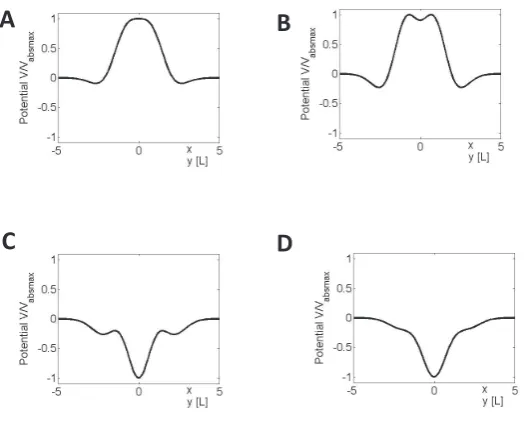
Figure 1.Shape of the potentialV as function of the control parameterα=a/c.V was computed from (13). On the horizontal axis the rescaled order parameterxis plotted or alternatively the distanceyin units of the scaling parameterLis shown. On the vertical axis the ratioV /Vabsmaxis shown, i.e.,
the potential is rescaled by the maximal value in the amount. Panels A,B,C,D correspond to control parametersα=−10,−5,5,10.
2.2
Transitions between personal and intimate
spaces
We will focus on transitions between personal and intimate spaces. As we will see below, for this purposes it is suffi-cient to consider a function expansion that contains only the first three terms. Consequently, the truncated order parameter equation model for the order parameterxreads
d dtx=−
d
dxV(x), V(x) =aV1+bV2+cV3. (12)
The parametersa,b,care the expansion coefficients of the first three rescaled, symmetric Hermite functions.
We consider next a person who switches from personal space distance to an intimate space distance (we might a per-son who performs an embracing gesture as part of a greeting or say-good-bye ritual). That is, the proxemic space changes from personal to intimate as a result of a change in the social interaction.
Mathematically speaking, let α denote a parameter that characterizes the social interaction in which an actor is en-gaged. We will considerαas control parameter and assume for sake of simplicity that it is a real number that might take on positive or negative values. The change in the social inter-action from personal to intimate is described by a change of
α. More precisely, the control parameter is assumed to pass beyond a critical value ofα. As a results, the interpersonal distance changes fromy≈0.7m (personal space) toy≈0m (intimate space) [1, 2].
Let us determine the bifurcation diagram related to such a change. Since the problem at hand exhibits a mirror-symmetry property, the bifurcation is of the pitchfork type. The order parametery(or the rescaled counterpartx) is as-sumed to change discontinuously. Therefore, the pitchfork bifurcation is subcritical. A detailed analysis shows that it is not possible to obtain a subcritical pitchfork bifurcation with the two first expansion function. That is, fora, b ̸= 0and
c= 0the subcritical case can not be modeled (we will return to an alternative application of the condition a, b ̸= 0 and
c = 0in the discussion section). However, as we will show next, fora, c ̸= 0andb = 0a subcritical pitchfork bifurca-tion can be obtained. Let us putb = 0. Equation (12) then becomes
d dtx=
d
dxV(x), V(x) =aV1+cV3. (13)
When changingα=a/cwithc >0fromα=a/c=−10to
α=a/c= 10then the potentialV(x)changes qualitatively in form of a subcritical pitchfork bifurcation, see Fig. 1. That is, for relative large negative values ofαthe order parameter model exhibits only stable fixed points atx±dwithd > 0
(panel A). The valued >0reflects a preferred interpersonal distance related to the personal space of the actor. At a criti-cal valueαc,1a stable fixed atx= 0emerges (panel B) and
the order parameter model predicts bistability of personal and intimate space. However, since the fixed point of the personal space is stable the actor will continue to position himself or herself at a personal space distance rather then at the distance of the intimate space. For positive but not too large values of
α = a/cthe stable fixed point atx = 0reflecting intimate space corresponds to the global maximum of the potential (panel C). The order parameter dynamic is still bistable such that the actor may maintain a position at the personal space distance. However, slight fluctuations will be sufficient to move the actor out of that condition and will bring him or her to the stable fixed point of the global potential maximum that reflects an intimate space distance. In particular, whenα be-comes larger than a critical valueαc,2withαc,2> αc,1, then
according to the potential dynamics interpretation of the or-der parameter model (13) the intimate space is the only stable performance pattern.
−10
0
10
0
1
2
3
a/c
[image:4.595.54.263.58.234.2]x
stFigure 2. Subcritical pitchfork bifurcation diagram (only the upper half is shown) of the scaled distance order parameterxst. Solid (dashed) lines
represent stable (unstable) fixed point locations. See text for details.
control parametersα. This procedure yielded the bifurcation diagram shown in Fig. 2. Figure 2 shows stable and unsta-ble fixed points of the rescaled order parameterxversusα. Only the positive values forxare shown. From the numer-ical solution method we obtain estimates for critnumer-ical control parameters:αc,1≈ −9.0andαc,2≈7.0.
2.3
Laboratory framework and body-scaled
model
In order to relate the dimensionless order parameterxwith distancesy measured in the laboratory frame, we consider the scaling parameterLand the mappingy =x L. In order to obtain a fixed point foryaty ≈ 0.7m forα < αc,1 we
rescale x using L = 0.28m. From Fig. 2 it then follows that the bifurcation diagram foryin laboratory space looks as shown in Fig. 3. The parameterL may reflect a body-dimension. In this case, the order parameter equation (1) for
yis a body-scaled order parameter equation.
−10
0
10
0
0.2
0.4
0.6
0.8
a/c
y
st [image:4.595.44.264.593.764.2][m]
Figure 3. As in Fig. 2 but for the (original) distance order parameteryst
measured in the laboratory framework.
We derived a model for interpersonal distance under the two assumptions that the human spatial behavior is a self-organization process and that the process operates close to bi-furcation points. Under these two assumptions, synergetics, a theory of pattern formation and self-organization, applies and predicts the emergence of an order parameter. Conducting a top-down approach, we considered interpersonal distance as the order parameter. This implies that within the proposed framework the interpersonal distance of an actor with respect to another actor is regarded as a time-dependent variable of a dynamical system. The variable converges to a stable fixed point value (stable stationary value) that determines the pre-ferred interpersonal distance of the actor. In a similar vein the Haken-Kelso-Bunz model of bimanual coordination [17], a prism adaptation model [18, 19], and a model for haptic distance perception [20, 21] have been derived in previous studies. In doing so, we advocate that interpersonal distance is a self-organization phenomenon that is governed by prin-ciples that hold irrespective of the nature of the underlying neurobiological mechanisms.
In fact, the notion that preferred interpersonal distances correspond to stable fixed points of appropriately defined dy-namical systems is consistent with the literature. First of all, individuals are known to exhibit ”preferred degrees of closeness” (see Ref. [2], p. 390) or ”preferred interaction distances” (see Ref. [2], p. 393). Second, these preferred distances are regarded as equilibrium points at which ap-proach forces and avoidance forces are balanced [2]. While experimental research suggests that on the individual level such preferred interpersonal distances exist, on the popula-tion level we need to consider a probabilistic descrippopula-tion due to the variability among individuals. That is, we can only pre-dict probability functions that tell us how frequently a given distance will be observed under given circumstances (for a worked out example of an analogous problem in the field of grasping see Ref. [13]).
Interestingly, our derivation required to introduce a scaling parameterL. On the basis of literature data, we determined the value ofLto aboutL= 0.28m. This value could corre-spond to the upper- or lower-arm length of an adult. By intro-ducing a body-scaled parameter and measuring the parameter for an individual, the model (13) can be used to predict the range of personal space distances of that individual.
less subjected to the impact of fluctuations. This increased predictability of behavior might be beneficial for establish-ing social relationships.
While we demonstrated that the case of a subcritical pitch-fork bifurcation can be modeled using the parametera, c̸= 0
andb = 0, an alternative set of parameters might be of in-terest as well. Fora, b̸= 0andc = 0a numerical analysis similar to the one shown above, reveals a supercritical pitch-fork bifurcation. Such a bifurcation may describe transitions that come with a gradual (not jump like) change of the inter-personal distance. For example, during child development it is known that with beginning of the age of 5 the interpersonal distances increases continuously until young adulthood [2]. Therefore, when a change from intimate to personal activi-ties in young children results in a change of the interpersonal differences with respect to an adult, then this may be modeled by means of a control parameterγ=b/athat is increased be-yond a critical valueγc. The precise value ofγ > γc would
depend on ageAof a child such that forA2 > A1we have
γ(A2)> γ(A1).
REFERENCES
[1] E. T. Hall, The hidden dimension, Doubleday, New York, 1966.
[2] J. R. Aiello, Human spatial behavior, in: D. Stokols, I. Alt-man (Eds.), Handbook of Environmental Psychology, Vol. 1, Wiley, New York, 1987, pp. 389–504.
[3] L. A. Hayduk, Personal space: an evaluative and orienting overview, Psychological Bulletin 85 (1978) 117–134.
[4] L. A. Hayduk, The shape of personal space: an experimen-tal investigation, Canadian Journal of Behavioral Science 13 (1981) 274–287.
[5] L. A. Hayduk, Personal space: where we now stand, Psycho-logical Bulletin 94 (1983) 293–335.
[6] R. Gifford, Projected interpresonal distance and orientation choices: personality, sex, and social situation, Social Psychol-ogy Quaterly 45 (1982) 142–152.
[7] D. Uzzell, N. Home, The influence of biological sex, sexuality and gender role on interpresonal distance, British Journal of Social Psychology 45 (2006) 579–597.
[8] N. Bruno, M. Muzzolini, Proxemics revisited: similar effects of arms length on men’s and women’s personal distances, Universal Journal of Psychology 1 (2013) 46–52.
[9] J. A. S. Kelso, Dynamic patterns - The self-organization of brain and behavior, MIT Press, Cambridge, 1995.
[10] H. Haken, Principles of brain functioning, Springer, Berlin, 1996.
[11] M. T. Turvey, Coordination, Am. Psychol. 45 (1990) 938– 953.
[12] F. J. Diedrich, W. H. J. Warren, Why change gaits? dynamics of the walk-run transition, J. Exp. Psychol. - Hum. Percept. Perform. 21 (1995) 183–???
[13] T. D. Frank, M. J. Richardson, S. M. Lopresti-Goodman, M. T. Turvey, Order parameter dynamics of body-scaled hys-teresis and mode transitions in grasping behavior, J. Biol. Phys. 35 (2009) 127–147.
[14] S. M. Lopresti-Goodman, M. T. Turvey, T. D. Frank, Behav-ioral dynamics of the affordance ”graspable”, Attention, Per-ception, and Psychophysics 73 (2011) 1948–1965.
[15] H. Haken, Synergetic computers and cognition, Springer, Berlin, 1991.
[16] H. Haken, Synergetics. An introduction, Springer, Berlin, 1977.
[17] T. D. Frank, P. L. Silva, M. T. Turvey, Symmetry axiom of the Haken-Kelso-Bunz coordination dynamics revisited in the context of cognitive activity, Journal of Mathematical Psy-chology 56 (2012) 149–165.
[18] T. D. Frank, J. J. C. Blau, M. T. Turvey, Nonlinear attractor dynamics in the fundamental and extended prism adaptation paradigm, Phys. Lett. A 373 (2009) 1022–1030.
[19] T. D. Frank, J. J. C. Blau, M. T. Turvey, Symmetry break-ing analysis of prism adaptations’s latent aftereffect, Cogni-tive Science 36 (2012) 674–697.
[20] M. T. Turvey, S. J. Harrison, T. Frank, C. Carello, Human odometry verifies the symmetry perspective of biped gaits, J. Exp. Psychol. - Hum. Percept. Perform. 38 (2012) 1014– 1025.