A HYBRID MODEL FOR DISCOVERING SIGNIFICANT PATTERNS IN DATA MINING
ZAILANI BIN ABDULLAH
A thesis submitted in
fulfillment of the requirements for the award of the Doctor of Philosophy.
Faculty of Computer Science and Information Technology Universiti Tun Hussein Onn Malaysia
ABSTRACT
v
ABSTRAK
vii
PUBLICATIONS
A fair amount of the materials presented in this thesis has been published in various refereed conference proceedings and journals.
Journal
1. Abdullah, Z., Herawan, T. & Deris, M.M. (2012). Mining Highly-Correlated of Least Association Rules using Scalable Trie-based Algorithm. Journal of Chinese Institute of Engineers, 35(5), pp. 547-554. (impact factor 0.225)
2. Abdullah, Z., Herawan, T. & Deris, M.M. (2012). Detecting Critical Least Association Rules in Medical Databases. International Journal of Modern Physics Conference Series, World Scientific, 9, pp. 464 – 479.
3. Abdullah, Z., Herawan, T. & Deris, M.M. (2012). ECLAR: An Enhanced Critical Least Association Rules Model. International Journal of Data Warehousing and Mining (impact factor 0.200) (in press).
4. Abdullah, Z., Herawan, T., Ahmad, N. & Deris, M.M. (2011). Extracting Highly Positive Association Rules from Students' Enrollment Data. Elsevier - Procedia Social and Behavioral Sciences, 28, pp. 107111.
5. Abdullah, Z., Herawan, T., Ahmad, N. & Deris, M.M. (2011). Mining Significant Association Rules from Educational Data using Critical Relative Support Approach. Elsevier - Procedia Social and Behavioral Sciences, 28, pp. 97101.
6. Abdullah, Z., Herawan, T. & Deris, M.M. (2012). Tracing Significant Information using Critical Least Association Rules Model. International Journal of Innovative Computing and Applications, Inderscience. (in press)
ix
8. Abdullah, Z., Herawan, T. & Deris, M.M. (2012). Fast Algorithm for Constructing Incremental Tree Data Structure. Procedia Information Technology and Computer Science, AWER. (in press)
9. Abdullah, Z., Herawan, T. & Deris, M.M. Mining Interesting Association Rules in Manufacturing Industry A Case Study in MODENAS. IGI-Global - International Journal of Knowledge-Based Organizations. (accepted)
10. Abdullah, Z., Herawan, T. & Deris, M.M. Finding Least Association Rules from Application of Undergraduate Programs. International Journal of Knowledge Society Research, 2012. (submitted)
11. Abdullah, Z., Herawan, T. & Deris, M.M. Weighted Patterns Mining Framework. Elsevier - Journal of Systems and Software. (submitted)
12. Abdullah, Z., Herawan, T. & Deris, M.M. & Abawajy, J. T3: An Efficient Model for Constructing Frequent Pattern Tree. Elsevier - Information Systems. (submitted)
13. Abdullah, Z., Herawan, T. & Deris, M.M. A Fast Technique to Find Items Support from Scalable Trie-based Structure. IGI-Global - International Journal of Software Innovation. (submitted)
14. Abdullah, Z., Herawan, T. & Deris, M.M. A Tool for Visualizing Critical Least Association Rules. IGI-Global - International Journal of 3-D Information Modeling. (submitted)
15. Abdullah, Z., Herawan, T. & Deris, M.M. A Scalable Algorithm for Constructing Frequent Pattern Tree. IGI-Global - International Journal of Intelligent Information Technologies. (submitted)
16. Abdullah, Z., Herawan, T. & Deris, M.M. Detecting Critical Least Association Rules in Manufacturing Industry: A case study in MODENAS. International Journal of Knowledge-Based Organizations. (submitted)
17. Abdullah, Z., Herawan, T., Ahmad, N. & Deris, M.M. WLAR-Viz: Weighted Least Association Rules Visualization. Manuscript recommended to be included in Special Issues of ICICA 2012.
18. Abdullah, Z., Herawan, T., Ahmad, N. & Deris, M.M. Scalable technique to discover items support from trie data structure. WLAR-Viz: Weighted Least Association Rules Visualization. Manuscript recommended to be included in Special Issues of ICICA 2012.
20. Abdullah, Z., Herawan, T., and Deris, M.M. Mining Least Association Rules of Degree Level Programs Selected by Students. Manuscript recommended to be included in Special Issues of SIA 2012.
21. Abdullah, Z., Herawan, T., and Deris, M.M. Fast Determination of Items Support Technique from Enhanced Tree Data Structure. Manuscript recommended to be included in Special Issues of SIA 2012.
22. Abdullah, Z., Herawan, T., and Deris, M.M. CLAR-Viz: Critical Least Association Rules Visualization. Manuscript recommended to be included in Special Issues of ICHCI 2012.
Book Chapter
23. Noraziah, A., Abdullah, Z., Herawan, T. & Deris, M.M. (2012). WLAR-Viz: Weighted Least Association Rules Visualization. In Liu et al. (Eds.): ICICA 2012, LNCS, 7473. Chengde, China: Springer Verlag. pp. 592-599
24. Abdullah, Z., Noraziah, A., Herawan, T. & Deris, M.M. (2012). An Efficient Algorithm for Mining Frequent Patterns in Dynamic Database. In Liu et al. (Eds.): ICICA 2012, LNCS, 7473. Chengde, China: Springer Verlag. pp. 51-58
25. Noraziah, A., Abdullah, Z., Herawan, T. & Deris, M.M. (2012). Scalable Technique to Discover Items Support from Trie Data Structure. In Liu et al. (Eds.): ICICA 2012, LNCS, 7473. Chengde, China: Springer Verlag. pp. 500-507
26. Abdullah, Z., Herawan, T., Ibrahim-Fakharaldien, M.A., and Deris, M.M. Mining Least Association Rules of Degree Level Programs Selected by Students. SIA 2012, LNCS. (accepted)
27. Abdullah, Z., Herawan, T., Ibrahim-Fakharaldien, M.A., and Deris, M.M. Fast Determination of Items Support Technique from Enhanced Tree Data Structure. SIA 2012, LNCS. (accepted)
28. Abdullah, Z., Herawan, T., Ibrahim-Fakharaldien, M.A., and Deris, M.M. CLAR-Viz: Critical Least Association Rules Visualization. ICHCI 2012, LNCS. (accepted)
29. Abdullah, Z., Herawan, T. & Deris, M.M. (2011). Visualizing the Construction of Incremental Disorder Trie Itemset Data Structure (DOSTrieIT) for Frequent Pattern Tree (FP-Tree). In H.B. Zaman et al. (Eds.): IVIC 2011, LNCS, 7066. Bangi, Malaysia: Springer Verlag. pp. 183195.
xi
31. Abdullah, Z., Herawan, T. & Deris, M.M. (2010). Mining Significant Least Association Rules using Fast SLP-Growth Algorithm. In T.H. Kim and H. Adeli (Eds.): AST/UCMA/ISA/ACN 2010, LNCS, 6059. Miyazaki, Japan: Springer-Verlag. pp. 324336.
32. Abdullah, Z., Herawan, T. & Deris, M.M. (2010). Scalable Model for Mining CriticalLeast Association Rules. In Rongbo Zhu et al. (Eds.): ICICA 2010, LNCS, 6377. Tangshan, China: Springer-Verlag. pp. 509-516.
33. Abdullah, Z., Herawan, T. & Deris, M.M. CIAR: A Model for Mining Critical Indirect Association Rules. ACIIDS 2012, LNCS. (submitted)
Proceeding
34. Abdullah, Z. and Deris, M.M. (2009). Association Rules Mining with Relative Weighted Support. In proceeding of IIWAS2009. KL, Malaysia: ACM Press. pp. 505–509.
35. Abdullah, Z., Zulaikha, S. and Deris, M.M. (2009). An Efficient Algorithm for Mining Causality Least Pattern. In proceeding of ICACTE2009, 2. Cairo, Egypt: ASME Press. pp. 1103–1110.
Tools (Software)
Abdullah, Z., Herawan, T. & Deris, M.M. ECLAR: A Data Mining Tool for Capturing Critical Least Association Rules (C#).
Abdullah, Z., Herawan, T. & Deris, M.M. WELAR: A Data Mining Tool for Capturing Weighted Least Association Rules (C#).
CONTENTS
TITLE i
DECLARATION ii
ACKNOWLEDGEMENTS iii
ABSTRACT iv
ABSTRAK vi
PUBLICATIONS viii
CONTENTS xii
LIST OF TABLES xvii
LIST OF FIGURES xix
LIST OF SYMBOLS AND ABBREVIATIONS xxiii
xiii
CHAPTER 1 INTRODUCTION 1
1.1 Research Background 1
1.2 Problem Statement 2
1.3 Research Objectives 5
1.4 Research Scopes 5
1.5 Research Methodology Process 6
1.6 Thesis Contributions and Organization 8
CHAPTER 2 LITERATURE REVIEW 11
2.1 Knowledge Discovery in Database 11
2.2 Data Mining 12
2.3 Significant Patterns 14
2.4 Trie Data Structure 15
2.5 Pattern Measures 16
2.6 Association Rules Mining 17
2.7 Association Rules 17
2.8 Frequent Pattern Algorithms 18
2.9 Significant Pattern Algorithms 19
2.10 Frequent Pattern Tree 22
2.11 CATS-Tree 24
2.12 CanTree 27
2.13 Common Interesting Measures 31
2.14 Correlation Analysis 33
2.15 Multiple Supports 34
2.16 Relative Support 35
2.17 Weighted Association Rules 36
2.18 Weighted Support Association Rules 37
CHAPTER 3 METHODOLOGY 40
3.1 Preliminaries 40
3.2 Design of Efficient Frequent Pattern Mining Model
41
3.2.1 Definition 42
3.2.2 Disorder-Support Trie Itemset 46 3.2.3 Trie Transformation Technique 56 3.2.4 Fast Online Trie Algorithm 68 3.2.5 Trie Transformation Technique
Algorithm
71
3.2.6 Enhanced FP-Growth (FP-Growth*)
73
3.2.7 An Overview Model 74
3.3 Design of Efficient Least Pattern Mining Model
77
3.3.1 Definition 78
3.3.2 Least Pattern Tree 80
3.3.3 Least Pattern Tree Algorithm 95 3.3.4 Least Pattern Growth Algorithm 97
3.3.5 An Overview Model 98
3.4 Design of Significant Least Pattern Mining Model
101
3.4.1 Definition 101
3.4.2 An Overview Model 103
3.5 Design of Hybrid Model for Discovering Significant Patterns
106
3.5.1 Least Trie Transformation Technique Algorithm
106
3.5.2 An Overview Model 109
3.6 An Overview of Hybrid Framework for Discovering Significant Patterns
112
xv
CHAPTER 4 RESULT AND DISCUSSION 115
4.1 Experimental Setup 115
4.2 Retail Dataset 117
4.2.1 Evaluation on EFP-M2 118
4.2.2 Evaluation on ELP-M2 119
4.2.3 Evaluation on SLP-M2 121
4.2.4 Evaluation on Hy-DSP 123
4.3 T10I4D100K Dataset 124
4.3.1 Evaluation on EFP-M2 125
4.3.2 Evaluation on ELP-M2 126
4.3.3 Evaluation on SLP-M2 129
4.3.4 Evaluation on Hy-DSP 131
4.4 Mushroom Dataset 132
4.4.1 Evaluation on EFP-M2 133
4.4.2 Evaluation on ELP-M2 134
4.4.3 Evaluation on SLP-M2 137
4.4.4 Evaluation on Hy-DSP 139
4.5 Kuala Lumpur Air Pollution Dataset 140
4.5.1 Evaluation on SLP-M2 141
4.6 UMT Student Enrolment Dataset 143
4.6.1 Evaluation on SLP-M2 143
4.7 MODENAS Motorcycle Production Dataset
146
4.7.1 Evaluation on SLP-M2 147
4.8 Multiple Datasets 148
4.8.1 Evaluation on EFP-M2 149
CHAPTER 5 CONCLUSION 151
5.1 Research Summary 151
5.2 Future Work 154
REFERENCES 155
xvii
LIST OF TABLES
2.1 Transaction and ordered items 23
2.2 Sample transaction 34
3.1 Sample transaction for constructing DOSTrieIT 51
3.2 Item and support 61
3.3 Items in support descending order 61
4.1 Retail characteristics 117
4.2 Details of performance analysis of the algorithms against Retail dataset (frequent pattern)
118
4.3 Details of performance analysis of the algorithms against Retail dataset (least pattern)
119
4.4 Details of computational complexity of the algorithms against Retail dataset (least pattern)
120
4.5 Details of performance analysis of LP-Growth against Retail dataset (least pattern)
121
4.6 The mapped of different measures 122
4.7 Details of total significant least association rules from Retail dataset
122
4.8 Top 20 of significant least association rules from Retail dataset
123
4.9 Details of performance analysis of the three algorithms against Retail dataset
124
4.10 T10I4D100K characteristics 125
4.11 Details of performance analysis of the algorithms against T10I4D100K dataset (frequent pattern)
126
4.12 Details of performance analysis of the algorithms against T10I4D100K dataset (least pattern)
127
4.13 Details of computational complexity of the algorithms against T10I4D100K dataset (least pattern)
128
4.15 Details of total significant least association rules from Retail dataset
130
4.16 Top 20 of significant least association rules from Retail dataset
131
4.17 Details of performance analysis of the three algorithms against Retail dataset
132
4.18 Mushroom characteristics 133
4.19 Details of performance analysis of the algorithms against Mushroom dataset (frequent pattern)
134
4.20 Details of performance analysis of the algorithms against Mushroom dataset (least pattern)
135
4.21 Details of computational complexity of the algorithms against Mushroom dataset (least pattern)
136
4.22 Details of performance analysis of LP-Growth against Mushroom dataset (least pattern)
136
4.23 Details of total significant least association rules from Mushroom dataset
138
4.24 Top 20 of significant least association rules from Mushroom dataset
139
4.25 Details of performance analysis of the three algorithms against Mushroom dataset
140
4.26 The mapped Kuala Lumpur Air Pollution dataset 141
4.27 The executed transactions 141
4.28 Top 20 Significant association rules from Kuala Lumpur Air Pollution dataset
142
4.29 The mapped of bachelor programs 143
4.30 Top 20 Significant association rules from UMT Student Enrolment dataset
144
4.31 Explanation of Top 20 significant association rules from UMT Student Enrolment dataset
145
4.32 The mapped models 147
4.33 The mapped quantity 147
4.34 Top 20 of significant association rules from MODENAS Motorcycle Production
148
4.35 Details of performance analysis of constructing both data structures against different datasets
xix
LIST OF FIGURES
1.1 Research Methodology Process 6
2.1 An Overview Process of KDD 12
2.2 FP-Tree construction 23
2.3 CATS-Tree construction for T1 25
2.4 CATS-Tree construction for T2 25
2.5 CATS-Tree construction for T3 26
2.6 CATS-Tree construction for T4 26
2.7 CATS-Tree construction for T5 27
2.8 CanTree construction for T1 28
2.9 CanTree construction for T2 29
2.10 CanTree construction for T3 29
2.11 CanTree construction for T4 30
2.12 CanTree construction for T5 31
3.1 DOSTrieIT 42
3.2 Reordering DOSTrieIT and SIWE Path 48
3.3 DOSTrieIT construction for T1 51
3.4 DOSTrieIT construction for T2 52
3.5 DOSTrieIT construction for T3 52
3.6 DOSTrieIT construction for T4 53
3.7 DOSTrieIT construction for T5 53
3.8 DOSTrieIT construction for T6 54
3.9 DOSTrieIT construction for T7 54
3.10 DOSTrieIT construction for T8 55
3.11 DOSTrieIT construction for T9 56
3.12 Reordering DOSTrieIT 59
3.14 Transformation from 1st prefix path of DOSTrieIT to FP-Tree
63
3.15 Transformation from 2nd prefix path of DOSTrieIT to FP-Tree
64
3.16 Transformation from 3rd prefix path of DOSTrieIT to FP-Tree
65
3.17 Transformation from 4th prefix path of DOSTrieIT to FP-Tree
66
3.18 Transformation from 5th prefix path of DOSTrieIT to FP-Tree
67
3.19 Transformation from 6th prefix path of DOSTrieIT to FP-Tree
67
3.20 Complete transformation from DOSTrieIT into FP-Tree 68
3.21 Complete structure of FP-Tree 68
3.22 Procedure in FOLTA 70
3.23 Procedure in T3A 73
3.24 Procedure in FP-Growth* 74
3.25 An overview model for EFP-M2 75
3.26 LP-Tree 81
3.27 FP-Tree 81
3.28 LP-Tree construction for T1 84
3.29 LP-Tree construction for T2 85
3.30 LP-Tree construction for T3 85
3.31 LP-Tree construction for T4 86
3.32 LP-Tree construction for T5 86
3.33 LP-Tree construction for T6 87
3.34 LP-Tree construction for T7 87
3.35 LP-Tree construction for T8 88
3.36 LP-Tree construction for T9 88
xxi
3.42 LP-Tree construction from 6th prefix path of DOSTrieIT 93 3.43 LP-Tree construction from 7th prefix path of DOSTrieIT 94
3.44 LP-Tree construction from 8th prefix path of DOSTrieIT 94
3.45 Procedure in LP-TA 97
3.46 Procedure in LP-Growth 98
3.47 An overview of ELP-M2 99
3.48 An overview of SLP-M2 104
3.49 Procedure in LT3A 109
3.50 An overview of Hy-DSP 110
3.51 An overview of Hyf-DSP 112
4.1 Part of Retail dataset 117
4.2 Performance analysis of the algorithms against Retail dataset (frequent pattern)
118
4.3 Performance analysis of the algorithms against Retail dataset (least pattern)
120
4.4 Computational complexity of the algorithms against Retail dataset (least pattern)
120
4.5 Performance analysis of LP-Growth against Retail dataset (least pattern)
121
4.6 Total significant least association rules from Retail dataset 122 4.7 Performance analysis of the three algorithms against Retail
dataset
124
4.8 Part of T10I4D100K dataset 125
4.9 Performance analysis of the algorithms against T10I4D100K dataset (frequent pattern)
126
4.10 Performance analysis of the algorithms against T10I4D100K dataset (least pattern)
127
4.11 Computational complexity of the algorithms against T10I4D100K dataset (least pattern)
128
4.12 Performance analysis of LP-Growth against T10I4D100K dataset (least pattern)
129
4.13 Total significant least association rules from T10I4D100K dataset
130
4.14 Performance analysis of the three algorithms against T10I4D100K dataset
4.15 Part of Mushroom dataset 133 4.16 Performance analysis of the algorithms against Mushroom
dataset (frequent pattern)
134
4.17 Performance analysis of the algorithms against Mushroom dataset (least pattern)
135
4.18 Computational complexity of the algorithms against Mushroom dataset (least pattern)
136
4.19 Performance analysis of LP-Growth against Mushroom dataset (least pattern)
137
4.20 Total significant least association rules from Mushroom dataset
138
4.21 Performance analysis of the three algorithms against Mushroom dataset
140
4.22 Performance analysis of constructing both data structures against different datasets
xxiii
LIST OF SYMBOLS AND ABBREVIATIONS
AFOPF - Ascending Frequency Ordered Prefix-Tree AFPIM - Adjusting FP-Tree for Incremental Mining
ARs - Association Rules BIT - Batch Incremented Tree BSM - Branch Sorting Method
BtB - Break the Barrier Algorithm
CATS - Compressed and Arranged Transaction Sequence ChildItem - Child Item
CMC - Collective Minimum Count CRS - Critical Relative Support CurPP - Current Prefix Path of FP-Tree DBMS - Database Management System
DCP - Downward Closure Property
DCS-Apriori - Dynamic Collective Support Apriori DMS - Dynamic Minimum Support Count DOSTrieIT - Disorder Support Trie Itemset
DSIP - Disorder-Support Itemset Path
EFP-M2 - Efficient Frequent Pattern Mining Model ELP-M2 - Efficient Least Pattern Mining Model
EPFIM - Extending FP-Tree for Incremental Mining ExtPP - Extension Prefix Path of FP-Tree
FAR - Frequent Association Rules
FIMI - Frequent Itemset Mining Dataset Repository FOLTA - Fast Online Trie Algorithm
FP-Tree - Frequent Pattern Tree FRIT - Frequent Itemset FUFPT - Fast Updated FP-Tree
HFIT - Highly Frequent Itemset
Hy-DSP - Hybrid Model for Discovering Significant Patterns
Hyf-DSP - Hybrid Framework for Discovering Significant Patterns ICFP-growth - Improved Conditional Pattern-growth
IR - Information Retrieval
KDD - Knowledge Discovery in Database LAR - Least Association Rules
LEIT - Least Itemset
LFIT - Least Frequent Itemset
LP-Growth* - Enhanced LP-Growth Algorithm LP-TA - LP-Tree algorithm
LP-Tree - Least Pattern Tree
LT3A - Least Trie Transformation Technique Algorithm MG - Minimal Generators
MinConf - Minimum Confidence MinSupp - Minimum Support
MIS - Minimum Item Support MIS-tree - Multiple Item Support tree
MISupp - Minimum Itemset Support mRIs - minimal Rare Itemsets MRR - Minimal Rare Generators
MSAA - Multiple Support Apriori Algorithm MSApriori - Multiple Support Apriori
MZG - Minimal Zero Generators NewPP - New prefix path of FP-Tree
xxv
RSAA - Relative Support Apriori Algorithm SIWE - Single Item without Extension SLAR - Significant Least Association Rules SLP-M2 - Significant Least Pattern Mining Model SLP-M2 - Significant Least Pattern Mining Model
T3 - Trie Transformation Technique T3A - T3 Algorithm
Tcp - FP-Tree based Correlation Mining Algorithm USIP - Unordered-Support Itemset Path
WAR - Weighted Association Rules
WARM - Weighted Association Rule Mining Algorithm WSAR* - Weighted Support ARs
LIST OF APPENDICES
APPENDIX TITLE PAGE
A Enhanced Critical Least Association Rules Tool (ECLAR)
165
B Weighted Least Association Rules Tool (WELAR) 166
C Significant Patterns Miner Tool (SPM) 167
D Kuala Lumpur Air Pollution Dataset 168
E1 UMT Enrolment Dataset 169
E2 UMT Enrolment Dataset (cont.) 170
E3 UMT Enrolment Dataset (cont.) 171
E4 UMT Enrolment Dataset (cont.) 172
E5 UMT Enrolment Dataset (cont.) 173
E6 UMT Enrolment Dataset (cont.) 174
E7 UMT Enrolment Dataset (cont.) 175
E8 UMT Enrolment Dataset (cont.) 176
E9 UMT Enrolment Dataset (cont.) 177
155
REFERENCES
Adda, M., Wu, L. & Feng, Y. (2007). Rare Itemset Mining. Proc. of the 6th
Conference on Machine Learning and Applications. Ohio, USA: IEEE
Computer Society. pp. 73-80.
Aggarwal, C.C. & Yu, P.S. (1998). A New Framework for Itemset Generation. Proc. of the 17th Symposium on Principles of Database Systems. Seattle, WA:
ACM Press. pp. 18–24.
Agrawal, R. Imielinski, T. & Swami, A. (1993). Database Mining: A Performance Perspective. IEEE Transactions on Knowledge and Data Engineering, 5(6), pp. 914 – 925.
Agrawal, R. & Srikant, R. (1994). Fast Algorithms for Mining Association Rules. Proc. of the 20th VLDB Conference. Santiago, Chile: Morgan Kaufmann. pp.
487–499.
Amir, A., Feidman, R. & Kashi, R. (1997). A New and Versatile Method for Association Generation. Information Systems, 2, pp. 333–347.
Anad, R., Agrawal, R. & Dhar, J. (2009). Variable Support Based Association Rules Mining. Proc. of the 33rd Annual IEEE International Computer Software and Application Conference. Washington, USA: IEEE Computer Society. pp. 25 –
30.
Ashrafi, M.Z., Taniar, D. & Smith, K.A. (2004). ODAM: An Optimized Distributed Association Rule Mining Algorithm, IEEE Distributed Systems Online, 5(3), pp. 1-18.
Ashrafi, M.Z., Taniar, D. & Smith, K.A. (2007). Redundant Association Rules Reduction Techniques. International Journal Of Business Intelligence And Data Mining, 2(1), 29-63.
Brin, S., Motwani, R. & Silverstein, C. (1997a). Beyond Market Basket: Generalizing Association Rules to Correlations. Proc. of ACM SIGMOD, International Conference on Management of Data. New York, USA: ACM
Press. pp. 255-264.
Brin, S., Motwani, R., Ullman, J.D. & Tsur, S. (1997b). Dynamic Itemset Counting and Implication Rules for Market Basket Data. Proc. of ACM SIGMOD, International Conference on Management of Data. New York, USA: ACM
Press. pp. 255-264.
Burdick, D., Calimlim, M. & Gehrke, J. (2001). MAFIA: a maximal frequent item set algorithm for transactional databases. Proc. of the 17th International Conference on Data Engineering. Heidelberg, Germany: IEEE Computer
Society. pp. 443-452.
Cai, C.H., Fu, A.W.C., Cheng, C.H. & Kwong, W.W. (1998). Mining Association Rules with Weighted Items. Proc. of the 2nd International Database Engineering and Application Symposium (IDEAS’98). Cardiff, UK: IEEE Computer Society. pp. 6877.
Cheung, W. & Zaïane, O.R. (2003). Incremental Mining of Frequent Patterns without Candidate Generation of Support Constraint. Proc. of the 7th International Database Engineering and Applications Symposium (IDEAS’03). Hong Kong,
China: IEEE Computer Society. pp. 111-117.
Clark, P. & Boswell, R. (1991). Rule Induction with CN2: Some Recent Improvements. In EWSL 1991, Lecture Notes in Artificial Intelligent, 482. Porto, Portugal: Springer-Verlag. pp. 151–163.
Ding, B., and Konig, A.R. (2011). Fast Set Intersection in Memory. Proc. of the VLDB Endowment, 4(4). Seattle, USA: VLDB Endowment Inc. pp. 255-266.
Ding, J. (2005). Efficient Association Rule Mining among Infrequent Items. University of Illinois at Chicago: Ph.D. Thesis.
Dunham, M.H. (2003). Data Mining: Introductory and Advanced Topics. New Jersey, USA: Prentice-Hall.
Fayyad, U., Patesesky-Shapiro, G., Smyth, P. & Uthurusamy, R. (1996). Advances in Knowledge Discovery and Data Mining. Cambridge, MA: MIT Press.
157
Giannikopoulos, P., Varlamis, I. & Eirinaki, M. (2010). Mining Frequent Generalized Patterns For Web Personalization In The Presence Of Taxonomies. International Journal of Data Warehousing and Mining, 6(1), pp. 58-76.
Grahne, G., & Zhu, J. (2003). Efficiently using Prefix-Trees in Mining Frequent Itemsets. Proc. of the Workshop Frequent Itemset Mining Implementations 2003. Florida, USA: Citeseer. pp. 123-132.
Han, J., Pei, H. & Yin, Y. (2000). Mining Frequent Patterns without Candidate Generation. Proc. of the 2000 ACM SIGMOD. Texas, USA: ACM. pp. 112. Han, J. & Kamber, M. (2001). Data Mining Concepts and Techniques. San
Francisco, USA: Morgan Kaufmann.
Han, J. & Pei, J. (2004). Mining Frequent Pattern without Candidate Itemset Generation: A Frequent Pattern Tree Approach. Data Mining and Knowledge Discovery, 8, pp. 53 – 87.
He, Z., Xu, X. & Deng, S. (2005). A FP-Tree Based Approach for Mining Strongly Correlated Pairs without Candidate Generations. In CIS 2005, Part I, Lecture Note in Artificial Intelligent, 3801: Springer-Verlag. pp. 735 – 740.
Hipp, J., Guntzer, U. & Nakhaeizadeh, G. (2000). Algorithms for Association Rule Mining – A General Survey and Comparison. Proc. of SIGKDD Explorations, ACM SIGKDD, 2(1). New York, USA: ACM. pp 58 – 64.
Hong, T-P., Lin, J-W. and We, Y-L. (2008). Incrementally Fast Updated Frequent Pattern Trees. An International Journal of Expert Systems with Applications, 34(4), pp. 2424 – 2435.
Hu, Y-H. & Chen, Y-L. (2006). Mining Association Rules with Multiple Minimum Supports: A New Mining Algorithm and a Support Tuning Mechanism. Decision Support Systems, 42(1), pp. 1 – 24.
Huan, J., Wang, W., Bandyopadhyay, D., Snoeyink, J., Prins, J. & Tropsha, A. (2004). Mining Protein Family-Specific Residue Packing Patterns from Protein Structure Graphs. Proc. of the 8th International Conference on Research in Computational Molecular Biology (RECOMB2004), California, USA: ACM.
Huang, X., Wu, J., Zhu S. & Xiong, H. (2010) and COSI-tree: Identification of Cosine Interesting Patterns Based on FP-tree. Proc. of the International Conference on E-Business Intelligence (ICIBI2010). Yunan, China: Atlantis
Press. pp. 456 – 463.
Huang, Y., Xiong, H., Wu, W., Deng, P. &And Zhang, Z. (2007). Mining Maximal Hyperclique Pattern: A Hybrid Search Strategy. Information Sciences, 177 (3), pp. 703-721.
Ibrahim, S.P.S & Chandran, K.R. (2011). Compact Weighted Class Association Rule Mining Using Information Gain. International Journal of Data Mining & Knowledge Management Process, 1(6), pp. 1 – 13.
Inokuchi, A., Washio, T. & Motoda, H. (2000). An Apriori-based Algorithm for Mining Frequent Substructures from Graph Data. Proc. of the Principles of Knowledge Discovery and Data Mining (PKDD2000), Lyon, France: Springer
Berlin Heidelberg. pp. 13 – 23.
Jain, A.K. & Dubes, R.C. (1988). Algorithms for Clustering Data. New Jersey, USA: Prentice-Hall.
Ji, L., Zhang, B. and Li., J. (2006). A New Improvement of Apriori Algorithm. Proc. of International Conference on Computer Intelligence and Security
(ICCIS2006). Guangzhou, China: Springer-Verlag. pp. 840 – 844.
Jiang, B., Hu, X., Wei, Q., Song, J., Han, C. & Liang, M. (2011). Weak Ratio Rules: A Generalized Boolean Association Rules. International Journal of Data Warehousing and Mining, 7(3), pp. 50-87.
Jin, R. & Agrawal, G. (2006). A Systematic Approach for Optimizing Complex Mining Tasks on Multiple Datasets. Proc. of the 22nd International Conference on Data Engineering. Boston, USA: IEEE. pp. 1 – 17.
Khan, M.S, Muyeba, M. and Coenen, F. (2008). Weighted Association Rule Mining from Binary and Fuzzy Data. In ICDM 2008, Lecture Note in Artificial Intelligent 5077, Leipzig, Germany: Springer-Verlag. pp. 200-212.
159
Kiran, R.U. & Reddy, P. K. (2009). An Improved Frequent Pattern-Growth Approach to Discover Rare Association Rules. Proc. of the International
Conference on Knowledge Discovery and Information Retrieval
(ICKDIR2009). Funchal - Madeira, Portugal: INSTICC Press. pp. 43 – 52.
Kiran, R.U. & Reddy, P. K. (2009). An Improved Multiple Minimum Support Based Approach to Mine Rare Association Rules. Proc. of IEEE Symposium on Computational Intelligence and Data Mining (SCIDM2009). Nashville, USA:
IEEE. pp. 340 347.
Koh, J-L. & Shieh, S-F. (2004). An Efficient Approach for Maintaining Association Rules Based on Adjusting FP-Tree Structure. Proc. of the 2004 Database Systems for Advanced Applications, 2004, Jeju Island, Korea: Springer-Verlag.
pp. 417 – 424.
Koh, Y.S. & Rountree, N. (2005). Finding Sporadic Rules using Apriori-Inverse. In PAKDD2005, Lecture Notes in Artificial Intelligent 3518. Hanoi, Vietnam:
Springer-Verlag. pp. 97 – 106.
Koh, Y.S., Rountree, N. & O'keefe, R.A (2006). Finding Non-Coincidental Sporadic Rules Using Apriori-Inverse. International Journal of Data Warehousing and Mining, 2(2), pp. 38-54.
Koh, Y.S., Pears, R. & Dobbie, G. (2011). Automatic Item Weight Generation for Pattern Mining and Its Application. International Journal of Data Warehousing and Mining, 7(3), pp. 30-49.
Leung, C. K-S, Khan Q.I., Li, Z. & Hoque, T. (2007). CanTree: A Canonical-order Tree for Incremental Frequent-Pattern Mining. Knowledge and Information Systems, 11(3), pp. 287–311.
Leleu, M., Regotti., C., Boulicaut, J.F. & Euvrard. (2003). GO-SPADE: Mining Sequential Patterns over Databases with Consecutive Repetitions. In MLDM2003, Lecture Note in Computer Science 2734. Leipzig, Germany: Springer-Verlag. pp. 293–306.
Liu, B., Hsu, W. & Ma, Y. (1999). Mining Association Rules with Multiple Minimum Support. Proc. of the 5th ACM SIGKDD International Conference on Knowledge Discovery and Data Mining (KDD99). San Diego, USA: ACM. pp.
337 – 341.
Liu, G., Lu, H., Lou, W., Xu, Y. & Yu, J.X. (2004). Efficient Mining of Frequent Patterns using Ascending Frequency Ordered Prefix-Tree. Data Mining and Knowledge Discovery, 9, pp. 249 – 274.
Lu, J., Chen, W. & Keech, M. (2010). Graph-Based Modelling of Concurrent Sequential Patterns. International Journal of Data Warehousing and Mining, 6(2), pp. 41-58.
Mustafa, M.D., Nabila, N.F., Evans, D.J., Saman, M.Y. & Mamat, A. (2006). Association Rules on Significant Rare Data using Second Support. International Journal of Computer Mathematics 88 (1), pp. 69 – 80.
Muyabe, M., Khan M.S. & Coenen, F. (2010). Effective Mining of Weighted Fuzzy Association Rules. in Koh Y.S and Rountree, N (Eds.). Rare Association Rule Mining and Knowledge Discovery. Pennsylvania, United States: IGI-Global. pp.47-64
Omiecinski, E.R. (1997). Alternative Interest Measures for Mining Associations in Databases. IEEE Transactions on Knowledge and Data Engineering, 15(1), pp. 57 - 69.
Park, J.S., Chen, M. & Yu, P.S. (1995). An Effective Hash Based Algorithm for Mining Association Rules. Proc. of the ACM SIGMOD International Conference Management of Data (ICMD95). California, USA: ACM. pp. 175
– 186.
Pei, J., Han, J., Lu, H., Nishio, S., Tang, S. & Yang, D. (2001). Hmine: Hyper-Structure Mining of Frequent Patterns in Large Databases. Proc. of the IEEE International Conference on Data Mining (ICDM2001). California, USA: IEEE. pp. 441 - 448.
Piatetsky-Shapiro, G. (1991). Discovery, Analysis and Presentation of Strong Rules. Knowledge Discovery in Databases. Cambridge, MA: MIT Press.
161
Raman, V., Qiao, L., Han, W., Narang, I., Chen, Y-L., Yang, K-H. & Ling, F-L. (2007). Lazy, Adaptive RID-list Intersection, and Its Application to Index Anding. Proc. of the ACM SIGMOD International Conference on Management of Data (ICMD2007). Beijing, China: ACM. pp. 773 – 784.
Sahar, S. & Mansour, Y. (1999). An Empirical Evaluation of Objective Interestingness Criteria. Proc. of the SPIE Conference on Data Mining and Knowledge Discovery. Florida, USA: pp. 63–74.
Selvi, C.S.K. & Tamilarasi, A. (2009). Mining Association Rules with Dynamic and Collective Support Thresholds. International Journal on Open Problems Computational Mathematics, 2(3), pp. 427438.
Shenoy, P., Haritsa, J.R., Sudarshan, S., Bhalotia, G., Bawa, M. &Shah, D. (2000). Turbo-charging Vertical Mining of Large Databases. Proc. of the ACM SIGMOD International Conference on Management of Data (ICMD2000).
Texas, USA: ACM Press. pp. 22 - 23.
Silverstein, C., Brin, S. & Motwani, R. (1998). Beyond Market Baskets: Generalizing Association Rules to Dependence Rules. Data Mining and Knowledge Discovery, 2, pp. 39 – 68.
Sun, K. & Bai, F. (2008), Mining Weighted Association Rules without Preassingned Weight. IEEE Transaction on Knowledge and Data Engineering, 20 (4), pp. 489 – 495.
Szathmary, L. & Napoli, A. (2007). Towards rare Itemset Mining. Proc. of the ICTAI (1). Patras, Greece: IEEE. pp. 305 – 312.
Szathmary, L. Valtchev, P. and Napoli, A. (2010). Generating Rare Association Rules Using the Minimal Rare Itemsets Family. International Journal of Software and Informatics 4(3), pp. 219 238.
Tan, P-N., Kumar, V. & Srivastava, J. (2002). Selecting the Right Interestingness Measure for Association Patterns. Proc. of the KDD'2002. Alberta, Canada: ACM Press. pp. 32 – 41.
Tan, P-N., Steinbach, M. & Kumar, V. (2006). Introduction in Data Mining. Boston: Addison Wesley.
Tanbeer, S.K., Chowdhury, F.A., Jeong, B.S. & Lee, Y-K (2008). CP-Tree: A Tree Structure for Single-Pass Frequent Pattern Mining. Proc. of the Pacific-Asia Conference on Knowledge Discovery and Data Mining (PAKDD '08). in T.
Washio et al. (Eds.), LNAI 5012. Osaka, Japan: Springer-Verlag. pp. 1022 –
1027.
Taniar, D., Rahayu, W., Lee, V.C.S & Daly, O. (2008). Exception Rules in Association Rule Mining. Applied Mathematics and Computation, 205(2), pp. 735 – 750.
Tao, F., Murtagh, F. & Farid, M. (2003). Weighted Association Rule Mining using Weighted Support and Significant Framework. Proc. of the ACM SIGKDD ’03. Washington, USA: ACM Press. pp. 661 666.
Tjioe, H.C. & Taniar, D. (2005). Mining Association Rules In Data Warehouses. International Journal of Data Warehousing and Mining, 1(3), pp. 28-62.
Totad, S, G., Geeta, R, B. and Reddy, P.P. (2010). Batch Processing for Incremental FP-Tree Construction. International Journal of Computer Applications, 5(5), pp. 28 – 32.
Troiano, L., Scibelli, G. & Birtolo, C. (2009). A Fast Algorithm for Mining Rare Itemset. Proc. of the 9th International Conference on Intelligent Systems Design and Applications. Pisa, Italy:IEEE. pp. 149 – 1155.
Tsang, S., Koh, Y.S. and Dobbie, G. (1991). RP-Tree: Rare Pattern Tree Mining. In DaWaK 2011, Lecture Notes in Computer Science, 6862. Toulouse, France:
Springer-Verlag. pp. 277 – 288.
Tsirogianni, D., Guha, S. & Koudas, N. (2009). Improving the Performance of List Intersection. Proc. of the VLDB Endowment - PVLDB 2(1) Seattle, USA: VLDB Endowment Inc. pp. 838 – 849.
Wang, K. & Su, M.Y. (2002). Item Selection by “Hub-Authority” Profit Ranking. Proc. of the 8th International Conference on Knowledge Discovery and Data
Mining (ACM SIGKDD 2002). New York, USA: pp. 652 – 657.
Wang, K., He, Y. & Han, J. (2003). Pushing Support Constraints into Association Rules Mining. IEEE Transactions on Knowledge Data Engineering, 15(3), pp. 642 – 658.
163
Weiss, G.M. (2004). Mining with Rarity: A Unifying Framework. ACM SIGKDD Explorer News Letter 2004 6(1), pp. 7 – 19.
Woon, Y.K., Ng, W.K. & Lim, E.P. (2004). A Support Order Trie for Fast Frequent Itemset Discovery. IEEE Transactions on Knowledge and Data Engineering, 16(7), pp. 875 – 879.
Wu, T., Chen, Y. & Han, J. (2010). Re-Examination of Interestingness Measures in Pattern Mining: A Unified Framework. Data Mining and Knowledge Discovery, 21, pp. 371 – 397.
Xiong, H., Tan, P.N. & Kumar, V. (2003). Mining Strong Affinity Association Patterns in Datasets with Skewed Support Distribution. Proc. of the 3rd IEEE International Conference on Data Mining. Washington, DC: IEEE Computer
Society. pp. 387-394.
Yen, S-J., Wang, C-K. & Ouyang, L-Y. (2012). A Search Space Reduced Algorithm for Mining Frequent Patterns. Journal of Information Science and Engineering, 28, pp. 177 - 191.
Yun, H., Ha, D., Hwang, B. & Ryu, K.H. (2003). Mining Association Rules on Significant Rare Data using Relative Support. The Journal of Systems and Software, 67(3), pp.181 – 191.
Zaki, M.J. & Gouda, K. (2003). Fast Vertical Mining using Diffsets. Proc. of the 9th ACM SIGKDD International Conference on Knowledge Discovery and Data
Mining. Washington, USA: ACM Press. pp. 326 – 335.
Zaki, M.J & Aggarwal, C.C. (2003). Xrules: An Effective Structural Classifier for XML Data. Proc. of the 9th ACM SIGKDD Iconference on Knowledge Discovery and Data Mining. Washington, USA: ACM Press. pp. 316 – 325.
Zaki, M.J. & Hsiao, C.-J. (2002). CHARM: An Efficient Algorithm for Closed Itemset Mining. Proc. of the 2nd SIAM International Conference on Data Mining. Chicago, USA: SIAM. pp. 457 – 473.
Zaki, M.J., Parthasarathy, S., Ogihara, M. & Li, W. (1997). New Algorithms for Fast Discovery of Association Rules. Proc. of the Third International Conference on Knowledge Discovery and Data Mining. California, USA: AAAI Press. pp.
Zhou, L. & Yau, S. (2010). Association Rule and Quantitative Association Rule Mining among Infrequent Items. in Koh, Y.S. & Rountree, N. (Eds.): Rare Association Rule Mining and Knowledge Discovery: Technologies for
Infrequent and Critical Event Detection. Pennsylvania, USA: IFI-Global. pp.
15 – 32.
CHAPTER 1
INTRODUCTION
In this chapter, the background of the research is outlined, followed by problem statements, the objectives and the scopes of the research, process of methodology, contributions and lastly, the thesis organization.
1.1 Research Background
With the rapid development of data collection and storage technology, most of the organization can be easily to accommodate with large volume of data. However, extracting useful and meaningful information is extremely very challenging and quite subjective. Most of the tradition data analysis tools and algorithms are not able to deal with vast amounts of data efficiently. Indeed, some explanations or interpretation cannot be addressed properly by the existing data analysis techniques. As a result, data mining is one of the alternative technologies that merged the traditional data analysis techniques for processing vast amounts of data. It has emerged as among a rapidly growing research field for over the past decade. Data mining is a part and the most influence fields in Knowledge Discovery in Database (KDD) process. It originally roots from machine learning but nowadays becomes the confluence of machine learning, statistics and databases.
alone is still not sufficient. Thus, efficient algorithm to extract and generate the desired patterns in a timely manner is becoming a necessity. In addition, those patterns must be also assigned with some measure in an attempt to rank and identify which patterns that is really significant. In more advanced cases, items may have their own value and they are not limited to hold only “1” and “0” values. Therefore, new measures that can easily handle the item with individual weight become a fundamental and must be further explored.
Until recently, designing a complete model that can integrate together the different types of data structures, algorithms and measures are very complicated and nearly unfocused (Zhou and Yau, 2007). Most of the previous models are not designed for integration. In fact, the integration of different models always required additional adoption and reconciliation of the fundamental functionality (Ziegler and Dittrich, 1997). In data mining, the integrated model is very important since it can help the organization to decide which patterns mining problems that they really want to resolve. Therefore, an efficient model for mining significant patterns with integration capability needs to be developed and well experimented.
1.2 Problem Statement
Mining patterns or Association Rules (ARs) from any application domains is considered as one of the important research areas in data mining. It is a basic step in deriving a suitable hypothesis and finding associations among items (parameters or values). For example, the retail transaction is aimed at finding the association between the most frequent items that are bought together. By understanding the customers’ behavior, it can help the management to perform promotional strategies, determine potential buyers, increase profit-sales etc. This pattern is also known as frequent pattern. Apriori (Agrawal et al., 1993) was the first algorithm to capture sets of frequently bought products at the stores. Since mining frequent pattern is very useful in market-basket analysis, thus frequent pattern can be classified as significant pattern.
3
occurrences or events, that resultant of a decisive implication is very important as compared to regular or well-known pattern. Moreover, least pattern can also provide new insights and exciting knowledge for further exploration. For example, cancer is a dangerous disease and has been identified as a very common cause of death. The least combination of cancer symptoms that resultant of high implication can provide a very useful insight for doctors. Other examples are to detect the least pattern at nuclear plant for hazard processes, banking industries for fraudulent credit-card, networking systems for intruders or viruses, etc. Indeed, the occurrences of 1% (least transactions) from 100,000 transactions are becoming very interesting and reasonable for further analyzing since it is basically equivalent to 1000 cases. Since mining least pattern is very useful in certain application domain, thus least pattern can be classified as significant pattern.
From the above explanation, all items are assumed to have an equal weight or also known as binary weight (1 or 0). However, in certain cases, some items might hold their own weight. In fact, the weight can be used to represent the importance of the item in the transactional databases such as the price, profit margin, quantity, etc. For instance, in market-basket analysis the manager may keen to find out the patterns with the highest profit margins. Let assume that the profit of selling the smart phone is more than selling the cell phone accessories. Hence, the association between SIM card and smart phone is more significant than the association between SIM card and cell phone accessories. However, without considering the profit margin for each individual item, it is impossible to discover the most significant pattern. Thus, the transactional items should be able to hold their own weight rather than the typical binary value. Since the mining significant least pattern (least pattern with weight) is very useful in certain cases, thus significant least pattern can be classified as significant pattern.
(Koh et al., 2004) and Extending FP-tree for Incremental Mining (EPFIM) (Li et al., 2006). The related researches in the second category are Compressed and Arranged Transaction Sequence (CATS) tree (Cheung & Zaïane., 2003), Fast Updated FP-Tree (FUFPT) (Hong et al., 2008), Branch Sorting Method (BSM) (Tanbeer et al., 2009) and Batch Incremented Tree (BIT) (Totad et al., 2010).
However, there are two major drawbacks encountered from the past studies. First, the construction of FP-Tree is still based on extracting the patterns that fulfills the support threshold from the semi structured of its original databases. Second, if the existing databases are suddenly updated, the current FP-Tree must be rebuilt again from the beginning because of the changes in items and patterns supports. In some research extensions, the structure of FP-Tree will be reorganized with extensive modification operations (deletion and insertion) due to the addition of new transactions into databases. Therefore, computationally extensive in constructing FP-Tree is still an outstanding issue and need to be resolved to ensure efficiency in mining frequent patterns.
In the second case i.e. least pattern, several researches have been carried out to overcome this problem. Therefore, various approaches have been suggested in the literature such as Cfarm Algorithm (Khan et al., 2011), Automatic Item Weight Generation (Koh et al., 2011), Weak Ratio Rules (Jiang et al., 2011), FGP Algorithm (Giannikopoulos et al., 2010), ConSP (Lu et al., 2010), Multiple Support-based Approach (Kiran & Reddy, 2009), Non-Coincidental Sporadic Rules (Koh et al., 2006), ODAM (Ashrafi et al., 2004), Fixed Antecedent and Consequent (Ashrafi et al., 2007), Exceptionality Measure (Taniar et al., 2008), (Zhou et al., 2010),
Apriori-inverse (Koh and Rountree, 2005), Relative Support Apriori Algorithm (Yun et al., 2003), Multiple Minimum Support (Liu et al., 1999), Pushing Support Constraints (Wang et al., 2003), Transactional Co-Occurrence Matrix (Ding, 2005).
5
embedded with standard Apriori-like algorithm. The point is this algorithm is undoubtedly may suffer from the “rare item problem”.
In the third case i.e. significant least pattern, there are quite limited studies that have been conducted until this recent as compared to the first and second category. In this category, the item may carry its own individual weight. Among the famous weighted items measures are Minimal rare itemset (Szathmary et al., 2010), Weighted ARs (Cai et al., 1998), Auto-counted Minimum Support (Selvi et al., 2009) and Weighted Association Rule Mining (Tao et al., 2003).
However, from the proposed measures, there are two shortcomings detected from the past literature. First, the restoration of least pattern is very computationally extensive and may generate a huge number of unnecessary patterns if their proposed measure is set close to zero. Second, all of these approaches are based on the standard Apriori-like algorithms which will finally trigger the “rare item problem” during discovering the desired patterns.
1.3 Research Objectives
In order to ensure this research can successfully arrive at the destiny, several research objectives have been critically designed and derived. The main objectives are:
(i) To design a hybrid model which consists of the integration of three different models for efficiently mining frequent, least and significant patterns.
(ii) To implement the proposed hybrid model by developing a prototype using .Net Framework and C# as a programming language.
(iii) To evaluate the hybrid model in the developed prototype in term of efficiencies and significances using real and benchmarked datasets.
1.4 Research Scopes
(i) Only three (3) benchmarked datasets from the Frequent Itemset Mining Dataset Repository (FIMI) are employed for the performance evaluations called Retail, T10I4D100K and Mushroom datasets.
(ii) Only three (3) real datasets are used for the significant evaluations called Kuala Lumpur Air Pollution, UMT Student Enrolment and MODENAS Motorcycle Production datasets.
(iii) Only two (2) benchmarked tree data structures are employed for the comparison purposes namely FP-Tree and CanTree.
(iv) Only FP-Growth algorithm is employed as a benchmarked algorithm for performance analysis in the experiments.
1.5 Research Methodology Process
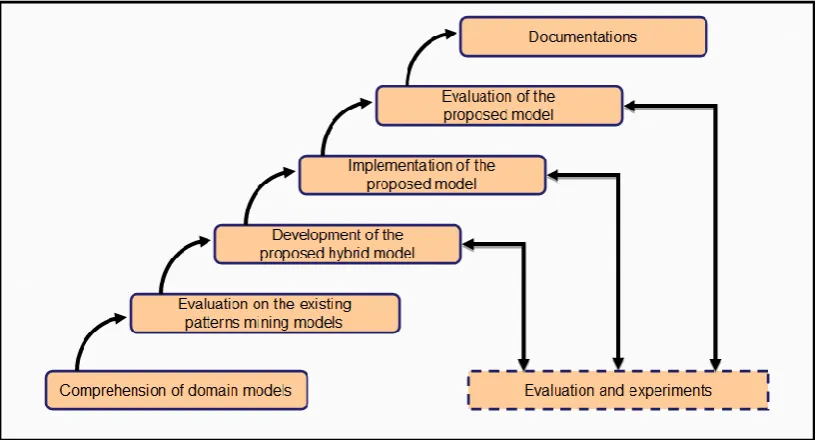
[image:40.595.115.523.451.671.2]Research methodology defines what the activity of research is, how to proceed, how to measure progress, and what constitutes success. Therefore, several organized stages, purposes, processes and outcomes are precisely and clearly outlined. Figure 1.1 depicts the incremental development paradigm of research methodology process.
7
1.5.1 Comprehension of Domain Models
(i) Purpose: Discovering the related domain models for significant patterns mining models such as Frequent Association Rules (FAR), Least Association Rules (LAR) and Significant Least Association Rules (SLAR).
(ii) Process: Reviewing the research papers and relevant documentations from journals, proceeding, thesis and books.
(iii) Outcome: Completion of literature review chapter 1.5.2 Evaluation of Existing Patterns Mining Models
(i) Purpose: Deep understanding of the current data structures and algorithms for significant pattern mining models.
(ii) Process: Implementing the selected data structures and algorithms for comparison purposes in the future.
(iii) Outcome: Completion of introduction and literature review chapters, experimental results and a framework for future works.
1.5.3 Development of the purposed hybrid model
(i) Purpose: First, designing new models for different categories of significant patterns mining models. Second, designing a hybrid model by integrating all models. Third, fine-tuning and embedding the elements of efficiencies and significances.
(ii) Process: Designing new models and a hybrid model which containing the components of efficient algorithms, flexible data structures and novel measures.
(iii) Outcome: First, the completion of the proposed prototype which consist of the efficient frequent pattern model, efficient least pattern mining model and significant least pattern mining model. Second, completion of compiling all artifacts in the proposed models into methodology chapter.
1.5.4 Implementation of the proposed hybrid model
(i) Purpose: Implementing the proposed hybrid model in the prototype and ensuring workability.
(iii) Outcome: Completion of the workable prototype to mine different category of the significant patterns.
1.5.5 Evaluation of the proposed hybrid model
(i) Purpose: Comparing the performance of the proposed models with other models in term of the efficiencies and significances.
(ii) Process: First, evaluating the efficiency of the algorithms and data structures in the proposed models against the algorithms and data structures in the benchmarked models, respectively. Second, analyzing the significances of the generated patterns based on the proposed measures against the other standard measures.
(iii) Outcome: First, the completion of the result and discussion chapter based on the experiments. Second, completion of abstract and conclusion chapters which derived from the findings.
1.5.6 Documentation
(i) Purpose: Documenting all the research artifacts into proper research articles and thesis.
(ii) Process: First, writing conference proceedings and journal papers to prove the novelty of the research efforts. Second, compiling research artifacts into a conclusion chapter.
(iii) Outcome: Completion of a thesis, conference proceedings, book chapters and journal papers.
1.6 Thesis Contribution and Organization
Specifically, this thesis makes fives (5) contributions in the field of data mining as follows:
9
current models, Hy-DSP also introduced a new algorithm called Least Trie Transformation Technique Algorithm (LT3A) for integration purposes. In Hy-DSP, three categories of significant patterns based on the specific requirement of the application domains can be easily produced. Experiments with the FIMI datasets showed that Hy-DSP which consist of a new Disorder Support Trie Itemset (DOSTrieIT) data structure and enhanced LP-Growth algorithm (LP-Growth*) outperformed the benchmarked CanTree data structure and FP-Growth algorithm up to 4.13 times (75.78%) and 10.31% times (90.31%), respectively, thus verify its efficiencies.
(ii) EFP-M2 introduces the DOSTrieIT data structure. In this model, the construction of FP-Tree totally relies on the flexibility of DOSTrieIT in handling the updatable database. EFP-M2 is different from typical construction of FP-Tree which is wholly depending on the main source of the original database. A new technique called Trie Transformation Technique (T3) is also employed to transform the data from DOSTrieIT into FP-Tree. Moreover, two new algorithms are directly involved in this model namely Fast Online Trie Algorithm (FOLTA), T3 Algorithm (T3A) and enhanced FP-Growth algorithm (FP-Growth*). The frequent pattern that has been extracted from EFP-M2 is known as FAR and classified as significant pattern. Experiments with the FIMI datasets showed that FP-Growth* algorithm is on average faster at 7,947.27 times (99.34%) than FP-Growth in generating the frequent pattern.
LP-(iv) SLP-M2 efficiently constructs and mine significant least patterns from its original database. This model also employs the pervious LP-Tree data structure and previous algorithms namely T3A, LP-TA and LP-Growth. Two extra measures called Critical Relative Support (CRS) and Weighted Support ARs (WSAR*) are introduced in this model. These measures are then applied to the least patterns in an attempt to prune and finally mine the rules that are really significant. The least pattern that satisfies the threshold value from the respective measures is known as SLAR and classified as significant pattern. Experiments with the three real datasets showed that, the average number of SLAR produced by our proposed measures is still lowest as compared to the other standard measures.
(v) Hybrid Framework for Discovering Significant Patterns (Hyf-DSP). This framework is based on the simplification of Hy-DSP. In comparative studies, an asterisk (*) is only added at end of LP-Growth (becomes LP-Growth*) if the data source is referred to DOSTrieIT.
11
CHAPTER 2
LITERATURE REVIEW
In this section, the basic concepts and related works including KDD, data mining, significant patterns, trie data structure, pattern measures, ARs mining, ARs, frequent pattern algorithms, significant pattern algorithms, FP-Tree, CATS-Tree, Can-Tree, correlation analysis, multiple supports, relative Support, weighted ARs and weighted support ARs are discussed in details.
2.1 Knowledge Discovery in Database
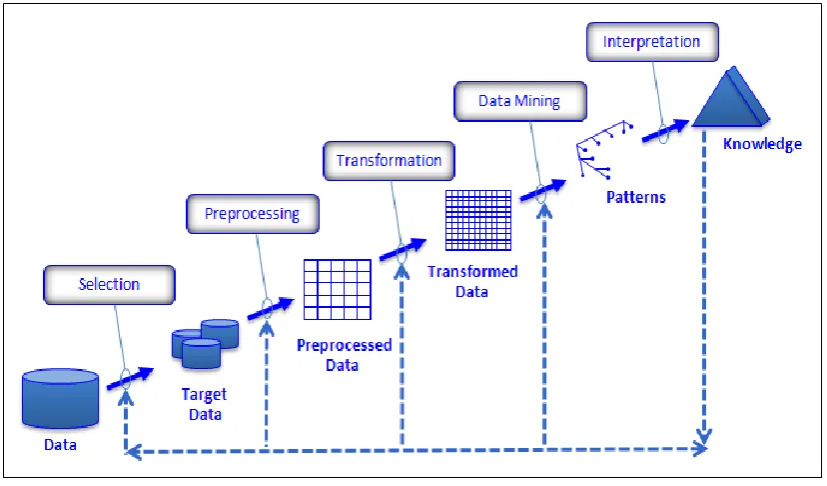
Figure 2.1: An Overview Process of KDD (Fayyad et al., 1996)
The focus of the first step in KDD is to understand the domain applications, the prior knowledge and general goal of knowledge discovery. A statement on what to be accomplished is clearly defined. The second step is to select the dataset with appropriate number of attributes for further exploration. It may consist of human experts or KDD tools to help in analyzing the initial data. The third step is to ensure data is valid by removing the outliers or noisy data (data cleaning). It is important to decide the best strategy on how to do about the missing data value. The fourth step is to select the suitable algorithm and technique for data transformation. Some attributes and instance are added or removed from the target data. The fifth step is to present the best model of mined patterns by applying certain data mining algorithms. The sixth step is to examine the model and determine whether it is useful and interesting. It is possible to repeat the previous steps to refine the model.
2.2 Data Mining
13
potentially useful, and ultimately comprehensible knowledge from database” to assist
in the decision making process (Fayyad et al., 1996). Data mining techniques are employed to find novel, unknown and useful patterns. It also provides the functionality to predict the future result. Not all of the information discovery tasks are classified as data mining. For example, searching records from the database management system (DBMS) or Internet are the tasks related to information retrieval (IR) area. Undeniable, data mining techniques have been deployed to enhance the ability of information retrieval systems. As mentioned earlier, data mining is part of the KDD process model which transforms the input data into meaning information. These input data can be stored in various formats such as in flat files, spreadsheets, XML, relational tables, etc. Because of the multi-formats and outliers usually occurred in raw data, data pre-processing steps is perhaps the most tedious and time-consuming in the overall KDD process model.
Data mining task can be divided into 2 general categories. The first one is a predictive task. The main objective of this category is to predict the value of the desired attribute by giving the values of others attributes. The desired attribute to be predicted is normally known as targeted (dependent) variable and attributes used in the prediction are commonly known as explanatory (independent) variables. The second part is a descriptive task. The main objective here is to generate patterns based on the relationship between the values of attributes. Usually, this part is always required further exploration and additional post-processing techniques in explaining the obtained results.
2.3 Significant Patterns
Significant patterns (Webb, 2007) can be defined as a set of extracting patterns from data repositories that are potentially very useful and meaningful for certain applications. During the mining processes, certain threshold values will be employed as a filtering mechanism to extract these patterns. Any pattern that fails to satisfy the user-defined thresholds are pruned out and considered as not important or insignificant. Typically, the significances of these patterns highly depend on the problems that need to be resolved. In other words, it is closely related to domain-specific applications. Therefore, for more domain-specific classification, the significant patterns can be divided into three core categories; frequent pattern, least pattern and significant least pattern.
Frequent pattern was first introduced by Agrawal (1993) to mine the ARs between items and also known as market basket analysis. Besides ARs, it also reveals the strong rules, correlation, sequential rules, causality, and many other important discoveries. There are two important reasons of finding frequent patterns from data repositories. First, frequent patterns can effectively summarize the underlying datasets, and provide new information about the data. These patterns can help the domain experts to discover new knowledge hiding in the data. Second, frequent pattern serves as the basic input for others data mining tasks including association rule mining, classification, clustering, and change detection, etc. (Huan et al., 2004; Inokuchi et al., 2000; Jin & Agrawal, 2006; Zaki et al., 2003). In the real
world, mining the frequent itemset may involve with the massive datasets and highly pattern dimensions. Therefore, minimizing the computational cost and ensuring the high efficiency in mining activities is very important. Hence, numerous strategies and improvement of data structures have been put forward until this recent.
15
At the moment, many series of ARs mining algorithms are using the minimum supports-confidence measure to limit the number of ARs. As a result, by increasing or decreasing the minimum support (MinSupp) or confidence (MinConf) values, the interesting rules might be missing or untraceable. The extraction of least patterns is very challenging for the data mining algorithm (Weiss, 2004). In fact, the standard frequent pattern mining algorithms are inefficient at capturing the least patterns (Koh et al., 2007; Adda et al., 2007; Selvi et al., 2009; Szathmary et al., 2010). Since the
complexity of the study, difficulties in the algorithms (Yun et al., 2003) and it may require excessive computational cost, there are very limited attentions have been paid to discover the significant least patterns. Therefore, designing the new and specific algorithm is undeniable very important to specifically deal with least patterns (Szathmary et al., 2010).
In some cases, the least and frequent patterns are not really the interested patterns. The main limitation of the previous two categories of patterns is all items in the transaction are assumed to hold an equal weight (1 or 0). However, in certain domain applications, the items might hold their own weight to represent the importance of the items such as the price, profit margin, quantity etc. Therefore, least patterns with weighted items or also known as significant least pattern is considered as more interesting and useful. The use of weighted items can lead into prioritize the patterns according to their importance rather than typical support and confidence measures (Ibrahim & Chandran, 2011). Among the popular studies in this area are Multiple Support Apriori Algorithm (Liu et al., 1999), Relative Support Apriori Algorithm (Yun et al., 2003), Weighted Association Rules (Cai et al., 1998) and Weighted Association Rule Mining (Tao et al., 2003). However, the process of mining significant least pattern is also very challenging (Khan et al., 2008) and facing the similar difficulties as the least pattern.
2.4 Trie Data Structure
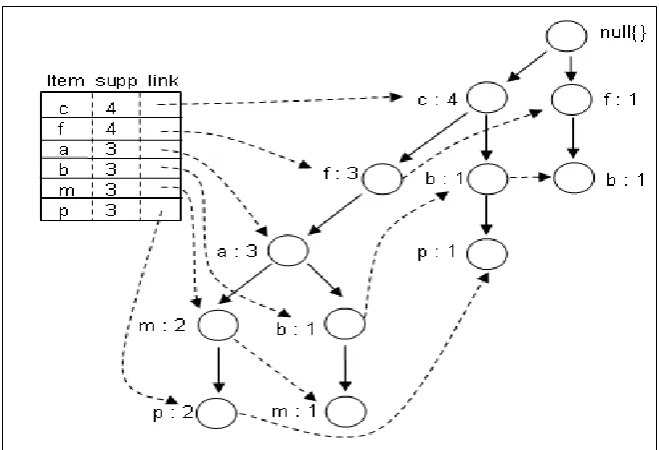
prefix sub-trees, it has three fields: item-name, support and node-link. Item-names is the name of items which represented by this node, support is the frequency of this item in the portion of the path that reaching this node, and node-link links to the next node carrying the same item-name or null if there is no node. Besides the root node, other nodes have exactly only one parent. It is possible to reach any node by following a unique path of arcs from the root. If arcs are considered as bidirectional, there is a unique path between any two nodes.
2.5 Pattern Measures
The support-confidence framework is the most commonly used measure in identifying, and consequently defining the strength of ARs. Support is the number of occurrences of some set of attributes (itemsets) in a dataset. It also refers to support count. Confidence is to show the support for an AR in a rule set, which is the level of "confident" of a rule. However, it has many limitations and not really good in determining the desired patterns (Brin, 1997). Hence, several interestingness measures have been proposed (Tan et al., 2006; Wu et al., 2010) in the literature to mine the preferred patterns. The challenges are, selecting an appropriate measure is quite troublesome and not straight forward. As a result, Tan (2006) proposed the best approaches for selecting the desired measures based on their list of key properties. These mappings exercise help in identifying which measure that can be the most appropriate for the respective domain applications.
17
2.6 Association Rules Mining
Association Rules (ARs) mining is one of the most important and well researched techniques of data mining. It was first introduced in (Agrawal, et al., 1993). Until today, mining of ARs has been extensively studied in the literature (Hipp et al., 2000). It aims at discovering correlations, frequent patterns, associations or casual structures among sets of items in the transaction databases or other data repositories. (Zhao et al., 2010). Association is a rule, which implies certain association relationships among a set of objects such as occur together or one implies the other (Tan et al., 2006). Its main goal is to find associations among items from transactional database.
ARs mining can find an interesting association or correlation relationships among a large set of data items (Han & Kamber, 2001). Usually, ARs are considered to be interesting if they satisfy both a MinSupp threshold and a MinConf threshold. The most common approach to finding ARs is to break up the problem into two parts (Dunham, 2003):
(i) Find all frequent itemsets: By definition, each of these itemsets will occur at least as frequently as a pre-determined MinSupp count (Han and Kamber, 2001).
(ii) Generate strong ARs from the frequent itemsets: By definition, these rules must satisfy MinSupp and MinConf (Han & Kamber, 2001).
2.7 Association Rules