International Journal of Emerging Technology and Advanced Engineering
Website: www.ijetae.com (ISSN 2250-2459,ISO 9001:2008 Certified Journal, Volume 4, Issue 8, August 2014)
711
Optical Character Recognition using Neural Network
Surabhi Varshney
1, Rashmi Chaurasiya
2, Yogesh Tayal
3Department of Electronics and Instrumentation Engineering, ITM University, Gwalior, M.P., India
Abstract— Optical character recognition is one of the most challenging problems in pattern recognition. It is a complex challenge because there are lots of variations in a handwritten character and different person have different handwriting. This paper implements neural network based character recognition system using multi layered feed forward neural network. Different training algorithms have implemented and the performance of these algorithms is compared. Error-back propagation algorithm is used to train the multi layered feed forward neural network. Gradient descent training and Levenberg-Marquardt algorithm based training is also used in error back propagation algorithm
Keywords— Optical character recognition, Levenberg-Marquardt algorithm, gradient descent algorithm
I. INTRODUCTION
Artificial intelligence enables machines the human like abilities and human aptitude based intelligence, it has remained one of the most challenging areas in last few decades. Giving machine the power to see, interpret and the ability to read text is one of the major tasks of AI. A lot of work has been done in this field, but still the problem is not solved in its full complexity. A good text recognizer has many commercial and practical applications, e.g. from searching data in scanned book to automation of any organization, like post office, which involve manual task of interpreting text. The problem of text recognition has been attempted by many different approaches. Template matching is one of the simplest approaches. In this many templates of each word are maintained for an input image, error or difference with each template is computed. The symbol corresponding to minimum error is output. The technique works effectively for recognition of standard fonts, but gives poor performance with hand written characters. Feature extraction is another approach, in which statistical distribution of points is analysed and orthogonal properties extracted. For each symbol a feature vector is calculated and stored in database. And recognition is done by finding distance of feature vector of input image to that of stored in the database, and outputting the symbol with minimum deviation. Though this technique gives lot better results on handwritten characters ,but is very sensitive to noise and edge thickness.
Features extracted in last approach tend to be very mathematical (most of them are results of some transforms etc) and mostly cannot be interpreted by simple logic. In geometric approach, on the other hand, attempt is made to extract features that are quite explicit and can be very easily interpreted. These features depend on physical properties, such as number of joints, relative positions, number of end points, length to width ratio etc. Classes forced on basis of these geometric features are quite distinct with not much overlapping. The main drawback of this approach however is that this approach depends heavily on the character set, Hindi alphabets or English alphabets or Numbers etc. Features extracted for one set are very unlikely to work for other character set. In contrast to this, neural networks offer complete independence of recognition process and character set. In this neural network is first trained by multiple sample images of each alphabet. Then in recognition process, the input image is directly given to neural network and recognized symbol is outputted.
The advantage of neural networks is lies in the domain of the character set that can be very easily extended; one just needs to train the network over new set. Another advantage is that neural networks are very robust to noise. The disadvantage is that a lot of training is required which is very time consuming .None of the above approaches thus used in their pure form yields good result on handwritten text. So generally hybrid approaches are taken to achieve desired recognition rates. Although even best of the recognition approaches are able to recognize all those texts that human can. Major reason for this has been wide variation in writing practices and styles of different people and lot of context based information that human brain uses to interpret any text sample.
This paper presents neural network based optical character recognition system. Multi-layer feed forward neural network with back propagation training algorithm is implemented. Gradient descent algorithm and Levenberg-Marquardt algorithm are used and the results are compared.
International Journal of Emerging Technology and Advanced Engineering
Website: www.ijetae.com (ISSN 2250-2459,ISO 9001:2008 Certified Journal, Volume 4, Issue 8, August 2014)
712 II. CHARACTER RECOGNITION
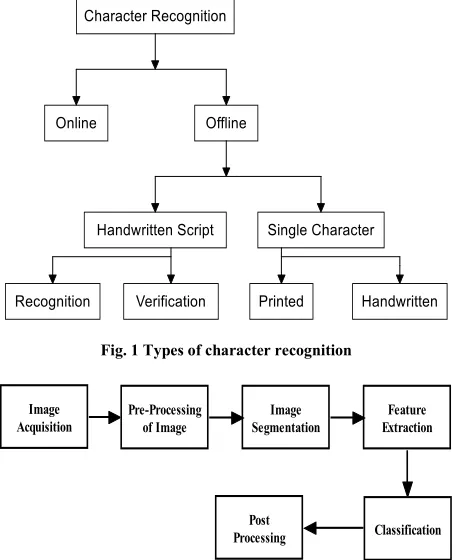
[image:2.612.381.508.188.276.2]Some approaches take a holistic approach, recognizing entire words, while others focus more on recognizing individual characters. Holistic approaches incur more computational cost since there are more models, but have more expressive and discriminative power since the visual cues are gathered over large areas. Fig. 1 shows the classification of character recognition techniques. Basically the character recognition can be done using online and offline methods. Fig. 2 show different steps of character recognition.
Fig. 1 Types of character recognition
Image Acquisition
Pre-Processing of Image
Image Segmentation
Feature Extraction
Classification Post
Processing
Fig. 2 Steps of character recognition
In optical character recognition, the alphabets are coded in 0’s and 1’s. A 6x6 matrix of 0’s and 1’s are used to represent each and every alphabet. The alphabet A is symbolized as follows
0 0 0 1 0 0 0 0 1 0 1 0 0 1 0 0 0 1 0 1 1 1 1 1 0 1 0 0 0 1 0 1 0 0 0 1
A
III. ARTIFICAL NEURAL NETWORK
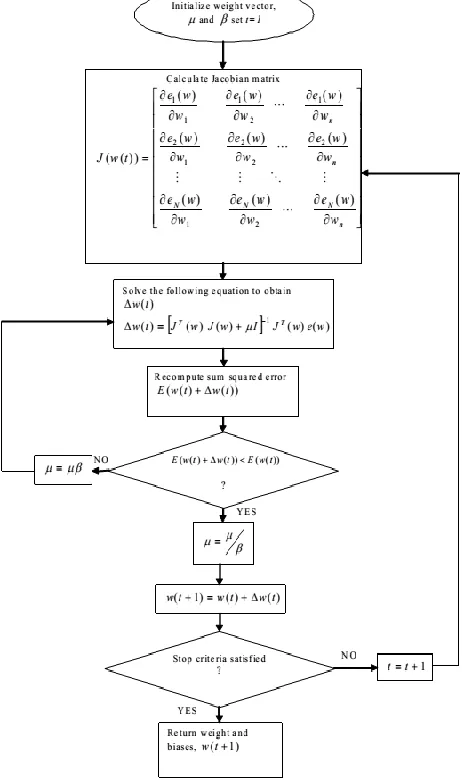
[image:2.612.55.286.277.557.2]This section describes the basics of artificial neural network and different training algorithms of multi layered feed forward neural network. Fig. 3 shows the basic topology of neural network which has an input layer, a hidden layer and an output layer. Fig. 4 shows the flow chart of error-back propagation algorithm. Fig. 5 shows the flow chart of LM method.
Fig. 3 Basic topology of neural network
[image:2.612.330.563.397.541.2]International Journal of Emerging Technology and Advanced Engineering
Website: www.ijetae.com (ISSN 2250-2459,ISO 9001:2008 Certified Journal, Volume 4, Issue 8, August 2014)
[image:3.612.332.563.148.538.2]713
Fig. 4 Flow chart of error back propagation
Levenberg-Marquardt Algorithm
The Levenberg-Marquardt (LM) algorithm is an approximation to the Newton method that is also used for training NNs. The Newton method approximates the error of the network with a second order expression, which contrasts to the LM is popular in the NN domain, although it is not that popular in the meta-heuristics field. LM updates the NN weights as follows
1
T T
w
J
w J w
I
J
w e w
[image:3.612.55.282.150.442.2]The flow chart of LM method is shown below.
Fig. 5 Flow chart of LM method
IV. RESULTS
International Journal of Emerging Technology and Advanced Engineering
Website: www.ijetae.com (ISSN 2250-2459,ISO 9001:2008 Certified Journal, Volume 4, Issue 8, August 2014)
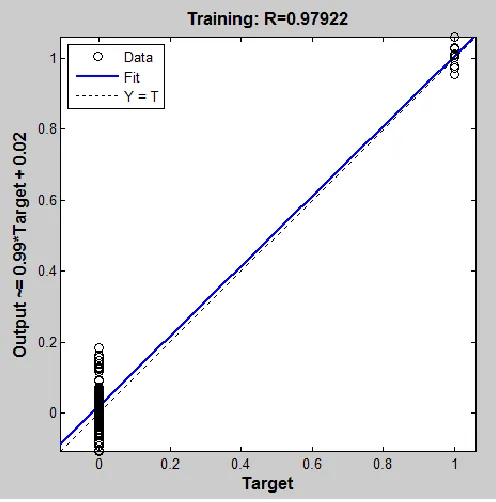
[image:4.612.325.575.136.393.2]714 Fig. 9 shows the error v/s epoch graph of LM method and Fig. 10 shows the regression plot for LM method.
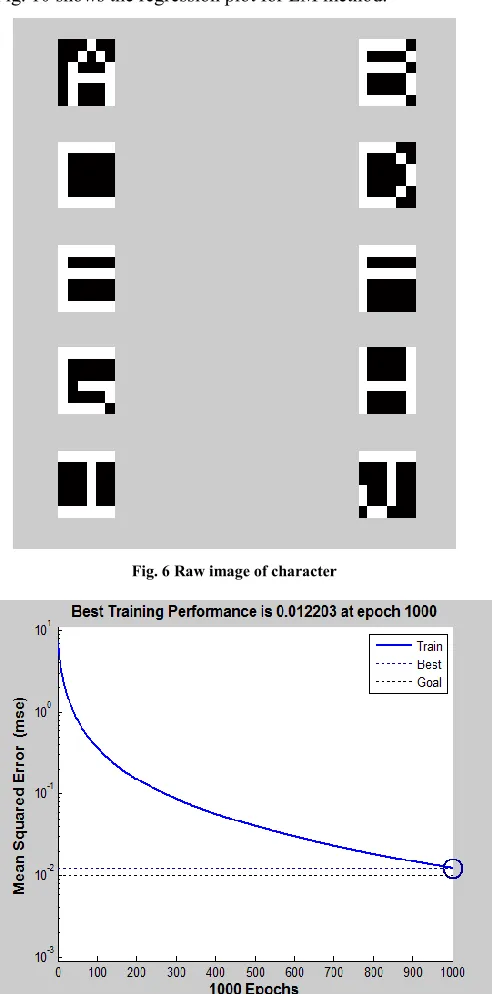
Fig. 6 Raw image of character
Fig. 7 Error v/s epoch graph for gradient descent
[image:4.612.51.297.155.652.2]Fig. 8 Regression graph for gradient descent
[image:4.612.324.573.406.618.2]International Journal of Emerging Technology and Advanced Engineering
Website: www.ijetae.com (ISSN 2250-2459,ISO 9001:2008 Certified Journal, Volume 4, Issue 8, August 2014)
[image:5.612.50.298.137.388.2]715
Fig. 10 Regression in classification for LM method
Table 1 Classification Results
Character tested Regression Accuracy (%)
1 A 0.944 100 2 B 0.972 100 3 C 0.947 100 4 D 0.841 100 5 E 0.891 100 6 F 0.897 100 7 G 0.874 100 8 H 0.877 100 9 I 0.954 100 10 J 0.978 100
100% (Avg)
Table I shows the classification accuracy of optical character recognition technique.
V. CONCLUSIONS
This paper implements neural network based optical character recognition system. The paper uses two training algorithms such as gradient descent and LM method. The classification accuracy of the results is also provided. Neural network based OCR finds wide spread application in various disciplines such as handwriting recognition, banking system and fraud detection system.
As future scope different neural network topologies such as recurrent neural network, probabilistic neural network can be used for OCR.
REFERENCES
[1] Y. Fujisawa, Meng Shi, T. Wakabayashi and F. Kiruma, “Handwritten numerical recognition using gradient and curvature of gray scale image,” in Proc. 5th Int. Conf. Document Analysis and
Recognition, pp. 277-280, 1999.
[2] U. Pal and B B Chaudhuri, “Indian script character recognition: a survey,” Pattern Recognition, 37 (9), 2004, pp. 1887-1899. [3] Y. Hamamoto, S. Uchimura, S. Tomia, “On the behavior of artificial
neural network classifiers in high dimensional spaces,” IEEE Transactions Pattern Analysis and Machine Intelligence, 18, 5, pp. 571-574, 1996
[4] Rafel. C. Gonzalez and Richard E. Woods, Digital image processing, 3rd Ed, Prentice Hall, 2006
[5] Yogesh Tayal, Ruchika Lamba, Subhransu Padhee, “Automatic face detection using color based segmentation,” International Journal of Scientific and Research Publication, vol. 2, no. 6, 2012, pp.1-7. [6] Badi, m. Boutalline and s. Safi, “The Neural Networks: Application
and Optimization Application Of Levenberg-Marquardt Algorithm For Tifinagh Character Recognition”, International Journal of Science, Environment and Technology, Vol. 2, No 5, 2013, 779 – 786, ISSN 2278-3687 (O).
[7] Batsukh Batbayar and Xinghuo yu, “An Improved Levenberg-Marquardt Learning Algorithm for Neural Networks Based on Terminal Attractors”, 1-4244-2386-6/08/$20.00 ©2008 IEEE. [8] Gaganjot kaur and monika aggarwal, “Artificial Intelligent System
For Character Recognition Using Levenberg-Marquardt Algorithm” ,International Journal Of Advanced Research In Computer Science And Software Engineering , Volume 2, Issue 5, May 2012, ISSN: 2277 128x.
[9] Suruchi G. Dedgaonkar, Anjali A. Chandavale and Ashok M. Sapkal, “Survey of Methods for Character Recognition”, International Journal of Engineering and Innovative Technology (IJEIT) Volume 1, Issue 5, May 2012, ISSN: 2277-3754.