Georgia State University Georgia State University
ScholarWorks @ Georgia State University
ScholarWorks @ Georgia State University
Gerontology Theses Gerontology Institute
Summer 8-7-2012
Exploring the Influence of Functional Status on Older Adults'
Exploring the Influence of Functional Status on Older Adults'
Social Relationships in Assisted Living Communities
Social Relationships in Assisted Living Communities
Navtej K. Sandhu Georgia State University
Follow this and additional works at: https://scholarworks.gsu.edu/gerontology_theses
Recommended Citation Recommended Citation
Sandhu, Navtej K., "Exploring the Influence of Functional Status on Older Adults' Social Relationships in Assisted Living Communities." Thesis, Georgia State University, 2012.
https://scholarworks.gsu.edu/gerontology_theses/31
EXPLORING THE INFLUENCE OF FUNCTIONAL STATUS ON OLDER ADULTS’ SOCIAL
RELATIONSHIPS IN ASSISTED LIVING COMMUNITIES
by
NAVTEJ SANDHU
Under the Direction of Candace Kemp
ABSTRACT
Social relationships can have considerable influence on physical and mental well-being. AL
re-search suggests that other residents are among the most available social contacts and that co-resident
rela-tionships can affect life satisfaction, quality of life, and well-being. Although functional status influences
social relationships, research has yet to provide an in-depth understanding of how cognitive and physical
function affects co-resident relationships in AL. In this thesis, I present an analysis of qualitative data
col-lected over a one-year period in two diverse settings. The thesis addressed: 1) How does functional status
influence co-resident relationships? ; and 2) What factors shape its influence? Analysis was guided by
principles of Grounded Theory Method. Coming together and pulling apart signifies the key finding that
functional status is multi-directional, fluid, and operates in different ways in various situations and across
time. Facility and resident –level factors further affect the influence of functional status on co-resident
relationships.
EXPLORING THE INFLUENCE OF FUNCTIONAL STATUS ON OLDER ADULTS’ SOCIAL
RELATIONSHIPS IN ASSISTED LIVING COMMUNITIES
by
NAVTEJ SANDHU
A Thesis Submitted in Partial Fulfillment of the Requirements for the Degree of
Master of Arts
in the College of Arts and Sciences
Georgia State University
Copyright by Navtej Kaur Sandhu
EXPLORING THE INFLUENCE OF FUNCTIONAL STATUS ON OLDER ADULTS’ SOCIAL
RELATIONSHIPS IN ASSISTED LIVING COMMUNITIES
by
NAVTEJ SANDHU
Committee Chair: Candace Kemp
Committee: Mary Ball
Elisabeth Burgess
Electronic Version Approved:
Office of Graduate Studies
College of Arts and Sciences
Georgia State University
iv
DEDICATION
This Thesis is dedicated to my brother, my parents, my husband, and my in- laws who supported
v
ACKNOWLEDGEMENTS
I would like to offer sincere thanks to my Thesis Advisor, Dr. Candace Kemp who helped me
throughout my thesis work. It is just because of her enormous support and encouragement that I am able
to make it. I am glad that I got a chance to work as a Graduate Research Assistant under her mentorship
and I developed interest in qualitative analysis from the point I started working with her on data analysis.
This growing interest in qualitative analysis leads me to choose and complete this thesis. I would also like
to thank my thesis committee members, Dr. Mary Ball and Dr. Elisabeth Burgess who also helped me a
lot throughout my thesis work by suggesting good ways to approach it. I am grateful to other faculty
members, Dr. Ann Pearman, Dr. Heying J. Zhan, Dr. Tai Wang, and Dr. Ralph LaRosaa who helped me
vi
TABLE OF CONTENTS
ACKNOWLEDGEMENTS ... v
LIST OF TABLES ... vii
LIST OF FIGURES ... viii
CHAPTER ONE INTRODUCTION ... 1
CHAPTER TWO LITERATURE REVIEW ... 5
CHAPTER THREE METHODS... 27
CHAPTER FOUR FINDINGS COMING TOGETHER AND PULLING APART: THE INFLUENCE OF FUNCTIONAL STATUS ON CO-RESIDENT RELATIONSHIPS IN AL ... 36
CHAPTER FIVE FINDINGS FACTORS SHAPING THE INFLUENCE OF FUNCTIONAL STATUS ON CO-RESIDENT INTERACTIONS AND RELATIONSHIPS ... 62
CHAPTER SIX DISCUSSION ... 80
vii
LIST OF TABLES
Table 1. Select characteristics by home ... 29
viii
LIST OF FIGURES
1
CHAPTER ONE
INTRODUCTION
Statement of the problem
The population of older adults in United States is aging very rapidly, and it is expected that by
2030 the population of people above the age of 65 will rise to 70 million from the total of 40,267, 984 as
measured in 2010 (Hooyman & Kiyak, 2002; U.S. Census, 2010). With the changing aging trends, the
health of aging people is also changing in comparison to previous cohorts. The present cohorts are said to
be healthier than the previous ones (Crimmins et al., 2009; Hooyman & Kiyak, 2002). As life expectancy
is increasing, the chances of becoming disabled are decreasing and also are being delayed, but not
elimi-nated.
The aging of the population and increasing life expectancy means increasing numbers of
individ-uals with functional limitations. People aged 65 years and above are more inclined to develop functional
disability (Lewis & Bottomley, 2008). According to the Profile of Older Americans (2010), in the year
2009, 37% of those 65 and over reported having some type of disability. There are various age related
disorders that influences the life of older adults by making them functionally impaired. Hypertension,
ar-thritic symptoms, coronary heart disease, diabetes, cancer, and stroke are highly prevalent in the
popula-tion of older adults (Lewis & Bottomley, 2008). Apart from these condipopula-tions, there are other age-related
conditions seen in older adults that make them functionally impaired, including hearing and visual im-pairments, Parkinson’s disease, pulmonary disorders like Pneumonia and Chronic obstructive lung
dis-ease, osteoporosis and hip fractures, Alzheimer’s disdis-ease, dementias, swallowing disorders, renal failure,
and incontinence (Lewis & Bottomley, 2008). Assistive devices like canes, wheelchairs, higher
com-modes, indwelling catheters, and bath chairs can be used to compensate for impairments in terms of
cer-2
tain ADLs, like eating and dressing, assistive devices are not yet well developed or highly accepted
(Al-bert, 2004).
When people with disabilities reach the point when they are unable to carry out ADLs and/or live
independently, they sometimes require and draw on formal long term care (LTC) services, including
resi-dential care. Assisted living (AL) is a LTC setting that caters mainly to older adults who can no longer
live independently in their own home; it provides watchful oversight, assistance with ADLs, and certain
instrumental activities of daily living (IADLs) (e.g., medication management, meal preparation, and
household cleaning) (Ball et al., 2000; Burdick et al., 2005). In the United States, nearly one million
indi-viduals reside in AL settings and the number is expected to grow in the coming years (Golant, 2008). The
typical AL resident is a woman, 86 years old, who requires assistance in approximately two ADLs
(Na-tional Center on AL, 2011), and very few have a partner or spouse (Kemp, 2008). Estimates of the preva-lence of Alzheimer’s disease and other types of dementia among AL residents range from 50% (Ball et
al., 2010) to nearly 68% (Leroi et al., 2006). According to Roadman (2001), the prevalence of medical
conditions found in AL residents in descending order is: bladder incontinence, heart disease, bowel incon-tinence, osteoporosis, diabetes, stroke, Parkinson’s disease, cancer, multiple sclerosis, and pressure ulcers.
Many elders relocate to AL because they are functionally impaired, but some relocate to reduce
social isolation (Ball, Perkins, Whittington, Hollingsworth, King, & Combs, 2005). When older adults
move to AL, many maintain pre-existing social relationships with family, friends, and neighbors
(Yamaski & Sharf, 2011), and some form new, sometimes meaningful, relationships with others (Ball et
al., 2005). Generally, residents have three main types of social relationships, including those with: (a)
friends and family outside AL; (b) co-residents; and (c) paid caregivers (Ball et al., 2000; Burge & Street,
2010). Family connections are very important for residents but, for the majority, family members are not
available daily (Ball et al., 2000; 2005). Relationships with staff also carry importance (Ball et al., 2005;
2009), but quite often staff members do not have adequate time to socialize with residents beyond their
rela-3
tionships with other residents in AL can be of considerable importance in their lives and are predictors of
life satisfaction (Park, 2009) and quality of life (Ball et al., 2000; 2005).
Research on co-resident relationships in AL is limited somewhat, but recent qualitative research
by Kemp, Ball, Perkins, & Hollingsworth (2012) indicates that co-resident relationships in AL can range
from strangers to friends and include enemies and romantic type relationships with each resident
experi-encing unique social careers (i.e. their combined set of co-resident relationships and social trajectory in
AL). Kemp and colleagues (2012) identified a number of multi-level factors influencing co-resident
rela-tionships, including facility location and community connections, staff training and knowledge of
resi-dents, and resident tenure, gender, marital status and family involvement. Cognitive and physical function
is also known to significantly affect social relationships (Iechovich & Ran, 2006). Kemp et al.’s (2012) analysis confirmed that residents’ functional status is one of the major individual-level factors influencing
social relationships in AL. Functional impairment acted as a double-edged sword. It created interactions
by means of help given to those with greater impairment from comparatively less impaired residents, but
it also hindered interactions and therefore relationships because of frequent medical appointments, pain,
incontinence, decreased mobility, speech and hearing impairments, depression, dementia, and other
com-munication barriers. Other researchers note that stigma often is attached to physical and cognitive
im-pairments in AL, which further impedes relationships among residents of varying functional abilities
(Dobbs et al., 2008; Perkins, Ball, Whittington, & Hollingsworth, 2012).
Existing findings highlight the importance of co-resident relationships in AL and hint at the
com-plex influence of cognitive and functional status on social relationships. To date, however, research has
not provided an in-depth understanding of how functional status affects co-resident social connections or
the factors that shape the ways functional ability influences co-resident social relationships and
interac-tions in AL. This research builds upon and expands existing work during a time when AL is growing in
4
the past (Polivka, 2008). These patterns are expected to continue and heighten the importance of
under-standing how cognitive and physical function affects social relationships in this frail population of elders.
Research aims
The purpose of the proposed research is to explore the influence of physical and mental function on residents’ social experiences in AL with a focus on co-resident relationships. More specifically, my
aims are as follows:
Aim 1: To understand how functional status influences co-resident interactions and
rela-tionships; and
Aim 2: To identify the factors that shape how functional status affects social interactions
5
CHAPTER TWO
LITERATURE REVIEW
In this chapter, I review existing literature and establish the research context. This chapter is
di-vided into several subparts. I begin by reviewing literature related to functional status, disability and
ag-ing, formal LTC settings among disabled people, social relationships in later life and the interaction of
social relationship with health. Then, I discuss, social relationships in AL, factors influencing social
rela-tionships in AL, and functional status and its impact on social relarela-tionships in AL. I conclude by
articulat-ing my research aims and questions.
Functional status, disability, and aging
In Chapter 1, I noted that the population is rapidly aging and that the life expectancy is also
in-creasing. Given the connection between likelihood of disability and age, this situation means increasing
number of people with functional limitations. Statistics shows that 65% of the elderly above the age of 65
have difficulty in performing at least one of the ADLs (Vierck & Hodges, 2003, p. 50). This type of
im-pairment rises with age, with 59 % of people aged 65 to75 years and 74% of those aged 75 and over re-porting difficulties, respectively (Vierck & Hodges, 2003, p. 50). An individual’s “functional status”
(George, 1996) is a key factor influencing how people live their lives and interact with others. This term
relates to the ability to perform ADLs, which are necessary for self-care and living independently
(George, 1996). According to the World Health Organization (2011), “disability” is a general term which
further includes three things: impairments, activity limitations, and participation restrictions. Impairment
could be further defined as a problem in function and structure of the body; an activity limitation is a
dif-ficulty encountered by an individual in doing activities; while a participation restriction is a problem
ex-perienced by an individual in involvement in life situations. Verbrugge & Jette (1994, p. 1) define disabil-ity as “difficulty doing activities in any domain of life (from hygiene to hobbies, errands to sleep) due to a
6
ADLs and IADLs (Christensen, Doblhammer, Rau, & Vaupel, 2009; Crimmins et al., 2009). However, it
is still ambiguous and subjective when trying to quantify disability according to difficulty experienced by
individual in performing ADLs and IADLs (Berlau, Corrada, & Kawas, 2009).
Disability type
Cognitive disability is defined as, “significant limitation in thought processing, like
conceptualiz-ing, plannconceptualiz-ing, and sequencing thoughts and actions, rememberconceptualiz-ing, interpreting subtle social cues, and un-derstanding numbers and symbols”, and can result from all types of dementias, brain injury, stroke and
some mental illnesses (Braddock, Rizzolo, Thompson, & Bell, 2004, p.49). Physical disability is defined as “a condition where a person experiences significant deviation or loss in their body function or structure
that results in physical limitations in their physical activity that may affect their participation in life, de-pending on the context within which they live” (Taleporos & McCabe, 2005, p.638).
Both cognitive and physical disabilities can lead to functional disability, which occurs when there
are problems performing ADLs and IADLs and is associated with changes related to aging (Dunne,
Wrosch, & Miller, 2011). Chronic illness of any type, like hypertension, heart diseases, diabetes, cancer,
stroke, arthritis, lung diseases and neurological problems, leads to impairment, which further causes
disa-bility (Hung, Ross, Boockvar, & Siu, 2011). Women have higher life expectancy than men, which in part
increases their chances of being susceptible to a variety of chronic illnesses (Moody, 2010). Suffering
from chronic illness in old age contributes to functional disability (Robb, Small & Haley, 2008) and likely
is one reason why older women experience more disabilities and have a greater chance of suffering from
functional limitations than men (Freedman, Grafova, Schoeni, & Rogowski, 2008). The recent trend in
the United States shows that the prevalence of chronic diseases has increased over time but the prevalence
of impairments, except urinary incontinence, and disabilities have been stable over time. So despite the
increase in the prevalence of chronic illnesses, the prevalence rate of impairments and disabilities has
re-mained stable over time (Hung, Ross, Boockvar, & Siu, 2011). According to report, the State of Aging
7
above, the order of prevalence from highest to lowest is hypertension, arthritic symptoms, coronary heart
disease, cancer of any type, diabetes and stroke. Disease rates vary by gender, race and ethnicity.
Hypertension. Hypertension affects 46 % of older adults (Vierck & Hodges, 2003, 129). It is
al-so a risk factor of heart disease and cerebrovascular disease among older people. The prevalence of
hy-pertension varies among older people on the basis of age, race and gender (Vierck & Hodges, 2003, 129).
It occurs most commonly among older adults above the age of 65, blacks, and women. In the year
2000-2001, 65% of Black elders had hypertension in comparison to 49% Hispanics and 47% Whites (SAHA,
2007). Medication and lifestyle changes constitute common treatments for hypertension (Lewis &
Bot-tomley, 2008).
Arthritic symptoms. Arthritic symptoms (i.e. pain and stiffness) are seen among 46 % of the
el-derly population (Vierck & Hodges, 2003, p. 134). They are more prevalent among older adults,
com-pared to younger adults, women, and non-Hispanics (Vierck & Hodges, 2003, p. 134.) Pain medication
and use of assistive devices can enhance the quality of life among arthritis sufferers (Lewis & Bottomley,
2008).
Coronary heart disease. Coronary heart disease, including angina and heart attack, is seen in
21% of older adults (Vierck & Hodges, 2003, p. 134). It is most prevalent among older adults in
compari-son to younger people, men compared to women, and non-Hispanic whites compared to Hispanics
(Vierck & Hodges, 2003, p. 134).
Cancer. Cancer of any type, including breast, prostrate, lung, and colorectal is common among
older adults, and every year 59% of the reported cases of cancer are seen in older adults (Vierck &
Hodg-es, 2003, p. 140). Men are 1.7 times more prone to develop cancer than women (Vierck & HodgHodg-es, 2003,
p. 140). On the basis of race, white women are more prone to develop cancer than black women and men
(Vierck & Hodges, 2003, p. 140). After the age of 85, white women are more prone to develop cancer
than the white men (Vierck & Hodges, 2003, p. 140). Statistics shows that 22% of Whites had some form
8
Diabetes. Diabetes is seen in 1 out of 10 older adults and is also more common among elders
than the younger counterparts (Vierck & Hodges, 2003, p. 138). On the basis of race, it is more prevalent
among Hispanic blacks. Hispanics have two times more chances of developing diabetes than the
non-Hispanic whites (Vierck & Hodges, 2003, p. 138). Statistics shows Diabetes affects 25% of non-Hispanic
el-ders followed by 23% of Black and 14% of White elel-ders (SAHA, 2007).
Stroke. There are 250,000 to 300, 000 reported cases of stroke annually. Stroke mostly occurs in
later life, and 43% of the reported cases are in individuals age 74 and above (Lewis & Bottomley, 2008,
p. 292) and more common among men (Lewis & Bottomley, 2008, p. 292). Race-wise, stroke is more
prevalent in Blacks and Japanese Americans and geographically it is more prevalent in the southern
Unit-ed States (Lewis & Bottomley, 2008, p. 292). Stroke causes significant impairments and 40 % of stroke
patients report limitations in activities (Lewis & Bottomley, 2008, p. 292).
Apart from the above mentioned chronic conditions, hearing and vision impairments, Parkin-son’s disease, pulmonary disorders like pneumonia and chronic obstructive lung disease, osteoporosis,
Alzheimer’s disease, dementias, swallowing disorders like dysphagia, renal failure, and incontinence also
are common among older adults (Vierck & Hodges, 2003). According to the Alzheimer’s Association
(2011), Alzheimer’s disease is highly prevalent among those 65 and over. In the United States alone, 5.2
million people have the disease. Meanwhile, according to the American-Speech Language Association
(2006), there are over 31.5 million Americans suffering from some type of hearing loss and it is more
prevalent in men than women.
According to the Profile of Older Americans (AoA, 2010), 37% of older people reported having
some type of disability in 2009. There are 18.1 million people aged 65 or over who are disabled in the
United States (Brault, 2008). However, Berlau and colleagues (2009) report that the 90 and over age
group is one of the most rapidly increasing sections of the population in United States; occurrences of
9
In sum, the prevalence of disability increases with age. Disability in later life is common and can
cause problems for individuals and those who support them. Having a disability can compromise older adults’ independence, lead to relocation to formal LTC settings, and ultimately can affect their social
rela-tionships.
Older adults’ experiences with disability
The ways older adults perceive and hence experience their disability varies. According to a study
conducted by Moore, Schumacher, Kahana and Kahana (2006), older adults often perceive their
disabili-ties even with the same health status. The results from this study show that some older adults consider
themselves disabled and some do not. The way participants perceived their disability depends on many
factors, including social, physical, and personal influences. Visiting health care professionals, cessation of
driving, suffering from poor health because of chronic illnesses, functional and cognitive impairments,
significant decline in functional status over time, and anxiety about health are factors that define the older adult’s perceptions of his or her own disability. Some older adults in Moore et al’s study perceived
them-selves as disabled even if they were not functionally impaired. Their experience of suffering from multi-ple illnesses led to frequent doctors’ visits, greater numbers of medications, and somatic complaints,
which contributed to self-perceived disability. However, other older adults were less inclined to perceive
themselves as disabled even if they had functional limitations because they had greater social support.
The idea of perceiving oneself as disabled has further implications in one’s proclivity towards using
assis-tive devices, seeking health care, and engaging in safe practices. Presumably, such self-perceptions also
influence attitudes towards receiving assistance from others, including relocation to LTC settings, as well
as attitudes towards others in the setting.
Formal residential care settings for disabled older adults
Formal LTC is one option for people with disabilities when they reach to the point when they are
unable to carry out ADLs/ IADLs and/or live independently. Formal LTC can be provided at age
10
options such as family care or move because in-home services are either too expensive or unavailable
(Doherty & Kevin, 2002). Keysor, Desai and Mutran (1999) found that people with long-term disabilities
chose LTC settings as opposed to staying home because they did not want to ask for help repeatedly from
their social network.
Nursing homes and AL residences are two common residential LTC settings in the United States.
Nursing homes have existed since the 19th century (Brandy, Gillespie, Liese, & Farley, 2004). In recent
decades, AL has emerged as an alternative and is growing in popularity. Although there are new
move-ments afoot, nursing homes are based generally on a medical model, provide skilled care, and usually
bear some resemblance to hospitals (Brandy, Gillespie, Liese, & Farley, 2004). Individuals often are
shifted to nursing homes after hospitalization as they still require 24-hour watchful oversight and skilled
care.
Ideally, and in contrast, AL is based on a social model of care with home-like environments
(Brandy et al., 2004). While there is 24-hour oversight, the assistance given is non-medical and help is
provided with performing ADLs and certain IADLs (Ball et al., 2000). Typically, AL includes various
types of congregate settings that differ from each other in terms of size, service provision, regulation
standards, funding, and characteristics of residents (Polivka, 2008). Most states have different names and
regulations, but AL typically refers to congregate settings that provide 24-hour watchful oversight, meals,
and social activities, some kind of health care and housing (Polivka, 2008). According to AL regulations
and licensing (2012), in the state of Georgia, the number of residents per bedroom is limited to 4, and
in-dividuals requiring 24-hour nursing care typically are not admitted as residents. In most of the AL settings
in the United States, there are apartments or private rooms offered to residents, common dining areas and
places for social activities (Polivka, 2008). Polivka (2008, p. 29) summed up AL patterns nationwide
not-ing:
Although AL settings range considerably in size, presently two-thirds of AL residents
re-11
maining are attached with other types of settings like nursing homes, rehabilitation
cen-ters, board and care homes, independent living apartments and continuing care retirement
communities. About half of the AL settings are non- profit, and about half are for-profit;
very few are government run.
The cost of AL means that it is not accessible to many older adults. Base monthly fees in AL
set-tings can range from $ 1, 980- $4,700, with fees varying according to the geographic location, type of
accommodation, (i.e., private or shared), and number and type of services provided (Polivka, 2008).
As AL is based on a social model of care, according to Brandy and colleagues (2004), residents
tend to perceive their quality of life in these settings more positively than in nursing homes in terms of
their satisfaction with the environment and care staff, and they tend to have less depression and more
con-trol over their decisions related to their daily activities, care, and assistance. AL regulations regarding the
provision of autonomy, privacy, dignity and freedom of making choices can increase the quality of life of
the residents (Polivka, 2008). Generally, how residents perceive their quality of life in AL appears to
de-pend on various factors. For instance, the acceptance of state payments for low income residents by AL,
strong social relationships within the facility and more privacy tends to promote positive perception of
life (Street, Burge, Quadagno, & Barrett, 2007). In sum, AL is a LTC option that provides care, and, in
theory, helps residents maintain independence and autonomy and also provides a home-like environment
(Street et al., 2007), as well as opportunities for social relationships (Ball et al., 2005).
Social relationships
Social relationships can be defined as the recurrent patterns of interactions with others which are
dynamic in nature and can change over the life course (Antonucci, 1990). Social relation is an umbrella
term which further includes the terms social support, social networks, and social integration (Antonucci, 1990). Social support refers to, “the provision or receipt of something perceived to be needed by the
pro-vider, the recipient or both” (Antonucci, Birditt, & Akiyama, 2009, p. 248). Social networks are “the
integra-12 tion is defined as “the degree to which individuals have formal attachments to social structure” (George,
1996, p. 231). The social make-up of one’s network typically is dependent on personal factors, including
for example, gender, race, socioeconomic status, and age (Antonucci, 1985).
Research suggests that women have generally larger network than men and they receive more
so-cial support from others (Antonucci & Akiyama, 1987). Gender interacts with marital status as married
men mostly receive support from their wives (Antonucci & Akiyama, 1987). Research on racial
differ-ences suggests that no racial differdiffer-ences exist in network proximity (i.e., the geographic proximity of
members), but African Americans tend to have smaller networks formed of their families with more
con-tact frequency (Ajrouch, Blandon, & Antonucci, 2005). If we take socioeconomic status into account,
people of lower socioeconomic status have smaller networks compared to people of higher
socioeconom-ic status (Antonucci, 1985).
In terms of age, it is generally said that social network size decreases with advancing age (Aldwin
& Gilmer, 2004). Taking age into account, compared to younger adults, the networks of older people
typ-ically are smaller and made up mostly of family members (Ajrouch, Antonucci, & Janevic, 2001) and, to
a lesser extent, peer group members (Antonucci, Birditt, & Akiyama, 2009). Relationships with family
and peer group members carry different meanings in the lives of older people (Antonucci, 1990).
General-ly, family members often are more dominant in elders’ social networks but older adults usually prefer
friends for support (Antonucci, 1990). Older adults prefer to take support from their friends rather than
their family members because they feel less self-competent when they rely for support on their family
members (Siebert & Mutran, 1999). Friends tend to have a more positive effect on well-being than the
family (Antonucci, 1990), which makes understanding peer relationships, particularly in later life,
im-portant.
Social relationships, health, and aging
Social relationships are considered very important in late life because of their impact on the
13
and making emotional connections with people) tends to have many positive effects on health, including
decreased rates of mortality, higher levels of happiness and quality of life, reduction in the rate of
func-tional decline, reduced depression, and lower chances of suffering from cognitive impairment (Park,
2008; Luger et al., 2008). The association between social relationships and health has been theorized us-ing the “convoy model of social relations” (Kahn 1979; Antonucci, 1985; Antonucci, Birditt, & Akiyama,
2009). According to the convoy model, social relationships involve three major components: (1) social
networks; (2) social support; and (3) satisfaction with support. The social network is the backbone of
so-cial relationships which further provides the basis for assessing these relationships subjectively in terms
of perceptions and interpretations of support. Social support and satisfaction with support are the
subjec-tive aspects of social relationships.
Social relationships promote health by buffering stress and by promoting self-efficacy
(Anto-nucci, Birditt, & Akiyama, 2009). Social network composition and social support influence individual
health and well-being (Antonucci, Fuhrer, & Dartigues, 1997). A person’s network typei, which is
deter-mined by the configuration of network members and the distribution of family and friends, has an
influ-ence on their health, with those having restricted non-friends network types being associated with high
depressive symptomatology, while diverse network types are associated with low depressive
sympto-matology (Fiori, Antonucci, & Cortina, 2006; Fiori, Antonucci, & Akiyama, 2008). Social supportii has
such a remarkable influence that even anticipated social support can reduce the risk of functional
disabili-ties (Shaw & Janevic, 2004). This connection might be related to decreased depression in the presence of
anticipated social support or the sense of self efficacy in performing activities that further enhances
func-tioning (Shaw & Janevic, 2004).
Social relationships can further influence the chances of developing or recovering from a
disabil-ity (Leon, Glass, Beckett, Seeman, Evans, & Berkman, 1999). Leon and colleagues (1999) investigated
the influence of social ties on individual capability of developing disability and recovering from
de-14
veloping and recovering from disability. They also found that while social support in terms of emotional
and instrumental support may help out in the recovery from disability, it has less effect on developing
disability.
If different relationships in older adults’ social networks are considered, networks with friends
tend to have more protective effects on disability than family relationships (Leon et al., 2001). The
rela-tionship between social ties and prevalence of disease or disability can be influenced by physiological
mechanisms like immunological responses showing decrease in cellular immunity and higher
neuroendo-crine and cardiac activities (Seeman, 1996). Similar results were found in terms extensive social
relation-ships and their effect on disability development in the study of Avlund, Lund, Holstein and Due (2004),
who further studied the effect of gender and age on developing disability. It was found that men aged 80
years were more likely to show functional decline in the presence of social support, but this finding was
not applicable to women. The authors explained the gender differences in this aspect by assuming that
those receiving social support in case of men were not as functionally able as those who were not
receiv-ing social support. It was also found that social participation has an inverse relationship with functional
decline. So overall there is a lower probability of developing disability and more probability of recovery
from disability if older adults are embedded in social networks.
The contribution of social relationships in developing a disability is also influenced by the
va-lence of social exchanges (Mavandadi, Rook, & Newsom, 2007). Positive social exchanges are associated
with a lower chance of developing disability and vice versa (Mavandadi et al., 2007). On the other hand,
negative exchanges between individuals are associated with a greater chance of developing disability
(Mavandadi et al., 2007). Further research suggests that a negative element in relationships is seen in
ma-jority of the relationships, particularly in close relationships (Antonucci et al., 2009). This is referred to as, “ambivalence in close relationships”, where people have both positive and negative aspects attached to
15
Social isolation or loneliness represents the opposite form of social engagement, where a person
is emotionally and physically disconnected from others, their surrounding community, and society, more
generally (Park, 2008). Loneliness can exist in integrated and non-integrated social networks. Loneliness
further leads to depression and poor wellbeing, which can further affect the health of an individual
(Gold-en, Conroy, Bruce, Denihan, Greene, Kirby, & Lawlor, 2009).iv Loneliness can be influenced by social opportunities, which in turn are influenced in part by one’s living arrangements.
Social Relationships in AL
AL research finds that the need for assistance is the most common reason elders relocate to these
residential care settings; some move to overcome isolation and to be around other people. Ball and col-leagues’ (2000) qualitative study of 17 AL settings involved three counties of suburban-Atlanta. The AL
settings ranged in size from small with the capacity of two residents to large with the capacity of 75
resi-dents. Data were collected using structured face-to-face interviews and observations of 55 randomly
se-lected residents from the 17 AL with the ability to participate as directed by providers. Reflecting the
general AL population, the sample composition mainly women aged 65 and above, white and
college-educated. Participants had a mean facility tenure length of slightly more than a year. The authors
de-scribed three types of relationships in these settings: (a) Relationships with friends and family outside the
AL; (b) with co-residents; and (c) with the caregiving staff. For many of the interviewees, when they felt
they were not getting proper attention from friends and family outside the facility then they would
com-pensate by making friendships with co- residents and staff. Some participants even reported forming
family-like relationships with the AL staff, particularly caregivers. According to this study, some true
friendships developed among AL residents.
Given the relative availability of other residents, co-resident relationships represent important
op-portunities for social connections in AL. More recent research in AL finds that co-resident relationships
can vary from strangers to friends and also involve enemy and romantic type of relationships (Kemp et
16
other in terms of size, location, ownership, and residents’ profiles and identified neighboring and
anti-neighboring as two primary ways of interacting between AL residents. They found that in anti-neighboring
type of interactions, residents greet and discuss various topics with each other. Many engaged in sharing
behaviors (e.g. food, books, etc.) and displayed concern for especially frail residents. Many also engaged
in helping behaviors, including assisting with eating, reminding about activities and meals, pushing
wheelchairs, giving directions, and also supporting dietary preferences and needs. Residents with friendly,
romantic or family connections also sometimes visited each other in their rooms. Overall, neighboring
interactions can vary from joking, gossiping and teasing to flirting. Alternatively, anti-neighboring
inter-actions were not friendly. Residents engaged in anti-neighboring by, “bullying, name calling, intolerance,
gossiping, shunning, harassing, disagreements, and physical confrontations” (Kemp et al., 2012, p.13)
during meals, informal gatherings and while involved in activities.
Co-resident social relationships can influence residents’ health, well-being, and life satisfaction
(Park, 2008). Park (2008), for example, studied 82 residents across eight AL communities in Alabama.
Through surveys conducted face-to-face interviews, Park found that having meaningful and friendly rela-tionships with one’s co-residents and the AL staff promoted feelings of life satisfaction and also reduced
depressive symptoms. In this study, mealtimes were identified as important in helping to reduce residents’
depressive symptoms. Meanwhile, Street and colleagues (2007) examined the importance of social rela-tionships to residents’ well-being in AL. The data for this study were taken from the Florida Study of
As-sisted Living and includes a sample of 384 cognitively-intact residents aged 65 years and over. In this
study, relationships formed within AL were the main predictors of resident well-being. External
friend-ships with families and friends outside the facility did not have significant effect on the measures of
being. Good relationships with the staff and co-residents showed more positive effects on person’s
well-being. One possible reason for the absence of effect of external friendships on residents’ well-being was
related to the life situation of the residents prior to moving to AL. Many participants had been living
Flori-17
da, which is a hub for retirees. It was, therefore, suggested as a possibility that the participants were
al-ready living away from their families after migrating to this state.
A similar study investigating the predictors of psychological well-being of AL residents was
con-ducted by Cummings (2002) in a single AL and included 57 residents. Questionnaires were administered
to participants using face-to-face interviews. Depression was common and highly related to participants’
degree of functional impairment and difficulty performing ADLs. Social support of any kind appeared to
be a powerful predictor of enhanced psychological well-being. Participating in social activities arranged
by the AL also has been shown to decrease depression in residents (Mitchell & Kemp, 2000). However, residents’ psychological well-being is not solely dependent on the number of social activities, but also on
the quality of relationships they have with other residents and staff (Cummings, 2002; Cummings &
Cockerham, 2004). Overall, it is clear that quality social relationships can develop within AL and can play a great role in influencing residents’ psychological well-being. Moreover, there are a number of
fac-tors that influence residents’ relationships, their functional status, and the relationship between the two.
Factors influencing social relationships in AL
There are various factors that can influence the social interactions of AL residents. These factors
operate at different levels, including societal, facility, and individual levels (Kemp et al., 2012). At the
societal or community level, factors can include, for example, federal and state regulations. Kemp and
colleagues (2012) found for example, that the Health Insurance Portability and Accountability Act
(HIPAA) influenced social relationships of the residents. According to HIPAA, the privacy of the
resi-dents living in the communal settings has to be protected. So, as a means of protecting privacy, resiresi-dents
often are unable to learn about the health and well-being of co-residents who are sick or have relocated.
Location of the facility also was influential as the involvement of community members, particularly
reli-gious institutions, enhanced co-resident interactions and relationships.
There are various facility-level factors that can influence the social relationships of the residents.
educa-18
tion, and knowledge and activity programming (Kemp et al., 2012). Ball et al’s (2005) AL research
sug-gests that facility size influences social relationships as smaller homes typically promote greater
interac-tion among residents than larger homes. Even in the smaller homes, heterogeneity in terms of different
race and class of the residents disappears and they develop family like relationships with each other. This
is evident in the following passage:
Blue Skies has the most heterogeneous resident population, with variations in race, class,
age, gender, and disability; when the Jamaican culture of the owner and primary staff person is added, the home’s diversity increases. Yet small size may temper the discordant
effect of heterogeneity (Ball et al., 2005, p. 198).
However, the smaller size of the AL also negatively influenced co-resident relationships because
the smaller population limited relationship partners and options. These limited options in small homes
primarily influence the romantic type of relationships because sometimes residents do not have any
pro-spects among them (Ball et al., 2005, p. 199). As a female resident in a small home noted, “It would be nice to find a nice man in my life, somebody to go out with and talk to. There’s not one in it now” (Ball et
al., 2005, p. 199).
The physical environment in terms of the lay-out of a setting also can affect or promote social
re-lationships whereas comfortable spacing in the common areas can promote interactions and social
rela-tionships between the residents (Kemp et al., 2012). In the study conducted by Kemp and colleagues
(2012), one AL in the sample had high levels of resident frailty and relationships were hindered
some-what by the physical layout. Residents using assistive devices such as walkers and wheelchairs faced
dif-ficulty in moving around or gathering because of limited usable common spaces. The dining room was
the only area large enough to fit all residents at one time remained closed outside of mealtimes - a prac-tice that further limited resident from congregating. Lu, Rodiek, Shepley and Duffy’s (2011) research on
corridor walking in AL determined that walking is very important for residents and an important context
walk-19
ing, areas for resting, and corridors wide enough for two walkers, promotes social relationships among
residents.
Formal activity programming also influences social relationships in AL, and participation in ac-tivities enables residents’ interactions. Some AL communities craft policies to, “foster togetherness” and
consequently do not allow residents to have televisions in their rooms instead encouraging them to watch
T.V. in the common room by showing programs of their interest (Ball et al., 2005, p. 196). Active staff
involvement also helps in promoting relationships among the residents as evident in the study conducted
by Kemp and colleagues (2012). They found that although, participation in activities is sometimes open to
all residents, staff play a key role in encouraging the residents to participate in the activities. Staff
knowledge and experience therefore are crucial in encouraging relationships among the residents.
Facili-ties can promote interactions by crafting policies encouraging staff to introduce new residents to the
co-residents and with resident interest, encouraging them to talk about their personal lives including past
ex-periences and families. Sometimes the rapid changes of the staff members and their limited numbers lead
to residents asking for help from the co-residents and make them closer because of their reciprocity (Ball
et al., 2005).
Mealtimes and the seating arrangements in the dining room are influential in forming co-residents
relationships (Kemp et al., 2012). Various types of interactions are noticed among the residents during mealtime like, “greeting, conversations, tiffs, showing concern, helping and sharing” (Kemp et al., 2012,
p. 13-14). Sometimes facilities assign dining room seating, but sometimes, “rigidity in seating is
genered more by residents claiming ownership of a particular seat, and conflicts arise when other resident at-tempts to usurp this right” (Ball et al., 2005, p. 192). Sometimes facilities divide floor occupancy
accord-ing to the gender, for instance women are given one floor and men are given the other floor of the AL,
which can inhibit interactions among them (Ball et al., 2005). Strict facility rules can impede relationships
by stigmatizing the cognitively and physically impaired residents by transferring them to one level of care
sep-20
arate dementia care units (DCUs) when AL residents who decline are shifted to locked care units (Dobbs
et al., 2008). Facility factors can also interact with the individual factors like functional status in
influenc-ing the social relationships among the AL residents.
Research in a variety of AL settings has identified a number of resident factors, including their
personal characteristics, family involvement, attitudes, preferences, and strategies, and functional status
that influenced social interactions in AL. Kemp et al (2012) found residents’ personal characteristics,
in-cluding age, gender, race, marital status, and culture played a large role in influencing the relationships
among residents. On the basis of age, younger residents sometimes avoid older residents and do not
con-sider themselves to fit in the majority of the older residents in AL. Yet sometimes helping relationships
developed between young and old. On the basis of race, other work suggests that sometimes residents
choose the AL facility on the basis of their race and class (Ball et al., 2005). Residents sometimes seek
out co-residents on the basis of their common race and geographic location and identify themselves with
the similarities in these characteristics while also separate themselves from others (Kemp et al., 2012).
Gender also plays a role because of which mostly men are more prone to develop relationships with the
opposite sex in comparison to the women (Kemp et al., 2012). Marital status influences relationships
wherein couples have built-in companionship, but often one spouse adopts the role of informal caregiver,
which limits opportunities for interacting with others (Kemp, 2008; Kemp et al., 2012). Kemp’s (2008)
qualitative study involving 20 married couples living together in 11 AL settings identified three types of
couples: (a) independent; (b) inter-reliant; and (c) restricted- independent. These couples were named
ac-cording to the type of interaction they were involved in and the degree of social integration they showed in the AL setting. On the basis of these characteristics, “independent couples were those who although
help each other in meeting their physical needs but they were not fully dependent on one another for emo-tional support or for social activity” (Kemp, 2008, p. 243). Inter-reliant couples were “virtually
insepara-ble and rarely left one another’s side” (Kemp, 2008, p.243). Restricted-independent couples were those
21
they had in the past, but, in many cases, perceived that caregiving responsibilities prevented this out-come” (Kemp, 2008, p. 245). It was further found that married couples who were independent because of
having the same functional status and fewer physical limitations socialize with the other residents and
also develop friendships with them. Meanwhile, the inter-reliant couples have moderate to high levels of
disability and they engage in social distancing and spend most of the time together and do not socialize
with others. They show social distancing to maintain their previous identity of constant togetherness
(Kemp, 2008).
Residents’ prior personal and professional experiences can help them to relate to co-residents and
promote interactions between them (Kemp et al., 2012; Ball et al., 2005; Yamasaki & Sharf, 2010).
Commonality in terms of same interests and hobbies also promotes relationships among them (Kemp et
al., 2012). Having an active outside social circle can act as a signal of persons’ willingness to form new
social relationships with co-residents (Burge & Street, 2010). Kemp et al (2012) conclude that family
par-ticipation is also influential in promoting co-resident relationships. Sometimes active family involvement in residents’ lives inhibited socialization with other residents. But, sometimes families encourage
resi-dents to socialize with others and even participate in organized activities or promote relationships by
tak-ing residents on outtak-ings for dinner, church or other events. Lack of family involvement in their lives can
prompt the development of family-like relationships with the co-residents.
Residents’ attitudes and preferences in term of interacting with others also play a role in
deter-mining social relationships with the co- residents. Some residents consider themselves as private and do
not like interacting with others and feel happier by sitting alone in their rooms (Kemp et al., 2012). Some
residents preserve privacy as the aspect of autonomy so prefers it by regulating contact with the other res-idents (Ball et al., 2005). There are also resres-idents who are “proactive” and promote socializing in AL by
“welcoming new residents, keeping apartment doors open, attending activities, and sitting in public
plac-es” (Kemp et al., 2012, p. 21). Attitudes and preferences pertaining to social interaction and relationships
22
Functional status and its impact on social relationships in AL
Functional status is one of the major individual-level factors influencing social relationships in
AL. Suffering from any kind of disability affects social relationships. To examine the inclination of
healthy older adults to form relationships with older adults suffering from disability, a study was
conduct-ed by Iecovich and Ran (2006). The data for this study were collectconduct-ed by interviewing 70 residents in two
different residential settings (Old age homes in Israel). Participants in this study were functionally
inde-pendent and aged 65 and above. In one setting, both functionally indeinde-pendent residents and residents with
disability were living in the same building on different floors. There was a common cafeteria, lobby,
gar-den and elevators for both type of resigar-dents and hence they had more chances to meet each other. The
other setting had different buildings for functionally independent and residents with disability, which
meant there were fewer chances for the two groups to interact. It was found that the reactions of
function-ally-abled older adults towards older adults with disability depended on the physical layout of the facility.
Healthy older adults in the integrated facility had more tendencies to develop negative attitudes toward
their disabled peers than those who lived in the separate facilities. One interpretation of this finding is that
functionally-able older adults relate themselves to the disability as possible outcomes of their own future
and could ultimately lead to death. Being fearful from this perspective would mean they would tend
there-fore to avoid the older adults with disability.
Stigma is “the assignment of negative worth on the basis of devalued group or individual
charac-teristics” and can be associated with physical and cognitive impairments, consequently impeding
relation-ships among residents in AL (Dobbs et al., 2008, p. 517). Dobbs and colleagues (2008) examined stigma
and ageism in six residential care AL communities. Data collected from staff, families, and residents
demonstrated that both physical and cognitive impairments are stigmatized in these settings. People
avoided those who were suffering from dementia. Some residents and families believed it to be
23
wheelchairs were stigmatized and those without physical impairments did not like to go on outings with
other residents who used wheelchairs. On the other hand, stigma attached to impairments can act in a
pos-itive way too for residents who felt good when they assisted residents with dementia.
According to the study conducted by De Medeiros and colleagues (2011) at three AL housed in
the same building, friendships exist among residents with dementia in AL. The characteristics of these
friendships follow the cultural and stereotypical stereotypes which are; common interests, reciprocity, reliability, and intimacy. “How friendship is conceptualized does not always coincide with how it is
ob-served and possibly experienced in this population” (De Medeiros et al., 2011, p. 15). This is because
staff perceived the existence of friendships among the men who were made to sit at the same table by the
staff. But, on observation and interviewing the residents, it was found that there hardly exist any
friend-ships among them. Nested social groups are also seen among residents having dementia (Doyle et al.,
2011). The interaction which takes place in each group is distinct from other groups. There exist
envi-ronmental and organizational barriers to the intergroup interactions. The envienvi-ronmental barriers are
be-cause of demarcation of three AL by means of locking the doors connecting these three facilities. The
organizational factors are related to the staff preferences in completing their tasks like taking residents to
their room after meals rather than providing them an opportunity to interact with each other (Doyle et al.,
2011).
Sometimes residents attach meanings to their relationships with other residents who are
function-ally similar to them (Ball et al., 2005; Perkins et al., 2012). This happens in the case of residents suffering
from dementia as they repetitively talk to each other about the same things and but forget that they had
talked about them earlier (Ball et al., 2005). However, difference in functional status inhibits relationships
among the residents (Ball et al., 2005). Generally, residents with comparatively good functional status
distance themselves from the residents with poor functional status (Ball et al., 2005). Residents with
comparatively good functional status act like this to construct positive image in comparison to that of
24
distancing for maintaining their identities and viewing themselves as separate from others” (Kemp, 2008,
p. 244). Sometimes residents because of their poor functional status prefer privacy and do not want to be
bothered by others and prefer to spend most of the time in their rooms, which further constricts their
so-cial relationships (Ball et al., 2005, p. 200). Similarly residents with a good functional status prefer
priva-cy to avoid interactions with cognitively impaired residents as they get tired listening to their repetitive
talks (Ball et al., 2005, p. 200). Occasionally, the facility also decreases functionally good residents’
op-portunities to interact with functionally poor residents by planning activities that are not meant for them
(Ball et al., 2005).
The notion of self-care, “ADLs, IADLs, and health care and promotion activities” also influences residents’ social relationships based on their functional status (Ball et al., 2005, p. 135). Self- care can
promote relationships among residents by creating emotional ties when they support each other’s self-care
activities; it also can foster a sense of community (Ball et al., 2005). Yet, functional impairment can be a
double-edge sword, simultaneously promoting interactions and relationships because of helping between
residents of varying physical and cognitive abilities and creating barriers to interaction and relationships
because of frequent medical appointments, pain, incontinence, decreased mobility, speech and hearing
impairments, depression and dementia (Kemp et al, 2012).
Summary
Older adults are more prone to disability than any other age group. Disability can increase
de-pendence on others, including family members, and can lead to the need for formal care. Due to the high
expenses of in-home care services, as well as the scarcity of in home service providers, some older adults
opt for residential care settings. AL is one of the rising residential preferences for frail older adults who
need assistance in performing ADLs and IADLs. Ideally, this type of setting provides a more of
home-like environment and encourages aging in place. When they come in contact with other AL residents, new
25
residents in AL may hold considerable meaning and effect on well-being. These relationships also may be both positively and negative affected by residents’ physical and cognitive functional status.
Purpose of the Research
The studies conducted thus far on the association of functional status with social relationships
have examined the effect of social relationships on disability and effect of disability on social
relation-ships. Studies also have shown the inclination of functionally-abled people to form friendships with adults
suffering from disabilities living in same and different buildings (Iecovich & Ran, 2006). Kemp and
col-leagues (2012) identified functional status as one of the factors influencing social relationships in AL and
it is apparent that stigma is an important concept in understanding its effect on co-resident interactions
(Dobbs et al., 2008). Ball and colleagues (2005) identified the notion of self-care and finding meanings
from interactions that influences the relationships of residents based on their functional status. To date,
however, few, if any studies have attempted to provide an in-depth understanding of how functional
sta-tus, cognitive and physical, operates as a factor in creating or hampering co-resident relationships in AL.
Research aimed at understanding the connection between functional status and the formation of
relation-ships can contribute to the development of strategies aimed at promoting positive social experiences in
AL. I will be addressing the existing research gap by examining the connection between functional status
and co-resident relationships in AL, a setting with increasing levels of resident frailty.
Research aims and questions
The overall goal of this thesis is to examine the social experiences of residents in AL with a focus
on understanding the role of functional status on co-resident interactions and relationships. Specifically,
my thesis will address the following research aims and questions:
Aim 1: To understand how functional status influences co-resident interactions and
rela-tionships
a) How does mental status influence co-resident interactions and relationships?
26
Aim 2: To identify the factors that shape how functional status affects social interactions
and relationships.
a) What resident factors (e.g., behaviors, personal and situational characteristics, and social
involvement) influence how functional status affects co-resident relationships?
b) What facility factors (e.g., physical layout, size, staff involvement) influence how
27
CHAPTER THREE
METHODS
In this chapter I describe the methods used for conducting my research. As secondary data
anal-yses is conducted, I will describe the primary study and its methods in detail and methods for conducting
secondary data analysis and the characteristics of the subsample used in the thesis.
Primary Study
The primary study, “Negotiating Residents’ Relationships in AL: The experiences of Residents”
(R01 AG030486-01A1, Mary M. Ball, PI) had the following three aims:
1. To learn how residents experience relationships with other residents in the AL setting.
2. To understand how individual, sociocultural, and environmental factors shape how residents
experience relationships with other residents in the AL.
3. To identify successful strategies of AL residents and staff that help residents negotiate and
manage social interactions and relationships with other residents.
Methods and Procedure
The data for the larger study were collected over a two-year period in eight AL settings located
in and around the metro-Atlanta area. The homes differed from each other in terms of their location, size,
ownership, and resident profiles. Data collection included: participant observation, informal interviews,
and formal in-depth interviews with staff, residents, administrators and visitors, as well as surveys with
residents. A ninth home was used to collect additional survey data with residents.
The observation guide appears in Appendix A and provided structure for the observations
re-searchers made of activities and the physical and social environments. Informal interviews were part of
natural interaction with those in the setting. Questions were generated spontaneously according to the
sit-uation and ongoing data analysis. Observations and informal interviews were recorded in detailed field
28
Formal in-depth interviews with administrators (n=9), activity staff members (n=9), care staff
members (n=14) and residents (n=49) were conducted, recorded, and transcribed. Interview guides for
administrators, activity staff members, care staff members and residents, relevant to my study appear in
Appendices B, C, D, and E, respectively. The formal in-depth interview of the administrator was
conduct-ed during the first month of study and lastconduct-ed for about one and half hours on average. Information about policies and procedures related to residents’ relationships, their knowledge about residents’ relationships,
their idea about the factors influencing the resident’s relationships, and their attitude about importance of
residents relationships were asked from the administrators during the interview. Similarly in-depth
inter-views with activity staff asked about their knowledge, attitudes, and the influence of the activity programs on residents’ relationships. In-depth interviews with care staff members were conducted after developing
rapport, generally after three months in the setting. Staff was asked to reflect on the importance of resi-dents’ relationships, their knowledge of resiresi-dents’ relationships, and their thoughts about the factors
in-fluencing co-resident relationships. Informal interviews were conducted with all residents who were
will-ing to speak with researchers. Cognitively-intact residents who had resided in the home for at least three months were invited to participate in a survey (see Appendix F) collecting information about residents’
personal characteristics, health status, support needs, and social support networks. The survey also asked
an open-ended question about co-resident relationships. These responses are included in the study’s
quali-tative database.
Purposive stratified sampling among cognitively intact residents was used to select participants
for formal in-depth interviews. Participants were selected to allow variability in terms of gender, race,
disability, socioeconomic status, marital and parental status, tenure in AL, and health status. These
in-depth interviews were conducted after sufficient rapport was created and generally were preceded by
sur-vey participation. On average, interviews lasted between 1 to 1 ½ hours. The interview collected
infor-mation about daily routines, social relationships with co-residents and with persons outside AL settings,
29
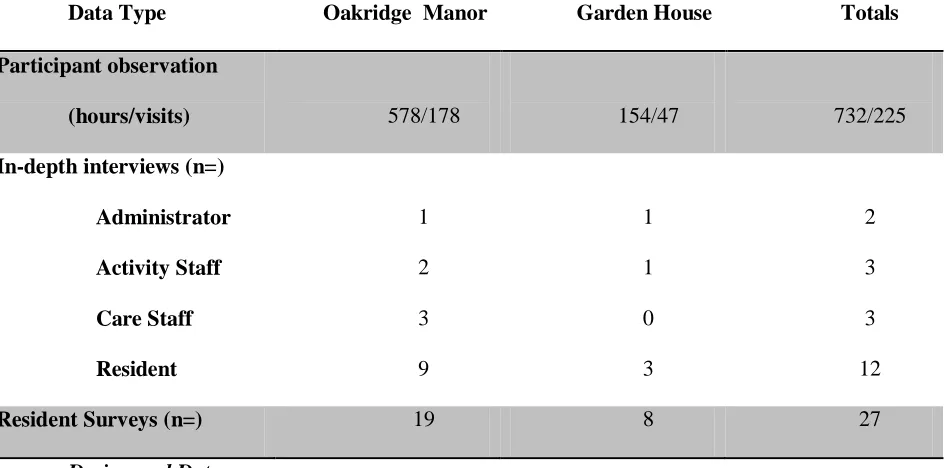
Field notes, in-depth interviews, and open-ended survey questions are included in the qualitative
data base for this study. Overall, there were a total of 3660 hours of observation and 1166 visits. All visits
were recorded in field notes and became part of the qualitative database along with 49 interviews and 178
responses to the open-ended survey questions.
Subsample and Present Analysis
Participants and settings
For the present analysis, I examined data collected from two AL settings: Oakridge Manor and
Garden House. Each are described separately below. Select characteristics for each home appear in Table
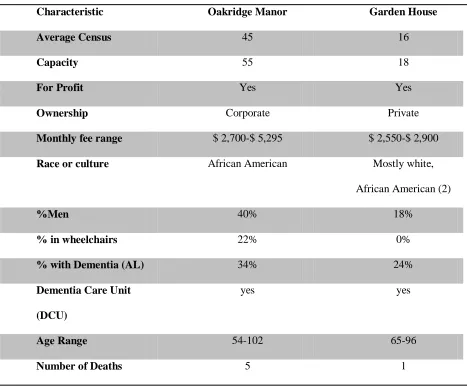
[image:39.612.77.544.324.710.2]1.
Table 1. Select characteristics by home
Characteristic Oakridge Manor Garden House
Average Census 45 16
Capacity 55 18
For Profit Yes Yes
Ownership Corporate Private
Monthly fee range $ 2,700-$ 5,295 $ 2,550-$ 2,900
Race or culture African American Mostly white,
African American (2)
%Men 40% 18%
% in wheelchairs 22% 0%
% with Dementia (AL) 34% 24%
Dementia Care Unit
(DCU)
yes yes
Age Range 54-102 65-96
30
Oakridge Manor is for-profit, corporately-owned and houses middle-class and wealthier African
American older adults. It has the capacity for 55 AL residents (does not include DCU residents), but an
average of 42 residents lived at Oakridge when the study was conducted. There were 22 residents with
dementia and 14 wheelchair-bound residents when the study was conducted. Ten residents used walker
and 9 residents used cane. The age of the residents ranged from 54 to102 years. The physical environment
of Oakridge Manor is explained in the following lines quoted from the work of Ball and colleagues
(2005), p. 133
Oakridge Manor is built by keeping the residents independence in mind. It has
wide halls with handrails, an elevator, good lighting, shower chairs in all bathrooms, and
washers and dryers for resident use. Residents have private bedrooms, and most have
pri-vate baths, which provides more space for supports such as microwave ovens, ironing
boards, hospital beds, rolling desk chairs, computers, and hanging valets. The paved path
encircling the building makes a pleasant and safe walk place to walk. Apart from it, only
a few baths have roll-in-showers; closet rods are out of reach for residents in wheelchairs;
the chairs in the lobby area are low and soft; the upstairs halls are long; the door to
laun-dry room is heavy; and the nearby shopping center is up a hill on a busy street with no
sidewalks.
Field note data further describe the home:
Oakridge Manor has separate DCU on the first floor. The DCU has its own dining room.
The activities program also runs separately in the DCU. The reception area is also on the first
floor, just opposite to the front doors. It has a lounge area which included 3-4 tables with chairs
and couple comfortable chairs. The lounge area also has a large entertainment console that
spanned one entire wall which included a large flat screen television and various books. French
doors in the room led to an outside patio/porch that serves as a smoking area. The facility has a