2018 International Conference on Communication, Network and Artificial Intelligence (CNAI 2018) ISBN: 978-1-60595-065-5
A New Vision About AI and Situation Awareness Model of Auto-driving with Implicit Memory
Hang SONG*, Bo-han JIANG and Da-xue LIU
College of Intelligence Science and Technology, National University of Defense Technology, 410073, China
*Corresponding author
Keywords: AI (Artificial Intelligence), Situation Awareness (SA), Deep learning (DL), Reinforcement Learning (RL), Deep Reinforcement Learning(DRL), Cognition Psychology.
Abstract. As AI developed with the relationships with other science, such as Psychology, needs of human-machine cooperation appear and situation awareness is modeled to evaluate driver and other kinds of operators in complex working condition. As to car-driving, an action- taking model based on situation awareness is presented, which shows two main action-taking ways. One is Reaction Chain; the other is Implicit/Action Ring. This paper is enlightenment by implicit memory, situation awareness model of Ensley’s and the way a very young child watching, touching and knowing the objects of the world. Although human take actions sometimes unconsciously, they are orientated by implicit memory. Similarly, some skills and knowledge are acquired by implicit learning and this kind of learning show an enormous migration and analogy ability. Finally, Reaction Chain which includes Perception-Comprehension-Projection-Decision-Action in driving is discussed with RL.
Introduction
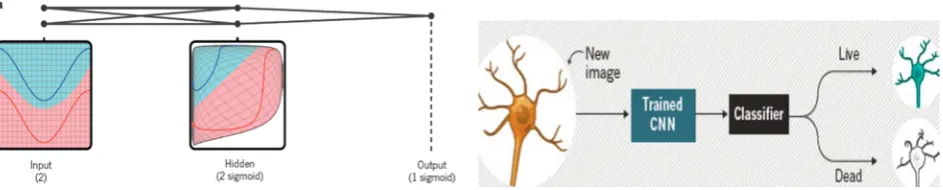
Deep learning (DL) has dramatically improved the state-of-the-art in image recognition1–2 and speech recognition3–4, object detection and many other domains such as drug discovery, genomics1 and biological analysis5. A convolutional neural network (ConvNet, or CNN) is used by Steve Finkbeiner’s lab to identify dead neurons in a population of live and dead cells(as Figure 1 shown)5.Deep learning tools could also help researchers to stratify disease types, understand disease subpopulations, find new treatments and match them with the appropriate patients for clinical testing and treatment5. Reinforcement learning (RL) 6 is a computational approach to learning whereby an agent tries to maximize the total amount of reward it receives when interacting with a complex, uncertain environment. And RL solves problems well in a wide range of fields in science and engineering, such as traffic and transportation, chess-playing and game theory, robot controlling and optimistic of decision-making6-8. Along With recent achievements of DL, powerful computation and new algorithmic techniques, we have been witnessing the renaissance of RL, especially, the combination of reinforcement learning and deep neural networks, i.e., deep reinforcement learning8 (DRL).
Whether a similar principle can be applied to teaching machines; can we supervise networks without individual examples by instead describing only the structure of desired outputs10? Furthermore, humans are often able to learn across fields of knowledge, unite rules across fields, even sharing success or failure of others experience without direct experiment, opting instead for high level rules for how our society or a task should be performed to satisfy our needs for long term, or what it will look like with furtherly deep mind or opinions by sociologies and psychologies when ongoing AI. The new vision of this article is composed of three parts. Firstly, a wider enlightenment from Label-Free learning to domain knowledge in supervised learning. After the CNNs has been simulated by neuroscience in Deep learning, Label-Free supervision with domain knowledge can also tell us that we shall stand on the shoulders(or contribution) of giants like Newton in the development of AI. In fact, AI’s development has been on the shoulders of giants, such as Optimization Theory, Calculus, approximate dynamic programming(ADP), No Free Lunch Theorem, and cognitive psychology.
psychology vision, analysis between “We know and don’t know” is discussed about AI development in different cognitive parts. Furthermore, from implicit learning vision, some abilities of observation and exploration even in a very young child give some clues in cognition of Deep Learning or Deep Reinforcement Learning. Humans are able to infer a wide range of physical properties such as mass, friction and deformability by interacting with them in a goal driven way10. This process of active interaction is in the same spirit as a scientist performing experiments to discover hidden facts. The same process is alike young children exploration of the world to uncover the unknown rules.
Thirdly, as to exploration of human driver, how to describe actions of sensation, memory, behavior and decision in the combination of DL and RL. From RL vision, Reaction Chain in Part3 shows a decision-making way of driving. But endowing our agents with knowledge of objects would help enormously with planning, reasoning and exploration, and yet, doing so is far from trivial11. What is an object or where is an abstract number like one? It turns out this question does not have a straightforward answer, and this paper is based around the idea that staring at steering wheel and surroundings is not enough to understand how to drive. Some physical issues like movement, mass, friction and deformability (some of them are discussed as hidden properties in learning to perform physics experiments via DRL11) will be raised in a joint visions above. Implicit understanding of physics, relations and object, which enables children to solve seemingly simple problems that our best existing AI agents do not come close to begin to solve.
The three parts of the new vision is preparation stage for high level construction of common sense, such as driving and other working skills. After the discussion of Label-Free Neural Networks and performing physics experiments via Deep Reinforcement Learning, two ways of skills learning of human to drive, operate and using tools are shown in a driving cognition model. They are Reaction Chain and implicit intelligence- action (Implicit/ action rings). The former one is Reinforcement Learning or ways likewise, and the latter one is Deep Learning with ambiguous labels, which start as ones obtaining common sense of the world (from touching, watching, walking and child tricycle playing).
Related Works and Analysis of the New Vision
Supervised learning begins with labels and it is used in identifying dead neurons after training, as shown in Figure 1. But human learning is largely unsupervised or Label-Free. After this discussion of Label-Free Neural Networks in tracking an object with known physical rule10, continues research with deep reinforcement learning methods can learn to perform the experiments necessary to discover such hidden properties11. Their research enlightens a direction from Label-Free to Action-Oriented, and this will be discussed in an action- taking model of auto-driving based on situation awareness.
Supervised Learning
In supervised learning, Imagine that we want to build a system that can classify images. We first collect a large data set of images, each labelled with its category. In Figure 1, the known borders are set between each other with assumption ahead and images classifying is needed, we make the CNN machine work to find the parameters for the set division. The methods include four steps in multilayer neural networks and backpropagation, such as “a, A multi-layer neural network (shown by the connected dots) can distort the input space to make the classes of data (with the example shown in Figure 1, the red part and blue part) linearly separable”, b, c and d1 parts.
Figure 1. Multilayer neural networks of Deep learning1 and it is used in identifying dead neurons5.
Complex functions can be learned with enough transformations that shown above. Human learning is largely unsupervised or Label-Free: we discover the structure of the world by observing it, not by being told the name of each object firstly; we find the rules of life by touching or listening without being told true or false. When we explore ourselves, Human vision is an active process that sequentially samples the optic array in an intelligent, task-specific way using a small, high-resolution fovea, then decide to get food, other reward and the meaning of life with sequential actions. When we explore the nature outside of ourselves with tools, Physics, other domain knowledge and laws of the world, a purposeful experiment with RL approach that have been understood gives us new clues or new vision. The former exploration is from unknown to known, and the latter exploration focus on known to unknown.
Label-Free Neural Networks in Tracking an Object with Domain Knowledge
Unsupervised learning1 are expected more important in the longer term. An improved Label-Free supervision of neural networks were made with physics and domain knowledge by specifying constraints that should hold over the output space, rather than direct examples of input-output pairs10. These constraints are derived from prior domain knowledge, e.g., from known laws of physics (such as gravitation with the formula:yi = y0 + v0(iΔt) + a(iΔt) 2 ). In their experiment of the convolutional neural network that is trained to detect and track objects without any labeled examples, prior knowledge on the structure of the outputs by providing a weighted constraint function g : X × Y → R, used to penalize “structures” that are not consistent with our prior knowledge. When Y is a (multi-dimensional) discrete space (e.g., describing many potential binary attributes of an image) as in the application(y∈ RN), g can be specified compactly using a graphical model approach, as a sum
of weighted potential or constraints that only depend on a small subsets of the variables10. Videos of an object being thrown across the field of view w e r e recorded to learn the object’s height in each frame. The network would be trained as a prediction problem operating on a sequence of N images to produce a sequence of N heights, (IR height×width×3)N →IRN , and each piece of data xi
will be a vector of images, x. Rather than supervising their network with direct labels 10. Δt = 0.1s is
the duration between frames. An object acting under gravity freely has a fixed acceleration a( where a = −9.8m/s2), and the plot of the object’s height over time will form a parabola as: yi = y0 + v0(iΔt) +
and other machine learning methods gives a good direction.
Reinforce Learning and Other Machine Learning in Cognitive Dimension of AI
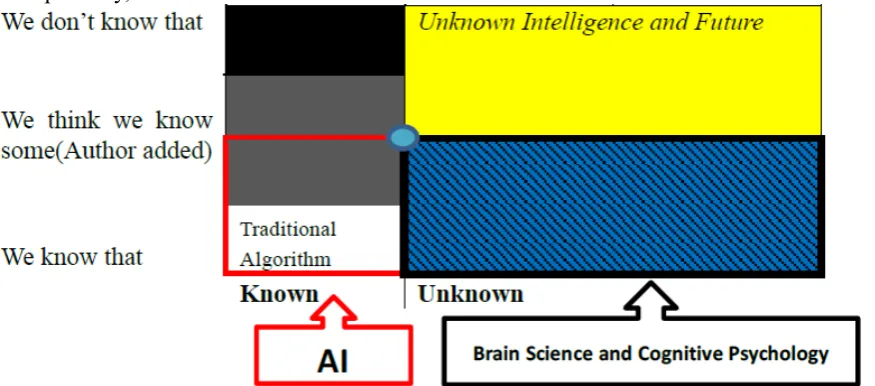
[image:4.595.82.520.219.412.2]Reinforcement learning is learning what to do —how to map situations to actions — so as to maximize a numerical reward signal. As discussed in grey (or black) box mentioned above, Reinforce learning focus on the grey part of Figure 2 as we know or know some (in a long round). Most Traditional Algorithm (Such as ADP, SVM, Genetic Algorithm, Game Theory and operation theory) and RL methods locates in Figure 2 as the red block of AI, but RL gives the ability from grey box to white in transitivity. RL is different from supervised learning in interaction with the environment by exploration and exploitation, in mediation of immediate reward and subsequent reward expectedly, and in balance of trial and error.
Figure 2. “We know and don’t know” under the condition that the cognition of known or unknown fields 12
Deep Learning and other AI methods are also locates in the red block in Figure 2. DL methods more focused on the different strategy of learning to find un-explaining different relations of known and unknown parts, implicit compose and outlook style.
Deep Reinforce learning is making progress in this grey part also. And the DRL joint advantages of DL and RL, as Alpha Go, are shown as the central point of Figure 2, which indicates that perception ability of us and analysis-decision-making ability behaving as rational exploration in a joint way. Machine learnings give us a new vision to “unknown” and they are good leverage.
The cross part between cognition of human and AI may have vague borders. But the parts dividing depending on our perception of the world of cognition, it depends on how much we know about ourselves and the nature. As cognition about the world and ourselves is divided in two parts, the left part is” known” and the right part is “ unknown”, as in Figure 2. a. the white part in Figure 2
shows that” We know what we know”, as so-called white box. It composed the rules we known about the world and how it works. For example, AI applies in playing chess with traditional Algorithm. b . the black part in Figure 2 shows that” We don't know what we know”, as so-called
black box. Many scientists are working in this field with human intelligence, and with deep learning maybe. c. the gray part between white and black. We know a little rules about it but cannot grasp
the law (such as gravity laws works well everywhere). For example, In go chess, even the master cannot state where the next chess piece should be located clearly and why. In the field Alpha Go became works well with deep reinforcement learning. d. the blue part in Figure 2 shows that” We
know clearly what we don't know”. Knowledge in Brain Science and Cognitive Psychology, such as emotion, consciousness and other characters of sociology, psychology and philosophy, may play an important role in AI.
intention, some progress are made in deep reinforcement learning agent that actively interacts with physical objects to infer their hidden properties11. Their approach is inspired by findings from the developmental psychology literature indicating that infants spend a lot of their early time experimenting with objects through random exploration. Hidden properties cognition or hidden skills learning is explained as implicit learning in Cognitive Psychology, we get knowledge and use it as common sense without awareness. Domain knowledge can be used in training the neural net and genetic algorithms that simulate human evolution have been widely used in. For connatural (innate) knowledge acquiring, Human can find answers constantly from genetic exploration and human brain decryption, maybe with AI. For the implicit knowledge, "basic skills" or common sense training that is being used for DRL application, from walking and reading to playing chess and car driving. Sensing the world and finding hidden properties of matter and physical rules. Learning to perform physics experiments via Deep Reinforcement Learning11 gives an example.
An Action- taking Model of Auto-driving Based on Situation Awareness
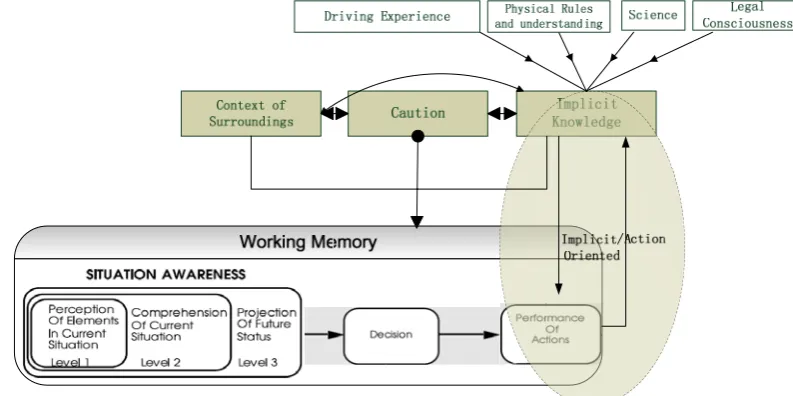
The labeled learning has the form as “Problems of what or why---answers (Labels)”, and with the feedback to the neural nets to self-adjustment. RL has the form as “observing-thinking-acting-insight”, and with the introspection of neural nets under some useful known rules (Domain Knowledge).The former is that one asking and one answer, and the latter is that asking less and thinking more. Facing the inexhaustible rules of the world, DRL shows an exploratory action of combination of sensibility and rationality. In this paper, “observing-thinking-acting-insight” is called as Reaction Chain, which is used in an auto-driving model to explain how to drive. Reaction Chain of auto-driving in working memory (in Figure 3), is shown as another way likewise, “Perception-Comprehension-Projection-Decision-Action”.
Driving Skills Learning and Situation Awareness Model
[image:5.595.88.485.467.665.2]The brain’s neural network has long inspired artificial-intelligence researchers, but Cognition Phycology inspired less. Driving is a typical operational skill and obeys the reaction chain, which belongs to human-machine cooperation in order to get to our destination fast and safely.
Figure 3. An action- taking model of auto-driving based on situation awareness
taking model of auto-driving based on situation awareness is presented as Figure 3.
Methods of how to drive well are composed of so many reasons, and they differ from one by one. But when one sit in front of the steering wheel; he will be immersed in a driving mode as shown in Figure 3. In a state of complete rationality, a driver will follow the reaction chain mentioned above; in a state of finite rationality but a good awareness mood, a driver can also drive well without too much caution and energy. The former way is better but we don’t take it every time, and the latter way we take often unconsciously. In Cognition Phycology, the latter is explained as implicit driving with implicit knowledge. A relatively consistent study shows that human memory is divided into explicit memory and implicit memory, and they are stored in different parts of brain14. Implicit memory is often below the edge of consciousness or below the threshold of consciousness. Under certain circumstances and tasks, it can be activated to enter the level of consciousness. In Figure 3, implicit driving, which is indicated by the dotted oval, is shown as Implicit/Action ring. Feedforward of the ring explains the process from implicit knowledge to action, and feedback of the ring explains the process from result of action to implicit learning.
Model Analysis and Extension by Machine learning
Knowledge from implicit learning is not easy to be interfered by external factors, nor does it decrease with time. Knowledge from implicit learning is more stable and durable. The relationship between driving skills unconsciously and the implicit learning needs further research. Implicit learning, which are cultivated (accumulating) little by little, from very young stage, some of them, is based on the pattern of question-answer of the past directly, and is based on observation and reflection and insight in an undirected way. From this point, implicit learning shows a similar way of DRL. Implicit driving experience in Figure 3 includes bike or tricycle experience, other moving experience like walking and so on. We learned the implicit driving-like experience unconsciously even from our young children crawling episode. And we use this kind of experience as comprehend by analogy. In driving a car, driving experience is just one kind of implicit knowledge, others are physical rules, science, legal and traffic consciousness (rules). Implicit learning is supervised by the law of nature and the rules of objects. It depends on enlightenment, but also on accumulation. From this point, implicit learning shows a similar way of DL. The results-oriented thinking emphasizes rationality and decision, because it is direct to the aim of reward. RL are used to guide cognition and behavior (labels can also be continuous expected returns). And behavior-oriented emphasizes exploration, sometimes label is not clear enough to build, or it is hided attributions of object. In this situation, DRL helps human cognitive to knowing the world and uncovering the rules.
Conclusion and Future Directions
further works of AI in a joint cognitive of DL, RL and DRL.
Acknowledgments
This work was supported by the grant from Post-Doctoral Foundation of China (P.PHD. 44919).
References
[1] Yann LeCun, Yoshua Bengio & Geoffrey Hinton. Deep learning [J].Nature 521,436-444(28 May 2015)
[2] Krizhevsky, A., Sutskever, I. & Hinton, G. ImageNet classification with deep convolutional neural networks[J]. In Proc. Advances in Neural Information Processing Systems 25 1090–1098 (2012).
[3] Hinton, G. et al. Deep neural networks for acoustic modeling in speech recognition[J]. IEEE Signal Processing Magazine 29, 82–97 (2012).
[4] Sainath, T., Mohamed, A.-R., Kingsbury, B. & Ramabhadran, B. Deep convolutional neural networks for LVCSR[J]. In Proc. Acoustics, Speech and Signal Processing 8614–8618 (2013). [5] Sarah Webb. DEEP LEARNING FOR BIOLOGY[J]. Nature 554, 555-557(22 FEBRUARY 2018).
[6] Sutton, R. S. and Barto, A. G. (2017). Reinforcement Learning: An Introduction (2nd Edition) [M]. MIT Press.
[7] A. Salkham, R. Cunningham, A. Garg, and V. Cahill, A collaborative reinforcement learning approach to urban traffic control optimization[C]. in Proc. IEEE/WIC/ACM Int. Conf. IAT, 2009, vol. 2, pp. 560–566.
[8] S.P.K. Spielberg, R.B. Gopaluni, P.D. Loewen. Deep Reinforcement Learning Approaches for Process Control[C]. 2017 6th International Symposium on Advanced Control of Industrial Processes (AdCONIP). May 28-31, 2017. Taipei, Taiwan
[9] Hubel, D. H. & Wiesel, T. N. Receptive fields, binocular interaction, and functional architecture in the cat’s visual cortex[J].. Physiol. 160, 106–154 (1962).
[10] Russell Stewart , Stefano Ermon. Label-Free Supervision of Neural Networks with Physics and Domain Knowledge [J]. Proceedings of the Thirty-First AAAI Conference on Artificial Intelligence (AAAI-17).
[11] Misha Denil, Pulkit Agrawal, et,al. Learning to perform physics experiments via Deep Reinforcement Learning[C]. ICLR 2017” https://arxiv.org/abs/1701.07274v2”
[12] Zhangbo. AI in the Post Deep Learning Era. [J]. “HANGZHOU SCIENCE AND TECHNOLOGY” , 2017(2):41-42(Fig. 2 is from PPT of Zhangbo in his topic, which can be seen in “https://www.leiphone.com/news/201610/my3RisHxpQ0hjvz7.html”, The revised part is shown “We think we know some(Author added)”, and the original words “Brain Science and Cognitive Psychology” are extended to Brain Science and Cognitive Psychology.)
[13] Endsley M R. Situation awareness in aviation systems. In Garland D J, Wise J A, Hopkin V D. Handbook of aviation human factors.Mahwah, NJ: Erlbaum, 1999. 257~276