Technology (IJRASET)
Increment in Lifetime of Wireless Sensor Networks
Using Simulations in Load Balancing Routing
Algorithm
Raviraj Srikrishna, Vinith Chauhan, Pradeep Nathany
M.Tech Student, Digital Comm., Asst. Prof., Dept. of ECE, St. Margret Engg. College, Neemrana, India
Abstract: In this paper we present a productive Load balancing routing system to expand the life time of every existing node in a manner to get most efficiency from the system. The current routing algorithms are used to pick a minimal effort to decrease the transmission time for Wireless Sensor Networks since they don't consider the energy utilized by nodes for transmission. A little build in transmission time is the main shortcoming of existing load balancing directing algorithm. However our new approach of Load balancing will based on the cluster of system nodes means our proposed algorithm will work on the clustering of nodes. Indeed it will pick cluster head on the premise of vitality of nodes. Yet the cluster head will be picked intermittently. Proposed results prove that regardless of the routing algorithm utilization, our method enhances the lifetime of the framework. A comparison result demonstrates the higher skill of proposed methodology.
Keywords: Wireless Sensor Networks (WSN), Lad Balancing, Cluster Head, Load Balancing Routing Algorithm and Network Model
I. INTRODUCTION
Wireless Sensor Networks have gotten expanding consideration in the late few years. In many military and common applications of sensor systems, sensors are compelled in installed vitality supply and are left unattended. Vitality, size and cost demands of such sensors restrict their correspondence range. Load balancing clustering expands the framework dependability and enhances the correspondence between diverse nodes in the framework [1].
The basic goals of this research in wireless sensor network are to enhance the lifetime of the network and also to use the power of the network nodes efficiently. There are so many conventional accesses or methods available in wireless sensor network (WSN) to achieve the aim of research. But, they are not so effective and trustworthy in terms of utilization of power of the nodes in the network [2]. Thus, Clustering is one of the key techniques to achieve the above goals in wireless sensor network with less power consumption. It can also increase network scalability. Sensor nodes are often thought to be homogeneous in nature since the researches about the field of wireless sensor systems have been advanced however truly, homogeneous sensor networks barely exist. In this manner, we oblige a clustering strategy which will work in heterogeneous environment which are almost nearly connected with real situations. In this paper, examinations have been made to outline a heterogeneous mindful clustering system named "Multi level clustering protocol" (MLCP) in remote sensor network to guarantee the protocol to nearly work with the real life circumstances. The main target of the Multi level clustering protocol (MLCP) is to develop the stable area of remote sensor nodes, which at last expands the life time of the system with efficient energy utilization. The protocol clustered the nodes into distinctive sorts in term of their energy levels [3].
II. PROBLEM DESCRIPTION
In this paper, we approach the efficient routing of reports to the sink node by balancing the power consumption throughout the network. By doing so, we aim at improving the WSN lifetime. For each sensor node v, generated path to the cluster can follow one of the possible [P(v)] paths. We associate to each path p Є P(v) a weight w(p), such that
W(v)= ∑ ∈ ( ) ( ) = 1. (1)
Technology (IJRASET)
the energy utilization in the whole process. It represents the rate of packets transmitted by link node (u) to sensor node (v). These packets can be either generated by link node (u) or by other sensor nodes (v) or relayed by link node (u) to attain their final destination (i.e., the sink node). The above mathematical work describes the problem in a way of explaining our experimental or analytical approach of finding efficiency of proposed algorithm in comparable to existing algorithms. The above mathematical work is used to calculate the energy utilization in whole clustering and looping process of our proposed algorithm.
III. RELATED WORK
Clustering could be utilized for balancing the clusters within the Wireless Sensor Networks. S. Ozdemir (2009) stated that in a cluster based Load balancing, the most of the transmission power of the nodes is utilized to prepare networks into the cluster. Cluster participation relies upon the correspondence cost. The proposed methodology does not consider the repowering concept [4].
Y. Zhang et. al. reported a heap balancing clustering methodology, utilizes weight of nodes enough to separate it with the head and the others and the persistent energy to enhance cluster division decision. It similarly utilizes reformation limit quality to secure it from Load unbalancing. The algorithm considers load balancing for making balanced cluster. A multi-bounce clustering algorithm for Load balancing in Wireless Sensor Networks utilizes layered methodology for intra cluster and generates cluster networks. But the algorithm considers homogeneous system [5].
C. Nam et. al. (2011) examined about reconfiguration of cluster head for Load balancing in Wireless Sensor Networks that builds the system lifetime via safely message passing to cluster heads. Reconfiguration of the cluster is carried out based on the amount of general nodes in the cluster & the amount of cluster [6]. A novel Load balancing round robin or randomized algorithm for Wireless Sensor Networks is proposed by W. Rabiner et. al. that utilizes ideal planning algorithm for message communication which decides the time initiating for sending the bundles for the nodes. The algorithm gives uniform message loss to all the nodes. Secure Load balancing through enhanced data storage in heterogeneous Wireless Sensor Networks, this algorithm offers pseudo link nodes or connecting nodes to enhance data storage and transmission capacity by usage of wireless sensor network to increment system lifetime [7].
IV. CONCEPT OF LOAD BALANCING IN WSNs USING CLUSTERING
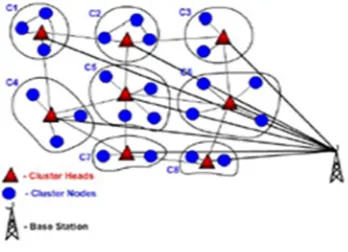
[image:3.612.222.396.510.636.2]A wireless sensor network is typically consisting of a potentially large number of sensor nodes with limited resources and few number of sensor nodes with powerful resources. As sensor nodes have very limited power consumption and they are randomly deployed, where it become unfeasible to recharge the sensor nodes. So the consumed power in WSN is considered as scarce resource and should be efficiently used. Sensor node consumes in sensing data, receiving data, sending data and processing data.
Fig. 1: Load balancing using clustering in WSNs
Technology (IJRASET)
prolong the lifetime of the sensor network by making the cluster head to collect information from the nodes in the cluster and send it to the base station. An irregularly deployed sensor network requires a cluster formation protocol to partition the network into clusters [8].
The cluster heads should also be selected. There are two approaches used in this process the leader first and the cluster first approach. In the leader first approach the cluster head is selected first and then cluster is formed. In the cluster first approach the cluster is formed first and then the cluster head is selected. Clustering has numerous advantages like it reduces the size of the routing table, reduce the idleness of data packets, extend network lifetime, protects communication bandwidth, reduces the rate of energy utilization etc.
V. EXISTING WORK
[image:4.612.223.390.305.427.2]As per exiting algorithm a minimal effort way is used for information transmission system that utilizes connection state algorithm in which all the nodes included in an ease way are checked. If power of every live nodes included is more than threshold value, then a route is decided for transmission. At the same time if power of a node is short of threshold or equivalent to threshold value then load at this node is directed through some other substitute regardless of more cost. This may expand the transmission time however a remarkable increase in lifetime of a system is attained [12].
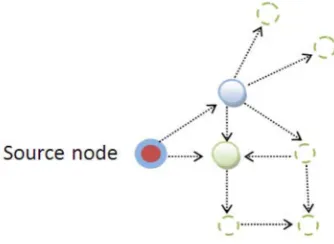
Fig. 2: A small network to examine behavior of a critical node (M. Gerla, 1995)
A node with less power than threshold value might be utilized if there is no other way accessible for transmission. This algorithm fundamentally decreases the load on critical node and builds the life of a wireless sensor network [4], [7].
M. Gerla accomplishes the above described design by consistent observing [9]. Every node screens its energy persistently. If power of a node is short of threshold power, that node is proclaimed as a critical node. A critical node publicizes to its neighbors about the current state and builds the cost of all the linked connections to a high value. A connection state algorithm when connected on such system to attain less cost it depends on a discriminating node as all the connections joined with a basic node now have a high value. An inclusion of such node in a less cost is decently impossible unless there is no substitute way accessible [10]. The basic nodes are utilized just for those ends of the line that are connected through these nodes.
A. Drawback in existing technique
Besides choosing the shortest path, the proposed technique also increases lifetime of a network by defining power saving mode. But there are lots of demerits in exiting system:
1) A small increase in transmission time increases cost very high for the system is the drawback of efficient load sharing routing algorithm.
2) The algorithm is applicable on homogeneous systems only
Technology (IJRASET)
VI. PROPOSED METHODOLGY
In vast sensor organize, the sensor nodes could be gathered into little clusters. Each one cluster has a cluster head to arrange the nodes in the cluster [11]. Cluster networks can decrease the lifetime of the sensor network by making the cluster head that collect total information from the nodes in the cluster and send it to the base station. A randomly sent sensor network results into a cluster routing algorithm to divide the system into clusters.
The cluster heads should be chosen similarly. There are two methodologies utilized as a part of this process the pioneer first and the cluster first approach. In the pioneer first approach the cluster head is chosen first and after that cluster is shaped. In the cluster first approach the cluster is shaped first and afterward the cluster head is chosen.
A. Methodology steps
The enhancement technique is based on as follows steps:
1) We will cluster the network based on behavior of nodes. Nodes with similar kind of behavior in terms of their energy level and their send and received process they clustered into cluster. This step is used to establish and use clustering algorithm proposed. 2) In each cluster only one node will be chosen as representative node. The node with biggest energy value will be chosen as the
representative node. This node will keep its antenna on and capture event, all other nodes will move to low power listening mode. This step is used to utilize the energy detection formula and to detect overall cost of the algorithm.
3) The 2nd step will be continuing by looping and at every period a head node is chosen. This step utilizes the looping algorithm proposed to continue the process till the networking ends.
B. Proposed Algorithm
Pv = power of node v
Pc = critical power (threshold)
t= Transmission time (i= number of time units)
v=sender node
w=destination node
maxFactor = High power sensor node (Cluster head)
minFactor = low power sensor nodes
N = Set containing all the nodes of network
Q= List containing all the nodes processed by the Algorithm for all nodes v in network N
if ( Pv < Pc)
for all nodes of cluster
set Q
Cluster head=maxFactor
Technology (IJRASET)
For all nodes v in network N except sset Message format: with address and sequence number messenger send the message using send_message for all messenger setnexthop from Q
if nexthop=0
set messenger as received message
else "Report reached Base station" Create UDP connection to v, w
Create a CBR traffic source and attach it to udp While (maxFactor != Pc)
Set ti as now and tf as ti+1
For each v in Q and adjacent to w, Calculate
maxFactor = minFactor (v), Q (w) + (ti+1)(v))
VII. SIMULATION RESULTS
[image:6.612.190.415.383.479.2]Simulation results have demonstrated the efficiency of load balanced clustering for sensor networks applying different routing methodologies.
Fig. 3: Lifetime increment with load sharing using clustering
Likewise in current implementation the lifetime increment values are 2-20 per units of time as considered the threshold value is 25.
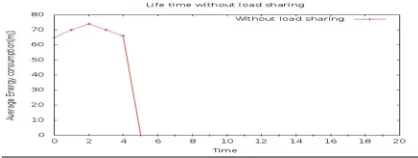
Fig.4: Lifetime increment without load sharing using clustering
The above fig.3 and fig.4 presented that using the implementation of clustering in load sharing of wireless sensor networks the energy consumed can be decreased which in return increase the total lifetime of sensor nodes.
[image:6.612.218.427.539.618.2]Technology (IJRASET)
Comparison results:Fig.5: Comparison graph for Lifetime increment between with and without load sharing using clustering
Fig.5 shows that the number of live nodes against the number of rounds in each of the proposed model is higher than the existing system. Load sharing using Clustering increases the ratio of stable region in network lifetime. Clustering select high energy nodes to be the cluster-head first for load balancing in the network and then periodically changes the clustering energy as cluster head and as a result, low energy nodes spend less energy than high energy nodes. So Clustering helps to sustain the survival of low energy nodes more longer time and hence extends the stable region of the wireless sensor networks and finally increase the life time of the network.
VIII. CONCLUSION
In this paper, an approach for load balancing in the wireless sensor network is proposed. In this research work algorithms for clustering, cluster head formation, cluster head selection, intra cluster communication and inter cluster communication in wireless sensor network has been proposed. The results demonstrate that the proposed approach is effective in prolonging the network lifetime. We plan to extend the clustering in future for mobile sensors and gateways and compare the results with dissimilar ad-hoc clustering approaches. We also plan to take account of fault tolerance in the network by performing improvement from gateway failures.
REFERENCES
[1] Akyildiz I..F, Weilian Su., Sankarasubramaniam Y, Cayirci E,. (2002). “A survey on sensor networks,” IEEE Communication Magazine, vol. 40, no. 8, pp. 102–114
[2] Rajaravivarma V, Yang Y, Yang T,. (2003). “An Overview of Wireless Sensor Network and Applications,” In Proc. 35th Southeastern Symposium on System Theory, Morgantown USA, pp. 432– 436.
[3] C-K. Toh. (June 2003). “Maximum Energy Life Routing to Support Ubiquitous Mobile Computing in Wireless Ad Hoc Networks”, IEEE Communications Magazine.
[4] S. Ozdemir. (2009). “Secure Load Balancing via Hierarchical Data Aggregation in Heterogeneous Sensor Networks”, Journal of Information Science And Engineering 25, 1691-1705.
[5] Y. Zhang, Z. Zheng, Y. Jin, X. Wang. (2009). “Load Balanced Algorithm In Wireless Sensor Networks Based on Pruning Mechanism”, IEEE transaction, 978-0-7695-3522-7.
[6] C. S. Nam, Y. S. Han & D. R. Shin. (2011). “Multihop Routing Based on Optimization of the number of cluster heads in Wireless Sensor Networks”, Sensors, 11, 2875-2884; doi: 10.3390 /s110302875.
[7] W. Rabiner Heinzelman, A. Chandrakasan, and H. Balakrishnan. (January 2000). “Energy-Efficient Communication Protocols for Wireless Microsensor Networks”,. Hawaii International Conference on System Sciences (HICSS ’00).
[8] D.J Baker and A. Ephremides. (April 1991). “A Distributed algorithm for Organizing Mobile Radio Telecommunication Networks”, in the Proceedings of the 2nd International Conference in Distributed Computer Systems.
[9] M. Gerla and J.T.C Tsai,. (1995). “Multi-cluster, mobile, multimedia radio network”, ACM/Baltzer Journal of Wireless networks, Vol. 1, No. 3, pp. 255-265. [10] A.K. Parekh. (August 1994). “Selecting Routers in Ad-Hoc Wireless Networks”, Proceedings of the SBT/IEEE International Telecommunications Symposium. [11] F. Zhan, C. Noon. (1996). “Shortest Path Algorithms: An Evaluation Using Real Road Networks”, Transportation Science.