
www.impactjournals.com/oncotarget/
Oncotarget, Vol. 5, No. 11
Expression and functionality of histone H2A variants in cancer
Fátima Liliana Monteiro
1, Tiago Baptista
2, Francisco Amado
1,3, Rui Vitorino
1,
Carmen Jerónimo
2,4and Luisa A. Helguero
11 Mass Specrometry Center, Organic Chemistry and Natural Products Unit (QOPNA), Dep. of Chemistry, Universidade de
Aveiro., Aveiro, Portugal
2 Cancer Biology & Epigenetics Group, Research Center Portuguese Oncology Institute – Porto. Porto, Portugal 3 School of Health Sciences, Universidade de Aveiro., Portugal
4 Department of Pathology and Molecular Immunology, Institute of Biomedical Sciences Abel Salazar (ICBAS) – University
of Porto, Porto, Portugal
Correspondence to: Luisa A. Helguero, email: [email protected]
Keywords: epigenetics, post-translational modifications, histone H2A, cancer.
Received: April 8, 2014 Accepted: May 24, 2014 Published: May 26, 2014
This is an open-access article distributed under the terms of the Creative Commons Attribution License, which permits unrestricted use, distribution, and reproduction in any medium, provided the original author and source are credited.
ABSTRACT
Regulation of gene expression includes the replacement of canonical histones for non-allelic histone variants, as well as their multiple targeting by postranslational modifications. H2A variants are highly conserved between species suggesting they execute important functions that cannot be accomplished by canonical histones. Altered expression of many H2A variants is associated to cancer. MacroH2A variants are enriched in heterocromatic foci and are necessary for chromatin condensation. MacroH2A1.1 and macroH2A1.2 are two mutually exclusive isoforms. MacroH2A1.1 and macroH2A2 inhibit proliferation and are associated with better cancer prognosis; while macroH2A1.2 is associated to cancer progression. H2AX variant functions as a sensor of DNA damage and defines the cellular response towards DNA repair or apoptosis; therefore, screening approaches and therapeutic options targeting H2AX have been proposed. H2A.Z is enriched in euchromatin, acting as a proto-oncogene with established roles in hormone responsive cancers and overexpressed in endocrine-resistant disease. Other H2A family members have also been found altered in cancer, but their function remains unknown. Substantial progress has been made to understand histone H2A variants, their contribution to normal cellular function and to cancer development and progression. Yet, implementation of high resolution mass spectrometry is needed to further our knowledge on highly homologous H2A variants expression and function.
INTRODUCTION
Genomic DNA in eukaryotic cells is packaged into
chromatin being the nucleosome the smallest subunit.
Nucleosomes consist of 145-147 base pairs of DNA
wrapped around an octamer of core histone proteins
which usually includes two molecules of each of the
canonical core histones: H2A, H2B, H3 and H4. These
are assembled in one central H3-H4 heterotetramer and
two H2A-H2B heterodimers [1, 2] with the linker histone
H1 holding the nucleosome together [3]. The highly
dynamic changes in nucleosome composition and in their
biochemical properties allows regulation of transcription,
gene silencing, DNA replication and recombination
[4]. Regulation of gene expression at the nucleosome
level occurs through combinatorial effects of epigenetic
marks including DNA methylation, core histone
post-translational modifications (hPTMs) [5] and incorporation
of diverse replacement histone variants [6]. While DNA
remodelers to the DNA [13, 14].
Histone variants are highly conserved between
different species [15-17], indicating that they have evolved
to fulfill important functions that cannot be accomplished
by canonical histones [14]. There are several examples
of highly divergent replacement variants which have
specialized functions and whose deregulation can
contribute to cancer development (Table 1). The H2A
family of replacement histone variants comprises the
largest number of genes identified found associated with
cancer, as recently reviewed [18]. H2A variants differ
mainly in their N- and C-terminal sequence, whereas the
core region is highly conserved [19]. Currently, there
are over 19 H2A histone variants identified in human
and mouse. They share high degree of homology in their
nucleotide and amino acid sequence (Supplementary
Tables 1 and 2). This review focuses on H2A histone
variants which are altered in cancer; describes their
functions, and the methodological difficulties faced in the
analysis of many members of the H2A family.
macroH2A histone variants
MacroH2A is an extremely divergent H2A variant
with a tripartite structure consisting of an amino-terminal
histone-like region that is 64% identical in the amino acid
sequence to full length histone H2A, a large
carboxyl-terminal globular domain and the macro domain
which is a lysine (K) rich H1-like linker region that
includes a random coil with no similarity to other histones
[15, 20]. Two macroH2A genes are present in vertebrates,
H2AFY
and
H2AFY2
, which encode macroH2A1 and
macroH2A2 proteins, respectively [21]. Several PTMs
have been identified on histone macroH2A1, mostly in the
N-terminal domain (Fig. 1A) [22-25].
[31]. On the other hand, macroH2A can be phosphorylated
by Cdk complexes, containing cyclin E and cyclin B.
Consequently, macroH2A-phSer137 is excluded from
heterochromatin in Xi chromosome and is enriched in
heterochromatin during mitosis, suggesting it may play a
role in cell cycle regulation [22].
Contrary, to its enrichment in heterochromatin,
macroH2A positively regulates a subset of specific genes
associated with lipid metabolism during liver transition
from newborn to young-adult state [32]. In line with this
work, macroH2A1 is likely found in promoter-proximal
regions in IMR90 human primary lung fibroblasts and
MCF-7 breast cancer cells and can also increase
signal-regulated transcription, specifically for genes activated by
serum starvation [29].
The
H2AFY
gene contains two mutually exclusive
exons which can be alternatively spliced to originate two
isoforms, macroH2A1.1 and macroH2A1.2 (Fig. 1B) [27,
33], differing only in a part of the non-histone region
[34]. MacroH2A1.1 splice variant is mostly restricted to
differentiated cells [33, 34] and can bind to nicotinamide
adenine dinucleotide (NAD)
+-derived ligands; while
macroH2A1.2 cannot interact with these small molecules
[35], it is generally expressed in embryonic stem cells and
the early embryo [27, 33, 34].
Histone macroH2A in cancer
MacroH2A variant expression is majorly lost
in melanoma progression, mainly through promoter
methylation, as shown for macroH2A2 in metastatic
disease [36]. In addition, macroH2A1 suppresses
melanoma progression through downregulation of
cyclin-dependent kinase 8 (CDK8) gene expression, which
promotes cellular proliferation through enhancement of
malignant transformation by β-catenin [36]. While in
normal adult cells macroH2A1 isoforms are expressed
with similar levels, macroH2A1.1 decreases in a variety of
human cancers including breast [37], colorectal [38], lung
[39, 40], testis, bladder, ovarian, endometrial and cervical
cancers [40]; and the ratio macroH2A1.1 / macroH2A1.2
has a profound effect on patient prognosis and survival.
In cancers with poor prognosis, alternative splicing of the
H2AFY
gene strongly favours macroH2A1.2 expression,
due to decreased activity of the splicing factor QKI [39,
40]. MacroH2A1.1 is highly expressed in tumours with
better prognosis and low mitotic index [39]; while its low
levels correlate to tumours undergoing rapid cell division
marked by high expression of the proliferation marker
Ki-67 [39]. Moreover, macroH2A1.1 downregulation favours
metastasis and correlates with decreased patient survival
and tumour recurrence, as shown in lung cancer [39].
Furthermore, macroH2A1.1 is upregulated in senescent
cells and triggers oncogene-induced senescence [30].
Poly (ADP-Ribose) Polymerase 1 (PARP-1)
has been implicated in several processes that promote
cellular proliferation of lung and cervical cancer cells.
Their growth suppression is at least in part, mediated by
macroH2A1.1 interaction with PARP-1 and its subsequent
downregulation [40]. MacroH2A1.1 not only acts as a
transcriptional repressor as in the case of the oncogene
c-Fos
[41], but it also promotes the expression of proteins
involved in redox metabolism, such as Superoxide
Dismutase 3, Extracellular (
SOD3)
, Hydroxyacid
Oxidase (Glycolate Oxidase) 1 (
HAO1
), Rieske
(Fe-S) Domain Containing (
RFESD
) and Glucose-Fructose
Oxidoreductase Domain Containing 1 (
GFOD1)
[42]
(Fig. 1B). Depletion of macroH2A1.2 in metastatic 4T1
cells, which under normal conditions display a higher
content of macroH2A1.2 in detriment of macroH21.1,
induces
SOD3
expression. In a similar way, depletion of
macroH2A1.1 in non-metastatic cells 67NR, which have
a high macroH2A1.1/macroH2A1.2 ratio,
SOD3
was also
induced, suggesting that macroH2A1.1 is able to promote
SOD3
expression, while macroH2A1.2 inhibits it [42].
Also, macroH2A1.2 is by far the predominant form in
MCF-7 breast cancer cell line [29] and can interact with
HER-2 in the nucleus to enhance the over-expression
of oncogene
ERBB2
[37] (Fig. 1B). Therefore, while it
is generally accepted that histones macroH2A1.1 and
macroH2A2 act as tumour suppressors, macroH2A1.2
variant seems to be an oncogene associated with disease
progression and negative patient outcome.
The varying array of biological processes regulated
by macroH2A histones can be inferred from their network
of interacting proteins including positive and negative
regulators of transcription (Fig. 1C). Interestingly, one
of the major advantages of cancer cells compared to
non-malignant cells is their ability to adapt their metabolism
to the nutrient availability. Thus, identification and
understanding the macroH2A protein complexes that
regulate genes in redox metabolism such as
SOD3
as well
as lipid metabolism genes deserves further study.
H2AX histone variant
H2AX levels are cell line or tissue specific and
represent about 2–25% of total H2A [43]. In contrast
to other genes encoding H2A histone variants,
H2AFX
contains landscapes of both replication dependent and
replication-independent histone species [44]. It has
been proposed that this dual mechanism of translational
regulation ensures the presence of sufficient H2AX
molecules in the replicating genome for efficient and
continued presence of H2AX at G1 and G0 phase of the
cell cycle [45].
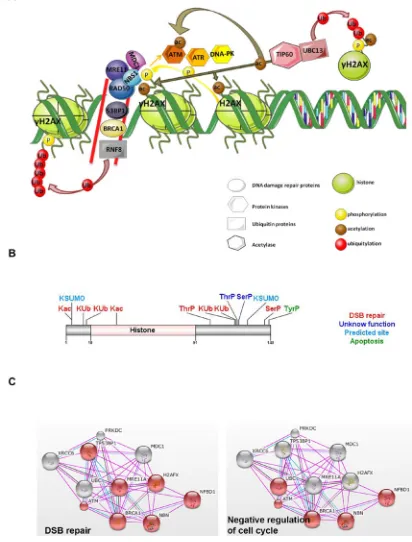
of histone H2AX. This yields a specific modified form
known as γH2AX, and promotes recruitment of DNA
repair proteins to sites of DSBs [43, 46], leading to a linear
increase in the number of γH2AX molecules with the
severity of the DNA damage. Therefore, γH2AX has been
used as a sensitive marker for the presence of DSBs in
cells and tissues [43]. H2AX can also be acetylated in K36
by the CBP/p300 acetyltransferases [47] and in threonine
(Thr) 101 [48]. These two PTMs are required for cells to
survive exposure to ionizing radiation (IR) independently
of H2AX phosphorylation [48].
H2AX phosphorylation is catalysed by three
phosphatidylinositol-3 kinase-like kinases (PIKKs):
ataxia telangiectasia mutated (ATM), ataxia telangiectasia
and Rad3-related (ATR) and DNA-dependent protein
kinase (DNA-PK) [49, 50]. A signal amplification loop
involving H2AX, Nijmegen breakage syndrome 1
(nibrin- NBS1) and mediator of DNA damage checkpoint
protein 1 (MDC1) stimulates ATM and increases H2AX
phosphorylation [51]. NBS1 and MDC1 bind directly to
γH2AX through MDC1 BRCT domain, which allows
the accumulation of DDR proteins including the MRN
(MRE11–RAD50–NBS1) complex, Ring Finger Protein
8, E3 Ubiquitin Protein Ligase (RNF8), Breast Cancer 1,
Early Onset (BRCA1) and p53-binding protein 1 (53BP1)
[52-54]. In addition, DSBs facilitate TIP60 and
Ubiquitin-Conjugating Enzyme E2N (UBC13) association and
further ATM acetylation and activation as well as H2AX
acetylation in K5-independently of its phosphorylation
[55]. Consequently, H2AX is released from chromatin and
it is ubiquitylated on K119 by UBC13 [55]. Ring Finger
Protein 168, E3 Ubiquitin Protein Ligase (RNF168) and
RNF8 also ubiquitylate H2AX on K13, K15, K118 and
K119, which initiate the formation of ubiquitin chains and
recruitment of various DDR proteins containing
ubiquitin-binding domain [55-60]. The H2AX ubiquitination
by RNF168 and RING1B/BMI is mediated by the
nucleosome acid patch which is also required for RNF168-
and RING1B/BMI- dependent DDR proteins recruitment
to repair DNA damage [61]. Although it is generally
accepted that DNA DSBs induce the formation of γH2AX
foci, DNA single-stranded regions induced by ultraviolet
C irradiation can also induce formation of γH2AX [50].
Furthermore, in apoptosis provoked by UV irradiation,
γH2AX may be further phosphorylated by c-Jun
NH2-terminal kinase (JNK) [62] and function as a response to
endonuclease-mediated DNA fragmentation downstream
from caspase-3/caspase-activated DNase (CAD) pathway
activation [63]. More recent studies reveal that the
decision to undergo DDR or apoptosis is determined by
phosphorylation of γH2AX in tyrosine 142 (Tyr142P)[64,
65]. As it inhibits the binding of repair factors to γH2AX
and promotes the recruitment of pro-apoptotic factors such
as JNK1 [64]. On the other hand, loss of H2AX Tyr142P,
alters the kinetics of γH2AX in response to DNA damage
[65].
Histone H2AX in cancer
[image:5.612.73.260.204.476.2]The association of DNA damage, apoptosis
and genome stability with premalignant stages and
progression of a tumour is highly recognized.
H2AFX
is
located in a chromosome region that frequently exhibits
mutations or deletions in a large number of human cancers
(11q23), especially in haematopoietic malignancies [66].
Furthermore, a reduction in
H2AFX
gene copy number
was verified
in
MCF7 breast cancer cell line
[67] and
Figure 1: Role of
H2AFY
and
H2AFY2
in cancer
progression.
A. Structural domains and postranslational modifications identified on macroH2A.1 protein [22-25]. B. Alternative splicing of H2AFY gives rise to macroH2A1.1 and macroH2A1.2 isoforms. Their incorporation into nucleosomes of specific genes exerts different effects. MacroH2A1.1 negatively impacts cancer progression through inhibition of expression of genes that stimulate cell proliferation (CDK8 andc-Fos) and involved in redox metabolism (SOD3 and HAO1).On
higher methylation status of
H2AFX
promoter leads to a
reduction of H2AX expression in lung squamous cancer
[68]. Further, upregulation of H2AX by the clinically
approved protein kinase inhibitor Imatinib mesylate
triggers apoptosis in gastrointestinal stromal tumour cell
lines [69].
Based on H2AX function in DNA repair and in
maintaining DNA stability, the use of H2AX / γH2AX
as marker for early cancer detection, prognosis and
therapeutics has been proposed [70]. Elevated endogenous
levels of γH2AX have been found in various human cancer
cell lines such as cervical [71], ovarian [72], breast [73],
leukaemia and melanoma, colon, renal, and prostate cancer
cell lines [70]. Many therapeutic agents act by introducing
sufficient DSBs into cancer cells to activate the apoptotic
pathway [74]. Thus, H2AX could also be targeted to
promote cancer cell death. For example, latrunculin B,
an agent that inhibits actin dynamics, induces γH2AX
formation, leading to G2 arrest and consequently resulting
in MCF-7 breast cancer cell apoptosis [75]. Therefore,
quantification of γH2AX enriched foci to detect DSBs
formation, may be a sensitive method to monitor either
cancer progression or response to treatment [70].
H2A.Z histone variant
The variant H2A.Z is highly conserved from yeast
to human, with 90% of its primary sequence preserved
among different species, showing only 60% homology
with canonical histone H2A [76]. H2A.Z has been one of
the most studied H2A variants in recent years. Different
studies reported diverse and controversial conclusions
regarding alteration in the nucleosome stability by
insertion of this variant. Some authors claim that
H2A.Z nucleosomes are more stable [77], while others
have observed that H2A.Z incorporation destabilizes
nucleosome core particles [13, 78]. In yeast, the
mechanism by which histone H2A is replaced by H2A.Z
in the nucleosome is mediated through the action of a
multisubunit protein complex, SWR1-Complex, which
contains a Swi2/Snf2 paralog [79]. In higher eukaryotes,
two SWR1-related multiprotein complexes (SRCAP
and p400/TIP60) were described. While the SRCAP
chromatin remodeling complex is involved in global
H2A.Z deposition activity [80], the p400/TIP60 complex
is known to mediate a more localized deposition of H2A.Z
[81]. Recently, it was described that the acidic nuclear
phosphoprotein 32 kilodalton E (ANP32E), a member of
the p400/TIP60 complex, is responsible for the removal
and deposition of H2A.Z in the nucleosome [82].
H2A.Z is found in approximately 10% of
mammalian nucleosomes and participates in different
biological processes such as cell cycle and DNA
replication [83], DNA repair [84], spermatogenesis [85],
chromosome segregation [86], centromere structure [87],
transcription regulation [88-91], and maintenance of
heterochromatic/euchromatic status [92, 93]. However, its
role in transcriptional regulation is complex since it has
been reported to function both as a transcriptional repressor
and activator. The apparently contradictory roles of H2A.Z
[image:6.612.70.276.172.443.2]in vivo
might be explained by different combinations of
H2A.Z with other epigenetic regulators, PTMs on H2A.Z
(Fig. 3A) and interaction with chromatin binding proteins
(Fig. 2B) [94]. Acetylated H2A.Z is enriched at the 5’
regions of active genes in yeast and vertebrates [95, 96],
Figure 2: H2AX histone variant.
A. Main mechanismswhereas ubiquitylated H2A.Z associates with facultative
heterochromatin [97], and monomethylation of H2A.Z
at K7 by the lysine methyltransferase SETD6 has been
suggested as a marker of cellular differentiation [98].
Histone H2A.Z in cancer
A possible role for H2A.Z in cancer was first
reported using genome wide gene expression profiling
where overexpression of H2A.Z was observed in sporadic
colorectal tumors [99]. Undifferentiated cancers show
H2AFZ
overexpression compared to well differentiated
cancers [100] and overexpression of this histone variant
was also reported in genitourinary cancers, such as
prostate [101] and bladder cancer [102]. Breast cancer is
where H2A.Z role has been best characterized, with its
overexpression correlating with lymph node metastasis
in primary breast cancer [103], and overexpression also
observed in late stages of the disease [104]. The correlation
between H2A.Z levels and short patient overall survival
suggests that this histone variant might be a biomarker of
tumor progression.
H2A.Z gene is under the positive control of c-Myc
(Fig. 3B) and therefore might be an important indirect
target for breast cancer therapy [105]. H2A.Z positively
regulates estrogen receptor (ER)α-dependent transcription
and estrogen simulation of cell proliferation [106]. Yet, in
MCF7 cells, H2A.Z overexpression also promotes cellular
proliferation under low estrogen levels and upon treatment
with the ER antagonist tamoxifen, which suggests that
proliferation induced by H2A.Z overrides the inhibitory
effects of tamoxifen on gene transactivation by ERα and
may play a role in endocrine resistance [107].
H2A.Z is also associated to androgen receptor (AR)
gene transactivation and progression of prostate carcinoma
(PCa). H2A.Z ubiquitylation in K120, K121 and K125
has been described as present in PCa and associated with
transcriptional silencing (Fig. 3A). Deubiquitylation of
H2A.Z by ubiquitin-specific protease (USP10) leads to
transcriptional activation of the AR-regulated
PSA
and
KLK3
genes [97]. A significant increase of
H2A.Z
was
found in castration-resistant LNCaP xenograft model
[108]. Furthermore, since PCa patients submitted to
androgen-deprivation therapy tend to express more
H2A.Z over time, it has been suggested that the elevated
expression of
H2A.Z might be
indicative of primary
PCa
progression to androgen-independence [108]. A
recent study in PCa cell lines evaluated how H2A.Z and
its acetylation in K4, K7 and K11 (acH2A.Z) positively
regulates transcription of oncogenes and showed that
acH2A.Z mutually excluded DNA methylation and
the deposition of the H3K27me3 mark within the
promoter region [109]. Consequently, acH2A.Z tended
to accumulate within the TSS of active genes and was
tightly associated with active gene transcription [109].
In line with this, H2A.Z deacetylation is most prevalent
in nucleosomes next to the TSS and correlates with
lower gene transcription activity including that of tumor
suppressor genes [109]. More recently, Baptista,
et al.
using PCa cell lines showed that H2A.Z regulates its own
expression by increasing its accumulation nearby the TSS
of the
H2AFZ
gene, while its regulation is impaired by
decreased expression and protein levels of the histone
deacetylase NAD-dependent protein deacetylase sirtuin-1
(SIRT1), which is necessary to maintain H2A.Z levels
[101]. Furthermore, effective restoring of SIRT1 function
by epigenetic modifying drugs in conjunction with
enzymatic modulators lead to proteasomal degradation
of H2A.Z and of its target/regulator c-Myc. Therefore,
SIRT1 activation, emerged as a promising tool for targeted
therapy of endocrine-resistant PCa patients through
reduction of H2A.Z [101].
[image:7.612.65.276.432.575.2]A dependence of H2A.Z for cancer cell proliferation,
viability and progression into cell cycle was showed in
the osteosarcoma U2OS cell line with H2A.Z depletion;
However, the same was not observed in relation to DNA
repair [110]. These results seems to be contradictory, since
Xu et al described that H2A.Z exchange at DSBs shifts the
chromatin to an open conformation required for loading
some of the DDR proteins [84]. The authors suggested that
the p53 status and the cell line may be key to explain these
contradictory results [110].
Other H2A variants in cancer
Additionally, there are some H2A variants
altered in cancer but with no associated function
identified. For example, during sequential development
of hepatocellular carcinoma, the major histone H2A
variant H2A.1
(HIST2H2AA1)
is overexpressed, and
H2A.2 (
HIST2H2AA3
) is decreased at the protein and
mRNA levels [111]. The histone variant H2A1C was
described as overexpressed in MCF-7 cell line along
with the silencing of the oncogenic protein phosphatase
magnesium-dependent 1 delta (PPM1D) [112]. Moreover,
in acute myeloid leukemia, reduced expression of
the
HIST1H2AC
locus leads to increased rates of cell
proliferation and tumorigenicity [113], also supporting a
loss of function for H2A1C during cancer progression.
Lastly, H2AFJ has been subject of controversial findings,
with downregulation reported in melanocytic tumor
lesions [114] and overexpression in breast cancers with
12p13 regional copy number gain compared with a panel
of normal mammary epithelial cells [115].
Future challenges in the study of H2A family
members
Methods using antibodies or DNA probes are
the primary tools used for molecular and biochemical
investigation. Since many members of the H2A family
share high sequence homology (Supplementary Tables
1 and 2), the lack of reagents with high-specificity for
individual variants has hindered studies on expression and
function of several H2A variants. Some variants share up
to 98% homology and therefore, even approaches designed
to identify non-homologous regions are restricted. The
high homology in the base pair sequence and existence of
duplicated genes poses a methodological draw-back for
the design of probes for RNA quantification, alignment
of RNA-seq data and gene expression silencing using
siRNAs. In addition, the high similarity of epitopes in
H2A variants and the variety of PTMs on these molecules
complicate the generation of specific antibodies adding to
the difficulty of finding high quality antibodies for H2A
variant quantification and chromatin immunoprecipitation
(ChIP / ChIP-Seq) analysis. Consequently, and not
surprisingly, research has concentrated on those variants
which are less conserved and for which it has been easier
to obtain specific detection reagents.
Mass spectrometry (MS) has become widely used
to analyze histone variants. MS has an advantage over
the limitations posed by immunological reagents and
has emerged as a promising complementary analytical
strategy not only to identify known and novel PTMs on
proteins, but also for their relative quantification
[116-119]. Yet, MS also has its limitations. For instance, some
histone H2A family members differ in sequence by as
little as one amino acid residue which can result in false
positive identifications by attribution of multiples of 14 Da
mass shifts due to the amino acid differences between the
variants which is also traditionally assigned as methylation
[120]. The recent advent of high-resolution mass
spectrometry (possible with modern mass spectrometers,
with a resolution that allows accurate determination of the
mass corresponding to a molecular ion), in combination
with different strategies for peptide fragment dissociation,
electron capture dissociation (ECD) and electron transfer
dissociation (ETD) has increased the relevance of
MS-based PTM characterization in unveiling the histone
code [121]. Indeed, the high mass accuracy afforded by
high-resolution MS data greatly increases the confidence
in assigning a protein modification. For example, the
difference in mass (Δm) of 14 Da, attributed to Glu->Asp
and also to an aminoacid methylation, can be discerned
using high-resolution MS since Glu->Asp presents a Δm
14.015650 Da) and methylation presents a Δm 14.016650
Da). Furthermore, histone variant analysis is highly
dependent on liquid chromatography separation whose
use is critical in the case of modified histone peptides
from a complex sample mixture of a wide concentration
range -including large peptides with identical amino
acid sequences modified in slightly different ways-
and which result in many isobaric structural isomers
[122]. Nevertheless, despite these drawbacks, the high
throughput tools available in MS labs allow a sensitive
and reproducible histone profiling that will be of great
value for exploring variants and their PTMs and which can
readily be applied to clinical or pharmaceutical studies.
In summary, the immunological limitations for
studying the expression and function of H2A variants
make it a challenging field of research. There has been
considerable progress made, yet overcoming these
difficulties will require improving combinatorial
mass spectral methods to bypass the necessity for
immunological reagents. In addition, site-directed
mutagenesis is also one option for functional analysis to
uncover the specific cellular functions of each H2A variant
and their respective PTMs.
CONCLUSION
cancer. These results lead to propose non-canonical H2A
variants as markers of disease progression and response
to cancer therapy. Notwithstanding the difficult task of
finding highly specific antibodies, future work should be
done to validate these data in a broader number of cancer
cases, as well as developing highly sensitive MS-based
methodologies to discriminate H2A variants with high
sequence homology and for which specific detection
reagents are lacking.
List of Abbreviations
Ac – acetylated
ANP32E – acidic nuclear phosphoprotein 32
kilodalton E
AR – androgen receptor
ATM – ataxia telangiectasia mutated
ATR – ataxia telangiectasia and Rad3-related
BRCA1 – Breast Cancer 1, Early Onset
CAD – caspase-activated DNase
CDK8 – cyclin-dependent kinase 8
c-Fos – FBJ Murine Osteosarcoma Viral Oncogene
Homolog
ChIP – chromatin immunoprecipitation
DDR – DNA damage repair
DNA-PK – DNA-dependent protein kinase
DSBs – DNA double strand breaks
ERBB2
– V-Erb-B2 Avian Erythroblastic Leukemia
Viral Oncogene Homolog 2
Eya – eyes absent homolog
GFOD1 –
Glucose-Fructose Oxidoreductase
Domain Containing 1
HAO1 –
Hydroxyacid Oxidase (Glycolate Oxidase)
1
hPTMs – histone post-translational modifications
IR – ionizing radiation
JNK – c-Jun NH2-terminal kinase
K – lysine
MDC1 – mediator of DNA damage checkpoint
protein 1
MS – Mass spectrometry
NAD – Nicotinamide adenine dinucleotide
NBS1 – Nijmegen breakage syndrome 1 (nibrin)
P – phosphorylation
PARP-1 – Poly (ADP-Ribose) Polymerase 1
PCa – prostate carcinoma
PIKKs – phosphatidylinositol-3 kinase-like kinases
PPM1D – oncogenic protein phosphatase
magnesium-dependent 1 delta
RFESD
– Rieske (Fe-S) Domain Containing
RNF8 – Ring Finger Protein 8, E3 Ubiquitin Protein
Ligase
Ser – serine
SOD3 –
Superoxide Dismutase 3, Extracellular
SPOP – speckle-Type POZ Protein
Thr - threonine
TSSs – transcription start sites
Tyr - tirosine
Ub – ubiquitylation
UBC13 – Ubiquitin-Conjugating Enzyme E2N
USP10 – ubiquitin-specific protease
Xi
– inactive X chromosome
53BP1 – p53-binding protein 1
Competing interests
The authors declare that they have no competing
interests
Authors’ information
LM: is a Research Fellow currently studying
expression and functionality of different H2A histones in
mammary gland development and breast cancer.
TB: is a PhD student currently at Institut de
Génétique et de Biologie Moléculaire et Cellulaire -
IGBMC, Strasbourg, France and former MSc student at
Cancer Biology & Epigenetics group at the Portuguese
Oncology Institute- Porto
FA, PhD: is the Head of the Mass Spectrometry
Centre at the University of Aveiro.
RV, PhD: coordinates the proteomics laboratory
at QOPNA-University of Aveiro. His work is focused
in the development of proteomics tools for biological
sample characterization from different pathophysiological
conditions.
CJ, PhD: coordinates the Cancer Biology &
Epigenetics group at the Portuguese Oncology Institute-
Porto and is invited associate Professor at the Department
of Pathology & Molecular Immunology at the Institute of
Biomedical Sciences Abel Salazar (ICBAS) of University
of Porto
LAH, PhD: coordinates the Hormones and
Cancer group at the Mass Spectrometry Centre,
QOPNA-University of Aveiro. Her work is focussed in
understanding epigenetic mechanisms that regulate cell
proliferation and differentiation.
ACKNOWLEDGEMENTS
UI0062/2013.
This work was also supported by
CENTRO-07-ST24-FEDER-002034.
REFERENCES
1. Luger K, Mader AW, Richmond RK, Sargent DF and Richmond TJ. Crystal structure of the nucleosome core particle at 2.8 A resolution. Nature. 1997; 389(6648):251-260.
2. Marc F, Sandman K, Lurz R and Reeve JN. Archaeal histone tetramerization determines DNA affinity and the direction of DNA supercoiling. J Biol Chem. 2002; 277(34):30879-30886.
3. Michael R. Cummings WSK. (2005). Concepts of Genetics. 4. Ausio J. Histone variants--the structure behind the function.
Brief Funct Genomic Proteomic. 2006; 5(3):228-243. 5. Strahl BD and Allis CD. The language of covalent histone
modifications. Nature. 2000; 403(6765):41-45.
6. Bonenfant D, Coulot M, Towbin H, Schindler P and van Oostrum J. Characterization of histone H2A and H2B variants and their post-translational modifications by mass spectrometry. Mol Cell Proteomics. 2006; 5(3):541-552. 7. Albert L. Lehninger DLN, Michael M. Cox. (2008).
Lenhinger Principles of Biochemistry: W.H. Freeman, 2008).
8. Robbins E and Borun TW. The cytoplasmic synthesis of histones in hela cells and its temporal relationship to DNA replication. Proc Natl Acad Sci U S A. 1967; 57(2):409-416.
9. Kurat CF, Lambert JP, van Dyk D, Tsui K, van Bakel H, Kaluarachchi S, Friesen H, Kainth P, Nislow C, Figeys D, Fillingham J and Andrews BJ. Restriction of histone gene transcription to S phase by phosphorylation of a chromatin boundary protein. Genes Dev. 2011; 25(23):2489-2501. 10. Chen P, Zhao J and Li G. Histone variants in development
and diseases. J Genet Genomics. 2013; 40(7):355-365. 11. Ahmad K and Henikoff S. The histone variant H3.3 marks
active chromatin by replication-independent nucleosome assembly. Mol Cell. 2002; 9(6):1191-1200.
12. Recinos RF, Kirchhoff LV and Donelson JE. Cell cycle expression of histone genes in Trypanosoma cruzi. Molecular and Biochemical Parasitology. 2001; 113(2):215-222.
13. Suto RK, Clarkson MJ, Tremethick DJ and Luger K. Crystal structure of a nucleosome core particle containing the variant histone H2A.Z. Nat Struct Biol. 2000; 7(12):1121-1124.
14. Chakravarthy S, Bao Y, Roberts VA, Tremethick D and Luger K. Structural characterization of histone H2A variants. Cold Spring Harb Symp Quant Biol. 2004; 69:227-234.
15. Pehrson JR and Fuji RN. Evolutionary conservation of histone macroH2A subtypes and domains. Nucleic Acids Res. 1998; 26(12):2837-2842.
16. Waterborg JH. Evolution of histone H3: emergence of variants and conservation of post-translational modification sites. Biochem Cell Biol. 2012; 90(1):79-95.
17. Wu RS, Nishioka D and Bonner WM. Differential conservation of histone 2A variants between mammals and sea urchins. J Cell Biol. 1982; 93(2):426-431.
18. Vardabasso C, Hasson D, Ratnakumar K, Chung CY, Duarte LF and Bernstein E. Histone variants: emerging players in cancer biology. Cell Mol Life Sci. 2014; 71(3):379-404.
19. Bonisch C and Hake SB. Histone H2A variants in nucleosomes and chromatin: more or less stable? Nucleic Acids Res. 2012; 40(21):10719-10741.
20. Pehrson JR and Fried VA. MacroH2A, a core histone containing a large nonhistone region. Science. 1992; 257(5075):1398-1400.
21. Chadwick BP and Willard HF. Histone H2A variants and the inactive X chromosome: identification of a second macroH2A variant. Hum Mol Genet. 2001; 10(10):1101-1113.
22. Bernstein E, Muratore-Schroeder TL, Diaz RL, Chow JC, Changolkar LN, Shabanowitz J, Heard E, Pehrson JR, Hunt DF and Allis CD. A phosphorylated subpopulation of the histone variant macroH2A1 is excluded from the inactive X chromosome and enriched during mitosis. Proc Natl Acad Sci U S A. 2008; 105(5):1533-1538.
23. Ogawa Y, Ono T, Wakata Y, Okawa K, Tagami H and Shibahara KI. Histone variant macroH2A1.2 is mono-ubiquitinated at its histone domain. Biochem Biophys Res Commun. 2005; 336(1):204-209.
24. Chu F, Nusinow DA, Chalkley RJ, Plath K, Panning B and Burlingame AL. Mapping post-translational modifications of the histone variant MacroH2A1 using tandem mass spectrometry. Mol Cell Proteomics. 2006; 5(1):194-203. 25. Hernandez-Munoz I, Lund AH, van der Stoop P, Boutsma
E, Muijrers I, Verhoeven E, Nusinow DA, Panning B, Marahrens Y and van Lohuizen M. Stable X chromosome inactivation involves the PRC1 Polycomb complex and requires histone MACROH2A1 and the CULLIN3/SPOP ubiquitin E3 ligase. Proc Natl Acad Sci U S A. 2005; 102(21):7635-7640.
26. Costanzi C and Pehrson JR. Histone macroH2A1 is concentrated in the inactive X chromosome of female mammals. Nature. 1998; 393(6685):599-601.
27. Costanzi C and Pehrson JR. MACROH2A2, a new member of the MARCOH2A core histone family. J Biol Chem. 2001; 276(24):21776-21784.
28. Angelov D, Molla A, Perche PY, Hans F, Cote J, Khochbin S, Bouvet P and Dimitrov S. The histone variant macroH2A interferes with transcription factor binding and SWI/SNF nucleosome remodeling. Mol Cell. 2003; 11(4):1033-1041. 29. Gamble MJ, Frizzell KM, Yang C, Krishnakumar R
target genes from silencing. Genes Dev. 2010; 24(1):21-32. 30. Zhang R, Poustovoitov MV, Ye X, Santos HA, Chen W,
Daganzo SM, Erzberger JP, Serebriiskii IG, Canutescu AA, Dunbrack RL, Pehrson JR, Berger JM, Kaufman PD and Adams PD. Formation of MacroH2A-containing senescence-associated heterochromatin foci and senescence driven by ASF1a and HIRA. Dev Cell. 2005; 8(1):19-30. 31. Buschbeck M, Uribesalgo I, Wibowo I, Rue P, Martin D,
Gutierrez A, Morey L, Guigo R, Lopez-Schier H and Di Croce L. The histone variant macroH2A is an epigenetic regulator of key developmental genes. Nat Struct Mol Biol. 2009; 16(10):1074-1079.
32. Changolkar LN, Costanzi C, Leu NA, Chen D, McLaughlin KJ and Pehrson JR. Developmental changes in histone macroH2A1-mediated gene regulation. Mol Cell Biol. 2007; 27(7):2758-2764.
33. Rasmussen TP, Huang T, Mastrangelo MA, Loring J, Panning B and Jaenisch R. Messenger RNAs encoding mouse histone macroH2A1 isoforms are expressed at similar levels in male and female cells and result from alternative splicing. Nucleic Acids Res. 1999; 27(18):3685-3689.
34. Pehrson JR, Costanzi C and Dharia C. Developmental and tissue expression patterns of histone macroH2A1 subtypes. J Cell Biochem. 1997; 65(1):107-113.
35. Kustatscher G, Hothorn M, Pugieux C, Scheffzek K and Ladurner AG. Splicing regulates NAD metabolite binding to histone macroH2A. Nat Struct Mol Biol. 2005; 12(7):624-625.
36. Kapoor A, Goldberg MS, Cumberland LK, Ratnakumar K, Segura MF, Emanuel PO, Menendez S, Vardabasso C, Leroy G, Vidal CI, Polsky D, Osman I, Garcia BA, Hernando E and Bernstein E. The histone variant macroH2A suppresses melanoma progression through regulation of CDK8. Nature. 2010; 468(7327):1105-1109. 37. Li X, Kuang J, Shen Y, Majer MM, Nelson CC, Parsawar
K, Heichman KA and Kuwada SK. The atypical histone macroH2A1.2 interacts with HER-2 protein in cancer cells. J Biol Chem. 2012; 287(27):23171-23183.
38. Sporn JC and Jung B. Differential regulation and predictive potential of MacroH2A1 isoforms in colon cancer. Am J Pathol. 2012; 180(6):2516-2526.
39. Sporn JC, Kustatscher G, Hothorn T, Collado M, Serrano M, Muley T, Schnabel P and Ladurner AG. Histone macroH2A isoforms predict the risk of lung cancer recurrence. Oncogene. 2009; 28(38):3423-3428.
40. Novikov L, Park JW, Chen H, Klerman H, Jalloh AS and Gamble MJ. QKI-mediated alternative splicing of the histone variant MacroH2A1 regulates cancer cell proliferation. Mol Cell Biol. 2011; 31(20):4244-4255. 41. Gamble MJ and Kraus WL. Multiple facets of the unique
histone variant macroH2A: from genomics to cell biology. Cell Cycle. 2010; 9(13):2568-2574.
42. Dardenne E, Pierredon S, Driouch K, Gratadou L,
Lacroix-Triki M, Espinoza MP, Zonta E, Germann S, Mortada H, Villemin JP, Dutertre M, Lidereau R, Vagner S and Auboeuf D. Splicing switch of an epigenetic regulator by RNA helicases promotes tumor-cell invasiveness. Nat Struct Mol Biol. 2012; 19(11):1139-1146.
43. Rogakou EP, Pilch DR, Orr AH, Ivanova VS and Bonner WM. DNA double-stranded breaks induce histone H2AX phosphorylation on serine 139. J Biol Chem. 1998; 273(10):5858-5868.
44. Mannironi C, Bonner WM and Hatch CL. H2A.X. a histone isoprotein with a conserved C-terminal sequence, is encoded by a novel mRNA with both DNA replication type and polyA 3’ processing signals. Nucleic Acids Res. 1989; 17(22):9113-9126.
45. Bonner WM, Redon CE, Dickey JS, Nakamura AJ, Sedelnikova OA, Solier S and Pommier Y. GammaH2AX and cancer. Nat Rev Cancer. 2008; 8(12):957-967. 46. Paull TT, Rogakou EP, Yamazaki V, Kirchgessner CU,
Gellert M and Bonner WM. A critical role for histone H2AX in recruitment of repair factors to nuclear foci after DNA damage. Curr Biol. 2000; 10(15):886-895.
47. Jiang X, Xu Y and Price BD. Acetylation of H2AX on lysine 36 plays a key role in the DNA double-strand break repair pathway. FEBS Lett. 2010; 584(13):2926-2930. 48. Xie A, Odate S, Chandramouly G and Scully R. H2AX
post-translational modifications in the ionizing radiation response and homologous recombination. Cell Cycle. 2010; 9(17):3602-3610.
49. Hanasoge S and Ljungman M. H2AX phosphorylation after UV irradiation is triggered by DNA repair intermediates and is mediated by the ATR kinase. Carcinogenesis. 2007; 28(11):2298-2304.
50. Stiff T, Walker SA, Cerosaletti K, Goodarzi AA, Petermann E, Concannon P, O’Driscoll M and Jeggo PA. ATR-dependent phosphorylation and activation of ATM in response to UV treatment or replication fork stalling. Embo J. 2006; 25(24):5775-5782.
51. Stucki M and Jackson SP. gammaH2AX and MDC1: anchoring the DNA-damage-response machinery to broken chromosomes. DNA Repair. 2006; 5(5):534-543.
52. Lou Z, Minter-Dykhouse K, Franco S, Gostissa M, Rivera MA, Celeste A, Manis JP, van Deursen J, Nussenzweig A, Paull TT, Alt FW and Chen J. MDC1 maintains genomic stability by participating in the amplification of ATM-dependent DNA damage signals. Mol Cell. 2006; 21(2):187-200.
53. Stucki M, Clapperton JA, Mohammad D, Yaffe MB, Smerdon SJ and Jackson SP. MDC1 directly binds phosphorylated histone H2AX to regulate cellular responses to DNA double-strand breaks. Cell. 2005; 123(7):1213-1226.
domain. J Radiat Res. 2004; 45(4):473-478.
55. Ikura T, Tashiro S, Kakino A, Shima H, Jacob N, Amunugama R, Yoder K, Izumi S, Kuraoka I, Tanaka K, Kimura H, Ikura M, Nishikubo S, Ito T, Muto A, Miyagawa K, et al. DNA damage-dependent acetylation and ubiquitination of H2AX enhances chromatin dynamics. Mol Cell Biol. 2007; 27(20):7028-7040.
56. Mailand N, Bekker-Jensen S, Faustrup H, Melander F, Bartek J, Lukas C and Lukas J. RNF8 ubiquitylates histones at DNA double-strand breaks and promotes assembly of repair proteins. Cell. 2007; 131(5):887-900.
57. Huen MS, Grant R, Manke I, Minn K, Yu X, Yaffe MB and Chen J. RNF8 transduces the DNA-damage signal via histone ubiquitylation and checkpoint protein assembly. Cell. 2007; 131(5):901-914.
58. Gatti M, Pinato S, Maspero E, Soffientini P, Polo S and Penengo L. A novel ubiquitin mark at the N-terminal tail of histone H2As targeted by RNF168 ubiquitin ligase. Cell Cycle. 2012; 11(13):2538-2544.
59. Mattiroli F, Vissers JH, van Dijk WJ, Ikpa P, Citterio E, Vermeulen W, Marteijn JA and Sixma TK. RNF168 ubiquitinates K13-15 on H2A/H2AX to drive DNA damage signaling. Cell. 2012; 150(6):1182-1195.
60. Doil C, Mailand N, Bekker-Jensen S, Menard P, Larsen DH, Pepperkok R, Ellenberg J, Panier S, Durocher D, Bartek J, Lukas J and Lukas C. RNF168 binds and amplifies ubiquitin conjugates on damaged chromosomes to allow accumulation of repair proteins. Cell. 2009; 136(3):435-446.
61. Leung JW, Agarwal P, Canny MD, Gong F, Robison AD, Finkelstein IJ, Durocher D and Miller KM. Nucleosome acidic patch promotes RNF168- and RING1B/BMI1-dependent H2AX and H2A ubiquitination and DNA damage signaling. PLoS Genet. 2014; 10(3).
62. Lu C, Zhu F, Cho YY, Tang F, Zykova T, Ma WY, Bode AM and Dong Z. Cell apoptosis: requirement of H2AX in DNA ladder formation, but not for the activation of caspase-3. Mol Cell. 2006; 23(1):121-132.
63. Rogakou EP, Nieves-Neira W, Boon C, Pommier Y and Bonner WM. Initiation of DNA fragmentation during apoptosis induces phosphorylation of H2AX histone at serine 139. J Biol Chem. 2000; 275(13):9390-9395. 64. Cook PJ, Ju BG, Telese F, Wang X, Glass CK and
Rosenfeld MG. Tyrosine dephosphorylation of H2AX modulates apoptosis and survival decisions. Nature. 2009; 458(7238):591-596.
65. Xiao A, Li H, Shechter D, Ahn SH, Fabrizio LA, Erdjument-Bromage H, Ishibe-Murakami S, Wang B, Tempst P, Hofmann K, Patel DJ, Elledge SJ and Allis CD. WSTF regulates the H2A.X DNA damage response via a novel tyrosine kinase activity. Nature. 2009; 457(7225):57-62.
66. Bassing CH, Suh H, Ferguson DO, Chua KF, Manis J, Eckersdorff M, Gleason M, Bronson R, Lee C and Alt
FW. Histone H2AX: a dosage-dependent suppressor of oncogenic translocations and tumors. Cell. 2003; 114(3):359-370.
67. Srivastava N, Gochhait S, Gupta P and Bamezai RN. Copy number alterations of the H2AFX gene in sporadic breast cancer patients. Cancer Genet Cytogenet. 2008; 180(2):121-128.
68. Castro M, Grau L, Puerta P, Gimenez L, Venditti J, Quadrelli S and Sanchez-Carbayo M. Multiplexed methylation profiles of tumor suppressor genes and clinical outcome in lung cancer. J Transl Med. 2010; 8(86):1479-5876.
69. Liu Y, Tseng M, Perdreau SA, Rossi F, Antonescu C, Besmer P, Fletcher JA, Duensing S and Duensing A. Histone H2AX is a mediator of gastrointestinal stromal tumor cell apoptosis following treatment with imatinib mesylate. Cancer Res. 2007; 67(6):2685-2692.
70. Sedelnikova OA and Bonner WM. GammaH2AX in cancer cells: a potential biomarker for cancer diagnostics, prediction and recurrence. Cell Cycle. 2006; 5(24):2909-2913.
71. Banath JP, Macphail SH and Olive PL. Radiation sensitivity, H2AX phosphorylation, and kinetics of repair of DNA strand breaks in irradiated cervical cancer cell lines. Cancer Res. 2004; 64(19):7144-7149.
72. Yu T, MacPhail SH, Banath JP, Klokov D and Olive PL. Endogenous expression of phosphorylated histone H2AX in tumors in relation to DNA double-strand breaks and genomic instability. DNA Repair. 2006; 5(8):935-946. 73. Nagelkerke A, van Kuijk SJ, Sweep FC, Nagtegaal ID,
Hoogerbrugge N, Martens JW, Timmermans MA, van Laarhoven HW, Bussink J and Span PN. Constitutive expression of gamma-H2AX has prognostic relevance in triple negative breast cancer. Radiother Oncol. 2011; 101(1):39-45.
74. Helleday T, Petermann E, Lundin C, Hodgson B and Sharma RA. DNA repair pathways as targets for cancer therapy. Nat Rev Cancer. 2008; 8(3):193-204.
75. Shin IJ, Ahn YT, Kim Y, Kim JM and An WG. Actin disruption agents induce phosphorylation of histone H2AX in human breast adenocarcinoma MCF-7 cells. Oncol Rep. 2011; 25(5):1313-1319.
76. Iouzalen N, Moreau J and Mechali M. H2A.ZI, a new variant histone expressed during Xenopus early development exhibits several distinct features from the core histone H2A. Nucleic Acids Res. 1996; 24(20):3947-3952. 77. Park YJ, Dyer PN, Tremethick DJ and Luger K. A
new fluorescence resonance energy transfer approach demonstrates that the histone variant H2AZ stabilizes the histone octamer within the nucleosome. J Biol Chem. 2004; 279(23):24274-24282.
activation. J Biol Chem. 2001; 276(45):41945-41949. 79. Kobor MS, Venkatasubrahmanyam S, Meneghini MD,
Gin JW, Jennings JL, Link AJ, Madhani HD and Rine J. A protein complex containing the conserved Swi2/Snf2-related ATPase Swr1p deposits histone variant H2A.Z into euchromatin. PLoS Biol. 2004; 2(5):23.
80. Ruhl DD, Jin J, Cai Y, Swanson S, Florens L, Washburn MP, Conaway RC, Conaway JW and Chrivia JC. Purification of a human SRCAP complex that remodels chromatin by incorporating the histone variant H2A.Z into nucleosomes. Biochemistry. 2006; 45(17):5671-5677. 81. Lee K, Lau ZZ, Meredith C and Park JH. Decrease of
p400 ATPase complex and loss of H2A.Z within the p21 promoter occur in senescent IMR-90 human fibroblasts. Mech Ageing Dev. 2012; 133(11-12):686-694.
82. Obri A, Ouararhni K, Papin C, Diebold ML, Padmanabhan K, Marek M, Stoll I, Roy L, Reilly PT, Mak TW, Dimitrov S, Romier C and Hamiche A. ANP32E is a histone chaperone that removes H2A.Z from chromatin. Nature. 2014; 505(7485):648-653.
83. Dhillon N, Oki M, Szyjka SJ, Aparicio OM and Kamakaka RT. H2A.Z functions to regulate progression through the cell cycle. Mol Cell Biol. 2006; 26(2):489-501.
84. Xu Y, Ayrapetov MK, Xu C, Gursoy-Yuzugullu O, Hu Y and Price BD. Histone H2A.Z controls a critical chromatin remodeling step required for DNA double-strand break repair. Mol Cell. 2012; 48(5):723-733.
85. Greaves IK, Rangasamy D, Devoy M, Marshall Graves JA and Tremethick DJ. The X and Y chromosomes assemble into H2A.Z-containing [corrected] facultative heterochromatin [corrected] following meiosis. Mol Cell Biol. 2006; 26(14):5394-5405.
86. Rangasamy D, Greaves I and Tremethick DJ. RNA interference demonstrates a novel role for H2A.Z in chromosome segregation. Nat Struct Mol Biol. 2004; 11(7):650-655.
87. Greaves IK, Rangasamy D, Ridgway P and Tremethick DJ. H2A.Z contributes to the unique 3D structure of the centromere. Proc Natl Acad Sci U S A. 2007; 104(2):525-530.
88. Larochelle M and Gaudreau L. H2A.Z has a function reminiscent of an activator required for preferential binding to intergenic DNA. Embo J. 2003; 22(17):4512-4522. 89. O’Donnell A, Yang SH and Sharrocks AD. PARP1
orchestrates variant histone exchange in signal-mediated transcriptional activation. EMBO Rep. 2013; 14(12):1084-1091.
90. Creyghton MP, Markoulaki S, Levine SS, Hanna J, Lodato MA, Sha K, Young RA, Jaenisch R and Boyer LA. H2AZ is enriched at polycomb complex target genes in ES cells and is necessary for lineage commitment. Cell. 2008; 135(4):649-661.
91. Adam M, Robert F, Larochelle M and Gaudreau L. H2A.Z is required for global chromatin integrity and for recruitment
of RNA polymerase II under specific conditions. Mol Cell Biol. 2001; 21(18):6270-6279.
92. Meneghini MD, Wu M and Madhani HD. Conserved histone variant H2A.Z protects euchromatin from the ectopic spread of silent heterochromatin. Cell. 2003; 112(5):725-736.
93. Sarcinella E, Zuzarte PC, Lau PN, Draker R and Cheung P. Monoubiquitylation of H2A.Z distinguishes its association with euchromatin or facultative heterochromatin. Mol Cell Biol. 2007; 27(18):6457-6468.
94. Ku M, Jaffe JD, Koche RP, Rheinbay E, Endoh M, Koseki H, Carr SA and Bernstein BE. H2A.Z landscapes and dual modifications in pluripotent and multipotent stem cells underlie complex genome regulatory functions. Genome Biol. 2012; 13(10).
95. Bruce K, Myers FA, Mantouvalou E, Lefevre P, Greaves I, Bonifer C, Tremethick DJ, Thorne AW and Crane-Robinson C. The replacement histone H2A.Z in a hyperacetylated form is a feature of active genes in the chicken. Nucleic Acids Res. 2005; 33(17):5633-5639.
96. Millar CB, Xu F, Zhang K and Grunstein M. Acetylation of H2AZ Lys 14 is associated with genome-wide gene activity in yeast. Genes Dev. 2006; 20(6):711-722.
97. Draker R, Sarcinella E and Cheung P. USP10 deubiquitylates the histone variant H2A.Z and both are required for androgen receptor-mediated gene activation. Nucleic Acids Res. 2011; 39(9):3529-3542.
98. Binda O, Sevilla A, LeRoy G, Lemischka IR, Garcia BA and Richard S. SETD6 monomethylates H2AZ on lysine 7 and is required for the maintenance of embryonic stem cell self-renewal. Epigenetics. 2013; 8(2):177-183.
99. Dunican DS, McWilliam P, Tighe O, Parle-McDermott A and Croke DT. Gene expression differences between the microsatellite instability (MIN) and chromosomal instability (CIN) phenotypes in colorectal cancer revealed by high-density cDNA array hybridization. Oncogene. 2002; 21(20):3253-3257.
100. Rhodes DR, Yu J, Shanker K, Deshpande N, Varambally R, Ghosh D, Barrette T, Pandey A and Chinnaiyan AM. Large-scale meta-analysis of cancer microarray data identifies common transcriptional profiles of neoplastic transformation and progression. Proceedings of the National Academy of Sciences of the United States of America. 2004; 101(25):9309-9314.
101. Baptista T, Graca I, Sousa EJ, Oliveira AI, Costa NR, Costa-Pinheiro P, Amado F, Henrique R and Jeronimo C. Regulation of histone H2A.Z expression is mediated by sirtuin 1 in prostate cancer. Oncotarget. 2013; 29:29. 102. Kim K, Punj V, Choi J, Heo K, Kim JM, Laird PW and An
W. Gene dysregulation by histone variant H2A.Z in bladder cancer. Epigenetics & Chromatin. 2013:34.
Genomic analysis of estrogen cascade reveals histone variant H2A.Z associated with breast cancer progression. Mol Syst Biol. 2008; 4(188):15.
104. Zucchi I, Mento E, Kuznetsov VA, Scotti M, Valsecchi V, Simionati B, Vicinanza E, Valle G, Pilotti S, Reinbold R, Vezzoni P, Albertini A and Dulbecco R. Gene expression profiles of epithelial cells microscopically isolated from a breast-invasive ductal carcinoma and a nodal metastasis. Proc Natl Acad Sci U S A. 2004; 101(52):18147-18152. 105. Rangasamy D. Histone variant H2A.Z can serve as a new
target for breast cancer therapy. Curr Med Chem. 2010; 17(28):3155-3161.
106. Gevry N, Hardy S, Jacques PE, Laflamme L, Svotelis A, Robert F and Gaudreau L. Histone H2A.Z is essential for estrogen receptor signaling. Genes Dev. 2009; 23(13):1522-1533.
107. Svotelis A, Gevry N, Grondin G and Gaudreau L. H2A.Z overexpression promotes cellular proliferation of breast cancer cells. Cell Cycle. 2010; 9(2):364-370.
108. Dryhurst D, McMullen B, Fazli L, Rennie PS and Ausio J. Histone H2A.Z prepares the prostate specific antigen (PSA) gene for androgen receptor-mediated transcription and is upregulated in a model of prostate cancer progression. Cancer letters. 2012; 315(1):38-47.
109. Valdes-Mora F, Song JZ, Statham AL, Strbenac D, Robinson MD, Nair SS, Patterson KI, Tremethick DJ, Stirzaker C and Clark SJ. Acetylation of H2A.Z is a key epigenetic modification associated with gene deregulation and epigenetic remodeling in cancer. Genome Res. 2012; 22(2):307-321.
110. Taty-Taty GC, Courilleau C, Quaranta M, Carayon A, Chailleux C, Aymard F, Trouche D and Canitrot Y. H2A.Z depletion impairs proliferation and viability but not DNA double-strand breaks repair in human immortalized and tumoral cell lines. Cell Cycle. 2014; 13(3):399-407. 111. Khare SP, Sharma A, Deodhar KK and Gupta S.
Overexpression of histone variant H2A.1 and cellular transformation are related in N-nitrosodiethylamine-induced sequential hepatocarcinogenesis. Exp Biol Med. 2011; 236(1):30-35.
112. Parssinen J, Alarmo EL, Khan S, Karhu R, Vihinen M and Kallioniemi A. Identification of differentially expressed genes after PPM1D silencing in breast cancer. Cancer Lett. 2008; 259(1):61-70.
113. Singh R, Mortazavi A, Telu KH, Nagarajan P, Lucas DM, Thomas-Ahner JM, Clinton SK, Byrd JC, Freitas MA and Parthun MR. Increasing the complexity of chromatin: functionally distinct roles for replication-dependent histone H2A isoforms in cell proliferation and carcinogenesis. Nucleic Acids Res. 2013; 16:16.
114. de Wit NJ, Rijntjes J, Diepstra JH, van Kuppevelt TH, Weidle UH, Ruiter DJ and van Muijen GN. Analysis of differential gene expression in human melanocytic tumour lesions by custom made oligonucleotide arrays. Br J Cancer.
2005; 92(12):2249-2261.
115. Yao J, Weremowicz S, Feng B, Gentleman RC, Marks JR, Gelman R, Brennan C and Polyak K. Combined cDNA array comparative genomic hybridization and serial analysis of gene expression analysis of breast tumor progression. Cancer Res. 2006; 66(8):4065-4078.
116. Plazas-Mayorca MD, Zee BM, Young NL, Fingerman IM, LeRoy G, Briggs SD and Garcia BA. One-pot shotgun quantitative mass spectrometry characterization of histones. J Proteome Res. 2009; 8(11):5367-5374.
117. Drogaris P, Wurtele H, Masumoto H, Verreault A and Thibault P. Comprehensive profiling of histone modifications using a label-free approach and its applications in determining structure-function relationships. Anal Chem. 2008; 80(17):6698-6707.
118. Sidoli S, Cheng L and Jensen ON. Proteomics in chromatin biology and epigenetics: Elucidation of post-translational modifications of histone proteins by mass spectrometry. J Proteomics. 2012.
119. Guedes S, Vitorino R, Domingues MR, Amado F and Domingues P. Glycation and oxidation of histones H2B and H1: in vitro study and characterization by mass spectrometry. Anal Bioanal Chem. 2011.
120. Boyne MT, 2nd, Pesavento JJ, Mizzen CA and Kelleher NL. Precise characterization of human histones in the H2A gene family by top down mass spectrometry. J Proteome Res. 2006; 5(2):248-253.
121. Young NL, DiMaggio PA, Plazas-Mayorca MD, Baliban RC, Floudas CA and Garcia BA. High throughput characterization of combinatorial histone codes. Mol Cell Proteomics. 2009; 8(10):2266-2284.
122. Contrepois K, Ezan E, Mann C and Fenaille F. Ultra-high performance liquid chromatography-mass spectrometry for the fast profiling of histone post-translational modifications. J Proteome Res. 2010; 9(10):5501-5509.
123. Yamagata K and Kitabayashi I. Sirt1 physically interacts with Tip60 and negatively regulates Tip60-mediated acetylation of H2AX. Biochem Biophys Res Commun. 2009; 390(4):1355-1360.
124. Chen WT, Alpert A, Leiter C, Gong F, Jackson SP and Miller KM. Systematic identification of functional residues in mammalian histone H2AX. Mol Cell Biol. 2013; 33(1):111-126.
125. Kalashnikova AA, Winkler DD, McBryant SJ, Henderson RK, Herman JA, DeLuca JG, Luger K, Prenni JE and Hansen JC. Linker histone H1.0 interacts with an extensive network of proteins found in the nucleolus. Nucleic Acids Res. 2013; 41(7):4026-4035.
126. Moorman AF, de Boer PA, Charles R and Lamers WH. The histone H1(0)/H5 variant and terminal differentiation of cells during development of Xenopus laevis. Differentiation. 1987; 35(2):100-107.
acid induced differentiation of synchronized embryonal carcinoma cells. Mol Biol Rep. 1992; 16(1):33-38.
128. Kostova NN, Srebreva LN, Milev AD, Bogdanova OG, Rundquist I, Lindner HH and Markov DV. Immunohistochemical demonstration of histone H1(0) in human breast carcinoma. Histochem Cell Biol. 2005; 124(5):435-443.
129. Pieler C, Adolf GR and Swetly P. Accumulation of histone H1(0) during chemically induced differentiation of murine neuroblastoma cells. Eur J Biochem. 1981; 115(2):329-333. 130. Mannironi C, Rossi V, Biondi A, Ubezio P, Masera G,
Barbui T and D’Incalci M. Histone H1(0) is synthesized by human lymphocytic leukemia cells but not by normal lymphocytes. Blood. 1987; 70(4):1203-1207.
131. Rousseau D, Khochbin S, Gorka C and Lawrence JJ. Regulation of histone H1(0) accumulation during induced differentiation of murine erythroleukemia cells. J Mol Biol. 1991; 217(1):85-92.
132. Rousseau D, Khochbin S, Gorka C and Lawrence JJ. Induction of H1(0)-gene expression in B16 murine melanoma cells. Eur J Biochem. 1992; 208(3):775-779. 133. Medrzycki M, Zhang Y, McDonald JF and Fan Y. Profiling
of linker histone variants in ovarian cancer. Front Biosci. 2012; 17:396-406.
134. Izzo A, Kamieniarz-Gdula K, Ramirez F, Noureen N, Kind J, Manke T, van Steensel B and Schneider R. The genomic landscape of the somatic linker histone subtypes H1.1 to H1.5 in human cells. Cell Rep. 2013; 3(6):2142-2154. 135. Naldi M, Andrisano V, Fiori J, Calonghi N, Pagnotta E,
Parolin C, Pieraccini G and Masotti L. Histone proteins determined in a human colon cancer by high-performance liquid chromatography and mass spectrometry. J Chromatogr A. 2006; 29(1):73-81.
136. Konishi A, Shimizu S, Hirota J, Takao T, Fan Y, Matsuoka Y, Zhang L, Yoneda Y, Fujii Y, Skoultchi AI and Tsujimoto Y. Involvement of histone H1.2 in apoptosis induced by DNA double-strand breaks. Cell. 2003; 114(6):673-688. 137. Ruiz-Vela A and Korsmeyer SJ. Proapoptotic histone H1.2
induces CASP-3 and -7 activation by forming a protein complex with CYT c, APAF-1 and CASP-9. FEBS Lett. 2007; 581(18):3422-3428.
138. Gine E, Crespo M, Muntanola A, Calpe E, Baptista MJ, Villamor N, Montserrat E and Bosch F. Induction of histone H1.2 cytosolic release in chronic lymphocytic leukemia cells after genotoxic and non-genotoxic treatment. Haematologica. 2008; 93(1):75-82.
139. Davis CF and Dorak MT. An extensive analysis of the hereditary hemochromatosis gene HFE and neighboring histone genes: associations with childhood leukemia. Ann Hematol. 2010; 89(4):375-384.
140. Popova EY, Grigoryev SA, Fan Y, Skoultchi AI, Zhang SS and Barnstable CJ. Developmentally regulated linker histone H1c promotes heterochromatin condensation and mediates structural integrity of rod photoreceptors in mouse
retina. J Biol Chem. 2013; 288(24):17895-17907.
141. Lee LR, Teng PN, Nguyen H, Hood BL, Kavandi L, Wang G, Turbov JM, Thaete LG, Hamilton CA, Maxwell GL, Rodriguez GC, Conrads TP and Syed V. Progesterone enhances calcitriol antitumor activity by upregulating vitamin D receptor expression and promoting apoptosis in endometrial cancer cells. Cancer Prev Res. 2013; 6(7):731-743.
142. Li JY, Patterson M, Mikkola HK, Lowry WE and Kurdistani SK. Dynamic distribution of linker histone H1.5 in cellular differentiation. PLoS Genet. 2012; 8(8):30.
143. Hechtman JF, Beasley MB, Kinoshita Y, Ko HM, Hao K and Burstein DE. Promyelocytic leukemia zinc finger and histone H1.5 differentially stain low- and high-grade pulmonary neuroendocrine tumors: a pilot immunohistochemical study. Hum Pathol. 2013; 44(7):1400-1405.
144. Tanaka M, Hennebold JD, Macfarlane J and Adashi EY. A mammalian oocyte-specific linker histone gene H1oo: homology with the genes for the oocyte-specific cleavage stage histone (cs-H1) of sea urchin and the B4/H1M histone of the frog. Development. 2001; 128(5):655-664.
145. Nayernia K, Meinhardt A, Drabent B, Adham IM, Muller C, Steckel M, Sancken U and Engel W. Synergistic effects of germ cell expressed genes on male fertility in mice. Cytogenet Genome Res. 2003; 103(3-4):314-320.
146. Warneboldt J, Haller F, Horstmann O, Danner BC, Fuzesi L, Doenecke D and Happel N. Histone H1x is highly expressed in human neuroendocrine cells and tumours. BMC Cancer. 2008; 8(388):1471-2407.
147. Seyedin SM and Kistler WS. Isolation and characterization of rat testis H1t. An H1 histone variant associated with spermatogenesis. J Biol Chem. 1980; 255(12):5949-5954. 148. Tanaka H, Matsuoka Y, Onishi M, Kitamura K, Miyagawa
Y, Nishimura H, Tsujimura A, Okuyama A and Nishimune Y. Expression profiles and single-nucleotide polymorphism analysis of human HANP1/H1T2 encoding a histone H1-like protein. Int J Androl. 2006; 29(2):353-359.
149. Hoyer-Fender S, Costanzi C and Pehrson JR. Histone macroH2A1.2 is concentrated in the XY-body by the early pachytene stage of spermatogenesis. Exp Cell Res. 2000; 258(2):254-260.
150. Tanasijevic B and Rasmussen TP. X chromosome inactivation and differentiation occur readily in ES cells doubly-deficient for macroH2A1 and macroH2A2. PLoS One. 2011; 6(6):30.
151. Bao Y, Konesky K, Park YJ, Rosu S, Dyer PN, Rangasamy D, Tremethick DJ, Laybourn PJ and Luger K. Nucleosomes containing the histone variant H2A.Bbd organize only 118 base pairs of DNA. Embo J. 2004; 23(16):3314-3324. 152. Doyen CM, Montel F, Gautier T, Menoni H, Claudet C,
![Figure 1: Role of H2AFY and H2AFY2 in cancer progression. A. Structural domains and postranslational modifications identified on macroH2A.1 protein [22-25]](https://thumb-us.123doks.com/thumbv2/123dok_us/8307064.856539/5.612.73.260.204.476/figure-progression-structural-domains-postranslational-modifications-identified-protein.webp)
![Figure 3: H2A.Z histone variant structure and function. A. H2A.Z protein domain and reported PTMs [93, 94, 97, 98, 109]](https://thumb-us.123doks.com/thumbv2/123dok_us/8307064.856539/7.612.65.276.432.575/figure-histone-variant-structure-function-protein-domain-reported.webp)
