A Reusable Fuzzy Extractor with Practical Storage Size:
Modifying Canetti
et al.
’s Construction
Jung Hee Cheon, Jinhyuck Jeong , Dongwoo Kim, Jongchan Lee {jhcheon,wlsyrlekd ,dwkim606,jclee0208}@snu.ac.kr
Department of Mathematical Sciences, Seoul National University, Seoul, Korea
Abstract. After the concept of a Fuzzy Extractor (FE) was first introduced by Dodiset al., it has been regarded as one of the candidate solutions for key management utilizing biometric data. With a noisy input such as biometrics, FE generates a public helper value and a random secret key which is reproducible given another inputsimilar to the original input. However, “helper values” may cause some leakage of information when generated repeatedly by correlated inputs, thusreusability should be considered as an important property. Recently, Canettiet al.(Eurocrypt 2016) proposed a FE satisfying bothreusability androbustness with inputs from low-entropy distributions. Their strategy, the so-called Sample-then-Lock method, is to sample many partial strings from a noisy input string and to lock one secret key with each partial string independently.
In this paper, modifying this reusable FE, we propose a new FE with size-reduced helper data hiring a threshold scheme. Our new FE also satisfies both reusability and robustness, and requires much less storage memory than the original. To show the advantages of this scheme, we analyze and compare our scheme with the original in concrete parameters of the biometric, IrisCode. As a result, on 1024-bit inputs, with false rejection rate 0.5 and error tolerance 0.25, while the original requires about 1TB for each helper value, our scheme requires only 300MB with an additional 1.35GB of common data which can be used for all helper values.
Keywords:Fuzzy extractors, reusability, key derivation, digital lockers, threshold scheme, biometric authentication
1
Introduction
Biometrics are metrics derived from biological characteristics inherent to each individual, such as fin-gerprints, iris patterns, facial features, gait, etc. A noteworthy property of this biometric information is inseparability. Biometric information cannot be separated from its owner, and can be used to authen-ticate a person without requiring other keys or passwords. However, biometric authentication has its problems; First, once biometric information is leaked to an adversary it is not easy to revoke. This makes protecting biometric information more crucial. Second, whenever one generates biometric data from their biological source using a device, small errors occur naturally because of the various environments and conditions.
This obstacle causes much harder problems in “Privacy-preserving Biometric Authentication” since classical cryptographic systems are constructed so that even little errors in inputs lead to huge errors in outputs. For privacy-preserving biometric authentication, there are recent works [1–4] using cryptographic tools, especially, homomorphic encryption. They propose a secure biometric authentication system which is executed with encrypted biometrics, to prevent an adversary from obtaining any information about the biometrics. Such an authentication system, however, may lose its power if the secret key is leaked and thus secret key management is a subject of major concern. Storing the secret key in secure memory and tamper-resistant hardware such as TrustZone and SoftwareGuardExtensions might be a solution, but these hardwares are too expensive, and/or can be vulnerable to physical attacks. For these reasons, generating a secret key whenever biometrics are scanned was proposed as an alternative solution, and the notion of Fuzzy Extractors (FE) was introduced by Dodiset al. It is a cryptographic primitive which extracts the same key from noisy inputs [5,6].
biometrics.Rep reproduces the same key from the helper value and a biometric, when it is sufficiently similar to the original used in theGen algorithm.
For the security of a FE, there are some important properties such asrobustness andreusability. A fuzzy extractor is robust if an adversary cannot forge a given helper value in a way that Rep outputs a wrong key even though the input biometric is legitimate. This robustness is quite important, since in a non-robust FE, a user cannot trust the key generated byRep, rendering the FE meaningless. On the other hand, a FE is reusable if it remains secure even if several pairs (random key, and related helper value) issued from correlated inputs are revealed to an adversary. Considering biometric authentication via FE, reusability guarantees that the authentication system is still safe for future use even if some helper values and related keys of a user have been compromised.
In [7], Aponet al. modified the constuction of [8] based on the LWE-assumption making it reusable with a common matrix for every input of Gen. Unfortunately, it fails to satisfy robustness since it is susceptible to trivial forgery. In Eurocrypt 2016, Canettiet al.proposed a reusable fuzzy extractor [9]. It is the first reusable robust fuzzy extractor without assumptions on correlations of multiple readings of the source, applying the sample-then-lock method with cryptographic digital lockers. It can tolerate
cnlnn
k errors in a givenn-bit input allowing running time inn
c with a security parameter of at most k.
However, some biometrics such as IrisCode have error linear (20%∼30%) inn.
In this paper, we point out that Canetti et al. ’s fuzzy extractor is inappropriate for these cases; it requires too much storage space for the helper value. In their construction, each locker acts as an oracle to check each partial substring of the input biometric, outputting the original secret key if that substring is correct. Therefore, a smaller substring size directly leads to a decrease in the security of the fuzzy extractor. Without diminishing the size of substrings, the number of lockers should increase exponentially, leading to impractical storage requirement in cases with linear errors of input.
The main idea of our construction is to overcome this oracle by modifying the digital lockers and using shorter substrings. We also exploit a (perfect) threshold scheme to divide each locker, preserving security. More precisely, we providemmodified lockers, and each unorderedτ-pair of them is applied with a recovery algorithm of a threshold scheme for reproducing the secret key. As a result, the probability that each modified locker is unlocked successfully becomes larger under the same security, leading to a crucial decrease of storage for the helper values. Although time consumption increases as a side-effect, this trade-off is favorable because it can be relieved with parallel computing. More precisely, our contribution can be summarized as follows;
• Combining the reusable FE of [9] and a threshold scheme, we propose a new size-reduced reusable fuzzy extractor satisfying robustness.1 Our construction is based on the same or weaker conditions
on the biometric source distribution than Canettiet al. ’s construction.
• We analyze this new FE and the original with concrete parameters focusing on the biometric IrisCode. As a result, we highly reduced the amount of storage space required. For example, when using a 1024 bit biometric with false rejection rate2 0.5, the original requires about 6GB of each helper value for error tolerance 0.2, 1TB for 0.25, and 270TB for 0.3. On the other hand, our scheme requires only 1.6MB for 0.2, 300MB for 0.25, and 111GB for 0.3 with an additional 1.35GB of common data which is commonly used for every helper value. One can find more information in Table 1and Table2. • In fact, there is a trade-off between required time and storage space; approximately, a decrease by a
factor of 103in storage space causes an tenfold increase in required time. We implement our scheme as a proof-of-concept with parallel computing via Cuda, and show that the trade-off can be relieved outstandingly.
Road Map.In Section 2, we provide some preliminaries for our work. In Section 3, we briefly introduce the reusable fuzzy extractor of Canettiet al.with concrete analysis. In Section 4, we give our construction of new fuzzy extractor and analysis of it.
1 Robustness can easily be satisfied by the random-oracle-based transform of [10] as mentioned in [9]. Thus, we only focus on the reusability in this paper.
2 The false rejection rate is the probability that the reproducing algorithmRep fails to regenerate the secret
2
Preliminaries
Through this paper, for a natural numbera,|a| denotes the bit size ofa. Here we mostly adhere to the notations used by Canettiet al., for convenience.
2.1 Entropy
Let Xi be a random variable over some alphabetZ for i= 1, . . . , n. We denote by a random variable
X =X1, . . . , Xn:= (X1, . . . , Xn). TheminentropyH∞(X) ofX is defined as H∞(X) =−log[max
x P r(X=x)],
and theaverage (conditional) minentropy H˜∞(X|Y) ofX givenY defined as ˜
H∞(X|Y) =−log[Eymax
x P r(X=x|Y =y)].
Thecomputational distancebetween variablesXandY is defined byδD(X, Y) =|
E[D(X)]−E[D(Y)]| for a given distinguisherD, and for a class of distinguishersDwe defineδD(X, Y) = max
D∈Dδ
D(X, Y). We
will consider the classDsof distinguishers (circuit) of size at mostswhich output a single bit.
2.2 Fuzzy extractor and reusability
Fuzzy extractors (FE) consist of two algorithms; Genand Rep.Gen takes an inputw such as biometric data and outputs an extracted string r and a helper value p ∈ {0,1}∗. Rep takes as input w0 and p and outputs the previousr wheneverw0 is similar tow. In this work, we focus on computational fuzzy extractors. (For the information-theoretic notions, see [6].) The formal definition of computational fuzzy extractors and their notion of security follows.
Definition 1 (Computational Fuzzy Extractors [8]) Given a metric space (M,dis), let W be a family of probability distributions over M. A pair of randomized procedures “generate” (Gen) and “re-produce” (Rep) is an (M,W, κ, t)-computational fuzzy extractor that is (εsec, ssec)-hard with errorδ if
Gen andRepsatisfy the following properties:
– The generate procedure Gen on input w ∈ M outputs an extracted string r ∈ {0,1}κ and a helper
string p∈ {0,1}∗.
– Correctness The reproduction procedureReptakes an element w0∈ M and a bit stringp∈ {0,1}∗
as inputs. The correctness property guarantees that if dis(w, w0) ≤ t and (r, p) ← Gen(w), then
Pr[Rep(w0, p) =r]≥1−δ where the probability is over the randomness of (Gen,Rep).
– Security For any distribution W ∈ W, the string r is pseudorandom conditioned on p, that is
δDssec((R, P),(Uκ, P))≤εsec.
Fuller et al. proposed a computational fuzzy extractor based on the Learning with Error (LWE) problem [8]. However, their construction does not satisfy robustness and reusability, which mean the security against an adversary forging a given helper value while avoiding detection,3 and the security of a reissued pair (r, p) ← Gen(w) when an adversary has extorted some pairs (ri, pi) ← Gen(wi) for
correlatedwandwi’s, respectively.
The formal definition of a reusable fuzzy extractor is as follows:
Definition 2 (Reusable Fuzzy Extractor [9]) LetW be a family of distributions overM. Let (Gen,
Rep) be a(M,W, κ, t)-computational fuzzy extractor that is(εsec, ssec)-hard with errorδ. Let(W1, W2, . . . , Wρ)
be ρcorrelated random variables such that each Wj ∈ W. LetD be an adversary. Define the following
game for allj= 1, . . . , ρ:
– Sampling The challenger sampleswj ←Wj andu← {0,1}κ.
– Generation The challenger computes (rj, pj)←Gen(wj).
3
– Distinguishing The advantage ofD is
Adv(D) :=Pr[D(r1, . . . , rj−1, rj, rj+1, . . . , rρ, p1, . . . , pρ) = 1] −Pr[D(r1, . . . , rj−1, u, rj+1, . . . , rρ, p1, . . . , pρ) = 1].
(Gen,Rep) is(ρ, εsec, ssec)-reusable if for all D ∈ Dssec and for all j = 1, . . . , ρ, the advantage is at mostεsec.
The first reusable fuzzy extractor without assumptions about the correlations on multiple readings of the source is proposed by Canettiet al.in Eurocrypt 2016 using the digital lockers with sample-then-lock construction [9]. We analyze this scheme with concrete parameters focusing on the biometric IrisCode. It requires too much storage space to tolerate up to 20% or more errors in 1024-bit iris code. To overcome this problem, we propose a modified FE exploiting threshold scheme, which satisfies both robustness and reusability. More details including Canettiet al. ’s construction and analysis of it are in Section3. Construction of our new fuzzy extractor is in Section4.
On the other hand, recently, another reusable fuzzy extractor has been proposed by [7] adapting the LWE-based FE [8]. They presented a generic technique for converting any weakly reusable FE to a strongly reusable one in the random-oracle model, and made a (strongly) reusable FE by modifying the original LWE-based FE into a weakly reusable one. Furthermore, they provided a construction of a strongly reusable FE based on the LWE assumption, not relying on the random oracles. However, it does not satisfy robustness. On the contrary, Canettiet al.[9]’s constructions can easily be made robust by the random-oracle-based transform of [10], and so can our modification.
2.3 (τ, m)-threshold scheme
The (τ, m)-threshold scheme is a secret sharing scheme with participantsmand thresholdτ. It consists of a Distribution AlgorithmDAτ,mand a Recovery AlgorithmRAτ,m.DAτ,mtakes a secrets, and divides
it intomshares which are distributed to each participant.RAτ,mtakesτ inputs, and outputs the original
secret sonly if eachτ input is the corresponding share generated byDAτ,m(s). For the security of this
threshold scheme, an adversary with less than τ shares should not be able to obtain any information about the secret.
The basic idea of a secret sharing scheme was introduced by Shamir and Blakely independently [12,13]. Shamir’s scheme is based on polynomial interpolation, and it requires heavy computation forDAτ,m and
RAτ,m due to the employment of aτ-degree polynomial. To reduce computational costs, a new secret
sharing scheme using just EXCLUSIVE-OR (XOR) operations was proposed for special cases, such as (2,3),(2, m),(3, m)-threshold schemes by Ishizuet al., Fujiiet al., Kuiharaet al. , respectively [14–16]. Finally, Kuriharaet al. proposed a (τ, m)-threshold scheme [17] generalizing previous schemes.
Perfect (τ, m)-threshold scheme. In the (τ, m)-threshold scheme, leakage of information about the secret can be measured by entropy. LetH(X) denote the Shannon entropy of a random variable X. Let s∈ S andsi∈ Sibe a secret and a share respectively, andS,Si be the random variables of secrets and
shares, respectively.
A (τ, m)-secret sharing scheme isperfect if
H(S|SI) =
(
0 ifIcontainskor more elements H(S) otherwise
whereI={i1, i2, . . . , ij} ⊆ {1,2, . . . , N}, andSI =Si1Si2. . . Sij := (Si1, Si2, . . . , Sij).
Kuriharaet al. ’s (τ, m)-threshold scheme [17]. In fact, our scheme can be instantiated with any
perfectsecret sharing scheme. For the clarity of description and the concrete parameter comparison with Canetti et al. , we utilize Kurihara et al.’s (τ, m)-threshold scheme [17]. As far as we know, it is one of the most efficient (τ, m)-threshold schemes which areperfect. From now on, (τ, m)-threshold scheme refers to Kurihara et al. ’s (τ, m)-threshold scheme. In the following, we list some properties of DAτ,m
1. DAτ,mcan only be constructed for a primem. For a generalm, one can take a primemplarger than
m, runDAτ,mp, and discard the surplus shares.
2. For a fixed D ∈ Z>0, and an input secret s∈ {0,1}D(mp−1), DAτ,m(s) outputs si ∈ {0,1}D(mp−1)
fori= 1,2, . . . , mp.
3. RAτ,m takes as inputτ shares of secrets, and outputssif all τ inputs are correct shares.
For a setS0={s01, . . . , s0τ}, we denote RAτ,m(S0) :=RAτ,m(s01, . . . , s0τ).
4. DAτ,m requires at mostτ Dmp(mp−1) XOR operations.
5. EachRAτ,m requires at mostτ Dmp(mp−1) XOR operations givenD(mp−1) byτ D(mp−1) binary
matrices. (Each of which can be generated by O(τ3m3p) bitwise XOR operations).
3
Canetti
et al.
’s Reusable Fuzzy Extractor
As mentioned before, Canettiet al.proposed a reusable fuzzy extractor using digital lockers and sample-then-lock construction. In this section, we review their construction and give an analysis on concrete parameters focusing on the case when the input biometric is IrisCode.
3.1 Sources with α-entropy k-samples
As in the Canettiet al. ’s construction [9], we assume that the sourceW =W1W2. . . Wn, consisting of
strings of lengthnover some alphabetZis a source withα-entropyk-samples, i.e., ˜H∞(Wj1Wj2. . . Wjk|j1, j2, . . . jk)≥
αfork uniformly random indices 1≤j1, j2, . . . , jk≤n.
3.2 Digital lockers
A digital locker is a kind of symmetric encryption scheme which is secure even if many correlated keys have already been used before [18]. It is composed of two algorithms; lock, and unlock. Thelock algo-rithm encryptsval(a value) withkey (a key), and outputslock(key,val). Theunlockalgorithm decrypts lock(key,val) with givenkey0, outputsvalifkey=key0, and aborts (⊥) otherwise. The digital locker can be instantiated as lock(key,val) = (nonce, H(nonce,key)⊕(valk0s)) where nonce is a nonce , k denotes
concatenation, ands is a security parameter.unlockis instantiated by XORing(⊕) H(nonce,key0) with lock(key,val). H can be a random oracle [19], or a cryptographic hash function with specific proper-ties [20]. Note that nonce is usually different for each lock, and by hashing it with key, the correlation between keys disappears. For the following definition of digital lockers, let idealUnlock(key,val) be the oracle that returnsvalwhen givenkey, and⊥otherwise.
Definition 3 (Digital locker) The pair of algorithms (lock,unlock) with security parameter λ is an
`-composable secure digital locker with errorγ if the following holds:
– Correctness For allkey and val,Pr[unlock(key,lock(key,val)) =val]≥1−γ.Furthermore, for any
key06=key,Pr[unlock(key0,lock(key,val)) =⊥]≥1−γ.
– Security For every PPT adversaryA and every positive polynomial p, there exists a (possibly inef-ficient) simulator S and a polynomialq(λ)such that for any sufficiently larges, any polynomial-long sequence of values(vali,keyi)fori= 1, . . . , `, and any auxiliary input z∈ {0,1}∗,
Pr
h
Az,{lock(keyi,vali)} ` i=1
= 1i−PrhSz,{|keyi|,|vali|} ` i=1
= 1i ≤
1 p(s)
where S is allowed q(λ) oracle queries to the oracles{idealUnlock(keyi,vali)}`i=1.
3.3 Description
The main idea of Canettiet al. ’s scheme [9] is that a random stringr∈ {0,1}κ is locked multiple times
by some substringsv1, . . . ,v`of an input stringwand thus each locked value can be unlocked only with
v1, . . . , v`, respectively. To reproduce the samer, one must extract substrings v01, . . . ,v0` corresponding
tov1, . . . , v`, at least one of which must be identical to its counterpart, and proceed to unlock with those
Construction(Sample-then-Lock, [9]).LetM={0,1}n be an input space andw=w
1. . . wn ∈ M,
wherewi ∈ {0,1}. Let`be a positive integer and let (lock,unlock) be an`-composable secure digital locker
with error γ. To recover the random value r in Rep, information on how the substrings are generated should be stored. Thus a helper value pcontaining the indices of the bits of w = w1. . . wn which are
used for each substring is generated along withrinGen. The algorithms are in the next table.
Algorithm 1:Gen andRepof Canettiet al.’s Reusable Fuzzzy Extractor
Gen Rep
Input:w=w1. . . wn Input:w0=w01. . . w
0
n,p=p1. . . p` 1. Sampler←− {$ 0,1}κ
2. Fori= 1, . . . , ` 1. Fori= 1, . . . , `
(i) Uniformly chooseji,m $
←− {1, . . . , n} (i) Parsepi asci,(ji,1, . . . , ji,k)
for each 1≤m≤k (ii) vi0←w
0
ji,1. . . w
0
ji,k
(ii) vi←wji,1. . . wji,k (iii)ri←unlock(v
0
i, c) (iii)ci←lock(vi, r) Ifri6=⊥, then outputri. (iv)pi←ci,(ji,1, . . . , ji,k)
3. Output (r, p) wherep=p1. . . p` 2. Output⊥
3.4 Analysis on concrete parameters
In this subsection, we give an analysis of Canettiet al.’s fuzzy extractor with concrete parameters with IrisCode as the input biometric. To make the False Rejection Rate (FRR) less than δ, it requires the following condition:
1−
1− t n
k!`
+`·γ≤δ.
Using the approximationex≈1 +x, they suggested parameter conditions`·γ≤δ/2,tk=cnlogn, and `≈nclog2δ for some constantc. Note that under these parameter conditions, we have1− 1− t
n
k`
≈
(1−e−tkn)`≈exp(−`e− tk
n)≈δ/2 whereeis the natural constant.
However, if lock(key,val) = (nonce, H(nonce,key)⊕val||0s) whereH is a hash function, we can set
better parameters sinceγ= 2−sis small enough. In our parameter setting, we setδ= 1/2,κ= 128, and
use SHA24with 224-bit output as an instantiation ofH. Then,lock(v
i, r) has an error rateγ≈2128−224=
2−96, and`·γ is negligible. Therefore, we set parameters so that the first term of the above condition is slightly smaller than δ= 1/2, instead of δ/2. Now, we have 1− 1− t
n
k`
≈exp(−`e−tkn).δ from
`≈nclog1
δ =e
tk
n andtk=cnlogn.5
Error tolerance. Many researches have indicated that the Threshold Hamming Distance T := nt of IrisCode should lie between 20% and 35% [21–23]. According to this, we setT = 0.2,0.25,0.3,0.35.
Security. With the helper value p, an adversary without biometric information can run a brute force attack on digital lockerlock(vi, r) with an exhaustive search forviwhich is a partial biometric of a user.
Therefore,k=|vi| must be larger than at least the security parameterλ. We setk=λ= 80.6
Iteration number. GivenT =t/n, k, andδ= 0.5, we set iteration number`≈etkn so that the false
rejection rate is smaller than 0.5. 4
One can also use SHA3 or other hash functions. 5
We takeδ= 1/2 for convenience. One can achieveδ= 1/2bincreasing`tob`.
6 In fact, we should take into account the min-entropy of the partial biometric, but we will assume that the
Storage space. The helper value p consists of two parts; indices and locks for each iteration. The indices for each iteration representkamong nbit positions of the biometric, and requires (klogn)-bits of storage space. On the other hand, since we use SHA2-224, |r|=κ= 128,k= 80, and the output size of hash function is 224bits. We set the nonce for the hash input to 144 bits7. As we need` iterations,
the total storage space for lockers is`·(klogn+ 368) bits.
Time consumption. To measure actual time consumption, we implemented Canettiet al.’s reusable fuzzy extractor as a C++ program. We used g++ 5.4.0 to compile C++ source codes under the C++ 11 standard and ran them on a GNU/Linux ubuntu 4.4.0-62-generic machine that has a Intel(R) Xeon(R) E5-2620 v4 2.10GHz CPU with a 64GB RAM and a x86 64 architecture. We measured the average time for 1 unlock under various sets of parameters, and obtained results as displayed in the table below.
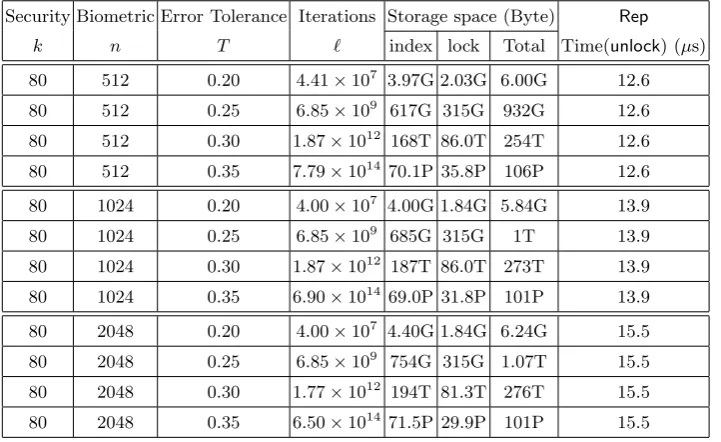
Table 1: Security, storage space and time consumption withδ= 1/2,κ= 128, SHA2-224. Security Biometric Error Tolerance Iterations Storage space (Byte) Rep
k n T ` index lock Total Time(unlock) (µs)
80 512 0.20 4.41×10⁷ 3.97G 2.03G 6.00G 12.6
80 512 0.25 6.85×10⁹ 617G 315G 932G 12.6
80 512 0.30 1.87×10¹² 168T 86.0T 254T 12.6
80 512 0.35 7.79×10¹⁴ 70.1P 35.8P 106P 12.6
80 1024 0.20 4.00×10⁷ 4.00G 1.84G 5.84G 13.9
80 1024 0.25 6.85×10⁹ 685G 315G 1T 13.9
80 1024 0.30 1.87×10¹² 187T 86.0T 273T 13.9
80 1024 0.35 6.90×10¹⁴ 69.0P 31.8P 101P 13.9
80 2048 0.20 4.00×10⁷ 4.40G 1.84G 6.24G 15.5
80 2048 0.25 6.85×10⁹ 754G 315G 1.07T 15.5
80 2048 0.30 1.77×10¹² 194T 81.3T 276T 15.5
80 2048 0.35 6.50×10¹⁴ 71.5P 29.9P 101P 15.5
In Table 1, we present security, storage space, and time required for each unlock with concrete pa-rameters.8The maximum required time ofRepis`×Time(unlock). As fully carrying out all`iterations
ofRepis unfeasible for most parameter sets due to the large storage space requirements, we ranRepfor a much smaller number of iterations and computed the average running time for each single iteration of Repand measured the storage memory theoretically.
The form of digital lockers are the same for all cases, and time forunlockchanges little by input size. Note that the iteration`and Storage space highly (exponentially) depends onT, but not onn.
4
Our Construction and Analysis
Note that, in Canetti et al. ’s scheme, tk = cnlogn and l ≈ nclog2
δ give large ` values, leading to
large storage space forT ∈[0.2,0.35]. One easy strategy for reducing memory requirements is reducing k. However, a smallerk value implies less security, since an adversary can easily unlocklock(key,val) if k=|key|is small.
We solve this problem by preventing adversaries from checking their guesses on each individual lock. For this purpose, we use a modified digital locker (lock0,unlock0). It is a symmetric encryption scheme very similar to the original digital locker except for one difference; unlock0 outputs a random string 7 In fact, we should take the size of nonce so that the resulting locker is`-composable, i.e., no collision occurs
among`nonces. In our cases, 144(=224-80) bit is sufficient for the size of nonce.
instead of⊥whenkey06=key. With this modified digital locker, adversaries can not check whether their guesses are right or not, since they can not distinguish a random string fromvalin our construction.
However, a fuzzy extractor must output⊥when the input is not legitimate. We additionally exploit a (τ, m)-threshold scheme to enable legitimacy checking. More precisely, we encrypt each share with the modified lock, so that the adversary can recover the original secretsonly if he or she has foundτor more correct shares by unlocking correspondinglock0s with their correct keys. Then, the legitimacy check of the recovered secrets0 is done byunlock(s0,lock(s, r)).
4.1 Construction
The details of our construction are as follows. First, the modified digital locker can be instantiated as the original digital locker with the reduction of the zero-padding portion, i.e., lock0(key,val) := (nonce, π◦ H(nonce,key)⊕val) forval ∈ {0,1}v and key ∈ {0,1}k, where π: {0,1}µ −→ {0,1}v is the canonical
projection of the firstvbits of vectors in{0,1}µ, the output space of hashH.Unlock0is similar tounlock, XORing (⊕) lock0 with π◦H(nonce,key0). The notion of security for the modified digital locker is the same as that of the original digital locker, except that if key0 6=key, unlock0(key0,lock(key,val)) outputs val0 6=valwhich is indistinguishable from a uniformly random string. H can be a random oracle or the same cryptographic hash functionH as in the original digital locker.
The Gen algorithm takes as input a bit string w with length n. For a divisor d of n,9 we consider
the set Pd(n) of partitionsP ={Bj:|Bj|=d} m
j=1 of [n] ={1, . . . , n} where m=n/d.
10 For a partition
Pi ∈ Pd(n), we denote vi,j = wBj := wj1, . . . , wjd, where Bj = {j1, . . . , jd} ∈ Pi. We first choose a
random stringr∈ {0,1}κ and lock it with a random secrets
i∈ {0,1}k resulting inlock(si, r).11
Next we split this si into several shares {si,j}mj=1 using the Distribution Algorithm DAτ,m of the
(τ, m)−threshold scheme. We now choose a random partition Pi ∈ Pd(n), which specifies vi,j’s for
j= 1, . . . , m. Finally, lock the sharessi,jwith the substringsvi,jofwusing the modified locker, resulting
in lock0(vi,j, si,j). We iterate this process N times, and output the public helper value which can be
represented by{lock(si, r),lock0(vi,j, si,j)|mj=1,Pi}Ni=1.
TheRepalgorithm is simple. Each partitionPiin the helper value specifiesv∗i,j’s from the inputw∗.
Unlock all modifiedlock0(vi,j, si,j)’s withvi,j∗ ’s. Finally, use Recovery AlgorithmRAτ,mto recoversifrom
s∗i,j, and check if the recovered s∗i is correct by unlocking lock(si, r). Output r if at least one of such
unlocks was successful, and output⊥otherwise.
Algorithm 2: GenandRepof our RFE
Gen Rep
Input:w=w1. . . wn Input:w∗=w1∗. . . w
∗
n,p= (p1. . . pN) 1. Sampler←− {$ 0,1}κ
2. Fori= 1, . . . , N 1. Fori= 1, . . . , N
(i) ChoosePi∈Pd(n) and samplesi $
←− {0,1}k (i) Parsep
iasci,1, . . . , ci,m,Pi, di (ii) si,1, . . . , si,m←DAτ,m(si) wherem=n/d (ii) Forj= 1, . . . , m
(iii) forj= 1, . . . , m (ii)-1v∗i,j=w
∗
Bj where{B1, . . . , Bm}=Pi
(iii)-1vi,j=wBj where{B1, . . . , Bm}=Pi (ii)-2s∗i,j←unlock
0
(vi,j∗ , ci,j)
(iii)-2ci,j←lock0(vi,j, si,j) (iii) For each subsetS of{s∗i,j}mj=1with cardinalityτ, (iv)di←lock(si, r) (iii)-1s∗i ←RAτ,m(S)
(v) pi←ci,1, . . . , ci,m,Pi, di (iii)-2ri∗←unlock(s∗i, di), and ifri∗6=⊥then outputri∗. 3. Output (r, p) wherep= (p1. . . pN) 2. Output⊥
9
We can also consider a divisordofn0≤n, and follow the construction takingn0 instead ofn.
10For convenience, we only consider the partitions whose elements have the same cardinality. An analogous
statement can be made for more general partitions.
11Note that, in (τ, m) threshold scheme, the size of secretkisD(m
4.2 Parameters and security analysis
Correctness and security. To ensure correctness of the FE, the parameters must satisfy FRR:= Pr[⊥←Rep(w∗)|dis(w, w∗)≤t]≤δ.
To compute this probability, for fixedPi andw∗withdis(w, w∗) =t, let
q= Pr
s=s∗i|s∗i ←RAτ,m(S) for some S∈Pτ({s∗i,j} m j=1)
. (1)
Note that q is independent from the index i. Then, FRR is at most (1−q)N +N ·γ considering
incorrectness arising from errorγ in the lockers. As in3.4we ignoreN·γ and set (1−q)N ≈1−qN . δ= 1/2
Here, we state a lemma calculating the exact value ofq. A proof is given in the appendix.
Lemma 4 Let M={0,1}n be the input space of the reusable fuzzy extractor in Construction with
pa-rameters n, d, λ, τ, δ, t as previously defined. For an input w = w1w2. . . wn, let (r, p) ←Gen(W). If a
certifier has a query inputw∗=w∗
1. . . w∗n withdis(w, w∗) =t,
q:= Pr(ri∗=r) =
τmCτ nCt
m
X
η=τ
(−1)η−τ· m−τCη−τ×n−ηdCt
η for alli= 1, . . . , N.
Here aCb denotes the usual binomial coefficient b!(aa−!b)! for integers a,b such that 0≤b≤a.
We can easily see that our fuzzy extractor is reusable, as is Canettiet al. ’s.
Theorem 5 Let λbe a security parameter andW be a family of sources withα-entropyk-samples over
Zn whereα=ω(logλ). Then for anys
sec=poly(λ)there exists ansec=ngl(λ)such that Construction
is a(Zn,W, κ, t)- computational fuzzy extractor that is(
sec, ssec)-hard with errorδ= (1−q)N+mN·γ,
where the formula forq is given in Lemma4.
Proof. The proofs for correctness and security are analogous to those of [9] and are in the appendix.
Reusability. As in [9], reusability follows easily from the security of digital lockers. To enable ρ reuses, we need N(m+ 1)·ρ composable digital lockers. Then we can simulate an adversary given r1, . . . , ri−1, ri+1, . . . , rρ, andp1, . . . , pρas a simulator withr1, . . . , ri−1, ri+1, . . . , rρas auxiliary input in the security of digital locker (see Definition3). Now, we can prove the reusability similarly to Theorem
5.
Theorem 6 Fixρand let all the variables be as in Theorem5, except that(lock,unlock)isN(m+ 1)·ρ
- composable instead of N(m+ 1) - composable12 (for κ-bit values and keys over Zk). Then for all
ssec = poly(n) there exists some sec =ngl(n) such that Construction is a (ρ, sec, ssec)-reusable fuzzy
extractor.
Comparison with [9]. In Canettiet al.’s work [9], they used the subsets of strings (biometrics) to lock and take multiple samples for correctness. However, for reliable error tolerance, they required too many samples, resulting in the use of enormous amounts of memory space as displayed in Table1. We divide said subsets into small pieces and use the threshold scheme to diminish storage space requirement. As a result, our scheme consumes more time as it requires multipleRAoperations in recovering the secret. We will show that this can be resolved through the use of parallel computing. In [9], the source ofwneeded to beα-entropy k-samples, i.e., ˜H∞(Wj1Wj2. . . Wjk|j1, j2, . . . jk) ≥αfor k uniformly random indices
1≤j1, j2, . . . , jk ≤n. Our construction requires a slightly different condition regarding the distribution
of the source : ˜H∞(Wj1Wj2. . . Wjk|j1, j2, . . . jk)≥αforkuniformly random indices 1≤j1, j2, . . . , jk≤n
selected without repetition.
4.3 Analysis on concrete parameters
To analyze our scheme as in3.4 with concrete parameters, we calculated the storage space and number of operations needed when employing Kurihara et al. ’s threshold scheme. We set δ = 1/2, κ = 128, T = nt = 0.2,0.25,0.3, ˜k:=τ d≥λ= 80 and used SHA2-224 as the hash function as in section3.4.
Security. To recoverr, an adversary equipped with helper valuepmust correctly guess at leastτ of the d−bit keys forlock0’s. Therefore, τ·d should be at leastλ= 80, the security parameter. (Note that as in Canettiet al. ’s scheme, we should consider the min-entropy of the partial biometric of lengthτ d.)
Iteration number. For given T = nt, ˜k=τ d, andδ= 0.5, we can find iteration number N such that FRR≤(1−q)N +N·γ≤0.5 whereqis defined in Lemma4. As in section3.4, N γ is negligible.
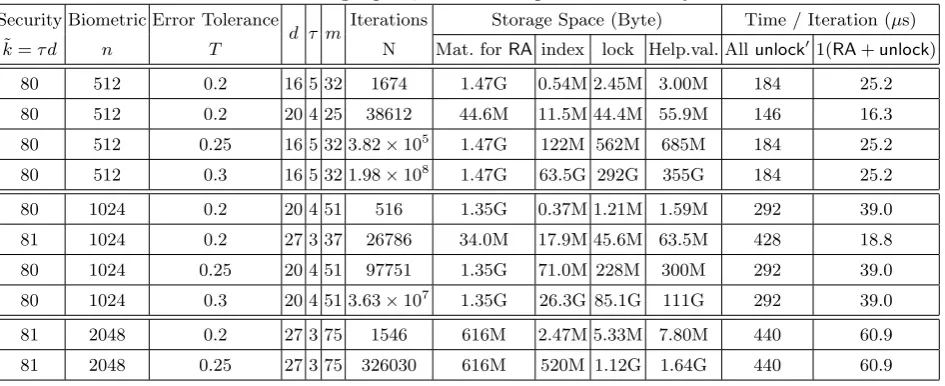
Storage space. The helper value pagain consists of two parts; indices and digital lockers. Indices for each iteration indicate which amongmsets in a partition of [n] each biometric bit belongs to, and take up roughly (nlogm)-bits of memory space. The size of a locker (of either type) is the sum of the output size 224 bits of hash function SHA2-224 and that of the nonce in the hash input which is 144 bits. Since we needm+ 1 lockers (1 forlock(si, r)) each for a total ofNiterations, the total memory required forpis
N·(nlogm+(224+144)·(m+1)) bits. This is denoted as “Help.val.” in Table2. For efficient computation of the secret sharing scheme, we will additionally store mτ
precomputed (mp−1)×τ(mp−1) binary
matrices needed for each of the mτ
recovery algorithms. The matrices are reused for all N iterations. The amount of memory space dedicated to these matrices is denoted as “Mat. forRA” in Table2.
Time consumption. We implemented our fuzzy extractor in the same environment as in Section3.4. Here we give a table for the required storage space, time consumption, and security of our reusable fuzzy extractor. Again, we did not run the program for allN iterations, but instead ran it for a smaller number of iterations multiple times to obtain average values of the time costs of theunlock0 and (RA+ unlock) operations. “Allunlock0 ” denotes the time for (ii), and “1(RA+unlock)” denotes the time for each subsetS in (iii) ofRep(Algorithm2).
Table 2: The table for the storage space, time consumption and security of our scheme. Security Biometric Error Tolerance
d τ m Iterations Storage Space (Byte) Time / Iteration (µs) ˜
k=τ d n T N Mat. forRA index lock Help.val. Allunlock01(RA+unlock)
80 512 0.2 16 5 32 1674 1.47G 0.54M 2.45M 3.00M 184 25.2
80 512 0.2 20 4 25 38612 44.6M 11.5M 44.4M 55.9M 146 16.3
80 512 0.25 16 5 32 3.82×10⁵ 1.47G 122M 562M 685M 184 25.2
80 512 0.3 16 5 32 1.98×10⁸ 1.47G 63.5G 292G 355G 184 25.2
80 1024 0.2 20 4 51 516 1.35G 0.37M 1.21M 1.59M 292 39.0
81 1024 0.2 27 3 37 26786 34.0M 17.9M 45.6M 63.5M 428 18.8
80 1024 0.25 20 4 51 97751 1.35G 71.0M 228M 300M 292 39.0
80 1024 0.3 20 4 51 3.63×10⁷ 1.35G 26.3G 85.1G 111G 292 39.0
81 2048 0.2 27 3 75 1546 616M 2.47M 5.33M 7.80M 440 60.9
81 2048 0.25 27 3 75 326030 616M 520M 1.12G 1.64G 440 60.9
In our FE,Reptakes at mostN· mτ
·Time(RA+unlock) +Time(Allunlock0)
time. The maximum time forGenisN· Time(DA+lock) +Time(Alllock0)
.13
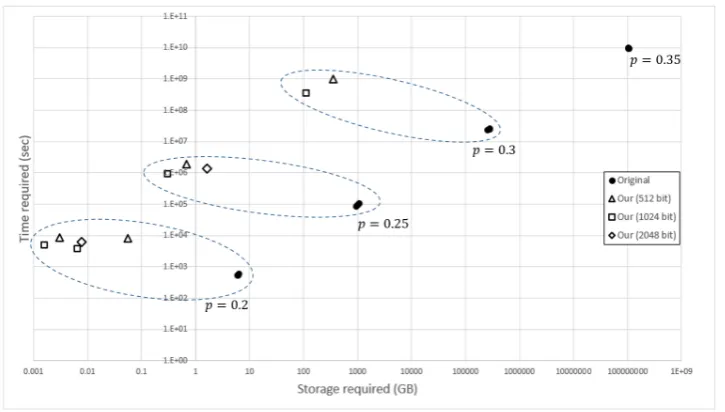
We visualized the trade-off between time and helper value storage space in Fig. 1.14 Every point in the figure comes from either Table1 or Table2. The amount of required memory tends to decrease by 13SinceTime(RA)≈Time(DA), maximal time ofRepis much bigger than that ofGen, and we only consider the
time ofRep.
14 The space for “Mat. for DA” is excluded since it is a common data for every users. It doesn’t affect the
a factor of approximately 103, i.e. from GB to MB(or TB to GB) whenever time consumption increases tenfold. Although time consumption seems impractical for both FEs, this can be solved with parallel computing methods since Rep consists of mutually independent iterative routines. We actually imple-mented our scheme with parallel computing using CUDA as proof of this (though not optimized), and the obtained positive results. We compiled CUDA and C++(test driver) codes using nvcc v7.5.17 with the SM53 architecture and under the C++ 11 standard. Then we ran the program on the aforemen-tioned GNU/Linux machine with the same CPU, with an additional NVIDIA GeForce GTX 1080 GPU attached for the parallel computing. For the case (n, p, d, τ, m) = (1024,0.2,27,3,37), the algorithmRep takes only 151 seconds, which is 20 times faster than without parallelization.
Fig. 1: A log-scaled graph of storage space for helper values and time (Original and Ours)
5
Conclusion
We analyzed the reusable fuzzy extractor of Canettiet al.with concrete parameters regarding iris authen-tication with IrisCode and found out that the required storage space is too large to be used in practice. To solve this problem, we propose a modified reusable fuzzy extractor using a perfect threshold scheme. Our modification cuts down the memory cost by a considerable amount. Though this approach yields a trade-off between memory and time costs, this can be resolved through parallel computing, sinceRep consists of independent subroutines. When fully parallelized, our scheme reduces memory requirements from GB or TB to MB in many cases, while still operating in reasonable time.
Acknowledgements.The authors would like to thank the anonymous reviewers of ACISP 2018 for their valuable comments. This work were supported by Samsung Electronics, Co., Ltd. (No. 0421-20150074).
References
1. Erkin, Z., Franz, M., Guajardo, J., Katzenbeisser, S., Lagendijk, I., Toft, T.: Privacy-preserving face recog-nition. In: Privacy Enhancing Technologies, 9th International Symposium, PETS 2009. Proceedings, pp. 235–253 (2009). doi:10.1007/978-3-642-03168-7 14
2. Kulkarni, R., Namboodiri, A.M.: Secure hamming distance based biometric authentication. In: International Conference on Biometrics, ICB 2013, pp. 1–6 (2013). doi:10.1109/ICB.2013.6613008
3. Karabat, C., Kiraz, M.S., Erdogan, H., Savas, E.: THRIVE: threshold homomorphic encryption based se-cure and privacy preserving biometric verification system. EURASIP J. Adv. Sig. Proc. 2015, 71 (2015). doi:10.1186/s13634-015-0255-5
5. Dodis, Y., Reyzin, L., Smith, A.D.: Fuzzy extractors: How to generate strong keys from biometrics and other noisy data. In: Advances in Cryptology - EUROCRYPT 2004, International Conference on the Theory and Applications of Cryptographic Techniques, pp. 523–540 (2004). doi:10.1007/978-3-540-24676-3 31
6. Dodis, Y., Ostrovsky, R., Reyzin, L., Smith, A.D.: Fuzzy extractors: How to generate strong keys from biometrics and other noisy data. SIAM J. Comput.38(1), 97–139 (2008). doi:10.1137/060651380
7. Apon, D., Cho, C., Eldefrawy, K., Katz, J.: Efficient, reusable fuzzy extractors from lwe. In: International Con-ference on Cyber Security Cryptography and Machine Learning, pp. 1–18. Springer (2017). doi: 10.1007/978-3-319-60080-2 1
8. Fuller, B., Meng, X., Reyzin, L.: Computational fuzzy extractors. In: International Conference on the Theory and Application of Cryptology and Information Security, pp. 174–193. Springer (2013). doi: 10.1007/978-3-642-42033-7 10
9. Canetti, R., Fuller, B., Paneth, O., Reyzin, L., Smith, A.D.: Reusable fuzzy extractors for low-entropy distributions. In: Advances in Cryptology - EUROCRYPT 2016 - 35th Annual International Conference on the Theory and Applications of Cryptographic Techniques, pp. 117–146 (2016). doi: 10.1007/978-3-662-49890-3 5
10. Boyen, X., Dodis, Y., Katz, J., Ostrovsky, R., Smith, A.: Secure remote authentication using biometric data. In: Annual International Conference on the Theory and Applications of Cryptographic Techniques, pp. 147–163. Springer (2005). doi:10.1007/11426639 9
11. Dodis, Y., Kanukurthi, B., Katz, J., Reyzin, L., Smith, A.D.: Robust fuzzy extractors and authenti-cated key agreement from close secrets. IEEE Trans. Information Theory 58(9), 6207–6222 (2012). doi:10.1109/TIT.2012.2200290
12. Shamir, A.: How to share a secret. Communications of the ACM (11), 612–613 (1979). doi:10.1145/359168.359176
13. Blakley, G.R.: Safeguarding cryptographic keys. In: Proc. AFIPS 1979 National Computer Conference, pp. 313–317 (1979). doi:10.1109/AFIPS.1979.98
14. Ishizu, H., Ogihara, T.: A study on long-term storage of electronic data. In: Proc. IEICE General Conf., D-9-10, 1, p. 125 (2004)
15. Fujii, Y.: A fast (2, n)-threshold scheme and its application. Proc. CSS2005 pp. 631–636 (2005)
16. Kurihara, J., Kiyomoto, S., Fukushima, K., Tanaka, T.: A fast (3, n)-threshold secret sharing scheme using exclusive-or operations. IEICE transactions on fundamentals of electronics, communications and computer sciences91(1), 127–138 (2008). doi:10.1093/ietfec/e91-a.1.127
17. Kurihara, J., Kiyomoto, S., Fukushima, K., Tanaka, T.: A new (k, n)-threshold secret sharing scheme and its extension. Information Security pp. 455–470 (2008). doi:10.1007/978-3-540-85886-7 31
18. Canetti, R., Kalai, Y.T., Varia, M., Wichs, D.: On symmetric encryption and point obfuscation. In: Theory of Cryptography Conference, pp. 52–71. Springer (2010). doi:10.1007/978-3-642-11799-2 4
19. Lynn, B., Prabhakaran, M., Sahai, A.: Positive results and techniques for obfuscation. In: International confer-ence on the theory and applications of cryptographic techniques, pp. 20–39. Springer (2004). doi: 10.1007/978-3-540-24676-3 2
20. Canetti, R., Dakdouk, R.R.: Obfuscating point functions with multibit output. In: Advances in Cryptology -EUROCRYPT 2008, 27th Annual International Conference on the Theory and Applications of Cryptographic Techniques, Proceedings, pp. 489–508 (2008). doi:10.1007/978-3-540-78967-3 28
21. Hollingsworth, K.P., Bowyer, K.W., Flynn, P.J.: Improved iris recognition through fusion of hamming distance and fragile bit distance. IEEE transactions on pattern analysis and machine intelligence33(12), 2465–2476 (2011). doi:10.1109/TPAMI.2011.89
22. Daugman, J.: Probing the uniqueness and randomness of iriscodes: Results from 200 billion iris pair compar-isons. Proceedings of the IEEE94(11), 1927–1935 (2006). doi:10.1109/JPROC.2006.884092
23. Desoky, A.I., Ali, H.A., Abdel-Hamid, N.B.: Enhancing iris recognition system performance using templates fusion. Ain Shams Engineering Journal3(2), 133–140 (2012). doi:10.1109/ISSPIT.2010.5711758
A
The Proof of Theorems
Lemma 4 LetM={0,1}nbe the input space of the reusable fuzzy extractor in Construction with
param-etersn, d, λ, τ, δ, t defined as in Parameter Setting. For an inputw=w1w2. . . wn, let(r, p)←Gen(W).
If a certifier has a query input w∗=w1∗. . . wn∗ with dis(w, w∗) =t,
q:= Pr(ri∗=r) =τmCτ
nCt m
X
η=τ
(−1)η−τ· m−τCη−τ×n−ηdCt
η for alli= 1, . . . , N.
Proof. LetAj be the set of events withr∗i,j=ri,j, which is also the set of events withv∗i,j=vi,j. Let us
define AJ :=Tj∈JAj, A∗J :=AJ∩(Tj∈G−JA{j) for any subsetJ of the index set G:={1,2, . . . , m},
and denote byGη the family of allη-element subsets ofGforη= 1, . . . , m.
Forη=τ, . . . , m, and J={g1, . . . , gη} ∈ Gη, we have
Pr(AJ) = Pr(Ag1∩. . .∩Agη) =
n−ηdCt nCt
,
sinceAg1∩. . .∩Agη is equal to the set of events in which alltof the indicesjsuch thatwj 6=w
∗
j belong
to the m−η boxes in {Bg|g /∈ {g1, . . . , gη}}. Also, as a consequence of the definitions ofAJ andA∗Q,
and that all of the set of eventsA∗Q are exclusive, we have
Pr(AJ) =
X
J⊆Q⊆G
Pr(A∗Q).
From our use of the (τ ,m) - threshold scheme, the set of events in whichr∗i =ri is the union of allAJ
for whichJ ⊂Gand|J|≥τ, which in turn is the disjoint union of allAQ for whichQ⊂Gand|Q|≥τ,
and thus
q= X
Q⊂G
|Q|≥τ
Pr(A∗Q).
From the symmetry between elements ofGη, the cardinality of which is|Gη|=mCη, we can deduce that
X
J∈Gη
Pr(AJ) =mCη·
n−ηdCt nCt
.
Combining this with
τ·mCτ×m−τCη−τ
η =η−1Cτ−1×mCη forη=τ, . . . , m,
we can observe that the rightmost side of the equation in the lemma statement is equal to 1
nCt m
X
η=τ
(−1)η−τ·η−1Cτ−1×mCη×n−ηdCt= m
X
η=τ
[(−1)η−τ·η−1Cτ−1·
X
J∈Gη
Pr(AJ)]
=
m
X
η=τ
(−1)η−τ·η−1Cτ−1·
X
J∈Gη X
J⊂Q
Pr(A∗Q)
= X
Q⊂G
|Q|≥τ
X
J⊂Q
|J|≥τ
(−1)|J|−τ·
|J|−1Cτ−1
Pr(A∗Q)
= X
Q⊂G
|Q|≥τ
|Q|
X
η=τ
(−1)η−τ·
η−1Cτ−1×|Q|Cη
Pr(A∗Q),
the third equation following from simple double counting. Thus it follows from the identity of the following LemmaA.1
x
X
η=τ
(−1)η−τ·
η−1Cτ−1×xCη= 1 forx=τ, τ+ 1, . . . , m
that the coefficients of Pr(A∗Q) in the previous equation are all 1, and therefore that the rightmost side of the equation is indeed equal toq=P
Q⊂G
|Q|≥τ
Lemma A.1 For any integerx≥τ, we have
x
X
η=τ
(−1)η−τ·
η−1Cτ−1×xCη= 1.
Proof. Simple computations regarding the binomial coefficients in the left hand side give us
x
X
η=τ
(−1)η−τ·η−1Cτ−1·xCη=x×x−1Cτ−1·
x
X
η=τ
(−1)η−τ
η ·x−τCη−τ.
Integrating the generating functionf(y) =yτ−1(1−y)x−τ =Px
η=τ(−1) η−τ·
x−τCη−τ·yη−1, we have
Z y
0
f(z)dz=
x
X
η=τ
(−1)η−τ
η ·x−τCη−τ·y
η,
and takingy= 1, we arrive at
x
X
η=τ
(−1)η−τ
η ·x−τCη−τ=
Z 1
0
f(z)dz.
Using integration by parts results in
Z 1
0
yτ−1(1−y)x−τdy= τ−1 x−τ+ 1
Z 1
0
yτ−2(1−y)x−τ+1dy,
the repeated use of which leads to
Z 1
0
yτ−1(1−y)x−τdy=. . .= (τ−1)· · ·1 (x−τ+ 1)· · ·(x−1)
Z 1
0
(1−y)x−1dy= 1 x×x−1Cτ−1
,
which in turn implies our desired result. ut
Theorem 5 Letλbe a security parameter andWbe a family of sources withα-entropyk-samples15over
Zn whereα=ω(logλ). Then for anys
sec=poly(λ)there exists ansec=ngl(λ)such that Construction
is a(Zn,W, κ, t)- computational fuzzy extractor that is(
sec, ssec)-hard with errorδ= (1−q)N+mN·γ,
where the formula forq is given in4.
Proof. Correctness follows from Lemma4.
The security proof is almost the same as the proof of Canettiet al.’s [9], except that we additionally considerlock0 and recovery algorithm (RA) of the threshold scheme. We assume thatRAis given to the distinguisher and simulator though we don’t denote it explicitly.
Let R, P be the random variables onr, and the public helper value, respectively. U is a uniformly random variable over{0,1}κ. For the proof, we will show that for alls
sec=poly(λ), there existssec=
ngl(λ) such thatδDssec((R, P),(U, P))≤
sec.In other words, we need to bound|E[D(R, P)]−E[D(U, P)]| by a negligible function p(1λ) for some polynomialp(·). We will denoteD=Dssec from now on.
First, we can substitute the distinguisherDby an unbounded simulatorS with the security of digital lockers (Definition 3). That is, there is a polynomial q(·) and an unbounded time simulator S, which makes at mostq(λ) queries to the oraclesidealUnlock(si, r)
N
i=1, such that
E[D(R, P)]−E h
SidealUnlock(si,r)Ni=1 R,{lock0
i,j| m
j=1,Pi}Ni=1, k, κ
i
≤
1 3p(λ), wherelock0i,j=lock0(vi,j, si,j). Note that this is also true forR substituted byU.
15
Now, we claim that
E
h
SidealUnlock(si,r)Ni=1 R,{lock0
i,j| m
j=1,Pi}Ni=1, k, κ
i
−E
h
SidealUnlock(si,r)Ni=1 U,{lock0
i,j| m
j=1,Pi}Ni=1, k, κ
i
≤
1 3p(λ).
GivenidealUnlock, the only way ofSto distinguishr∈Randu∈U is to queryidealUnlockand get a non-⊥response, which is equivalent to correctly guessingsi ofidealUnlock(si,r). Unbounded simulatorScan guesssidirectly or by guessing the sharesi,j ofsiwithlock0d,k,µ(vi,j, si,j). Note that we exploitedperfect
(τ, m)-threshold scheme so thatH(Si|Si,j, j∈J) =H(Si) ifJ contains elements less thanτ. In other
words,Smust correctly guessτ si,j’s to findsiusingRAorSgets no advantage over randomly(uniformly
random) guessingsi. Guessingτ si,j’s withlockd,k,µ0 (vi,j, si,j) is equivalent to guessingτ vi,j’s. Note that
our construction satisfies dτ ≥k, and guessing τ of the vi,j’s is at least harder than guessingk bits of
the partial biometrics. The argument regarding the probability of guessingk bits of partial biometrics correctly when givenq(λ) queries onidealUnlockis the same as in the proof of Lemma 1 in [9].
First, we modify S slightly so that it quits immediately after getting a non-⊥answer.16 Then, the view ofSonqor less queries haveq+1 values. (qvalues of getting a non-⊥answer on thei-th query, and 1 value of getting all⊥answers.) By Lemma 2.2b in [6], ˜H∞(Vi|V iew(S), ji,j)≥H˜∞(Vi|ji,j)−log(q+ 1)≥
α−log(q+ 1).Therefore, at each query, the probability thatSgets a non-⊥answer is at most (q+ 1)/2α. Since there areqqueries ofS, the overall probability is bounded byq(q+ 1)/2α. Now,α=ω(logλ) gives
q(q+1) 2α ≤
1
3p(λ), and the claim holds. ut
16