Technology (IJRASET)
Study of Various Performance Parameters of Wire
Electrical Discharge Machining For H11 Using
Taguchi L16 Array
Harshdeep1, Ishu Monga2
1,2
Department of Mechanical Engineering, PPIMT, HISAR (INDIA)
Abstract: The main goals of wire electrical discharge machine manufacturers and users are to achieve a better stability and high productivity of the process with desired accuracy and minimum surface damage and experimentally study the response of various input parameters like pulse on time, pulse off time, wire feed, wire tension and peak current on the performance parameters like material removal rate, surface flatness and wire wear ratio. In the present experimental work, Experiments were performed as per Taguchi’s L’16 mixed orthogonal array. All experiments were performed under different working conditions by changing the values of pulse on time, pulse off time, wire feed and wire tension, peak current. H11 steel grade was selected as a work material. The study concludes that the wire electrical discharge machining process parameters can be adjusted to achieve better metal removal rate, wire wear ratio and good surface flatness
Key words:-WEDM, MRR, WRR, SF, Mean of Mean, Taguchi L16 OA, Zinc coated wire.
I. INTRODUCTION
It was introduced in the late 1960s', and has revolutionized the tool and die, mold, and metal working industries. It is probably the most exciting and diversified machine tool developed for this industry in the last fifty years, and has numerous advantages to offer [17]. Wire electrical discharge machining (WEDM) technology has grown tremendously .In 1974, D.H. Dulebohn applied the optical line follower system to automatically control the shape of the components to be machined by the WEDM process. By 1975, its popularity rapidly increased, as the process and its capabilities were better understood by the industry. It was only towards the end of the 1970s, when computer numerical control (CNC) system was initiated into WEDM, which brought about a major evolution of the machining process.
Wire electrical discharge machining is a thermal energy method of Non-Traditional Machining Methods (NTMM). In WEDM material is eroded from the job by a series of discrete sparks occurring between the electrode wire and job, separated by a dielectric fluid, which is continuously fed at the point of liberation of high amount of thermal energy [4].
Now a day’s WEDM is a NTMM for machining of all types electrically conductive materials used in industry such as metals, metallic alloys or even some ceramic materials of any hardness . A wire which is in vertical position is fed in to the work material continuously from a supply spool to a take up spool [6]. A computer controlled positioning system is also used to maintain the gap between the tool and the work material which varies from 0.025 to 0.050 mm. the diameter of wire electrode ranges from 0.05 to 0.25 mm and its value depends upon the controlled process parameter [7,8].
This process is widely used for burr free intricate shapes which is too difficult with other conventional machining methods. It has capability of generating profile with high degree of dimensional accuracy without making any mechanical contact between tool (wire electrode) and work piece. Good surface finish with low thermal affected zone depth are obtained which minimize manual finishing operation time and fewer finishing operations are required for further finishing only in that cases in which surface finish is the primary importance. In this machining, job is not submerged in dielectric fluid as in case of electric discharge machining (EDM).
II. LITERATURE REVIEW
After a comprehensive study of the existing literature, a number of gaps have been observed in machining of WEDM Researcher always striving for better performance in terms of productivity and surface quality of components during manufacturing on WEDM but due to its applications accuracy and capability in cutting complex job its full utilization yet to be achieved.
Technology (IJRASET)
flushing pressure of water dielectric, wire feed, wire tension, spark gap set voltage, servo feed and cutting speed [13, 10]. The performance of the machine can be judged in terms of work specific output parameters like wire wear ratio, material removal rate and surface flatness. These parameters are uncontrollable parameters, but they can be optimized by selecting a suitable range of input parameters [3, 10].
In this present investigation we highlight the inter relationship of five process parameters (pulse on time, pulse off time, wire feed, wire tension, Peak current) to the response parameter (Material removal rate, wire wear ratio and surface flatness).In this experimental work number of experiment has been made to optimize the multiple performance characteristics of the WEDM and a finally a single setting of the input parameters has been suggested.
Previous work also shows that selection of good wire electrode is essential. The most common electrode used in WEDM are copper, brass and tungsten [11, 13, 23]. Copper wire has comparatively low mechanical strength and low working speed. Brass wires have poor workability and surface finish. The disadvantage of the molybdenum wire electrodes lies in its poor discharge capability. Tungsten wire electrodes are relatively costly.
The researchers have worked on above short comings and used various techniques like layered structure, coating, super quenching, electroplating, galvanizing etc for the performance improvement. But every treatment has its own limitations; some studies have proved that high processing speed requires strong mechanical strength and good electric conductivity of wire electrodes. However, it is found that metallic materials having a high mechanical strength generally shows a low electrical conductivity and vice versa. Hence it is very hard to obtain all the characteristics like high processing speed, improved accuracy of the work piece with a good surface condition. Finally to get best machining conditions, wire electrode must have a good electrical conductance, so that high machining current can flow thorough the electrode. In the present study, the zinc coated copper wire electrode is used as the best compromise of above complex needs [3, 15].Wire diameter should also be considered when cutting speed is critical [14]. Since smaller diameter wires cannot carry as much current, use the largest diameter wire possible for maximum speed.
III. EXPERIMENT WORK
Pulse on time, Pulse off time, wire feed, wire tension and Peak current are selected as a process parameter for the present investigation. Selection of process parameters and their range are based on the pilot experiments and literature survey. Those process parameters are selected for further investigation whose influence is more on the machining characteristics. In this present investigation we studied the effect of various process parameters (pulse on time , pulse off time ,wire tension, wire feed and peak current on various response parameters (material removal rate , wire wear ratio, surface flatness) for WEDM Sodick A320D Model. A suitable range has to be selected for these process parameters. The selection of these parameters and design play a vital to obtain an optimum condition. For present experimental work we use Taguchi Method Mean and Mean approach.L16 orthogonal array, four levels for each experiment has been selected as suggested by Taguchi. The response value obtained from experiment and performance measure from by using orthogonal and plotted with reference to mean value and finally a optimum condition were found.
Performance measures are characteristics whose variations have a significant effect on quality. The performance characteristics for WEDM process are discussed below.
A. Material removal rate
Material removal rate is the duration in which material is removed from the work piece in a given span of time. Mathematically, it can be given by
MRR = Cs x L mm²/min.
B. Wire wear ratio
Wire wear ratio is the ratio of weight loss of wire during machining to the initial wire weight. It can be expressed as
WWR = WWL / IWW
Technology (IJRASET)
C. Surface Roughness (SR)Roughness plays an important role in determining how a real object will interact with its environment. It is quantified by the vertical deviations of a real surface from its ideal form.
D. Selection of range of parameters
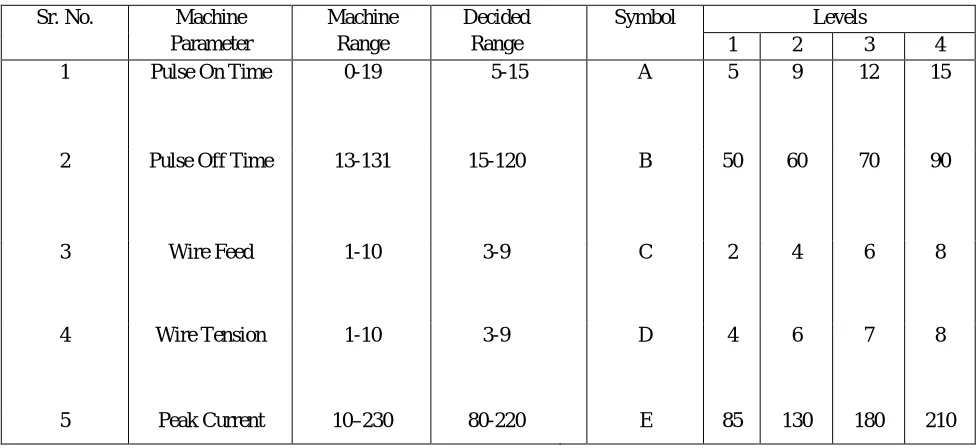
[image:4.612.62.552.210.434.2]The process parameter is a parameter whose variation has a critical effect on performance measures and product quality. Input process parameters have been chosen on the basis of literature survey and pilot experiments. Selected range of process parameters for WEDM is given in Table 1.
Table 1: Input parameters range
Sr. No. Machine
Parameter
Machine Range
Decided Range
Symbol Levels
1 2 3 4
1 Pulse On Time 0-19 5-15 A 5 9 12 15
2 Pulse Off Time 13-131 15-120 B 50 60 70 90
3 Wire Feed 1-10 3-9 C 2 4 6 8
4 Wire Tension 1-10 3-9 D 4 6 7 8
5 Peak Current 10–230 80-220 E 85 130 180 210
IV. RESULT AND DISCUSSION
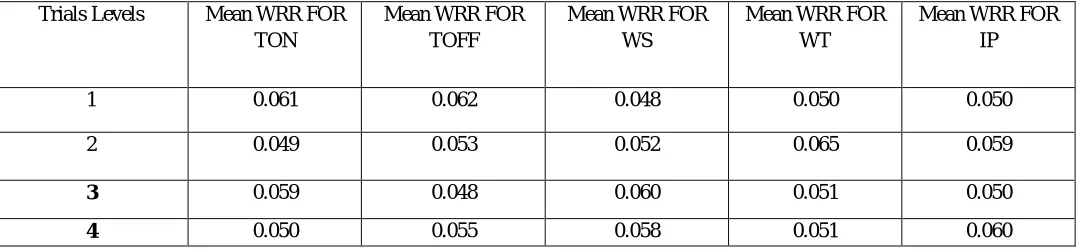
This chapter gives the optimum condition of various input parameters on response parameters of WEDM. Which we have obtained experimentally. The scheme of carrying out experiment has selected initially and the experiments have conducted to investigate the effect of process parameters on machining characteristics. The result comes from experimental trials by calculating their means of means. The optimum condition for different performance parameters has been calculated by getting their response to the various combinations of the input parameters. Obtained result corresponding to various process parameters at different levels are shown in Table 2.1, 2.2, 2.3.
Table 2.1: Mean response of material removal rate at different level of Ton, Toff, WS, WT and IP
Trials Levels Mean MRR FOR
TON
Mean MRR FOR TOFF
Mean MRR FOR WS
Mean MRR FOR WT
Mean MRR FOR IP
1 27.01 36.22 37.38 37.22 37.97
2 43.50 35.075 38.37 37.29 37.82
3 41.47 39.05 52.65 38.20 36.94
[image:4.612.38.584.573.701.2]Technology (IJRASET)
Table 2.2: Mean response of wire wear ratio at different level of Ton, Toff, WS, WT and IP
Trials Levels Mean WRR FOR
TON
Mean WRR FOR TOFF
Mean WRR FOR WS
Mean WRR FOR WT
Mean WRR FOR IP
1 0.061 0.062 0.048 0.050 0.050
2 0.049 0.053 0.052 0.065 0.059
3 0.059 0.048 0.060 0.051 0.050
[image:5.612.43.582.99.225.2]4 0.050 0.055 0.058 0.051 0.060
Table 2.3: Mean response of surface flatness at different level of Ton, Toff, WS, WT and IP
Trials Levels Mean SF FOR
TON
Mean SF FOR TOFF
Mean SF FOR WS Mean SF FOR
WT
Mean SF FOR IP
1 0.061 0.062 0.048 0.050 0.050
2 0.049 0.053 0.052 0.065 0.059
3 0.059 0.048 0.060 0.051 0.050
4 0.050 0.055 0.058 0.051 0.060
V. CONCLUSION
In present investigation we have studied the effect of process parameters on response parameters by applying Taguchi and mean of mean approach method. Effect of selected input parameters pulse on time, wire tension, pulse off time wire feed and peak current on response parameters such as material removal rate, surface flatness and wire wear ratio for WEDM Sodick A320D Model has been studied. The Taguchi and Mean of the Mean approach method which offers a predefined set known as orthogonal array is used for finding the optimum condition and stable results. This design and approach is selected to gain more accurate answers on system behavior and interaction effects. Present work an approach is proposed for selecting the most preferred set of parameters for optimal operation of WEDM. The selection criteria for parameters are based on physical measured outputs of machining i.e. MRR, WWR, and Surface Flatness. All above study present the optimal grouping of the various machining parameters which are given below A. Material Removal Rate is 2-4-3-4-4 foremost favorable conditions of input parameters. Above combination which we have
obtained for material removal rate corresponds to pulse on time 9µsec, pulse off time 90µsec, wire speed 6m/min and wire tension 8g, Peak current 210 Ampere.
B. Wire Wear Ratio is 1-1-3-2-4 foremost favorable conditions of input parameters. Above combination which we have obtained
for wire wear ratio corresponds to pulse on time 5µsec, pulse off time 15µsec, wire speed 6m/min and wire tension 6g, Peak current 210 Ampere.
C. Surface Flatness is 2-4-3-1-3 is suitable foremost favorable conditions of input parameters. This combination corresponds to pulse on time 10µsec, pulse off time 90µsec, wire speed 6m/min and wire tension 4g, Peak current 180 Ampere.
D. Observation from trial experiments show that peak current, pulse on time, and pulse off time have significant effect on machining characteristics.
REFERENCES
[1] S.B.Prajapati and N.S. Patel (2013), Effect of process parameters on performance measure of wire edm for AISI A2 tool steel, International journal of Computational Engineering Reseacrh, vol, 03 issue, 4.
Technology (IJRASET)
Advanced Technology and Engineering Research.
[4] N.G Patil, P.K Brahmankar (2012), “ Some studies into electro-discharge machining of alumina particulate- reinforced aluminium matrix composite”, International journal of Advanced Manufacturing Technology, Vol. 48, pp. 537-555
[5] Kamla jangra ,Sandeep grover, Aman aggarwal (2011), Simultaneous optimization of material removal rate and surface roughness for WEDM of WC-CO composite using grey relational analysis along with taguchi method,International journal of Industrial Engineering Computations, pp. 479-490.
[6] Parshar.,V., Rehman. A., Bhagoria. J.L., and Puri. Y.M., (2009), Investigation and optimization of Surface Roughness for Wire Cut Electro Discharge Machining of SS304L using Taguchi Dynamic Experiments. International Journal of Engineering Studies ISSN 0975- 6469 Volume 1, pp. 257–267.
[7] Gao., Q., Zhang., Q., and Zhang., J., (2008), Parameter optimization model in electrical discharge machining process, Journal of Zhejiang University Science A, pp.104-108.
[8] G.Krishna Mohan Rao. G.Ranga.Janardhan, and M.Srinivasa Rao,(2007) ,optimal machining parameters on Diesinking EDM using Taguchi technique on Aluminum Alloy (HE 20), pp. 103-116 .
[9] Davies M. A., Ueda. T., Saoubi., and Mullany., B., (2007), On the measurement of temperature in material removal process, Annals of the CIRP vol. 56, pp. 581-604.
[10] Mahapatra, S. and Patnaik , A., (2007), Optimization of wire electrical discharge machining (WEDM) process parameters using Taguchi method, International journal of advanced manufacturing technology, pp. 911-925.
[11] Ramakrishnan, R. and Karunamoorthy, L.,(2006), Multi response optimization of wire EDM operations using robust design of experiments, International journal of advanced manufacturing technology, 29, pp. 105–112.
[12] Hewidy., M., Taweel., T., and Safty., M.F.,(2005), Modeling the machining parameters of wire electrical discharge machining of Inconel 601 using RSM, Journal of Materials Processing Technology 169. pp.328–336.
[13] Garg, R. (2005), Effect of process parameters on performance measures of wire electrical discharge machining, Ph.D. thesis, NIT (KUK).
[14] Katz, Z. and Tibbles, C. (2005), Analysis of micro-scale EDM process, International journal of advanced manufacturing technology 25, pp. 923–928.
[15]Obara, H., Satou., H., and Hatano. Masatoshi., (2004), Fundamental study on corrosion of cemented carbide during wire EDM .Journal of Materials Processing Technology 149.pp. 370–375.
[16] Qu. J., Shih, Albert, J., and Ronald, O., (2002), Development of the cylindrical wire electrical discharge machining process, part 1: concept, International journal of manufacturing science Eng. 124, pp.702–707
[17] Technology manual of Sodick A320D [2000].
[18]Donald B.Moulton (Usa).,Edm Network Sugar Grove, IL USA Fundamentals of WEDM pp 3-7.
[19] Hsue W.J., Liao Y.S. and Luet. S.S.,(1999), Fundamental geometry analysis of wire electrical discharge machining in corner cutting, International Journal of machine tools & manufacture 39 (1999), pp.651–667.
[20]Speeding, T. and Wang, Z., (1997), Parametric optimization and surface characterization of wire electrical discharge machining process, Precision Engineering, 20, pp.5-15.
[21] Williams, R. and Rajurkar., K.,(1991),Study of wire electrical discharge machined surface characteristics, Journal of Materials Processing Technology, 28, pp.127-138.