5
X
October 2017
Utilization of Waste by Replacing Of Aggregates in
Concrete
Sukhpal Singh Aujla1,
1
M.Tech Student Gurukul Vidyapeeth, Banur..
Abstract: Exhaustion of natural assets is a typical marvel in creating nations like India, because of quick urbanization and Industrialization including development of Infrastructure or different pleasantries. In perspective of this, civil engineers have begun scanning for appropriate other suitable option materials for concrete, so current regular assets could be saved to the conceivable degree for the future era. In this procedure, distinctive modern waste materials, for example, fly ash, furnace slag, quarry dust, construction waste, brick bats, broken glass waste, waste aggregate from demolition of structures, ceramic insulator waste, etc. and so forth have been attempted as a practical substitute material to the customary materials in concrete and has additionally been succeeded. In this study the waste glass powder is replaced by fine aggregates and ceramic/ vitrified tiles are replaced by coarse aggregates as far as experienced from pervious researches. In this study the waste glass powder (WGP) is replaced in two propositions (10% and 20%) as studied from previous researcher’s also ceramic/ vitrified tiles is replaced in concrete in different propositions as the rate of 5% to the total coarse aggregate up-to 20% of the total coarse aggregate, after replacing the natural aggregates in concrete the different properties Fresh and Hardened concrete properties studied.
This investigation of exertion examinations the effects from guaranteeing tiles and waste glass powder as a characteristic aggregate and filler correspondingly as a fragmented supplanting about standard total in the cement concrete. The study have been done to evaluating those hardened and durability properties for concrete. This examination requires showed that dislodging a bit rate of normal aggregates by tiles and glass powder makes basic change in properties from guaranteeing concrete. The properties concentrated on would 7days and 28days compressive strength, flexural strength, modulus of crack and sturdiness from ensuring break properties at cetera all through thusly, watching and stock arrangement of all instrumentation may be made strides.
Keywords: Ceramic Tiles, Waste Glass, flexural strengthand split tensile strength.
I. INTRODUCTION
Concrete is an unnatural developed material and has excellent quality makes more well known among any other materials as a result of plastic state at the season of utilization. Concrete is the most broadly utilized man-made development material all around the world as a result of its predominant strength of being thrown in any alluring shape.
It has synonymous with quality and life span, henceforth rose as the predominant development material for the foundation needs of the current circumstance. Strong waste administration has picked up a great deal of thoughtfulness regarding the exploration group as of late. As concerned solid waste, accumulated ceramic tiles and waste glass, has become a major problem of interest because of its non- biodegradable nature.
II. LITERATURE REVIEW
Ahmad Shayanand AiminXu (2016) Glass is shaky in the basic condition of cement and could cause malicious soluble alkali silica response issues.This property has been utilized to advantage by pounding it into a fine glass powder for consolidation into concrete as a pozzolanic material. In research facility tests, it can smother the salt reactivity of coarser glass particles and also that of normal responsive totals. It experiences helpful pozzolanic responses in the solid and could supplant up to 30% of bond in some solid blens with agreeable quality improvement.
Sameer Shaikhet. al. (2015) In this examination the endeavors have been made to mostly supplant the cement and additionally sand by squander glass powder and smashed glass particles with break even with mix by 5% interim up to 20% substitution and watch its impact on the quality of cement following 7 days and 28 days of curing.
Bhupendra Singh Shekhawat and Dr. VanitaAggarwal (2014) This paper display writing audit on substitution of cement by squander glass powder which incorporates ebb and flow and future patterns of research on the utilization of pounded glass powder in Portland bond concrete.
Ana Mafalda Matos and Joana Sousa-Coutinho (2012) Pounded squander glass was ground (WGP) and utilized as a part of mortar as a halfway bond substitution (0%, 10% and 20%) material to discover materialness in concrete.
A broad test program was completed including pozzolanic movement, setting time, soundness, particular gravity, substance examinations, laser molecule measure dispersion, X-beam diffraction and filtering electron microscopy (SEM) on WGP and protection from antacid silica response (ASR), chloride particle infiltration protection, retention by capillarity, quickened carbonation and outside sulfate protection on mortar containing WGP.
Luiz A. Pereira-de-Oliveira et al. (2012) contemplate was to inspect the likelihood of reusing ceramic materials squander from holder glass, blocks and tiles of red-earth earthenware industry in Portugal as incomplete bond substitution in mortar and cement. The outcomes got affirm the pozzolanic movement of the grounded squander, gathered in the focal area of Portugal, making practical their fuse as bond mortars and solid parts.
J.M. Khatib et al. (2012) This paper researches the execution of concrete containing glass powder as incomplete substitution of bond. Portland concrete (PC) was somewhat supplanted with 0-40% glass powder. Testing included ultrasonic heartbeat speed, compressive quality and ingestion. Examples were cured in water at 20°C. The outcomes show that the most extreme quality of cement happens at around 10% glass powder. Past 10% glass powder the quality of cement decreases and is lower than that of the control.
Caijun Shi and KerenZheng (2007) examined the utilization of pulverized glasses as totals for Portland bond concrete has some negative impact on properties of the solid; be that as it may, commonsense appropriateness can at present be created notwithstanding utilizing 100% pounded glass as aggregates.
Ahmad Shayanand AiminXu (2006) examine the execution of glass powder in concrete under site conditions, a site trial was led utilizing a 40 MPa solid blend, fusing different extents of GLP (0%, 20%, and 30%) as bond substitution. Chambers and crystals were likewise produced for the estimation of compressive and part rigidity, flexural quality, shrinkage, extension, ultrasonic heartbeat speed, volume of porous voids, and chloride porousness. Results demonstrated that quality pick up was slower in GLP-bearing cement up to 28 days, yet at 404 years old days every one of the blends surpassed the 40 MPa target and accomplished around 55 MPa quality.
Bashar Taha and GhassanNounu (2008) This examination work contemplates the plausibility of reused glass sand (RGS) and pozzolanic glass powder (PGP) in concrete as sand and bond substitution, separately. Ground granulated impact heater slag (GGBS) and metakaolin (MK) were utilized as a part of this examination to supplant Portland bond and explore the impact of RGS on the conduct and properties of cement contains mix of various cementitious materials.
P. Asokan et al. (2010) An extensive research center tests were led to enhance the mechanical properties of glass fiber strengthened plastic (GRP) squander powder filled solid utilizing superplasticiser for broadening the degree for GRP squander reusing for various applications. Note that the compressive quality of solid examples created with GRP is around 45% higher than that of without the expansion of superplasticiser (with GRP squander) and around 11% higher than that of the control concrete (without GRP squander) with 2% superplasticiser.
Tung-Chai Ling (2013) concentrated to reuse squander glass for the creation of various solid items, for example, solid pieces, self-compacting concrete and structural mortar. Some of these claims to fame glass-solid items have been effectively marketed and are increasing more extensive acknowledgment.
Md Daniyal and Shakeel Ahmad (2015) Thus, the pulverized waste earthenware tiles were utilized as a part of concrete as a supplanting for normal coarse totals with 10%, 20%, 30%, 40% and half of substitution. Subsequent to investigating comes about, the ideal estimation of waste clay tile to be utilized inside the solid blend with a water/concrete proportion of 0.5was decided as around 30%.
Parminder Singh and RakeshSingla (2015) examined the utilization of clay tile total in solid generation. The paper gives an account of the execution of 3 distinctive cement blends containing diverse proportions of pulverized tiles having 20 mm most extreme size as coarse aggregates.
O. Zimbili, W. Salim, M. Ndambuki (2014) The capacity of earthenware squanders to go about as a pozzolanic material in the generation of bond has been viably investigated. The outcomes demonstrated that temperatures utilized as a part of the assembling of these tiles (around 900⁰C) are adequate to enact pozzolanic properties of earth. They additionally demonstrated that, after enhancement (11-14% substitution); the bond mix performs better, with no morphological contrast between the concrete mixed with artistic waste.
Dr. T. Sekar et al. (2011)This paper depicts the examinations led on quality attributes of cement made with using waste materials viz: artistic tiles, clay separator squander, and broken glass pieces.
Anna Halicka et al. (2013) contemplated on conceivable reuse fired sterile squanders as the aggregates (both fine and coarse) in concrete. Concentrates on properties of these aggregates and properties of cement containing this total are exhibited.
Hiroshi Higashiyama et al. (2012) This paper shows the consequences of test examination on compressive quality and protection from chloride particle entrance of mortars made of clay squander as fine aggregates.
III. MATERIAL & MIX DESIGN.
A. Cement
Cement is mixed with water and materials as sand, gravel, and stone to make concrete. It is conformed to the requirement of Indian Standard specification IS: 455 (2015). The tests on cement were carried out as per IS: 4031(1988).
B. Waste Glass Powder
Glass is cmprehensively used as a piece of our lives through influenced things, for instance, to sheet glass, containers, dish sets, and vacuum tubing. The measure of waste glass is well ordered extended over the present a very long time because of an always creating usage of glass things. Most waste glasses have been dumped into landfill districts. The Land filling of waste glasses is bothersome since they are not biodegradable, which makes them normally less very much arranged. So we use the waste glass in cement to twist up doubtlessly the advancement productive and furthermore eco-accommodating.
Table-1.1 Composition of Glass Powder. Sr.
No. Properties
Waste Glass Powder (GLP) 1 SiO2 (%) 70.22
2 CaO (%) 11.33 3 MgO (%) ___ 4 Al2O3 (%) 1.64
5 Fe2O3 (%) 0.52
6 SO3 (%) ____
7 Na2O3 (%) 15.29
8 K2O (%) ____
C. Ceramic Tiles as Aggregates
[image:5.612.127.489.464.714.2]The waste ground fired utilized as a part of this examination was acquired from reused artistic ground tile provided by Johnson Tile Company from Chandigarh. Ceramic Aggregates were sieved such that their evaluating is precisely good with the regular utilized total in concrete;Physical Properties of Ceramic Tiles are shown in Table 1.2.
Table-1.2, Physical Properties of Ceramic Tiles . Sr.
No.
Property Ceramic Tiles 1 Specific Gravity 2.20
2 Fineness Modulus 7.89 3 Maximum Size (mm) 12.5 4 Crushing Value (%) 27.5 5 Impact Value (%) 17.3 6 Abrasion Value (%) 23.7
D. Fine Aggregates
The sand utilized for the work was privately secured and fit in with Indian Standard Specifications IS: 383-1970. The sand was sieved through 4.75 mm sifter to expel any particles more noteworthy than 4.75 mm. The fine accumulated had a place with reviewing zone II.
E. Coarse Aggregates
The material which is held on IS strainer no. 4.75 is named as a coarse aggregates. The aggregates were tried as per IS: 383-1970.
IV. EXPERIMENTAL RESULTS & DISCUSSION.
A. Gradations
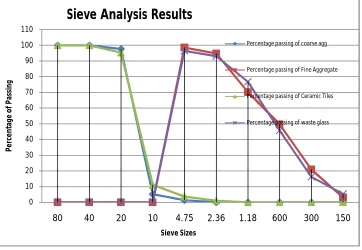
The sieve analysis of the material was a combination of both fine aggregates and coarse aggregates. Figure 1.1 shows the results of sieve analysis of Waste glass and Ceramic Tiles obtained and compared with fine aggregates and coarse aggregates.
Figure 1.1: Sieve analysis results of Waste glass and Ceramic tiles compared with fine and coarse aggregates.
0 10 20 30 40 50 60 70 80 90 100 110
80 40 20 10 4.75 2.36 1.18 600 300 150
P
e
rc
e
n
ta
ge
o
f
P
as
si
n
g
Sieve Sizes
Sieve Analysis Results
Percentage passing of coarse agg
Percentage passing of Fine Aggregate
Percentage passing of Ceramic Tiles
B. Modulus of Rupture
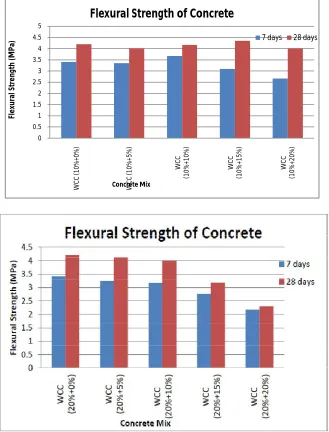
[image:6.612.144.473.131.563.2]Flexural strength is defined as a material's ability to resist deformation under load.The modulus of rupture was also found at the end of 7 & 28 days, The Flexure Strength of concrete prisms by following IS 516-1959 using a third point loading. Figure 1.2 shows the results for the modulus of rupture for concrete mixture. All specimens have modulus of rupture for 28 days above 2.30MPa.
Figure 1.2: Graph showing the Modulus of rupture for concrete beams at 7 days and at 28 days.
The flexural strength of concrete made with Waste Glass and Ceramic tiles was tested according to IS 516-1959. All the mixtures gave a modulus of rupture more than 2.30 MPa in 28 days. This test is very useful since concrete pavements tend to be loaded in bending rather than in axial tension. The flexure test gives better representation of concrete property. It can be noted that the flexure test gave higher values than the tension test. The flexural strength for a structural concrete is around 4.5 MPa. Fig 1.2 shows that the concrete with different % of waste glass and Ceramic Tiles performs well upto 10 % waste glass + 15 % Ceramic Tiles also 20% waste glass + 10% Ceramic tiles aggregate concrete.
C. Splitting Tensile Strength
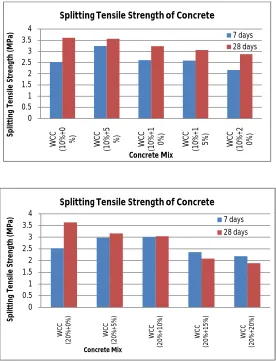
The splitting tensile strength of the concrete specimens was determined at 7 and 28 days following IS 5816-1999. Cylinders were molded with a diameter of 150 mm and a length of 300 mm. Figure 1.3 displays the average splitting tensile strength of the samples at 7 and 28 days.
0 0.5 1 1.5 2 2.5 3 3.5 4 4.5 5
W
C
C
(1
0
%
+0
%
)
W
C
C
(1
0
%
+5
%
)
W
C
C
(1
0
%
+1
0
%
)
W
C
C
(1
0
%
+1
5
%
)
W
C
C
(1
0
%
+2
0
%
)
Fl
e
xu
ra
l S
tr
e
n
gt
h
(
M
P
a)
Concrete Mix
Flexural Strength of Concrete
Figure 1.3: Graph showing the Splitting Tensile Strength for concrete beams at 7 days and at 28 days.
The splitting tensile test is an indirect way of estimating the tensile strength of cylindrical concrete specimens. The cylinders were tested according to IS 516-1959. The control mixture showed splitting tensile strength after 28 days around 2.19MPa.while all other specimens had around 1.79MPa. For the ordinary structural concrete the tensile strength is around 2.4MPa. If we analysis 10 % waste glass + 15 % Ceramic Tiles also 20% waste glass + 10% Ceramic tiles aggregate concrete carefully than we find out upto this limit of aggregate concrete there is considerable change in tensile strength of the concrete.
D. Compressive Strength for concrete
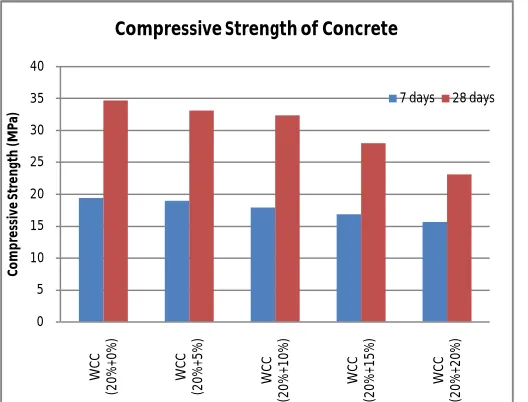
The compressive strength of concrete is determined by cube specimens having dimensions 150 X 150 X 150 mmat the end of 7 and 28 days. Figure 1.4 shows that at the end of 7 &28 days all the specimens have a compressive strength less than 38MPa.
0 0.5 1 1.5 2 2.5 3 3.5 4 W C C (1 0 % +0 % ) W C C (1 0 % +5 % ) W C C (1 0 % +1 0 % ) W C C (1 0 % +1 5 % ) W C C (1 0 % +2 0 % ) Sp lit ti n g Te n si le S tr e n gt h ( M P a) Concrete Mix
Splitting Tensile Strength of Concrete
7 days 28 days 0 0.5 1 1.5 2 2.5 3 3.5 4 W C C (2 0 % +0 % ) W C C (2 0 % +5 % ) W C C (2 0 % +1 0 % ) W C C (2 0 % +1 5 % ) W C C (2 0 % +2 0 % ) Sp lit ti n g Te n si le S tr e n gt h ( M P a) Concrete Mix
Splitting Tensile Strength of Concrete
7 days 28 days 0 5 10 15 20 25 30 35 40 45 W C C (1 0 % +0 % ) W C C (1 0 % +5 % ) W C C (1 0 % +1 0 % ) W C C (1 0 % +1 5 % ) W C C (1 0 % +2 0 % ) C o m p re ss iv e S tr e n gt h ( M P a) Concrete Mix
Compressive Strength of Concrete
Figure 1.4: Graph showing the Compressive Strength of concrete beams at 7 days and at 28 days.
Most properties of concrete are directly related to its compressive strength. The compression test on the concrete specimens was carried out according to IS 516-1959. The samples were properly molded and cured. The control mixture had 28 day strength of more than 35 MPa in case of WCC 10% in case of WCC 20% 34 MPa. The specimen with 10% waste glass + 20% Ceramic Tiles tyre aggregates in concrete had 28 days compressive strength of 30.12MPa while specimen with 20% waste glass and 20% Ceramic tiles aggregate had about 23.07 MPa. The 10 % waste glass + 15 % Ceramic Tiles also 20% waste glass + 10% Ceramic tiles aggregate sample gave good strength than the rest; the reason might be the water-cement ratio. The strength might be due to the cement paste and the bond strength at the paste-aggregates boundary only up to 10 % waste glass + 15 % Ceramic Tiles also 20% waste glass + 10% Ceramic tiles aggregate. Variability of test method might be the reason. The rate of loading and progress of crack around the aggregate particles might be the reason of lower strength. The rest of the specimens 10 % waste glass + 15 % Ceramic Tiles also 20% waste glass + 10% Ceramic tiles aggregate had 28 day strength less than 38MPa.
E. Resistance to Chloride attack of concrete
This test was conducted on 150 x 150 x 150mm cube specimens. The cubes were casted and cured in water for 28 days. Hydrogen Chloride solution of 30g/l is used to evaluate chloride resistance of concrete. Cubes are immersed in solution after 28 days curing, and are tested for compressive strength at 14, 28 and 56 days.
0 5 10 15 20 25 30 35 40 W C C (2 0 % +0 % ) W C C (2 0 % +5 % ) W C C (2 0 % +1 0 % ) W C C (2 0 % +1 5 % ) W C C (2 0 % +2 0 % ) C o m p re ss iv e S tr e n gt h ( M P a)
Compressive Strength of Concrete
7 days 28 days
0 5 10 15 20 25 30 35 40 W C C (1 0 % +0 % ) W C C (1 0 % +5 % ) W C C (1 0 % +1 0 % ) W C C (1 0 % +1 5 % ) W C C (1 0 % +2 0 % ) C o m p re ss iv e S tr e n gt h ( M P a) Concrete Mix
Chloride Resistance of Concrete
7 days Control at 28 days
7 days Immersed at 7 days
28 days Immersed at 28 days
Figure1.5: Graph showing the 7 &28 days Resistance to Chloride attack of concrete.
The compressive strength was determined from concrete cubes at 28 days. Figure 1.5shows that concrete made with Waste Glass and Ceramic Tiles retains its strength up to a 10% waste glass + 15% Ceramic Tiles also 20% waste Glass + 10% Ceramic Tiles . Strength decreases afterwards may be due to the bond strength between the particles of concrete.
F. Overall experimental Observations
No major difficulty in handling the concrete which incorporated waste glass and ceramic tiles as aggregates was encountered except at 20%+20% (Waste glass + Ceramic tiles) or higher replacement percentages due to heterogeneous and isotropic concrete starts forming. There were no major changes in the fresh or hardened properties of concrete with Waste glass 10% + Ceramic Tiles 20% strength of concrete. The size and grading of waste glass and ceramic tiles tyre aggregates were similar to natural aggregates. Using different ranges of sizes of aggregates enable the smaller particles to pack between larger particles, and thereby reducing the void spaces and lowering the cement paste requirements.
The shapes of the waste glass and Ceramic tiles aggregates were try to make angular in nature, which made the concrete mixture workable. The water absorption capacity of waste glass and ceramic tiles aggregates was more than that of natural aggregate, which sometimes made the concrete mixture less workable and so water reducing admixtures were added accordingly. One of the important aspects in the concrete mixture is the amount of air voids in the matrix. Air voids helps the water to seep into the pores, which in turn reduce high internal stresses and thereby reduce micro cracking in the structure. Proper amount of air entraining admixtures are added to introduce air bubbles in the concrete mixture. The reason for failing of concrete samples with 20% waste glass and 15% Ceramic tiles or more tyre aggregates might be due to presence of excessive entrapped air and less entrained air in the mixture during the mixing of concrete. Proper amount of air entraining admixtures were added accordingly depending upon required air content.
V. CONCLUSIONS AND RECOMMENDATIONS
The main aim of this research was to study the behavior of concrete and changes in the properties of Waste glass and Ceramic Tiles concrete by replacing the use of natural aggregates. Waste glass and Ceramic tiles tyre is a waste product and used in concrete will might prove an economical and environmentally friendly solution. Also might be to clear the products which are non-biodegradable in nature and make in nature pollution free to make chain system as far as possible.
The results of this research were encouraging, since they show that using waste glass and Ceramic tiles as aggregates in concrete has some negative effects on mechanical properties after certain addition of waste glass and Ceramic tiles the short term properties of hardened concrete.
A. The reasons for reduction in the strength of concrete when waste glass and Ceramic tiles was used are as follows: 1) Lake of proper bonding between waste glass and Ceramic tiles particles and the cement paste.
2) Due to replacement of aggregates by the waste glass and Ceramic tiles, the weight was reduced.
3) Due to non-uniform distribution of waste glass and Ceramic tiles particles in the concrete, non-homogeneous samples are produced, which in turn results in reduction in concrete strength.
0 5 10 15 20 25 30 35 40 W C C (2 0 % +0 % ) W C C (2 0 % +5 % ) W C C (2 0 % +1 0 % ) W C C (2 0 % +1 5 % ) W C C (2 0 % +2 0 % ) C o m p re ss iv e S tr e n gt h ( M P a) Concrete Mix
Chloride Resistance of Concrete
B. Suggestions for future research
1) A much more extensive field study on a concrete structure made with Waste Glass and Ceramic Tiles aggregates used in the mixture should be conducted and changes in durability and mechanical properties should be investigated and correlated to laboratory results.
2) Further investigation on resistance of concrete with Waste Glass and Ceramic Tiles aggregates to attack by sulfates; alkali silica reactions, carbonation, sea water attack, harmful chemicals and resistance to high temperatures are needed.
3) The long term behavior of concrete with Waste Glass and Ceramic Tiles aggregates should be studied and its compatibility with reinforcing steel should be analyzed in the future.
REFERENCES
[1] Ahmad Shayanand AiminXu (2004) “Value-added utilisation of waste glass in concrete”, Cement and Concrete Research, Volume 34, Issue 1, January 2004, Pages 81–89.
[2] Ahmad Shayan and AiminXu (2006) “Performance of glass powder as a pozzolanic material in concrete: A field trial on concrete slabs”,Cement and Concrete Research, Volume 36, Issue 3, March 2006, Pages 457–468.
[3] Ana Mafalda Matos and Joana Sousa-Coutinho (2012) “Durability of mortar using waste glass powder as cement replacement”, Construction and Building Materials, Volume 36, November 2012, Pages 205–215.
[4] ASTM C 1012. (1997). Standard Test Method for length change of hydraulic cement mortars exposed to a Sulphate solution. ASTM International. [5] ASTM C 138/C 138M. (2001). Standard Test Method for Density (Unit Weight), Yield, and Air Content (Gravimetric) of Concrete.. ASTM International. [6] ASTM C 143/C 143M. (2005). Standard Test Method for Slump of Hydraulic-Cement Concrete.. ASTM International.
[7] ASTM C 150. (2005).Standard Specification for Portland Cement.. ASTM International.
[8] ASTM C 157/C 157 M. (2004).Standard Test Method for Length Change of Hardened Hydraulic-Cement, Mortar, and Concrete.. ASTM International. [9] ASTM C 173. 2004. .Standard Test Method for Air Content of Freshly Mixed Concrete by the Volumetric Method. ASTM International.
[10] ASTM C 192/C 192M. 2002. .Standard Practice for Making and Curing Concrete Test Specimens in the Laboratory. ASTM International. [11] ASTM C 231. 2004. Standard Test Method for Air Content of Freshly Mixed Concrete by the Pressure Method.. ASTM International. [12] ASTM C 260. (2001). Standard Specification for Air, Entraining Admixtures for Concrete. ASTM International.
[13] ASTM C 33. (2003).Standard Specification for Concrete Aggregates. ASTM International.
[14] ASTM C 39/C 39M. (2003). Standard Test Method for Compressive Strength of Cylindrical Concrete Specimens.. ASTM International. [15] ASTM C 496. 1996. Standard Test Method for Splitting Tensile Strength of Cylindrical Concrete Specimens.. ASTM International.
[16] ASTM C 78. (2002). Standard Test Method for Flexural Strength of Concrete (Using Simple Beam with Third-Point Loading).. ASTM International. [17] ASTM D 4792 (2006) .Potential Expansion of Aggregates from Hydration reaction. ASTM International
[18] Bashar Taha and GhassanNounu (2008) “Properties of concrete contains mixed colour waste recycled glass as sand and cement replacement”, Construction and Building Materials, Volume 22, Issue 5, May 2008, Pages 713–720.
[19] Bashar Taha and GhassanNounu (2008) “Using lithium nitrate and pozzolanic glass powder in concrete as ASR suppressors”, Cement and Concrete Composites, Volume 30, Issue 6, July 2008, Pages 497–505.
[20] Bhupendra Singh Shekhawat and Dr. VanitaAggarwal (2014) “Utilisation of Waste Glass Powder in Concrete – A Literature Review”, IJIRSET, Vol. 3, Issue 7, July 2014, ISSN: 2319-8753, Page-14822-14826.
[21] Caijun Shi and KerenZheng (2007) “A review on the use of waste glasses in the production of cement and concrete”, Resources, Conservation and Recycling, Volume 52, Issue 2, December 2007, Pages 234–247.
[22] DR. T. SEKAR (2011) “Studies On Strength Characteristics On Utilization Of Waste Materials As Coarse Aggregate In Concrete”, ISSN : 0975-5462 Vol. 3 , No. 7, July 2011, Page – 5436-5440.
[23] IS 10262:2009- Concrete Mix Design - Guidelines, Bureau of Indian Standards,(BIS), New Delhi India. [24] IS 383 (1997) — Specification for course and fine aggregates from Natural Sources for Concrete. [25] IS-1199 (1959) – Method of Sampling and analysis of Concrete.
[26] IS-516 (1959) — Methods of Tests for Strength of Concrete.
[27] IS-5816 (1999) — Splitting tensile strength of concrete- Method of test.
[28] J.M. Khatib et al. “Glass Powder Utilisation in Concrete Production”, European Journal of Applied Sciences 4, 2012, ISSN 2079-2077, Page-173-176. [29] J.P,Patel (2006), Broder use of steel slag aggregate in concrete.
[30] K.L.Lin et al. (2009) “The utilization of thin film transistor liquid crystal display waste glass as a pozzolanic material”, Journal of Hazardous Materials, Volume 163, Issues 2–3, 30 April 2009, Pages 916–921.
[31] L.M. Federico and S.E. Chidiac (2009) “Waste glass as a supplementary cementitious material in concrete – Critical review of treatment methods”, Cement and Concrete Composites , Volume 31, Issue 8, September 2009, Pages 606–610.
[32] Luiz A. Pereira-de-Oliveira et al. (2012) “The potential pozzolanic activity of glass and red-clay ceramic waste as cement mortars components”,Construction and Building Materials, Volume 31, June 2012, Pages 197–203.
[33] MdDaniyal and Shakeel Ahmad (2015) “Application of Waste Ceramic Tile Aggregates in Concrete”, IJIRSET, Vol. 4, Issue 12, December 2015, ISSN(Online): 2319-8753, ISSN (Print): 2347-6710.
[34] O. Zimbili, W. Salim, M. Ndambuki (2014) “A Review on the Usage of Ceramic Wastes in Concrete Production”, World Academy of Science, Engineering and Technology International Journal of Civil, Environmental, Structural, Construction and Architectural Engineering Vol:8, No:1, 2014, page-91-95. [35] P. Asokan et al. (2010) “Improvement of the mechanical properties of glass fibre reinforced plastic waste powder filled concrete”, Construction and Building
[36] Parminder Singh and RakeshSingla (2015) “Utilization Of Waste Ceramic Tiles As Coarse Aggregate In Concrete”, Journal of Multidisciplinary Engineering Science and Technology (JMEST) ISSN: 3159-0040 Vol. 2 Issue 11, November – 2015,page 3294-3300.
[37] Sameer Shaikh et al. (2015) “Effective Utilisation of Waste Glass in Concrete”, Int. Journal of Engineering Research and Applications, ISSN: 2248-9622, Vol. 5, Issue 12, (Part - 4) December 2015, pp.01-04.
[38] Anna Halicka et al. (2011) “Using ceramic sanitary ware waste as concrete aggregate”, Construction and Building Materials, Volume 48, November 2013, Pages 295–305.