Journal of Chemical and Pharmaceutical Research, 2015, 7(3):334-338
Research Article
CODEN(USA) : JCPRC5ISSN : 0975-7384Research and design on resource addressing model in ubiquitous network
Minglang Jiang and Fang Cheng
Key Laboratory on Communication Networks and Testing Technology, Chongqing University of Posts and Telecommunications, Chongqing, China
____________________________________________________________________________________________
ABSTRACT
Ubiquitous network has achieved the communication between people and people, objects and objects, or even people and objects, making the interconnection among all kinds of applications into reality. By using a variety of methods, not only people and physical objects but also various businesses and services can be identified. Through identifier parsing systems and addressing systems based on context translation, mapping and conversion, much more corresponding address and associated information of resources in ubiquitous network can be obtained. The systematic study and norm on the issues of resources addressing can be urgency since the ubiquitous network-related researches have been carried out in depth, especially on condition of the introduction of billions of communicating entities and services. Based on the demand analysis for resources in ubiquitous network, this paper puts forward two models for resource addressing, namely common hierarchical model and applied structure model. Expanding and combining with the basic model for Internet addressing, the two models can be brilliant solutions for resource addressing in ubiquitous network.
Keywords: Resource Addressing; UNRA; Hierarchical Model; Applied Structure Model.
____________________________________________________________________________________________
INTRODUCTION
With the globalization of networks, related technology and development of ubiquitous network resources (UNR) also present a worldwide range of applications, and recently become the keys of national economic and technological development. Ubiquitous network has broken through the traditional and limited means of communication between people. And it takes advantage of existing and new network technologies to achieve services name information gaining, transmitting and saving as on-demand between human-to-human, human-to-objects and objects-to-objects. Thus it could provide ubiquitous informational service and application for individuals and the community.
Requirement Analysis of Ubiquitous Network Resource Addressing
Researches show that, to complete the process of resources in ubiquitous network from identifying to positioning, we must rely on addressing technology. Ubiquitous network resource addressing (UNRA) technology mainly refers to the process including determining of communication path based on identifier and passing useful information to specified communication addresses.
______________________________________________________________________________
Research and Design on Ubiquitous Network Resource Addressing Model
In this part, we’ll first study iterative model for resource addressing in internetwork. Afterwards, we shall build a common hierarchical model and an applied structure model which can satisfied the addressing condition of UNR, combined with the nature and disciplines of UNRA.
Iterative model for resource addressing in internetwork. The use of level iterative model indicates that resource
addressing in internetwork adheres to a hierarchical iterative rule [1]. Iteration refers to access to resource address by resource name address, then the resource address will be regarded as a resource name and repeat the process. The output of the iteration in previous layer can be used for resource name of the iteration in later layer. And the iteration will terminate until direct resource address is exported.
Each iteration constitute a hierarchy in the resource addressing system. And every subsystem of iteration for resource addressing is independent to others. Besides, each subsystem is without having to know all the underlying logic but the interface information in the layer close to it. This makes the coupling coefficient between the addressing systems greatly reduced. And the implementation of subsystems will be considered more than interactions between interval hierarchical systems. The way to implement each hierarchy of resource addressing system can be different, or it can be the same resource addressing system to complete addressing function in different hierarchies and the method still belongs logically to different hierarchical resource addressing. What’s more, an output of resource addressing subsystem may be used by multiple resource addressing subsystem of lower hierarchy. Similarly one of the resource addressing subsystems also allows to be invoked by multiple resource addressing subsystem of higher hierarchy.
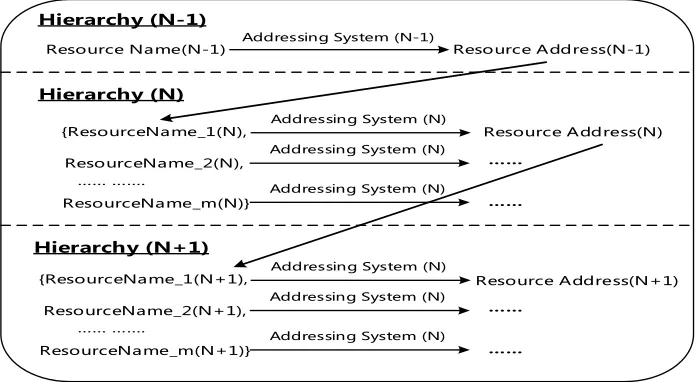
Although resource addressing systems of different hierarchies wouldn’t necessarily lead to bottom layer of the resource addressing system, the resource addressing system aims ultimately at the implementation of communications between network resources. In terms of modeling perspective, there is no single directivity among different hierarchies. In other words, hierarchy N only concern addressing logic of neighbor hierarchies (N-1 or N+1). As shown in Fig.1, it’s a resource addressing model of hierarchical iteration in internetwork which is based on resource name, resource addressing system, resource address and hierarchical logic of resource addressing technology [2].
Resource Name(N-1) Addressing System (N-1) Resource Address(N-1)
{ResourceName_1(N),
ResourceName_2(N),
ResourceName_m(N)} …… …….
Addressing System (N)
Resource Address(N) Addressing System (N)
Addressing System (N)
……
……
{ResourceName_1(N+1),
ResourceName_2(N+1),
ResourceName_m(N+1)} …… …….
Addressing System (N)
Resource Address(N+1) Addressing System (N)
Addressing System (N)
……
……
Hierarchy (N-1)
Hierarchy (N)
[image:2.595.133.483.402.593.2]Hierarchy (N+1)
Fig. 1 Iterative model for resource addressing in internetwork
Resource addressing in Internetwork features hierarchical iteration, meaning that after numerous operations, the last result of resource addressing (that is, indirect address) will be taken as a resource name to continue addressing. The process could be circulated to any resource address or direct address.
Common hierarchical model for ubiquitous resource addressing. As descripted in section 2.1, the iterative model
The common hierarchical model for UNRA features an addressing rule of iteration. That is to say, several hierarchies consist the model and the output of every hierarchy can be used as input to next hierarchy. Other features are basically similar to resource addressing in Internetwork. Due to the specificity of hierarchical structure of ubiquitous network resource name. Therefore, we need to carry on some appropriate conversion to the resource name in order to remove the possible existence of dispersion and unpredictability. Afterwards, the resource name can be taken as input of resource addressing system. In this model, the resource name is subdivided into the original resource names and the converted resource name. In each hierarchy, resource address information needed when original resource name transformed to converted resource name can be provided by the output of last hierarchy. In the same way, the address information exported by the present hierarchy can be used as converted resource name.
As vividly descripted in Fig.2, this is a common hierarchical model for UNRA (ORN: Original Resource Name; RAI: Resource Address Information; CRN: Converted Resource Name; RAS: Resource Addressing System; RAIS: Resource Address Information Set). It is built based on original resource name, resource address information, and converted resource name, resource addressing system and resource address of hierarchical logic.
ORN(N-1) RAI_m (N-1) Hierarchy (N-1)
Hierarchy (N)
CRN(N-1) RAS (N-1) RAIS_m(N-1)
ORN(N) RAI_1 (N) CRN_1(N) RAS (N) RAIS_1(N)
ORN(N) RAI_2 (N) CRN_2(N) RAS (N) RAIS_2(N)
ORN(N) RAI_m (N) CRN_m(N) RAS (N) RAIS_m(N)
… … …
Hierarchy (N+1)
ORN(N+1) RAI_m1 (N+1) CRN_m1(N+1) RAS (N+1) RAIS_m1(N+1)
… … …
ORN(N+1) RAI_m2 (N+1) CRN_m2(N+1) RAS (N+1) RAIS_m2(N+1)
ORN(N+1) RAI_mm(N+1) CRN_mm(N+1) RAS (N+1) RAIS_mm(N+1)
Fig. 2 Common hierarchical model for UNRA
We define the original resource name of the addressing hierarchy N as original resource name , converted resource
name as , and resource address information as . As a result, the namespace of original resource name, converted resource name and resource address separately expressed as follows [3]:
(1)
(2)
(3)
The resource transforming function of the present hierarchy is defined as a binary function ( ), and it satisfies the following 4 equations:
(4)
And (5)
______________________________________________________________________________
(7)
The resource addressing function of the present hierarchy is defined as a unary function ( ), and it satisfies the following 2 equations:
(8)
(9)
Supposing that the corresponding addressing hierarchy for directed resource address is M, then the common hierarchical model for UNRA can be expressed as follows:
(10)
And
(11)
The model will turn to any hierarchy (N) and export the resource address information of the present hierarchy ( ). Among them, the maximum N value is highest hierarchy M for UNRA, and the corresponding resource address information is the directed resource address, namely MAC address.
ORN RAI CRN SAS RAI
ORN RAI_m CRN SAS
RAIS_1
RAIS_m
ORN
RAI_1
RAI_m
CRN_1
CRN_m
DA S
DA S
RAIS_1
RAIS_m
RAI_n CRN_n DA S RAIS_n
ORN
RAI_1
RAI_m
CRN_1
CRN_m
IAS
IAS
RAIS_1
RAIS_m
ORN RAI CRNS PA AS RAIS
Applied Structure Model for UN RA
Sta ndard AH
Coding AH
Discove ri ng A H
Inform at ion AH
Physical A ddres s AH
Fig. 3 Applied Structure Model for UNRA
Applied Structure Model for UNRA. The applied structure model is proposed based on the common hierarchical
model for UNRA. After analyzing the relationship between UNRA systems, as is illustrated in Fig. 3, the model has summed up 5 addressing hierarchies, namely, standard addressing hierarchy (Standard AH), coding addressing hierarchy (Coding AH), discovering addressing hierarchy (Discovering AH), information addressing hierarchy
Compared with resource addressing model for Internetwork [5], the Applied Structure Model for UNRA is a brand new one. The first hierarchy is Standard AH which can provide corresponding standard and extensional hierarchical structure information for the transforming process between ORN and CRN in the next hierarchy. And the second one is Coding AH. The output can be used in the Discovering AH or Information AH. The Discovering AH should convert the coding information to CRN. The fourth hierarchy is Information AH [6] which can export RAI, IP address. Physical Address AH lies in the bottom and it can finish the addressing process from IP address to MAC address.
Applied Structure Model is based on Common Hierarchical Model in UNRA. The model has analyzed and interpreted the relationship among ubiquitous resource addressing systems. Each hierarchy performs its own functions, and then works together and accomplishes resource addressing process.
CONCLUSION
Based on UNRA features, we have expanded the hierarchical iterative model for internetwork addressing and put forward a common hierarchical model, and then the model has been developed into an applied structure model. By setting up and improving the UNRA model, this paper reveals the relationship between the resource addressing systems of ubiquitous network.
Acknowledgments
This work is financially supported by “National Science and Technology Major Project Next-generation Broadband Wireless Mobile Communication Network, Grant No. 2012ZX03005008”.
REFERENCES
[1] L. Liu, “The Research and Implementation of Server Framework for REST”, M.S. degree thesis, Beijing University of Posts and Telecommunications, Beijing, (2010).
[2] X. Li, “Research on Computer Network Resources Naming and Addressing Technologies”, PhD thesis, Institute of Computing Technology Chinese Academy of Science, Beijing, (2003)
[3] W. Wu, “The Internet of things and ubiquitous communication technology”, Beijing: Electronic Industry Press, (2012)
[4] N. Kong, “Research on Key Technology of the Resource Addressing in the Internet of Things”, PhD thesis, Chinese Academy of Science, Beijing, (2008)
[5] J. Ye, “Analysis on internet of things addressing key technology resources”, Journal of Nanchang Education Academy, (2010)