ii
STUDY ON THE GAS PERFORMANCE OF CERAMIC MEMBRANE FROM KAOLIN PREPARED BY PHASE INVERSION TECHNIQUE
SITI KHADIJAH HUBADILLAH
A thesis submitted in
fulfillment of the requirement for the award of the Master of Engineering
Faculty of Mechanical Engineering Universiti Tun Hussein Onn Malaysia
ABSTRACT
ABSTRAK
vii
TABLE OF CONTENT
TITLE i
DECLARATION
ii
DEDICATION
iii
ACKNOWLEDGEMENT
iv
ABSTRACT v
ABSTRAK vi
TABLE OF CONTENT vii
LIST OF TABLES xi
LIST OF FIGURES xii
LIST OF ABBREVIATIONS xvi
LIST OF SYMBOLS xvii
CHAPTER 1 INTRODUCTION 1
1.1 Background of study 1
1.2 Statement of Problems 5
1.3 Objective of Study 7
1.4 Scope of Study 7
viii
CHAPTER 2 LITERATURE REVIEW 9
2.1 Introduction 9
2.2 Ceramic Membrane 9
2.3 Material Selection for Ceramic Membrane 11
2.4 Fabrication of Ceramic Membrane 15
2.4.1 Traditional Method 15
2.4.2 Phase Inversion Method 18
2.5 Characterization nd Properties of Ceramic Membrane prepared via Phase Inversion Technique
21
2.6 Effect of Particle Size on Ceramic Membrane Preparation
26
2.7 Effect of Different Types of Non-solvent Coagulant Bath on the Ceramic Membrane Preparation
28
2.8 Membrane Separation Processes 32
2.9 Membrane for Gas Separation Application 33
2.9.1 Application of Ceramic Membrane in Gas Separation
34
2.10 Closure 35
CHAPTER 3 METHODOLOGY 37
3.1 Introduction 37
3.2 Material Selection 39
ix
3.2.2 N-Methyl-2-pyrrolidone (NMP) 44
3.2.3 Polyethersulfone (PESf) 44
3.2.4 Non-solvent Coagulant Bath 44
3.3 Preparation of Kaolin Ceramic Membrane 45
3.3.1 Preparation of dope suspension with different kaolin particle size and composition
45
3.3.2 Membrane Casting 47
3.3.3 Sintering of Kaolin Ceramic Membrane 48
3.4 Characterization 49
3.4.1 Kaolin Powder Characterization 49
3.4.2 Viscosity Test for Ceramic Suspension 50
3.4.3 Membrane Characterization 50
3.4.3.1 Field Emission Scanning Electron Microscope (FESEM)
50
3.4.3.2 Atomic Force Microscopy (AFM) 51
3.4.3.3 Pore Size Distribution (PSD) analysis
52
3.4.3.4 Mechanical Strength 54
3.4.3.5 Gas Permeation Test 55
CHAPTER 4 RESULTS AND DISCUSSIONS 57
x
4.2 Characteristics of Kaolin Powder 58
4.2.1 Particle Size Distribution of Kaolin Powder
58
4.2.2 Morphological Analysis on the Kaolin Powder at Different Sizes
59
4.2.3 Functional Groups in Kaolin 60
4.3 Viscosity of Ceramic Suspension 61
4.4 Effect of Kaolin Particle Size and Composition on Properties and Gas Separation Performance of Kaolin Ceramic Membrane
62
4.4.1 Introduction 62
4.4.2 Morphological Properties of Membranes 62
4.4.3 Membrane Surface Roughness 67
4.4.4 Membrane Pore Size Distribution (PSD) and porosity
69
4.4.5 Membrane Mechanical Strength 73
4.4.6 Gas Permeation Properties 74
4.5 Effect of Different Coagulant Bath on the Properties and Gas Separation Performance of Low Cost Ceramic Membrane
77
4.5.1 Introduction 77
4.5.2 Membrane Cross Sectional Images prepared by Immersion into Different Types of Non-Solvent Coagulant Bath
xi
4.5.2.1 Distilled Water 78
4.5.2.2 Ethanol 80
4.5.2.3 Mixture of 70% NMP nd 30% Distilled Water
82
4.5.3 Membrane Surfaces Images prepared by Immersion into Different Types of Non- Solvent Coagulant Bath
84
4.5.4 Membrane Surface Roughness 90
4.5.5 Membrane Pore Size Distribution (PSD) and porosity
92
4.5.6 Membrane Mechanical Strength 96
4.5.7 Gas Permeation Properties 97
4.5.7.1 Permeability 93
4.5.7.2 Selectivity 95
CHAPTER 5 CONCLUSIONS AND RECOMMENDATIONS 97
5.1 Conclusions 97
5.2 Recommendations 98
REFERENCES 99
APPENDIX A 117
APPENDIX B 119
APPENDIX C 122
xii
APPENDIX E 130
APPENDIX F 131
xiii
LIST OF TABLES
2.1 Various applications of membranes 11
2.2 Properties of high cost ceramic material 12
2.3 Several studies used kaolin as the raw material in membrane fabrication
14
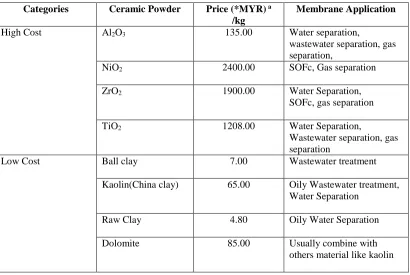
2.4 Comparison of ceramic materials in term of its price and application
14
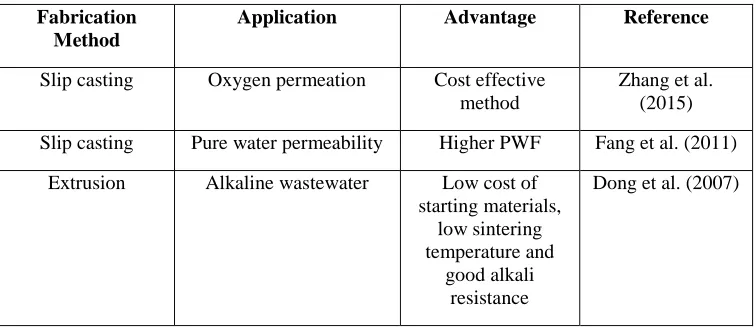
2.5 Various method in ceramic membrane fabrication 15 2.6 Ceramic membrane prepared via phase inversion 20 2.7 Pore size distribution for the Ni and NiO hollow fibres with
three structures
25
2.8 Characteristics of various membrane separation processes 32
2.9 Summary of available membrane processes 33
2.10 Summary for gas separation system available 34
3.1 List of chemical used in this study 39
3.2 The physical and chemical properties of chemicals used in this study
40
3.3 Experiment of kaolin powders at different particle size of previous study
43
3.4 Properties of different types of non-solvent coagulant bath 45 3.5 Summary of ceramic suspension composition for low cost
ceramic membrane for the effect of kaolin particle size
46
3.6 Membrane Casting Process 48
4.1 Membrane composition for study the effect of particle size 62 4.2 Kaolin content for study the effect of non-solvent coagulant
bath
xiv
LIST OF FIGURES
1.1 Ceramic membrane structure prepared using different techniques
3
1.2 Ceramic membrane structure fabricated via phase inversion
5
2.1 Schematic diagram of Membrane Structure; a(i) symmetric membrane and b(i) asymmetric membrane; SEM Micrographs of a(ii) symmetric membrane and b(ii) asymmetric membrane
10
2.2 Schematic of membrane separation process 10
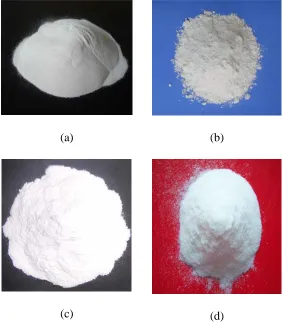
2.3 Image for high cost ceramic material; (a) aluminium oxide, (b) Zirconium dioxide, (c) Titanium dioxide and (d) Silica dioxode
13
2.4 Asymmetric membrane structure via combined tape casting and phase inversion method
18
2.5 Ternary diagram represents the study of different types of solvent
19
2.6 Alumina membrane finger-like structure resulting from membrane fabrication via phase inversion system at different air-gap
20
2.7 Reduced finger-like structure observed 22
2.8 Ceramic Membrane finger-like and sponge-like structure 23
2.9 Ceramic Membrane sandwich-like structure 23
2.10 Pore size distribution for membrane M2 by mercury porosimetry
25
2.11 Macrovoids formation caused by the agglomeration of smaller particle sizes
xv
2.12 Ternary diagram of PVDF/NMP/non-solvent system at 25oC
29
2.13 SEM images of PVDF hollow fibre membrane at different coagulation bath: (a) 15:85 of ethanol:water bath, (b) 30:70 of ethanol:water bath and, (c) 50:50 of ethanol:water bath
30
2.14 SEM images of surface PVDF membranes prepared from different concentration of ethanol at (a) 0%, (b) 25%, (c) 50% and, (d) 75%
31
3.1 Research Design 38
3.2 Kaolin used in this work: a) particle size less than 1µm and b) particle size more than 10µm
41
3.3 Mechanism of particles agglomeration; repulsive force (↔)
43
3.4 Polyethersulfone (PESf) 44
3.5 Flowchart of kaolin ceramic membrane 45
3.6 Experimental setting for ceramic suspension preparation 47 3.7 Sintering profile for kaolin ceramic membrane 49 3.8 (a) top view, (b) side view for membrane attachment on
studs
51
3.9 The capillary action of wetting and non-wetting liquid 54 3.10 Sample preparation for 3-point bending test 55
3.11 Gas permeation system 56
4.1 Particle size distribution of kaolin powders at different types
58
4.2 FESEM images of kaolin particles at (a) less than 1 µm and (b) more than 10 µm
59
4.3 FTIR comparison of kaolin at different particle size: (a) Type A kaolin and (b) Type B kaolin
60
4.4 Viscosity versus kaolin content at different particle size 61 4.5 FESEM images of the cross section prepared at different
kaolin particle size and composition (x300)
63
xvi
4.7 Schematic diagram of kaolin particle movement in ceramic suspension containing NMP and PESf; (a)Type A (b) Type B
4.8 FESEM images of the surface prepared at different kaolin particle size and composition
66
4.9 Membrane surface roughness and AFM 3D-images from the effect of kaolin particle size at different kaolin composition
68
4.10 Pore size distribution for membrane fabricated at different kaolin particle size and kaolin content; (a)14wt.%, (b)19wt.%, (c)24wt.%, (d)29wt.%, (e)34wt.% and (f)39wt.%
70
4.11 Porosity of ceramic membrane from kaolin as a function effect of particle sizes
72
4.12 Bending strength of the prepared ceramic membrane from kaolin on the effect of particle size at different kaolin composition
73
4.13 Effect of different types of non-solvent coagulant bath of ceramic membrane prepared at different kaolin
composition onto gas permeance. (a) Carbon Dioxide, (b) Oxygen and (c) Nitrogen
75
4.14 Effect of different types of non-solvent coagulant bath of ceramic membrane prepared at different kaolin
composition onto gas selectivity. (a) CO2/N2 and (b) O2/N2
76
4.15 FESEM images of the cross section prepared at different kaolin content and immersed into distilled water; a) 24 wt.%; b) 29 wt.%; c) 34 wt.%; d) 39 wt.% kaolin content
78
4.16 Mechanism of solvent/non-solvent exchange 80 4.17 FESEM images of the (i) overall cross section (ii)
zoomed at 600x magnification prepared at different kaolin content and immersed into ethanol; E1= 24
xvii
wt.%; E2 = 29 wt.%; E3 = 34 wt.%; E4 = 39 wt.% kaolin content
4.18 FESEM images of the (i) overall cross section (ii) zoomed at 600x magnification prepared at different kaolin content and immersed into mixture of 70% NMP and 30% distilled water; N1= 24 wt.%; N2 = 29 wt.%; N3 = 34 wt.%; N4 = 39 wt.% kaolin content
83
4.19 FESEM images of membrane surface prepared at
different kaolin composition and immersed into different coagulant; M=distilled water; E= ethanol; N=mixture of 70%NMP and 30% water
85
4.20 Membrane surface roughness on the effect of different types of non-solvent coagulant bath
87
4.21 Pore size distribution for membrane fabricated at different non-solvent coagulant bath and kaolin
composition; a)24 wt.%; b)29 wt.%; c)34 wt.%; and d)39 wt.%
89
4.22 Porosity of the kaolin ceramic membrane as a function effect of non-solvent coagulant bath
91
4.23 Bending strength for membrane fabricated at different non-solvent coagulant bath and kaolin composition
92
4.24 Effect of different types of non-solvent coagulant bath of ceramic membrane prepared at different kaolin
composition onto gas performance
93
4.25 Effect of different types of non-solvent coagulant bath of ceramic membrane prepared at different kaolin
composition onto gas selectivity. (a) CO2/N2 and (b) O2/N2
xviii
LIST OF ABBREVIATIONS
AFM - Atomic Force Microscopy
Al - Aluminum
Al2O3 - Alumina Oxide
BSCF - Ba0.5Sr0.5Co0.8Fe0.2O3-δ
CH4 - Methane
CO2 - Carbon Dioxide
FESEM - Field Emission Scanning Electron Microscopy FTIR - Fourier Transform Infrared Spectroscopy
MF - Microfiltration
MIP - Mercury Intrusion Porosimetry
N2 - Nitrogen
NF - Nanofiltration
Ni - Nickel
NiO - Nickel (II) Oxide
NMP - N-methylpyrrolidone
O - Oxide
O2 - Oxygen
PESf - Polyethersulfone PSA - Particle Size Analysis PSD - Pore Size Distribution PVDF - Polyvinylidenedifloride
RO - Reverse Osmosis
SEM - Scanning Electron Microscopy
Si - Silica
SiO2 - Silica (II) Oxide SOFc - Solid Oxide Fuel Cell
LIST OF SYMBOLS
σb - Mechanical Strength
Ra - Surface Roughness
F - Fracture Force
L - Membrane Span Length
w - Membrane Width
t - Membrane Thickness
P - Gas Permeability
Q - Flowrate
A - Membrane Area
CHAPTER 1
INTRODUCTION
1.1 Background of Study
The impact of global warming caused by discharges of CO2 from various sources is a major worry. According to the Environmental Protection Agency, the U.S. emitted 6,673 million metric tons of CO2 into the atmosphere in 2013 [1]. The escalating level of atmospheric CO2 has caused widespread public concern [2]. One of the major sources of CO2 emission is fossil fuel combustion. Today, coal-fired power plants alone emit about 2 billion tons of CO2 per year [3]. Imagine for another 30 years, fossil fuels will remain an important source of the world’s energy. For instance, high indoor levels
of CO2 could lead to severe health effects, even death. In fact, carbon dioxide level is allowed to be at the 5% level or 600 ppm [4] in normal environment. The exceed value will help increase a poisonous quality which harm to health. A recent data from Intergovermental panel on climate change in 2014 reveal that the CO2 concentration has reached 394ppm [5] in the atmosphere which is far beyond the upper safety limit of 350ppm [6]. Hence, separation of CO2 removal is crucially required for most of industry actions to avoid excessive CO2 gas pollution. Other than CO2, the separation of oxygen from nitrogen in the air also is an important procedure that is widely used in manufacturing. Oxygen is utilized to give advantages in various chemical processes such as natural gas combustion, coal gasification, sewage treatment and welding. Whilst, nitrogen used as a low-temperature coolant, an inert diluent and in the production of ammonia.
2
offer a promising separation technology to execute process intensification strategies, that is the cutback of production costs by minimizing equipment size, energy consumption and waste production [7]. Apart from that, there are two types of membrane: (1) polymeric membrane and (2) inorganic membrane. Polymeric membranes are widely used among all types of membranes. This has, in accordance of polymeric membranes offered a cheaper method, and yet the simple fabrication process involved. However, it is well known challenges of low selectivity and permeability in polymer membranes which have been addressed with some degree of success with advanced engineering polymers [7]. Furthermore, the physical and properties of polymer which cannot endure the application requiring high thermal, chemical and strength has limit the application of polymer membrane for critical applications. Because of this, researchers have taken attention towards inorganic membranes that has the ability to sustain at high temperature and extreme condition. In general, ceramic membrane can be subdivided into another three types: (1) ceramic membrane, (2) metal membrane and, (3) carbon membrane. The latest development has shown that ceramic membrane is gaining a place in gas separation compared to other membranes as it is offer simple sieving mechanism through the pore size obtained [8]. Since ceramic membranes offer significant advantages over polymeric membranes, therefore, it has been widely used especially in oilywater separation [9], wastewater separation [10] and water separation [11]. However, for the past few years the application of ceramic membrane still dominated the application in many gas industries which demanded high thermal and pressure.
3
Slip casting
Tape casting
Pressing method
[image:19.598.179.460.69.172.2]Phase Inversion
Figure 1.1 :Ceramic membrane structure prepared at different techniques
4
techniques generally involves multiple steps. Generally, it can be subdivided into three stages: (1) preparation of the ceramic powder paste or suspension, (2) shaping of the ceramic powder into the desired geometry and, (3) heat treatment which including calcination and sintering [15]. After completing these main steps, additional deposition layer or coating layer needs to be formed to allow selective mechanism at the top layer, Then, further heat treatment steps need to be conducted in orders to have a good selectivity as well as to improve other membrane properties. The choice of method for each step depends on the desired membrane configuration, quality, morphology, mechanical, chemical stability and selectivity of the desired final membranes. However, the fabrication method should also be economical and easy to replicate without compromising the quality of final membrane [16].
5
Figure 1.2: Ceramic Membrane Structure fabricated via phase inversion [15]
Ceramic membrane fabricated from phase inversion technique used materials like Alumina, Zirconia and Titania which considered as very expensive materials. Overall comparisons showed that polymeric membranes are still more inexpensive to get compared to ceramic membranes. Even so, a technical and economical comparison between different membrane processes must take into account both investment and maintenance. Investment involves the price of equipment for pretreatment and post treatment of fluids in addition to the monetary value of the membrane plant. Maintenance includes replacement of membranes, electricity consumption, cleaning products and labor prices. Consequently, a comparison of overall costs, including membrane lifetime, cleaning procedures and pretreatment has put a ceramic membrane is a preferable material in a number of applications. More than that, the technical progress made in the manufacture of ceramic membranes with production costs getting closer to those of many polymeric membranes explains why they are entering markets much more extensive than those accessible of the first polymer membranes. In fact, ceramic membrane developed from kaolin and clay has gained attention recently as it employs to offer better properties and at the same time cut off the cost of materials.
1.2 Statement of Problems
Gas separation application seems to be an important research nowadays. This is due to the problem of carbon dioxide emission that could affect severe health. In addition, others gas separation such as oxygen and nitrogen that could be used in medication and production of ammonia, respectively have attracting many researchers in this research. Finger-like voids
Sponge-like voids
Dense layer
6
Membrane for gas separation application have been used in past few years according to the advantages have been promoted. There are two types of membrane which are polymeric and inorganic membrane. However, polymeric membrane has disadvantages which cannot endure high temperature, chemical resistivity and mechanical strength, thus, not suitable for gas application. Due to this, ceramic membrane, a part of inorganic membrane have gaining attention. The combination of high chemical, thermal and mechanical resistance has made ceramic membranes an attractive alternative to polymeric membranes.
In ceramic membrane fabrication process, two most important parameters that always being investigated are materials and fabrication method. For materials, previous study have focused towards refractory ceramic materials such as alumina, nickel and zirconia. These materials are just not requiring high sintering temperature, but expensive too. Due to this, kaolin have become attractive materials to be study in ceramic membrane fabrication. Kaolin is not only cheap, but provides low plasticity and high refractories properties to the membranes [19]. For fabrication methods, pressing method is the one most method that have been used in ceramic membrane fabrication and is well-known method for ceramic membrane. However, pressing method could only produce symmetric membrane structure and need additional method to produce separation layer. Furthermore, pressing method is the most expensive method. Clearly, combining a suitable materials and fabrication method which can cut the time and cost, and hence ceramic membrane price is desirable.
7
1.3 Objective of study
The main objective of the study is to develop new ceramic membrane from kaolin via phase inversion technique by investigating the effect of kaolin particle size and non-solvent coagulant bath. Hence, the objectives of the study can be separated into the following:
1. To prepare ceramic membrane from kaolin at different types of particles size, kaolin composition and non-solvent coagulant bath via phase inversion technique.
2. To study the ceramic membrane from kaolin towards the morphology, membrane roughness, mechanical strength and pore size distribution.
3. To determine the gas performance of ceramic membrane from kaolin towards gas permeability and selectivity.
1.4 Scope of Study
1. Preparing the kaolin powder into two types of particle size of less than 1µm and more than 10µm and characterize in term of particle size distribution, morphology and FTIR.
2. Preparing ceramic suspension at the different kaolin particle size and composition, which the kaolin content used are 14 wt.%, 19 wt.%, 24 wt.%, 29 wt.%, 34 wt.% and 39 wt.% with PES as a binder and NMP as solvent.
3. Analyzing the viscosity of the ceramic suspension at different kaolin particle sizes and composition.
4. Fabricating the ceramic membrane via phase inversion technique and immersed into distilled water for study the effect of kaolin particle size.
5. Selecting the ceramic membranes from the study of the effect of particle size and fabricate via phase inversion technique by immersing into different types of non-solvent coagulant bath: distilled water, ethanol, and a mixture of 70% NMP and 30% distilled water.
8
7. Analyzing the membrane roughness for both effects using Atomic Force Microscopy (AFM).
8. Investigating the bending strength of the each kaolin ceramic membrane prepared by using 3-point bending strength.
9. Analyzing the membrane pore size distribution from both effects by using Mercury Intrusion Porosimetry (MIP).
10.Testing the kaolin ceramic membrane with regard both effects via gas permeability and gas selectivity.
1.5 Significant of Study
CHAPTER 2
LITERATURE REVIEW
2.1 Introduction
This chapter reports the most pertinent work that is relevant to the preparation and characterization of ceramic membrane via phase inversion technique. An introduction to problem statement and membrane was presented in Chapter 1 and this provides an outline to support the explanation and description in this chapter. A description of the membrane materials and fabrication methods towards the membrane characterization need to be included as it is the main objectives in this work. The membrane characterization includes membrane microstructure, surface roughness, pore size distribution, porosity and mechanical strength. Whilst, the gas permeation result from others ceramic membrane is also be included. As based on the objectives of this work, previous work on effect of particle size and non-solvent coagulant bath is discussed.
2.2 Ceramic Membrane
10
membrane freely, while preventing permeation of other unwanted component [21]. Commonly, the particle which is bigger than the other particle in a solution will be blocked and the smaller particle will pass through the membrane which called permeates. The bigger particles which are blocked by the membrane are called rejection. The most significant characteristic used to categorize membrane is maximum permeate particle size. Figure 2.2 explains the mechanism in detail. In conclusion, membrane could be also called as a ‘filter’. Anyway, due to its ability to diffuse,
[image:26.598.185.455.257.492.2]synthesis, absorb and repel has made membrane widely used in separation application.
Figure 2.1 Schematic diagram of Membrane Structure; a(i) symmetric membrane and b(i) asymmetric membrane ; SEM Micrographs of a(ii) symmetric membrane and
b(ii) asymmetric membrane [22]
Figure 2.2 Schematic of membrane separation process [23]
a (i) b (i)
[image:26.598.190.462.590.716.2]11
[image:27.598.143.500.212.446.2]The interesting part of membrane technology is the fact that it is functioning without the addition of chemicals, with a comparatively low energy utilization and easy well-arranged process conductions. The operation principle used is quite simple. Due to this, membrane technology have been widely used in various application. Table 2.1 lists various applications of ceramic membrane separation technology.
Table 2.1: Various Applications of Membranes [24-31] Types of
Membrane
Application References
Ceramic Air separation Wu et al, 2015
Ceramic O2 and N2 permeation Ahmad et al, 2011
Ceramic Water treatment Lee et al, 2015
Ceramic Corn Syrup clarification Almandoz et al, 2010
Ceramic Oxidation Butane Gandhi and
Mok, 2014
Ceramic Solid Oxide Fuel Cells Othman, 2010
Carbon CO2/CH4 separation Yoshimune and Haraya,
2013
Carbon Gas Separation Mahurin et al, 2011
2.3 Material Selection for Ceramic Membrane
In membrane fabrication, the economic factors that determine the selection, design and operation of the membrane system are: (1) the cost of materials; (2) power consumption in operating and (3) ease of replaceability. Instead of design and energy consumption, the selection of novel materials in cutting the cost of membrane production is gaining attention by most researchers now. Basically, the ceramic materials are categorized into two types: (1) High cost ceramic material and (2) Low cost ceramic material. The large majority of ceramic membranes are fabricated from particles of ceramic oxides, such as Al2O3, TiO2, ZrO2 and SiO2 which are in group of expensive ceramic materials [24]. Powder like clay, dolomite, apatite, fly ash, natural raw clay and kaolin which are categorized into cheap ceramic materials and also have been quite oftenly used in ceramic membrane fabrication in order to reduce the cost production.
12
[image:28.598.129.513.421.707.2]component [25]. Indeed, alumina have been applied widely in ceramic membrane fabrication towards various separation technologies. Alumina membrane has received considerable attention in membrane separation processes because of its thermal, chemical and mechanical stability. The latest finding of alumina membrane has revealed that it can endure high temperature up to 1580oC with an open porosity of 41.14% and a flexural strength of 61.9MPa [26]. However, alumina membrane is thought to be at high price. It was reported that alumina membrane were costing around $1200-2000/m2 which is more than half of the price of polymeric membranes [27]. ZrO2 and TiO2 are also gaining attention in ceramic membrane fabrication. This is imputable to the ZrO2 and TiO2 were considered for mesoporous and microporous membrane formation and produce higher chemical stability at high and low pH values [28]. In fact, ZrO2 is the expensive among other type of ceramic material as can be seen in the next section (Table 2.4). The price of ZrO2 is more than ten times of the alumina price. Table 2.2 lists the properties of high cost ceramic materials and Figure 2.3 presents the image for high cost ceramic materials.
Table 2.2: Properties of high cost ceramic material [31-34] Ceramic Materials Chemical Formula Molar Mass
(g.mol-1)
Density
(g/cm3)
Melting Point
(oC)
Boiling Point
(oC)
Reference
Aluminium oxide
Al2O3 101.96 3.95-4.1 2072 2977 https://en.wikipe
dia.org/?title=Al uminium_oxide
Zirconium dioxide
ZrO2 123.22 5.68 2715 4300 https://en.wikipe
dia.org/wiki/Zirc onium_dioxide
Titanium dioxide
TiO2 79.87 4.23
(rutile)
3.78
(anatase)
1843 2972 https://en.wikipe
dia.org/wiki/Tita nium_dioxide
Silica dioxide
SiO2 60.08 2.65 1600 2230 https://en.wikipe
13
(a) (b)
[image:29.598.179.462.71.394.2](c) (d)
Figure 2.3: Image for high cost ceramic material (a) aluminium oxide, (b) Zirconium dioxide, (c) Titanium dioxide and (d) Silica dioxide
14
Table 2.3: Several studies used kaolin as the ceramic material in membrane fabrication [9, 38-40]
Fabrication Method Application Year
Pressing Water Separation 2013
Dry compaction Oil-water emulsion 2014
Pressing Oil-bacteria separation 2011
Pressing (combined with alumina powder)
Gas separation 2014
As discussed in the previous section, the limitation of using polymeric membrane in separation technology has led to the exploration of ceramic membrane that possessed good thermal and chemical properties. Because of the economic competitiveness of existing separation technologies and this has taken the present challenges of more expensive ceramic membranes. The power of low cost ceramic material to produce ceramic membrane with desirable properties at low cost has attracted many industries to put much effort on this material development. Table 2.4 lists the comparison of ceramic materials used in ceramic membrane fabrication in term of its price and application. The price is given by BGOIL CHEM SDN BHD, Malaysia.
Table 2.4: Comparison of ceramic materials in term of its price and application
Categories Ceramic Powder Price (*MYR) a
/kg
Membrane Application
High Cost Al2O3 135.00 Water separation,
wastewater separation, gas separation,
NiO2 2400.00 SOFc, Gas separation
ZrO2 1900.00 Water Separation,
SOFc, gas separation
TiO2 1208.00 Water Separation,
Wastewater separation, gas separation
Low Cost Ball clay 7.00 Wastewater treatment
Kaolin(China clay) 65.00 Oily Wastewater treatment,
Water Separation
Raw Clay 4.80 Oily Water Separation
Dolomite 85.00 Usually combine with
[image:30.598.119.529.488.763.2]15
2.4 Fabrication of Ceramic Membrane
Ceramic membrane is one type of inorganic membrane which have been used for a long time in gas separation application [41]. Basically, preparation of ceramic membrane involves three main steps which are (1) formation of suspension consist of mixture ceramic particle and liquid medium; (2) packing of the particles in the suspension into a membrane precursor with a certain shape; and (3) consolidation of the membrane precursor at high temperatures [15]. Basically, there are two methods of ceramic membrane fabrication;
1. Traditional/Conventional Method 2. Phase Inversion Method
2.4.1 Traditional Method
Ceramic Membrane fabricated through traditional method have been applied for decades. Table 2.5 summarizes some traditional method that have been applied in ceramic membrane fabrication and its application. Traditionally, in membrane preparation, there are four methods:
[image:31.598.133.511.586.750.2]1. Slip casting 2. Tape casting 3. Pressing Method 4. Extrusion
Table 2.5 Various Method in Ceramic Membrane Fabrication Fabrication
Method
Application Advantage Reference
Slip casting Oxygen permeation Cost effective
method
Zhang et al. (2015)
Slip casting Pure water permeability Higher PWF Fang et al. (2011)
Extrusion Alkaline wastewater Low cost of
starting materials, low sintering temperature and
good alkali resistance
16
Table 2.5 (Continued)
Extrusion Bacteria filtration Obtain desired pore
size (≤ 0.2µm)
Kroll et al. (2010)
Tape casting Solid Oxide Fuel Cells
(SOFc)
Grain size of around 200 nm
Meier et al. (2004)
Isostatic Pressing Microfiltration and ultrafiltration
Obtain together top layer and support
Colle et al. (2011)
Slip casting is one of the most commonly used methods. According to Choi et al (2012), slip casting technique may provide additional advantages as it needs less equipment and a lot cheaper than other techniques [42]. In addition, this technique able to form various shapes from simple to complex shapes only using particle suspension [43]. In slip casting method, the prepared suspension is poured into mould of the desired shape. This is accompanied by the formation of the solid consolidated layer as the drying takes place and water is taken away from the consolidated body. However, this technique needs a long period of casting time as involves a slow drying process. Furthermore, during the consolidation of drying stage, the wall thickness is hard to control and is usually thick. As described by Li (2007), the thickness and value of ceramic membrane made by slip casting was depended on the slurry condition and casting time [15]. Besides proposing a difficulty in controlling, this mechanism also creates a thickness of the film due to the large thickening rate of consolidation [44].
Tape casting is another well know technique in the fabrication of flat sheet ceramic membranes. It is well-established technique for large scale fabrication of ceramics suspension and multi-layered structures. Tape casting is particularly applied for constructing large, thin and flat ceramic parts. This technique is also known as traditional slip casting as it also uses a fluid suspension of ceramic particles as the
starting point for processing [45].
Pressing method is also commonly used in ceramic membrane in a disc shape. In this method, the pressure applied to the ceramic membrane to force the particle into a disc shape to form dense structure. A previous study has reported that this kind of technique produces membrane less than 50 µm especially for SOFc application [46]. Nevertheless, the fabrication of ceramic membrane via pressing method demanded high cost, which, therefore, produce symmetric membrane instead of asymmetric membrane.
[image:32.598.117.512.89.164.2]17
honeycombs, and also for the preparation of fiber reinforced ceramic composite [47]. Many attempts have been reported in the ceramic membrane fabrication by this method. The comparison in the fabrication of porous ceramic membrane via extrusion and pressing proved that extrusion produced excellent orientation of membrane pores. According to Isobe et al., controlling the microstructure of porous ceramic membrane is extremely important in order to produce ceramic membrane with high permeability and mechanical strength [8]. However, this method only can be applied in the fabrication of ceramic membrane in tubular shape. In addition, the ceramic suspension also should show certain value within the control of plastic behaviour to get a homogenous structure [15]. Recently, this method used in the preparation of Ba0.5Sr0.5Co0.8Fe0.2O3-δ (BSCF) feedstock with different thermoplastic binders and also use to produce thin tubular [48]. Even this method offer a good membrane structure especially for tubular, this method involves a complicated preparation process in general, including difficulty in controlling the temperature to reach an ideal temperature for a stable extrusion process.
In general, these traditional methods in ceramic membrane fabrication are broadly used and known. Cheap fabrication such as slip and tape casting would cut the cost, but, it is complex methods. In order to reduce fabrication cost, several effective methods have been developed such as low temperature sintering with low melting-points aids [49], adoption of simplified fabrication process (control casting, one-step co-sintering), and use of cheap raw materials such as natural clay minerals like kaolin [19], bauxite [50] and natural topaz [51].
18
Figure 2.4: Asymmetric membrane structure via combined tape casting and phase inversion method [54]
2.4.2 Phase Inversion Method
Historically, Loeb and Sourirajan (1963) invented the first asymmetric integrally skinned cellulose acetate reverse osmosis membrane via phase inversion [17]. It is first introduced in polymeric membrane fabrication. According to Lalia et al (2013), phase inversion can be described as a demixing process whereby the transformation of the initial homogeneous polymer solution from liquid phase into solid phase within a short duration [55]. This process can be influenced or controlled by many factors, for instance the concentration of the polymer and solvent, different type of non-solvent coagulant bath and incorporation of additives [56]. In membrane fabrication via phase inversion, the process was induced by immersion precipitation method. The membrane is casted onto a suitable glass plate with desired thickness with casting knife and immediately immersed into the non-solvent coagulant bath [57]. This precipitation involves the exchange of solvent and non-solvent of coagulant that change the polymer solution from thermodynamically stable to a metastable or unstable state [58]. After that, the liquid-liquid demixing takes place in the solution which result in the formation of membrane structure.
19
binodal while dotted line represents spinodal line. Both line represent the demixing process of polymeric membrane fabricated via phase inversion technique. However, the application ternary diagram is limited in order to describe the phase inversion of ceramic membrane due to additional of ceramic powder in a big volume that able to reduce the effect of polymer phase inversion. The reduction of phase inversion can be related to the mechanism viscous fingering that able to form finger-like voids structure [12, 18]. Detail study that carried out by Wang et al (2012) had shown that finger-like voids was induced by viscous fingering mechanism during phase inversion of alumina/PES/NMP suspension [13]. Figure 2.6 shows the resulting alumina membrane finger-like structure fabricated via phase inversion system. This unique structure has made the ceramic membrane have been extensively used in many gas and SOFc applications [18, 60].
[image:35.598.184.455.325.523.2]
Figure 2.5: Ternary diagram represents the study of different types of solvent [59]
20
Figure 2.6: Alumina membrane finger-like structure resulting from membrane fabrication via phase inversion system at different air-gap [12].
Table 2.6: Ceramic membrane prepared via phase inversion
Year Researcher Material Application
2013 Wu, Z Sr(NO3)2 Oxygen permeation
2003 Liu, S Al2O3 Gas permeability
2009 Wang, B YSZ-SiO2 N2 and H2 permeation
2008 Wei, C.C Yttria-stabilised
zirconia
Nitrogen permeance
2014 Li, T Cerium-gadolinium
oxide
[image:36.598.113.529.549.726.2]21
2.5 Characterization and Properties of Ceramic Membrane prepared via Phase Inversion Technique
Phase inversion technique has been applied in ceramic membrane fabrication for past decades. By applying this technique, membrane structure could be controlled. In addition, other characteristics such as pore size, porosity, surface roughness and mechanical strength could also be affected by phase inversion. Therefore, this section discussed the improvement of ceramic membrane characterization and properties via phase inversion technique.
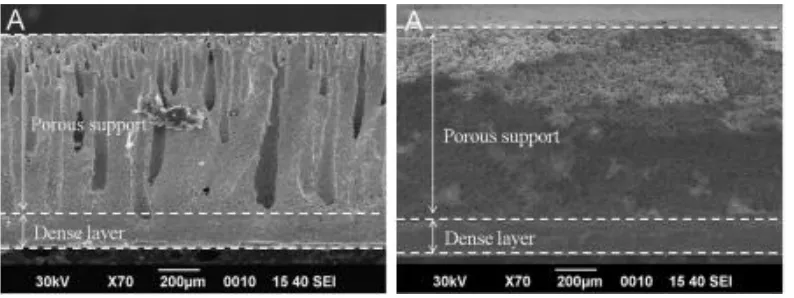
Membrane structure plays an important role in membrane characterization and performance. Due to this, most investigations have been focused more on ceramic membrane structure of the phase inversion technique. As mentioned earlier, ceramic membrane fabricated via phase inversion commonly induced two types of structures: finger-like and sponge-like structure. These structures have been reported by most previous studies [12, 18, 62, 63]. According to Zhang (2009), these structures are generated from instantaneous phase demixing [64]. Others researchers reported that these structures could also be obtained by playing with the dope suspension viscosity [12, 63]. For example, Othman (2010) reported that the increased of suspension viscosity could be diminished membrane’s finger-like structure as shown in Figure 2.7.
22
[image:38.598.176.468.174.615.2]higher suspension viscosity, which was in contradiction with the study conducted by Lee et al (2015). This is according to the different parameters applied by Lee et al (2015), in which the effect of different solvents has been applied [67]. This concluded that different parameters applied would promoted different membrane structure.
23
Figure 2.8: Ceramic membrane finger-like and sponge-like structure [67]
Figure 2.9: Ceramic membrane sandwich-like structure [68]
In most cases, ceramic membrane fabricated through phase inversion always described and measured via it structures has been discussed before. Conversely, the membrane surface roughness also plays an important role in membrane characterizations and performances as it strongly influenced the membrane performance as well. According to Zhong et al (2013), rough surface is more easily to be fouled due to larger surface area [69]. The mechanism of fouling is always observed in liquid separation such as water separation [70], oil-water separation [69] and removal of heavy metal in wastewater [71]. As reported by Khulbe et al (1997) who studied the relationship between the surface roughness and the gas permeability of dense homogeneous membranes prepared from poly (phenylene oxide) [72]. From the study, the permeability increased while the selectivity decreased with increased membrane roughness. Furthermore, Tan and Matsuura (1999) also reported that smoother membrane roughness could enhance the selectivity of the gas mixtures [73]. As far as concerned, there are no studies of membrane roughness towards ceramic membrane via phase inversion technique for gas application. Thus, the roughness result obtained from this work will be related to the result of polymeric membrane fabricated from phase inversion system.
Sponge-like
Finger-like
[image:39.598.156.487.254.377.2]24
Membrane pore structure characterization such as pore size and porosity are become one of crucial measurement in gas separation analysis [74]. This is imputable to the performances of the membrane itself is related to the membrane pore size and porosity. According to Li (2007), there are many methods can be employed in measuring ceramic membrane pore size and porosity such as a bubble point method, nitrogen separation and mercury intrusion porosimetry (MIP) [15]. In this study, the literature is concentrated along the membrane pore size measured by MIP due to large numbers of studies used this method [63, 68, 75]. Futhermore, MIP is based on the fact that mercury is a strongly non-wetting liquid on most materials [15]. Therefore, when mercury is forced into a dry membrane with the volume of mercury being determined at each pressure, a cumulative volume of mercury can be determined. Interestingly, using MIP, both pore size and pore size distribution can be determined and at the same time porosity could be also measured.
158
[1] US Environmental Protection Agency. Available:
http://www.epa.gov/climatechange/policy/intensitygoal.html.
[2] D. M. D'Alessandro, B. Smit, and J. R. Long, "Carbon Dioxide Capture: Prospects for New Materials," Angewandte Chemie International Edition,
vol. 49, pp. 6058-6082, 2010.
[3] A. Brunetti, F. Scura, G. Barbieri, and E. Drioli, "Membrane technologies for CO2 separation," Journal of Membrane Science, vol. 359, pp. 115-125, 2010.
[4] Toxicity of carbon dioxide gas exposure, CO2 poisoning symptoms, carbon
dioxide exposure limits. Available:
http://www.inspectapedia.com/hazmat/CO2gashaz.thm
[5] "IPCC Fourth Assesment Report: Climate Change (AR4)," 2007.
[6] M. L. Observatory, "Scripps Institution of Oceanography, Atmospheric CO2 on 5 December 2012," 2012.
[7] P. Bernardo, E. Drioli, and G. Golemme, "Membrane Gas Separation: A Review/State of the Art," Industrial & Engineering Chemistry Research, vol. 48, pp. 4638-4663, 2009.
[8] T. Isobe, Y. Kameshima, A. Nakajima, K. Okada, and Y. Hotta, "Gas permeability and mechanical properties of porous alumina ceramics with unidirectionally aligned pores," Journal of the European Ceramic Society,
vol. 27, pp. 53-59, 2007.
[9] S. Emani, R. Uppaluri, and M. K. Purkait, "Cross flow microfiltration of oil– water emulsions using kaolin based low cost ceramic membranes,"
Desalination, vol. 341, pp. 61-71, 2014.
159
[11] X. Sui and X. Huang, "The characterization and water purification behavior of gradient ceramic membranes," Separation and Purification Technology,
vol. 32, pp. 73-79, 2003.
[12] B. F. K. Kingsbury and K. Li, "A morphological study of ceramic hollow fibre membranes," Journal of Membrane Science, vol. 328, pp. 134-140, 2009.
[13] B. Wang and Z. Lai, "Finger-like voids induced by viscous fingering during phase inversion of alumina/PES/NMP suspensions," Journal of Membrane
Science, vol. 405–406, pp. 275-283, 2012.
[14] J. Smid, C. G. Avci, V. Günay, R. A. Terpstra, and J. P. G. M. Van Eijk, "Preparation and characterization of microporous ceramic hollow fibre membranes," Journal of Membrane Science, vol. 112, pp. 85-90, 1996.
[15] K. Li, Ceramic Membranes for Separation and Reaction: Wiley, 2007.
[16] A. Basile, A. Cassano, and N. K. Rastogi, Advances in Membrane
Technologies for Water Treatment: Materials, Processes and Applications:
Elsevier Science, 2015.
[17] S. Loeb and S. Sourirajan, "Sea Water Demineralization by Means of an Osmotic Membrane," in Saline Water Conversion?II. vol. 38, ed: AMERICAN CHEMICAL SOCIETY, 1963, pp. 117-132.
[18] B. F. K. Kingsbury, Z. Wu, and K. Li, "A morphological study of ceramic hollow fibre membranes: A perspective on multifunctional catalytic membrane reactors," Catalysis Today, vol. 156, pp. 306-315, 2010.
[19] F. Bouzerara, A. Harabi, S. Achour, and A. Larbot, "Porous ceramic supports for membranes prepared from kaolin and doloma mixtures," Journal of the
160
[20] M. Mulder, Basic Principles of Membrane Technology: Springer, 1996.
[21] R. W. Baker, Membrane Technology and Applications: Wiley, 2012.
[22] H. P. Hsieh, Inorganic Membranes for Separation and Reaction: Elsevier Science, 1996.
[23] J. Vital and J. M. Sousa, "1 - Polymeric membranes for membrane reactors,"
in Handbook of Membrane Reactors. vol. 1, A. Basile, Ed., ed: Woodhead
Publishing, 2013, pp. 3-41.
[24] S. Zhou, A. Xue, Y. Zhang, X. Huang, M. Li, Y. Zhao, et al., "Preparation of a new ceramic microfiltration membrane with a separation layer of attapulgite nanofibers," Materials Letters, vol. 143, pp. 27-30, 2015.
[25] K. A. DeFriend, M. R. Wiesner, and A. R. Barron, "Alumina and aluminate ultrafiltration membranes derived from alumina nanoparticles," Journal of
Membrane Science, vol. 224, pp. 11-28, 2003.
[26] W. Qin, B. Lei, C. Peng, and J. Wu, "Corrosion resistance of ultra-high purity porous alumina ceramic support," Materials Letters, vol. 144, pp. 74-77, 2015.
[27] Zeman, Microfiltration and Ultrafiltration: Principles and Applications: Taylor & Francis, 1996.
[28] T. Van Gestel, D. Sebold, H. Kruidhof, and H. J. M. Bouwmeester, "ZrO2 and TiO2 membranes for nanofiltration and pervaporation," Journal of
Membrane Science, vol. 318, pp. 413-421, 2008.
161
[30] J. Fang, G. Qin, W. Wei, and X. Zhao, "Preparation and characterization of tubular supported ceramic microfiltration membranes from fly ash,"
Separation and Purification Technology, vol. 80, pp. 585-591, 2011.
[31] N. Saffaj, M. Persin, S. A. Younssi, A. Albizane, M. Bouhria, H. Loukili, et al., "Removal of salts and dyes by low ZnAl2O4–TiO2 ultrafiltration membrane deposited on support made from raw clay," Separation and
Purification Technology, vol. 47, pp. 36-42, 2005.
[32] N. Saffaj, M. Persin, S. A. Younsi, A. Albizane, M. Cretin, and A. Larbot, "Elaboration and characterization of microfiltration and ultrafiltration membranes deposited on raw support prepared from natural Moroccan clay: Application to filtration of solution containing dyes and salts," Applied Clay
Science, vol. 31, pp. 110-119, 2006.
[33] M. C. Almandoz, J. Marchese, P. Prádanos, L. Palacio, and A. Hernández, "Preparation and characterization of non-supported microfiltration
membranes from aluminosilicates," Journal of Membrane Science, vol. 241, pp. 95-103, 2004.
[34] B. K. Nandi, R. Uppaluri, and M. K. Purkait, "Preparation and characterization of low cost ceramic membranes for micro-filtration applications," Applied Clay Science, vol. 42, pp. 102-110, 2008.
[35] I. Hedfi, N. Hamdi, E. Srasra, and M. A. Rodríguez, "The preparation of micro-porous membrane from a Tunisian kaolin," Applied Clay Science, vol. 101, pp. 574-578, 2014.
[36] A. Belouatek, N. Benderdouche, A. Addou, A. Ouagued, and N. Bettahar, "Preparation of inorganic supports for liquid waste treatment," Microporous
and Mesoporous Materials, vol. 85, pp. 163-168, 2005.
162
[38] R. D. Sahnoun and S. Baklouti, "Characterization of flat ceramic membrane supports prepared with kaolin-phosphoric acid-starch," Applied Clay Science,
vol. 83–84, pp. 399-404, 2013.
[39] D. Vasanth, G. Pugazhenthi, and R. Uppaluri, "Fabrication and properties of low cost ceramic microfiltration membranes for separation of oil and bacteria from its solution," Journal of Membrane Science, vol. 379, pp. 154-163, 2011.
[40] R. Donelson, G. Paul, F. Ciacchi, and S. Badwal, "Permeation and strength characteristics of macroporous supports for gas separation produced by co-sintering mixtures of α-alumina and kaolin," Journal of Membrane Science,
vol. 463, pp. 126-133, 2014.
[41] R. Abedini and A. Nezhadmoghadam, "Application of membrane in gas separation processes: Its suitability and mechanisms," Petroleum & Coal vol. 52, pp. 69-80, 2010.
[42] M. B. Choi, D. K. Lim, S. Y. Jeon, H. S. Kim, and S. J. Song, "Oxygen permeation properties of BSCF5582 tubular membrane fabricated by the slip casting method," Ceramics International, vol. 38, pp. 1867-1872, 2012.
[43] M. Barmala, A. Moheb, and R. Emadi, "Applying Taguchi method for
optimization of the synthesis condition of nano-porous alumina membrane by slip casting method," Journal of Alloys and Compounds, vol. 485, pp. 778-782, 2009.
[44] N. Miura, Y. Okamoto, J. Tamaki, K. Morinaga, and N. Yamazoe, "Oxygen semipermeability of mixed-conductive oxide thick-film prepared by slip casting," Solid State Ionics, vol. 79, pp. 195-200, 1995.
163
[46] Y. L. Liu and C. Jiao, "Microstructure degradation of an anode/electrolyte interface in SOFC studied by transmission electron microscopy," Solid State
Ionics, vol. 176, pp. 435-442, 2005.
[47] T. Isobe, Y. Kameshima, A. Nakajima, K. Okada, and Y. Hotta, "Extrusion method using nylon 66 fibers for the preparation of porous alumina ceramics with oriented pores," Journal of the European Ceramic Society, vol. 26, pp. 2213-2217, 2006.
[48] R. T. Cruz, S. R. Bragança, C. P. Bergmann, T. Graule, and F. Clemens, "Preparation of Ba0.5Sr0.5Co0.8Fe0.2O3−δ (BSCF) feedstocks with
different thermoplastic binders and their use in the production of thin tubular membranes by extrusion," Ceramics International, vol. 40, pp. 7531-7538, 2014.
[49] M. Kong, S. Jiang, T. Xie, and H. Zhang, "Low temperature sintering properties of Y-doped BaTiO3 ceramics by BaB2O4 sintering aid,"
Microelectronic Engineering, vol. 86, pp. 2320-2323, 2009.
[50] Y. Dong, X. Feng, X. Feng, Y. Ding, X. Liu, and G. Meng, "Preparation of low-cost mullite ceramics from natural bauxite and industrial waste fly ash,"
Journal of Alloys and Compounds, vol. 460, pp. 599-606, 2008.
[51] X. Miao, "Porous mullite ceramics from natural topaz," Materials Letters,
vol. 38, pp. 167-172, 1999.
[52] K. Lindqvist and E. Lidén, "Preparation of alumina membranes by tape casting and dip coating," Journal of the European Ceramic Society, vol. 17, pp. 359-366, 1997.
[53] N. Das and H. S. Maiti, "Ceramic membrane by tape casting and sol–gel coating for microfiltration and ultrafiltration application," Journal of Physics
164
[54] W. He, H. Huang, J.-f. Gao, L. Winnubst, and C.-s. Chen, "Phase-inversion tape casting and oxygen permeation properties of supported ceramic
membranes," Journal of Membrane Science, vol. 452, pp. 294-299, 2014.
[55] B. S. Lalia, V. Kochkodan, R. Hashaikeh, and N. Hilal, "A review on membrane fabrication: Structure, properties and performance relationship,"
Desalination, vol. 326, pp. 77-95, 2013.
[56] J. Garcia-Ivars, M.-I. Alcaina-Miranda, M.-I. Iborra-Clar, J.-A. Mendoza-Roca, and L. Pastor-Alcañiz, "Enhancement in hydrophilicity of different polymer phase-inversion ultrafiltration membranes by introducing
PEG/Al2O3 nanoparticles," Separation and Purification Technology, vol. 128, pp. 45-57, 2014.
[57] M. Sadrzadeh and S. Bhattacharjee, "Rational design of phase inversion membranes by tailoring thermodynamics and kinetics of casting solution using polymer additives," Journal of Membrane Science, vol. 441, pp. 31-44, 2013.
[58] N. Hilal, A. F. Ismail, and C. Wright, Membrane Fabrication: CRC Press, 2015.
[59] J. Barzin and B. Sadatnia, "Correlation between macrovoid formation and the ternary phase diagram for polyethersulfone membranes prepared from two nearly similar solvents," Journal of Membrane Science, vol. 325, pp. 92-97, 2008.
[60] M. H. D. Othman, N. Droushiotis, Z. Wu, G. Kelsall, and K. Li, "Dual-layer hollow fibres with different anode structures for micro-tubular solid oxide fuel cells," Journal of Power Sources, vol. 205, pp. 272-280, 2012.
vacuum-165
assisted coating technique," Ceramics International, vol. 40, pp. 10163-10169, 2014.
[62] Z. Wu, R. Faiz, T. Li, B. F. K. Kingsbury, and K. Li, "A controlled sintering process for more permeable ceramic hollow fibre membranes," Journal of
Membrane Science, vol. 446, pp. 286-293, 2013.
[63] M. H. D. Othman, Z. Wu, N. Droushiotis, G. Kelsall, and K. Li,
"Morphological studies of macrostructure of Ni–CGO anode hollow fibres for intermediate temperature solid oxide fuel cells," Journal of Membrane
Science, vol. 360, pp. 410-417, 2010.
[64] L.-Z. Zhang, "Coupled heat and mass transfer through asymmetric porous membranes with finger-like macrovoids structure," International Journal of
Heat and Mass Transfer, vol. 52, pp. 751-759, 2009.
[65] N. H. Othman, Z. Wu, and K. Li, "A micro-structured
La0.6Sr0.4Co0.2Fe0.8O3−δ hollow fibre membrane reactor for oxidative
coupling of methane," Journal of Membrane Science, vol. 468, pp. 31-41, 2014.
[66] Z. Wang, N. Yang, B. Meng, X. Tan, and K. Li, "Preparation and Oxygen Permeation Properties of Highly Asymmetric La0.6Sr0.4Co0.2Fe0.8O3−α
Perovskite Hollow-Fiber Membranes," Industrial & Engineering Chemistry
Research, vol. 48, pp. 510-516, 2009.
[67] M. Lee, B. Wang, Z. Wu, and K. Li, "Formation of micro-channels in
ceramic membranes – Spatial structure, simulation, and potential use in water treatment," Journal of Membrane Science, vol. 483, pp. 1-14, 2015.
[68] N. H. Othman, Z. Wu, and K. Li, "Bi1.5Y0.3Sm0.2O3-δ-based ceramic hollow fibre membranes for oxygenseparation and chemicalreactions,"
166
[69] Z. Zhong, W. Xing, and B. Zhang, "Fabrication of ceramic membranes with controllable surface roughness and their applications in oil/water separation,"
Ceramics International, vol. 39, pp. 4355-4361, 2013.
[70] S.-J. Lee, M. Dilaver, P.-K. Park, and J.-H. Kim, "Comparative analysis of fouling characteristics of ceramic and polymeric microfiltration membranes using filtration models," Journal of Membrane Science, vol. 432, pp. 97-105, 2013.
[71] X. Zhang, L. Fan, and F. A. Roddick, "Feedwater coagulation to mitigate the fouling of a ceramic MF membrane caused by soluble algal organic matter,"
Separation and Purification Technology, vol. 133, pp. 221-226, 2014.
[72] K. C. Khulbe, T. Matsuura, G. Lamarche, and H. J. Kim, "The morphology characterisation and performance of dense PPO membranes for gas
separation," Journal of Membrane Science, vol. 135, pp. 211-223,1997.
[73] J. M. A. Tan and T. Matsuura, "Effect of nonsolvent additive on the surface morphology and the gas separation performance of poly(2,6-dimethyl-1,4-phenylene)oxide membranes," Journal of Membrane Science, vol. 160, pp. 7-16, 1999.
[74] S.-i. Nakao, "Determination of pore size and pore size distribution: 3. Filtration membranes," Journal of Membrane Science, vol. 96, pp. 131-165, 1994.
[75] H. Dzinun, M. H. D. Othman, A. F. Ismail, M. H. Puteh, M. A. Rahman, and J. Jaafar, "Morphological study of co-extruded dual-layer hollow fiber
membranes incorporated with different TiO2 loadings," Journal of Membrane
Science, vol. 479, pp. 123-131, 2015.
167
membranes using natural alumino-silicates for microfiltration applications,"
Materials Characterization, 2015.
[77] Y. Liu, X. Tan, and K. Li, "SrCe0.95Yb0.05O3−α (SCYb) hollow fibre membrane: Preparation, characterization and performance," Journal of
Membrane Science, vol. 283, pp. 380-385, 2006.
[78] S. Liu, X. Tan, K. Li, and R. Hughes, "Preparation and characterisation of SrCe0.95Yb0.05O2.975 hollow fibre membranes," Journal of Membrane
Science, vol. 193, pp. 249-260, 2001.
[79] R. Sarbatly, "Effect of Kaolin/pesf Ratio and Sintering Temperature on Pore Size and Porosity of the Kaolin Membrane Support," Journal of Applied
Sciences, vol. 11, pp. 2306-2312, 2011.
[80] J. Fletcher and A. Hill. Making the connection - particle size, size distribution
and rheology. Available:
http://www.chemeurope.com/en/whitepapers/61207/making-the-connection-particle-size-size-distribution-and-rheology.html
[81] T. J. Fiske, S. B. Railkar, and D. M. Kalyon, "Effects of segregation on the packing of spherical and nonspherical particles," Powder Technology, vol. 81, pp. 57-64, 1994.
[82] Q. Chang, Y. Yang, X. Zhang, Y. Wang, J.-e. Zhou, X. Wang, et al., "Effect of particle size distribution of raw powders on pore size distribution and bending strength of Al2O3 microfiltration membrane supports," Journal of
the European Ceramic Society, vol. 34, pp. 3819-3825, 2014.
168
[84] E. Drioli and L. Giorno, Comprehensive Membrane Science and Engineering: Elsevier Science, 2010.
[85] S. Liu, K. Li, and R. Hughes, "Preparation of porous aluminium oxide (Al2O3) hollow fibre membranes by a combined phase-inversion and sintering method," Ceramics International, vol. 29, pp. 875-881, 2003.
[86] J. M. Benito, A. Conesa, F. Rubio, and M. A. Rodríguez, "Preparation and characterization of tubular ceramic membranes for treatment of oil
emulsions," Journal of the European Ceramic Society, vol. 25, pp. 1895-1903, 2005.
[87] X. Tan, S. Liu, and K. Li, "Preparation and characterization of inorganic hollow fiber membranes," Journal of Membrane Science, vol. 188, pp. 87-95, 6/30/ 2001.
[88] C. E. Capes, J. C. Williams, and T. Allen, Particle Size Enlargement: Elsevier Science, 2013.
[89] J. Luyten, A. Buekenhoudt, W. Adriansens, J. Cooymans, H. Weyten, F. Servaes, et al., "Preparation of LaSrCoFeO3−x membranes," Solid State
Ionics, vol. 135, pp. 637-642, 2000.
[90] T.-H. Young and L.-W. Chen, "Pore formation mechanism of membranes from phase inversion process," Desalination, vol. 103, pp. 233-247, 1995.
[91] P. Sukitpaneenit and T.-S. Chung, "Molecular elucidation of morphology and mechanical properties of PVDF hollow fiber membranes from aspects of phase inversion, crystallization and rheology," Journal of Membrane Science,
vol. 340, pp. 192-205, 2009.
[92] S. P. Deshmukh and K. Li, "Effect of ethanol composition in water
coagulation bath on morphology of PVDF hollow fibre membranes," Journal
169
[93] A. L. Ahmad, W. K. W. Ramli, W. J. N. Fernando, and W. R. W. Daud, "Effect of ethanol concentration in water coagulation bath on pore geometry of PVDF membrane for Membrane Gas Absorption application in CO2 removal," Separation and Purification Technology, vol. 88, pp. 11-18, 3/22/ 2012.
[94] R. Rautenbach, R. Rautenbach, and R. Albrecht, Membrane processes: Wiley, 1989.
[95] R. E. Kesting, Synthetic polymeric membranes: a structural perspective: Wiley, 1985.
[96] R. R. Bhave, Inorganic membranes synthesis, characteristics, and
applications: Van Nostrand Reinhold, 1991.
[97] R. W. Rice, Porosity of Ceramics: Properties and Applications: Taylor & Francis, 1998.
[98] S. S. Hashim, A. R. Mohamed, and S. Bhatia, "Oxygen separation from air using ceramic-based membrane technology for sustainable fuel production and power generation," Renewable and Sustainable Energy Reviews, vol. 15, pp. 1284-1293, 2011.
[99] Y. Wall, M. Ompe Aime, G. Braun, and G. Brunner, "Gas transport through ceramic membranes under super-critical conditions," Desalination, vol. 250, pp. 1056-1059, 2010.
[100] H. Z. Chen, Z. Thong, P. Li, and T.-S. Chung, "High performance composite hollow fiber membranes for CO2/H2 and CO2/N2 separation," International
Journal of Hydrogen Energy, vol. 39, pp. 5043-5053, 2014.
170
membranes," Journal of the European Ceramic Society, vol. 35, pp. 3187-3194, 2015.
[102] C. Hong, A. Dudek, B. Fang, C. Xu, I. W. M. Brown, K. A. Khalil, et al.,
Synthesis and Characterization of a Novel Hydrophobic Membrane:
Application for Seawater Desalination with Air Gap Membrane Distillation
Process: INTECH Open Access Publisher, 2012.
[103] A. Larbot, L. Gazagnes, S. Krajewski, M. Bukowska, and K. Wojciech, "Water desalination using ceramic membrane distillation," Desalination, vol. 168, pp. 367-372, 2004.
[104] C. Picard, A. Larbot, E. Tronel-Peyroz, and R. Berjoan, "Characterisation of hydrophilic ceramic membranes modified by fluoroalkylsilanes into
hydrophobic membranes," Solid State Sciences, vol. 6, pp. 605-612, 2004.
[105] A. Harabi, F. Zenikheri, B. Boudaira, F. Bouzerara, A. Guechi, and L. Foughali, "A new and economic approach to fabricate resistant porous membrane supports using kaolin and CaCO3," Journal of the European
Ceramic Society, vol. 34, pp. 1329-1340, 2014.
[106] S. Khemakhem and R. B. Amar, "Grafting of fluoroalkylsilanes on
microfiltration Tunisian clay membrane," Ceramics International, vol. 37, pp. 3323-3328, 2011.
[107] L. Besra, D. K. Sengupta, and S. K. Roy, "Particle characteristics and their influence on dewatering of kaolin, calcite and quartz suspensions,"
International Journal of Mineral Processing, vol. 59, pp. 89-112, 2000.
[108] R. E. Grim, Clay Mineralogy: McGraw-Hill, 1968.
[109] J. E. Kogel, M. Society for Mining, and Exploration, Industrial Minerals &
Rocks: Commodities, Markets, and Uses: Society for Mining, Metallurgy, and
171
[110] J. Mewis and N. J. Wagner, "Thixotropy," Advances in Colloid and Interface
Science, vol. 147–148, pp. 214-227, 2009.
[111] P. Marco, J. Labanda, and J. Llorens, "The effects of some polyelectrolyte chemical compositions on the rheological behaviour of kaolin suspensions,"
Powder Technology, vol. 148, pp. 43-47, 2004.
[112] H. S. Katz and J. V. Mileski, Handbook Of Fillers For Plastics: Springer, 1987.
[113] T. R. Hull and B. K. Kandola, Fire Retardancy of Polymers: New Strategies
and Mechanisms: Royal Society of Chemistry, 2009.
[114] M. Larsson, A. Hill, and J. Duffy, "Suspension Stability: Why Particle Size Zeta Potential and Rheology are Important," Annual transactions of the
nordic rheology society, vol. 20, pp. 209-214, 2012.
[115] R. Blazejewski, "Apparent viscosity and settling velocity of suspensions of rigid monosized spheres in Stokes flow," International Journal of Multiphase
Flow, vol. 39, pp. 179-185, 2012.
[116] G. Hochgesand, "Rectisol and Purisol," Industrial & Engineering Chemistry,
vol. 62, pp. 37-43, 1970.
[117] A. L. Kohl and R. Nielsen, Gas Purification: Elsevier Science, 1997.
[118] B. Su, C. Zhao, and S. Sun, Polyethersulfone Hollow Fiber Membranes for
Hemodialysis: INTECH Open Access Publisher, 2011.
[119] Z. Harun, H. S.K., S. Hasan, and M. Z. Yunos, "Effect of thermodynamic properties on porosity of ceramic membrane prepared by phase inversion,"
Applied Mechanics and Materials, vol. 575, pp. 31-35, 2014.
![Figure 1.2: Ceramic Membrane Structure fabricated via phase inversion [15]](https://thumb-us.123doks.com/thumbv2/123dok_us/8763404.895128/21.598.114.526.68.216/figure-ceramic-membrane-structure-fabricated-via-phase-inversion.webp)
![Figure 2.2 Schematic of membrane separation process [23]](https://thumb-us.123doks.com/thumbv2/123dok_us/8763404.895128/26.598.185.455.257.492/figure-schematic-membrane-separation-process.webp)
![Table 2.1: Various Applications of Membranes [24-31]](https://thumb-us.123doks.com/thumbv2/123dok_us/8763404.895128/27.598.143.500.212.446/table-various-applications-of-membranes.webp)
![Table 2.2: Properties of high cost ceramic material [31-34]](https://thumb-us.123doks.com/thumbv2/123dok_us/8763404.895128/28.598.129.513.421.707/table-properties-high-cost-ceramic-material.webp)