BIROn - Birkbeck Institutional Research Online
Paterson, Maura B. and Stinson, D.R. (2015) Optimal constructions for
ID-based one-way-function key predistribution schemes realizing specified
communication graphs. Journal of Mathematical Cryptology 9 (4), pp.
215-225. ISSN 1862-2976.
Downloaded from:
Usage Guidelines:
Please refer to usage guidelines at or alternatively
Optimal constructions for ID-based one-way-function key
predistribution schemes realizing specified communication graphs
Maura B. Paterson
Department of Economics, Mathematics and Statistics
Birkbeck, University of London, Malet Street, London WC1E 7HX, UK Douglas R. Stinson∗
David R. Cheriton School of Computer Science
University of Waterloo, Waterloo, Ontario, N2L 3G1, Canada March 6, 2014
Abstract
We study a method for key predistribution in a network of nusers where pairwise keys are computed by hashing users’ IDs along with secret information that has been (pre)distributed to the network users by a trusted entity. A communication graphG can be specified to indicate which pairs of users should be able to compute keys. We determine necessary and sufficient conditions for schemes of this type to be secure. We also consider the problem of minimizing the storage requirements of such a scheme; we are interested in the total storage as well as the maximum storage required by any user. Minimizing the total storage is NP-hard, whereas minimizing the maximum storage required by a user can be computed in polynomial time.
1
Introduction
Suppose we have a network of n users and we want every pair of users to have a secure pairwise key. When keying information is distributed “ahead of time” by a trusted authority, we have a
key predistribution scheme, or KPS. The trivial KPS assignsn−1 distinct pairwise keys to each user, so we say that each user has storage equal to n−1. The total storage in the trivial scheme is n(n−1), since each of the nusers has storage equal to n−1. Assuming the pairwise keys are chosen independently and uniformly at random from a specified keyspace, the trivial scheme is secure against (maximum size) coalitions of size n−2, since each pairwise key is known only to two participants and cannot be computed even if all the remainingn−2 participants collude.
An interesting way to reduce the storage requirement, as compared to the trivial scheme, is to use aBlom Scheme[3]. The Blom Scheme incorporates asecurity parameterdenoted byk; pairwise keys are unconditionally secure against coalitions of up tokusers. Each user’s storage requirement in the Blom Scheme isk+ 1 and this storage requirement is shown to be optimal by Blundoet al.
[4].
∗
Another approach, due to Lee and Stinson [7], is called an ID-based one-way-function key predistribution scheme, also known as IOS. Here, pairwise keys are computed by hashing public information along with secret information. This technique can be used to construct a secure scheme in which every pair of n users has a pairwise key. Here we obtain security against maximum size coalitions, but the security depends on the hash function used to construct the keys. We will assume that the hash function can be modelled as a random function, i.e, the security analysis will be done in the standard random oracle model [2]. The storage requirement of this scheme is reduced by almost half as compared to the trivial scheme. In [5], a very similar scheme was described that has the same storage requirement as IOS.
It is also possible to consider a more general setting where we specify a communication graphG
consisting of all the pairs of users who we want to be able to share a secret key. A trivial KPS for a given communication graphGwould assigndeg(u) keys to vertex u, for every vertexuinG, where
deg(u) denotes the degree of vertexu. In the case of unconditionally secure schemes secure against coalitions of sizek, Blundoet al. [4] gave a construction where a vertexu has storage requirement min{k+ 1,deg(u)}, for every vertexu. Lee and Stinson’s construction [7] applies to regular graphs of even degree d; the storage requirement for each vertex is 1 +d/2.
1.1 Our contributions
In Section 1.2, we introduce some graph-theoretic terminology and basic results that are required later in the paper. In Section 2, we define a general model for IOS for a specified communication graphG. In Section 2.1, we determine necessary and sufficient conditions for an IOS to be secure. Our characterization of secure IOS involves certain key graphs. We then use our characterization of secure IOS to investigate the storage requirements of the these types of schemes. We show in Section 2.2 that it is sufficient to restrict our attention to schemes obtained by decomposing the edges of the communication graph into “stars”. In Section 3.1, we investigate how to minimize the total storage in the scheme. In general, this turns out to be equivalent to determining the size of a maximum independent set of vertices in G, which is an NP-hard problem. For complete graphs, however, it is easy to give an exact answer. In Sections 3.2 and 3.3, we turn to the problem of minimizing the maximum storage required by any vertex of G. We give a complete solution for regular graphs. For arbitrary graphs, we can show that the optimal maximum storage can be determined in polynomial time by exploiting a connection with the minimum maximum indegree
problem. In Section 4, we discuss our results in comparison to the recent paper by Choi, Acharya and Gouda [5].
1.2 Graph-theoretic terminology
Definition 1.1. A graph is a pair G= (V, E) where V is a finite set of vertices and E is a set of
edges, where every edge is a set of two vertices. We say that the edge e={u, v}joins the vertices
u and v, and u and v are incident withe. We may also write an edge{u, v}as uv. If E is instead a multiset, then we say that G= (V, E) is a multigraph.
Definition 1.2. For a vertex uin a graph G, Thedegree ofu∈V, denoteddeg(u), is the number of edges that are incident with v. A graph is m-regular if every vertex has degree equal tom.
Definition 1.3. Suppose G= (V, E) is a graph and u, v∈ V,u 6=v. A (u, v)-path is a sequence of the form v1, e1, v2, e2, . . . , e`, v`+1, where v1, . . . , v`+1 ∈ V are distinct vertices, e1, . . . , e` ∈ E,
v1 =u,v`+1 =v, andei is incident withvi and vi+1 for 1≤i≤`.
Definition 1.4. A graph isconnectedif, for all distinct verticesuandv, there exists a (u, v)-path.
Definition 1.5. Adirected graph is a pairG= (V, E) whereV is a finite set ofverticesand E is a set of directed edges, where every edge is an ordered pair of two distinct vertices. The indegree of a vertex v∈V is the number of directed edges (u, v)∈E. The outdegree of a vertexv ∈V is the number of directed edges (v, u)∈E.
Definition 1.6. A connected graph (or multigraph)G= (V, E) has aneulerian circuitif there ex-ists a circuit in which every edge is used exactly once. It is well-known that a connected (multi)graph has an eulerian circuit if and only if every vertex has even degree.
Definition 1.7. A complete graph Kn is a graph on n vertices where every pair of vertices are
joined by an edge.
Definition 1.8. A complete bipartite graph Kn1,n2 is a graph on n1 +n2 vertices V = V1∪V2,
where|V1|=n1,|V2|=n2, and E ={{v1, v2}:v1 ∈V1, v2 ∈V2}.
Definition 1.9. A star is a complete bipartite graph K1,m for some m ≥ 1. If m > 1, then the
centre of the graph is the (unique) vertex of degree m. If m = 1, then the graph is a single edge and we can specify either endpoint to be the centre of the star. Vertices in a star that are not the centre will be termed leaves. A directed star is obtained from a star by directing every edge from the leaf to the centre.
Definition 1.10. Given a graph G = (V, E), an independent set is a subset of vertices V0 ⊆ V
such that {u, v} 6∈E for every u, v ∈V0. The size of a maximum independent set of vertices in a
graphG is denoted byα(G).
Theorem 1.1 (Rosenfeld [8]). In any m-regular graph G= (V, E), we have
α(G)≤min{bn/2c, n−m},
where n=|V|.
Definition 1.11. Given a graphG= (V, E), thecomplementof Gis the graphG= (V, E), where
{u, v} ∈E if and only if {u, v} 6∈E, for every u, v∈V,u6=v.
Definition 1.12. Let G = (V, E) and H = (W, F) be graphs, where V ∩W =∅. The join of G
and H, is the graph denoted as G∨H. The vertex set of G∨H is V ∪W. The edges of G∨H
consist of all edges inE or F, and all {v, w} withv∈V and w∈W.
2
A general model for ID-based one-way-function KPS
In an ID-based one-way-function key predistribution scheme (or IOS), pairwise keys are constructed by hashing public information along with secret information. We describe a general model for IOS for a given communication graph G= (V, E) on nvertices. We identify the nvertices inV with a set of nusers, say U. Our first goal is to obtain a KPS in which two usersu, v∈ U have a pairwise key Lu,v whenever{u, v} ∈E. Security of the scheme will be addressed in Section 2.1.
Let f:E(G)→ {1, . . . , t} be a publicly known surjective function and let R1, . . . , Rt ∈ {0,1}σ
be secret values chosen uniformly at random from {0,1}σ. Let h: {0,1}∗ → {0,1}σ be a hash
function (which we model as a random oracle). The length of the Ri’s, namely σ, is the same as
the length of the output of h. A suitable value forσ is σ= 128. The function h will be used as a
key derivation function.
Every pairwise key Lu,v will be computed as
Lu,v =Lv,u =h(Rf({u,v})kID(u)kID(v)), (1)
where
(1) for every u∈ U, ID(u) denotes public identifying information for user u, and
(2) u < v (this requirement ensures that Lu,v =Lv,u in (1)).
Suppose a value Rf({u,v}) is not known to a coalition of users. Recall thatRf({u,v}) was chosen
uniformly at random from a set of size 2σ. Also, the keyLu,v is the output of a random function h
that takes on values from a set of size 2σ. Therefore this key can be regarded as a secureσ-bit key. Eventually, we will investigate whether secret values may be “repeated”, i.e., used for the computation of more than one key, without compromising security. The motivation is that this might enable the storage of the scheme to be reduced. This question will be addressed in Section 2.1.
Remark 2.1. As described above, the public inputs to the hash function are taken to be (public) IDs. Actually, it doesn’t really matter what the public inputs tohare, as long as there do not exist two keys that have the same public and secret inputs and we ensure thatLu,v =Lv,u.
It is obvious that if{u, v} ∈E andf({u, v}) =j, then usersu andv each must store one ofRj
orLu,v. We will assume that neitheru norv stores bothRj and Lu,v, sinceLu,v can be computed
ifRj is known.
Definition 2.1. For 1≤j≤t, define
Ej =f−1(j) ={{u, v} ∈E :f({u, v}) =j}
and letVj be the vertices spanned byEj. (Vj, Ej) is a graph that we term thejth key graph.
Let
Wj ={v∈Vj :v stores Rj}
and define W = (W1, . . . , Wt). Since we are assuming that f is surjective, it follows that |Ej| ≥1
and |Vj| ≥2 for allj∈ {1, . . . , t}.
To summarize, here is all the keying information that is stored in a G-IOS, (f,W). Suppose
u ∈ V is any vertex and {u, v} ∈ E is any edge that is incident with u. If {u, v} ∈ Ej, then the
vertex ustores Rj when u∈Wj, and it storesLu,v, otherwise. Example 2.1. Consider the graph G= (V, E), where
V ={1,2,3,4,5} and E={12,13,14,15,23,25,34,45}.
Suppose we define
f(12) =f(13) =f(14) = 1 W1 ={1}
f(15) =f(25) =f(45) = 2 W2 ={5}
f(23) =f(34) = 3 W3 ={3}.
Then it is easy to see that
E1 ={12,13,14} V1 ={1,2,3,4}
E2 ={15,25,45} V2 ={1,2,4,5}
E3 ={23,34} V3 ={2,3,4}.
The keying material held by each user is as follows: user 1 stores R1,L1,5
user 2 stores L1,2,L2,3,L2,5
user 3 stores R3,L1,3
user 4 stores L1,4,L3,4,L4,5
user 5 stores R2.
2.1 Secure IOS
Suppose that (f,W) is a G-IOS. We say that (f,W) issecure if there does not exist a userw who can compute a key Lu,v where {u, v} ∈ E and w 6=u, v. This security condition will be satisfied
provided that w does not know either of the valuesRj orLu,v (where j=f({u, v})). Note that a
secure IOS is automatically secure against maximum size coalitions.
We now consider when aG-IOS, as defined above, will be secure. We prove a sequence of simple lemmas that culminate in a characterization of secureG-IOS. The first lemma is obvious.
Lemma 2.1. Suppose (f,W) is a G-IOS, {u, v} ∈ E and w stores Lu,v, where w 6= u, v. Then
(f,W) is not secure.
Lemma 2.2. Suppose (f,W) is a secure G-IOS andw stores Rj. Then w∈Vj.
Proof. Suppose wstores Rj butw6∈Vj. Let{u, v} ∈Ej; then w6=u, v becausew6∈Vj. But then
w can computeLu,v, so (f,W) is not secure.
Lemma 2.3. Suppose (f,W) is a G-IOS and {u, v},{u, v0} ∈ Ej, where v 6= v0. If v ∈ Wj or
Proof. If v∈Wj, thenv can compute Lu,v0. Similarly, if v0 ∈Wj, thenv0 can computeLu,v.
Lemma 2.4. Suppose (f,W) is a G-IOS and {u, v},{u0, v0} ∈ Ej, where {u, v} ∩ {u0, v0}= ∅. If {u, u0, v, v0} ∩Wj 6=∅, then (f,W) is not secure.
Proof. If u ∈ Wj, then u can compute Lu0,v0. If v ∈ Wj, then v can compute Lu0,v0. If u0 ∈Wj,
thenu0 can compute Lu,v. Ifv0∈Wj, thenv0 can compute Lu,v.
Lemma 2.5. Suppose (f,W) is a secure G-IOS and u, v∈Wj. Then the key graph Ej consists of
a single edge {{u, v}}.
Proof. First suppose that {u, v} 6∈ Ej. Suppose {u, u0} ∈ Ej and {v, v0} ∈ Ej. If u0 6= v0, then
Lemma 2.4 is contradicted. If u0 =v0, then Lemma 2.3 is contradicted. Therefore it follows that
{u, v} ∈ Ej. Suppose that there is some other edge {u0, v0} ∈ Ej. If {u, v} ∩ {u0, v0} = ∅, then
Lemma 2.4 is contradicted. Otherwise, suppose without loss of generality that u = u0. Then Lemma 2.3 is contradicted.
Lemma 2.6. Suppose (f,W) is a secure G-IOS. Then, for every j, |Wj|= 0,1 or 2.
Proof. Suppose |Wj| ≥3 and supposeWj contains three distinct elements u, v, w. We now apply
Lemma 2.5: since u, v∈Wj, we have that Ej ={{u, v}}. Furthermore, since u, w ∈Wj, we have
thatEj ={{u, w}}. This is impossible because v6=w.
Lemma 2.7. Suppose (f,W)is a secureG-IOS. If |Wj|= 1, sayWj ={v}, then thejth key graph
is a star with centre v.
Proof. Suppose there is an edge {u, u0} ∈Ej where v6=u, u0. Then v can computeLu,u0.
The above conditions are necessary for a G-IOS, say (f,W), to be secure; we now show that they are also sufficient to provide security.
Theorem 2.8. Suppose (f,W) is a G-IOS. Then (f,W) is secure if and only if the following conditions hold:
(1) |Wj| ≤2 for all j;
(2) for any j with |Wj|= 1, say Wj ={v}, the jth key graph is a star with centre v; and
(3) for anyj with|Wj|= 2, say Wj ={u, v}, thejth key graph consists of the single edge{{u, v}}.
Proof. These three conditions are shown to be necessary for (f,W) to be secure in Lemmas 2.5–2.7. We now show they are sufficient for the scheme to be secure. Suppose the three conditions hold but (f,W) is not secure. We will obtain a contradiction.
If (f,W) is not secure, then some user w6=u, vcan compute a key Lu,v where {u, v} ∈E. Let
f({u, v}) =j. Since w does not store Lu,v (Lemma 2.1), it follows from Lemma 2.2 thatw ∈Wj
and hence|Wj| ≥1. Applying Lemma 2.6, we have that |Wj|= 1 or 2.
Suppose |Wj|= 2. Clearlyu, v, w∈Vj and hence|Vj| ≥3. This contradicts Lemma 2.5 which
says thatEj consists of a single edge.
Suppose |Wj|= 1 (so Wj ={w}). From Lemma 2.7, it follows that Ej is a star with centrew.
It may be helpful to summarize the cases enumerated in Theorem 2.8 in more descriptive language. We will say that the jth key graph is of type iif |Wj|= i. Then Theorem 2.8 can be
restated by saying that every key graph is of type 0, 1 or 2. Furthermore, the structure of a key graph of a specified type is as follows:
type 0 In a key graph (Vj, Ej) of type 0, no vertex in Vj stores the value Rj. Hence, for
every vertex u∈ Vj and every edge{u, v} ∈Ej that is incident with u, the vertex
u stores the key Lu,v. There is no restriction on the number of edges in Ej or the
structure of Ej.
type 1 A key graph (Vj, Ej) of type 1 is a star whose centre (say u) stores the value Rj.
Any leafv∈Vj stores the keyLu,v.
type 2 A key graph (Vj, Ej) of type 2 consists of a single edge {u, v} where u and u both
store the value Rj.
Remark 2.2. The IOS considered in Example 2.1 consists of three key graphs of type 1.
2.2 Edge-decompositions into stars
We say that a (secure) G-IOS (f,W) is a star-IOS if every key graph is of type 1. That is, the KPS is based on an edge-decomposition ofGinto stars. This was the model introduced by Lee and Stinson [7]. In this section, we show that the any secureG-IOS can be transformed into a (secure)
G-star-IOS in which the storage of each vertex is the same in the two schemes.
Basically, we need to describe how to change type 0 and 2 key graphs into type 1 key graphs. Let’s begin by considering a type 2 key graph, say (Vj, Ej), which consists of single edge {u, v}.
Both vertices u and v store Rj. If we stipulate that one of vertices u or v stores Rj and the
other one stores Lu,v, thenEj has been transformed to a type 1 key graph with the same storage
requirements.
Now we suppose we have a type 0 key graph, (Vj, Ej). No vertex inVj stores the valueRj. In
this case, we can split this key graph into |Ej| key graphs of type 1, each of which is isomorphic
to K1,1. Every edge is now assigned a different random value by the function f. Furthermore,
for every edge e = {u, v} ∈ Ej, one endpoint stores the (new) random value f(e) and the other
endpoint stores the (new) key Lu,v.
Summarizing the above discussion, we have the following theorem.
Theorem 2.9. If (f,W) is a secure G-IOS, then there exists a secure G-star-KPS in which the storage of every vertex is the same in both schemes.
3
Optimal storage of IOS
In this section, we focus on secure G-IOS that have minimum possible storage requirements. In view of Theorem 2.9, we can restrict our attention to G-star-IOS. We are interested in the total storage required in such a scheme, as well as the (maximum) storage required by an individual user.
3.1 Total storage
(i.e., key graphs) that contain u. Thetotal storage requirement of the IOS, denoted by S(f,W), is defined as
S(f,W) =X
u∈V
s(u).
Let c(u) denote the number of stars for which u is the centre and let `(u) denote the number of stars for whichu is a leaf. Then
s(u) =c(u) +`(u) (2) and hence
S(f,W) =X
u∈V
(c(u) +`(u)).
If we define
C =X
u∈V
c(u),
then we have that
S(f,W) =C+X
u∈V
`(u). (3)
Example 3.1. In Example 2.1, we have the following storage requirements:
i c(i) `(i) s(i)
1 1 1 2
2 0 3 3
3 1 1 2
4 0 3 3
5 1 0 1
The total storage of the scheme is 11.
We now consider each star in the edge-decomposition to be directed as defined in Definition 1.9, i.e., each edge is directed from the leaf to the centre of the star containing it.
Lemma 3.1. P
u∈V `(u) =.
Proof. It is obvious that `(u) =d+(u) (i.e., the outdegree ofu). ClearlyP
u∈V d+(u) =, and the
result follows.
It follows from (3.1) and Lemma 3 that
S(f,W) =+C. (4)
Further, it is easy to see that
c(u) = 0 ifd−(u) = 0
c(u)≥1 ifd−(u)>0. (5)
We are interested in minimizing the total storage, we will denote byS∗(G) the minimum value of S(f,W) over all secure G-star-IOS. In order to computeS∗(G), we need to minimize the value of C in (4). It is convenient to let Cmin(G) denote the minimum possible value of C over all
Lemma 3.2. Let α =α(G) denote the size of a maximum independent set of vertices in G. Then
Cmin(G) =n−α. Furthermore, C =Cmin(G) only if c(u)∈ {0,1} for all verticesu.
Proof. LetV0be a set ofαindependent vertices inV. Direct all edges that are incident with a vertex
v∈V0 away fromv, and direct any remaining edges arbitrarily. This shows that Cmin ≤n−α.
Conversely, observe that the set of vertices for which c(u) = 0 form an independent set in G. This yields the bound Cmin ≥ n−α. Further, in order for this bound to be met with equality,
c(u)≤1 for all vertices u.
Theorem 3.3. For any graphG, S∗(G) =n+−α.
Remark 3.1. For the graph considered in Example 2.1, it is easy to see that α= 2. Theorem 3.3 then yields S∗(G) = 11. The scheme constructed in Example 2.1 has total storage 11, as noted in Example 3.1. Therefore this scheme has optimal total storage.
We now consider the situation where G is a complete graph Kn. The following result is an
immediate corollary of Theorem 3.3; it improves the constructions given in [7, 5] by one.
Corollary 3.4. S∗(Kn) = n+12
−1. Further, an edge-decomposition of Kn into stars meets this
bound with equality if and only if there is a (necessarily unique) vertexv withd−(v) = 0.
It is well-known that computing the exact value of α(G) is NP-hard. Thus we also have the following corollary of Theorem 3.3.
Corollary 3.5. Given a graphG, computing S∗(G) is NP-hard.
3.2 Maximum storage
It is also of interest to consider themaximum storageof a secureG-IOS, say (f,W), which is defined to be Smax(f,W) = max{s(u) : u ∈V}. Define Smax∗ (G) to be the minimum value of Smax(f,W)
over all (f,W) that are secureG-IOS. As before, we can restrict our attention to (f,W) that are secureG-star-IOS.
We begin with a lemma that states a simplification we can make without loss of generality.
Lemma 3.6. For any graph G, there exists a secure G-IOS having optimal maximum storage
Smax∗ (G) in which c(u)∈ {0,1} for all vertices u.
Proof. Consider the star-decomposition associated with a secure G-IOS having optimal maximum storage Smax∗ (G). If c(u) > 1 for some vertex u, then merge all the stars having centre u. This reduces the storages(u) and leaves the storage of all other vertices unchanged. Repeat this process until c(u)∈ {0,1}for all verticesu.
We next give a construction that yields an upper bound onS∗(G). This is a slight modification of a construction given by Lee and Stinson [7] that only applied to regular graphs of even degree.
Theorem 3.7. Let G= (V, E) be a graph and let d denote the maximum degree of any vertex in
V. Then
Smax∗ (G)≤ (d+3
2 if dis odd,
d+2
Proof. We first assume thatGis connected. Let V0 ⊆V be the vertices inV that have odd degree.
Clearly |V0| is even. Let M be any matching of the vertices in V0; M consists of |V0|/2 disjoint
edges. Now consider the multigraphG0 = (V, E0 =E∪M). Every vertex inG0 has even degree, so
G0 has a (directed) eulerian circuit, sayD.
The important property is that, with respect to this orientation defined on the edges in E0,
d+(u) =d−(u) for every vertexu. Now remove the edges inMand consider the resulting orientation on the edges in E. We have |d−(v)−d+(v)| ≤1 if d(v) is odd and d−(v) = d+(v) ifd(v) is even. This orientation gives rise to an associated decomposition ofE into stars, where each star consists of the edges directed into a vertex.
To complete the proof, we observe that any vertexv has storage
s(v) =c(v) +`(v) =c(v) +d−(v)≤1 +d−(v).
If d is even, then d−(v) ≤ d/2 for all v, and if d is odd, then d−(v) ≤ (d+ 1)/2 for all v. The desired result follows.
IfGis not connected, then apply the above-described technique to every connected component of G.
If we start with a regular graph degree at least two, then we can show that the result obtained above is optimal.
Theorem 3.8. Let G = (V, E) be a graph that is regular of even degree d >0. Then Smax∗ (G) = (d+ 2)/2.
Proof. We have that S∗(G) =n+−α. Here =nd/2 sinceG isd-regular. Therefore,
Smax∗ (G)≥
n+−α n
=
1 +d 2 −
α n
.
Since 1≤α < n, it follows that Smax∗ (G)≥1 +d/2. WeSmax∗ (G)≤1 +d/2 from Theorem 3.7, so the result follows.
For regular graphs of odd degree, we have the following similar result.
Theorem 3.9. Let G = (V, E) be a graph that is regular of odd degree d≥ 3. Then Smax∗ (G) = (d+ 3)/2.
Proof. As in the proof of the Theorem 3.8,
S∗(G)≥
n+−α n
=
1 +d 2 −
α n
.
In anym-regular graph, we have α≤n/2 from Theorem 1.1. Therefore
S∗max(G)≥
1 +d 2 − n/2 n ≥
1 +d−1 2
= d+ 1 2 .
Now, in order for this bound to be met with equality, it must happen that C = α = n/2 and the total storage S∗(G) = n(d+ 1)/2. In this case there will be n/2 vertices with s(v) = 1 and
n/2 vertices with s(v) = d. So Smax∗ (G) = d. However, (d+ 1)/2 < d when d≥3, so we have a contradiction. Therefore,Smax∗ (G)≥(d+ 1)/2 + 1 = (d+ 3)/2. Smax∗ (G)≤(d+ 3)/2 from Theorem 3.7, so the result follows.
3.3 Minimizing maximum indegree and outdegree
The problem of computingSmax∗ (G) is closely related to theminimum maximum indegree problem [6, 9], which is defined as follows. Given a graph G, the goal is to direct the edges in G so as to minimize the maximum indegree of a vertex of the resulting directed graph. Suppose we denote this quantity byMMI(G). It was shown in [9] thatMMI(G) can be computed in polynomial time, more specifically in timeO(2), whereis the number of edges in the graph. An improved algorithm can be found in [1]. These algorithms also find an orientation attaining the optimal value MMI(G).
We will use the following simple result a bit later.
Lemma 3.10. MMI(G)≥ dne.
Proof. Given any orientation of the edges of a graph G, theaverageindegree is/n.
We can analogously define theminimum maximum outdegreeproblem and the associated quan-tity MMO(G) in the obvious way. Observe that MMO(G) = MMI(G), simply by reversing the directions of all edges in an optimal solution.
Here is our result linking maximum storage of aG-IOS to MMO(G).
Theorem 3.11. For any graph G, we have MMO(G)≤Smax∗ (G)≤MMO(G) + 1.
Proof. Suppose we have with a star-decomposition ofGthat minimizesSmax∗ (G) and suppose that all edges are directed towards the centres of the stars in the decomposition, as usual. From (2), the storage of a vertexu iss(u) =`(u) +c(u). The value `(u) is clearly equal to the outdegree of
u. From Lemma 3.6, we can assume c(0) = 0 or 1. The result follows.
We expect for “most” graphs that Smax∗ (G) =MMO(G) + 1. The only way it can occur that
MMO(G) = Smax∗ (G) is if every vertex whose outdegree is equal to MMO(G) has indegree equal to 0. Nevertheless, this can occur: we show that there are infinitely many graphs for which
MMO(G) =Smax∗ (G).
Theorem 3.12. For any integer n > 15, there exists a graph G having n vertices such that
MMO(G) =Smax∗ (G).
Proof. For any integer t >10, letG=K5∨Kt(i.e.,Gis the join of K5 and a set of tindependent
vertices; see Definition 1.12). This graph hasn=t+ 5 vertices and= 5t+ 10 edges. From Lemma 3.10, sincet >10, we see thatMMO(G)≥5. We can construct an orientation of the edges of Gin which thetvertices in theKteach have outdegree 5 and indegree 0, and the vertices in theK5 each
have outdegree 2 and indegreet+ 2. This shows that MMO(G)≤5, whence MMO(G) = 5. Since the vertices of outdegree 5 all have indegree equal to 0, the resulting star decomposition proves thatSmax∗ (G) =MMO(G) = 5.
Since MMO(G) can be computed in polynomial time, Theorem 3.11 establishes that we can compute an integer T such that value S∗max(G) =T or T + 1, in polynomial time. In fact, as we now show, it is possible to compute the exact value ofSmax∗ (G) in polynomial time.
Theorem 3.13. Let G= (V, E) be a graph and let
W ={v∈V :deg(v)>MMO(G)}.
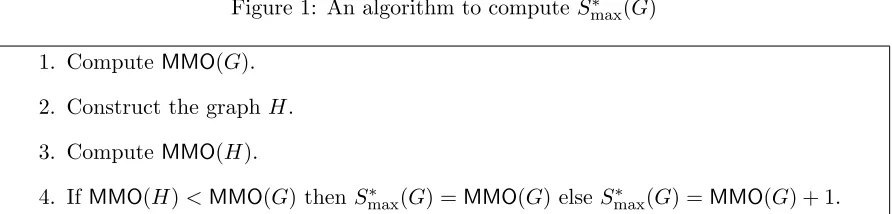
Let H = (W, F) be the subgraph of G induced by W. Then MMO(G) = Smax∗ (G) if and only if
Figure 1: An algorithm to compute Smax∗ (G)
1. Compute MMO(G).
2. Construct the graphH. 3. Compute MMO(H).
4. IfMMO(H)<MMO(G) thenSmax∗ (G) =MMO(G) else Smax∗ (G) =MMO(G) + 1.
Proof. Suppose MMO(G) = Smax∗ (G) and consider an orientation of the edges in E so that the maximum outdegree of any vertex is MMO(G). Let w ∈W; then w has indegree greater than 0. It follows that s(w) = 1 +`(w), where`(w) equals the outdegree of w. Therefore
`(w)< s(w)≤Smax∗ (G) =MMO(G).
Since this holds for every vertexw∈W, we have MMO(H)<MMO(G).
Conversely, suppose that MMO(H) <MMO(G). Consider an orientation of the edges in F so that the maximum outdegree of any vertex in W is at most MMO(H). Next, direct any edges having one endpoint inW towards the incident vertex inW. At this point, we have
s(w)≤1 +`(w)≤1 +MMO(H)≤MMO(G)
for every vertexw∈W. Finally, direct any edges with both endpoints inV \W arbitrarily. Then, for any vertex v∈V \W, we have
s(v)≤deg(v)≤MMO(G).
ThusMMO(G) =Smax∗ (G).
Example 3.2. Let us return again to the graphGconsidered in Example 2.1. It is easy to see that
MMO(G) = 2. Further,H =Gand hence S∗max(G) = 3. Thus the scheme constructed in Example 2.1 has optimal maximum storage.
Example 3.3. In the construction given in the proof of Theorem 3.12, we see thatH consists of the five vertices in the K5 and henceMMO(H) = 2.
As an immediate corollary of Theorem 3.13, we obtain a polynomial-time algorithm to compute
Smax∗ (G). This algorithm is presented in Figure 1.
Remark 3.3. Using ideas from the proof of Theorem 3.13, the above algorithm can be modified in a straightforward way to construct a scheme attaining the valueSmax∗ (G).
4
Discussion and Summary
Choi, Acharya and Gouda [5] also studied key predistibution in a similar setting. They only considered the situation where the communication graph is a complete graph and they gave a construction that is basically equivalent to the one found in [7]. They also considered lower bounds on the total storage of schemes of this type. Their model is very similar to ours, but they do not assume (as we did) that the key derivation function is a random oracle. In [5, Theorem 6], it is stated that the total storage required by a secure scheme is at leastn(n−1)/2. The proof involves analyzing the implications of an equation of the form
F(iv,ku) =F(iu,kv), (6)
whereF is a public key derivation function,iu and iv are public values, andku and kv are secret values known to nodes uand v respectively.
The equation (6) ensures that nodes u and v will compute the same pairwise key. Moreover, it is assumed ku and kv are each used for the computation of at least one other key, and then a contradiction is derived. It is observed in [7] that, under these circumstances, it should be infeasible to computeku given iv andF(iu,kv), and it should also be infeasible to computekv giveniu and
F(iv,ku). It is then claimed that this means that values ku and kv satisfying (6) cannot be computed when the scheme is set up. However, this last assertion does not seem to consider the possibility that the entity that sets up the scheme can compute these values, even though the nodes
u and v might not be able to computekv orku, respectively.
The Blom scheme [3] illustrates how this can happen. For simplicity, we consider a Blom scheme secure against individual nodes. Such a scheme is constructed by a trusted authority (TA) first choosing a symmetric polynomial of the formg(x1, x2) =a+b(x1+x2) +cx1x2. A nodeu is given
the polynomial fu(z) =g(iu, z) and v is given the polynomial fv(z) = g(iv, z). The pairwise key
for nodesuand visg(iu,iv) =g(iv,iu). Nodeucomputes this key as fu(iv) and nodev computes
fv(iu). Note that nodeu cannot compute fv and nodev cannot compute fu, but the TA who sets
up the scheme knows the relationship between these polynomials.
In the setting we studied, where the key derivation function is a random oracle, the equation (6) will not hold, so the above discussion does not apply. We were therefore able to prove stronger lower bounds on the total storage, as we presented in Section 3.
References
[1] Yuichi Asahiro, Eiji Miyano, Hirotaka Ono, and Kouhei Zenmyo. Graph orientation algo-rithms to minimize the maximum outdegree. International Journal of Foundations of Com-puter Science18(2007).
[2] Mihir Bellare and Phillip Rogaway. Random oracles are practical: a paradigm for designing efficient protocols.Proceedings of the 1st ACM Conference on Computer and Communications Security, pages 62–73, ACM Press, 1993 (CCS ’93).
[3] Rolf Blom. Non-public key distribution. In Proceedings of CRYPTO ’82, pages 231–236, Plenum Press, 1983.
[4] Carlo Blundo, Alfredo De Santis, Amir Herzberg, Shay Kutten, Ugo Vaccaro, and Moti Yung. Perfectly-secure key distribution for dynamic conferences.Lecture Notes in Computer Science
[5] Taehwan Choi, H.B. Acharya, Mohamed G. Gouda. The best keying protocol for sensor networks.Pervasive and Mobile Computing9 (2013), 564–571.
[6] A. Frank and A. Gy´arf´as. How to orient the edges of a graph? Colloquia Mathematica Societas J´anos Bolyai, Combinatorics, Keszthely (1976), 353–364.
[7] Jooyoung Lee and Douglas R. Stinson. Deterministic key predistribution schemes for dis-tributed sensor networks. Lecture Notes in Computer Science 3357 (2005), 294–307 (SAC 2004 Proceedings).
[8] M. Rosenfeld. Independent sets in regular graphs. Israel Journal of Mathematics 2 (1964), 262–272.