© 2016, IRJET | Impact Factor value: 4.45 | ISO 9001:2008 Certified Journal | Page 543
Universal Network for Intelligent Traffic Control System: Stolen vehicle
detection, Emergency vehicle clearance, Fine Collection and Dynamic
Traffic Light Control
Sagar Mahajan
1, Ajinkya Atiwadkar
2, Kiran Patil
3, Tushar Lande
4, Prof. Swapnil Choudhari
51235
Bachelor of Computer Engineering, Department of Computer Engineering, MMIT, Maharashtra, India
5
Professor, Dept. of Computer Engineering, MMIT, Maharashtra, India
---***---Abstract - The World has experienced an economical
bloom in past few decades. This has led to urbanization on a larger scale, as a result, the number of privately owned vehicles has grown exponentially.[1] This has
given rise to traffic congestions to counter this problem we present a Universal network for intelligent traffic system (U.N.I.T.S) based on a combination of RFID and IR sensor technology. In U.N.I.T.S every vehicle will be equipped with RFID tags whereas every emergency vehicle will be equipped with privileged RFID tags. [2] IR
Sensors will be placed at every traffic signal junction to count the volume of traffic. The traffic volume information will help in determining the dynamic traffic signal time at every traffic signal junction. This system will be useful in detecting stolen vehicles identified using RFID details by RFID readers equipped at every traffic signal junction. In the case of an emergency vehicle is identified at a particular junction, the system will clear the traffic to allow the emergency vehicle to pass. This system will also monitor the traffic rule violations; if a particular vehicle breaks a traffic rule the owner of that vehicle will receive a fine message on his mobile phone.
Key Words: U.N.I.T.S: Universal Network for Intelligent Traffic System, RFID: Radio Frequency Tags & Readers, IR Sensors: Infrared Sensors.
1. INTRODUCTION
The Indian automotive industry has emerged as a 'sunrise sector' in the Indian economy. [3] India is ranked among the
top countries for privately owned vehicles around the World. This has given rise to traffic congestions in Indian cities. “Preservation of human life is of paramount importance. - Honorable Supreme Court India” But unfortunately Emergency response is not able to attend the victim in a road accident within the golden hour for treatment. India has the overall doctor to population ratio of 1:1800. [4] The fact is
that 140,000 people are killed in accidents every year. However, current Emergency Medical Support (EMS) in the country is functioning sub-optimally and requires up
gradation. One of the reasons for this situation is emergency vehicles being trapped in traffic. With Increase in privately owned vehicles in India, the crime rate for stolen vehicles has also gone up. According to an article in Times of India newspaper dated Apr 15, 2016, for every 13 minutes a vehicle is being stolen in Delhi. The stolen vehicle crime rate has gone up by 44% since last year. The traffic challan is issued manually this has led to corruption in Traffic Department of India. Lastly, the traffic signals are statistically controlled and have fixed red light timing for a particular traffic junction. This gives rise to traffic jams on Indian Roads. The above-listed problems can be solved to some extent using Universal Network for Intelligent Traffic System. This paper is divided into 5 parts. 1. Introduction, 2. Proposed Model 3. Implementation of proposed model 4. Architecture 5. Conclusion 6. Future Enhancements.
Figure: Road Accident Graph.
1.1 TRAFFIC SYSTEM IN INDIA
© 2016, IRJET | Impact Factor value: 4.45 | ISO 9001:2008 Certified Journal | Page 544 provide privileged to the emergency vehicle such as
[image:2.595.30.295.158.557.2]ambulance to pass signal efficiently without wasting time.
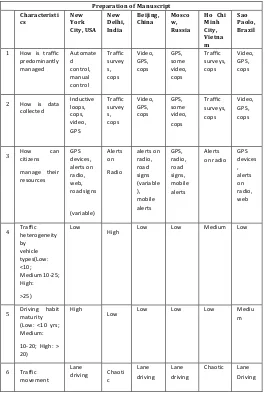
Table -1: Traffic System in Few Countries
Preparation of Manuscript Characteristi
cs New York City, USA
New Delhi, India
Beijing, China Moscow,
Russia
Ho Chi Minh City, Vietna m Sao Paolo, Brazil
1 How is traffic predominantly managed Automate d control, manual control Traffic survey s, cops Video, GPS, cops GPS, some video, cops Traffic surveys, cops Video, GPS, cops
2 How is data collected Inductive loops, cops, video, GPS Traffic survey s, cops Video, GPS, cops GPS, some video, cops Traffic surveys, cops Video, GPS, cops
3 How can
citizens
manage their resources GPS devices, alerts on radio, web, road signs (variable) Alerts on Radio alerts on radio, road signs (variable ), mobile alerts GPS, radio, road signs, mobile alerts Alerts on radio GPS devices , alerts on radio, web
4 Traffic heterogeneity
by vehicle types(Low: <10; Medium 10-25; High: >25) Low
High Low Low Medium Low
5 Driving habit maturity
(Low: <10 yrs; Medium:
10-20; High: > 20)
High
Low Low Low Low Mediu
m
6 Traffic movement
Lane
driving Chaoti c
Lane driving
Lane driving
Chaotic Lane Driving
1.2 CORRUPTION IN INDIA
As we know if any vehicle breaks the traffic role that time fine will collected by cops where every cop are not collect fine right way it will add some money in its personal wallet. Every year India lost 6,29,675 Cr in corruption witch 6.3% more than India GDP, 320% more than income tax revenues, 353% more than defense budget, 2,151% more than health expenditure, 942% more than expenditure, 741% more than food subsidy. Where each people west’s average 26,932 Rs in one year. For avoiding some of corruption we develop system that if any vehicle breaks traffic signal role that time fine will directly collected from owner’s bank account.
1.3 TRAFFIC MANAGEMENT PROBLEM
As we see traffic signals have same amount of time for each way whatever the traffic on each way are different. As signal one has average 100 vehicles regularly and signal two has average 50 vehicles regularly as per that our system provides same amount of time for each signal to pass is wasting of time and increase traffic at other side this problem will solve in our system as Dynamic traffic light control system as signal calculates average length of vehicle and update traffic signal time as per that.
1.4 STOLEN VEHICLE DETECTION PROBLEM
In world vehicle detected unique by its number plate but any one easily can remove it and that time vehicle are hard to search where 70 vehicles are theft in Delhi every day so think average of India and average of world. Problem solve in our system by RFID tags and reader where tag are unique number witch placed in chassis where reader are placed on traffic signal where tag read by radio frequency.
2. PROPESED WORK
Traffic Congestion is an increasing problem in cities and suburban spend more of their time commuting to work, school, shopping, and social events as well as dealing with traffic lights jams and accidents. Traffic becomes heavy in all directions, more to and from cities as well as between suburban locations. This paper is about the integration of intelligent traffic control system, for emergency vehicle clearance, stolen vehicle detection, traffic rules enforcement, and dynamic traffic control.
© 2016, IRJET | Impact Factor value: 4.45 | ISO 9001:2008 Certified Journal | Page 545 vehicle density at a particular lane and depend on the
density of the vehicles the system will dynamically change the green light of the traffic signal. The fourth and final module is of fine collection module. In this module if a vehicle violates a traffic rule than the system will identify that vehicle with the help of RFID details and will immediately send a fine SMS to the owner of that vehicle. List of hardware components used in the system is RFID readers & Tags, IR Sensors etc.
3. IMPLEMENTATION
3.1 RFID
RFID are called as Radio frequency identification. It can automatically identify the electromagnetic fields and track tags attached to any objects which is movable or not. In the tags electronically information are stored. Passive tags can collect energy from a nearby RFID reader's radio waves and Active tags have a local power source such as a battery and may operate at 10 cm hundreds of meters from the RFID reader. Unlike a barcode, the tag need not be within the sight of the reader, so it may be attached with tracked objects. RFID is one the method for Automatic Identification and Data Capture (AIDC).
3.2 IR SENSOR
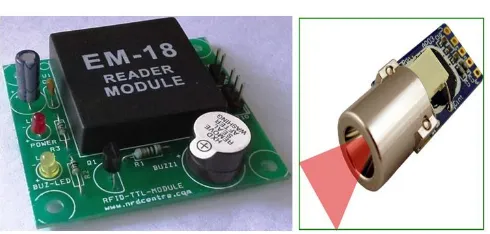
Fig – 4: A) RFID Reader B) IR Sensor
IR sensor transmits continuous IR rays on receiver where receiver receives signals by a photodiode (IR receiver module). An IR output terminal of the receiver varies is totally depending upon what kind of IR rays are received. Since this variation in environment cannot be analyzed as such, therefore this output can be fed to a comparator circuit.
3.3 EMERGENCY VEHICLE DETECTION
In our system we attach privileged RFID tag with emergency vehicle where the emergency vehicle are in range of RFID reader where its range in MHz and accuracy rate 99% that time RFID reader forward signal to traffic control system then system will switch traffic signal ON for emergency
[image:3.595.40.285.428.545.2]vehicle clearance. When vehicle are passed signal after 10 sec traffic system will continued from where it will stop.
Fig - 1: Working of RFID Reader and Tag.
Radio frequency is used by RFID reader to decode the data in the RFID tag. When a radio frequency wave are interact with the RFID tag, the bar code or tag produces its own magnetic field which has a unique identification pattern which will read by the RFID reader to obtain the unique number witch stored in RFID tag. Thus the RFID reader obtains the address of the desired RFID tag where each tag have its own and unique ID. This identified tag when attached to a real object (example: any vehicle) will be the reference to that object. Thus the object is indirectly detected [1].
3.4 STOLEN VEHICLE DETECTION
As we stated above the unprivileged RFID tag are attach with vehicle if any one steal a vehicle that time the database will update to the vehicle as stolen by the system administrator. And if stolen vehicle are in range of any RFID reader which is placed on signals are get notify to system [1] system will
transfer message to owner of vehicle and administration office.
3.5 AUTOMATIC TRAFFIC LIGHT CONTROL SYSTEM
Model states that if vehicles of one side of signal are more than other side it set more time to pass vehicles of that site by using IR sensors which are places in positions as per the signal wattage like 10 miter, 15 miter, 20 miter if beam of IR sensors are break that time a average of vehicle are assumed and time for signal are sate.
[image:3.595.308.561.618.784.2]© 2016, IRJET | Impact Factor value: 4.45 | ISO 9001:2008 Certified Journal | Page 546 Fig – 2: Place of IR Sensors on Signal
An infrared sensor is electronic device that are used to sense some aspects of the surroundings. IR sensor measures the heat of the object as well as detects the motion of object. These types of sensors measures only infrared radiation rather than emitting it that’s why is called as a passive IR sensor. Usually in infrared spectrum, all the objects generate some form of radiations. These types of radiations are thermal and invisible to human eyes that can be detected by an infrared sensor. The emitter is nothing but an IR LED (Light Emitting Diode) and the detector is simply an IR photodiode which are sensitive to IR light of the same wavelength as that emitted by the IR LED. When photodiode receives IR light drops on it, the resistances and these output voltages, change in proportion to the magnitude of the IR light received.
3.6 AUTOMATIC FINE COLLECTION
If any vehicle breaks the signal the fine is directly collected from its account. As vehicle enters in signal RFID tags unique ID are stores in data base and when vehicle moves from signal that time status of signal are also checked if signal are green so no problem if signal are red and vehicle break signal that time 100rs fine are collected from its account if vehicle breaks signal 5th time then license of owner are
cancelled. As per each situation of rule break and fine collection user gate notified by system trough SMS and also its status of license as valid or invalid.
4. ARCHITECTURE
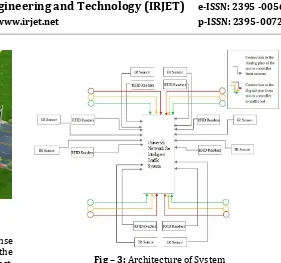
[image:4.595.37.285.91.248.2]Universal Network for Intelligent Traffic System consists of four components that work in real time traffic control system. Each of the modules work in integrated manner with each other and this can lead to improved traffic management system. The following figure shows the architecture diagram of our system.
Fig – 3: Architecture of System
Above diagram shows how our system works one server will handel all database operations and provid services (as vehicle is registered as normal, stolen or emergancy ) to system for its operations RFID reader read vehicles RFID tags and forword data to server trough inter connection network where the hardware controller kit are connected with server witch is with arduino for convorting handling signals. IR sensors for calculating vehicles. Through witch if any one break signal and if stolen vehicle are detected that time message transfer through SMS service.
5. CONCLUSIONS
Universal Network for Intelligent Traffic System will help in reducing human efforts on the part of the traffic policemen. As the entire system is automated, it requires very less human intervention. U.N.I.T.S can help in saving lives by using emergency vehicle clearance system. U.N.I.T.S will reduce corruption and also citizens will be obliged to follow tracking rules or else they would be fined by an automatic system. U.N.I.T.S will bring transparency into the system by using e-governance.
6. ENHANCEMENTS
© 2016, IRJET | Impact Factor value: 4.45 | ISO 9001:2008 Certified Journal | Page 547 system. Better town planning will be possible with the help
of U.N.I.T.S system.
REFERENCES
[1] Ajinkya Atiwadkar, Sagar Mahajan, Tushar Lande, and Kiran Patil “Vehicle License Plate Detection: A Survey”, IRJET Volume: 02 Issue: 08 | Nov-2015
[2] Eren Erman Ozguven, Kaan Ozbay “An RFID-based inventory management framework for emergency relief operations” Science Direct Volume 57, August 2015, Pages 166–187
[3] M. Krishnaveni and R. Vidya “Growth of Indian Automobile Industry”, IJCRAR Volume 3 Number 2 (February-2015) pp. 110-118.
[4] Madhav G. Deo “Doctor population ratio for India - The reality” ICMR Indian J Med Res 137, April 2013, pp 632-63.
BIOGRAPHIES
Sagar Mahajan received the
diploma in computer engineering from Smt. S. S. Patil Polytechnic Chopda and currently pursuing Bachelor of Computer Engineering from Marathwada Mitra Mandal’s Institute of Technology affiliated to Savitribai Phule Pune University.
Ajinkya Atiwadkar received the diploma in Information Technology from Sou. Venutai Polytechnic, Sinhgad Institute Pune and currently pursuing Bachelor of Computer Engineering from Marathwada Mitra Mandal’s Institute of Technology affiliated to Savitribai Phule Pune University.
Tushar Lande received the diploma in Information Technology from Government Polytechnic Awsari and currently pursuing Bachelor of Computer Engineering from Marathwada Mitra Mandal’s Institute of Technology affiliated to Savitribai Phule Pune University.
Kiran Patil received the diploma in computer engineering from Smt. S. S. Patil Polytechnic Chopda and currently pursuing Bachelor of Computer Engineering from Marathwada Mitra Mandal’s Institute of Technology affiliated to Savitribai Phule Pune University
Prof. Swapnil Chaudhari M.E. (CN) is a lecturer of computer department in Marathwada Mitra Mandal’s Institute of Technology affiliated to Savitribai Phule Pune University with a total experience of 3.5 years. Her area of interest is Embedded Operating System, Operating System Design, Computer Networks