EXPLORING RELATIONSHIPS BETWEEN WORK ETHIC AND
ORGANIZATIONAL COMMITMENT
Adam Simonson April Bender Olivia Fetherolf Stephanie Hancock
Kendall Krodel Kyle Reistad Vicki Michels Andy Bertsch
ABSTRACT
Retaining committed, ethical and independent employees significantly enhances the success of a business. The purpose of this study was fourfold: (1) to explore the relationship between organizational commitment and work ethic; (2) to explore if employment level and employment duration affect organizational commitment; (3) to explore if an employee’s sense of deindividuation affected work ethic and/or commitment to one’s job; and (4) explore any possible relationship between different demographics toward work ethic, organizational commitment, and deindividuation. Through convenience sampling techniques, quantitative data were gathered from employees in five small to midsize midwestern banks in Minot, North Dakota. A total of 99 valid surveys were obtained and analyzed out of 101 that were returned. We found several demographic variables impacted organizational commitment, work ethic, and deindividuation. We found no correlation between organizational commitment and work ethic; nor did we find a correlation between deindividuation and constructs of organizational commitment or work ethic.
Keywords: affective commitment, continuance commitment, deindividuation, hard work,
centrality of work, self-reliance, morality, ethics
International Research Journal of Human Resources and Social Sciences
Vol. 4, Issue 1, January 2017 Impact Factor- 5.414
ISSN(O): (2349-4085) ISSN(P): (2394-4218)
Exploring Relationships Between Work Ethic and Organizational Commitment
Organizational commitment creates advantages for both the employee and the employer. Being committed to an employment position may increase the employee benefits one receives, cultivate an opportunity for promotion, and increase the opportunity to claim retirement benefits (Kulicki, 2011). The company benefits from employee long-term commitment by avoiding time, effort, and cost to find and train new employees.The expense to replace a single $8 per hour employee can cost $9,444.47 per occurrence (Schnotz, 2015). Understanding factors that affect employee commitment could help companies develop policies that promote employee organizational commitment. We sought to determine the relationship between several factors and employee commitment.
The following questions were explored:
● Is there a relationship between work ethic and organizational commitment?
● How does employment level and tenure affect the commitment of the employee?
● Is deindividuation correlated to organizational commitment?
● Do demographics such as age, education, tenure, etc. influence an employee‟s
commitment, work ethic, and/or sense of deindividuation?
Organizational Commitment
According to McShane and Von Glinow (2012), “organizational commitment is the employee‟s emotional attachment to, identification with, and involvement in a particular organization” (p.112). Allen and Meyer (1990), propose three constructs of organizational commitment; they are: affective, continuance, and normative. They define them as:
“Employees with strong affective commitment remain because they want to, those with
strong continuous commitment because they need to, and those with strong normative commitment because they feel they ought to do so.” (Allen & Meyer,1990, p. 3)
may increase employee commitment by guaranteeing them job security (Madi, Abu-Jared &Alqahtani, 2012). However, many organizations downsize, restructure, or change due to competition, which can decrease employee job security challenging an organization‟s ability to maintain employee commitment (Madi et al., 2012). Employees at higher job levels usually have higher levels of internalizationof the organization‟s values and greater degrees of identification with their organization than those that have a lower job level.Therefore, higher job level will positively influence continuance and affective commitment (Lin & Wang, 2012). Greater job satisfaction, the earning and achievement of more satisfying positions, and having rationalized time spent with the organization were related to a higher sense of commitment for those who had longer work tenure (Tang, Cunningham, Frauman, Ivy & Perry, 2012). In addition, the ethical culture of an organization appears to influence the commitment of an employee (Ruiz-Palomino, Martinez-Canas&Fontrodona, 2012).
organizational commitment because it is a variable that is difficult to study for those employees with little accumulated time with their employer (Cohen, 1993).
Affective Commitment
Employees that express an emotional bond with the company as their reason to stay with an organization demonstrate affective commitment (Allen & Meyer, 1990). An employee‟s feeling of „want‟ can be translated into an employee‟s emotional bond to an organization through a sense of belonging. Strong affective commitment is demonstrated by identification with the organization and its goals and a strong willingness to work hard toward those goals (Lin & Wang, 2012). An employee who feels comfortable in his or her position, and who feels competent in his or her job, expresses greater attachment to the company (Allen & Meyer, 1990). Level of affective commitment can be a better predictor of behaviors such as absenteeism, job performance, and citizenship compared to normative or continuance commitment because the employee feels an emotional connection to the organization (Jaros, 2007).
Continuance Commitment
Work Ethic
Work ethic is by its very nature difficult to define making it difficult to study. Work ethic has been depicted as an array of attitudes toward one‟s working behavior that occupies a multidimensional phenomenon (Miller, Woehr& Hudspeth, 2001). This multidimensional qualitypertains to work related activity, is not instinctual but learned, and concerns not necessarily working behavior but ethical attitudes and beliefs (Miller, Woehr& Hudspeth, 2001). Work ethic is considereda set of characteristics and attitudes in which an individual worker assigns importance and merit to his or her work (Hill &Fouts, 2005). According to Van Ness, Melinsky, Buff, and Seifert (2010), the seven dimensions of work ethic are: (1) self-reliance, (2) morality/ethics, (3) hard work, (4) leisure, (5) wasted time, (6) centrality of work and (7) delay of
gratification. Ruiz-Palomino, Martinez-Canas, and Fontrodona (2012)employed a
multidimensional measure of work ethic to measure person-organization fit. They found that ethical culture related positively with employee job satisfaction, affective commitment, and intention to stay (Ruiz-Palomino, Martinez-Canas, and Fontrodona, 2012). It should be noted that currently there exists no measure of work ethic allowing for comprehensive measurement of each dimension (Miller, Woehr& Hudspeth, 2001).
Self-Reliance
Morality/Ethics
Morality is the behavior distinguishing between right and wrong; whereas ethics is the study and understanding of such behavior (Van Ness et al., 2010).Morality and ethics appear to be influenced by the level of one‟s career. Workforce professionals were found to have a more defined set of morals than those of college students (Van Ness et al., 2010).A college education presents a multitude of moral frameworks to a student. This, in turn, presents a form of ethical relativism, where no one set of morals appears to be right or wrong. In contrast, a workplace will almost certainly have a specific code of conduct endorsing a single moral framework and thus clearly defining and promoting a kind of moral behavior. Mujtaba (2005) believed that having a corporate code of ethics would increase employee commitment based on the pride they have in the integrity of their company‟s culture.
Hard Work
Hard work is defined as a person‟s belief that his or her goals can be accomplished through the dedication to the value of work itself (Van Ness et al. 2010). Employees who demonstrate careful and persistent effort and work in an organization put hard work into practice. Van Ness et al. (2010) found the average score measuring hard work among those enrolled in college was greater than those in the working environment possibly due to a reduction in reward and benefit programs in the work environment. Within the academic environment exists a specific relationship between the hard work sowed, and the high grade reaped; whereas in the work environment the connection between work and reward may be more vague. The typical workforce experience of a full-time college student is often one of flexible hours and minimum wage whichmay also influence his or her perception of hard work. It is likely that the perception of hard work will be emphasized in the academic setting rather than the employment setting, thus differentiating the value of hard work in the working environment from that of the academic environment.
Centrality of Work
he or she could also leave behind a sense of identity and self worth. It was found that the centrality of work was higher for workforce professionals than that of the college students (Van Ness et al., 2010). Smola and Sutton (2002) found that those in older-adulthood were more likely to consider his or her work to be valued as a significant factor of one‟s life.
Individuation/Deindividuation
Deindividuation is the process by which one loses the recognition of him or herself as a unique individual within a group dynamic (Hinduja, 2008). An employee‟s cognitive identity within an organization is one of the largest prevailing factors that describes the effectiveness of the employee‟s work as well as his or her self-concept about the value or importance of his or her place within it (Lai, Chan, & Lam, 2013). However, if an inconsistency arises between one‟s view of his or her own identity, and the opinion of his or her identity as seen by the organization, dissonance may be aroused. According to cognitive dissonance theory, a person will experience psychological tension when holding two competing ideas, and therefore engage in behavior that would minimize this tension (Lai et al., 2013). Due to this experience, those employees who perceive themselves as a unique individual, but believe that their employer does not, will have a strong desire to leave an occupation and thus relieve this sense of dissonance (Lai et al., 2013). Because of the cost of high turnover rates within a company, the ability to combat dissonance caused by deindividuation would benefit not only the employee in question but also the organization itself if it were able to retain its already trained workforce (Schwepker, 2001). When deindividuation occurs and leaving the job is not a viable option, the employee can also relieve this dissonance by altering his or her beliefs about the value of identity within an organization, and in turn, a sense of committed, ethical behavior toward the organization could degrade. According to Reicher and Levine (1994) this process of immersion into a group—and loss of one‟s identity—creates an environment where a person can engage in behavior that would otherwise not be done if easily perceived as an individual. Deindividuation can lead to a promotion of ethical behavior (e.g., donating to a charity anonymously) or it can lead to increased unethical behavior (e.g., corporate theft).
the same time not feel as though he or she is so isolated from the work environment as a whole that he or she feels as though one is not part of a team. The balance leads to the awareness that one of these occurrences must be sacrificed to the other because in order to attain either, is to do so in moderation (Kim & Park, 2011). One‟s professional identity could be best described as the interaction of one‟s personal identity that involves a subjective set of beliefs and values, and one‟s social identity that involves how he or she relates to a larger group (DeConinck, 2011).
To summarize the elements of organizational commitment and work ethic can be broken down into constructs to better clarify the relationship. All three constructs; affective commitment, continuance commitment and individuation, could possibly help distinguish a relationship between an employee and an organization. All three use different means of defining the bond.
Methodology
Our research design is exploratory in nature with a primary objective to provide insight into the problems and questions described earlier (Bertsch, 2009; Littrell&Bertsch, 2013). In exploratory research design, the primary research questions are ambiguous and the researcher seeks to discover new information (Zikmund&Babin, 2007). Such designs include samples that may not be representative but, instead, are based on convenience (see, for example, Hair et al., 2003; Malhotra, 2007; Zikmund and Babin, 2007). We seek to discover new information and new relationships; therefore, we have selected a sample based on convenience, an important aspect of exploratory research (Zikmund&Babin, 2007). For a more detailed discussion concerning convenience sampling and sample size, see Bertsch (2009). To reduce the margin of error, we followed advice described by Bertsch and Pham (2012) and took into consideration the arguments of large vs. small sample sizes (Hair, et al., 2006, 2010). We employed a 3:1 ratio in determining the target sample size as employed by Tande, Lamon, Harstad, Ondracek, and Bertsch (2013). This study will include convenience samples drawn from the local banking industry. We supplied lock boxes and paper surveys to local banks. Our resulting sample is significant.
Organizational Commitment
feelings of gratitude toward an organization (Buonocore& Russo, 2011). While outcomes are generally desirable from normative commitment, they are not as strong as the outcomes from affective and continuance commitment (Meyer et al, 2002). Further, it has been proposed that one‟s level of normative commitment can be influenced by an employee‟s life events prior to and following employment at an organization (Allen & Meyer, 1990), thus introducing variables we were not capable of controlling. It was our belief that normative commitment was found as a more significant aspect of the individual personality rather than the individual‟s relationship with the company, and because of this it was less applicable to our study.
Work Ethic
Four of seven constructs of work ethic were borrowed: hard work, centrality of work, self-reliance, and morality/ethics, and borrowed from Miller, Woeher and Hudspeth (2002). The three constructs not selected were leisure, wasted time, and delay of gratification. Van Ness (2010) describes what is found from work time subtracted from total time is considered leisure, or anything that is not considered “working-time”. Because we are concerned with time at the job only, leisureand wasted time were omitted. Delay of gratification, the ability to resist an immediate reward for a possible greater reward in the future, was also omitted because of the limited time to conduct the study. It was believed that because of this limited time, the „delay‟ would have been too small to study.
Deindividuation
The scales developed by Kim and Park (2011) with regard to perceived deindividuation, were also applied to this study. These scales were separated into three categories: Perceived deindividuation, Group identification and Conformity intention. Because this study was concerned with the individual‟s perception of their own sense of individuality, the categories of Group identification and Conformity intention were omitted and Percieved deindividuation was the only scale used. These items were specifically used because Kim and Park (2011) developed these items to measure one‟s own perceived uniqueness, where no previous research had existed with that in mind.
regard to being in an entry-level position (1=yes, 2=no). Sampling
The banking industry was chosen as the sample industry because of the clearly defined levels of employment (e.g., teller, banker). It was also desirable because it was an industry within the community having personnel large enough to support our research. This will allow for a variety of income, educational levels, age and several other demographics. A representative sample was selected from employees currently in the banking industry in a Midwestern community, and the surveys took place at five different banks. At each location, surveys, envelopes, and a lock box were left for the participants and picked up at a later date. A survey was handed to the employees with approval from the company manager. The sample includes all levels of employment within the banking sector.
Data Collection and Analysis1
The sample of the returned surveys was a total of 101 bank employeesfrom five different banks.In all of the 101 surveys, the only error of data occurred from either missing data or multiple answers for a single question. Any demographic data that was missing or had multiple answers were omitted. The missing/multiple data from demographics included questions asking gender, guardianship over another, age, hours worked per week, and annual income. The missing/multiple data from the constructs included questions from individuation and continuance commitment. For any missing data/multiple data, we employed mean substitution for that specific item. All questions pertaining to a specific construct were used to find the average for each individual. Under the category of hours worked per week, there might have been confusion if a respondent worked exactly 40 hours per week due to the category cut-offs.
Demographic Results
The age of the individuals ranged from 19 to 64 with a median of 34 years of age. The gender of the respondents totaled 18% males and 82% females. Marital status varied from 22.7% for single, 72.3% married, 3.9% divorced and 0.9% widowed. 27.2% of employees claimed guardianship over another while 72.7% did not. Education level had 16.8% with high school degree or its equivalency, 26.7% had some college, 10.9% had an Associate Degree, 41.6% had a Bachelor's Degree and 4% had a Graduates Degree. Hours per week an individual worked
1
varied, 2% work 2-30 hours, 38% work 30-40 hours, and 60% work 40 or more hours per week. An entry-level position on the survey was defined as not being a manager and not having a degree. 48.4% of individuals said they were in an entry-level position, while 53.5% of individuals said they were not. An individual‟s expectancy of employment with his or her organization varied with 40% of individuals responding that they would like to retire with their organization, 45% of individuals would like to work their way up in the organization, and 15% of individuals were unsure of staying with the organization.
Data Analysis
Gender
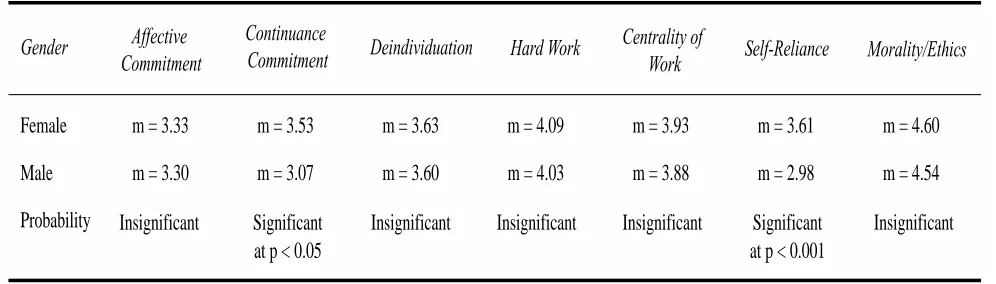
When comparing work ethic constructs (self-reliance, morality/ethics, hard work, centrality of work), the only construct where a significant difference existed was self-reliance. It should be noted the totals were: 18 male, 81 females, and two surveys omitted due to data error. For the comparison of males and females along the self-reliance construct, females score significantly higher compared to males at p<0.001 with a female (m=3.61) and (male m=2.98). For the organizational commitment, only continuance commitment showed significance at p<0.05 with female (m=3.53) and male (m=3.07). There was also no significance found between genders for deindividuation.
Marital Status
Married and single individuals were the two groups chosen for this data set since less than 5% of our sample were either divorced or widowed. Due to insufficient data, „divorced‟ and
Gender Affective Commitment
Continuance
Commitment Deindividuation Hard Work Centrality of Work Self-Reliance Morality/Ethics
Female
Male
[image:11.612.77.575.468.610.2]Probability
Table 1 – By Gender
m = 3.33 m = 3.53 m = 3.63 m = 4.09 m = 3.93 m = 3.61 m = 4.60
m = 3.30 m = 3.07 m = 3.60 m = 4.03 m = 3.88 m = 2.98 m = 4.54
Insignificant Significant Insignificant Insignificant Insignificant Significant Insignificant
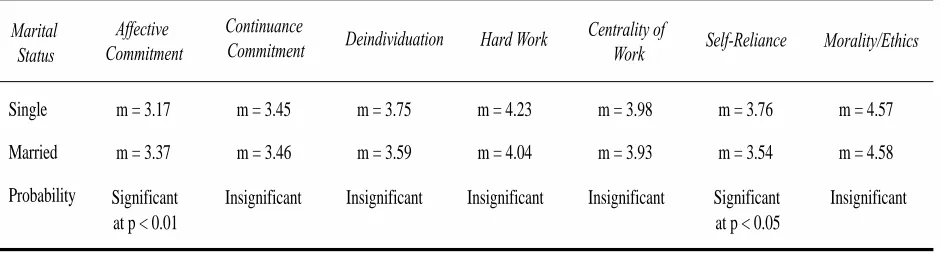
„widowed‟ were omitted. For affective commitment, results show that married individuals (m=3.37) and single individuals (m=3.17, at p<0.01). There was no significant difference in continuance commitmentby marital status. Results also show that single individuals (m=3.76), scored significantly higher in self-reliance, compared to married individuals (m=3.54, at p<0.05). The other work ethic constructs showed no significance by gender, as did deindividuation.
Age
Age of the respondents ranged from 19 to 64. Three categories showed the most significance, which were recorded by generations: “Millennials” ages 31 and younger, “Generation X” ages 32-49, and “Baby Boomers” ages 50 and above (Carlson, 2009). The number of individuals varied between generations, Millennials having 46 respondents, Generation X having 27 respondents, and Baby Boomers having 26 respondents. Data was then analyzed by comparing Millennials to the other two generations combined. Hard work significance level at p<0.001, with those younger than 31 years old at (m=4.12), and those older than 31 years at (m=3.74). There was no significant difference in self-reliance, centrality of work, and morality/ethics by age. Results for continuance commitment for those younger than 31 years old at (m=3.72) with older than 31 years old (m=3.52) at p<0.05. Affective commitment had no significant difference by age. Results show that those younger than 31 years old (m=4.34) showed significant difference in deindividuation at p<0.001 than those 32 years and older (m=3.88).
Marital Status
Affective Commitment
Continuance
Commitment Deindividuation Hard Work Centrality of Work Self-Reliance Morality/Ethics
Single
Married
[image:12.612.83.553.195.322.2]Probability
Table 2 – By Marital Status
m = 3.17 m = 3.45 m = 3.75 m = 4.23 m = 3.98 m = 3.76 m = 4.57
m = 3.37 m = 3.46 m = 3.59 m = 4.04 m = 3.93 m = 3.54 m = 4.58
Significant Insignificant Insignificant Insignificant Insignificant Significant Insignificant at p < 0.05
Dependents
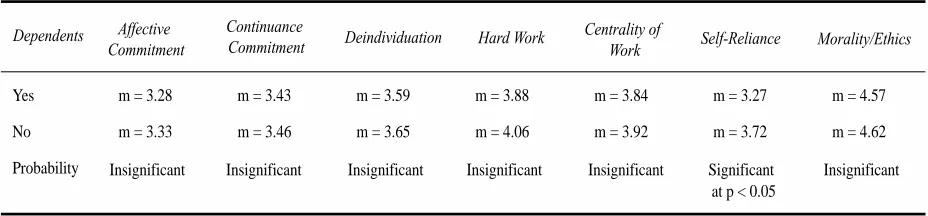
Participants were asked on the survey whether or not they have guardianship over another individual, which would include having guardianship over children and/or other adults. Two respondents were omitted because of missing data, while 27 respondents said they do have dependents, and 72 respondents said they do not have dependents. Results showed that self-reliance had significant difference between those who have dependents (m= 3.27) and those who do not, with those who do not have dependents (m=3.72), scoring significantly higher at p<0.05. The other work ethic constructs showed no significant difference and neither did organizational commitment or deindividuation.
Education
Education levels options in the survey were: high school graduate (or equivalency), some college, Associate‟s degree, Bachelor‟s degree, and Graduate degree. The data set was divided between Associate‟s degree and lower, and Bachelor‟s degree and higher. All 101 respondents answered the education level question. Of the organizational commitment constructs, only
Age Affective Commitment
Continuance
Commitment Deindividuation Hard Work Centrality of Work Self-Reliance Morality/Ethics
≤ 31
≤ 32
[image:13.612.81.544.87.218.2]Probability
Table 3 – By Age
m = 3.26 m = 3.45 m = 3.72 m = 4.34 m = 4.12 m = 3.64 m = 4.61
m = 3.37 m = 3.47 m = 3.52 m = 3.88 m = 3.74 m = 3.58 m = 4.56
Insignificant
Insignificant Significant Significant Significant Insignificant Insignificant
at p < 0.001 at p < 0.05 at p < 0.001
Dependents Affective Commitment
Continuance
Commitment Deindividuation Hard Work Centrality of Work Self-Reliance Morality/Ethics
Yes
No
Probability
Table 4 – By Dependents
m = 3.28 m = 3.43 m = 3.59 m = 3.88 m = 3.84 m = 3.27 m = 4.57
m = 3.33 m = 3.46 m = 3.65 m = 4.06 m = 3.92 m = 3.72 m = 4.62
Insignificant
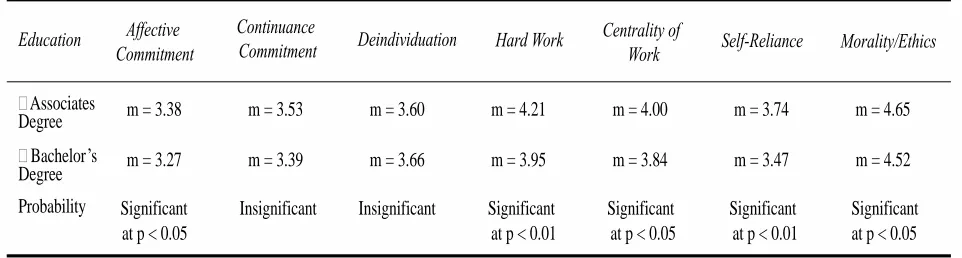
[image:13.612.81.545.463.571.2]affective commitment was relevant with Associate‟s degree (m=3.38) and Bachelor‟s degree (m=3.27) with a significance of p<0.05. Continuance commitment showed no significance in this data set. All four of the work ethics constructs showed significance. Results of centrality of work showed Associate‟s degree (m= 4.04), Bachelor‟s degree (m=3.84), with significance of p<0.05. Associate‟s degree was m=4.65 and Bachelor‟s degree (m=4.52) for morality/ethics with significance p<0.05. Results from hard work were Associate‟s degree (m = 4.21) and Bachelor‟s degree (m=3.95) with significance p<0.01. Associate‟s degree (m=3.74) and Bachelor‟s degree (m=3.47) for self-reliance at p<0.01. Deindividuation showed no significance in this data set.
Income
The data set was divided from those who make less than $29,999 and those who make $30,000 and higher. One survey was omitted due to the question not being answered. Hard work for those making less than $29,999 (m=4.34) and those making $30,000 (m=4.03) with significance level at p<0.05. Results from centrality of work had those less than $29,999 (m=4.18) and $30,000 or more (m=3.87) with significance level p<0.001. Self-reliance was also p< 0.001 with those making less than $29,999 (m=3.98) and those making more than $30,00 (m=3.52). For this data set morality/ethics, organizational commitment and individuation showed no significance.
Education Affective Commitment
Continuance
Commitment Deindividuation Hard Work Centrality of Work Self-Reliance Morality/Ethics
≤ Associates Degree ≤ Bachelor’s Degree
[image:14.612.77.558.247.376.2]Probability
Table 5 – By Education
m = 3.38 m = 3.53 m = 3.60 m = 4.21 m = 4.00 m = 3.74 m = 4.65
m = 3.27 m = 3.39 m = 3.66 m = 3.95 m = 3.84 m = 3.47 m = 4.52
Significant Insignificant Insignificant Significant Significant Significant Significant at p < 0.01 at p < 0.05 at p < 0.05
at p < 0.05 at p < 0.01
Income Affective Commitment
Continuance
Commitment Deindividuation Hard Work Centrality of Work Self-Reliance Morality/Ethics
≤ $29,999
≤ $30,000
Probability
Table 6 – By Income
m = 3.28 m = 3.41 m = 3.68 m = 4.34 m = 4.18 m = 3.98 m = 4.59 m = 3.35 m = 3.48 m = 3.63 m = 4.03 m = 3.87 m = 3.52 m = 4.60
Insignificant
Insignificant Insignificant Significant Significant Significant Insignificant
at p < 0.001 at p < 0.001
[image:14.612.68.541.601.697.2]Hours Worked
There was one omission in this data set because a respondent chose multiple answers. The data set for hours worked was divided by 40 hours or less, and more than 40 hours. Results showed affective commitment had significance at p<0.05 for those who worked less than 40 hours (m=3.24) and those who worked more than 40 hours (m=3.39). Self-reliance for working 40 hours or less (m=3.87) and working more than 40 hours (m=3.51) with significance at p<0.001. All other constructs showed no significance.
Employment Level
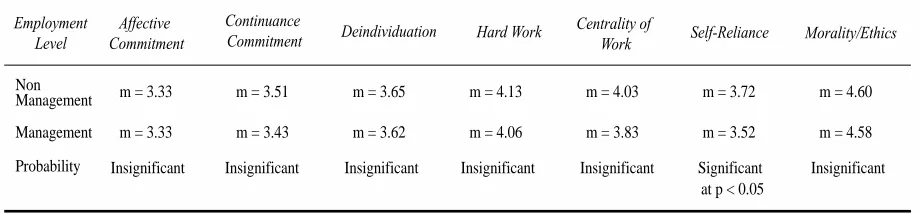
Respondents were asked if they were in an entry-level position, which was defined as a non-managerial position and not requiring a degree. This was a dichotomous question (1=yes, 2=no). Data was separated as non-management and management levels. No surveys were omitted. All work ethic constructs were found to have insignificant difference except self-reliance with non-management positions (m=3.72) and management positions (m=3.52) with significance at p<0.05. There were no significant differences found within the constructs of organizational commitment and individuation.
Hours
Worked CommitmentAffective
Continuance
Commitment Deindividuation Hard Work Centrality of Work Self-Reliance Morality/Ethics
≤ 40
≤ 40
[image:15.612.77.538.225.335.2]Probability
Table 7 – By Hours Worked per Week
m = 3.24 m = 3.40 m = 3.55 m = 4.13 m = 3.91 m = 3.87 m = 4.55 m = 3.39 m = 3.51 m = 3.70 m = 4.06 m = 3.91 m = 3.51 m = 4.62
Insignificant Insignificant Insignificant Insignificant Significant Insignificant
at p < 0.05
Significant
at p < 0.05
Employment Level
Affective Commitment
Continuance
Commitment Deindividuation Hard Work Centrality of Work Self-Reliance Morality/Ethics
Non Management
Management
Probability
Table 8 – By Employment Level
m = 3.33 m = 3.51 m = 3.65 m = 4.13 m = 4.03 m = 3.72 m = 4.60
m = 3.33 m = 3.43 m = 3.62 m = 4.06 m = 3.83 m = 3.52 m = 4.58
Insignificant
Insignificant Insignificant Insignificant Insignificant Significant Insignificant
[image:15.612.79.539.544.651.2]Tenure
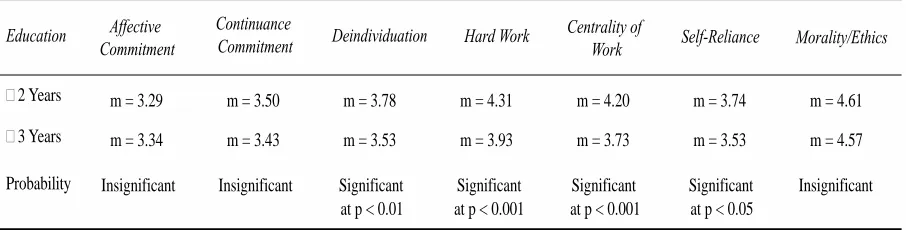
The multiple choices ranged from working at the bank for less than 1 year to working at the bank for 20 or more years. This data set was divided between respondents being employed less than or equal to two years, and greater than or equal to three years. No surveys were omitted from this group. Significance was found in four constructs. Hard work showed significance at p<0.001 with working less than or equal to 2 years (m=4.31) and those working there 3 years or longer (m=3.93). Results from centrality of work for working there less than or equal to 2 years (m=4.20) and working there 3 years or longer (m= 3.73) with significance at p <0.001. Self-reliance less than or equal to 2 years (m=3.74) and working 3 years or more (m=3.53) with significance at p<0.05. Morality/ethics showed no significance in this data set. Results from individuation were for those working less than or equal to 2 years (m=3.78) and those there 3 years or longer (m=3.53) with significance at p<0.01. No significance was found within the constructs of organizational commitment.
Expectancy of Employment
This data set was divided between groups wanting to either retire with the organization, and all the other options combined. Respondents who answered with the first four choices were grouped as not wanting to retire from the organization, with 61 individuals versus 40 individuals who would like to retire from the organization. Those who responded as wanting to retire with the organization (m=3.49), and all others options combined (m=3.23) which showed significance in affective commitment at p<0.001. Continuance commitment showed a significance level at p<0.01, with those wanting to retire (m=3.66)and all other options (m=3.34). However, the work ethic constructs showed no significance and neither did individuation.
Education Affective Commitment
Continuance
Commitment Deindividuation Hard Work Centrality of Work Self-Reliance Morality/Ethics
≤ 2 Years
≤ 3 Years
[image:16.612.84.537.348.463.2]Probability
Table 9 – By Tenure
m = 3.29 m = 3.50 m = 3.78 m = 4.31 m = 4.20 m = 3.74 m = 4.61
m = 3.34 m = 3.43 m = 3.53 m = 3.93 m = 3.73 m = 3.53 m = 4.57
Insignificant Insignificant
Insignificant Significant Significant Significant
at p < 0.05 at p < 0.001
at p < 0.001 Significant
Conclusion
Discussion
Much of the literature pertaining to work ethic and organizational commitment show a positive relationship between them (Ruiz-Palomino, Martinez-Canas&Fontrodona, 2012). However, there do exist studies that show the relationship of work ethic and organizational commitment as mixed. The relationship between work ethic and organizational commitment has been shown to be significantly positive, significantly negative, or no relationship at all (Komari&Djafar, 2013). Mujtabe (2005) suggested there is a positive significance between having a corporate code of ethic and employee commitment. As we found no relationship between work ethic and organizational commitment, our study has no new results to offer. This study sought to how organizational commitment, work ethic, and deindividuation manifest within individuals. We felt it necessary for the sake of convenience and focus to narrow the constructs of organizational commitment as well as work ethic. We acknowledge that there are other constructs that make up the overarching concept of organizational commitment and work ethic. A regression test was used to compare correlation possibilities between the constructs of work ethic and organizational commitment. All other possibilities showed no significance level.
The relationship between affective commitment and morality/ethics was significant at p < 0.01, similarly affective commitment and centrality of work was also significant at p < 0.05. The relationship between continuance commitment and morality/ethics was significant at p < 0.001. With regards to work ethic, the construct of self-reliance was influenced by several demographic variables, while the construct of morality/ethics was influenced the least. To summarize the type of respondent that showed the most self-reliance, it would be single working women in non-managerial positions with two years or less of tenure. It is possible that they recognize their entry-level placement within the organization and therefore feel the need to represent themselves
Income Affective Commitment
Continuance
Commitment Deindividuation Hard Work Centrality of Work Self-Reliance Morality/Ethics
Will Retire
All Other Options
[image:17.612.79.536.76.186.2]Probability
Table 10 – By Expectancy of Employment
m = 3.49 m = 3.66 m = 3.63 m = 4.98 m = 3.85 m = 3.55 m = 4.65
m = 3.23 m = 3.34 m = 3.63 m = 4.17 m = 3.98 m = 3.67 m = 4.55
Insignificant Insignificant Insignificant Insignificant Insignificant Significant
Significant
as self-reliant individuals. Workers can find their sense of self-reliance as being dependent on the individual accomplishments recognized by one‟s employer and therefore engage in behaviors that would grow favor in the eyes of his or her boss (Li & Madsen, 2009). This is supported by Van Ness (2010), who proposes that self-reliance is found in those who are not settled in his or her career and would appeal to those of a higher professional authority. We found no significant relationship between work ethic (the five constructs of hard work, self-reliance, centrality of work, morality/ethics) and organizational commitment (affective and continuance). Lin and Wang (2012) suggested higher job level would positively influence continuance and affective commitment. However, we found no significance between job level and commitment.
On the other hand, what our study did not find is perhaps more interesting. The relationship between ethical behavior and deindividuation is reliable and well documented. Most social psychology textbooks since 1980 that discuss the effect of deindividuation on ethical behavior portray a strong relationship (Postmes& Spears, 1998).A regression test was used to compare deindividuation and morality/ethics and found no significant relationship. Perhaps the sample of this community would engage in unethical behavior even if they could be easily identified, orregardless of any decreased sense of self-identity, they would still engage in ethical behavior. In future studies, it might be necessary to understand whether the employees see the banking industry as inherently ethical, or an industry that requires ethical employees. Considering the events surrounding the Wells Fargo racketeering scandal of November 2016, this may not be the case. Regardless, it appears that deindividuation has no effect on ethical behavior in this sample.
Simmons (2005) found a positive relationship between education and organization commitment while Mathieu (1990) suggested education negatively impacts and employee‟s commitment. Shore et al. (1995) suggested well educated employees would have lower continuance commitment. Iqbal (2010) showed a positively relationship between tenure and commitment. However, we found there is no significance between education or tenure and organization commitment.
Limitations
Appendix A
Exploring the Relationship Between Work Ethic and Organizational Commitment
Answer the questions in the space provided or circle the answer your feel best describes you:
1. With which gender do you associate?
Male Female
2. What is your marital status?
Single Married Separated Divorced Widowed
3. What is your age? (write in years)
4. Do you currently have guardianship over another individual?
Yes No
5. What is your education level?
High school graduate (includes equivalency )
Some college, no Degree
Associate's Degree
Bachelor's Degree
Graduate Degree
6. What is your income level?
Less than $19,999
$20,000 to $29,999
$30,000 to $39,999
$40,000 to $49,999
$50,000 and Over
7. How many hours per week do you USUALLY work at your job?
8. Are you in an entry level position? (Not in a managerial position and not requiring a degree)
Yes No
9. How long have you been employed here?
Less than 1 year
1-up to 2 years
2-up to 4 years
4-up to 6 years
6-up to 10 years
10-up to 15 years
15-up to 20 years
20+
10.How long do you plan to stay?
Not much longer
I‟m not sure, this is temporary. For a couple more years.
I want to see how far I can move up. Until I retire from here.
11.I would be very happy to spend the rest of my career with this organization.
Strongly Disagree 1
Disagree 2
Neutral 3
Agree 4
Strongly Agree 5
12.Anyone who is able and willing to work hard has a good chance of succeeding.
Strongly Disagree 1
Disagree 2
Neutral 3
Agree 4
13.I feel content when I have spent the day working. Strongly Disagree 1 Disagree 2 Neutral 3 Agree 4 Strongly Agree 5
14.I am not afraid of what might happen if I quit my job without having another one lined
up. Strongly Disagree 1 Disagree 2 Neutral 3 Agree 4 Strongly Agree 5
15.Stealing is all right as long as you don‟t get caught.
Strongly Disagree 1 Disagree 2 Neutral 3 Agree 4 Strongly Agree 5
16.One should always take responsibility for one‟s actions.
Strongly Disagree 1 Disagree 2 Neutral 3 Agree 4 Strongly Agree 5
17.Having a great deal of independence from others is very important.
18.I think I could be myself in this group. Strongly Disagree 1 Disagree 2 Neutral 3 Agree 4 Strongly Agree 5
19.Even if I were financially able, I would not stop working.
Strongly Disagree 1 Disagree 2 Neutral 3 Agree 4 Strongly Agree 5
20.I experience a sense of fulfillment from working.
Strongly Disagree 1 Disagree 2 Neutral 3 Agree 4 Strongly Agree 5
21.I think that I could easily become as attached to another organization as I am to this one.
Strongly Disagree 1 Disagree 2 Neutral 3 Agree 4 Strongly Agree 5
22.Nothing is impossible if you work hard enough.
Strongly Disagree 1 Disagree 2 Neutral 3 Agree 4 Strongly Agree 5
23.It is never appropriate to take something that does not belong to you.
24.It would be very hard for me to leave my organization right now, even if I wanted to. Strongly Disagree 1 Disagree 2 Neutral 3 Agree 4 Strongly Agree 5
25.Only those who depend on themselves get ahead in life.
Strongly Disagree 1 Disagree 2 Neutral 3 Agree 4 Strongly Agree 5
26.Working hard is the key to being successful.
Strongly Disagree 1 Disagree 2 Neutral 3 Agree 4 Strongly Agree 5
27.I think I see myself predominantly as an individual in this group.
Strongly Disagree 1 Disagree 2 Neutral 3 Agree 4 Strongly Agree 5
28.I do not feel like „part of the family‟ at my organization.
Strongly Disagree 1 Disagree 2 Neutral 3 Agree 4 Strongly Agree 5
29.A hard day‟s work provides a sense of accomplishment.
Disagree 1
2 3 4 5
30.Self-reliance is the key to being successful.
Strongly Disagree 1 Disagree 2 Neutral 3 Agree 4 Strongly Agree 5
31.Too much of my life would be disrupted if I decided to leave my organization now.
Strongly Disagree 1 Disagree 2 Neutral 3 Agree 4 Strongly Agree 5
32.If one works hard enough, one is likely to make a good life for oneself.
Strongly Disagree 1 Disagree 2 Neutral 3 Agree 4 Strongly Agree 5
33.I think I was not considered as a distinctive individual in this group.
Strongly Disagree 1 Disagree 2 Neutral 3 Agree 4 Strongly Agree 5
34.One should not pass judgment until one has heard all of the facts.
35.This organization has a great deal of personal meaning for me. Strongly Disagree 1 Disagree 2 Neutral 3 Agree 4 Strongly Agree 5
36.I do not like having to depend on other people.
Strongly Disagree 1 Disagree 2 Neutral 3 Agree 4 Strongly Agree 5
37.It wouldn‟t be too costly for me to leave my organization now.
Strongly Disagree Disagree 2 Neutral 3 Agree 4 Strongly Agree 5
38.You should never tell lies about other people.
Strongly Disagree 1 Disagree 2 Neutral 3 Agree 4 Strongly Agree 5
39.I think members in this group were not represented as unique individuals in this group.
40.Any problem can be overcome with hard work. Strongly Disagree 1 Disagree 2 Neutral 3 Agree 4 Strongly Agree 5
41.I do not feel a „strong‟ sense of belonging to my organization.
Strongly Disagree 1 Disagree 2 Neutral 3 Agree 4 Strongly Agree 5
42.Life without work would be very boring.
Strongly Disagree 1 Disagree 2 Neutral 3 Agree 4 Strongly Agree 5
43.Right now, staying with my organization is a matter of necessity as much as desire.
Strongly Disagree 1 Disagree 2 Neutral 3 Agree 4 Strongly Agree 5
44.I strive to be self-reliant.
Strongly Disagree 1 Disagree 2 Neutral 3 Agree 4 Strongly Agree 5
Resources
Agyeman, C.M., &Ponniah, V.M. (2014). Employee Demographic Characteristics and Their Effects onTurnover and Retention in MSMEs. International Journal of Recent Advances in Organizational Behavior and Decision Sciences.1(1), 12.29.
Allen, N.,&Meyer, J. (1990). The measurement and antecedents of affective,continuance and normative commitment to the organization.Journal of Occupational Psychology, 63, 1-18.
Ashman, I., &Winstanley, D. (2006). The ethic of organizational commitment.Business Ethics: A
European Review, 15(2), 142-153.
Bertsch, A. (2009) Exploring Perceptions of Values in U.S. Managers: Interstate Cross-Cultural
Differences and Similarities within the U.S.A., Henley Management College,
Henley-on-Thames, U.K.
Bertsch, A., &Pham, L. (2012) A Guide to Research Design and Multivariate Analysis in Cross
Cultural Research, Journal of International Doctoral Research, Vol. 1(1),
http://idrcentre.org/uploads/JIDR__2012__Vol_1__1__Complete.pdf
Carlson, E., (2009).20th-century U.S. generations.Population Reference Bureau, 64(1), 1-17.
Cohen, A. (1993). Age and Tenure in Relation to Organizational Commitment: A meta-Analysis.
Basic and Applied Social Psychology, 14(2), 143-159.
DeConinck, J.B. (2011). The effects of ethical climate on organizational identification, supervisory trust, and turnover among salespeople.Journal of Business Research, 64. 617-624..
Gbadamosi, G. (2004). Academic ethics: what has morality, culture, and administration got to do
with its measurement? Management Decision, 42(9). 1145-1161.
Hair, J. F., JR., Babin, B., Money, A. H. &Samouel, P. (2003) Essentials of Business Research
Methods, New Jersey, Wiley.
Hill, R. B., &Fouts, S. (2005). Work ethic and employment status: a study of job seekers,
Journal of Industrial Teacher Education, 42(3). Retrieved from
Hinduja, S. (2008).Deindividuation and Internet Software Piracy.Cyberpsychology&Behavior, 11(4). 391-398.
Iqbal, A. (2010). An Empirical Assessment of Demographic Factors, Organizational Ranks and
Organizational Commitment.International Journal of Business and Management, 5(3),
16-27.
Jaros, S. (2007). Meyer and Allen model of organizational commitment: Measurementissues.
The Icfai Journal of Organizational Behavior, VI(4), 7-25.
Kim, J., & Park, H.S. (2011). The effect of uniform virtual appearance on conformity intention: Social identity model of deindividuation effects and optimal distinctiveness theory.
Computers in Human Behavior, 27. 1223-1230. doi:10.1016/j.chb.2011.01.002.
Komari, N. &Fariastuti, D. (2013). Work Ethics, Work Satisfaction and Organizational
Commitment at the Sharia Bank, Indonesia. International Business Research, 6(12),
107-117.doi: 10.5539/ibr.v6n12p107
Kulicki, P. (2011). Pros and Cons of Long-Term Employment.Fiscal Fizzle: Experiments in
Personal Finance. Retrived from
http://fiscalfizzle.com/2011/06/01/pros-cons-working-one-company
Lai, J.Y.M., Chan, K.W., & Lam, L.W. (2013). Defining who you are not: The roles of moral dirtiness and occupational and organizational disidentification in affecting casino
employee turnover intention. Journal of Business Research, 66. 1659-1666.
Li, J., Madsen, J. (2009). Chinese workers‟ work ethic in reformed state-owned enterprises:
implications for HRD. Human Resource Development International, 12(2). 171-188.
Lin, Chein-Hung., & Wang, Wen-Cheng. (2012). The relationship between affective and
continuance organizational commitment.Journal of Asian Business Strategy, 2(5). 89-94.
Littrell, F. R., &Bertsch, A. (2013). UN Millennium Development Goals and gender equality inemployment in the Middle East.Foresight, 15(4), 249-263.
Madi, M., Abu-Jarad, I., &Alqahtani, A., (2012). Employee‟s perception and organizational
commitment: a study on the banking sector in Gaza, Palestine. International Journal of
Malhotra, N. K. (2007) Marketing Research: An Applied Orientation, 5th ed., Upper Saddle River, NJ, Pearson Prentice Hall.
Mathieu, J.E., &Zajac, D.M. (1990). A Review and Meta-Analysis of the Antecedents,
Correlates, and Consequences of Organizational Commitment.Psychological Bulletin,
108(2), 171-194.
Meyer, P., Stanley, J., Herscovitch, L., &Topolyntsky, L. (2002). Affective, continuance,and normative commitment to the organization: a meta-analysis of antecedents,correlates, and
consequences. Journal of Vocational Behavior, 61.20-52.
Miller, M., Woehr, D., & Hudspeth, N. (2001). The meaning and measurement of workethic:
Construction and initial validation of a multidimensional inventory. Journal of
Vocational Behavior, 59, 1-39.
McShane, S., & Von Glinow, M. (2012). Organizational behavior: Emerging knowledge. Global reality. (6th ed., p. 112). New York, NY: McGraw-Hill/Irwin.
Mujtaba, B.G. (2005) Understanding ethics and morality in business.Small Business. Retrieved from website: http://www.sbnonline.com/component/k2/13-national-editions/1756
Postmes, T. & Spears, R. (1998). Deindividuation and Antinormative Behavior: A
Meta-Analysis. Psychological Bulletin, 123(3), 238-259.doi: 10.1037/0033-2909.123.3.238
Reicher, S., & Levine, M. (1994).On the consequences of deindividuationmanipulations for the strategic communication of self; identifiability and the presentation of social
identity.European Journal of Social Psychology, 24, 511-524.
Rousseau, D. (1995). Psychological Contracts in Organizations: Understanding Written and Unwritten Agreements. London: Sage.
Ruiz-Palomino, P., Martínez-Cañas, R., &Fontrodona, J. (2013). Ethical Culture and Employee Outcomes: The Mediating Role of Person-Organization Fit. Journal OfBusiness Ethics, 116(1), 173-188.
Schnotz, W. (2015). The Average Cost to Train a New Employee. Chron: Small Business.
Retrieved from
Schwepker, C.H. (2001). Ethical climate‟s relationship to job satisfaction, organizational
commitment, and turnover intention in the sales force.Journal of Business Research, 54.
39-52
Shore, L., Barksdale, K., & Shore, T. (1995).Managerial perceptions of employee commitment
to the organization.Academy of Management Journal, 38, 1593-1616.
Sikorska-Simmons, E. (2005).Predictors of Organizational Commitment Among Staff in Assisted Living.The Gerentologist, 45(2), 196-205.
Tande, B., Lamon, K., Harstad, C., Ondracek, J., &Bertsch, A., (2013) An Empirical Investigation into Similarities and Differences in Communication of Female and Male Students at a U.S. University, Journal of International Doctoral Research, Vol 2 (1).
Tang, T. L., Cunningham, P. H., Frauman, E., Ivy, M. I., & Perry, T. L. (2012). Attitudes and occupational commitment among public personnel: Differences between Baby Boomers
and Gen-Xers. Public Personnel Management, 41(2), 327-360.
United States Office of Personnel Management, (n.d.). Federal Holidays. Retrieved fromwebsite: http://www.opm.gov/policy-data-oversight/snow-dismissal-procedures/federal-holidays/
Van Ness, R., Melinsky, K., Buff, C., & Seifert, C. (2010). Work ethic: Do newemployees mean new work values?.Journal of Managerial Issues, 22(1), 10-34.
Wallace, E., de Chernatony, L., &Buile, I. (2013). Building bank brands: how leadership
behavior influences employee commitment. Journal of Business Research, 66, 165-171.