DECISION SUPPORT SYSTEM FOR PREDICTING THE
DEGREE OF A CANCER PATIENT’S EMPOWERMENT
1Abdellah ABOUABDELLAH, 2Abdelghani CHERKAOUI
1
NationalSchool of Applied Sciences (ENSA), Ibn Tofail University, Kenitra, MOROCCO.
2Industrial Engineering Department, Mohammadia Engineering School, Agdal Mohamed V University,
Rabat, MOROCCO.
E-mail: [email protected], [email protected]
ABSTRACT
In this paper, we develop a decision support system (DSS) based on Knowledge Discovery from Databases (KDD). This system allows the prediction of the empowerment of a patient with cancer treated by chemotherapy.
The first part of this article presents the process of empowerment of the patient. The second part explains the principle of decision support systems and the principle of the Knowledge Discovery from Databases (KDD), inspired by the data mining method. The third part describes the platform for predicting the degree of a cancer patient’s empowerment.
Keywords: DSS, KDD, Data Mining, prediction, empowerment
.
1. INTRODUCTION
Hospital systems are complex. They are forced to better organize and innovate to control spending while ensuring the quality and safety of care.
To achieve these objectives, the doctor-patient relationship should be reviewed so that the medical decision concerning the health status of a patient is distributed between the patient and the doctor.
The relationship between patient and doctor is fundamentally changing: the patient is increasingly considered an "expert" whose active participation is crucial to the decision
The autonomy of a patient is to include, among other thing, the integration of information in the process of care to enable their participation in decision making about their health [1], [2], [3].
In the spirit of using the data as "mines", are used data mining involves an automated process operating data items, which is turn belongs to a more complex which use of the data to field information usable for decision making.
In recent years, the techniques of data mining have seen a considerable development in many fields of applications, particularly in the health sector.
The oncology department is a hospital setting, the richest in terms of data. There is a wealth of data that is currently under exploited.
Our decision support system shows the empowerment degree of a cancer patient, based on the process extraction of knowledge, allowing decision-makers to make inquiries about the degree of autonomy of a patient is necessary. Our research is situated within this context.
In this paper, we begin with a brief description of the state of art who present the basics concepts of Decision Support System (DSS) and Knowledge Discovery from Databases (KDD). In the second section, we describe our approach for designing and developing the DSS using KDD. In the third part, we present the realization of our DSS.
2. RELATED WORKS
Decision support system based on knowledge discovery from data consists to associate two components:
2.1 Decision Support System. (D.S.S)
A. Gorry and Scott Morton defined as follows: "interactive computerized system that helps the decision maker to manipulate data and models to solve poorly structured problems" [15].
available knowledge needed, to solve difficult cases. For solving some problems the decision-making process is linked to the knowledge [21].
In hospital, several decision support systems have been developed [17] [23] [12], but very few of them accompanied the decision maker during the entire decision-making process.
2.2 Knowledge Discovery from Databases (KDD).
In order to use the data, data mining involves an automated process operating of elementary data, itself is registered into a more complex process, who data is going to information and information to decision. [13] [16].
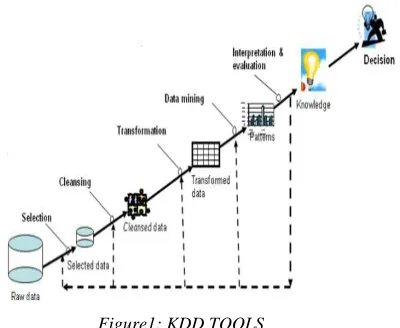
The KDD process can be defined by a series of processes and data analyses [13], which consist of (see Fig 1):
• Describe the problem which presents the first phase where we define the objectives, the results and the means to measure the success of the data mining step.
• The research of data by combining multiple data sources in a single form. They will be selected for having the data relevant from the analysis requested.
• These data will be cleaned and transformed, to prepare it to data mining.
• In the phase of data mining, the intelligent methods of extracting information are applied. This information is interpreted and evaluated to extract knowledge.
Figure1: KDD TOOLS
DSS is an interactive and iterative process. Interactivity is linked to different choices that user is bringing round to perform. The iterativity is related to the fact that KDD occurs following a
series of steps and the user can decide to go back at any time if the results do not suit him.
II.3 DECISION SUPPORT SYSTEM BASED ON A KDD
PROCESS.
A DSS/KDD is a system to detect strategies for solving a decision problem via data mining [19]. In this process, the analysis of the needs of policy makers, various activities related to the preparation and handling of relevant data, as well as the integration of knowledge to help in the decision making is very important steps.
[image:2.612.104.304.507.671.2]The diagram in Figure 2 illustrates the development of a DSS based on a KDD process.
Figure 2. Process of a DSS based on a KDD
The first phase of this process is the identification of the problem, which allows identifying and defining the different main objectives of the future system. The preprocessing steps include building corpus -specific as well as to clean the data, the treatment of missing data, selection of attributes or to the selection of bodies and the processing of these data.
The second phase is data mining, which must be performed to obtain knowledge put in the form of models which must be validated.
make the right decision at the arrival of a new cancer patient.
3. IMPORTANCE OF THE STUDY
PROBLEM STATEMENT.
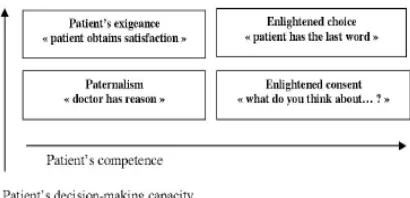
At the time of the conference on “the universe of the patient of tomorrow; our health system in 2010”, that took place October 23 2002 to Toronto [27], lecturers evoked the patient's empowerment as the agent of change and defined 4 degrees of individual empowerment (see Fig 3).
[image:3.612.95.300.306.405.2]The right to decide induces the decision's responsibility. While talking about the autonomous patient, possessor of the decision strength, we must equally reflect on the responsibility that the patient must assume.
Figure 3: Degrees Of Empowerment
Our research is based on implementation of a prediction system for a cancer patient. This system simulates the empowerment degree of a patient and to classify it in the appropriate cluster.
4. Methodology
4.1Data
System decision support based on a KDD process relies step of data mining on the case based reasoning [24]. It aims to help doctors oncology service, future users of said system via a human-machine interface, understand and predict the degree of autonomy of a patient with cancer treated with chemotherapy.
An investigation was launched during the month of February 2010 in the Mohamed V military hospital in Rabat, with 30 cancer patients receiving chemotherapy. This study showed that the criteria for a patient empowerment are segmented into two parts [2]
•Intra-individual criteria can be summarized as patient age, his self-perceived health, level of
education, the presence of relatives in the consultations, personal experience, medication insignificant.
•inter-individual criteria: such as cancer is an incurable disease, the patient is demoralized (degrees of patient empowerment is reduced) and the role of health professionals involved in the process of care (lack of dialogue with the patient medecin oncologue and lack of training of nurses.).
It is on the data base collected in this study we will test different modules developed for our system decision support.
4.2 Proposed approach U.
There are several models of development in software engineering such as the waterfall model [ 28 ] , V [25] , spiral [9] , Y [ 8] or the Unified [ 27] . But these models are very general and human factors are not explained as the development teams of decision support systems should be encouraged to take into account.
The V-model is one of the best-known software engineering models. It structures the steps in two phases: a top-down for the design and implementation of the system, and a bottom for the integration and evaluation. The evaluation methods are defined (planned) in the downswing. This model is not specific enough to allow a perfect development of DSS and does not explicitly consider human factors. This model has often been adapted and reused in other areas [11].
In the field of human-machine interface, the V cycle was adapted, expanded, revised to give the model U [ 4] [ 24] [ 6] [ 5 ] [ 11].
This model U is focused on man-machine interface (HMI). It seems most appropriate and meets our needs already expressed (human factors evaluation, etc.)
development team. The model U is structured in two phases
A downswing begins with a structural and functional description of the system to provide a structural framework for future activities as well as technical solutions. The result of this step is a list of tasks to be divided into automated tasks and interactive tasks (involving different degrees of collaboration between the user and the system), and then analyzed and modeled
A rising phase focused on the evaluation of the overall system, according to criteria of efficiency of the system and also the criteria focused on the human being. Validation involves comparing the theoretical model tasks (prescribed) of the downswing with the pattern of actual activities highlighted in the ascending phase (according to the original principles proposed by [6])
The decision support based on a KDD process system relies step of data mining on the case-based reasoning [Riesbeck and Shank 1989]. It aims to help doctors from oncology, future users of said system via a human-machine interface, to understand and predict the degree of autonomy of a patient with cancer and treated with chemotherapy
5. RESULTS AND
DISCUSSION
.5.1Measurement
Each patient is characterized by the following variables:
Age, sex, study level, presence of family member, nurse patient dialogue, training of nurse, personal experiences, oncologist patient dialog. These characteristics will represent the exogenous variables, whereas the endogenous variable is the degree of prediction.
5.2 Analysis and results
To develop our DSS based on KDD, we followed the various phases of the KDD process (Figure 1), the system was divided into modules by referring to the steps of KDD process. Three modules were designed and made: one for the storage, preparation of data and the system initializing by assigning to each group a tuplet, the second has been stored in a
classification of four patient group (paternalism requirements of the patient, informed consent and informed choice data) using a heuristic (the k-means algorithm), and the third module for data mining itself. The search algorithm we have chosen is that of the k-nearest neighbors (kNN) used in the art of reasoningfrom cases.
In what follows, we describe the course of the process with respect to each of the three modules of the proposed DSS.
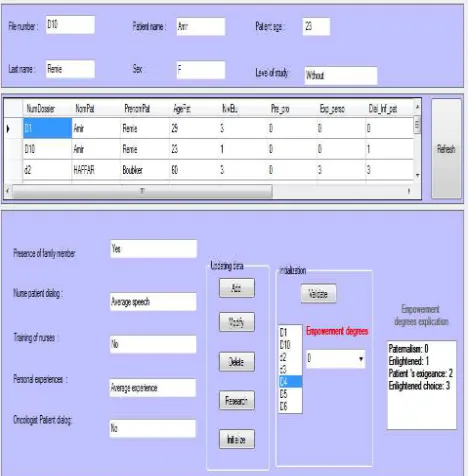
[image:4.612.314.548.410.648.2]The objective of the first module is to develop an interface for entering different information collected during our investigation, and that can influence the degree of autonomy of a patient. The implementation of the said unit has set up a database, preprocess the data outcome of the investigation (cleaning and processing of data) and represent the interface for data entry (Figure 4). Similarly, there is another part called, system initialization, which allows you to assign 4 patients selected from the population already entered in each of the four classification groups. This section also allows you to check whether one of the four classification groups has not been initialized.
Figure 4. Illustrate The Case Of The Arrival Of A New Patient And Initialized System.
the initialization already made in the first module. Each group contains those patients most similar (same degree of empowerment)
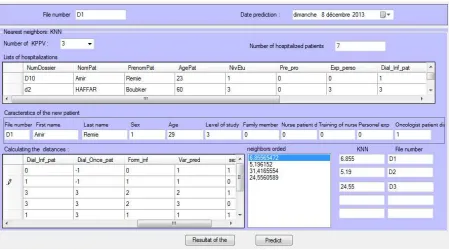
[image:5.612.92.541.418.668.2]After the completion of the module "Data Classification" completed, we started the 3rd module of "data mining". The initial objective of this application is to provide the physician with a prediction about the degree of empowerment of a new patient entering the service based on the technique of case-based reasoning [30]. This prediction is obtained from the k closest to patients new arrived while displaying their membership classes. The new patient must belong to the majority class of the k nearest knowing that number k (3, 5, 7, etc.) is always odd patients.
6. FUTURE RESEARCH.
As working prospect, the same database can be exploited to measure a set of indicators such as the number of patient step by step of empowerment, by environment, by school level and by time period of time. These indicators can be stored in a data warehouse.
Another perspective is to develop a new module for analyzing the characteristics of a new patient influencing the degree of empowerment and whether they are due to the inefficiency and respect to the illness or inadequate decision-making ability.
To release other performance indicators, the decision support system so designed, must be subjected in a set of tests by the future users in the coming months.
REFRENCES:
[1]A. Abouabdellah, A. Aguezzoul, A.Cherkaoui, Avril 2012,"Etude comparative des méthodes du génie logiciel pour la modélisation du processus d’autonomisation d’un patient atteint d’un cancer", revue Gestions
hospitalières, numéro 515, pages 257-263, ISSN: 00169218.
[2]A. Abouabdellah. 2011. Mise en place d’une méthodologie de modélisation du processus d’autonomisation par l’adaptation du concept holon., thèse de doctorat en es sciences
appliquées, EMI-Rabat, Maroc.
[3]A. Abouabdellah, A. Aguezzoul, A. Cherkaoui. "Application of software engineering methods for modeling the patient empowerment process with cancer International". In Proceedings of
the International Conference on Industrial
Engineering and Systems Management
(IESM'2011), pages 1542 -1548, Metz, France. École nationale d'ingénieurs de Metz (ENIM), International Institute for Innovation, Industrial Engineering and Entrepreneurship (I4e2). ISBN 978-2-9600532-3-4.
[4]Abed, M. 1990. Contribution à la modélisation de la tâche par outils de spécification exploitant les mouvements oculaires: application à la conception et à l'évaluation des interfaces homme-machine. Thèse de doctorat, Université de Valenciennes et du Hainaut-Cambrésis, France.
[5]Abed, M. 2001. Méthodes et Modèles formels et semi-formels de conception et évaluation des systèmes homme-machine. Mémoire d'HDR,
Université de Valenciennes et du Hainaut-Cambrésis, France.
[6]Abed, M., Bernard, J.M. et Angué, J.C. 1991. Task analysis and modelization by using SADT and Petri Networks. Proceedings Tenth European Annual Conference on Human Decision Making and Manual Control. Liege.
[7]Anderson, J. and Milson, R. 1989. Human memory: An adaptive perspective.
Psychological Review 96, 4, 703–719.
[8]André, J. 1993. Le cycle de vie en Y. Arche
SQL.
[9]Boehm, B. 1988. A Spiral Model of Software Development and Enhancement. IEEE Computer, 21 (5), 61-72.
[10] Brown, J. S. and Duguid, P. 2002. The Social Life of Information. Harvard Business
School Press. 356 pages.
[11] Cathelain, S. 2005. Contribution à la conception de systèmes coopératifs. Application au domaine du contrôle de trafic aérien. Thèse
de doctorat, Université de Valenciennes et du
Hainaut-Cambrésis, France.
[12] Evans, R.S. 2007. Case studies in clinical decision support: LDS hospital experience.
Clinical Decision Support, 6, 143-167.
[13] Fayyad, U.M., Djorgovski, S.G. et Weir, N. 1996. Automating the Analysis and Cataloging of Sky Surveys. Advances in Knowledge Discovery and Data Mining. MIT
Press, 471-494.
[14] Foulquié P., Dictionnaire de la langue et de la pédagogie. PUF, 1979.
[15] Gorry, G.A. & Scott Morton, M. 1971, «A Framework for Management Information Systems. », Sloan Management Review, Vol. 12, no1, pp.55-70.
[16] Jambu, M. 1999. Introduction au Data Mining, analyse intelligente des données. Eds
Eyrolles, Paris.
[17] Kaplan B. 2001. Evaluating informatics applications-clinical decision support systems literature review. International Journal of Medical Informatics, 64, 15–37.
[18] Klein, M. et Methlie, L.B. 1990. Expert Systems: A Decision Support Approach with applications in management and finance. Eds
Addison-Wesley Publishing Company.
[19] Lefébure, R. et Ventari, G. 2001. Data Mining : Gestion de la relation client, Personnalisation des sites Web. Eds Eyrolles. [20] Lepreux, S. 2006. Supports pour la prise
[21] Lepreux, S., Abed, M. et Kolski, C. 2003. A human-centred methodology applied to decision support system design and evaluation in a railway network context, Cognition.
Technology and Work, 5, 248-271.
[22] Lévine, P., et Pomerol, J. 1989. Systèmes interactifs d'aide à la décision et systèmes experts. Eds Hermès, Paris.
[23] Matheny, M.E., et Ohno-Machado, L. 2007. Generation of knowledge for clinical decision support: Statistical and machine learning techniques. Clinical Decision Support, 10, 227-248.
[24] Millot, S. Debernard, Men machines cooperative organizations: Methodological and Practical Attempts in air trafic control, in:
Proceedings IEEE SMC, Le Touquet, France,
October 1993.
[25] McDermid, J., et Ripkin, K. 1984. Life cycle support in the ADA, environment.Cambridge University Press, Cambridge, UK.
[26] C. Riesbeck, R. Shank, Inside Case-Based Reasoning, Lawrence Erlbaum, 1989.
[27] Jacobson, I., Booch, G., et Rumbaugh J. 1999. Le processus Unifié de Développement logiciel. Eds Eyrolles, Paris.
[28] W. Royce, Managing the development of large software systems: Concepts and techniques,WESCON, technical papers, 1970
[29] Singer P. et al., L'univers du patient de demain. Notre système de santé en 2010, 23
octobre 2002, Toronto.
[30] Kolodner, J.L., et Leake, D.B. 1996. A Tutorial Introduction to Case-Based Reasoning: Experiences. Lessons & Future Directions,