DEVELOP PRACTICAL METHODS OF KNOWLEDGE
MEASUREMENT IN UNIVERSITIES
1ALI TAHA Al-OQAILY, 2ZAINUDDIN BIN HASSAN, 3 AHMAD ABEDHAYY
AL-DALA’IEN, 4ABDULLAH MOHAMMED RASHID
1, 2, 3,4
Universiti Tenaga Nasional , Selangor, Malaysia
1, 2, 3,4
College Of Information And Communication Technology
E-mail: [email protected], [email protected], [email protected],
4
ABSTRACT
The organizations of various fields such as industry and education looking for manage their knowledge resources in order to provide efficient products performance. The knowledge measurement is one from the most important success factors of knowledge management implementations. The dynamic changes of businesses environments and knowledge levels maximize the difficulty of measure the efficiency levels of tacit and explicit knowledge. The academic staff in universities face challenges in retrieve the efficient explicit knowledge i.e. articles that compatible with their tacit levels in order to develop their tacit value to support their teaching and researching activities. The main aim of this research is to develop practical methods to match between the explicit and tacit knowledge levels inside universities environments in order to retrieve the suitable explicit knowledge that satisfy the employees needs of knowledge based on their tacit levels. This research data collected supporting qualitative data collecting method using interview with four experts of knowledge management. The knowledge measurement practical specifications and mathematic equations developed based on the collected data to provide the matching between the tacit levels of academic staff and retrieved explicit knowledge levels inside universities environments.
Keywords: Knowledge management, knowledge measurement, knowledge matching, success factors,
universities environments.
1. INTRODUCTION
The knowledge defined as the information insight as working activities within organizations environments [1]. Thus, the knowledge deeper layer than the information and data. [2] mentioned that, There are two main types of knowledge; (1) tacit knowledge which represent the stored knowledge in employees minds and applied as a skills in working environments, and (2) explicit knowledge which documented as may physical forms such as books and online articles. The organizations focus on develop tacit knowledge using various efficient sources to ensure accurate working activities in order to maximize the businesses profits and reduce the expenses of working mistakes [3]. The explicit knowledge considered as main source of tacit knowledge development [4]. Therefore, the employees could be retrieved useful explicit knowledge to develop
2. RELATED WORKS
This section will reviewed many related works of knowledge measurement to support the development vision of this research.
2.1 Knowledge Management Success Factors
[8, 9] argued that, the knowledge evaluation is the process of ensure the efficiency of explicit and tacit knowledge updating to support the dynamic changes of working environments and businesses strategies. The businesses strategies are changes frequently to provide the competitive advantages of organization services and products over other organizations in same field. Thus, both tacit and explicit knowledge could be developed usefully based on the organization strategies. However, the explicit knowledge is the main source of tacit knowledge developed development. The retrieved knowledge need to be evaluated to satisfy the employees’ tacit levels and the tacit need to be evaluated to retrieve efficient explicit knowledge.
[8, 10] found that the organization strategies and knowledge evaluation are main success factors of knowledge management implantations in financial companies. On the other hand, the significance result of [11] shows that one from the most success factors of knowledge management in Agriculture domain is the knowledge measurement. Moreover, [12, 13] surveyed the success factors of knowledge management in businesses organizations; the knowledge evaluation considered as main factors to ensure the success implementations of knowledge management.
According to [9, 14, 15] results the organization strategies and knowledge measurement are the most important success basements of knowledge implementations in universities. Also, [16, 17] found that the universities strategies could be ensured in knowledge management activities. Additionally, [18] results shows that continues improvement of knowledge through evaluation processes is important factor in knowledge management systems in universities.
2.2 Knowledge Evaluation
According to [19, 20], the explicit knowledge could be evaluated using three main approach; (1) the self method which allow the employees to evaluate the gained value of the retrieved
knowledge, (2) systematical processes such as measure the most accessed explicit knowledge by employees, and (3) empirical method through observe the employees working performance after retrieve the explicit knowledge. On the other hand, [21, 22] explained that the explicit knowledge efficiency could be evaluated through the compatibility between the explicit contents and organizations strategies of working.
On the other side, there are three variables are effective to evaluate the tacit knowledge; (1) formal methods such as tests, (2) informal methods such as supervisors observing of employees performance, (3) general characteristics of employees such as qualification levels and experience years [23, 24, 25].
3. RESEARCH METHOD
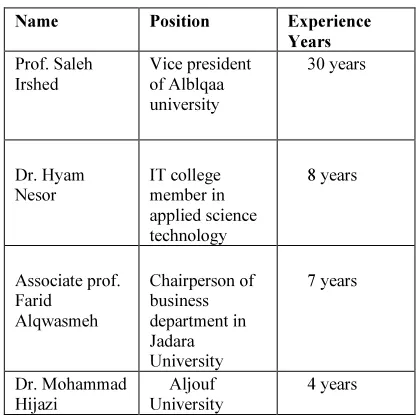
[image:2.595.306.514.486.695.2]The construction of the proposed methods is based on the feedback from the experts in Jordanian universities. The experts were chosen based on their working experiences and the position held in Jordanian universities and who frequently access knowledge resources. The interview was conducted to identify the specifications of tacit and explicit measurement equations. Table 1 illustrates the panel profiles.
Table 1: profiles of Expert Panel
Name Position Experience
Years Prof. Saleh
Irshed
Vice president of Alblqaa university
30 years
Dr. Hyam Nesor
IT college member in applied science technology
8 years
Associate prof. Farid
Alqwasmeh
Chairperson of business department in Jadara University
7 years
Dr. Mohammad Hijazi
Aljouf University
4. MEASUREMENT VARIABLES
Based on the gathering data of expert panel the tacit knowledge of employees could be measured using four responsible variables; qualification levels, years of experience, supervisor assessment, and assessment based quiz. On the other hand the explicit knowledge levels (articles) could be measured using two effective variables; manger ranking and employees ranking.
4.1 Tacit Measurement Variables
• Qualification Levels: the qualification
level of employees such as PhD and master reflect the variance of tacit knowledge levels. .
• Years of working experience: the
employees could be developed their tacit levels based on the gained value of their working experience. Thus, the experience years are effective indicator of tacit measurement.
• Supervisors Assessment: The working
supervisor basement of employees working performance is efficient variable to evaluate the tacit knowledge levels.
• Quick Assessment: The tacit knowledge
of employees can be evaluated through assessment approach such as quiz.
4.2 Explicit Measurement Variables
• Managers’ Ranking: the explicit
knowledge (articles) levels could be evaluated by knowledge mangers based on the matching between articles contents and businesses strategies.
• Employees’ Ranking: the employees’
evaluation of the gained value from explicit knowledge could be useful to measure the usefulness of explicit content.
5. MEASUREMENT METHODS
In this section the measurement specifications of tacit and explicit knowledge will explained based on the research collected data. The specification will support the measurement formulas development.
5.1 Tacit Measurement Method
There are four variables of tacit knowledge measurement which are as the following:
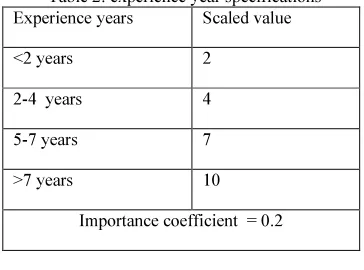
1- Experience years: The experience years
[image:3.595.316.498.401.536.2]classified as many classes, and each class assigned to scaled value. The importance coefficient is the importance of experience year’s variable to measure the tacit knowledge comparing with other variables such as qualification levels and assessment. Table 2 presents the findings of experience year specifications.
Table 2: experience year specifications Experience years Scaled value
<2 years 2
2-4 years 4
5-7 years 7
>7 years 10
Importance coefficient = 0.2
2- Qualification Level: The qualification level
Table 3: Qualification level specifications
Qualification level Scaled Value
Prof 10
Assoc Prof 9
Assist Prof 8
Master (instructor) 6
Master (Assist teacher) 5
Bachelor level A 4
Bachelor level B 3
Diploma level A 2
Diploma level B 1
Importance coefficient = 0.2
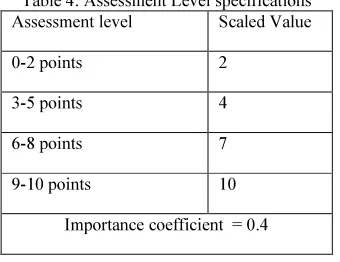
3- Assessment Level: The assessment level
[image:4.595.106.276.512.643.2]classified as many classes, and each class assigned to value. The importance coefficient is the importance of assessment level variable to measure the tacit knowledge comparing with other variables such as experience year. Table 4 shows the assessment level specifications.
Table 4: Assessment Level specifications Assessment level Scaled Value
0-2 points 2
3-5 points 4
6-8 points 7
9-10 points 10
Importance coefficient = 0.4
4- Observing Level: The observing level
classified as many classes, and each class assigned to value. The importance coefficient is the importance of observing level variable to measure the tacit knowledge comparing with other variables such as experience year.
Table 5 shows the specifications of observing level.
Table 5: Observing Level specifications Observing level Scaled Value
1-2 points 2
3 points 3
4 points 4
5 points 5
6 points 6
7 points 7
8 points 8
9 points 9
10 points 10
Importance coefficient = 0.2
The tacit levels classified based on qualification levels. Thus, the PhD, Master, Bachelors, and diploma employees will be measured separately. The Overall variables of tacit level can be measured using equation 1.
Tacit level = 0.2*EY + 0.2*QL+ 0.2*OL+ 0.4*AL (1)
Where EY: Experience year, QL: Qualification Level, OL: observing level, Al: Assessment level.
5.2 Explicit Measurement Method
There are two variables of explicit knowledge measurement which are as the following:
1- Employees’ Ranking: The employees
For example, the same article may be ranked as 10 from PhD employees and 5 from diploma employees. There is importance coefficient of employees’ ranking comparing with the importance of managers’ ranking.
2- Managers Ranking: The managers could
be ranked the explicit knowledge based on scale values from 2-10 (2 is the minimum value) based on the compatibility between their working and explicit knowledge contents. The managers’ evaluation will be categorized based on the compatibility between explicit contents and employees qualification levels. Thus, each category of PhD, master, bachelor, and diploma employees have their own ranking of explicit knowledge to ensure the efficiency of knowledge levels matching. For example, the same article may be ranked as 8 for master employees and 5 for bachelor employees. There is importance coefficient of managers’ ranking comparing with the importance of employees’ ranking.
The ranking of each employees of same qualification level will be separated from other employees of other qualification levels. Equation 2 represents the overall measurement variables of explicit knowledge level:
Explicit level = 0.4*ER+ 0.6* MR (2)
Where 2<ER<=10, 2<MR<=10. ER: employees ranking, MR: managers ranking.
5.3 Knowledge Levels Matching
The articles will retrieved based on the matching level between the explicit and tacit evaluation levels if |TKs – EKs| = 0.1, where TKs is the tacit evaluation level, EKs is the explicit evaluation level, and X is difference value between explicit and tacit evaluation levels.
6. CONCLUSION
The organizations are care of mange their knowledge resources efficiently to address the dynamic changes of working environment and business strategies. The tacit and explicit measurement is one from the most important success factors of knowledge management implementation. The employees in various
organizations develop their tacit knowledge using explicit knowledge resources. The retrieved explicit knowledge could be match with tacit knowledge levels of employees and the organizations strategies of working. This research focuses on knowledge matching inside universities environment to support the academic staff teaching and researching activities.
REFERENCES
[1] Alavi Maryam, and Dorothy E. Leidner,” Review: Knowledge management and knowledge management systems: Conceptual foundations and research issues”, MIS quarterly, vol. 25, no. 1, 2001, pp. 107-136. [2] Adolph, B. (2005, June). Learning how to do
things differently: Challenges in sharing tacit knowledge for agricultural and rural development (with examples from India and Namibia). In Symposium on Learning Alliances for scaling up innovative approaches in the water and sanitation sector, 7-9 June 2005, Delft, the Netherlands (pp. 1-10). IRC International Water and Sanitation Centre.
[3] Bollinger, AS & Smith, RD 2001, 'Managing organizational knowledge as a strategic asset', Journal of Knowledge Management, vol. 5, no. 1, p. 8-18.
[4] Debowski, S 2006, Knowledge Management, John Wiley & Sons, Milton, Queensland, Australia.
[5] Hana, U. (2013). Competitive advantage achievement through innovation and knowledge. Journal of Competitiveness, 5(1), 82-96.
[6] Earl, M, “Knowledge management strategies: toward a taxonomy”, Journal of Management Information Systems, Vol. 18, No. 1, 2001, pp. 215-34.
[7] Mohamad, R., Manning, K., & Tatnall, A. (2013). Knowledge Management in University Administration in Malaysia. In Next Generation of Information Technology in Educational Management (pp. 76-85). Springer Berlin Heidelberg.
[8] Yaghoubi, N. M., &Maleki, N. (2012).Critical Success Factors of Knowledge Management. [9] Mathi, K. (2004). Key success factors for
[10] Monavvarian, A., & Khamda, Z. (2010). Towards successful knowledge management: people development approach.Business Strategy Series,11(1), 20-42.
[11] Heaidari, M., Moghimi, S. M., & Khanifar, H. (2011). The critical success factors in implementing knowledge management: agricultural organization in Islamic Republic of Iran.British Journal of Science,1(2), 54-75.
[12] Zheng, W., Yang, B., & McLean, G. N. (2010).Linking organizational culture, structure, strategy, and organizational effectiveness: Mediating role of knowledge management. Journal of Business Research, 63(7), 763-771.
[13] Razi, M. J. M., & Karim, N. A. (2010).An Instrument to Assess Organizational Readiness to Implement Knowledge Management Process. In Knowledge management: theory, research and Practice, Proceedings Knowledge management 5th International Conference (pp. 323-328). [14] Abdullah, D. H. & Sinha, RR (2009),
Knowledge management and intellectual capital emerging perspectives (Eds.),“Critical factors for KM implementation: An L&T, E&C division case study”(pp. 53-71). Institute of management technology, Ghaziabad.
[15] Lehner, F., & Haas, N. (2010).Knowledge management success factors–proposal of an empirical research. Electronic Journal of Knowledge Management, 8(1), 79-90. [16] Nasiruzzaman, M., Qudaih, H. A., & Dahlan,
A. R. A. (2013). Project Success and Knowledge Management (KM) Practices in Malaysian Institution of Higher Learning (IHL). Journal of Education & Vocational Research, 4(5).
[17] Yip, M. W., Lau, D. H. C., & Songip, A. R. (2010). Influence of soft elements on KM implementation in Malaysian higher learning institutions. Journal of Knowledge Management Practice, 11(3), 1-9.
[18] Zwain, A. A. A., Teong, L. K., & Othman, S. N. (2014). TQM Practices and Organisational Knowledge Creation: An Empirical Study of Iraqi Higher Education Institutions. Asian Journal of Business and Accounting, 7(1), 1. [19] McElroy, MW, The New Knowledge
Management: Complexity, Learning, and Sustainable Innovation. 2003. Butterworth-Heinemann, USA
[20] OECD. 2013. “NEW SOURCES OF
GROWTH: KNOWLEDGE-BASED
CAPITAL – KEY ANALYSES AND POLICY CONCLUSIONS”, SYNTHESIS REPORT.
[21] Warwick, C., Siemens, R., Ruecker, S., and the INKE team. 2009. “ New Knowledge Environments. ACM 17th Conference on Information and Knowledge Management, New York.
[22] Roberta Katz. 2006. “Change Management and Strategic Planning”, Associate Vice President of Strategic Planning, Stanford University.
[23] Redman, T. C. , “Measuring data accuracy: A framework and review” , in Wang, R. Y., Pierce, E. M., Madnick, S. E. and Fisher, C. W. (eds.) Information quality. New York: M. E.Sharpe, 2005, pp. 21-36.
[24] S,Robert. 2013. “PARAMETRIC EXPLICIT
KNOWLEDGE MAPPING IN A
LEARNING ENVIRONMENT”.
Management and learning international conference 2013. Zadar, Croatia.