A KEY AGREEMENT FOR LARGE GROUP USING
BILINEAR MAPS
1TZU-CHUN LIN, 2TE-YU CHEN, 3CHIUN-SHIANG GAU, 4*MIN-SHIANG HWANG
1Assoc Prof., Department of Applied Mathematics, Feng Chia University
2Asstt. Prof., Department of Elder Care, National Tainan Institute of Nursing
3Department of Applied Mathematics, Feng Chia University
4Chair Prof., Department of Computer Science and Information Engineering, Asia University
E-mail: [email protected], [email protected] ,[email protected], [email protected]
*Corresponding author
ABSTRACT
A key agreement scheme for large dynamic multicast group systems has been designed to cope with such applications including pay-tv, teleconferencing, collaborative work, online games, and so forth. To avoid heavy loads and unauthorized accesses to the system, it is necessary to construct an efficient and secure scheme. Some recently released schemes have tree-based underlying structures. The efficiency of these tree-based schemes is closely associated with the height of the underlying tree. In this paper, we propose a secure and efficient key agreement scheme for large groups that adopts a quad tree as the underlying key tree.
Keywords: Multicast, Tree-Based Group, Key Agreement, Elliptic Curve, Bilinear Mapping
1. INTRODUCTION
Due to the rapid development of computer technologies, group communication has become a become a main focus. Generally speaking, group communication applications include video conferencing, online games or videos, military command transmission, etc. A common feature among these applications is that the members of the group may join or leave at any time as their wish. In order to relieve the burden on the network bandwidth, multicasting techniques, have been adopted in a wide variety of applications. However, In order to prevent unauthorized accesses to the messages during transmission, it is necessary to encrypt the messages. Therefore, the mechanism in which the authorized members efficiently and securely agree on a group key has been the major consideration in these applications [1, 2, 9-12].
A secure key agreement protocol for the large dynamic groups should meet the following requirements [20]:
1. Group key secrecy: It guarantees that the group keys used to encrypt the broadcast messages must not be compromised by a nonmember.
2. Backward secrecy: It guarantees that the previously used group keys must not be compromised by new group members.
3. Forward secrecy: It guarantees that the new group keys must not be compromised by former group members.
The rest of this paper is organized as follows. Section 2 reviews some related works. Then, in Section 3, the details of the proposed scheme are presented. In Section 4, the security of our scheme is analyzed, and the comparisons among our new work and some other schemes are also illustrated. Finally, the conclusions are drawn in Section 5.
2. RELATED WORK
To date, many researchers have offered their key management schemes for secure multicast [3, 5, 7, 13, 15-25]. These schemes can be classified into three categories [14]: the centralized architecture, the decentralized architecture, and the distributed
architecture. Recently, some researches have
focused on the tree based hierarchy where a logical tree of keys is maintained for the reason of efficiency [7, 10, 17, 18, 20, 21].
ISSN: 1992-8645 www.jatit.org E-ISSN: 1817-3195
deduce the upper level keys by using the Diffie-Hellman key agreement protocol.
In 2003, Lee et al. proposed an efficient tree-based group key agreement using bilinear map [10]. This distributed scheme extends from the one round protocol for tripartite Diffie-Hellman [6]. The logical key tree adopted in their system is ternary. The stretch of the underlying key tree from the binary form to ternion results in the reduction of the computation complexity from O(log2 n) to O(log3
n).
In 2005, Liming Wang and Chuan-KunWu [20] proposed a decentralized key agreement scheme. They adopted an identity tree instead of the key tree and thereby turned the scheme identity-based. In their scheme, the whole group is divided into some smaller subgroups maintained by a subgroup controller. Nam et al. developed a contributory group key agreement protocol in the same year [13]. In their scheme, all the users of the network are divided into two groups according to the computational capabilities of users.
3. THE PROPOSED SCHEME
In this section, we shall elaborate how our new scheme handles the membership operations as well as how dynamic group communication can be smoothly carried out.
3.1 Group Membership Operations
A good group key agreement system must be able to handle adjustments in a simple, efficient, and secure manner. Adjustments are taken place when members attempt to join (Member Join) or leave (Member Leave) the group. In the proposed scheme, a quad tree is adopted as the underlying key tree. Each individual member in the system is assigned to a leaf node of the key tree, and each node of the key tree is associated with a key which is shared by all the members of the subtree rooted at this node. A member can use his /her own private secret and some public information to derive the keys on the path from its leaf node to the root, which is also called thekey path. When a Member Join event happens, a new node will be inserted into the key tree, and the new member is assigned to the new node. The keys on the key path of the new node should be refreshed for assuring backward secrecy. When a Member Leave event happens, the node assigned to the leaving member should be deleted form the tree, and the keys on the key path of the deleted node should be refreshed for assuring forward secrecy. All communication channels are
considered public but authentic in the proposed protocol.
3.2 System Setup
The system parameters (G1, G2, e, P, H1, H2) are
generated and published, where G1 is an additive
cyclic elliptic curve group generated by P with a prime order q, G2 is a multiplicative group with the
same order q, e: G1╳G1→G2 is an bilinear map, and H1: G1→Zq
*
, H2: G2 →Zq *
are the hash functions.
The nodes of the quad key tree adopted in our scheme can be classified into three roles. The root node is associated with the shared group key which can be computed by all the members in the group.
The key node located at the internal node is
associated with two or three keys depending on the number of its sibling nodes and its position. When the number of sibling nodes is smaller than four, there will be two keys: one is the blinded key for the group that goes public, and the other is the key
generation key which can be computed by all the
members in the subtree rooted at this key node. For a node with four child nodes, a union blinded key is assigned to its rightmost child node additionally.
The member node represents each group member
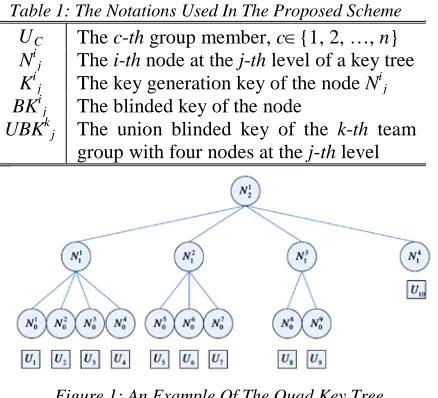
as a leaf node. The keys that come with the member nodes are similar to those of the key node except that the key generation key is randomly chosen from Zq*. Figure 1 shows an example of the key
tree. Table 1 summarizes the notations used in the proposed scheme.
Table 1: The Notations Used In The Proposed Scheme
UC The c-th group member, c∈{1, 2, …, n}
Nij The i-th node at the j-th level of a key tree
Kij The key generation key of the node Nij
BKij The blinded key of the node
UBKkj The union blinded key of the k-th team
[image:2.612.312.531.471.670.2]group with four nodes at the j-th level
Figure 1: An Example Of The Quad Key Tree
For the key node Nij, the key generation key Kij
𝐾 𝑗𝑖 = ⎩ ⎪ ⎪ ⎪ ⎨ ⎪ ⎪ ⎪
⎧𝐻1(𝐻2(𝑒(𝑃, 𝑃)𝐾𝑗−1
4𝑖−3𝐾
𝑗−14𝑖−2𝐾𝑗−14𝑖−1)𝐾
𝑗−14𝑖 𝑃),
if 𝑁 𝑗𝑖has four child node;
𝐻2(𝑒(𝑃, 𝑃)𝐾𝑗−1
4𝑖−3𝐾
𝑗−14𝑖−2𝐾𝑗−14𝑖−1),
if 𝑁 𝑗𝑖has three child node;
𝐻3�𝐾𝑗−14𝑖−3𝐾𝑗−14𝑖−2𝑃�,
if 𝑁 𝑗𝑖 has two child node;
The blinded key BKij for a node Nij is KijP. In the
case where a node has four sibling nodes, a union blinded key is assigned to the rightmost node of the four sibling nodes additionally, and the following computation is done:
UBKij = 𝐻2(𝑒(𝑃, 𝑃)𝐾𝑗 𝑖−3𝐾
𝑗𝑖−2𝐾𝑗𝑖−1)𝑃
If the system is constructed by the previous rules and all the blinded keys and union blinded keys are published, then each member in the group can compute the key generation keys on the key path by using his/her own private key generation key and the public blinded keys or union blinded keys.
For example, as shown in Figure 1, U2 can derive
the key generation key K11 from his private key
generation key K20 and the public keys BK10 , BK30
and BK40 as follows.
H1(H2(e(BK10 , BK30 )K
2 0)BK4
0)
= H1(H2(e(K 1
0P, K 3
0P) K
2 0)K4
0P)
= H1(H2(e(P, P) K
1
0 K30 K20)K4
0P) = K11
Subsequently, U2 can go on to compute the
group key K12 by using the derived K11 and the
public keys BK21, BK 3
1 and BK 4
1.
H1(H2(e(BK21 , BK31) K
1 1 )BK4
1)
= H1(H2(e (K21P, K31P) K
1 1)K4
1P)
= H1(H2(e(P, P) K
1
1K21 K31)K4
1P) = K12
Furthermore, U7 can compute the key generation
key K21 by using his own private key K70 and the
public keys BK50 and BK60 as follows.
H2(e(BK50, BK60 ) K
7 0) = H2(e(K50P, K60P) K
7 0) = H2(e(P, P) K
5
0 K60 K70) = K2
1
Afterward, U7 can compute the group key K12 by
using the derived K21 and the public keys BK11,
BK21 and BK41 the way U2 does so.
H1(H2(e(BK11, BK31) K
2 1)BK4
1)
= H1(H2(e(K 1
1P, K 3
1P) K
2 1)K4
1P)
= H1(H2(e(P, P) K
1
1 K21 K31)K4
1P) = K12
Similarly, U9 can compute the key generation
keys K31 and K 1
2 as follows:
H1(K90BK80) = H1(K90K80P) = K31 ;
And
H1(H2(e(BK11, BK21 ) K
3 1)BK4
1)
= H1(H2(e(K11P, K21P) K
3 1)K4
1P)
= H1(H2(e(P, P) K
1
1 K21 K31)K4
1P) = K12 .
U10 can compute the group key K12 from his own
private key K41 and the public key UBK41 as
follows.
H1(UBK41·K41)
= H1(H2(e(P, P) K
1
1 K21 K31)P·K4
1) = K12
3.3 Member Join Protocol
We assume that there are n users, U1, U2, … Un,
in the group. If a new member Un+1 wants to join in,
he/she first randomly chooses a key generation key from Zq* and computes the corresponding blinded
key. Then, the new member will broadcast a join request message, which includes his/her own blinded key, to all the members in the group. After receiving the request, all the members in the group will agree on the insertion point of the new member as well as the sponsor. The insertion point is the position where the new member will be allocated in the key tree; and all the members in the group will update the key tree accordingly. The sponsor who is one of the old members knowing all the necessary keys will take charge of the key refreshing.
The insertion point of the new member node is decided on the principle of keeping the height of the key tree as low as possible. Hence, the insertion point of the new member node is the first node with a degree that is lower than 4 on the traversal of the key tree from the top level to the bottom level and from left to right. There are two cases should be considered for modifying the key tree and determining the sponsor. First, if the node Nijis a
key node or the root node, the new member node will be inserted as the rightmost child node of the node Nij, and the sponsor is the rightmost child
node of the node Nijbefore the new member node is
inserted. Second, if the node Nij is a member node,
then the node Nij will become a key node and
branch into two member nodes, where the left hand side node is assigned to the old member who was associated with the node Nij originally and will be
the sponsor, and the right hand side node is assigned to the new member.
ISSN: 1992-8645 www.jatit.org E-ISSN: 1817-3195
[image:4.612.97.305.180.324.2]keys and union blinded keys to all the group members including the new member. After receiving the broadcast message, each member in the group can compute all the key generation keys on its key path, and all the legitimate members can achieve the same new group key.
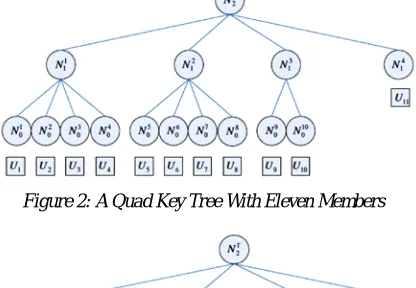
[image:4.612.98.306.301.397.2]Figure 2: A Quad Key Tree With Eleven Members
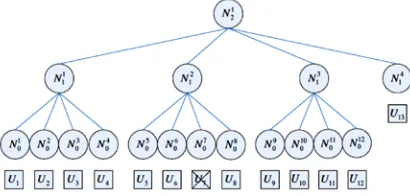
Figure 3: The New Key Tree After Member Join Event
For example, as shown in Figure 2, if a new member U12 wants to join the group, he/she has to
first randomly choose the key generation key from Zq* and then compute the corresponding blinded
key, and then he/she broadcasts the join request to the group. After the group receives the Member Join request from the new member U12, a new
member node N110 for U12 is inserted and the key
tree is updated (see Figure 3). The member U10
associated with the node N100 is then the sponsor
responsible for refreshing the related keys. The member U10 now re-computes the new blinded key
BK31’ and union blinded key UBK41’ as follows.
K31’= H2(e(BK90, BK110) K
10 0) = H
2(e(P, P) K
9 0 K100 K110) BK31’= K31’P = H2(e(P, P) K
9 0 K10
0 K11 0)P
UBK41’=H2(e(BK11, BK21)K
3 1’)P=H
2(e(P, P) K1
1K2 1K3
1’)P
It is clear that in addition to UBK41, all the keys
on the key path, namely K31, K12, and BK31, are
refreshed after the update so that backward secrecy can be accomplished. After finishing the computation, the sponsor U10 broadcasts the
modified key tree and the updated blinded key as well as the union blinded key to the members of the group. All the legitimate members, including the
new member U12, can now compute the group key
K12’= H1(H2(e(P, P) K
1
1 K21 K31’)K4
1P).
3.4 Member Leave Protocol
When a Member Leave event happens, the key tree should be modified and some keys should be replaced for forward secrecy. Upon receiving the leaving message, all the members in the group will update the key tree accordingly and decide on a sponsor.
Suppose a member Uc is leaving the group. Upon
receiving the member leaving request, all the members in the group will agree on a sponsor and update the key tree as follows. If the parent node of the member node originally assigned to the leaving member has more than two child nodes, than the member node assigned to the leaving member is removed directly, and the sponsor is the member associated with the rightmost remaining child node under the deleted member node's parent node. Otherwise, if the parent node of the member node assigned to the leaving member has only two child nodes, after the removal of the member node assigned to the leaving member, there is only one child node left. The member associated with this solitary node is promoted and re-associated with its parent node and will be the sponsor; this solitary node is no more necessary and is removed too.
After updating the key tree, the sponsor, who knows all the necessary keys, will stand out and be responsible for the key refreshing. The sponsor computes and updates all the blinded keys and union blinded keys of the nodes on its key path. Then, the sponsor will broadcast these refreshed keys to all of the group members. After receiving the broadcast message, each legitimate member in the group can derive all the key generation keys on his/her key path, and all the legitimate members can obtain the same new group key.
For example, as shown in Figure 4, there are thirteen members in this group and the member U7
will leave the group. The node N70 assigned to the
leaving member U7 will be deleted from the key
tree. The key generation key K70 and the union
blinded key UBK80 which are no longer necessary
will also be deleted. The new key tree is shown in Figure 5. U8 will be the sponsor and responsible for
the keys refreshing in this case. After computing the key generation keys K21’,
K21’= H2(e(BK50, BK60) K
8 0 ) = H
2(e(P, P) K
5 0 K60
K8 0 ),
U8 can proceed to compute the blinded key BK 2
1’
BK21’= K21’P = H2(e(P, P) K
5
0 K60 K80 )P
UBK41’=H2(e(BK11, BK31)K
2 1’)P=H
2(e(P,
P)K1 1K21’K31)P
After finishing the computation, the sponsor U8
broadcasts the updated blinded key BK21’and union
blinded key UBK41’ to the members of the group.
All the legitimate members now can compute the group key K12’=H1(H2(e(P, P)K
1
1K21’K31)K4
1P). It is
clear that the key generation key K21’ and the group
key K12’ are refreshed after the update, and the
[image:5.612.321.528.187.287.2]forward secrecy is guaranteed.
[image:5.612.99.304.246.344.2]Figure 4: The Key Tree Before Member Leave Event
[image:5.612.98.307.378.488.2]Figure 5: The New Key Tree After Member Leave Event
Figure 6: The Key Tree Before Member Leave Event
Another case in which more than one node will be deleted form the key tree after a member leaving is illustrated in Figure 6. If the member U10 will
leave the group, in addition to N100 , the node N90
should be deleted too and the member U9 will be
promoted and assigned to N31 . The new key tree is
shown in Figure 7. In this case, the member U9 will
be the sponsor, and refresh the keys as follows.
K31’= K90
BK31’= K90P
UBK41’= H2(e(P, P) K
1 1 K2
1K3 1’)P
After receiving the blinded key BK31’ and union
blinded key UBK41’ broadcasted by the sponsor U9,
all the legitimate members in this group can derive the group key K12’= H1(H2(e(P, P) K
1
1 K21K31’)K4
1P).
Figure 7: The Key Tree After Member Leave Event
4. ANALYSES AND COMPARISONS
A secure key agreement protocol for large dynamic groups should provide group key secrecy, backward secrecy and forward secrecy. This section will show how the proposed scheme does achieve these security requirements. Once a Member Join event or Member Leave event happens, the key tree will be updated accordingly, and all the keys concerning the joining or leaving member will be refreshed. In the Member Join case, the new member cannot learn any knowledge of the previous key generation keys. And the leaving member cannot derive any key generation keys from the old information he/she has in the Member Leave scenario.
Now let's discuss the group key secrecy of our scheme. An outside attacker might know the public system parameters (G1, G2, e, P, H1, H2), and all
the blinded keys and union blinded keys. If an attacker attempted to compromise a key generation key Kij directly from its corresponding blinded key
BKij which is equal to KijP, the problem the
attacker would have to solve is the DLP in G1,
which is an impossible mission to accomplish nowadays.
Attempts that an attacker might possibly make to compromise the key generation key Kij of a key
node from some public information can be categorized into 3 different cases.
Case I. Suppose the attacker tries to compromise a key generation key Kij of N
i
j which has two child
nodes N4i-3j-1 and N4i-2j-1. Since the key Kij is
defined as H1(K4i-3j-1K4i-2j-1P), and the correlative
[image:5.612.97.304.498.601.2]j-ISSN: 1992-8645 www.jatit.org E-ISSN: 1817-3195
1 (= K 4i-3
j-1P) and BK 4i-2
j-1 (= K 4i-2
j-1P), the problem
the attacker is facing now, namely to derive Kij
from BK4i-3j-1 and BK4i-2j-1, is equivalent to solving
the CDHP in G1
Case II. Suppose the attacker tries to compromise the key generation key Kij of some Nij
which has three child nodes N4i-3j-1 , N4i-2j-1, and N 4i-1
j-1. Since the key Kij is defined as
𝐻2(𝑒(𝑃, 𝑃)𝐾𝑗−1
4𝑖−3𝐾
𝑗−14𝑖−2𝐾𝑗−14𝑖−1), and the correlative public information the attacker can gather is BK4i-3j-1 (=
K4i-3j-1P), BK4i-2j-1 (= K4i-2j-1 P), and BK4i-1j-1 (= K 4i-1
j-1 P), the problem the attacker is facing now,
namely to derive Kij from BK4i-3j-1, BK4i-2j-1, and
BK4i-1j-1, is equivalent to solving the BDHP in (G1,
G2, e).
Case III. Suppose the attacker tries to compromise the key generation key Kij of some Nij
which has four child nodes N4i-3j-1, N4i-2j-1, N4i-1j-1,
and N4ij-1. Since the key Kij is defined as
𝐻1(𝐻2(𝑒(𝑃, 𝑃)𝐾𝑗−1
4𝑖−3𝐾
𝑗−14𝑖−2𝐾𝑗−14𝑖−1)𝐾
𝑗−14𝑖 , and the correlative public information the attacker can gather is BK4i-3j-1 (=K
4i-3
j-1P), BK
4i-2 j-1 (= K
4i-2 j-1P),
BK4i-1j-1 (= K4i-1j-1P), BK4ij-1(= K4ij-1P), and UBK4i
j-1 = 𝐻2(𝑒(𝑃, 𝑃)𝐾𝑗−1 4𝑖−3𝐾
𝑗−14𝑖−2𝐾𝑗−14𝑖−1)𝐾
𝑗−14𝑖 )𝑃, the problem the attacker is facing now, namely to derive Kij
from BK4i-3j-1, BK4i-2j-1, BK4i-1j-1, and BK4ij-1, is
equivalent to solving the BDHP in (G1, G2, e).
With the help of UBK4ij-1, in order to get Kij , the
attacker would have to solve K4ij-1 first, and that is
the difficulty of solving a DLP in G1.
Through the above analyses, we prove that the proposed scheme does provide group key secrecy, backward secrecy, and forward secrecy.
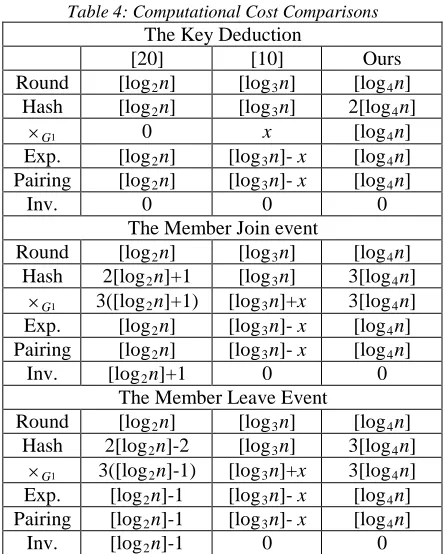
The computational efficiency and the economy of the number of keys are also very important criteria used to check out whether a group key agreement protocol can stand out among others. In this section, we shall show how our new scheme compares with [20] and [10] in these two aspects. The computational cost arises from two kinds of circumstances: one is the key deducing process, and the other is the key refreshing process. Computational costs of the two circumstances both depend on the height of the underlying key tree, the balance of the key tree, and the position where the involved member is located. In order to simplify the analyses, we only consider the worst case while the underlying key tree is full and highly balanced. Table 4 summarizes the computational costs of [20], [10] and the proposed scheme, where n is the number of members in the current group and x is the number of nodes with 2 sibling nodes.
[image:6.612.310.532.191.468.2]Table 4 reveals that the computational cost is highly correlated with the height of the underlying key tree. The proposed scheme gains the advantage over the others. The computations of pairings and exponentiations are rather costly and almost dominate the computational cost. The proposed scheme is superior to the others in terms of such computations.
Table 4: Computational Cost Comparisons
The Key Deduction
[20] [10] Ours
Round [log2n] [log3n] [log4n]
Hash [log2n] [log3n] 2[log4n]
×G1 0 x [log4n]
Exp. [log2n] [log3n]- x [log4n]
Pairing [log2n] [log3n]- x [log4n]
Inv. 0 0 0
The Member Join event
Round [log2n] [log3n] [log4n]
Hash 2[log2n]+1 [log3n] 3[log4n]
×G1 3([log2n]+1) [log3n]+x 3[log4n]
Exp. [log2n] [log3n]- x [log4n]
Pairing [log2n] [log3n]- x [log4n]
Inv. [log2n]+1 0 0
The Member Leave Event
Round [log2n] [log3n] [log4n]
Hash 2[log2n]-2 [log3n] 3[log4n]
×G1 3([log2n]-1) [log3n]+x 3[log4n]
Exp. [log2n]-1 [log3n]- x [log4n]
Pairing [log2n]-1 [log3n]- x [log4n]
Inv. [log2n]-1 0 0
The number of keys is another important factor we need to consider when we evaluate group key agreement protocols. We consider the worst case when the underlying key tree is full and highly balanced. Table 5 summarizes the numbers of keys and their types adopted in [20], [10], and the proposed scheme, where n is the number of members in the communication group.
number of public keys, the move from binary tree to ternary tree does mean more efficienct. However, due to the additional use of union blinded keys, our quad tree protocol needs a bit more public keys than the ternary tree. With all the keys counted, our new scheme has approximately the same number as [10] with the binary tree left far behind.
Table 5: Total Number Of Keys And Blinded Keys
Binary Ternary Ours Nodes 2n-1 (3n-1)/2 (4n-1)/3 KGKs 2n-1 (3n-1)/2 (4n-1)/3
Private keys 2n-1 0 0
BKs 2n-1 (3n-1)/2 (4n-1)/3
UBKs 0 0 (4n-1)/12
Public keys 2n-1 (3n-1)/2 5(4n-1)/12
5. CONCLUSIONS
In this paper, we propose a secure, efficient, and scalable key agreement scheme for large and dynamic multicast groups. The underlying key tree adopted in the proposed scheme is expanded to a quad tree. In this way, the height of the underlying key tree can be reduced, which acquired the efficiency. In fact, the proposed scheme not only performs with high efficiency but meets all the security requirements. Among these related schemes, our new scheme has made remarkable advances in comparisons on computational costs for the key deducing, Member Join event, and Member Leave event. The less improvement on the number of keys is caused by introducing the union blinded keys in our scheme. Owing to the properties of the bilinear mapping, the union blinded keys cannot be removed from our scheme. Therefore, how to effectively reduce the amount of keys is a significant and interesting problem which deserves further research.
ACKNOWLEDGEMENT
Part of this research was supported by National Science Council (NSC), Taiwan, under contract of NSC 101-2221-E-439 -001.
REFERENCES:
[1] S. Al-Riyami and K. Paterson. Authenticated three party key agreement protocols from pairings. Cryptology Print Archive, 2002. [2] Shu-Fen Chiou, Min-Shiang Hwang,
Song-Kong Chong, A Simple and Secure Key Agreement Protocol to Integrate a Key Distribution Procedure into the DSS, International Journal of Advancements in
Computing Technology, Vol.4, No.19, 2012,
pp.529-535.
[3] C. L. Liu, G. Horng, and T. Y. Chen, Further refinement of pairing computation based on Miller's algorithm. Applied Mathematics and
Computation, Vol.189, No.1, 2007, pp.395-409.
[4] W. Diffie and M. E. Hellman. New directions in cryptography. IEEE Transaction on
Information Theory, Vol.22, No.6, 1976,
pp.644-654.
[5] D. J. Huang and D. Medhi. A key-chain-based keying scheme for many-to-many secure group communication. ACM Trans. on Information
and System Security, Vol.7, No.4, 2004,
pp.523-552.
[6] A. Joux. A one round protocol for tripartite Diffe-Hellman. Journal of Cryptology, Vol.17, No.4, 2004, pp.263-276.
[7] Ting-Yi Chang and Min-Shiang Hwang, User-Anonymous and Short-Term Conference Key Distribution System via Link-Layer Routing in Mobile Communications, International Journal
of Mobile Communications, Vol.9, No.2, 2011,
pp.144-158.
[8] Y. Kim, A. Perrig, and G. Tsudik. Tree-based group key agreement. ACM Trans. on
Information and System Security, Vol.7, No.1,
2004, pp.60-96.
[9] Jung-Wen Lo, Min-Shiang Hwang, Chia-Hsin Liu, An Efficient Key Assignment Scheme for Access Control in a Class Hierarchy, Information Sciences, Vol.181, No.4, 2011, pp.917-925.
[10] S. Lee, Y. Kim, K. Kim, and D. H. Ryu. An efficient tree-based group key agreement using bilinear map. Applied Cryptography and
Network Security, vol.2846, 2003, pp.357-371.
[11] Ting-Yi Chang, Min-Shiang Hwang, Wei-Pang Yang, A Communication-Efficient Three-Party Password Authenticated Key Exchange Protocol, Information Sciences, Vol.181, 2011, pp. 217-226.
[12] Tsuei-Hung Sun and Min-Shiang Hwang, A Hierarchical Data Access and Key Management in Cloud Computing, ICIC
Express Letters, Vol.6, No.2, 2012, pp.569-574.
[13] J. Nam, S. Kim, and D. Won. Secure group communications over combined wired and wireless networks. International Conference on
Trust, Privacy and Security in Digital Business,
Vol.3592, Demark, 2005, pp.90-99.
[14] S. Rafaeli and D. Hutchison. A survey of key management for secure group communication.
ACM Computing Surveys, Vol.35, No.3, 2003,
ISSN: 1992-8645 www.jatit.org E-ISSN: 1817-3195
[15] M. M. N. Rasslan, Y. H. Dakroury, and H. K. Aslan. A new secure multicast key distribution protocol using combinatorial boolean approach.
International Journal of Network Security,
Vol.8, No.1, 2009, pp.75-89.
[16] A. El Sayed, V. Roca, and L. Mathy. A survey of proposals for an alternative group communication service. IEEE Network, Vol.17, No.1, 2003, pp.46-51.
[17] A. T. Sherman and D. A. McGrew. Key establishment in large dynamic groups using one-way function trees. IEEETransactions on
Software Engineering, Vol.29, No.5, 2003,
pp.444-458.
[18] Y. M. Tseng. A scalable key management scheme with minimizing key storage for secure group communications. International Journal
of Network Management, Vol.13, No.6, 2003,
pp.419-425.
[19] D. Wallner, E. Harder, and R. Agee. Key management for multicast: issues and architectures. RFC 2627, 1999.
[20] L. M Wang and C. K. Wu. Efficient key agreement for large and dynamic multicast groups. International Journal of Network
Security, Vol.3, No.1, 2006, pp.8-17.
[21] C. K. Wong, M. Gouda, and S. S. Lam. Secure group communications using key graphs.
IEEE/ACMTransactions on Networking, Vol.8,
No.1, 2000, pp.16-30.
[22] S. Xu, C. T. Huang, and M. M. Matthews. Secure multicast in WiMAX. Journal of
Networks, Vol.3, No.2, 2008, pp.48-57.
[23] Q. Zhang and K. L. Calvert. A peer-based recovery scheme for group rekeying in secure multicast. International Journal of Network
Security, Vol.6, No.1, 2008, pp.15-25.
[24] C. C. Lee, C. T. Li, T. Y. Chen, P.H. Wu, C. T. Chen, A New Key Exchange Protocol with Anonymity between STB and Smart Card in IPTV Broadcasting, 7th International Conference on Wireless Communications,
Networking and Mobile Computing, China,
2011.
[25] Song-Kong Chong, Hsien-Chu Wu, and Chia-Chun Wu, A Scheme for Key Management on Alternate Temporal Key Hash, International
Journal of Network Security, Vol.1, No.1, 2005,