ISSN: 1992-8645 www.jatit.org E-ISSN: 1817-3195
345
ACHIEVING QOS REQUIREMENTS USING
EVOLUTIONARY COMPUTATION SCHEDULING SCHEMES
IN 802.16 NETWORKS
1UMMITI SREENIVASULU, 2DR. PV. NAGANJANEYULU , 3DR. MN. GIRIPRASAD
1
AAssistant.Professor, Departmentt Of Ece, Mits , Madanapallee 2
Principal, Mvr College Of Engineering And Technology, Paritala, Vijayawada 3
Professor, Dept Of ECE, JNTUCE, Anantapur
E-mail: [email protected]
ABSTRACT
The exponential growth observed in the arena of wireless access technologies predominantly in the IEEE 802.16 networks put forth’s a large overhead in the uplink scheduling schemes particularly when rendering real time services. This paper introduces an evolutionary computation based uplink scheduling scheme ( ) with Quality of Service ( gurantee. A service threshold time is introduced in the scheme to meet the requirements and it determines the adaptive weights assigned to the service. The base station based on the weights ascertains the modulation scheme required to evade violation and constructs the scheduling set. In addition of the adaptive weights the channel interference parameters is also considered to construct the scheduling set. The scheduling set is optimized to achieve the desired parameters utilizing evolutionary computation techniques. The performance of scheduling scheme is evaluated and the results obtained not only prove higher slot success rates, higher system throughput but also prove its provisioning competence and its efficiency over an existing scheduling scheme.
Keywords: MIMO, OFDMA, IEEE 802.16, Evolutionary Computing, Quality of Service ( ), Uplink ( ), Uplink Scheduling, Adaptive weights, Service Threshold Time,Optimization
1.
INTRODUCTIONThe user needs to attain advanced services like multimedia streaming; voice over internet protocol (VoIP), high speed internet, video conferencing services and many more services on mobile environments have fueled the rapid growth of IEEE 802.16e networks [1]. The mobile WIMAX was established as an International Mobile Telecommunication advanced technology by the International Telecommunication Union. A recent survey conducted showed the number of wimax users to grow up to 133 million by this yearend [2]. The major concern is in the provisioning for such diverse services.
In the IEEE 802.16 standards the base station
receives bandwidth allocation requests from the subscriber stations through the uplink ( ). The onus is on the to allocate the service traffic of the ’s to the sub frame. The IEEE 802.16 [3] standards provide support for four types of services are supported. Each of the services offered in the 802.16 have varied requirements
Non-Real-ISSN: 1992-8645 www.jatit.org E-ISSN: 1817-3195
346 Time Polling Service ( ) is provided to maintain the delay tolerant traffic support. This kind of traffic requires minimum transmission rates requested by the . FTP and HTTP traffic could be considered as examples of traffic and a polling service could be utilized in scheduling such traffic based on the buffer criteria. The lowest priority is provided to the Best Effort ( ) kind of services. These traffic kinds are scheduled only after the , and the are serviced and post that if some resources remain. E-Mail services could be considered as an example of traffic.
The scheduling algorithms working on the are critical to provide for guarantee. The IEEE 802.16 specifications provided has no mention of the scheduling algorithms to be adopted at the . The IEEE 802.16 network providers decide on the scheduling algorithm to be adopted based on the network traffic observed. Researchers have proposed varied algorithms to resolve the bandwidth request strategies using fair scheduling [4][5][6] , round robin scheduling [7][8], round robin with channel dependence scheme[11], min max fair scheduling strategy [9], multi rate power controlled collision free scheduling scheme [10],collision free scheduling scheme [12], distributed fair scheduling scheme [13] , energy efficient scheduling scheme [14]. These scheduling schemes cannot be adopted in IEEE 802.16 networks owing to the specific technology specifications. Researchers have also proposed varied scheduling algorithms to provide guarantee. A scheduling scheme utilizing automatic repeat request and adaptive modulation scheduling [15] exhibits effective resource utilization and meets the minimum throughput requirements for but this scheme is only applied to service types. The Largest Weighted Delay First [16] and the modified Largest Weighted Delay First [17] scheduling schemes assigned weights for scheduling. The proposed in this paper uses a similar adaptive weighing concept. The delay of the head of line packets is also used to provide for but only for kind of traffic [18]. The also considers the head of line packets to provide guarantee for all kind of services. The dynamic classified buffer control for -Aware Packet Scheduling in IEEE 802.16/wimax networks [19] algorithm is used for comparison with the scheduling scheme. A detailed summary of the scheduling algorithms for IEEE 802.16 networks is presented in [20].
Optimization of the scheduling algorithms in IEEE 802.16 networks is a very critical issue to
overcome the back off optimization, polling mechanisms, overhead optimizations drawbacks that exist in the existing scheduling schemes [20]. To optimize the scheduling, adopts evolutionary computation. Evolutionary Computing is an evolutionary computing algorithm and it has been used by researchers to optimize varied kinds of problems defined through objective functions. The optimization efficiency of evolutionary computation over the other evolutionary algorithms has been clearly understood from [21][22] hence it is adopted in the scheme proposed in this paper.
The remaining manuscript is organized as follows. In the second section the system architecture and the modeling adopted in the IEEE 802.16 system is discussed. In the next section this paper introduces the service threshold time , the adaptive weighing scheme , the modulation schemes , the scheduling set and its optimization using evolutionary computation. The penultimate section of the manuscript describes the performance evaluation of the scheme and it also discusses the comparison with the existing scheduling scheme [19]. The conclusion and future work is discussed in the final section of this paper.
2.
IEEE 802.16 MIMO SYSTEMARCHITECTURE AND MODELLING
FOR PROVISIONING
The based system model discussed in this paper is considers a MIMO IEEE 802.16 system architecture. In such architectures the Base Station reins the communication channels via the number of antennas towards the number of users also known as subscriber stations Let’s consider the number of subchannels to be represented as and there exist number of subcarriers per sub channel. As per the specifications set for 802.16 the orthogonal frequency division multiple access frame constitutes of two sub frames namely Uplink Frame and a Downlink Frame . The time duration of these sub frames is assigned by the and transmitted using the Uplink Map ( !"#) and the Downlink Map ( !"#) frames to each of the number of considered in the system. The !"# compromises of symbols per assigned slot composed of one OFDMA symbol and one sub channel.
ISSN: 1992-8645 www.jatit.org E-ISSN: 1817-3195
347 error rates in noisy channels used in the transmission of IEEE 802.16 mobile networks. It is possible to achieve lower bit error rates at the number of in the system model if the transmission power available with each of the
$ ∈ number of could be obtained. The power available on the channel of operation is critical to handle channel noise and interference. Higher the transmission power higher is the throughput observed.
The system considers a quadratic amplitude modulation ( ) technique for all the channels. The technique adopted in the system model provides support for Quadrature Phase Shift Keying ( &), 16 and 64 for and .
Let’s consider a subscriber station $ ∈ on a sub channel * ∈ and the channel gain is represented as +,,.. Additive white Gaussian noise model is applied to all the transmissions in the system model. The additive white Gaussian noise is considered to have a mean equivalent to/ 0 and the variance is represented as 1. The received signal to interference plus noise ratio 2,,.3 is defined as
2,,.3 4 56,,.3 | +,,. |18 9: ; 6,3<,.| +,<,. |1
,< =, > ?
1@
A
where B represents a and B ∈ , C is the sub channel, D ∈ is the symbol and 2 represents the allocated power. Also B E 1 and BF ∈ .6,,.3 represents the power allocated of the BGH of each sub carrier on the C sub channel of the symbol D.
The bit error rate JKK observed of the
LQAM signal received is defined as
JKK M 0.2 OPQ.R S T UPQ⁄
where JKK,WXYis the targeted bit error rate of the BGH .
To achieve the required least bit error rate
JKKWXYthe power allocated to each subcarrier on sub channel C at the DGH symbol of the B is defined as
6,,.3 4 L L 1 ln 5 S JKK,WXY 1]51.5 S | +,,. |18
The power of the BGH in the CGHsub channel is defined as
6 ,,.3 4 ^ . 6,,.3
3.
EVOLUTIONARY COMPUTATIONBASED SCHEDULING STRATEGY - _
A scheduling strategy is designed for the utilizing an evolutionary computing algorithm. The scheduling algorithm is designed for guarantee and organized resource allocation to in IEEE 802.16 systems. In the the scheduling is achieved based on the weights assigned to the varied traffic services supported in the IEEE 802.16 system. To assign the weights the introduces a predefined service lifetime threshold. The service lifetime threshold could be defined as the quantum of time required to process the remaining available frames for the head of line ` packet of the considered service traffic. The adjusts the weights dynamically based on the service threshold time. If the time taken process the service is greater that the predefined threshold the ` packet is dropped. It can be stated that if the service lifetime threshold of a service is less the weights assigned would be greater to incorporate provisioning of guarantee. As per the standards of IEEE 802.16 the service class set can be defined as
4 a , , , b
The selects the with the highest weights for service. Let the service threshold time of a service c* ∈ requested by the BGH be represented as d,,c*. If the service class c* is of type the service threshold time is primarily set to the packet objective delay established by BGH and is represented as ∆d,,fghijk in other words
d,,fgh 4 ∆d,,fghijk
where the objective delay time ∆d,,fghijk is decremented per unit time frame by frame.
The service threshold time for c* 4 for the BGH whose packet objective delay represented ∆dlGmhijkas can be defined as
d,,lGmh4 ∆dlGmhijkL dF,,lGmh
where dF,,lGmhrepresents the number of frames received of the packet of the at the considered time.
For the traffic for a BGH where the minimum transmission rate required to service such traffic is n,,WXYopq the service threshold time
d,,YlGmh could be obtained from n,,WXYopq . To obtain
ISSN: 1992-8645 www.jatit.org E-ISSN: 1817-3195
348 packet and s,,YlGmhnumber of active frames, the service provided by the should fulfill the minimum rate requirement set by the BGH . In order to achieve the desired rate of transmission the number of frames that could transmit the ` packet is defined as
∆dYlGmhijk 4 t r,,YlGmh? ` ,,c* /n,,WXYopq v
L s,,YlGmh
The service threshold time for traffic is defined as
d,,YlGmh4 ∆dYlGmhijk L dF,,YlGmh
For traffic services of type is not of prime importance. To provide better to even services the considers a minimum transmission rate to be assigned to such services. Hence the service threshold time could be defined as
d,,wx 4 ∆dwxijk L dF,,wx where ∆d,,wxijkis defined as
∆dwxijk 4 t r,,wx? ` ,,c* /n,,WXYopq v L s,,wx The scheduling scheme allocates the bandwidth based on the weights assigned dynamically. The weights assigned to the services are based on the service threshold time assigned to the services and the packet objective delay established by the being serviced. In the scheduler the weights are adaptive in nature. The adaptive weight denoted as ∆yz{ can be defined as
∆yz{ 4 d,,c*⁄∆d,,c*ijk
Normalizing the above equation such that the weights attain values between 0 and 1
∆yz{ 4 | }⁄ 5 d,,c*⁄∆d,,c*ijk8
where } represents the required adaption degree and | represents the adaption factor such that
0 ~ | M }
In the proposed in this paper we consider the
} is assumed to be four i.e. } 4 4. Hence
| could take the values a 1, 2, 3, 4 b
The bandwidth to be allocated to the BGH for a service c* depends on the number of bits to be transmitted hencein the proposed scheduling scheme it is critical to identify the quantum of bits for a service c* ∈ for the BGH and is defined as
,,c*
4
€ •• ‚ ••
ƒ „`,,c*⁄ d,,c*… ∀ 0.75 M ∆yz{M 1
|WXYˆ„2 S `,,c*⁄ d,,c*…, ` ‰ ∀ 0.5 M ∆yz{M 0.75
|WXYˆ„4 S `,,c*⁄ d,,c*…, ` ‰ ∀ 0.25 M ∆yz{M 0.5
`,,c*∀ 0 M ∆yz{M 0.25 Š••
‹ •• Œ
where |WXY •, represents the function which returns the minim value amongst the variables•, .
From the above definition it is clear that the provides additional bandwidth to a service
c* ∈ if the adaptive weight is higher providing for better . Also the scheme limits the transmission overheads by cumulatively transmitting the service bits of varied services for the BGH . The scheduling introduced is designed to maximize the throughput of the system under consideration and also to achieve the for all the . The also considers the system constraints that exist like the buffer capacity constraints, the ranking constraints and the power constraints. The use of evolutionary computing algorithms is considered in the to determine the bandwidth modulation type and to determine the pair of sub channels for the users. The number of bits carried by the modulated transmitted wave from the to the B per sub carrier in the sub channel C when there exist Ž number of symbols is represented asŽ,,.• . The number of bits assigned is based on the modulation scheme. If the modulation scheme is 64_ then Ž,,.• 4 6 and if it is
16_ the number of bits carried is 4. Ž,,.• 4 2, if the modulation scheme is & and Ž,,.• 4 0 if no modulation scheme is assigned. The Ž,,.• is based on the assigned modulation type. The assignment scheme of the Ž number of symbols Ž•is defined as
Ž•
≡t ŽQ,Q•, … … . . , Ž , ŽQ,1• , … … . , ŽQ,“• , … … . , Ž,,Q• , … … , Ž,,1•
,,“• , Žf,Q• , Žf,1• … … … . , Žf,“• v ”
The assignment matrix for the frame is defined as
Ž 4 tŽQ , Ž• , … … , Ž•v
Also each sub channel * ∈ is said to constitute of sub carriers. Based on the assignment matrix Ž the total bits allocated to the
BGH is defined as
n, Ž 4 ; •
•–Q
; S Ž,,.• “
.–Q
ISSN: 1992-8645 www.jatit.org E-ISSN: 1817-3195
349
; O,,.• “
.–Q
M O,,Wz•
where O,,Wz•denotes the maximum energy of the
BGH
The buffer B||O, used to store the total bits allocated to the BGH is governed by the following definition
n,M B||O,
The use of evolutionary computation algorithm in the is to construct the bandwidth assignment matrix assuring parameters are satisfied and is defined as
ŽWzG 4 —˜™ Ž :; n, f
,–Q
>
Multiple users $ ∈ are assigned bandwidth on the same sub channel C hence it is very complex to accurately determine the transmission energy to be set. Channel correlation [26] can be utilized to solve the above hindrance as it is said to be independent of the sub channel C on which 2 users
Bš∈ } Bq ∈ are operating and is defined as
› œ •žžžžžžžžŸ5Bš , Bq8
4
€ •• • ‚ •• •
ƒ 1⁄
¡1 L OˆXWS1¢S { £⁄ S¤„¥¦§„¨©ª«¬…P ¥¦§„¨©-«¬……‰®
¡1 L OˆXWS1¢S { £⁄ „¥¦§„¨©ª«¬…P ¥¦§„¨©-«¬……‰® ¯| °,o•ª ± °,o•
-1 ¯| °,o•ª 4 °,o•- Š
•• • ‹ •• • Œ
where ¯• is the imaginary part, ² is the wavelength, ° is the angel and the distance between the antennas of Bš , Bq is }.
Based on the above equation it is evident that if
› œ
•žžžžžžžžŸ5Bš , Bq8is low then the Bš } Bq could be serviced on the same sub channel as the interference amongst them would nearly be cancelled. Based on the •žžžžžžžžŸ› œthe performs varied slot assignment to the FD to minimize the interference effects. To incorporate provisioning the observedJKK ~
JKKWXY.Let the set of FD who’s •žžžžžžžžŸ› œamongst themselves is high be represented as cc³,H3pGwhere
´ represents the set number and › represents the number of in the set . The scheduling set of › sets is defined as
3pG 4 µcc
Q,HQ3pG , cc1,H13pG , cc¶,H¶3pG , … … … ccH,HH3pG · Evolutionary Strategies [23][24] are investigative procedures incorporating the natural evolution properties of species in the usual environments and is represented as ¸¹X where ¯ represents the number of individuals. The evolutionary strategies is composed of individuals and the ¯GH is defined as
º»X4 ŽWzG , 3pG
A population of › number of Evolutionary Strategies individuals º»H is randomly constructed and can be represented as
¸¹H 4 a º»Q, º»1, º»¶, º»¼, … … … º»H b A set of¯ indivudalsº» amongst the population is
¸¹Hselected based on the fitness (½) of each individual and is represented as¸¹Xwp3G where 0 ~
¯ ~ ›. The fitness ½ is defined as
½ 9; n, Ž ,
, ∆yz{@
4 99; n, Ž ,
@ a.A ℓÀ @ . OPÁ∆yÂÃ
where Ä represents the exponential decay constant and ℓÀis the used slots of the current frame.
Using ¸¹wp3Gthe next population consisting of parents and off springs is generated using the recombination and mutation operation [25]. During the mutation operation generally it is observed finer changes occur frequently when compared to larger changes a random variableÅ, generated based on the normal distributions are added i.e.
º»X4 º»X? Å where Å ~ Ç 0, ccH,HH3pG
Prior to changing the ŽWzG the standard derivations are mutated using
ccH,HH3pG G4 ccH,HH3pG GPQO„È<É Ê,Q Ë ÈÉÌÌÊ,Q …
where O„È<É Ê,Q …induces a global change and
O5 ÈÉÌÌÊ,Q 8induces a mean change in the off spring generation.
The scheduling considers a global recombination strategy and could be defined as
ccH,HH3pG F4 ; ccÍ,HÍ3pG Î
ISSN: 1992-8645 www.jatit.org E-ISSN: 1817-3195
350 where Ï represents the number of parents.
This process is repeated till a suitable 3pG is constructed and the 3pGsatisfies the
parameters and all the slots are assigned.
4.
PERFORMANCE EVALUATIONThe This section of the paper discusses the performance evaluation of the proposed in this paper. The scheme is compared with the aware packet scheduling scheme [19]. The IEEE 802.16 system supports traffic services namely
, , } services. The traffic of the varied services followed a geometric distribution pattern. The simulation model considers a single and the number of is varied. The data rate per was set to 320 kbps. The simulation considers ricean fading channels and the base frequency is 2.5 ÐÑ.The fast Fourier transform size was set to 1024 bits. The scheme proposed provided gurantee. The parameters could be analyzed based on the Slot Success ratio and the Packet Throughput of the traffic. The Slot Success Ratio and the Packet Throughput statistics have been considered to prove the efficiency in scheduling. The aware packet scheduling scheme is denoted as ES.
The and the ES scheduling scheme was developed and the number of was set to 5. The efficiency of scheduling algorithms measured in terms of the slot success ratio against the simulation time is shown in Figure 1 given below. From the figure it could be observed that the proposed scheme achieves super provisioning and effectively schedules traffic of
, , and type. The
[image:6.612.314.525.45.286.2]scheduling scheme achieves about 8.7% and 13.81% additional slot success ratio for , traffic type when compared to the aware packet scheduling scheme and about 15% additional slot success ratio for and traffic.
Figure 1 : Slot Success Ratio for Varied Services using ESS and ES (Number of 4 Ò )
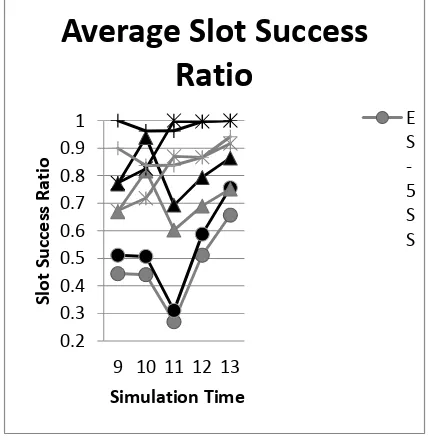
To further investigate the provisioning performance of the and the ES, the number of considered in the simulation model were varied from 4 5 , 10 ,15 } 20. The average traffic scheduled was analyzed and the results obtained are shown in figure 2 given below.From Figure 2 it could be observed that both the scheduling schemes and ES considered perform better when the number of increase. Also it was observed that the scheduling scheme proposed in this paper achieved a slot success rate of 13.86% higher than that of the ES hence providing for enhanced input to the ANN is the value
Figure 2: Average Slot Success Ratio with Varying
Number ofÕÕ
0 0.5 1
8 10 12 14 16
S
lo
t
S
u
cc
e
ss
R
at
io
Simulation Time
Slot Success Ratio
For Varied Service
Types
UG
S-E
S
0.2 0.3 0.4 0.5 0.6 0.7 0.8 0.9 1
9 10 11 12 13
S
lo
t
S
u
cc
e
ss
R
at
io
Simulation Time
Average Slot Success
Ratio
E
S
-5
S
[image:6.612.311.526.475.695.2]ISSN: 1992-8645 www.jatit.org E-ISSN: 1817-3195
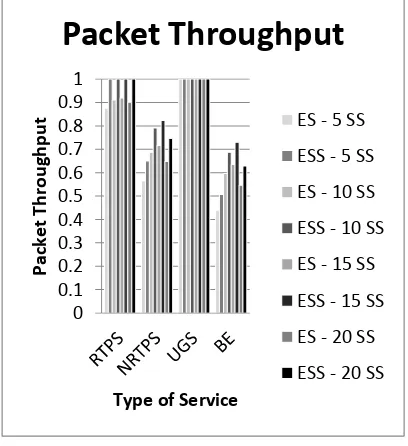
[image:7.612.86.290.364.587.2]351 System Throughput or Packet Throughput observed in the IEEE 802.16 networks is also considered by researchers to prove provisioning efficiency.The packet throughput observed for the heterogeneous traffic considered when the number of is varied is as shown in Figure 3.
From Figure 3 it could be observed that the aware scheduling scheme denoted as ES and the proposed scheduling scheme allocate bandwidth to the high priority traffic hence the system throughput achieved is100%. For traffic of kind the scheduling scheme achieves
100% system throughput where as the ES scheduling scheme achieves an average packet throughput of 90.05%. The average throughput observed for the and service kind of traffic using the scheduling scheme was observed to be 75.19% and 63.76%. The aware scheduling scheme (ES) achieved an average packet throughput of 65.38% and 55.44% for the servicing and kind of traffic.
Figure 3: Packet Throughput Observed for Varying Number of ÕÕ and for Varied Service Types
From the experimental observations presented in this section of the paper it can be concluded that the scheduling scheme proposed in this paper provides enhanced when compared to the aware packet scheduling scheme, for varied service types in the IEEE 802.16 networks. Better is provided owing to the fact that the scheduling scheme proposed achieves a further efficiency of
9% in the packet throughput and 13.86% in terms of the slot success ratio.
5.
CONCLUSIONThis paper introduces an evolutionary computation based uplink scheduling scheme named ESS with QoS gurantee. Efficient scheduling is achieved by introducing a service threshold time. Using the service threshold time, the weight assigned to a service is attuned. The adaptive weights ascertain the bandwidth that is allocated using adaptive modulation to the SS^' s creating a scheduling set with QoS gurantee. The scheduling set created is further optimized using evolutionary computation techniques. The ESS scheme not only provides for higher slot success rates but also facilitates higher system throughput for the UGS,rtPS,nrtPS and BE services supported in IEEE 802.16 systems, which is proved in this paper through the experimental evaluation presented. Furthermore the simulation results confirm that the ESS scheduling scheme accomplishes higher slot success ratio and packet throughput by 13% and 9% than the QoS aware packet scheduling scheme for IEEE 802.16 Networks. For the future work the efficiency of the ESS scheduling scheme with higher data rates to theSS and the packet delay analysis of the scheduling scheme is considered using Rayleigh fading channels.
REFRENCES:
[1] IEEE 802.16 WG, "IEEE tandard for Local and Metropolitan Area Networks Part 16: Air Interface for Fixed and Mobile Broadband Wireless Access Systems", Amendment 2, IEEE, Dec. 2005
[2] WiMAX Forum, "WiMAX Technology Forecast (2007-2012)",WebSite : http://www.wimaxforum.org/news/681 , Accessed September 6 2012.
[3] IEEE 802.16 WG, "IEEE Standard for Local and Metropolitan Area Networks Part 16: Air Interface for Fixed Broadband Wireless Access Systems", IEEE, June 2004.
[4] Lu S, Bharghavan V and Srikant R, "Fair scheduling in wireless packet networks", IEEE/ACM Trans. Netw., 1999, 7, pp. 473–489 [5] Kim, T., Lim, J.T.: "Quality of service
supporting downlink scheduling scheme in wordwide interoperability for microwave access systems", IET Commun., 2010, 4, (1), pp. 32– 38
[6] Kim, H., Han, Y.: ‘A proportional fair scheduling for multicarrier transmission
0 0.1 0.2 0.3 0.4 0.5 0.6 0.7 0.8 0.9 1
P
ac
k
e
t
T
h
ro
u
g
h
p
u
t
Type of Service
Packet Throughput
ES - 5 SS
ESS - 5 SS
ES - 10 SS
ESS - 10 SS
ES - 15 SS
ESS - 15 SS
ES - 20 SS
ISSN: 1992-8645 www.jatit.org E-ISSN: 1817-3195
352 systems’, IEEE Commun. Lett., 2005, 9, pp. 210–212
[7] Sayenko, A., Alanen, O., Hamalainen, T.: ‘Scheduling solution for the IEEE 802.16 base station’, Spec. Issue Comput. Netw., 2008, 52, (1), pp. 96–115
[8] Boedihardjo, A.P., Liang, Y.: ‘Hierarchical smoothed round robin scheduling in high-speed networks’, IET Commun., 2009, 3, (9), pp. 1557–1568
[9] Tassiulas, L., Sarkar, S.: ‘Maxmin fair scheduling in wireless networks’. Proc. IEEE Computer Communication Conf., New York, NY, 2002, vol. 2, pp. 763–772
[10] Friderikos, V., Papadaki, K., Wisely, D., Aghvami, H.: ‘Multi-rate power-controlled link scheduling for mesh broadband wireless access networks’, IET Commun., 2007, 1, (5), pp. 909–914
[11] Bhagwat, P., Bhattacharya, P., Krishna, A., Tripathi, S.K.: ‘Enhancing throughput over wireless LANs using channel state dependent packet scheduling’. Proc. IEEE Computer Communication Conf., San Francisco, CA, 1996, vol. 3, pp. 1133–1140
[12] Friderikos, V., Papadaki, K., Wisely, D., Aghvami, H.: ‘Multi-rate power-controlled link scheduling for mesh broadband wireless access networks’, IET Commun., 2007, 1, (5), pp. 909–914
[13] Vaidya, N.H., Bahl, P., Gupta, S.: ‘Distributed fair scheduling in a wireless LAN’, IEEE Trans. Mob. Comput., 2005, 4, pp. 616–629
[14] Jung, E., Vaidya, N.H.: ‘An energy efficient MAC protocol for wireless LANs’. Proc. IEEE Computer Communication Conf., New York, NY, 2002, vol. 3, pp. 1756–1764
[15] Fen Hou and Pin-Han Ho, "A Flexible Resource Allocation and Scheduling Framework for Non-real-time Polling Service in IEEE 802.16 Networks",IEEE
TRANSACTIONS ON WIRELESS
COMMUNICATIONS, VOL. 8, NO. 2, FEBRUARY 2009. pp 766 - 775
[16] A. L. Stolyar and K. Ramanan, “Largest Weighted Delay First Scheduling: Large Deviations and Optimality,” Annals of Applied Probability., vol. 11, pp. 1-48, 2001
[17] M. Andrews, K. Kumaran, K. Ramanan, A. Stolyar, P. Whiting, and R. Vijayakumar, “Providing quality of service over a shared wireless link,” IEEE Commun. Mag., vol. 39, pp. 150-154, Feb. 2001
[18] W. Park, S. Cho, and S. Bahk, “Scheduler Design for Multiple Traffic Classes in OFDMA Networks,” in Proc. IEEE Int. Conf. Communications., Istanbul, Turkey, 2006, vol. 2, pp. 790-795
[19] Jui-Chi Chen, "Dynamic Classified Buffer Control for QoS-Aware Packet Scheduling in IEEE 802.16/WiMAX Networks",IEEE COMMUNICATIONS LETTERS, VOL. 14, NO. 9, SEPTEMBER 2010. pp 815-817 [20] Chakchai So-In,Raj Jainand Abdel-Karim
Tamimi,"Scheduling in IEEE 802.16e Mobile WiMAX Networks: Key Issues and a Survey",IEEE JOURNAL ON SELECTED AREAS IN COMMUNICATIONS, VOL. 27, NO. 2, FEBRUARY 2009, pp 156-171
[21] M. B. Anandaraju and P. S. Puttaswamy,"Modified Interactive Evolutionary Computing for Speed Control of an Electric DC Motor"International Journal of Computer Applications (0975 – 8887),Volume 39– No.15, February 2012
[22] Sadasivan J and Dr Omana Mammen,"Modified Evolutionary Computing for Parameter Identification of Three Phase Induction Motors",International Journal of Applied Engineering Research,Volume 7, Number 9 (2012) pp. 955-963
[23] W.M. Spears, K.A. De Jong, T. Back, D.B. Fogel, and H. Garis. An overview of evolutionary computation. In Proceedings of European Conference on Machine Learning. 1993
[24] I. Rechenberg. Case studies in evolutionary experimentation and computation. Comput. Methods Appl. Mech. Engrg., 186:125–140, 2000.
[25] H.P. Schwefel. Numerical Optimization of Computer Models. John Wiley and Sons, New York, 2nd edition, 1995.