Full Length Research Article
SYNTHESIS , CHARACTERISATION AND ANTIBACTERIAL STUDIES OF ANIONIC CHELATE
COMPLEXES OF MANGANESE (II) WITH VARIOUS SCHIFF’S BASE LIGANDS
*Dr. Minati Sahu
Department of Chemistry, Dar-Es-Salaam University College of Education. Po. box 2329.
Dar-Es –Salaam, Tanzania
ARTICLE INFO ABSTRACT
In the present study, four anionic Mn(II) complexes of various Schiff’s bases such as Salicylaldehyde ethylenediamine (Sal2en), Salicylaldehyde Orthoaminophenol (Sal OAP),Salicylaldehyde Semicarbazone (Sal Sc) and salicylaldehyde o-phenylene diamine (Sal2phen) along with NH4SCN ligand were synthesised. The resulting complexes were suggested to have formulae (1)[NH4]2[Mn(Sal2en)(SCN)2], (2)[NH4]2[Mn(SalOAP)(SCN)2.H2O], (3)[NH4]2[Mn(Sal2phen)(SCN)2] and (4) [NH4]2[Mn(Sal.Sc) (SCN)2.H2O].The formulae of the complexes were based on the characterisation such as its molecular weight, conductivity measurements, melting point/stability, magnetic susceptibility, UV spectroscopy and Infrared spectral studies. Interesting results were obtained revealing six coordination and chirality of the central metal ion. The antibacterial activity was studied against two Strain Gram +ve bacteria (Staphalococcus auras, Enterococcus) and two Strain Gram -ve bacteria (E.coli, P.aeruginosa) to observe their inhibiting tendency. The results showed complexes were inactive against Staphalococcus auras except for complex (3) and all the complexes have moderate or no activity against the rest microorganisms.
Copyright © 2016, Dr. Minati Sahu.This is an open access article distributed under the Creative Commons Attribution License, which permits unrestricted use, distribution, and reproduction in any medium, provided the original work is properly cited.
INTRODUCTION
Schiff bases are considered as a very important class of organic compounds, which have wide applications in various fields, such as medicine, agriculture, industries etc. Transition metal complexes with 1,10 –phenanthroline and 2, 2 –
bipyridine are heavily used in petroleum refining (John et al,
1976). Transition metal complexes derived from a number of amino acids have been reported to have biological activity
(Zahid et al, 2007). The quest for clear understanding of the
nature of chemical bond and structure of coordination compounds has catalysed the investigative methodologies systematically. As a result of such endeavours the application of coordination chemistry has been extended to various fields such as identification and separation of chemical elements, preparation of reactor materials, extraction of rare elements and their enrichment, classification of some life processes etc. Transition metal complexes of Schiff’s bases are one of the most adaptable and thoroughly studied systems. A number of scientists had been interested in investigating the biological and medicinal properties of transition metal complexes.
*Corresponding author: Dr. Minati Sahu
Department of Chemistry, Dar-Es Salaam University College of
Thomas and Parmeswaran (2002) studied the antitumour
activities of Mn2+, Co2+, Ni2+ and Cu2+ chelates of
anthracene-9-carboxaldehyde thiosemicarbazone. Murthy and Dharmaraja (2002) reported the cytotoxic activity of phenylglyoxal bis(thiosemicarbazone) against Ehrlich ascites carcinona cells . Most of the literature survey reveals that transition metal complexes generally crystallize with octahedral, tetrahedral or
square planer geometry (Sleema et al, 2002). There has been
extensive research on manganese (II) complexes with water
ligands. The Mn-H2O complex can be a model species for all
high-spin manganese complexes, which include the majority of all Mn (II) complexes. This is because for Mn (II), the pairing energy is very high and there are only few known structures with ligands creating a sufficiently strong field to force the complex into the low-spin state. The low-spin
complexes, e.g. [Mn (CN)6]4- and [Mn(CNR)6]4- (R=CH3,
C2H5), have been studied much less frequently than the
high-spin complexes because their occurrence in biological and
other systems is very rare ( Bartosz Trzaskowski et al 2003).
In the present investigation, four different Schiff’s bases were synthesised by condensation of salicylaldehyde with ehtylenediamine/orthoamino phenol / semicarbazide and o-phenylene diamine. The resulting Schiff’s bases were made to coordinate with Mn(II) along with N/S donor ligand such as
ISSN: 2230-9926
International Journal of Development Research
Vol. 06, Issue, 04, pp. 7453-7458, April,2016
DEVELOPMENT RESEARCH
Article History:
Received 27th January, 2016
Received in revised form 16th February, 2016
Accepted 21st March, 2016
Published online 27th April, 2016
Key Words:
SCN-. The spectral and analytical characterization of the synthesised complexes were carried out to suggest the most plausible stereochemistry of the complexes around the Mn(II) ion. In this investigation, an antibacterial study has also been involved to follow the biological and medicinal potency of the coordination compounds synthesised.
MATERIALS AND METHODS
All chemicals used in this work were reagent grade (BDH/
Aldrich), including the metal salt MnCl2.4H2O,
salicylaldehyde, ethylenediamine, Orthoaminophenol,
semicarbazide, o-phenylenediamine, ammonium thiocyanate etc. The solvents like ethanol, nitrobenzene, DMSO were dried
over anhydrous calcium chloride. Schiff’s base (SB1) was
prepared by mixing ethylenediamine with ethanolic solution of salicylaldehyde in 1:2 molar ratio. It was then warmed, cooled and allowed to stand in a water bath for 1 hour. Then it was filtered, washed with ether and crystallised from ethanol and dried in a desiccator. Orthoamino phenol in ethanolic medium was added to ethanolic solution of salicylaldehyde in
1:1 molar ratio to prepare SB2. The resulting solution was
refluxed for half an hour, cooled and filtered when the Schiff’s base separated out. It was then washed with ether and recrystallised from ethanol followed by drying in a desiccator. O-phenylenediamine was mixed with ethanolic solution of
salicylaldehyde in 1:2 molar ratio to prepare SB3. The
resulting solution was refluxed for 1 hour, cooled and filtered. The resulting Schiff’s base was then washed several times with ether and recrystallised from alcohol and dried in a
desiccator. To prepare SB4, Semicarbazide hydrochloride was
mixed with ethanolic solution of salicylaldehyde in 1:2 molar ratio. The resulting solution was refluxed for 1 hour, cooled and filtered. The resulting Schiff’s base was then washed with ether and recrystallised from alcohol and dried in a desiccator.
Metal complexes were prepared as described in the literature
(Chen et al 1987: 1026). 0.01 mole ethanolic solution of each
of the Schiff’s bases synthesised was added separately to 0.01
mol (1.98 gm) aqueous solution of MnCl2.4H2O with constant
stirring and heating continuously on a magnetic stirrer
followed by dropwise addition of aq.NH3.. To the resulting
solution, excess NH4SCN solution was added dropwise. The
resulting mixture was refluxed for 5 hours on a heating mantle
at 650C. The solid complex started separating out in 2/3 days
which was then filtered, washed with ethanol , ether and dried in vacuum.
Instrumentation, physico-chemical measurements and analytical estimations
The IR spectra of the ligands and their mixed ligand complexes were measured using Bruker FT-IR
Spectro-Photometer in the range 400-4000 cm-1. The magnetic
susceptibilities of complexes were determined on Gouy balance model 7550 at 23°C. The diamagnetic corrections
were made by Pascal’s constant and Hg[Co(SCN)4] was used
as a calibrant. UV-Visible spectra were measured in DMSO using a Japson double beam UV-Visible spectrophotometer. The molecular weight determination of the complexes was carried out by Rast’s biphenyl method as described in the literature (Cowles, 1963). A HI 2314 conductivity meter was used for the conductivity measurements of the complexes in DMSO at room temperature. Melting point of the complexes was measured using a melting point apparatus.
Antibacterial activity
the antimicrobial activity of the prepared complexes were studied by the agar well diffusion method against two strain gram +ve bacteria (Staphalococcus auras, Enterococcus) and two strain gram –ve bacteria (E.oli, P.aeruginosa). The
bacteria were cultured for 24 h at 37 0C in an incubator. Stock
solutions of the compounds were prepared by dissolving (2 mg/ml) in DMSO solvent. The prepared agar medium was
autoclaved at 121 0C for 15 min and then poured onto a
pre-sterilized petridish. Petridishes containing nutrient Muller Hinton medium were seeded with 24 h culture of bacterial strains using sterile L-rod. A sterile cork borer was used to punch wells and 10 μg/ml of the prepared complexes were added from stock solution. The inoculated plates were then
incubated for 24 h at 37 0C. After incubation, the diameter of
the inhibition zone was measured and the results were
recorded in millimeters (mm). The antibacterial screening concentrations of the compounds were estimated from the
minimum inhibitory concentration (MIC), (Joseph et al. 2013).
RESULTS
The prepared complexes with four different Schiff’s bases and
NH4SCN were found to be quite stable and coloured. All the
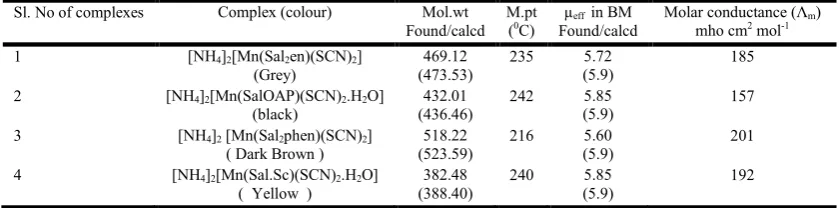
[image:2.595.88.508.629.733.2]synthesised complexes were insoluble in common organic solvents but were soluble in DMF and DMSO. The physical and analytical data of the complexes are presented in Table 1. The IR spectral data and uv data for the complexes are presented in Table 2.
Table 1. The physical and analytical data of the complexes
Sl. No of complexes Complex (colour) Mol.wt Found/calcd
M.pt (0C)
µeff in BM
Found/calcd
Molar conductance (Ʌm)
mho cm2 mol-1
1 [NH4]2[Mn(Sal2en)(SCN)2]
(Grey)
469.12 (473.53)
235 5.72 (5.9)
185
2 [NH4]2[Mn(SalOAP)(SCN)2.H2O]
(black)
432.01 (436.46)
242 5.85 (5.9)
157
3 [NH4]2 [Mn(Sal2phen)(SCN)2]
( Dark Brown )
518.22 (523.59)
216 5.60 (5.9)
201
4 [NH4]2[Mn(Sal.Sc)(SCN)2.H2O]
( Yellow )
382.48 (388.40)
240 5.85 (5.9)
192
Antimicrobial activity studies of the complexes are summarised in Table 3.
DISCUSSION
Magnetic susceptibility: Magnetic susceptibility measurements are generally diagnostic of the geometry of the coordination complexes about the metal ion. The values also support the electronic spectral measurements to suggest a plausible geometry and structure of the studied complexes. The room temperature magnetic moments of the complexes prepared during this investigation are listed in Table 1. The magnetic susceptibilities, all of which are independent of field strength, were corrected for the diamagnetic contribution of the ligands, the anions and the metal ions using Pascal’s constants. The effective magnetic moment of the synthesised
complex of manganese(II) is of the high-spin, d5 state
exhibiting magnetic moment in the range of 5.60- 5.85 B.M which is well within the range for a octahedral high spin
complex. (Natrajan et al 2002, Shoemaker et al 1989). In an
octahedral environment the ground term of Mn(II) is orbital singlet. Although there is no first-order orbital contribution to the susceptibility for this ion, there is second-order contribution due to the coupling between this state and some excited states arising from the same free ion states through the
spin-orbit coupling. (Bayri Ali et al 2007).
Conductivity measurement: All the complexes show a high
conductivity value which ranges in between 185-201 mho cm2
mol-1 indicating the complexes to be 2: 1 electrolytic in nature
(Table 1). All the complexes were found to have high melting
point above 2000C (Table 1). The molecular weight values
indicate the monomeric nature of all the complexes.
Infra-red spectra: The IR spectral data for the complexes are presented in Table 2. To study the co-ordinating donor sites of the Schiff’s bases to the metal ion, IR spectrum of the complexes were compared with the spectra of ligands.
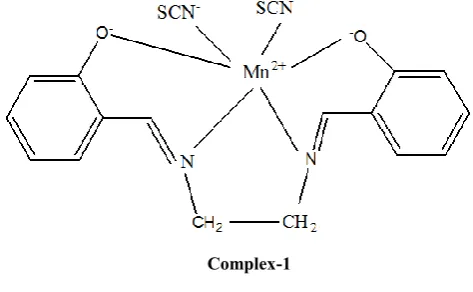
Complex-1
The Sciff’s base, Bis-Salicylaldehyde ethylene Diamine
(Sal2en) shows bands at 3025cm-1,1625cm-1,1575cm-1,1235cm
-1
,1060cm-1 due to ν (C-H)aromatic , ν C=N, ν (O-H)phenolic, ring
vibrations and ν and ν respectively (Nakamoto, 1997).
On complexation, the band at 3025cm-1 remains unaltered
showing the presence of ν (C-H) aromatic in the complexes. A
sharp band at 1594cm-1 - 1615cm-1 in the complex indicates
the shift due to azomethine ν C=N. The decrease in frequency
indicates a decrease in C=N bond order due to the coordination of the azomethine nitrogen to manganese. The
band at 1539cm-1 confirms the coordination of phenolic
oxygen to the metal atom. The ν C-N stretching frequency for
ethylene diamine is increased to 1085cm-1 on complexation
indicating the synthesis of Sciff’s base and involvement of
ethylenediamine as having the donor sites (Stuart, 2004 ) .The
coordination through oxygen and nitrogen is further supported
by the bands at 594cm-1 for νMn-O and bands at 462cm
-1
for ν
Mn-N respectively. (Aurel Pui et al 2007). Therefore, the IR
spectral studies suggests that the SB1, Bis-Salicylaldehyde
ethylene Diamine (Sal2en) coordinate as a dibasic tetradentate
ligand.
Complex-1
Complex-2
Salicylaldehyde Ortho Amino Phenol (Sal OAP) shows its characteristic spectra in the mid infra red region. A broad band
at 3135-2000 cm-1 corresponds to the hydroxyl protons of the
Schiff’s base ligand which signifies the existence of a strong hydrogen bonding between the O-H and N-H groups (Syamal
et al 1979),(Dudek et al 1961). However, this band disappeared in the spectra of complexes containing Sal OAP due to deprotonation and involvement of the oxygen atoms in the coordination sphere. The phenolic O-H stretching vibration
bands at 1272 cm-1 is shifted to 1292cm-1 in the complexes,
confirming the complexation via the phenolic oxygen atoms
[image:3.595.41.553.74.174.2](Abdullahi Owolabi Sobola et al 2013). Further, in the
Table 2. The IR and UV spectral data for the complexes
Sl No Complex νC=N Phenolic
OH
M-O M-N M-NCS νNH4+ δNCS + CS
(bend)
H2O Electronic
Spectra 1 [NH4]2[Mn
(Sal2en)(SCN)2]
1615 1539 594 462 2040 3020,3100(bp) 1435,1380 (sp)
1145.1045 ---- 20,000; 22700 28,300 2 [NH4]2 [ Mn
(SalOAP)(SCN)2.H2O]
1634 1530 581 450 2064 3138,3043 (bp) 1401 (sp)
1145,1030 3400 ( bp) 837,754 (R,W)
17,857; 22,790 28,674 3 [NH4]2 [ Mn (Sal2
Phen) (SCN)2]
1595 1530 564 460 2040 3149,3000(bp) 1430,1372 (sp)
1146,1025 --- 18,050; 23,750 29136
4
[NH4]2 [ Mn (Sal. Sc)
(SCN)2.H2O]
1644 1510 600 437 2089 3169,3013(bp) 1438 (sp)
1143,1036 3434 900.756 (R,W)
[image:3.595.308.545.460.606.2]16,835; 22,800 29,100
Table 3. Antimicrobial activity of complexes in (mm) in 10 ppm DMSO solvent
complexes S.aureus Enterococcus E.coli P.aeruginosa [NH4]2[Mn(Sal2en)(SCN)2] --- 4.8 5.1 4.6
[NH4]2[Mn(SalOAP)(SCN)2.H2O] --- 3.7 4.3 3.2
[NH4]2 [Mn(Sal2phen)(SCN)2] 5.2 8.2 7.6 9.1
complexes, ν(C-O) band is appearing at 1490cm-1 indicating
the coordination of phenolic oxygen atom to the metal ion.
(Besseler G.C and R.M Silverstein). A strong band at 1589cm
-1
is due to azomethine ν(C=N) linkage; in the free ligand. In
the complexes, the band is red shifted to 1634cm-1, indicating
the coordination through imine nitrogen.The coordination of
the SB2 was further supported by the bands at 581cm
-1
and
450cm-1 which is due to νMn-O and νMn-N respectively ( Reddy
et al 2008).Therefore, the IR spectral studies suggests that the
SB2, Sal OAP coordinate as a dibasic tridentate ligand.
Complex-2
Complex-3
Bis salicylaldehyde O-phenylenediamine (Sal2phen). A sharp
band at 3150cm-1 corresponds to the hydroxyl protons of the
ligand which indicates a strong intramolecular H-bonding between two OH groups. However the band disappeared in the complex indicating the deprotonation and involvement of the oxygen atoms in bond formation with Mn atom. The phenolic
stretching vibration at 1559cm-1 in the ligand is reduced to
1530cm-1 in the complex. A strong band at 1608cm-1 due to
azomethine ν(C=N) linkage; in the free ligands reduced to
1595 cm-1 in the complex, indicating the coordination through
two imine nitrogen . The reduction of frequency may be attributed to conjugation in the molecule involving aromatic
system. The coordination of the SB3 was further supported by
the bands at 564cm-1 and 460cm-1 which is due to νMn-O and
νMn-N respectively (Reddy et al 2008). Therefore, the IR
spectral studies suggests that the SB3, Sal2 phen coordinate as
a dibasic tetradentate ligand.
Complex-3
Complex-4
The Sciff’s base Salicylaldehyde semicarbazone(Sal Sc)
shows it’s characteristic spectra in the regions, 3274cm-1,
3141cm-1,, 1583cm-1,1682cm-1, 1487cm-1 assignable to νNH2,
νNH, ν (C=N-N=C) , ν C=N, νphenolic OH vibrations respectively. On
complexation, the strong bands still appearing around 3274cm
-1
and 3149 cm-1 confirms the non bonding of one of the NH2
groups to metal atom. There is appearance of a band at
1350cm-1 confirms enolisation in the ligand and a band at
1323cm-1 in the complex confirms the bonding through the
oxygen of deprotonated enolic OH. (Nakamoto, 1997). A
band at 1510cm-1 confirms the bonding of phenolic oxygen
with the Mn atom in the complex. Furthermore, a strong band
at 600cm-1 and 437cm-1 indicates the νMn-O and νMn-N
respectively in the complex. Strong bands are appearing at
1644cm-1 and 1572cm-1 in the complex showing the
presence of ν (C=N)+(O-C=N) and ν C=N-N=C structure in the
complexes (Kasuga et al 2001). Therefore the IR spectral
analysis indicates the coordination of the Schiff’s base,SB4,
Sal Sc to the metal atom is through one N and two enolic O atoms and hence dibasic tridentate in nature.
Complex-4
NH4SCN
For SCN-, it was observed that in general class “b” metals
form S-bonded complexes and class “a” metals form
N-bonded complexes in their common oxidation states (Mitche et
al 1960). Some exceptions are found where a certain metal
atom can both be N-coordinated and S- coordinated in one complex forming an end to end bridge between metal atoms of
same kind (Alam et al 2011).In the present investigation , the
IR spectra of NH4SCN appeared at a very strong band at
2048cm-1 in the free ligand, which are caused by ν CN and the
band at 741 cm-1 which was assigned as ν CS (Socrates. 1980),
(Kazuo N. 1997) . On complexation, two of the complexes, 2
and 4 (table2 ) were found to have bands shifted to higher
frequencies i.e 2064cm-1 and 2089cm-1 and two of the other
complexes 1 and 3 have bands shifted to lower frequencies at
2040 cm-1 indicating the involvement of nitrogen in
coordination. A group of bands appearing between 1025-1146
cm-1 due to δNCS + CS (bend) vibrations indicates that the
metal is bonded through N atom of isothiocyanato.
Furthermore, a band at 3000-3169cm-1 and at 1372-1435cm-1
in the ligand was found to be unaltered in the complexes
indicating the presence of NH4+ in the complex but not
coordinated to the metal atom.
In addition to all the above mentioned bands, complex 2 and
complex 4 was found to have strong peaks at 3400cm-1
-3434cm-1 and at 837-900cm-1(rocking) and 754-756 cm-1
(wagging) indicating the presence of coordinated H2O in the
complexes.
UV spectral analysis: The electronic absorption spectral measurements were used for assigning the stereochemistry of metal ions in the complex based on the positions and number
of d-d transition peaks. The UV spectra was recorded in DMSO solution. The UV spectral data is presented in Table 2. Manganese (II) is normally found in an octahedral
coordination environment (Naskar et al., 2005). The
electronic spectra of the synthesized complexes were very much similar to each other and showed spin allowed
transitions at 16835-20,000 cm-1, 22,700-23,750 cm-1 and at
28,300-29,836 cm-1 regions assignable to the transitions
6A1g4T1g, 6A1g4Eg and charge transfer band respectively.
(A.S.El-Tabi et al., 2011). The nature and positions of the
bands support hexa-coordinated geometry for the Mn complexes and hence concluded to be octahedral by nature. However, the exact geometry can be established from X-ray crystallographic studies of the compound.
Antibacterial study: The Schiff base containing manganese complexes were evaluated for antimicrobial activity in concentration of 10 ppm in DMSO solvent against two strain gram +ve bacteria (Staphalococcus auras, Enterococcus) and two strain gram –ve bacteria (E.oli, P.aeruginosa). The observations showed that the complexes are inactive against
staphalococcus auras except for [NH4]2 [Mn(Sal2phen)
(SCN)2] with low activity against the other microorganisms.
The complex [NH4]2 [Mn(Sal2phen)(SCN)2] is comparatively
more active than all the other complexes towards the microorganisms. The difference in the antibacterial activity of manganese (II) complexes studied in this work probably is associated to ligand type and its space distribution around the
complex core (Sengupta et al 1998). The variation in the
activity of different metal complexes against different microorganisms depends on the impermeability of the cell or differences in the ribosomes in the microbial cells. (Dharmaraj
et al 2001).
Acknowledgement
I wish to extend my thanks to the Chemistry Department, DUCE where the synthesis part of complexes was carried out along with some physic-analytical studies. Especially I am grateful to the Laboratory Technicians who extended their cooperation during the work. I also thank the technical staff of the Department of Chemistry and the microbiology department, University of Dar es Salaam (UDSM) Mwalimu J. K. Nyerere Campus for assisting me while carrying out the spectral analysis and the antimicrobial studies respectively.
REFERENCES
Abdullahi O. S and Gareth M. W (2013). Antimicrobial activity and Cu(II) complexes of Schiff bases derived from
ortho-aminophenol and salicylaldehyde derivatives,
Journal of Chemical and Pharmaceutical Research, 5(10):147-154
Alam, M. M., Begum R., Rahman S. M. M. and Islam S. M. S. 2011. Synthesis, Spectroscopic and Electrochemical Studies of Mononuclear Fe(II) and Ni(II) Complexes Containing a Macrocyclic Ligand Derived from Pyridine-2, 6-dicarboxaldehyde and 1, 2-Bis(2-aminoethoxy)
Ethane. J. Sci. Res.3(3): 609-617.
Aurel Pui, Clotilde Policar, Jean-Pierre Mahy. 2007. Electronic and steric effects in cobalt Schiff bases
activity of some cobalt(II) tetra-halogens-dimethyl salen, Inorg. Chim. Acta, oi:10.1016/j.ica.2006.10.040
Bartosz Trzaskowski, Les Andrzej and Adamowicz Ludwik
2003. Modelling of Octahedral Manganese II Complexes
with Inorganic Ligands: A Problem with Spin-States, Int. J
Mol. Sci., 4, 503-511
Bayri Ali , Karakaplan Mustafa, 2007. Theoretical approach to the magnetic properties of Mn(II), Cr(III), and Cu(II) complexes in the newly reported 12- and 15-membered macrocyclic Ligands Indian Academy of Sciences Vol. 69,
No. 2 — journal of August physics pp. 301–306,
Besseler, G.C and Silverstein, R.M, Spectrophotometric I dentification of Organic compounds, 3rd Edn, John Wiley and Sons Inc; New York.
Chen D., Martel A.E. 1987. Dioxygen affinities of synthetic
cobalt Schiff base complexes, Inorg. Chem. 26 1026.
Cowles E. J. and Pike M. T. 1963. Semimicro modification of
the Rast method for determining molecular weights, J.
Chem. Educ., 40 (8), p 422
Dharmaraj, N., Viswanathamurthy, P., Natarajan, K, 2001. Ruthenium (II) complexes containing bidentate Schiff
bases and their antifungal activity, Trans. Met. Chem. 26,
pp. 105–109
Dudek, G. O.; Holm, R. H. 1961. A Nuclear Magnetic Resonance Study of Keto-Enol Equilibria in Schiff Bases II, J. Am. Chem. Soc, 83, 3914.
El-Tabi. A.S., Shakdofa M.E. and El-Seidy A.M.A. (2011)
Synthesis and spectroscopic characterization of
Manganese(II), Iron(III) and cobalt(III) complexes of
macrocyclic ligand. Journal of the Korean chemical
society. 55(6) 919 -925.
John, J. Alexander and Magret, J.S, 1976. Chemistry with
Laboratory, Harcout Bruce, Johanovich, pp 63-64.
Joseph, J., Nagashri, K., Rani, G.A.B. 2013. Synthesis, characterization and antimicrobial activities of copper
complexes derived from 4-aminoantipyrine derivatives, J.
Saudi Chem. Soc. 17, pp. 285–294.
Kasuga, N.C, Sekino, K., Koumo, C., Shimada, N. and Normiya, I.M.. 2001. Synthesis, structural characterization and antimicrobial activities of 4 and 6 co-ordinate Ni(II)
complexes with three thiosemicarbazones and
semicarbazone ligands J. Inorg. Biochem. 84 (1-2), 55-56.
Mitchel, P. C. H. and Williams R. J. P. 1960. The infrared
spectra and general properties of inorganic thiocyanates, J.
Chem. Soc. 1912-1918.
Murthy N. and Dharamarajan T.S 2002. Synthesis, characterization and biological activity of copper(II)
complexes with phenylglyoxalbis(thiosemicarbazone)
Asian J. Chem., 14, 1325-1330 .
Nakamoto K. 1997. Infrared and Raman Spectra of Inorganic
and Coordination Compounds, part B, 5th ed., Wiley. Naskar S., Mishra D., Chattopadhyay S.K., Corbella M. and
Blake A. J. 2005. Versatility of 2,6-diacetylpyridine(dap)
hydrazones in stabilizing uncommon coordination
geometries of Mn(II): synthesis, spectroscopic, magnetic and structural characterization. Dalton Transactions, 2428 – 2435.
Reddy, V, Patil, N, Angadi, SD. 2008. Synthesis, Characterization and Antimicrobial Activity of Cu(II), Co(II) and Ni(II) complexes with O, N, and S Donor Ligands, E- J. Chem., 5(3), 577-583.
Sengupta, S.K., Pandey, O.P, Srivastava, B.K., Sharma, V.K. 1998. Synthesis, structural and biochemical aspects of titanocene and zirconocene chelates of acetylferrocenyl thiosemicarbazones Trans. Met. Chem. 23, pp. 349–353, Shoemaker, D. P. and Garland, C. W. 1989. Experiments in
physical Chemistry,5th ed. McGraw-Hill: New York, PP.
17-27.
Sleema, B. and Parameshwaran, G. 2002. X-Ray Diffraction studies of Iron (II), Nickel(II) and Copper (II) complexes
of o-Vanilin-L- Histidine, Asian J. Chem., 14, 961-966.
Socrates. G. 1980. Infrared characteristic group frequencies. New York, John Wiley and sons.
Stuart B. 2004. Infrared Spectroscopy: Fundamentals and
Applications John Wiley & Sons, Ltd ISBNs:
0-470-85427-8 (HB); 0-470-85428-6 (PB)
Syamal, A, Kale, K.S. 1979. New copper (II) complexes of Tridentate Dibasic ONO Donor Ligands derived from Salicylaldehyde or Substituted salicylaldehydes and
o-hydroxybenzylamime, Transition Met. Chem., 4, 298-300.
Thomas, J. and Parameswaran, G. 2002. Structural, Thermoanalytical and Antitumor studies of metal chelates
of Anthracene-9-carboxaldehyde thiosemicarbazone. Asian
J. Chem., 14, 1354- 1364.
Zahid, H. Chohan, Arif, M., Akhtar, A. and Claudiu, T. Supuran, 2006. Metal based Antibacterial and Antifungal agents: synthesis, characterization and invitro biological evaluation of Co(II), Cu(II), Ni(II) and Zn(II) with Amino Acid derived compounds. Bioinorg chem... And Appl. doi: 10.1155/BCA/2006/83131