IJPSR (2014), Vol. 5, Issue 4 (Research Article)
Received on 30 October, 2013; received in revised form, 11 December, 2013; accepted, 10 March, 2014; published 01 April, 2014
DEVELOPMENT AND VALIDATION OF RP-HPLC METHOD FOR THE ESTIMATION OF CHOLINE FENOFIBRATE IN BULK AND ITS PHARMACEUTICAL DOSAGE FORM
G. Saravanan*, Md. Yunoos, A. Naveen Kumar and P. Pradeep Kumar
Department of Pharmaceutical Analysis, Bapatla College of Pharmacy, Bapatla - 522101, Guntur (Dt), Andhra Pradesh, India
ABSTRACT: A simple and precise RP-HPLC method was developed and validated for the determination of Choline fenofibrate in pharmaceutical dosage forms. Chromatography was carried out on Agilent make Zorbax C18 column (4.6 mm x 15 cm), 5 µ particle size
using a mobile phase of phosphate buffer (pH 6.8) : acetonitrile (70 : 30 % v/v) at a flow rate of 0.8 ml/min. The analyte was monitored using UV detector at 298 nm. The retention time was found to be 3.207 min for Choline fenofibrate. The proposed method was found to be having linearity in the concentration range of 5-35 µg/ml with correlation coefficient 0.999. The mean recoveries obtained for Choline fenofibrate were in the range of 99.4-100.65 %. The developed method has been statistically validated according to ICH guidelines and found to be simple, precise and accurate with the prescribed values. Thus the proposed method was successfully applied for the estimation of Choline fenofibrate in routine quality control analysis in bulk and its formulations.
INTRODUCTION: Choline fenofibrate is a
choline salt of fenofibric acid. It is chemically (figure 1) known as [1-({2-[4-(4-Chlorobenzoyl) phenoxy]-2- methylpropanoyl} oxy)-2-hydroxy ethyl] trimethylazanium and its empirical formula
is C22H28ClNO5 and molecular weight is 421.91. It
is an Anti lipedimic agent and belong to a group of fibrates, used to lower low density lipoproteins (LDL) and increases high density lipoproteins (HDL).
It is an active ingredient in the cholesterol medication generally known as fenofibric acid, it is used for the management of high LDL and cholesterol help reduce triglycerides and increase
the quantity of HDL cholesterol in the blood 1.
QUICK RESPONSE CODE
DOI:
10.13040/IJPSR.0975-8232.5(4).1315-19
Article can be accessed online on: www.ijpsr.com
DOI link: http://dx.doi.org/10.13040/IJPSR.0975-8232.5(4).1000-04
This medication is also used to reduce the level of fatty acids in the blood. The fenofibric acid contains a carboxylic moiety instead of an ester moiety which is an important role in formation of rare acid to ketone hydrogen bond type packing interaction. It is sold under brand names Trilipix and Fibricor.
Cl
O
O
H3C CH3
O O
N H3C
CH3
CH3
CH2
H2C OH .
FIG. 1: STRUCTURE OF CHOLINE FENOFIBRATE
Literature survey reveals that the fenofibrate in both single and simultaneous with other drugs can
be estimated by HPLC in biological fluids 2-3,
RP-HPLC in pharmaceutical dosage forms 4-8, UPLC 9
and spectrophotometric method 10 but no RP-HPLC
method for the estimation of Choline fenofibrate in pharmaceutical dosage forms have not been reported so far.
Keywords:
Choline fenofibrate, RP-HPLC, Capsules, Method validation
Correspondence to Author:
G. Saravanan
Department of Pharmaceutical Analysis, Bapatla College of Pharmacy, Bapatla - 522101, Guntur (Dt), Andhra Pradesh, India
The objective of this study is to develop a simple, fast, economical, selective, accurate, precise and
sensitive RP-HPLC-UV method for the
determination of Choline fenofibrate in bulk and its pharmaceutical dosage forms suitable for routine quality control analysis.
MATERIALS AND METHODS:
Chemicals and solutions: HPLC grade methanol and acetonitrile (MERCK) were used for the analysis, potassium dihydrogen ortho phosphate (AR grade SD Fine-chem. Ltd, Mumbai) were used. All solutions were filtered through 0.45 µm nylon membrane filter using vacuum pump.
Instrumentation: Quantitative HPLC was
performed on Agilent technologies1200 series, PDA detector module equipped with auto injector with Ezchrome elite software. A reverse phase
Agilent Zorbax Eclipse XDB C18 (150 x 4.6mm,
particle size 5µm) analytical column was used. Weighing was done on Schimadzu balance (Model AX 200).
Chromatographic conditions: Preliminary studies
were conducted and trails are made for the method
development. Separation and analysis was carried
out on Agilent Zorbax C18 column (4.6 x 15 cm), 5
µ particle size. The optimized mobile phase consisting of methanol and phosphate buffer (pH adjusted to 6.8 with triethylamine) in the ratio of 70:30 % v/v, filtered through 0.45 µm nylon membrane filter using vacuum pump. Flow rate was maintained at 0.8 ml/min and run time for 10 min, prior to sample injection, column was saturated with mobile phase for 40 min and injection volume was 10 µl injected by auto sampler. The detection response was measured at 298 nm and maintained at ambient temperature.
Preparation of standard stock solution:
Accurately weighed and transferred 10 mg of Choline fenofibrate working standard into a 100 ml clean dry volumetric flask, added 70 ml methanol to dissolve completely and made the volume up to the mark with the methanol to obtain concentration of 100 µg/ml.
Preparation of sample stock solution: 20 capsules of choline fenofibrate (Average weight =
weighed and powdered using a motor and pestle. 20.05 mg of powder was taken which is equivalent to 10 mg of Choline fenofibrate was accurately weighed & transferred into a 100 ml volumetric flask. To this 70 ml methanol was added and sonicated for 15 min and then made up the volume with methanol to obtain a final concentration of 100 µg/ml.
Method validation:
1.
System suitability: Standard solution was
injected six times into system and
chromatograms were recorded, % RSD (relative standard deviation) of retention time & peak area, theoretical plates and tailing factor were calculated.
2. Accuracy: Accuracy was determined in terms of % recovery. Sample solutions were prepared at three different concentration levels 50 %, 100 % and 150 %. Predetermined amount of standard was added to these solutions by spiking standard drug solution to the sample. % recovery was calculated by assaying these solutions.
System precision and method precision: The system and method precision of the proposed method is ascertained by injecting 6 replicates of test and standard sample, % RSD were calculated.
1. Specificity: Standard solution, sample solution, blank solution and placebo solution were injected simultaneously into the system and chromatograms were recorded.
2. Linearity: From the above standard stock solution, aliquots of 5 µg/ml, 10 µg/ml, 15 µg/ml, 20 µg/ml, 25 µg/ml, 30 µg/ml and 35
µg/ml were prepared and injected
simultaneously into the system and
chromatograms were recorded. Graph was
plotted between concentration Vs peak area, R2
was calculated.
to analyst, column to column and provides an indication of its reliability.
RESULTS AND DISCUSSION: Choline
fenofibrate is not official in any pharmacopoeia and no RP-HPLC methods were reported for the estimation of this drug in pharmaceutical dosage forms. The availability of commercial formulations containing this drug and RP-HPLC methods are limited. Hence, we planned to develop a validated RP-HPLC method for the estimation of choline fenofibrate in pharmaceutical dosage form.
From this study, it was found that a simple, precise, accurate, sensitive and efficient RP-HPLC method has been developed and validated for the estimation of choline fenofibrate in pharmaceutical dosage form. Separation was done by using mobile phase composed of phosphate buffer (pH 6.8) and methanol in the ratio (70: 30 % v/v).
Chromatographic separation were carried out on
Agilent Zorbax C18 column (4.6 mm x 15 cm) 5 µ
particle size at a flow rate 0.8 ml/min using UV detection at 298 nm. The retention time was found to be 3.2 min.
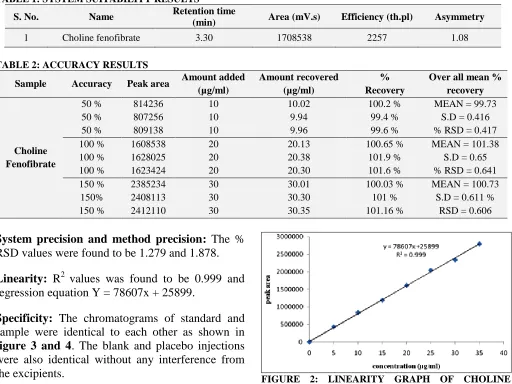
Linearity was evaluated in the concentration range of 5-35 µg/ml. The calibration curve was described by the equation Y = 78607x + 25899 with
correlation coefficient 0.999 as shown in figure 2.
System suitability parameters as shown in table 1.
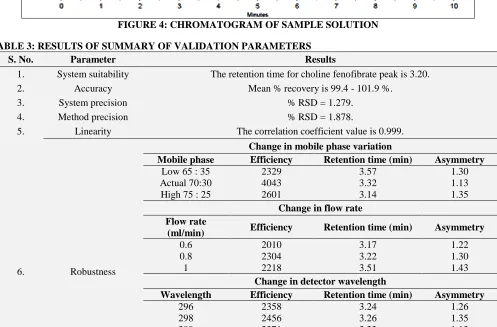
The % RSD in precision, accuracy and robustness studies were found to be less than 2.0 %, indicating
that the method is precise, accurate and robust.
Accuracy data as shown in table 2. The assay results and validation summary obtained from the
marketed formulations are given in table 3.
TABLE 1: SYSTEM SUITABILITY RESULTS
S. No. Name Retention time
(min) Area (mV.s) Efficiency (th.pl) Asymmetry
1 Choline fenofibrate 3.30 1708538 2257 1.08
TABLE 2: ACCURACY RESULTS
Sample Accuracy Peak area Amount added (µg/ml)
Amount recovered (µg/ml)
% Recovery
Over all mean % recovery
Choline Fenofibrate
50 % 814236 10 10.02 100.2 % MEAN = 99.73
S.D = 0.416 % RSD = 0.417
50 % 807256 10 9.94 99.4 %
50 % 809138 10 9.96 99.6 %
100 % 1608538 20 20.13 100.65 % MEAN = 101.38
S.D = 0.65 % RSD = 0.641
100 % 1628025 20 20.38 101.9 %
100 % 1623424 20 20.30 101.6 %
150 % 2385234 30 30.01 100.03 % MEAN = 100.73
S.D = 0.611 % RSD = 0.606
150% 2408113 30 30.30 101 %
150 % 2412110 30 30.35 101.16 %
System precision and method precision: The % RSD values were found to be 1.279 and 1.878.
Linearity: R2 values was found to be 0.999 and regression equation Y = 78607x + 25899.
Specificity: The chromatograms of standard and sample were identical to each other as shown in
figure 3 and 4. The blank and placebo injections were also identical without any interference from
the excipients. FIGURE 2: LINEARITY GRAPH OF CHOLINE
[image:3.612.53.565.330.714.2]FIGURE 3: CHROMATOGRAM OF STANDARD SOLUTION
FIGURE 4: CHROMATOGRAM OF SAMPLE SOLUTION
TABLE 3: RESULTS OF SUMMARY OF VALIDATION PARAMETERS
S. No. Parameter Results
1. System suitability The retention time for choline fenofibrate peak is 3.20. 2. Accuracy Mean % recovery is 99.4 - 101.9 %.
3. System precision % RSD = 1.279.
4. Method precision % RSD = 1.878.
5. Linearity The correlation coefficient value is 0.999.
6. Robustness
Change in mobile phase variation
Mobile phase Efficiency Retention time (min) Asymmetry
Low 65 : 35 2329 3.57 1.30
Actual 70:30 4043 3.32 1.13
High 75 : 25 2601 3.14 1.35
Change in flow rate Flow rate
(ml/min) Efficiency Retention time (min) Asymmetry
0.6 2010 3.17 1.22
0.8 2304 3.22 1.30
1 2218 3.51 1.43
Change in detector wavelength
Wavelength Efficiency Retention time (min) Asymmetry
296 2358 3.24 1.26
298 2456 3.26 1.35
300 2371 3.22 1.13
CONCLUSION: From this study, it is concluded that the proposed RP-HPLC method was found to be simple, accurate, precise, rapid and useful for routine analysis of choline fenofibrate in bulk & its pharmaceutical dosage form. The statistical parameters and recovery studies were carried out and reported. The obtained results were satisfactory
ACKNOWLEDGEMENT: The author is grateful
REFERENCES:
1. Mark L and Csaszar A: Antilipemic agents in combined therapy. Orv Hetil 2002; 143:1973-1978.
2. Patel H, Rathod R and Dash RP: Simultaneous quantification of rosuvastatin and fenofibric acid by HPLC-UV in rat plasma and its application to pharmacokinetic study. Journal of Liquid Chromatography and Related Technologies 2013; 5:87-92.
3. Zaman MT, Khan SA, Arora A and Ahmad O: Method development and validation of fenofibrate by HPLC using human plasma. Electronic Journal of Biomedicine 2009; 3:41-54.
4. Patel, Archita, Macwana, Parmar, Vishal Patel and Samir: Simultaneous determination of atorvastatin calcium, Ezetimibe, and Fenofibrate in a tablet formulation by HPLC. Journal of AOAC International Ingenta Connect 2012; 95(2):419-423.
5. Jain N, Raghuwanshi R and Deeti Jain: Development and validation of RP-HPLC method for simultaneous estimation of Atorvastatin calcium and Fenofibrate in tablet dosage forms. Indian Journal of Pharmaceutical Sciences 2008; 70(2):263-265.
6. Lacroix PM, Brain A Dawson and Roger: HPLC methods for assay and purity and an NMR method for purity. Journal of Pharmaceutical and Biomedical Analysis 2009; 18(3):42-47.
7. Bhamare PC, Bari SB, Natarajan S, Patil AA and Shirode PT: Development and validation of a precise stability indicating HPLC method for determinations of Metformin hydrochloride and Fenofibrate, in pure form and in
pharmaceutical tablets. International Journal of Pharma Tech Research 2011; 3:505-515.
8. Anand Kumar Karunakaran, Vetsa Subhash, Ramu Chinthala and Jayamaryapan Muthuvijayan: Simultaneous estimation of Rosuvastatin calcium and Fenofibrate in bulk and tablet dosage form by UV spectrophotometry and RP-HPLC. Stamford Journal of Pharmaceutical Sciences 2011; 4(1):58-64.
9. Kadav and Vora DN: Stability indicating UPLC method was developed and validated for the simultaneous determination of Atorvastatin, Fenofibrate and their impurities in tablets. Journal of Pharmaceutical and Biomedical Analysis 2008; 48(I, 10):120-126.
10. Alaa Gindy, Samy Emara and Mostafa: Spectrophotometric and liquid chromatographic determination of Fenofibrate and Vinpocetine and their hydrolysis products. Elsevier Journal 2005; 60(5):425-438. 11. Atul A. Shirkhedkar and Sanjay J. Surana: Simultaneous densitometric TLC analysis of Atorvastatin calcium and Fenofibrate in bulk drug and pharmaceutical formulations. 2009; 22(5):108-114.
12. Sethi PD: High performance liquid chromatography. CBS Publishers, First Edition 2001.
13. Chatwal GR and Anand SK: Instrumental methods of chemical analysis. Himalaya Publishing House, New Delhi, Fifth Edition 2002.
14. Beckett AH and Stenlake JB: Practical pharmaceutical chemistry. CBS Publishers and Distributors, New Delhi, Fourth Edition 1997.
15. Snyder LR, Kirkland JJ and Glajch JL: Practical HPLC method development. Willey International Publication, Second Edition 1997.
All © 2013 are reserved by International Journal of Pharmaceutical Sciences and Research. This Journal licensed under a Creative Commons Attribution-NonCommercial-ShareAlike 3.0 Unported License.
This article can be downloaded to ANDROID OS based mobile. Scan QR Code using Code/Bar Scanner from your mobile. (Scanners are available on Google Playstore)
How to cite this article: