162
STABILIZATION OF HUMAN HEART
USING PID CONTROLLER
M.AABID1, A.ELAKKARY2 N.SEFIANI3
1
Prof, Department of Electrical Engineering and Computer Science, EST Sale Morocco 1
Prof, Department of Electrical Engineering and Computer Science ,EST Sale Morocco 1,2,3
Mohammed V University of Rabat, 1
Mohemmadia Engineering School Rabat Morocco 1,2,3
LASTIMI Laboratory: "Systems Analysis, Information Processing and Integrated Management" 1
[email protected], [email protected], [email protected]
ABSTRACT
In the Aim of making an improvement on patient’s quality of life, especially the development of an optimized technique for Hydro-electromechanical (HEM) stimulation and regulation of the Human Heart, This paper simulates the control and the command of the human heart based on three main functions: hydraulic, electrical and mechanical parameters. The based MATLAB mathematical model will primary help to understand the proper functioning of heart attack. In this way we disturb a cardiovascular system with a noise (like Arousal, Anxiety ,disease) coming from human brains and we try to stabilised the whole system by applying a command from PID controller. This research especially focuses on dealing with health care problems to improve quality patients life with heart medical problems. By analysis study of results of the simulation of the whole system by using MATLAB it is found that the overall response of the disturbed system regulated by the adaptive controller is quite like the normal Heart signal.
Keywords : Proportional Integral Derivative (PID (), Human Heart, Control and command, Pacemaker, Hydro Electromechanical System.
1. INTRODUCTION
Cardiovascular disease is nowadays a major public health problem worldwide. The World Health Organization - WHO estimates that one third of all deaths worldwide are caused by cardiovascular disease.
Two diseases of the heart and vessels represent a risk to public health associated with high mortality and hospitalizations, but also the direct and indirect economic costs they generate.
In Morocco, hypertension, major risk factor for cardiovascular disease, is a major reason for consultation in the health and medical office canters. The national survey showed that 33.6% of Moroccans aged 20 years and older have high blood pressure .This prevalence increases with age and is 54% for over 40 years. The survey reveals that 55% of these cases of arterial hypertension are grade I, ie they require in most cases that lifestyle changes: a little salty diet and low in fat.
Physical models are able to simulate real physiological data to the appropriate experimental base set up, but the objective of this article is to solve the problem of a new automatically control and stabilization of the human heart as a Hydro Electromechanical System (HEMS) .
The study is done firstly started by studying the situation of cardiovascular disease in Morocco and worldwide after that we based our work on the mathematical model with hydro-electro-mechanical parameters described in paper [5], finely we control and stabilized the system by applying the PID command.
2.ANALYZE OF CARDIOVASCULAR SYSTEM LIKE HYDRO-ELECTROMECHANICALLYSYSTEM
Many electrical analog models for the circulatory system have appeared in the literature, but few of them are based on the use of an actual physical model. In order to realize the beat-by-beat dynamic control of the heart, an explanatory model of behavior of heart like a hydro-electromechanical system is used on (Fig 1). It explain the general function of cardiovascular system, the PIN(t) is the input of the system (pressure input), CBL Right-atrium systemic capacitance, CCL Left-atrium
systemic capacitance, CDL Right-ventricle systemic
capacitance, CEL Left-ventricle systemic
capacitance, LF Ventricle and atrium interaction inductance, LE Left-ventricle inductance, LD
Right-ventricle inductance, LB Right-atrium inductance,
163 a first pump and it’s declared on the circuit like a capacitor, the same things go for the left atrium.
Fig 1 : The Hydro-Electromecanical
behaviour of the System
For the right ventricle it received the pressure coming from the atrium like an input and the same goes for the left one.
A. Analyze of cardiovascular System without noise
[image:2.612.105.266.151.409.2]Various electric models of the human heart, partial or complete, with linear or non-linear models were developed [2][3][5]. in the literature, there are some applications of mathematics and physical analogue models total artificial heart (TAH), a baro-receptor model, a state-space model, an electromechanical biventricular model of the heart, and a mathematical model for the artificial generation of signals electrocardiogram (ECG)[4].
Fig 2: Normal Heart Beat from ECG
The based model [5] constitutes a significant extension of a mathematical model described in several papers, its explain The electrical and hydraulic model described in [11]. The main improvements are as follows.
1) The heart is described as a hydroelectro mechanical pump. To this end, the activity of the ventricles is simulated by an elastic variable model. 2) Since arterial pressure is pulsatile in nature , a more accurate description of the systemic and pulmonary input impedances is required, valuable also in the mid frequency range.
For this reason, the new based model discriminates between large arterial vessels and peripheral arterioles, and includes the inertial effects of blood.
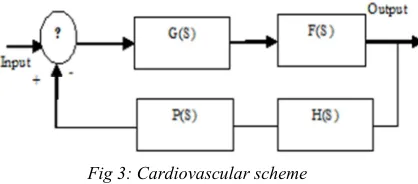
So our based model after they use the Laplace transform to the whole electrical circuit they obtained the transfer function below for the heart:
.
That means after numerical treatment they have the design of our based basic plan System of
cardiovascular system (fig3) :
Fig 3: Cardiovascular scheme
[image:2.612.317.526.574.666.2]164 For The Pacemaker:
.
For The Circulatory System:
.
For the sensor:
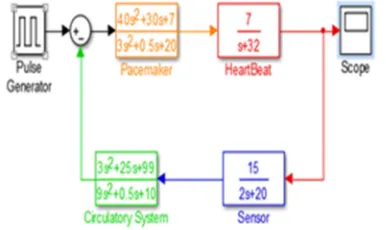
Based on the mathematical formulation above, using MATLAB/Simulink simulation. The system consists of four main components with their Mathematical models defined separately, the main elements are pacemaker (is the sinus node, one of the major elements in the cardiac conduction system, the system that controls the heart rate. This stunningly designed system generates electrical impulses and conducts them throughout the muscle of the heart, stimulating the heart to contract and pump blood), the heart, the sensor and the circulatory system and which are represented by the loop below.
Fig 4: Simulation Of The Heartbeat On Closed Loop In The Normal Condition.
[image:3.612.97.290.472.587.2]Result:
Fig 5: Signal Of Cardiovascular System At Normal Case
The rhythmic action of heart is mainly due to the regularly occurring action potentials originating from the natural pacemaker located in the senatorial node. Each impulse will be propagated to the Atria ventricular node through the myocardium. ECG signal (Fig2) are characterized as a recurrent sequence of three waves namely: the P wave, QRS complex(combination of Q, R and S waves) and T wave as shown in Fig2. Of the three waves,
the QRS complex has more energy with higher amplitude than P and T waves over the RR interval (interval between two adjacent R waves).
To precisely monitor the heart-beat rate of the patients, QRS complex (or R wave) must be detected with high accuracy. The normal heart rate depends on the continuous and periodic performance of the natural pacemaker and integrity of neurons in conducting pathways like we have on the results of this simulation Fig 5 :
- P-wave : 0.07 sec - QT-interval : 0.375 sec
- PR-interval : 0.20
- QRS-complex : 0.139 sec
165 Table 1
Flow Through Parameters Of Generator
B. Analyze of cardiovascular System with noise
1. Fictitious NOISE.
[image:4.612.75.541.60.369.2]In this part we apply a noise to disturb the system and we will simulate it in order to see w the result of a system disturbed:
Fig 6: Simulation of the Human Heartbeat on closed loop With Noise.
The parameters of the noise applied are:
Table 2
Flow Through Parameters Of The Disturbance Generator
[image:4.612.78.290.329.451.2]Result :
Fig 7 signal Simulation of the Human Heartbeat on closed loop With Noise.
Based on the wave obtained by using the MATLAB simulation facility, many case studies were conducted like explained in the next part below.
2. Reel Disturbance with Disease /Arousal like à NOISE
The brain is one of the most important organ that control emotion, thought, movement and all functions in the human body. The brain cells are known as neurons and scientists estimated that a normal adult human brain consists of one hundred billion neurons and each neuron is connected to another two hundred fifty thousand other neuron. Thus, like a Central Processing Unit (CPU) to a computer system, the brain employ parallel distributed processing where processing occurs simultaneously across billions of neurons distributed throughout the brain [12][13].
Its very common that the brainwaves has a huge effect on the heart rate and the cardiovascular system, its play a role of disturbance if its overdosed [10] Brainwaves are normally categorized into four groups known as Delta, Theta, Alpha
and Beta frequency bands [13]. Beta is the highest frequency band with the lowest amplitude while Delta is the lowest frequency band having the highest amplitude.
Type d’impulsion Temp-Base
Amplitude 1 mV
Period 2 sec
Pulse Width(% of
period) 1 sec
Phase delay 0-1 unit
Value
Noise Paower 1
Sample Time 0.09
166 Table Iii3 Values Of The Brain Frequency
So in this study we use the frequency of the brain in the cases of disease like a disturbance of the electrical activation of the heart and cardiovascular system and we try to control the heart rate in order to the return to the normal state of the heart function[10].
In the part below we disturb a human heart (Fig 9) with BETA brainwaves out and the heart is going to oscillate.
Fig 8 the Model of Comparison between Simulation of the Human Heartbeat With Disease /arousal like à noise.
[image:5.612.97.274.126.187.2]Result:
[image:5.612.316.516.282.400.2]Fig 9: Simulation of the Human Heartbeat With Disease /arousal giving a heart attack and heart going to stop.
Table 4 Parameters Of The Disturbance Brain Generator Frequencies Like A Reel Disturbances
We observe that the System oscillate that’s wath can result à heat attack and the value of QRS 0.012 Sec and the amplitude is between 30 and -30 so we conclude that the is going to stop
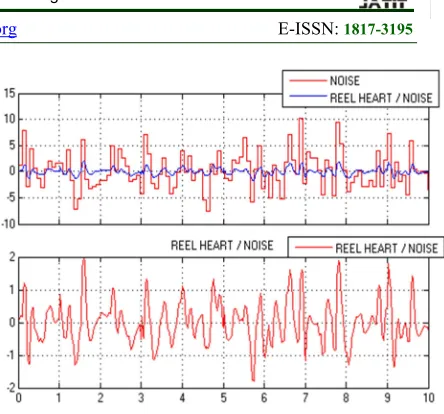
Fig 10 Noise and the Human Heartbeat attacked Disease /arousal like à NOISE.
3. CONTROLOFTHECARDIOVASCULAR SYSTEMUSINGPIDCONTROLLER
Regulation in the field of industrial processes regarding the implementation of all theoretical, material and techniques to maintain each essential physical quantity equal to a desired value, called the setpoint, per share on a controller output, despite the influence of disturbance variables of the system. The term regulation can have other meanings. In a general sense, the control is the set of techniques for maintaining consistency of a function. The purpose of the control is to maintain the stable state, according to what is provided in the operation of a machine or the state of a system.
The relay feedback tuning strategy is not suitable for time varying property. To overcome this we based on the refrence [15] uses a relay feedback auto tuning (part A.1) strategy based on Ziegler Nichols method which can adjust control parameters online.
Value
Wave Form random
Amplitude 20
Brain Frequency (
Anxiety ,disease) 100 Hz
CATEGORIE OF BRAIN WAVE TAKED LIKE DISTURBANCE
BETA (14-100 Hz) Arousal, Anxiety ,disease, fight
ALPHA (8-13.9 Hz) Pre-sleep, pre-waking, drowsiness
THETA (4-7.9 Hz) Deep mediation, Hypnagogic
DELTA (1-3.9 Hz) Loss of body awareness,
[image:5.612.85.295.322.438.2] [image:5.612.93.285.487.620.2]167 Fig 11 : Design of PID controller
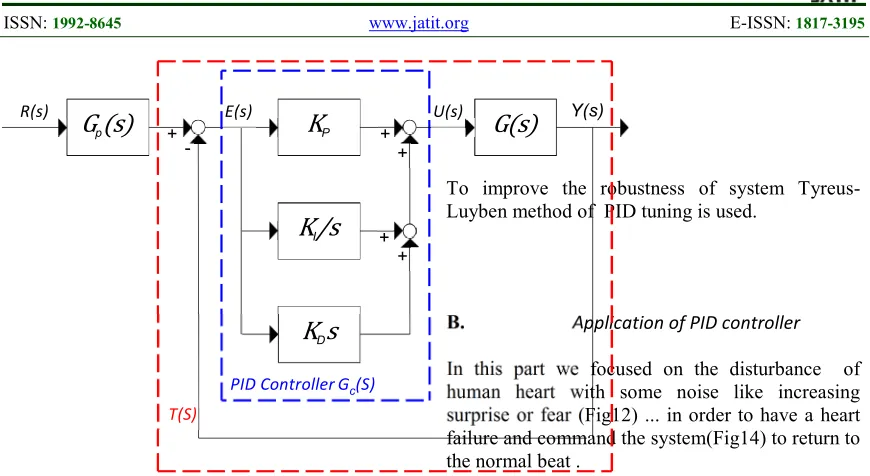
The proportional integrator and differentiator are applied with the next following result (Table V).
A. The Ziegler–Nichols tuning method This is a heuristic method of tuning a PID controller. It was developed by John G. Ziegler and Nathaniel B. Nichols. The process of tuning the parameters is as follows:
a) Put the values of Ti=∞ and Td=0
b) Now increase the value of from 0 to critical value
c) The values of at which output exhibits sustained oscillations is critical gain Kcr
d) Obtain the values of period corresponding to critical gain
[image:6.612.89.524.63.301.2]Put the values of Kcr and Pcr in the formula shown in table1 to obtain the values of the parameters Kp, Ti and Td.
Table 5: Ziegler –Nichols Rule Base On Critical Gain And Critical Period Of A Plant
To improve the robustness of system Tyreus- Luyben method of PID tuning is used.
B. Application of PID controller In this part we focused on the disturbance of human heart with some noise like increasing surprise or fear (Fig12) ... in order to have a heart failure and command the system(Fig14) to return to the normal beat .
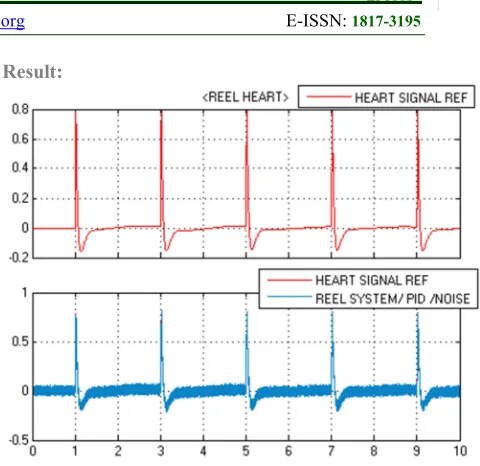
The part below show the cardiovascular system controlled by the PID and the comparison with the real behaviour of the heart like reference. The model of the “HEART SIGNAL REF” is described on the (Fig 13).
Fig 12 the Model of Simulation of the Human Heartbeat With Disease /arousal like à NOISE.
HEART SIGNAL REF : Gives the signal QRS of the heart like in the (Fig5), it’s the reference in our study and the PID controller try to catch this signal. REEL SYSTEM PID/NOISE : is the insertion of disturbance (TABLE IV) from brainwaves (anxiety or disease) like a noise in order to disturb the mean function of the heart like described on (Fig13) Because resting on the clinical experiment [7] tested on the human body we concluded that the brain is the actor of disturbance of the human cardiovascular system
Type of
Controller Kc Ti Td
P 0.5 ∞ 0
PI 0.45 1 1.2 Pcr 0
PID 0.6 0.5 0.125
K
PR(s) Y(s)
K
I/s
G
ps
G s
- +
U(s)
+
+ + +
E(s)
K
Ds
PID Controller Gc(S)
[image:6.612.315.521.378.469.2]168 Fig 13 the Model inside of “REEL SYSTEM
PID/NOISE” .
[image:7.612.110.268.377.413.2]The result of this part is the comparison between the signal of human heart in rest state (normal state without any kind of disturbance like Arousal, Anxiety ,disease, fight, anger, Deep mediation, Hypnagogic) the result is :
Table 6
Flow Through Parameters Of Pid
Parameters P I D Filter
coefficient
Value 40 0.1 0 143.33
The result of simulation of the comparison between
controlled disturbed heart (REEL
SYSTEM/PID/NOISE) and the reel heart (REEL SIGNAL REF) is shown in (Fig15)
PD command case : in this case we observe that the system become instable. So comparing to the normal Ref System of normal beat heart we find that :
Disturbed Heart (Fig10): - The PQ part is not existed
- The QRS is very high and we know that this action is for the ventricular part so with this rate that QR=50 and RS = -50 we can have a heart failure.
On the other hand if we increase the D parameter we have an oscillation of the system.
Disturbed Heart (Fig10):
- PR-interval : 0.23
- QRS-complex : 0.132 sec
Result:
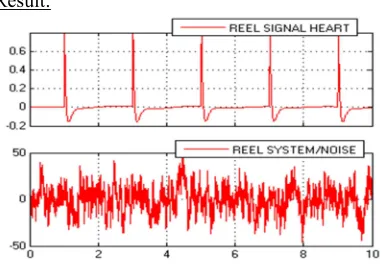
Fig 14 The Simulation of the heart without disturbance and the once with disturbance controlled by PID Model
inside of “REEL SYSTEM PID/NOISE” .
If we zoom on midle windows shown in (Fig14) we have :
First zoom :
[image:7.612.313.520.385.682.2]169 Fig 15 Zoom of comparison between the heart witout disturbance (SIGNAL REF) and the once with it and
controlled by PID Model inside of “REEL SYSTEM PID/NOISE” .
4. DISCUSSIONANDCONCLUSIONS
This work based on automation and control of disturbing mathematical modelling of human heart as a hydroelectromechanical system, the response presents some of the important features of the human cardiovascular system when its disturbed by a Arousal, Anxiety ,disease or fight and the way to cure the disturbances . The approach employed is to determine the appropriate physical analogy, write the system equations, and formulate the computer simulation. This allowed us consider on the methods of transforming physiological data into
useful model parameters, and to establish the analogies between electrical, mechanical and hydraulic systems also to built an entire regulation and enslavement of the human cardiovascular system based on brainwaves like a disturbances. So In order to improve the HEMS of human heart models found in prior studies, we have introduced a PID model to adapt the heart rate if it is disturbed and to command the cardiovascular system. In a short term regulation of the artificial heart, this model plays a crucial role in blood pressure control. Our heart model can be applied not only to steady state studies but also to dynamic processes of the cardiovascular system. Several further aspects, including the effects of the heart failures, and the disturbance of the cardiovascular system or drugs disturbance can be similarly studied using this model, the results of this study will be useful not only for detection and analysis of cardiac abnormalities but also for improvement of the performance of pacemakers and the function human heart.
REFERENCES:
[1] Yalcinkaya, F. ; Dept. of Electr. & Electron. Eng., Kirikkale Univ., Krkkale,
Turkey ; Kizilkaplan, E. ; Erabas, A. Mathematical modelling of human heart as a hydroelectromechanical system Published in: Electrical and Electronics Engineering (ELECO), 2013 8th International Conference on Date of Conference:28-30 Nov. 2013 [2] A.M. Cook, J.G. Simes, “A Simple Heart
Model Designed to Demonstrate Biological System Simulation”, IEEE Transactions on Biomedical Engineering, Vol. Rme-19, No. 2, March 1972.
[3] Y. Wu, P.E. Allaire, G. Tao, D. Olsen,” Modeling, Estimation, and Control of Human Circulatory System With a Left Ventricular Assist Device”, IEEE Transactıons on Control Systems Technology, Vol. 15, No. 4, July 2007.
[4] S.L.M. Abad, N.J. Dabanloo, M.R. Mohagheghi, “Different Approaches for linear and non-linear ECG Generation”, International Conference on Biomedical Engineering and Informatics, 2008.
[5] Yalcinkaya, F. ; Dept. of Electr. & Electron. Eng., Kirikkale Univ., Krkkale, Turkey ; Kizilkaplan, E. ; Erabas, A. Mathematical modelling of human heart as a hydroelectromechanical system Published in: Electrical and Electronics Engineering (ELECO), 2013 8th International Conference on Date of Conference:28-30 Nov. 2013 [6] da Silva, F. L., Neural mechanisms
underlying brain waves: from neural
membranes to networks.
Electroencephalography and Clinical Neurophysiology, Vol. 79, No. 2, 1991, pp81-93.
[7] Ader, R., Felten, D., & Cohen, N. (1990). Interactions between the brain and the immune system.Annual Review of Pharmacology and Toxicology30: 561–602. [8] W. Shi, M.-S. Chew, “Mathematical and
Physical Models of a Total Artificial Heart”, IEEE International Conference on Control and Automation, Christchurch, New Zealand, December 9-11, 2009.
170 [10] Wei-Ning Lee, Kana Fujikura, and Elisa E.
Konofagou ,”Electromechanical Wave Imaging of Normal and Ischemic Hearts In Vivo Jean Provost”pp 625-629,2010
[11] E.H. Maslen, G.B. Bearnson, P.E. Allaire, R.D. Flack, M. Baloh, E. Hilton, M.D. Noh, D.B. Olsen, P.S. Khanwilkar,J.D. Long, “Feedback Control Applications in Artificial Hearts”, IEEE Control Systems Magazine, Vol.18, No.6, pp.26-34, December 1998. [12] Y. M. Randall C. O'Reilly, Computational
Exploration in Cognitive Neuroscience: Understanding The Mind by Simulating The Brain, 2000.
[13] Fatimah Ibrahim, Noor Azuan Abu Osman, Juliana Usman and Nahrizul Adib Kadri, Performance Evaluation of Coifman Wavelet for ECG Signal Denoising, IFMBE Proceedings, vol 15, pp 419-422,2007. [14] S. M. Sharun, M. Y.Mashor, W. N.H. Wan
Jaafar, N. Mohd Nazid, S. Yaacob. Adaptive Neuro-Controller Based on Hybrid Multi Layered Perceptron Network for Dynamic Systems 2012; pp 34-41.