2017 2nd International Conference on Computer Engineering, Information Science and Internet Technology (CII 2017) ISBN: 978-1-60595-504-9
Primary Synchronization Signal
Detection Algorithm in LTE-A
LINXIAO LI, ZHIZHONG ZHANG and FANG CHENG
ABSTRACT
The time domain autocorrelation algorithm requires a long estimated time and has a poor detection timing performance in the case of low signal to noise ratio. The drawback of the sliding correlation algorithm is that the computation is large and the complexity is high. In order to solve the problems in the existing methods, a frequency domain convolution correlation algorithm is proposed. In order to simplify the received signal and the local signal, so that cross-correlation can be carried out in the frequency domain, this method makes full use of the relationship between cross-correlation and convolution, and the characteristics of Fourier transform. Compared with the time domain sliding correlation algorithm, the frequency multiplication algorithm reduces the number of multiplication times 92.6%, the number of complex additions decreased by 95.3%. The simulation results show that the frequency domain convolution cross correlation algorithm is efficient, robust and feasible, can reduce the computational complexity, shorten the synchronization time, improve the detection efficiency and meet the synchronization performance requirements of the LTE system.
KEYWORDS
TD-LTE, Cell search, Convolution correlation, PSS.
INTRODUCTION
In the LTE-A system, the cell search is a process of obtaining the ID number of the cell and acquiring the time-frequency synchronization with the base station using the synchronization signal. The cell search is the first step of the UE access system, which relates to whether the UE can access the system quickly and accurately.
To support cell search, the LTE system defines two download synchronization signals: Primary Synchronization Signal (PSS) and Secondary Synchronization Signal (SSS). The PSS signal is generated by a Zadoff-Chu (ZC) sequence of length 63, which occupies the central six resource blocks (RBs) of the system bandwidth1. The SSS signal is generated by interleaving two m sequences with a length of 31, occupying the center six RBs. SSS detection is performed after the PSS detection obtaining the Nid(2), the overall download synchronization performance depends on the
PSS detection.
For FDD, the PSS signal is located at the last OFDM symbol of the first slot of sub-frame 0 and sub-frame 5; for TDD, the PSS signal is located on the third OFDM symbol of sub-frame 1 and sub-frame 61.
_________________________________________
TABLE 1. RELATION BETWEEN NCELLID 2 AND ROOT INDEX IN PSS GENERATION.
Nid_2 Root Index u
0 25
1 29
2 34
( 1) 63
( 1)( 2) 63 , 0,1,...30 ( ) , 31,32,...61 un n j
u u n n
j e n d n e n (1)
AUTOCORRELATION DETECTION ALGORITHM
Using the strong autocorrelation performance of the ZC sequence, the two PSS signals are correlated to obtain the timing metric function2:
1 2 2 1 2 2 2 | ( ) ( ) | | ( ) | ( ) | ( ) | | | ( ) | | n N s k n n N k n
r k r k L n S n n r k
(2)( )n
denotes the autocorrelation value of two PSS signals, ( )n represents the average energy of the PSS signal, n is the starting position of the sliding window, the number of sampling points of the OFDM symbol is N, and Ls represents the interval
between the two PSS signals, that is, the number of sampling points of 5ms.
When S n( ) obtains the maximum value, the timing synchronization point position n^ is obtained.
^
arg max{ ( )}
n
n S n (3)
CROSS CORRELATION DETECTION ALGORITHM
The received signal PSS sequence is correlated with the local 3-group signal PSS sequence3, the metric function is:
1 2 2 1 1 | ( ) ( ) | | ( ) | ( ) ( ) | ( ) | | ( ) | 2 N u u k
u N N
u
u
k k
r k n d k
n S n
n
r n k d k
Where ( )n represents the cross-correlation value between the received signal and the local signal with the sequence number u, ( )n represents the average energy value of the received signal and the local signal. When S n( ) obtains the maximum value, we can get the timing synchronization point position n^ and the cell group
number Nid(2).
^ ^
,
{ , } arg max{ u( )}
n u
n u S n (5)
FREQUENCY DOMAIN CONVOLUTION CORRELATION ALGORITHM
Coarse Timing Synchronization
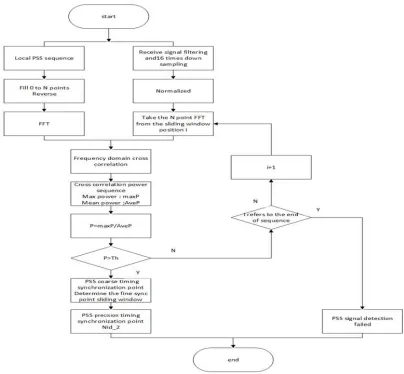
In this paper, a frequency-domain convolution correlation detection algorithm for the primary synchronization signal PSS in an LTE system is proposed. The cross-correlation process is converted into linear convolution by reversing and zeroing, and then converted into a circular convolution. Obtaining the maximum value of the relevant power sequence and its corresponding position, and finally get the PSS signal timing position n^ and the cell group numberNid(2).
The sliding cross-correlation is defined as follows:
1
0
( ) ( ) ( ) ( ) ( )
N
rd
k
S n r n d n r k d n k
(6)The above formula is transformed as follows:
1
*
0
( ) ( ) ( ) ( ) ( )
N
rd k
S n r k d n k r n d n
(7)The equation (7) indicates that a certain relationship is established between linear convolution and cross correlation. Cross-correlation operation can be carried out according to the following steps, reverse operation, take conjugation, and then convolution operation. Where d n*( ) represents the conjugate of d n( ) , and the inverse of d n*( ) is represented by d n( ). Then equation (7) can be written as:
( ) ( ) ( )
rd
S n r n d n (8)
There is also a link between linear convolution and circular convolution5, 6.
( ), 0,1,.. 1 ( )
0, , 1,...
r n n M
r n
n M M L
( ), 0,1,.. 1 ( )
0, , 1,...
d n n N
d n
n N N L
(10)
1
0
( ) [ ( )] [ ( ) ( )]
( ) (( )) ( )
u L
L L i
S n IDFT S K IDFT R K D K
r i d n i R n
(11)2 1
L M N , is a positive integer. S K( )R K D K( ) ( ) , R K( ) and
( )
D K represents the frequency domain representation of r n( ) andd n( ), respectively. When S nu( ) obtains the maximum value, we can get the timing synchronization
point position n^ and the cell group numberNid(2).
^ ^
,
{ , } arg max{ u( )}
n u
n u S n (12)
From the formula (11) we can see that the fast convolution method can achieve cross-correlation operation, and the time domain convolution is converted to frequency domain multiplication, can avoid the sequence slip caused by the calculation of complex.
Precision Time Synchronization
According to the PSS coarse timing synchronization point position n^ and the cell
group number Nid(2), the non-down-sampled receive sequence is intercepted by the
L-point at the position of n^ and cross-correlated with the local signal, which is
corresponding to Nid(2). Find the maximum position from the associated sequence
The Flow Diagram of Algorithm
Figure 1. Algorithm flowchart.
Simulation Results Analysis
Define the length of the PSS sequence is N, a half of the frame is M, OFDM symbol is 128, and the segment length is L, then the calculation of different algorithms can be obtained. The number of complex multiplication and complex additions of time domain correlation are both 3MN. The number of coarse synchronization multiplication and the number of complex additions in the frequency domain
convolution correlation algorithm are 3 (3 log2 ) 128
2
M L
L L L
L and
2
3M (3 logL L L) 128L
Figure 2. The correlation with the Figure 3. Precision synchronization local 3-sequence sequence. point calculation.
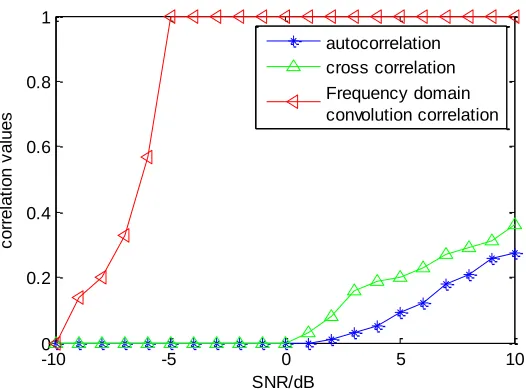
Figure 4. Detection Probability at Different SNR.
In the figure 2, PSS0, PSS1 and PSS2 represent the local signal sequence of 25, 29, and 34, respectively. The correlation between the received sequence and the local PSS0 sequence has a significant peak, the position is 2261, the peak size is close to 3, and the corresponding non-descending coarse synchronization position can be calculated as (2261-1) * 16 + 1 = 36161, Nid(2)is 0. The peak position of the precision
synchronization point is 1823, and the position of the final PSS sequence is 36161- (2048-1823) = 35945, as shown in Figure 3.
In Figure 4, the correct detection probability increases as the increase of signal-to-noise ratio. When the SNR is -5 dB, the frequency domain convolution algorithm correctly detects the probability is 100%, and the correct probability of the time domain correlation algorithm is 0 with a slowly detection probability.
-10 -5 0 5 10
0 0.2 0.4 0.6 0.8 1
SNR/dB
c
o
rr
e
la
ti
o
n
v
a
lu
e
s
[image:6.612.164.427.284.479.2]SUMMARY
In this paper, an algorithm of frequency domain convolution correlation algorithm is proposed by studying the existing PSS timing synchronization algorithm, which can greatly simplify the computational complexity. The feasibility of the method is verified by the simulation results, which proves that the method can meet the requirements of LTE system search algorithm.
ACKNOWLEDGEMENTS
Linxiao Li Email:[email protected]; this work is partially supported by Innovation. Team Building Program at Institutions of Higher Education in Chongqing (KJTD201312).
REFERENCES
1. Wei Xiang. 2009. “Research and Implementation of PP LTE Downlink Physical Layer,” University of Electronic Science and Technology. C. pp. 16-23.
2. Zhu Juan. 2012. “Research and Implementation of Downlink Synchronization Algorithm for LTE System” University of Electronic Science and Technology. C. pp. 26-33.
3. M. M. Mansour, 2009. “Optimized architecture for computing Zadoff-Chu sequences with application to LTE,” in Proc. IEEE GLOBECOM, Honolulu, HI, pp. 1-6.
4. Yang X, Xiong Y, Jia G, et al. “PSS based time synchronization for PP LTEdownlink receivers,” presented at the IEEE 1h International Conference on Communication Technology, September 25-28, 2011.
5. Zhongshan Zhang, Jian Liu, Keping Long, 2012. “Low-Complexity Cell Search with Fast PSS Identification in LTE,” J. IEEE Transactions on vehicular technology. 61(4):1719-1727.