Study on the Gain Material with Four Energy Level
Model Using FDTD Method
Hui Xue1, Zhixiang Huang1, Xianliang Wu1,2 1
Key Laboratory of Intelligent Computing and Signal Processing, Anhui University, Hefei, China
2
Department of Physics and Electronic Engineering Hefei Normal University, Hefei, China Email: [email protected]
Received 2013
ABSTRACT
A faster numerical method based on FDTD for the four energy level atomic system is present here. The initial condi-tions for the electrons of each level are achieving while the fields are in steady state. Polarization equation, rate equa-tions of electronic population and Maxwell’s equaequa-tions were used to describe the coupling between the atoms and elec-tromagnetic wave. Numerical simulations, based on a finite-difference time-domain (FDTD) method, were utilized to obtain the population inversion and lasing threshold. The validity of the model and its theory is confirmed. The time, which we can observe the lasing phenomenon, is much shorter in our new model. Our model can be put into using in large scale simulations in mutiphysics to reduce the total simulated time.
Keywords: Finite-Difference Time-Domain; Gain Material; Lasing
1. Introduction
The system is always treated either semi classical or fully quantum mechanical [2, 3] while a high-frequency light is incident on a medium. Because of metallic nature of metamaterials constituent metamolecules, they suffer from high dissipative losses in the range of optical frequencies. Losses are too large in the real applications. It is better to incorporate the gain media into matematerial to compen-sate the losses. When an electromagnetic wave propa-gates in a medium, the dipole moment in the individual atom changes, in turn changing the total field coupling to the medium until a steady state established. A full-vec- torial time domain approach is utilized to do self-consistent calculations. Finite-difference time-domain (FDTD) method [4] is used as a powerful tool in modeling linear disper-sive media [5, 6]. In an attempt to achieve more realistic simulations two-level Maxwell-Bloch equations can be solved using iterative predictor-corrector finite difference time-domain FDTD methods to demonstrate saturation and self-induced transparency [7].
To simulate lasing dynamics, we present here a faster numerical simulation model for the four energy level atomic system. We use the populations of each level while the fields are achieving steady state as the initial value, in this way, the simulation time will sharply be reduced. The electromagnetic fields and atomic energy level populations at any time step can be calculated in terms of known quantities. Comparing the results of this model with those which putting all the electrons on the
ground state level (E0). We can find that the results of two methods are similar. So the validity of the model and its theory is confirmed.
2. Theoretical and Numerical Model
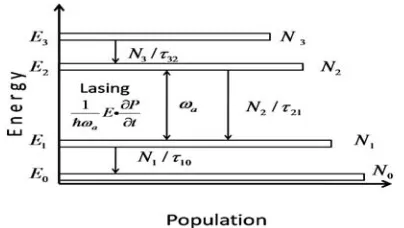
2.1. Rate EquationsA simplified four level atomic system with energy levels
E0, E1, E2, E3 and populations upon each level N0, N1, N2,
N3 is depicted in Figure 1.
[image:1.595.323.525.604.718.2]In our model, the gain atoms are embedded in the each level of host medium aforehand. The electrons of the ground state level are pumped to the third level by the some external pumping mechanism (Pr). After a very short time period 32, the electrons of the third level (E3) fall into the second level (E2) by a non-radioactively transition. A population accumulates in the second level
due to the lifetime of the laser transitionis longer than other lifetime, e.g. 32. The amount of electrons in the second level (E2) is larger than the amount of electrons in the first level (E1).Then a population inversion is achieved. The lasing and optical amplification E2 will happen at the frequency of 21 = (E2-E1)/ħ. At last, the electrons transfer quickly and non-radiatively from the first state level (E1) to the ground state level (E0).
In the traditional four-level atomic system model, the populations can be modeled by the following rate equa-tions: 3 3 0 32 r N N P N t
(1a)
3 2 2 32 21 1 a N
N N P
E t t
(1b)
1 2 1
21 10 1
a
N N N P
E t t
(1c)
1 2 1
21 10 1
a
N N N P
E t
t (1d)
We set the right of the equations as zero. The physical interpretation of this is owing to the steady state for the populations of each level. So the corresponding homo-geneous equations can be rewritten as follows:
3 32 N N t 3
(2a)
3 2 32 21 N N t 2 N
(2b)
1 2
21 10
N N N t
1
(2c)
0 32 N N t 3
(2d)
2.2. Classical Electron Oscillator Model
Using the Lorenz Model, the electric polarization in real atomic transitions can be described by the following equation: 2 2 2 0 0 2 ( ) ( )
( ) r ( ) ( ) c
d P t dP t e
P t N t E t
dt m
dt
(3)
where e is the charge of an electron. m is the mass of an electron and N = N2 N1. r = 1/21 is the real decay rate of the second level. c = 1/21 is the classical rate.0 is the total energy decayrate and 0 = 1/21 + 2/T2. T2 is the mean time between dephasing events.
2.3. FDTD Formulation
Presuming a two-dimensional problem of a plane wave
propagating along +y direction, using spatial and tempo-ral interleaving of the fields and the centtempo-ral differencing scheme. We can write the discretized equations for the electric and magnetic fields as follows:
1 1 2 2 0 1 1 ( , ) ( , ) 2
[ ( , 1) ( , )]
n n
x x
n n
z z
H i j H i j
t
E i j E i j
y 2 (4a) 1 1 2 2 0 1 1 ( , ) ( , 2
[ ( 1, ) ( , )]
n n
y y
n n
z z
H i j H i j
t
E i j E i j
y ) 2 (4b) 1 1 1 1 2 2 1 1 2 2
( 1, ) ( 1, )
( , ) ( , ) 1 [ ( , ) ( , 2 2 1 1 [ ( , ) ( , ) 2 2 n n z z n n z z n n y y n n x x
E i j E i j
P i j P i j
t
H i j H i j
x t
H i j H i j
y 1 )] ] (4c)
The macroscopic polarization has a nonzero compo-nent in the x direction alone. The polarization equation can be discretized as:
2 2 1 0 0 1 0 0 2 2 1 2 0 2
( 1, ) ( , )
1 / 2
1 / 2
( , )
1 / 2
[ ( , ) ( , )] ( , )
1 / 2
n n
z z
n z
r
n n n
c
z
t
P i j P i j t
t P i j t
e t m
N i j N i j E i j t (5)
Similarly, the discrete rate equations are:
1 32 3 3 32 32 0 32 2 ( , ) ( , ) 2 2 ( , ) 2 n n n r t
N i j N i j
t
P N i j
t (6a) 1 1 21 0 21 1 21 2 2 21 1 21 3 3 32 21 [ ( , ) ( , )][ ( , ) ( , )] (2 ) 2 ( , ) ( , ) 2 [ ( , ) ( , )] ( )
n n n n
z z z z
n n
n n
E i j E i j P i j P i j t
t
N i j N i j
t
t N i j N i j
t (6b) 1 1 10 0 10 1 10 1 1 10 1 10 2 2 21 10 [ ( , ) ( , )][ ( , ) ( , )] (2 ) 2 ( , ) ( , ) 2 [ ( , ) ( , )] (2 )
n n n n
z z z z
n n
n n
E i j E i j P i j P i j t
t
N i j N i j
t t
N i j N i j
The initial state is t = 0. So we can embed the gain atoms in the each level of host medium aforehand base on above equations. There is no polarization at first. However, the system begins to evolve while electrons are pumped by external pumping into high energy level.
1 1
0 1
10
0
( , ) [ ( , ) ( , )]
2
(1 ) ( , )
n n
n r
t
1
n
N i j N i j N i j
tP N i j
(6d)
3. Numerical Results
We set parameters as fellows. The slab width is 300 nm. The gain slab width is 100nm. The discrete time and space steps are chosen as ∆t = 1.667 × 10⁻¹⁷ s and ∆x = 1 × 10⁻⁸ m. The center frequency of the radiation 0 is set as 2 × 10¹⁴ Hz. ∆ω0 is set as 5THz. The parameters 10, 21 and32 are chosen as 5 × 10-14 s, 5 × 10-12 s and 5 × 10-14 s. The total electron density (Nt) is chosen as 6 × 10²³ m-3.The total iterated time step is set as 1.5 × 10⁶. The frequency of the CW wave is 250 THz.
The 2D system incorporated a gain material as showing in Figure 2.
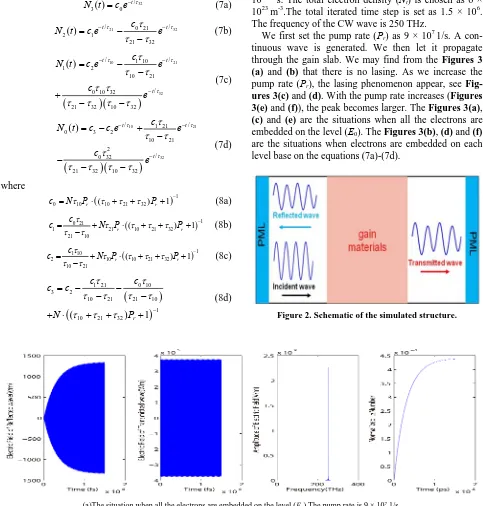
By solving the differential equations (1a)-(1d) the amount of electrons of each level in each time step can be gotten as (8a)-(8b):
32
/ 3( ) 0
t
N t c e (7a)
32
21 /
/ 0 21
2 1
21 32
( ) t c t
N t c e e
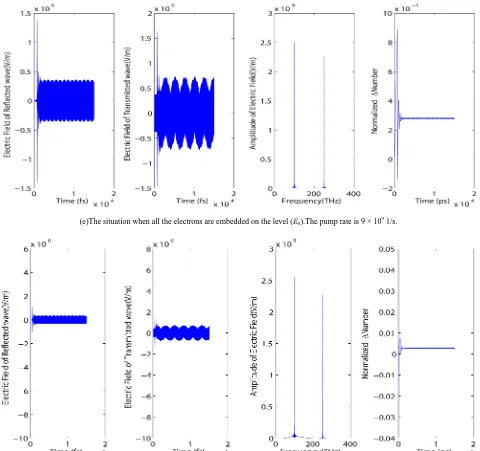
(7b) We first set the pump rate (Pr) as 9 × 10⁷ 1/s. A con-tinuous wave is generated. We then let it propagate through the gain slab. We may find from the Figures 3 (a) and (b) that there is no lasing. As we increase the pump rate (Pr), the lasing phenomenon appear, see
Fig-ures 3(c) and (d). With the pump rate increases (Figures 3(e) and (f)), the peak becomes larger. The Figures 3(a),
(c) and (e) are the situations when all the electrons are embedded on the level (E0). The Figures 3(b), (d) and (f) are the situations when electrons are embedded on each level base on the equations (7a)-(7d).
10 21
32
/ 1 10 /
1 2
10 21 / 0 10 32
21 32 10 32
( ) t t
t
c
N t c e e
c
e
(7c)
10 21
32
/ 1 21 /
0 3 2
10 21 2
/ 0 32
21 32 10 32
( ) t t
t
c N t c c e e
c
e
(7d)
where
10 10 r ( 10 21 32)
c N P Pr1 (8a)
10 21
1 21 10 21 32
21 10
( )
r r
c
c N P P
1
(8b)
11 10
2 10 10 21 32
10 21
( )
r
c
c N P P
r 1
(8c)
0 10 1 21
3 2
10 21 21 10 1 10 21 32
( ) r
c c
c c
N P 1
[image:3.595.56.539.224.730.2](8d)
Figure 2. Schematic of the simulated structure.
(b) The situation when electrons are embedded on each level base on the equations (7a) - (7d). The pump rate is 9 × 10⁷ 1/s.
(c) The situation when all the electrons are embedded on the level (E0).The pump rate is 9 × 10⁸ 1/s.
(e)The situation when all the electrons are embedded on the level (E0).The pump rate is 9 × 10⁹ 1/s.
[image:5.595.61.536.82.307.2](f) The situation when electrons are embedded on each level base on the equations (7a) - (7d). The pump rate is 9 × 10⁹ 1/s.
Figure 3. The Electric field of the reflected wave, transmitted wave, the Fourier transform results, and the normalized dif-ference of electron number between the upper level and lower level under different pump rate.
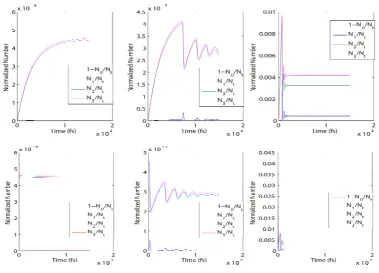
Populations changing can also be observed in the Fig-ure 4. The Figure 4(a) is the situation when all the elec-trons are embedded on the ground state level, we may record this as case a. The Figure 4(b) is the situation when electrons are embedded on each level base on the equations (7a)-(7d), namely case b. Here we use the pump rate of 9 × 10⁸ 1/s. If we increase the pump rate further, we may see the populations begin to oscillating strongly. It is easy to see that case b has a shorter lasing time than the case a does. That means our model costs
Figure 5 shows the c
less time to start to lase.
omparisons of the lasing time un
4. Conclusions
umerical model for gain materials der two situations, case a and case b, with different pumping rates. We may find that the case b needs less simulated time to lase than case a. Which means our new system takes less time to start to lase than the system which all the electrons are embedded on the ground level. Furthermore, when the pump rate gets higher the lasing time which the system begins to lase is decreasing.
[image:5.595.59.539.85.536.2]Figure 4. The two situations’ populations change in each level with different pump rate.
Figure 5. The lasing time of two situations under differen
nd numerical simulations based on the lasing dynamics
5. Acknowledgements
the National Natural
Sci-ence Foundation of Anhui Province (Nos.KJ2011A002,
[1] Anan Fang, T stas M Soukoulis,
“Lasing in me s,” Journal of
Op-t pump rates.
a
are presented here. The system begins to lase while the pumping rate increased to a certain value. Our modified model obviously reduces the lasing time (the time when the system start to lase) and the simulation results agree with the classic theory. Our model can be applied in lar-ger electromagnetic and optics physics simulations to reduce the total simulated time.
This work was supported by
ence Foundation Of China under Grant (Nos.60931002, 61101064, 51277001), Distinguished Natural Science Foundation (No.1108085J01), Universities Natural
Sci-KJ2012A013) and 211 Project of Anhui University.
REFERENCES
homas Koschny and Co tamaterial nanostructure tics, Vol. 12, No. 2, 2010, p. 024013. doi:10.1088/2040-8978/12/2/024013 [2] J. Singh, “Semiconductor Optoelectr
Technology,” McGraw-Hill, 1995.
onics: Physics and
ge, England, 1997. [3] M.O. Scully and M.S. Zubairy, “Quantum Optics”,
Cam-bridge University Press, Cambrid
doi:10.1017/CBO9780511813993
[4] A. Taflove, “Computational Electrodynamics: The Finite- Difference Time-Domain Method,” Artech House, 1995.
[5] P. Goorjian and A. Taflove, “Direct Time Integration of Maxwells Equations in Nonlinear Dispersive Media for Propagation and Scattering of Femtosecond Electromag-netic Solitons,” Optics letters, Vol. 17 No. 3, 1992, pp. 180-182.doi:10.1364/OL.17.000180
[6] P. Goorjian, A. Taflove, R. Joseph and S. Hagness, “Computational Modeling of Femtosecond Optical Soli-tons from Maxwell’s Equations,” Quantum Electronics, Vol. 28, No. 10, 1992, pp. 2416-2422.
doi:10.1109/3.159548
[7] R. Ziolkowski, J. Arnold and D. Gogn Interactions with Two-Lev
y, “Ultrafast Pulse el Atoms,” Physical Review A, Vol. 52, No. 4, 1995, pp. 3082-3094.
[image:6.595.60.289.380.512.2]