Munich Personal RePEc Archive
Communication and Procedural Models
of the E-commerce Systems
Suchánek, Petr
Silesian University - School of Business Administration, VŠB-TU
Ostrava, Faculty of Mechanical Engineering
October 2009
Online at
https://mpra.ub.uni-muenchen.de/19248/
Transactions of the VŠB – Technical University of Ostrava, Mechanical Series
No. 2, 2009, vol. LV, article No. 1703
Petr SUCHÁNEK*
COMMUNICATION AND PROCEDURAL MODELS OF THE E-COMMERCE SYSTEMS
KOMUNIKAČNÍ A PROCESNÍ MODELY E-COMMERCE SYSTÉMŮ
Abstract
E-commerce systems became a standard interface between sellers (or suppliers) and customers. One of basic condition of an e-commerce system to be efficient is correct definitions and describes of the all internal and external processes. All is targeted the customers´ needs and requirements. The optimal and most exact way how to obtain and find optimal solution of e-commerce system and its processes structure in companies is the modeling and simulation. In this article author shows basic model of communication between customers and sellers in connection with the customer feedback and procedural models of e-commerce systems in terms of e-shops. Procedural model was made with the aid of definition of SOA.
Abstrakt
E-commerce systémy se staly základním rozhraním mezi prodejci (dodavateli) a zákazníky (odběrateli). Jednou ze základních podmínek úspěšnosti e-commerce systémů jsou správné definice a popisy všech vnitřních a vnějších procesů. Vše je zaměřeno na potřeby a požadavky zákazníků. Nejvhodnějším a nejpřesnějším způsobem pro nalezení optimálního řešení struktury e-commerce systémů a jejich procesů je modelování a simulace. V tomto článku je uveden základní model komunikace mezi zákazníky a prodejci v souvislosti se získáváním zpětné vazby v internetových obchodech a procesní modely e-commerce systémů vytvořené na základě SOA.
1 INTRODUCTION
Electronic Commerce or e-commerce is the trade of products and services by means of the Internet or other computer networks. E-commerce is seen as a potent tool to streamline business processes and reduce operating costs. Market environment and its development urge managers to look for new methods and procedures lowering financial charges especially in the sphere of the ancillary processes. Cost reduction mustn´t lead to reduction of volume of production and productive activities.
Decision-making processes always have to be realized quickly and under the strong thumb of competitive environment. Many companies have to redefine some internal and external processes and IS/IT architecture and in many cases companies have to use a support of internal functions with the aid of external resources (outsourcing).
The main home elements of the companies´ processes reengineering is a process simulation and development of models involving procedural definition of the all subsystems. The development of the models for a better representation of real processes is the core of the further development of the simulation software. Models and approaches used in this article will become the starting elements of the research in terms of project OP VK č. CZ.1.07/2.3.00/09.0197.
*
2 CUSTOMER REQUIREMENTS
In terms of e-commerce, customer requirements can be separated up two groups. The first group of customer requirements result from exploitation of IS/IT as the main technological support of e-business and e-commerce environment. In 2003, ANEC Policy Statement on Design for All called upon the standard- makers to take the following generic consumer requirements into account when designing, selecting, commissioning, modifying and standardising ICT systems. Requirements for IS/IT were summarized as accessibility/design for all, adaptability, child safety issues, comprehensible standards, consistent user interface, cost transparency, easily adaptable access and content control, ease of use, environmental issues, error tolerance and system stability, explorability, functionality of solution, health and safety issues, information supply for first-time user set-up procedure, interoperability and compatibility, multi-cultural and multi-lingual aspects, provision of system status information, privacy and security of information, quality of service, system reliability and durability, rating and grading systems, reliability of information, terminology. (ANEC, 2005)
The second group of customer requirements is closely associated with business transactions. Customers want to find what they want easily and in short time, to get sufficient number of information, to place an order easily, payment system to be secured and failsafe, to get goods in quality of service and in short time, goods to be guaranteed by sellers (producers) and to get benefits in dependence on a number of purchases.
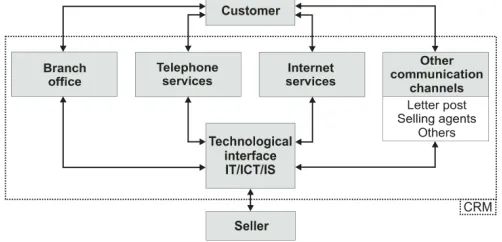
[image:3.499.124.375.347.468.2]The most important condition of customer satisfaction is feedback. Sellers and producers have to monitor market environment and all have to be targeted the customers. All customer requirements have to be monitored for ever and company information system with the all company processes have to be formed to ensure quality and rapid processing of the all customer feedback information, needs and requirements. Feedback information can be getting by the communication channels which are usually integrated in CRM (Customer Relationship Management) system (Figure 1).
Fig. 1 Communicationchannels between customers and sellers
In the e-commerce environment, sellers can get feedback information through e-shop web sites. It is considered to be a main communication channel. In e-shops, customer feedback solution can be realized as the web service oriented applications. This interface is integrated into CRM with the feed forward to ERP (Enterprise Resource Planning) (Figure 3). To this purpose sellers can to place a number of tools into e-shop web sites pages, for example discussion groups, public inquiry, frequently asked questions (FAQ), electronic questionnaire, competition, customer response and the like. All or some of the mentioned feedback functions can be seen on high percentage of e-shop web site pages. Feedback is a very important support of business. Better manage customer feedback resulting in improved store performance and measurements, greater customer insight and loyalty and higher customer repurchase rates. (Customer feedback solusions, 2007)
considered as an efficient system. There are many other performance indicators of effective e-commerce systems. They result from technological base and are connected with system structure, network architecture, type of ERP, CRM, SCM, staffing, and the like.
3 E-COMMERCE PROCESSES
Nowadays processes management is one of the most important conditions of efficient operating management. Global market, market saturation, keen competition and rapid technology development evoke enhancement of activities supporting production, IS/IT, marketing and business. All is targeted the consumers´ needs and requirements. Electronic commerce (e-commerce) comprises of a set of technologies, applications and business processes that forms a strategic link between businesses, consumers and communities. The most important for the decision-making are current information. Managers have to get information in right time and requisite quality. For this purpose every company should has well-done activity, processes, productive and financial analyses. This analysis should be main fundament of company policy. The e-commerce process is essentially the entire process that takes place when a customer’s data is collected, stored, analyzed, and then presented back to the customer in a useful format. Process model of e-commerce system in light of business transactions can be formed in line with customer requirements and needs. Electronic commerce is expected to influence a wide range of supply chain systems and thus lead to unidentified environmental impacts. An important part of the sales process is to make sure that the contract which is formed with the customer is both legally correct and also affords the seller the maximum protection.
3.1 The basic loop of business transaction in e-commerce system
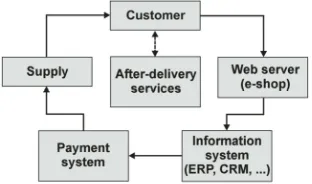
[image:4.499.172.328.383.475.2]All business transactions in e-commerce systems have the same elements (Figure 2). On the one hand is customer with his needs, requirements and expectations and in the other side there are elements and processes administered by seller. There are especially information system (ERP, CRM) with the technological and procedural interconnection to a web server, payment system and suppliers (strictly speaking suppliers´ information system).
Fig. 2 The basic loop of business transaction in e-commerce system
The basic communication is ongoing between customer and supplier´s information system. This information system includes technological support of the all single business processes which are necessary for the realization of a business transaction.
3.2 CRM as an information system interface
Fig. 3 CRM as information system interface
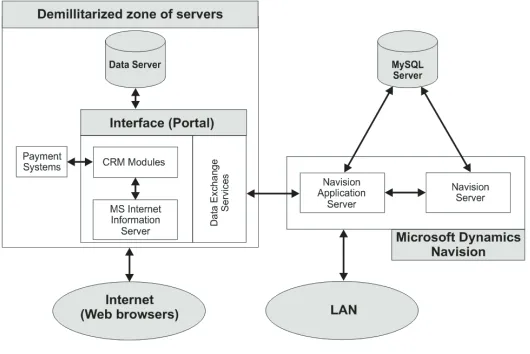
Fundamental aim of this suggested solution is providing of right and consistent data about customers in terms of all IS/IT infrastructure. The shown solution results from the many systems. As example, Navision Commerce Portal can be presented (Figure 4).
Fig. 4 Navision Commerce Portal
3.3 Models of e-commerce systems based on SOA
Since the structured and object-oriented technologies, development has come to a SOA (Service-Oriented Architecture). Substance of SOA is a usage of function modules that were identified as multiple applicable to the support of different company´s functions. Up-to-date subject can be analysis of relations between SOA and process simulation. Process modelling goes in for the reengineering of current company´s processes or development of new processes susceptible to achieve the objectives. Generally, enterprise modelling can be characterized as an abstract definition of processes running in enterprise using process, value, data and resource models. (Vymětal, 2009) E-commerce systems are based on exploitation of the web services. Web services can implement a SOA. A SOA is essentially a collection of services. These services communicate with each other. (Erl, 2005) To get a specific, objective and applicable model, it is advisable to separate up business information system to the individual models of subsystems pursuant to common decomposition rules.
[image:5.499.132.397.249.426.2]Fig. 5 Model of business processes in light of order procedure 1) Customer enters onto e-shop web sites
without registration (Is is related to 9).
7) Back to offer of goods. 8) The entry to an offer guide. 2) Customer login or check in e-shop
database.
9) Voting member (Logged or unlogged customer) (It is related to 1).
3) Logged customer enters onto e-shop. 10)The allowing of removal from storage. 4) Customer chooses the goods. 11)Handover of goods to supplier. 5) Goods are saved to basket (Cart, List, ...). 12)The supply of goods to customer. 6) Voting member (Choose next goods or
start offer guide).
13)The after-sales services.
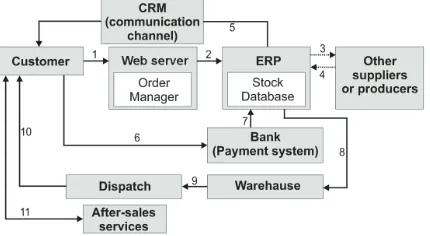
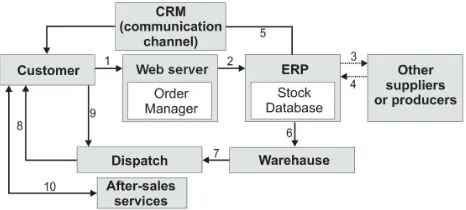
Offer of goods, selection of goods, basket (Cart, List, ...) and offer guide is usually integrated in CRM system which includes, among others, internet communication services (web sites administration, e-mail communication, may be voice over IP and so on). CRM system can be separate, but usually integrated in ERP. The second layer result from Figure 5 is shown in Figure 6. As payment system in model shown in Figure 6 is amount brought.
Fig. 6 Model of business processes in light of technological support 1) Customer chooses goods and places an
order.
5) Confirmation or disapproval of an order. 6) Order for costs.
2) Receipt order (formation of business transaction in ERP).
7) Confirmation of costs. 8) Consignation command. 3) If goods are not available, the other
supplier may be found.
9) Delivery ex stock. 10) Supply of goods. 4) Confirmation or disapproval of a
request.
11) The after-sales services.
[image:6.499.159.374.384.502.2]Fig. 7 Model of business processes in light of technological support with cash on delivery The all shown models are common models that are usable in the small-sized, middle-sized but also big business oriented companies. Differences between small-sized, middle-sized and big companies are at the level of specific ERP, CRM, web servers, etc. implementation.
4 CONCLUSIONS
As a prerequisite to building an effective e-commerce system is accurate definitions of the all processes. All is targeted the consumers´ needs and requirements. The most important condition of customer satisfaction is feedback. In e-commerce systems, customers´ feedback information are getting back by the communication channels usually integrated to CRM. CRM is usually an interface between customers and sellers. One way to get an effective e-commerce system is process modeling. To get a specific, objective and applicable model of e-commerce system, it may be used the business processes decomposition techniques that can help to specify business processes that are aligned with a SOA. Decomposition techniques make possible e-commerce system to be modeled in separate layers and managers and IT specialists to get very detailed procedural models. Every shown model can be divided to the other more detailed models. On the basis on it, the reengineering of current processes or development of new processes can be done. Models shown in this article will be elaborated in detail in the following period and the new resulting models with some suggested changes will be used for the education purposes and become a one of the starting elements of research in terms of project OP VK č. CZ.1.07/2.3.00/09.0197.
REFERENCES
[1] ANEC. (2005). Retrieved květen 5, 2009, from Consumer Requirements in Standardisation relating to the Information Society. <http://www.anec.org/attachments/it008-03rev1.pdf> [2] BABIUCH, M. Implementation and Operation of Computer Systems and Programming of
Internet Applications e-learning Courses. In Proceedings of XXXIII. Seminary ASR '08 “Instruments and Control”. Ostrava: Katedra ATŘ, VŠB-TU Ostrava, 25. 4. 2008, s. 13-18. ISBN 978-80-248-1727-9.
[3] BUCKI R., Thorough Analysis of the Technological Case Control. Management & Informatics, Network Integrators Associates, Parkland, Florida, Volume 1, No. 1, 2007, pp. 68-112. ISSN 1939-4187.
[4] Customer feedback solusions, i. (2007). Získáno 22. září 2009, z Customer support & Knowledge management made easy.: http://www.custfeedback.com/
[5] ERL, T. Service-Oriented Architecture (SOA): Concepts, Technology, and Design. Prentice Hall PTR, 2005. 792 p. ISBN 978-0131858589.
[6] SMUTNÝ, P. Building rich Internet applications as a desktop application. In XXXIII. Seminary ASR ‘2008 “Instruments and Control”. Ostrava: VŠB-TU Ostrava, 25. 4. 2008, s. 297 – 302. ISBN 978-80-248-1727-9.