Design of a Fuzzy Time Series Forecasting Model for
Hydro Power Generation
1.
Poornima Devi
Research Scholar,Department of Statistics, Manonmaniam Sundaranar
University,Tirunelveli
2.
C.Vijayalakshmi
School of Advanced Science,Department of Mathematics, VIT University, Chennai
3. E.Sakthivel
Research Scholar, Department of Statistics, Manonmaniam SundaranarUniversity,Tirunelveli
ABSTRACT
This paper mainly deals with the design of forecasting model for Hydro power generation using Fuzzy time series. The fuzzy time series has recently received an increasing attention because of its capability of dealing with vague and incomplete data. There have been a variety of models developed either to improve forecasting accuracy or reduce computation overhead. This technique has been applied to forecast various fields and have been shown to forecast better than other models. Hence, in this paper fuzzy time series forecasting technique has been applied on hydro power generation data set. An algorithm is designed and based on the numerical calculations and graphical representations it reveals that Hydro Power generation can be forecasted by using Fuzzy Time Series.
Keywords:Fuzzy,forecasting,HydroPower generation,Fuzzy time series, uncertainity
1.
INTRODUCTION
In the last decade, fuzzy time series have received more attention to deal with the vagueness and incompleteness inherent in time series data. Different types of models have been developed either to improve forecasting accuracy or reduce computation overhead. However, the issues of controlling uncertainty in forecasting, effectively partitioning intervals, and consistently achieving forecasting accuracy with different interval lengths have been rarely investigated.
In the literature survey most of the model is of first order fuzzy time series model. In the past decade many forecasting models based on the concepts of fuzzy time series have been proposed. It has been applied to predict enrollments, temperature, crop production and stock index, etc. Time series forecasting studied the relations on the sequential set of past data measured over time to forecast the future values. Forecasting technique are frequently conducted by using statistical tools like regression analysis, moving averages, integrated moving average and autoregressive integrated moving average. The historical data defined as linguistic terms are not being considered in forecasting technique which is one of the major limitations of these methods.
Fuzzy set theory and fuzzy logic was first introduced by Zadeh (1965) which provides a general method for handling uncertainty and vagueness in information available in linguistic terms. Song and Chissom (1993) used the fuzzy set theory given by Zadeh to develop models for fuzzy time series forecasting and considered the problem of forecasting enrollments on the time series data of University of Alabama.
Singh (2008, 2009) presented the computational method of forecasting based on fuzzy time series have been developed to provide improved forecasting results to deal with the situation containing higher uncertainty due to large fluctuations in consecutive year’s values in the time series data and having no visualization of trend or periodicity. He has developed the order three and higher order difference to use a time variant difference parameter on current state to forecast the next state. Ruey-Chyn Tsaur,(2012) developed the fuzzy time series-Markov chain approach for analyzing the linguistic or a small sample time series data is proposed to further enhance the predictive accuracy. In this method to transferred fuzzy time series data into fuzzy logic group, and using the obtained fuzzy logic group to derive a Markov chain transition matrix. Wangren Qiu et al., (2011) presented ensemble technique an effective method for improving the classification accuracy in data mining area. The ensemble technique was applied to fuzzy time series and improves that Song’s and Chissom (1993a, b), Chen (1996) and Lee et al. (2009) models can be approximated by the proposed model via the limitation of the fuzzy weights. The impact on the performance of the proposal model is discussed. Both university enrollment and Shanghai stock index are chosen as the forecasting targets. The empirical results not only testify the above assertion, but also show that the proposed model can provide better overall forecasting results than the previous models with appropriate parameters. Enjian Bai (2011) presented a simple heuristic time-invariant fuzzy time series forecasting model, which was used to prediction accuracy of model observations to train the trend predictor in the training phase, and uses this trend predictor to generate forecasting values in the testing phase.
2 from each fuzzy set and calculate the sample autocorrelation
function for each data set. Singh (2007) proposed an improved and versatile method of forecasting based on the concept fuzzy time series forecasting. The developed model has been presented in a form of simple computational algorithms. It utilizes various difference parameters being implemented on current state for forecasting the next state values to accommodate the possible vagueness in the data in a better way and making it a robust method. Huarng (2005) proposed a Type 2 fuzzy time series model. Type 2 model, extra observations are used to enrich or to refine the fuzzy relationships obtained from Type 1 models and then to improve forecasting performance. Cheng (2008) proposed a new fuzzy time-series model which incorporates the adaptive expectation model into forecasting processes to modify forecasting errors. Liu (2010) proposed an improved fuzzy time series forecasting method that can effectively deal with seasonal time series. This method can determine appropriate length interval. Moreover, a systematic search algorithm is used to find the best window base. It can be provide decision analysts with more precise forecasted values. Liu (2009): to developed an integrated fuzzy time series forecasting system in which the forecasted value will be a trapezoidal fuzzy number instead of a single-point value. Furthermore, this system can effectively deal with stationary, trend, and seasonal time series and increase the forecasting accuracy.
Wong et al.,(2010) proposed Traditional Time Series Method (ARIMA model and Vector ARMA model) and Fuzzy Time Series Method (Two-factor model, Heuristic model, and Markov model) for the forecasting problem. Reuter et al., (2010) presented an artificial neural network for modeling and forecasting of fuzzy time series. Analysis and forecasting of time series with fuzzy data may be carried out with the aid of artificial neural networks. Pierpaolo et al., (2009) were proposed fuzzy clustering approach based on the autocorrelation functions of time series, in which each time series is not assigned exclusively to only one cluster, but it is allowed to belong to different clusters with various membership degrees. Duru et al., (2010) proposed perform similar techniques for long term annual base data and also extend the conventional method with multi-variate heuristic algorithm. Lia et al., (2007) proposed a novel deterministic forecasting model to manage these crucial issues. Additionally, an important parameter, the maximum length of subsequence in a fuzzy time series resulting in a certain state, is deterministically quantified. Sheng-Tun Li et al., (2010) presented a new method to overcome this shortcoming, called deterministic vector long-term forecasting (DVL). This method, built on the basis of our previous deterministic forecasting method that does not require the overhead of determining the order number, as in other high-order models, utilizes a vector quantization technique to support forecasting if there are no matching historical patterns, which is usually the case with long-term forecasting. The vector forecasting method is further realized by seamlessly integrating it with the sliding window scheme. Finally, the forecasting effectiveness and stability of DVL are validated and compared by performing Monte Carlo simulations on real-world data sets. Aznarte et al.,(2012) were proposed a fuzzy model evolved through a bio-inspired algorithm and to produce accurate models for the prediction of these time series. Aladag et al., (2009) proposed a new approach for feed forward neural networks to define fuzzy relation in high
order fuzzy time series.
Bajestani et al., (2011) presented a new method to forecast TAIEX based on a high-order type 2 fuzzy time series. Cheng (2008) proposed a new fuzzy time series method, which is based on weighted-transitional matrix, also proposes two new
forecasting methods: the Expectation Method and the Grade-Selection Method. They have used forecasting the number of outpatient visits can help the expert of healthcare administration to make a strategic decision. If the number of outpatient visits could be forecast accurately, it would provide the administrators of healthcare with a basis to manage hospitals effectively, to make up a schedule for human resources and finances reasonably, and distribute hospital material resources suitably. Shah (2012) demonstrated the superiority of fuzzy based methods for non-stationary, non-linear time series. He has used to unequal length fuzzy sets and IF-THEN based fuzzy rules to capture the trend prevailing in the series. Egrioglu et al., (2013) proposed a hybrid approach, fuzzy c-means clustering method and artificial neural networks are employed for fuzzification and defining fuzzy relationships, respectively. The objective of this study is to forecast the electric power generation based on fuzzy time series method, and improve forecasting accuracy. However, these systems may suffer from the size of fuzzy rules when there are many intervals.
Section 2 reviews the definitions of fuzzy time series. Section 3 describes the fuzzy time series model. Section 4 discusses the empirical results. Section 5 concludes the paper.
2.
BASIC DEFINITION OF FUZZY TIME
SERIES
Song and Chissom (1993) presented the concept of fuzzy time series based on the historical enrollments of the University of Alabama. Fuzzy time series are used to handle forecasting problems. They presented the time-invariant fuzzy time series model and the time-variant fuzzy time series model based on the fuzzy set theory for forecasting the enrollments of the University of Alabama. Let U be the universe of discourse, where U= {u1, u2,…, un}. A fuzzy set Ai of U is defined by
n n A~ 2
2 A~ 1 1 A~
i
(
)
/
u
(
)
/
u
...
(
)
/
u
A
~
i i
i
where
i
A~
is the membership function of
A
~
i, iA
~
: U→ [0, 1].i
A
~
(ui) denotes the membership value of ui inA
~
i, iA
~
(ui)2.1
Definition :
Y (t), (t=…, 0, 1, 2,..) is subset of R. let Y (t) be the universe of discourse defined by the fuzzy set µi(t). if F(t) consists of µi(t) (i=1,2,3,…), F(t) is called a fuzzy time series on Y(t).
2.2
Definition :
If there exists a fuzzy relationship R (t-1,t), such that F(t)=F(t-1) º R(t-1,t), where º is an arithmetic operator, then F(t) is said to be caused by F(t-1). The relationship between F(t) and F(t-1) can be denoted by F(t-1) →F(t).
2.3
Definition :
Suppose F (t) is calculated by F (t-1) only, and
F (t) = F (t-1) º R (t-1, t). For any t, if R (t-1, t) is independent of t, then F (t) is considered a time invariant fuzzy time series. Otherwise, F (t) is time – variant.
2.4
Definition :
3.
COMPUTATIONAL ALGORITHM FOR
FUZZY TIME SERIES
The step by step forecasting process as follows:
Step 1: Compute the first order variation of the historical data
Step 2: Define the universe of discourse, U based on the range of available variation of the historical data. U= [Vmin-V1, Vmax], where Vmax is the maximum and Vmin value of the first order variation of the data, V1 and V2 are two positive integers.
Step 3: Define Fuzzy sets Ai on universe of discourse U. then determine how many linguistic variables to be fuzzy sets.
Step 4: Fuzzify the variations of the historical data and established the fuzzy logical relationship is represented by Ai
AjStep 5: Regulation of forecasting follows:
[Aj] is corresponding interval uj for which membership in Aj is supremum (i.e.1) L [Aj] is the length of the interval uj for whose membership in Aj is supremum (i.e.1)
M [Aj] is the mid value of the interval uj having supremum membership value in Aj for a fuzzy logical relationship Ai
AjAi is the fuzzified enrollment of the current year n;
Aj is the fuzzified enrollment of the next year n+1;
Di is the actual enrollment of the current year n;
Di-1 is the actual enrollment of the previous year n-1;
Ei is the variation enrollment of the current year n;
Ei-1 is the variation enrollment of the previous year n-1;
Fj is the forecasted enrollment of the next year n+1;
(i) Forecasting hydro electric for the year n+1 is obtained from modified computational algorithm as follows:
Obtain the fuzzy logical relationship Ai
Aj.If Ei < M [Ai], then Fj=Di-1+ (M [Aj]-1/4*L [Aj]),
Else if Ei > M [Aj], then Fj=Di-1+ (M [Aj] +1/4*L [Aj]),
Else Fj=Di-1+M [Aj].
(ii) Obtain the mean square error is using actual values and forecasted values.
4.
NUMERICAL CALCULATIONS AND
GRAPHICAL REPRESENTATIONS
Step 1: initially compute the first order variation of the historical data
Step 2: Define the universe of discourse U is defined as
U= [Vmin-V1, Vmax+V1]
U= [2125.82-125.82, 6469.919+30.18] = [2000, 6500]
Step 3: The Universe of discourse is partitioned in to ten equal length of interval.
U1= [2000, 2500], U2 = [2500, 3000], U3 = [3000, 3500], U4 =
[3500, 4000], U5= [4000, 4500]
[image:3.595.305.562.433.600.2]U6= [4500, 5000], U7= [5000, 5500], U8= [5500, 6000], U9= [6000, 6500].
Step 4: Define ten fuzzy sets A1,A2, A3…, A9
Year Hydro Power First difference Fuzzy set
1995 3963.77 - -
1996 3957.082 -4.688 V4
1997 4870.091 -911.009 V6
1998 5181.323 208.436 V7
1999 4502.29 -609.326 V5
2000 5367.981 1049.848 V7
2001 4603.738 -861.751 V6
2002 2737.409 -1943.769 V2
2003 2334.426 -402.572 V1
2004 3916.55 1920.038 V5
2005 5807.139 1765.907 V8
2006 6469.919 498.523 V9
2007 6340.202 -52.088 V7
2008 5625.227 -1207.719 V7
2009 5307.294 151.676 V7
2010 5090.157 -217.137 V7
2011 2125.82 -2964.337 V1
Step 5: The memberships of the linguistic variables are as follows
V1=1/u1+0.5/ u2 +0/ u3+0/ u4+0/ u5+0/ u6+0/ u7+0/ u8+0/ u9, V2=0.5/u1+1/ u2 +0.5/ u3+0/ u4+0/ u5+0/ u6+0/ u7+0/ u8+0/u9, V3=1/u1+0.5/ u2 +1/ u3+0.5/ u4+0/ u5+0/ u6+0/ u7+0/ u8+0/u9, V4=1/u1+0.5/ u2+0.5/u3+1/ u4+0.5/ u5+0/ u6+0/ u7+0/u8+0/u9, V5=1/u1+0.5/ u2 +0/u3+0.5/ u4+1/ 5+0.5/ u6+0/ u7+0/u8+0/ u9, V6=1/u1+0.5/ u2+0/ u3+0/ u4+0.5/u5+1/ u6+0.5/u7+0/u8+0/ u9, V7=1/u1+0.5/u2 +0/ u3+0/u4+0/u5+0.5/u6+1/ u7+0.5/ u8+0/ u9, V8=1/u1+0.5/ u2+0/ u3+0/u4+0/u5+0/u6+0.5/u7+1/u8+0.5/0/u9, V9=1/u1+0.5/u2+0/u3+0/u4+0/u5+0/u6+0/u7+0.5/u8+1/u1+0/u9
Step 6:
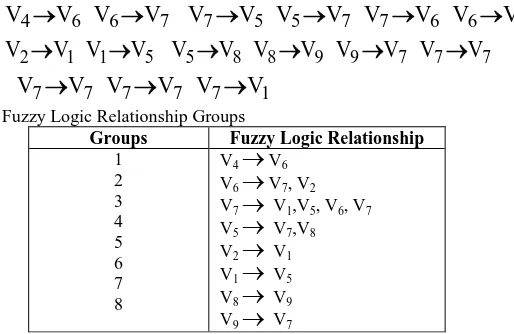
Variations in the Fuzzy Logic Relationships
2 6 6 7 7 5 5 7 7 6 6
4
V
V
V
V
V
V
V
V
V
V
V
V
7 7 7 9 9 8 8 5 5 1 1
2
V
V
V
V
V
V
V
V
V
V
V
V
1 7 7 7 7
7
V
V
V
V
V
V
Fuzzy Logic Relationship Groups
Groups Fuzzy Logic Relationship
1 2 3 4 5 6 7 8
V4
V6V6
V7, V2V7
V1,V5, V6, V7V5
V7,V8V2
V1V1
V5V8
V9V9
V7Step-7: Regulate the forecasted values by the combination function of the latest actual value of fuzzified data set and forecasted value.
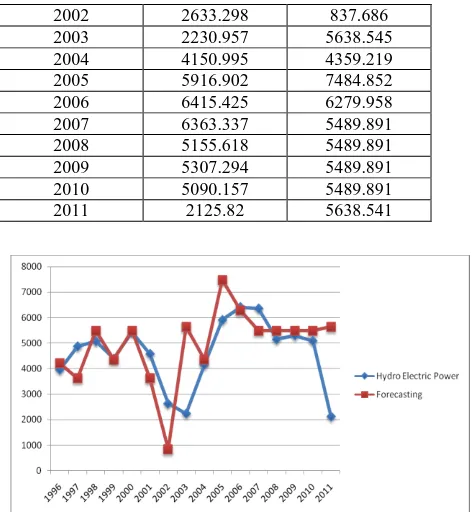
Table 2: Forecasting value of Hydro Power Generation
Year Hydro Electric
Power Forecasting
1995 3963.77 -
1996 3957.082 4213.857
1997 4870.091 3620.446
1998 5078.527 5489.891
1999 4389.201 4359.219
2000 5439.049 5489.891
4
2002 2633.298 837.686
2003 2230.957 5638.545
2004 4150.995 4359.219
2005 5916.902 7484.852
2006 6415.425 6279.958
2007 6363.337 5489.891
2008 5155.618 5489.891
2009 5307.294 5489.891
2010 5090.157 5489.891
[image:4.595.49.287.70.326.2]2011 2125.82 5638.541
Figure 1: Actual and Forecasted value of Hydro Power Generation
5.
CONCLUSION
In this paper fuzzy time series method is designed to forecast the hydro power generation of Tamil Nadu. Electricity is a critical infrastructure for sustainable growth of economy. Power development is an important input for the State’s industrial, commercial and socio economic growth. For this, the availability of affordable, reliable and quality power is necessary. In future, electricity more needed for every sector. Based on the numerical calculations and graphical representations the sufficient condition has to be made for augmenting power supply to bridge the gap between demand and supply as well as to meet the increasing future demand.
6.
REFERENCES
[1] Aladag Cagdas H., Basaran Murat A., Egrioglu Erol, Yolcu Ufuk and Uslu Vedide R. (2009): Forecasting in high order fuzzy times series by using neural networks to define fuzzy relations, Expert Systems with Applications, Vol.36, pp. 4228–4231.
[2] Aznarte José Luis, Alcalá-Fdez Jesús, Arauzo-Azofra Antonio and Benítez José Manuel (2012): Financial time series forecasting with a bio-inspired fuzzy model, Expert Systems with Applications, Vol.39, pp.12302–12309.
[3] Bajestani Narges Shafaei and Zare Assef (2011): Forecasting TAIEX using improved type 2 fuzzy time series, Expert Systems with Applications, Vol. 38, pp.5816–5821.
[4] Cheng Ching-Hsue, Wang Jia-Wen and Li Chen-Hsun (2008): Forecasting the number of outpatient visits using a new fuzzy time series based on weighted-transitional matrix, Expert Systems with Applications Vol.34, pp. 2568–2575.
[5] Cheng Ching-Hsue, Chen Tai-Liang, Teoh Hia Jong and Chiang Chen-Han (2008): Fuzzy time-series based on adaptive expectation model for TAIEX forecasting, Expert Systems with Applications, Vol. 34, pp. 1126–1132.
[6] Chi-Chen Wang, (2011): A comparison study between fuzzy time series model and ARIMA model for forecasting Taiwan export, Expert Systems with Applications Vol. 38, pp.9296–9304.
[7] Chunshien Li and Jhao-WunHu (2012): A new ARIMA-based neuro-fuzzy approach and swarm intelligence for time series forecasting, Engineering Applications of Artificial Intelligence, Vol. 25, pp. 295–308.
[8] Duru Oken, Bulut Emrah and Yoshida Shigeru (2010): Bivariate Long Term Fuzzy Time Series Forecasting of Dry Cargo Freight Rates, The Asian Journal of shipping and Logistics, Vol.28, No.2, pp.205-223.
[9] Egrioglu Erol, Aladag Cagdas Hakan, Yolcu Ufuk, Basaran Murat A. and Uslu Vedide R. (2009): A new hybrid approach based on SARIMA and partial high order bivariate fuzzy time series forecasting model, Expert Systems with Applications Vol.36, pp. 7424–7434.
[10]Egrioglu Erol, Aladag Cagdas Hakan and Yolcu Ufuk (2013): Fuzzy time series forecasting with a novel hybrid approach combining fuzzy c-means and neural networks, Expert Systems with Applications, Vol. 40, pp. 854–857.
[11]Enjian Bai, W.K. Wong, W.C. Chu, Min Xia, and Feng Pan, (2011): A heuristic time-invariant model for fuzzy time series forecasting, Expert Systems with Applications vol.38, pp. 2701–2707.
[12]Kunhuang Huarng and Hui-Kuang Yu (2005): A Type 2 fuzzy time series model for stock index forecasting, Physica A, Vol. 353, pp. 445–462.
[13]Lia Sheng-Tun, Cheng Yi-Chung (2007): Deterministic fuzzy time series model for forecasting enrollments, Computers and Mathematics with Applications, Vol. 53, pp. 1904–1920.
[14]Liu (2009): An integrated fuzzy time series forecasting system, Expert Systems with Applications, Vol. 36, pp.10045–10053.
[15]Liu Hao-Tien and Wei Mao-Len (2010): An Improved Fuzzy Forecasting Method for Seasonal Time Series, Expert Systems with Applications, Vol. 37, pp. 6310–6318.
[16]Pierpaolo D’Urso and Elizabeth Ann Maharaj (2009): Autocorrelation-based fuzzy clustering of time series, Fuzzy Sets and Systems, Vol.160, pp.3565–3589
[17]Qiang Song (2003): A Note on Fuzzy Time Series Model Selection with Sample Autocorrelation Functions, Cybernetics and Systems: An International Journal, Vol.34, pp. 93-107.
[18]RafiulHassan Md., Nath Baikunth, Kirley Michael, Kamruzzaman Joarder (2011): A hybrid of multi objective Evolutionary Algorithm and HMM-Fuzzy model for time series prediction, Neuro computing Vol.81, pp. 1–11.
[20]Ruey-Chyn Tsaur,(2012): A Fuzzy Time Series-Markov Chain Model with an Application to Forecast the Exchange Rate Between the Taiwan and US Dollar, International Journal of Innovative Computing, Information and Control,Vol.8, No.7(B), pp. 4931- 4942.
[21]Shah Mrinalini (2012): Fuzzy based trend mapping and forecasting for time series data, Expert Systems with Applications, Vol. 39, pp. 6351–6358.
[22]Sheng-Tun Li, Shu-Ching Kuo, Yi-Chung Cheng and Chih-ChuanChen (2010): Deterministic vector long-term forecasting for fuzzy time series, Fuzzy Sets and Systems, Vol.161,
pp.1852–1870.
[23]Shiva Raj Singh,(2008): A computational method of forecasting based on fuzzy time series, Mathematics and Computers in Simulation Vol.79, pp. 539–554.
[24]Shiva Raj Singh, (2009): A computational method of forecasting based on high-order fuzzy time series, Expert Systems with Applications Vol. 36, pp. 10551–10559.
[25]Shiva Raj Singh (2007): A Robust Method of Forecasting based on Fuzzy Time Series, Applied Mathematics and Computation, Vol. 188, pp. 472–484.
[26]Tiffany Hui-Kuang Yu and Kun-Huang Huarng (2008): A bivariate fuzzy time series model to forecast the TAIEX, Expert Systems with Applications Vol.34, pp. 2945–2952.
[27]Wangren Qiu, Xiaodong Liu and Hailin Li (2011): A generalized method for forecasting based on fuzzy time series, Expert Systems with Applications Vol.38, pp. 10446–10453.