and Non-termination Proofs
Ton Chanh Le1, Cristian Gherghina2, Aquinas Hobor1, and Wei-Ngan Chin1 1 Department of Computer Science, National University of Singapore, Singapore
2 Singapore University of Technology and Design, Singapore
Abstract. We propose a unified logical framework for specifying and proving bothtermination and non-termination of various programs. Our framework is based on a resource logic which captures both upperandlower bounds on re-sources used by the programs. By an abstraction, we evolve this resource logic for execution length into a temporal logic with three predicates to reason about termination, non-termination or unknown. We introduce a new logical entailment system for temporal constraints and show how Hoare logic can be seamlessly used to prove termination and non-termination in our unified framework. Though this paper’s focus is on the formal foundations for a new unified framework, we also report on the usability and practicality of our approach by specifying and ver-ifying both termination and non-termination properties for about 300 programs, collected from a variety of sources. This adds a modest 5-10% verification over-head when compared to underlying partial-correctness verification system.
1
Introduction
Termination proving is an important part of correctness proofs for software systems as “so-calledpartial correctnessis inadequate: if a program is intended to terminate, that fact must be part of its specification.” – Cliff Jones [26]. Thus,total correctnessproofs, denoted by the Hoare triple[P]c[Q], require the code fragmentcto be shown terminat-ing in addition to meetterminat-ing the postconditionQafter execution. The termination of a loop or a recursive method is usually proven by a well-founded termination measure given to the specification. However, such a measure is not a component of the logical formu-las for pre/post specifications. A reason for this distinction is that specification logic typically describes program states, while the termination proofs are concerned with the existence of well-founded measures to bound the execution length of loops/recursions, as argued by Hehner in [23]. Due to this distinction, we cannot automatically leverage richer logics that have been developed for safety properties to conduct more intricate termination and non-termination reasoning.
For illustration, let us use the Shuffle problem proposed in the Java Bytecode Recur-sive category of the annual Termination Competition [33]. In this problem, an acyclic linked list is shuffled by theshuffle method together with the auxiliaryreverse
method, whose source code is shown in Fig. 1. To prove thatshuffleterminates, we need to firstly show thatreversealso terminates. While the termination ofreverse
can be easily proved by current approaches, such as [30,7,11], provingshuffle ter-minates is harder because it requires a functional correctness related fact: thereverse
method does not change the length of the list. Based on this fact, it is possible to show S. Merz and J. Pang (Eds.): ICFEM 2014, LNCS 8829, pp. 267–283, 2014.
c
public static List shuffle(List xs){
if(xs==null)return null; else{
List next = xs.next; return new List(xs.value,
shuffle(reverse(next)));
} }
public static List reverse(final List l){
if(l==null||l.next==null) return l;
final List nextItem = l.next; final List reverseRest =
reverse(nextItem); l.next = null; nextItem.next = l; return reverseRest;}
Fig. 1.The Shuffle problem from the Termination Competition
that the linked list’s length is also decreasing across the recursive method callshuffle; as a result, the method always terminates.
Therefore, without an integration of termination specification into logics for func-tional correctness, such as separation logic [36], the termination ofshuffleis hardly specified and proved by verification systems based on the traditional Hoare logic for total correctness. Note that automated termination provers, such as AProVE [19] and COSTA [3], are not able to show thatshuffleterminates, even after applying a nu-meric abstraction on the size property toshuffle[32], due to the lack of information flow between the correctness and the termination arguments. We believe that relatively complex problems, such as Shuffle, highlight the need of a more expressive logic with the ability of integration into various safety logics for termination reasoning.
Moreover, if the termination proof fails,e.g., when the input list ofshuffleis cyclic, the program will beimplicitlyassumed to bepossiblynon-terminating. That is,definite non-termination is neitherexplicitlystated nor proven by Hoare logic. Explicitly prov-ing non-termination has two benefits. First, it allows more comprehensive specifications to be developed for better program understanding. Second, it allows a clearer distinction between expected non-termination (e.g., reactive systems where loops are designed to be infinite) and failure of termination proofs, paving the way for focusing on real non-termination bugs that minimize on false positives.
Some specification languages, such as Dafny [31], ACSL [6] and JML [29], allow the specification ofpossiblenon-termination but their corresponding verifiers provide lim-ited support for this feature. For example, the verifier of Dafny only allows such specifi-cation on loops or tail-recursive methods1, while Frama-C verifier of ACSL [15] has not implemented it. On the other hand, we can use thefalsepostcondition, which indicates that the method’s exit is unreachable, to specifydefinitenon-termination. However, such postcondition for partial correctness is not preferred as it is logically distinct from ter-mination proofs. This distinction has been designed into Dafny, Frama-C and KeY with JML [2], that makes the tools fail to take into account non-terminating behavior when proving termination. For example, Dafny succeeds in proving the termination of a recur-sive method2though this method contains a call to a non-terminating method.3 In fact, for termination proofs, these tools simply check that there is a finite number of mutually recursive calls to the analyzed methods, rather than the methods’ termination per se.
1
http://www.rise4fun.com/Dafny/PnRX
2http://www.rise4fun.com/Dafny/6FuR 3
The examples in ACSL and JML are at
Our Proposal. We propose integrating both termination and non-termination require-ments directly into the specification logic for functional properties. Our work follows Hoare and He [24] and Hehner [22], in which the termination is reasoned together with partial correctness proof. In [22], the program is instrumented with a time variablet and the termination is proven by a finite bound on theexactexecution timet−t, where t, tare the initial, resp. final time. In [24], a special ghost variableokis used to signify
termination. However, these approaches presently do not handle non-termination. As a formal foundation to unify termination and non-termination reasoning and integrate them into functional correctness proofs, we introduce a new resource logic which captures the concept of resource capacity; tracking bothminimum and maximum amounts of resources used by some given code. Our logic uses a primitive predicate
RCl, uwith invariant0≤l≤uto capture a semantic notion of resource capacity(l, u) with the lower boundland the upper boundu. Through this resource logic, we can specify a variety of complexity-related properties, including the notions of termination and non-termination, by tracking the number of calls (and loop iterations) executed by the given code. Termination is denoted by the presence of afiniteupper bound, while non-termination is denoted aninfinitelower bound on the execution length.
To support a more effective mechanism, we shall derive a simplertemporallogic from the richer resource logic itself. We define three temporal predicates,TermM,Loopand
MayLoop, whereM is a well-founded termination measure, and associate them with each method in a given program to denote the termination, definite non-termination and possible non-termination of these methods, respectively. In terms of resource rea-soning, these predicates representRC0,embed(M),RC∞,∞andRC0,∞, respec-tively, whereembed(M)is a finite bound obtained through an order-embedding ofM into naturals. Using the enriched specification logic, functional correctness, termination and non-termination of methods can be verified under a single modular framework. With this unification, the predicateTermM denotes exactly definite termination, instead of just denoting the bound on the number of loop iterations or method recursions like the termination measures used in the traditional Hoare logic for total correctness.
Our research contributions can be summarized as follows:
− A newresource logicthat can capture lower and upper bounds on resource usage via the concept of resource capacity, together with an entailment procedure to sup-port correctness proofs with resource-related properties. (Sec. 3)
− Atemporal logicthat is abstracted from the resource logic to reason about both program termination and non-termination. We introduce three new temporal con-straints, itsentailmentandHoare ruleslifted from the resource logic. (Sec. 4) − A successful integration of both resource and temporal logics into a separation
logic based verifier [35]. The new temporal logic is expressive enough to specify and successfully verify the (non-)termination behaviors for about 300 benchmark programs collected from a variety of sources, including the SIR/Siemens test suite [17] and problems from the Termination Competition (Sec. 5). The prototype im-plementation and benchmark are available for online use and download at:
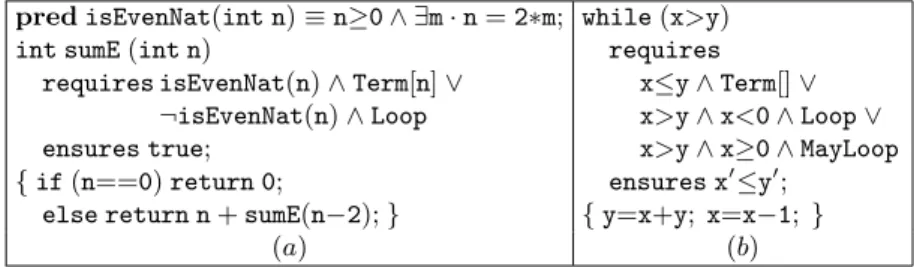
predisEvenNat(int n)≡n≥0∧ ∃m·n=2∗m;
int sumE(int n)
requires isEvenNat(n)∧Term[n]∨ ¬isEvenNat(n)∧Loop ensures true;
{if(n==0)return 0;
else return n+sumE(n−2);}
while(x>y)
requires x≤y∧Term[]∨ x>y∧x<0∧Loop∨ x>y∧x≥0∧MayLoop ensures x≤y;
{y=x+y; x=x−1; }
(a) (b)
Fig. 2.Examples on numerical programs
2
From Resource to Temporal Logic
We introduce a general resource predicateRCl, uwherelis a lower bound anduis an upper bound on resource capacity, with invariant0≤l≤u. This resource predicate can be specialized to execution capacity to capture a variety of complexity-related properties, via lower and upper bounds on the total number of method calls during the execution of a given piece of code. We shall give an instrumented semantics for this specific resource logic, and also specialize it for reasoning about termination and non-termination. To prove termination, we simply use the predicateRC0, uwhereuis some finite value, namelyu<∞. To prove non-termination, we can use the predicateRC∞,∞which signifies an infinite lower bound. Lastly, if we cannot prove either termination or non-termination, we use the predicateRC0,∞which covers all possibilities.
The resource logic we have outlined is quite expressive, and could moreover be spe-cialized for reasoning on just termination and non-termination with the direct handling of infinity∞value. In order to design a simpler logic, we introduce a temporal logic with three distinct predicates, as follows: (i)TermM to denoteRC0,embed(M), (ii) Loopto denoteRC∞,∞and (iii)MayLoopto denoteRC0,∞. Such a temporal logic
is considerably simpler than the more expressive resource logic, since we can omit rea-soning with∞. We can also use a simpler termination measureM, based on depth of recursion rather than number of calls, but relate to the latter usingembed(M). More-over, these temporal predicates can be made flow-insensitive, and thus need only appear in each method’s precondition where they describe execution capacity required for the method’s execution. This two-level approach simplifies both the design of a formal se-mantics, and the development of a verification framework for (non-)termination.
For illustration, let us look at some numerical examples, starting with the method
sumEin Fig. 2(a). This method is required to return the sum of all even natural
num-bers that are less than or equal to the inputn. However, the implementation satisfies this requirement only whenn is an even natural number, denoted by the predicate
isEvenNat(n); otherwise, the method does not terminate4. In our approach, these dis-tinct scenarios can be described in a termination-enriched specification by seamlessly integrating the temporal constraintsTerm[n]andLoopinto a logic with disjunctions.
4
The verification system assumes the use of arbitrary precision integers. When finite integers are used, we may give a different temporal specification for those prestates.
JML and ACSL also support the specification of several method behaviors. However, the current ACSL implementation in Frama-C does not allow fine-grained termination related specification of each behavior and ignores conditional termination clauses. As a result, it cannot verify all the (non-)terminating behaviors ofsumEtogether. KeY al-lows the specification of termination for each individual method behavior but it cannot disprove the termination ofsumEwhennis an odd positive number, because the variant
nis still valid under this precondition.3In contrast, our unified termination and non-termination reasoning does not accept the temporal constraintTerm[n]in these prestates because the execution starting from them will eventually reach a non-terminating exe-cution whenn<0. In terms of resource reasoning,Term[n], denoting a finite resource,
is invalid as it cannot satisfy the infinite resource required by the non-termination. The next example in Fig. 2(b)illustrates a usage ofMayLoop constraint. Starting from any prestate satisfyingx>y∧x≥0, the execution of the given loop may reach either the base case (whenx≤y, indicated byTerm[]) or the non-terminating case (when x>y∧x<0, indicated byLoop). We observe that thisMayLoopprecondition can be strengthened to thenon-linearconstraint4x2+4x+8y+9≥0for non-termination, but this requires stronger arithmetic solvers.
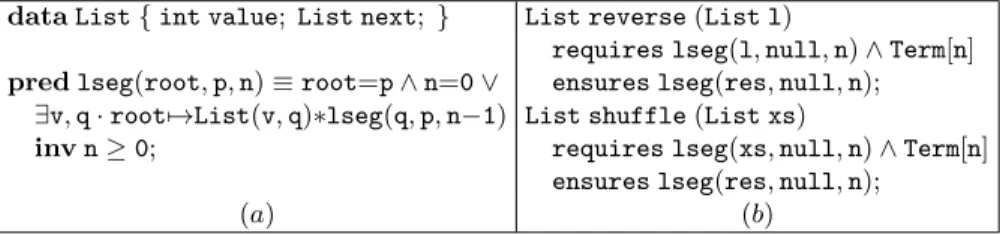
Though our proposal is independent of the underlying logics on functional proper-ties, it can leverage infrastructures of richer logics5 to conduct termination and non-termination reasoning for more complex domains. For example, our proposed temporal constraints are easily integrated into formulas of separation logic to reason about the termination and non-termination of heap-based programs. We choose a fragment of sep-aration logic with the separating conjunction∗and the points-to operator →to specify the heap assertions. These operators are used to describe several data structures, such as linked list and tree. For example, the inductive predicatelseg(root,p,n)declared in Fig. 3(a)describes a list segment size ofnfromroottopwith an invariant property stated that the list’s size is non-negative. This predicate can be used to specify either null-terminating lists (whenp=null) or circular lists (whenp=root).
dataList{int value;List next; } predlseg(root,p,n)≡root=p∧n=0∨
∃v,q·root →List(v,q)∗lseg(q,p,n−1) invn≥0;
List reverse(List l)
requires lseg(l,null,n)∧Term[n]
ensures lseg(res,null,n);
List shuffle(List xs)
requires lseg(xs,null,n)∧Term[n]
ensures lseg(res,null,n);
(a) (b)
Fig. 3.A specification in separation logic to verify the correctness of Shuffle’s methods
We then use the predicate lseg for the pre and postconditions of two methods
reverseandshufflein the Shuffle problem. The specification of each method in-dicates that the method’s resultresis a linked list with the same sizenas the input list. From these safety specifications, the temporal constraintTerm[n]integrated into the precondition of each method is able to specify that the depth of recursion is bounded by the size of the input list, thus indicating the method’s termination.
5
From the perspective of resource reasoning, a temporal constraint in the precondi-tion of a method defines the bounds of available resource allowed for program execu-tions from prestates satisfying (safety part of) this precondition. This idea is similar to Atkey’s logic [5], a type-based amortized resource analysis for imperative programs, which associates a piece of resource with each element of the data structures prior pro-gram execution. However, Atkey’s approach only tracks the upper bound of resource usage, so that it cannot reason about non-termination. This shortcoming also applies to other type-based approaches for termination reasoning, such as [1,38]. In addition, while the amortized resource analysis accounts for individual time-step (or heap chunk), we use termination measures, which are much simpler, to facilitate termination proofs. For example, to analyzeshuffle, Atkey’s logic requires the global length property to present the polynomial resource associated with the input list using the technique of Hoffmann and Hofmann [25], which is much harder than locally reasoning about each node of the list as stated in his paper. Finally, this logic is built on top of just separation logic, rather than being generic as our proposal.
3
A Logic for Resource Reasoning
In proving termination and non-termination, our goal is to use resource reasoning based on execution capacity to provide a means for quantitatively assessing the execution length of a program. For this purpose, we introduce a resource logic to formally assess the minimum and a maximum bounds on a program’s resource consumption. We first extend the program state model with a mechanism to track resource capacities of the underlying machine. Since the particular consumed resource is countable and possibly infinite, we use the setN∞, short forN∪ {∞}, as its domain.
3.1 Resource Capacity
Definition 1 (Program states).A program stateσis a triple(s, h, r)of stacks∈ S (locals), heaph∈ H(memory) andr∈ R, resource capacity whereris a pair(rl, ru) of bounds inN∞, with0 ≤ rl ≤ ru, denoting the allowed minimum and maximum resource consumption for executions starting from the current program state.
Intuitively, a program state’s resource capacity (rl, ru)ensures that any execution starting from this state must consumeat leastrlandat mostruof the tracked resource. Definition 2 (Resource Capacity Ordering).Let(≤c)⊂N∞×N∞be the resource capacity ordering, such that(bl, bu)≤c(al, au)iffal≤blandbu≤au.
The resource capacity(al, au)is considered larger (or more general) than(bl, bu) ifal≤blandbu≤au. The intuition is that under this condition, any execution which guarantees the capacity(bl, bu)also guarantees the capacity (al, au). Based on this observation,(0,∞)is the largest resource capacity. In fact, it indicates an unconstrained resource consumption.
In order to properly define an operational semantics in terms of the proposed program state model, we also need to be able to express resource consumption. To this end we define a splitting operation over the resource capacity. We will say that a capacity (al, au)can be split into capacities(bl, bu)and(cl, cu), written(al, au)(bl, bu) = (cl, cu), if whenever an execution that guarantees the capacity(bl, bu)starts from a state
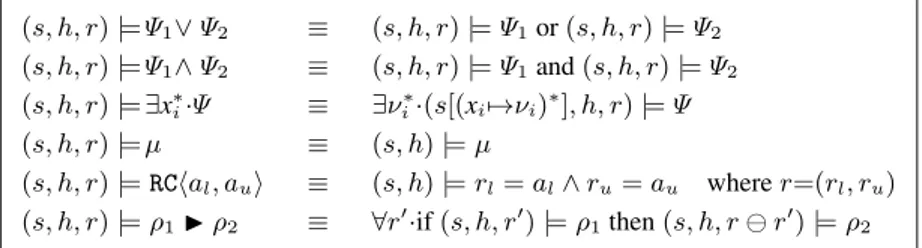
(s, h, r)|=Ψ1∨Ψ2 ≡ (s, h, r)|=Ψ1or(s, h, r)|=Ψ2
(s, h, r)|=Ψ1∧Ψ2 ≡ (s, h, r)|=Ψ1and(s, h, r)|=Ψ2
(s, h, r)|=∃x∗
i·Ψ ≡ ∃νi∗·(s[(xi →νi)∗], h, r)|=Ψ
(s, h, r)|=μ ≡ (s, h)|=μ
(s, h, r)|=RCal, au ≡ (s, h)|=rl=al∧ru=au wherer=(rl, ru)
(s, h, r)|=ρ1ρ2 ≡ ∀r·if(s, h, r)|=ρ1then(s, h, rr)|=ρ2 Fig. 5.Semantics of Assertions in the Resource-Aware Logic
with the capacity(al, au)then the remaining capacity is (cl, cu). In other words, the executions allowed by(al, au)can be decomposed into executions required by(bl, bu) followed by executions required by(cl, cu).
Definition 3 (Resource Capacity Splitting).Given resource capacities(al, au),(bl, bu) withbu≤auandal+bu≤au+blthen(al, au)(bl, bu) = (cl, cu)where
cl=min{xl∈N∞|xl+bl≥al}andcu=max{xu∈N∞|xu+bu≤au}. From Defn. 3,(cl, cu)is thelargestresource consumption allowed for any execution following executions satisfying(bl, bu)such that the overall resource consumption is described by(al, au). Under this interpretation it follows naturally that whenbu> au the splitting operation is undefined ascudoes not exist. In addition, whenal+bu > au+bl, the splitting operation is also undefined as it would lead tocl> cu.
3.2 Assertion Language and Semantics for a Resource-Aware Logic
To support resource reasoning, we extend a minimalistic assertion language with two resource assertions, as shown in Fig. 4. We usevandv∗for variables and sequences of variables,f(v∗)for functions from variables toN∞,μandΦto represent resource-free formulas andρfor resource assertions.
Ψ ::=(∃v∗·μ∧ρ)∗ Φ::=(∃v∗·μ)∗ ρ ::=RCal, au |ρ1ρ2
a ::=f(v∗)
Fig. 4.The Assertion Language
The resource assertionρranges over (i)atomic re-source assertionsRCal, au, whereal, au are func-tions from variables toN∞; and (ii)splittingresource assertionsρ1 ρ2, which holds for states that allow executions to be split into two execution fragments, on whichρ1andρ2hold respectively.
We concisely list in Fig. 5 the semantic model for the assertion language. We observe that the usual se-mantics of the logical connectives,e.g., conjunctions and disjunctions, lifts naturally over resource assertions. The semantics of the resource-free assertions is straightfor-ward: a resource-free formulaμholds for all states(s, h, r)such that(s, h)|=μwith respect to the semantics of the corresponding underlying logic.
We point out that we have chosen to model the RCal, au assertion as a precise predicate. That is, a program stateσ satisfies a resource constraintρif the resource capacity inσis equal to the evaluation, in the context ofσ, of the upper and lower functions associated withρ. This modeling relation ensures that the resource assertion ρisprecisewith regards to the resource capacity, where(s, h, r)|=ρdoes not imply
(s, h, r) |= ρwheneverr is larger thanr,i.e.,r ≥
c r. Consequently,RCal, au
RCbl, bu iff (s, h) |= al=bl ∧ au=bu. Additionally, RCal, au ∧ RCbl, bu ≡
RCal, auiffal=bl∧au=bu; otherwise,RCal, au ∧RCbl, bu ≡false.
To provide a precise modular resource reasoning, we lift the semantic split operation into a resource splitting assertionρ1ρ2. This enables our proof construction to follow the same style of other resource manipulating logics, such as separation logic. The intuition behind the splitting resource assertions is thatρ1ρ2holds for any program state from which it is possible to consume as many resources asρ1 requires and end in a state that satisfiesρ2. Or equivalently,ρ1ρ2holds for all states whose resource capacity can be split into two portions, such that the resulting capacities satisfyρ1and ρ2, respectively. In addition, we can useto add a resource capacityρ1into the current available resource capacityρ, resulting in ρ ρ1. The semantics ofρ1 ρ2is also given in Fig. 5.
3.3 Resource-Enhanced Entailment with Frame Inference
Based on the semantics of resource assertions and the standard definition of the logical entailment relation (i.e.,Ψ1 Ψ2 iff∀σ· ifσ |= Ψ1thenσ |= Ψ2), it is possible to define an entailment for resource constraints of the formρρ1ρ2as follows: Lemma 1 (Resource Entailments).Given resource assertionsρ,ρ1andρ2,ρρ1 ρ2iff∀s, h, r, r1· if(s, h, r)|=ρand(s, h, r1)|=ρ1then(s, h, rr1)|=ρ2. Proof. The proofs of all lemmas in this paper can be found in the technical report [28].
It follows that givenf, a lifting of resource capacity splitting to functions, then: (ρ2
l, ρ2u) = (ρl, ρu)f(ρ1l, ρ1u)
RCρl, ρu RCρ1l, ρu1RCρ2l, ρ2u
Entailments of the form ρ ρ1 ρ2 are of particular interest in the context of program verification as they naturally encode the restriction imposed at a method call and the remaining restriction after the execution of this method. For the proposed re-source logic, we construct a general entailment system with frame inference by merg-ing the entailment of resource constraints presented earlier with the entailment system corresponding to the underlying logic. Let the underlying entailment system be of the general formΨ Φ;Φrdenoting thatΨ impliesΦwith frameΦr. In sub-structural logics such as separation logic, the frame captures any residual state that is not required by the entailment. In pure logics where the program states are not changed, the frame is simply the antecedent of the entailment.
To support logics with disjunctions, the entailment system firstly deconstructs dis-junctive antecedents (e.g., using the rule[ENT−DISJ−LHS]) and consequents until
for-mulas of the formμ∧ρwith a single resource constraint6are encountered in both sides of the sub-entailments. The judgment system then applies the rule[ENT−CONJ]that is slightly changed to handle resource constraints by splitting an entailment into two parts, namelylogicalpart andresourcepart. The logical goal is solved by the entail-ment systemμaμc;Φrof the underlying logic. The resource goal is solved by using
6
A conjunction of resource constraints can be simplified to either a single resource constraint orfalseas discussed in Sec. 3.2.
the resource entailment rules presented above. The solving process for the resource part leverages the entailment outcomeΦrfrom the underlying logic, which is simply added to the antecedent of the resource entailment, to check the condition stated in Defn. 3 for the resource capacity splitting operation to be defined.
[ENT−DISJ−LHS]
Ψ = ∃v∗
i ·(μi∧ρi) ∀i· (μi∧ρi)Φ;Ψri
Ψ Φ;∃v∗
i ·Ψri
[ENT−CONJ]
μaμc;Φr μa∧Φr∧ρaρcρr μa∧ρaμc∧ρc;(Φr∧ρr) 3.4 Hoare Logic for Resource Verification
Language. We provide a core strict imperative language with usual constructs, such as type declarations, method declarations, method calls, assignments, etc. to facilitate the verification for multiple front-end imperative languages. For simplicity, we choose a core language without while-loop constructs and assume a preprocessing step that applies an automatic translation into tail-recursive methods with reference-type param-eters (declared by the keywordref).
The pre and post conditions of a method are specified by therequiresandensures
keywords, followed by logic formulas in the assertion language in Fig. 4. Resource-related assertions always appear in the method preconditions to denote resource re-quirements imposed on the caller for its execution. In contrast, resource assertions in the postconditions denote unspent/generated fuel returned to the caller, so that these as-sertions may not appear in the postconditions, depending on the analyzed resource. For example, as execution length (i.e., a temporal resource) can only be consumed, it is safe and convenient to assume that the method consumes all the initially required resource; thus we can avoid the need for execution length related assertions in postconditions. Hoare Logic. We observe that the resource consumption of each program statement is dependent on the tracked resource. As a result, the resource-aware Hoare logic needs to be adapted accordingly for each resource type. In terms of termination and non-termination reasoning, we are interested in the execution length as the tracked resource capacity. In the next section, we will construct a specific Hoare logic to reason about this resource.
4
(Non-)Termination Proofs via Resource Reasoning
For termination and non-termination reasoning, we have proposed three temporal con-straints to capture: guaranteed terminationTermX, guaranteed non-terminationLoop
and possible non-terminationMayLoop, whereX is a ranking function built from pro-gram variables. First, we define these constraints as resource capacity assertions, using the more generalRCpredicate. Next, we leverage the resource logic in Sec. 3, special-ized in execution capacity, to construct a logic for termination and non-termination rea-soning. A resource-based definition for the proposed temporal constraints is as follows: Definition 4 (Temporal Constraints).Temporal constraints are resource assertions over program execution lengths, such thatTermX ≡RC0f, ,Loop≡RC∞f,∞f
andMayLoop≡RC0f,∞fwhere0f and∞f denote the constant functions always returning0respectively∞.is a function of program variables to naturals, imposing a finite upper bound on the execution length of a terminating program.
Using the definition of resource entailments in Lemma 1, we formalize the set of valid entailments for temporal constraints below:
MayLoopMayLoopMayLoop MayLoopTermX MayLoop MayLoopLoopMayLoop
Loop MayLoopLoop
LoopTermXLoop LoopLoopMayLoop
μ=⇒Y ≤dX
μ∧TermX TermY TermX−dY
where≤dand−dare the ordering and the subtraction operation on the domain of the termination measuresXandY, respectively. All other decomposition attempts, such as
TermX MayLoop andTermX Loop , describe unfeasible splits. Thus in those cases, the entailment fails and an error is signaled.
4.1 From Termination Measures to Execution Capacity’s Finite Upper Bounds In Defn. 4, asX denotes a termination measure, a bounded function that decreases across recursive method calls, the resource upper boundmust also follow. Thus, the mapping function fromX to must be anorder-embeddingdenoted byembed(X).
In our approach, the termination measureX is a list of arithmetic formulas over nat-urals since this formulation is simpler to write than a single but more complex ter-mination measure and it can be used for a wider range of programs. In general, an order-embedding of lists of unbounded elements requiresordinals. However, transfinite ordinals are not suitable to model finite computational resources denoted byTermX.
By aco-inductiveargument that every execution of a terminating method only com-putes finitely many different values, it follows that every non-negative element of a lexicographic termination measure applied to states of the corresponding call tree is upper-bounded. We then show that there always exists an order-embeddingLfrom the codomain of a termination measure (i.e., tuples of bounded naturals) to naturals, such thatembed(X) =L ◦X.
Lemma 2. If the termination of a program can be proven by a given lexicographic termination measure, then for each call treeτ of the program, every element of the termination measure applied to the program states corresponding to the nodes in the call treeτis bounded.
If every element xi, where0 ≤ i ≤ n−1, of a lexicographic termination mea-sure[xn, xn−1, . . . , x0]corresponding to a given call treeτ is bounded by a constant k, we can use the base b = k+1to construct a possible order-embedding function D([xn, xn−1, . . . , x0]) =xn∗bn+xn−1∗bn−1+. . .+x0. The functionDpreserves the order of the given measure along every trace ofτ, as stated by Lemma 3.
Lemma 3. For allxn, . . . , x0, yn, . . . , y0∈Nsuch that∀i∈ {0..n−1} ·xi, yi < b, [xn, . . . , x0] >l [yn, . . . , y0]iffD([xn, . . . , x0]) > D([yn, . . . , y0]), where>l is the lexicographic ordering.
CheckMin(Ψ1) CheckMin(Ψ2)
CheckMin(Ψ1∨Ψ2)
μρl= 0
CheckMin(μ∧RCρl, ρu)
[FV−CALL]
t0mn((t v)∗) (ΨPre, ΦPost){code} ∈Prog
Ψ RC1,1;Θ ΘΨPre;Φ Ψr=Φ∧ΦPost {Ψ}mn(v∗){Ψr}
[FV−RET]
CheckMin(Ψ)
{Ψ}returnv{Ψ∧res=v}
Fig. 6.Hoare Verification Rules: Method Call and Return
In general, such a bounded constantkfor a call treeτ can be determined by a func-tionKof initial values of the call tree’s variables. Since the execution of a loop has only a single trace, the order-embeddingD, constructed from the constantk, would be enough to ensure the sufficiency of execution capacity for the loop. However, in order to give a proper estimate of the execution capacity for more complex recursion patterns, especially when the termination measures are based on the depth of recursion, we pro-pose using a more refined embedding for a call tree, that isL=
D ,N ≤1 ND,N >1, where
N is the maximum number of children for each node of the call tree.
Therefore, given the termination measureX of a terminating program, there always exists an order-embeddingLfrom the codomain ofXto naturals. The functionLcan be constructed from initial values of program variables and the call trees corresponding to these initial values. As a result,embed(X) =L◦Xis a function from program variables to naturals, which describes an upper bound on the number of method calls taken by any execution of the program.
4.2 Termination and Non-termination Verification
Here we elaborate on the construction of both termination and non-termination proofs based on Defn. 4 and the verification framework in Fig. 6 for tracking execution length as resource. Although execution length can be tracked at various levels of granularities, we choose to track it only at method calls (i.e., as the total number of method calls) in order to simplify the verification rules and the operational semantics. In Fig. 6, we only outline the Hoare logic rules for the method call and the return statements, which are especially relevant to the verification of execution lengths as they encode the resource consumption. The Hoare rules for other constructs are standard because they do not interact with the resource of interest.
As a standard preprocessing step, we check that all predicate invariants are satisfied, including the invariants of resource constraints: the resource assertion RCρl, ρu in preconditionΨPreis consistent if0≤ρl≤ρu, that is, for each disjunctμ∧RCρl, ρu ofΨPre it follows thatμ ρu ≥ ρl∧ρl ≥ 0. We observe that the invariant check onTermX requires that every element ofXbe non-negative to ensure a non-negative upper-boundL◦X, so that the execution capacity satisfies the invariant0≤0f≤L◦X.
In the method call rule [FV−CALL], the available execution capacity is first
de-creased by one step, denoted byRC1,1, to account the cost of method call, followed
by a check that the callee’s requirements are met. This check is translated into an entail-ment for proving the method precondition. Finally, the poststate after this method call is computed. With the help of the resource-enhanced entailment system introduced in
Sec. 3.3, both logical and resource proving are combined into one entailment, resulting in a standard-looking Hoare rule for method call.
In addition, specifically for temporal constraints, two entailmentsΨ RC1,1;Θ
andΘ ΨPre;Φcan be combined intoΨ ΨPre;Φby using a new entailmentt for temporal constraints.
Definition 5 (Unit Reduction Temporal Entailments).Given temporal constraintsθ, θ1andθ2,θtθ1θ2iff∀s, h, r· if(s, h, r)|=θthen(s, h, r(1,1))|=θ1θ2.
Therefore, ifθisLooporMayLoopthenθtθ1θ2iffθθ1θ2. IfθisTermX
thenμ∧TermX tTermY Term((X−d1d)−dY)ifμ=⇒Y <dX, where1dis the unit of termination measures’ domain. Basically, the checkY <d X is equivalent to the check that termination measures are decreasing across recursive method calls in the traditional termination proof. By introducing the temporal entailmentt, we obtain a resource-based temporal logic which is related to only the temporal constraints and thus the underlying resource reasoning becomes implicit.
In the method return rule[FV−RET], theCheckMinpredicate, which is also defined in Fig. 6, ensures that the specified minimum computation resource has been completely consumed when the method returns. Note that if the method does not terminate, the minimum guaranteed execution length is always satisfied since the actual return point is never reached. For temporal constraints,CheckMinholds for anyTermXandMayLoop
as the lower bounds in their execution capacities are always0. In non-termination cases, CheckMin(μ∧Loop)only holds whenμis unsatisfiable. This check ensures that a return statement cannot be executed/reachable from a state satisfyingLoop.
We now state the soundness of this resource-aware Hoare logic as follows:
Theorem 1. The standard Hoare rules (e.g., assignment, conditional, sequential com-position) and the Hoare rules for method call and return are sound.
Proof. The proof can be found in the technical report [28]. 4.3 Flow-Insensitive Temporal Logic
Observe that the current formulation of the temporal logic with temporal constraints isflow-sensitivesince the entailmentθ t θ1 θ2might return a residueθ2distinct fromθ. However, with the following observations, we can formalize aflow-insensitive version of the temporal logic and provide a further abstraction on the resource-based framework presented so far.
First, it is possible to refine the granularity of the termination and non-termination verification by tracking only execution lengths of (mutually) recursive method calls. Second, using K¨onig’s lemma [27], it is sufficient to inspect individual execution traces in the call tree for deciding just termination or non-termination, instead of tracking the total execution length of all traces in the call tree. That is, a program terminates iff every execution trace is finite; otherwise, the program is non-terminating.
Based on these observations, the tracked resource will be abstracted to capture the execution capacity required for the longest trace in the call tree, instead of the exe-cution capacity required for the remaining program. With this, the resource (for the longest trace allowed) remains unchanged after each splitting operation, which deter-mines the residue resource needed for subsequent method calls. Thus, for every method, we endeavor to provide a single abstract resource that is sufficient for executing a given method call and also its remaining code sequences.
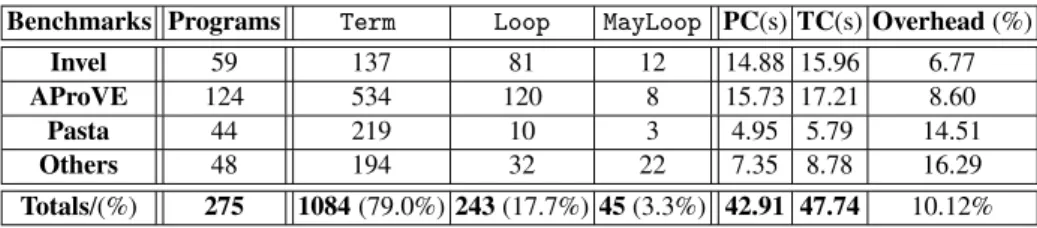
Benchmarks Programs Term Loop MayLoop PC(s)TC(s) Overhead(%)
Invel 59 137 81 12 14.88 15.96 6.77
AProVE 124 534 120 8 15.73 17.21 8.60
Pasta 44 219 10 3 4.95 5.79 14.51
Others 48 194 32 22 7.35 8.78 16.29
Totals/(%) 275 1084(79.0%)243(17.7%)45(3.3%) 42.91 47.74 10.12% Fig. 7.Termination Verification for Numerical Programs
By using this abstraction, we can obtain a formulation on temporal entailment that ensuresθt θ1 θwhereby the temporal constraint in residue is always identical to the one in the antecedent. Hence, the operator−dcan be fully circumvented. Moreover, the finite upper boundused for the definition ofTermXin Defn. 4 can be determined as = D ◦X, instead of the largerL ◦X. As a result, without any change to the Hoare rules, during a method’s verification, the same initial resource capacity is used for the verification of call traces and thus facilitating a simpler verification procedure for temporal constraint. As a direct outcome of this abstraction, the temporal assertions
Loop,MayLoopandTermX are nowflow-insensitive, and therefore closer to the pure logic form, as opposed to the sub-structural form of resource logics. Note that flow-insensitive label applies to only the temporal constraints. In general, program states (e.g., denoted by separation logic as the underlying logic) remain flow-sensitive since they might be changed due to changes on heap state and program variables.
5
Experiments
We have implemented the proposed termination logic into an automated verification system, calledHipTNT. The integration of the termination logic into an existing system allows us to utilize the infrastructure that has been developed for some richer specifi-cation logics, such as separation logic, beyond a simple first-order logic. Consequently, we are able tospecifyandverifyboth termination and non-termination properties, in addition to correctness properties for a much wider class of programs, including heap-manipulating programs. In this system, the final proof obligations are automatically discharged by off-the-shelf provers, such as Z3 [16]. The expressivity of our new inte-grated logic is shown in the following experimental results, in which the lexicographic order is needed for about 25% of the considered programs in our experiments.
5.1 Numerical Programs
HipTNTwas evaluated using a benchmark of over 200 small numerical programs se-lected from a variety of sources: (i) from the literature, such as [13,11], (ii) from bench-marks used by other systems (that are AProVE [19], Invel [37] and Pasta [18]) and (iii) some realistic programs, such as the Microsoft Zune’s clock driver that has a leap-year non-termination bug. Most of the methods in these benchmark programs contain either terminating or non-terminating code fragments, expressed in (mutual) recursive calls or (nested) loops. To construct these benchmarks we added the novel termina-tion specificatermina-tions to the original examples from the analysis tools for terminatermina-tion and non-termination. We have chosen these benchmarks in order to show the usability and
practicality of our approach. A comparison with these tools would be of less relevance as our proposal focuses on verifying the given specifications rather than infer them.
Fig. 7 summarizes the characteristics and the verification times for a benchmark of numerical programs. Columns 3-5 describe the number of preconditions that have been specified and successfully verified asterminating,non-terminatingorunknown, respectively. As hoped for, the number of preconditions annotated byMayLoopoccupies the smallest fragment (about3%) of the total number of preconditions. SuchMayLoop
constraints were only used in some unavoidable scenarios, such as (non-)termination depends on unpredictable user input or non-deterministic assignments to variables. In contrast, theTerm constraints (with the given measures) are in the majority because most of the methods are expected to be terminating, except for the Invel benchmark which focuses on mostly non-terminating programs.
Our verification system can perform both correctness and termination proofs. Col-umn 7 (TC) gives the total timings (in seconds) needed to perform both termination and correctness proofs for all the programs in each row, while column 6 (PC) gives the timings needed for just correctness proofs. The difference in the two timings represents the small overhead needed for termination and non-termination reasoning.
5.2 Heap-Manipulating Programs
We have also conducted termination reasoning on our own benchmark of heap-based programs using various data structures, on problems under Java Bytecode categories of the Termination Competition [33] and on some medium programs taken from the SIR/Siemens test suite [17]. Due to the tight integration with the underlying logics, the task of specifying and verifying the termination properties was easy even though some of the programs use non-trivial data structures (e.g., Red-Black and AVL-trees), or non-linear constraints (e.g., the BigNat program, which implements infinite precision natural numbers (by linked lists) with procedures for some arithmetic operations, in addition to a fast multiplication method based on the Karatsuba algorithm). We report that the termination and expected non-termination of all programs in these benchmarks are verified successfully with a small overhead (< 5%). Due to space limitation, the detailed experimental results and discussion on these benchmarks are put in [28].
6
Related Work and Conclusion
There exists a rich body of related works on automatic analysis for termination [30,8,14], non-termination [21,37,10], and both [19]. However, they consider termination and non-termination reasoning as distinct from functional correctness reasoning. Therefore, these works cannot leverage the result of functional correctness analysis to conduct more intricate (non-)termination reasoning. Recently, Brockschmidtet al.[9] propose a cooperation between safety and termination analysis to find sufficient supporting invari-ants for the construction of termination arguments but not considering non-termination. Chenet al.[12] introduce a similar approach for proving only non-termination. Our proposal complements these works since our aim is to construct a logic where termi-nation and non-termitermi-nation properties are directly integrated into specification logics, and thus utilize the available infrastructure on functional correctness proofs. We have
achieved this, and have also successfully evaluated its applicability on a wide range of programs, covering both numerical and heap-based programs.
Related to resource verification, [4] introduces a resource logic for a low-level lan-guage. While this logic avoids the need of auxiliary counters, it redefines the semantic model of the underlying logic to track the resource consumption via logical assertions, making the proposal harder to retrofit to other logics. Moreover, this logic only targets partial correctness, so that it does not take into account infinite resource consumption.
There are some works that are based on the well-foundedness of inductive definitions of heap predicates [7,11] or user-defined quantitative functions over data structures [20] to prove termination of heap-manipulating programs. On one hand, they do not require any explicit ranking function. On the other hand, these approaches might have problems with programs like the Karatsuba multiplication method, in which the arguments of the recursive calls are not substructures of the input lists. In addition, the automated tools, such as AProVE and COSTA, cannot prove the termination of this method. In contrast, our approach is more flexible as it allows explicit termination measures, that are possibly non-linear, for proving programs’ termination. These termination measures can be constructed from not only the heap structures but also the values of the data structures’ elements. For example, we use the actual value of the natural presented by a linked list to bound the execution of the Karatsuba method. Moreover, we also allow non-termination to be specified and verified for these programs. We believe that relatively complex examples, such as the Karatsuba method, highlight the benefits of our approach, which trades a lower level of automation but gains additional power.
The comparison of our approach with the other specification languages,i.e.. Dafny [31], JML [29], etc., has been discussed in Sec. 1. Another closely related work to ours is that of Nakata and Uustalu [34]. In this work, a Hoare logic for reasoning about non-termination of simple While programs (without method calls) was introduced. The logic is based on a trace-based semantics, in which the infiniteness of non-terminating traces is defined by coinduction. However, induction is still needed to define the finiteness of traces. In contrast, with resources, we can unify the semantics of the proposed termina-tion and non-terminatermina-tion temporal constraints and allow the Hoare logic for functermina-tional correctness to be enhanced for termination and non-termination reasoning with minor changes. Moreover, our logic allows interprocedural verification in a modular fashion. Conclusion.Termination reasoning has been intensively studied in the past, but it re-mains a challenge for the technology developed there to keep up with improvements to specification logic infrastructure, and vice versa. We propose an approach that would combine the two areas more closely together, through a tightly coupled union. Our unique contribution is to embed both termination and non-termination reasoning di-rectly into specification logics, and to do so with the help of temporal entailment. We also show how its properties can be captured by a resource logic based on execution ca-pacity, and how it could be abstracted into a flow-insensitive temporal logic. We believe this approach would have benefits. Its expressiveness is immediately enhanced by any improvement to the underlying logics. It can also benefit from infrastructures that have been developed for the underlying logics, including those that are related to program analysis. In particular we believe that a possible future avenue for investigation is to use the safety specifications as a basis for termination specification inference. Last, but not
least, it has placed termination and non-termination reasoning as a first-class concept, much like what was originally envisioned by Hoare’s logic for total correctness. Acknowledgement.This work was supported by MoE/NUS research project R-252-000-469-112.
References
1. Abel, A.: Type-based termination of generic programs. SCP 74(8) (2009)
2. Ahrendt, W., Baar, T., Beckert, B., Bubel, R., Giese, M., H¨ahnle, R., Menzel, W., Mostowski, W., Roth, A., Schlager, S., Schmitt, P.H.: The KeY tool. SSM 4 (2005)
3. Albert, E., Arenas, P., Genaim, S., Puebla, G., Zanardini, D.: COSTA: Design and Imple-mentation of a Cost and Termination Analyzer for Java Bytecode. In: de Boer, F.S., Bon-sangue, M.M., Graf, S., de Roever, W.-P. (eds.) FMCO 2007. LNCS, vol. 5382, pp. 113–132. Springer, Heidelberg (2008)
4. Aspinall, D., Beringer, L., Hofmann, M., Loidl, H.-W., Momigliano, A.: A program logic for resources. TCS 389(3) (2007)
5. Atkey, R.: Amortised resource analysis with separation logic. LMCS 7(2) (2011)
6. Baudin, P., Cuoq, P., Filliˆatre, J.-C., March´e, C., Monate, B., Moy, Y., Prevosto, V.: ACSL: ANSI/ISO C Specification Language Version 1.8. (2013),
http://frama-c.com/acsl.html
7. Berdine, J., Cook, B., Distefano, D., O’Hearn, P.W.: Automatic termination proofs for pro-grams with shape-shifting heaps. In: Ball, T., Jones, R.B. (eds.) CAV 2006. LNCS, vol. 4144, pp. 386–400. Springer, Heidelberg (2006)
8. Bradley, A.R., Manna, Z., Sipma, H.B.: The polyranking principle. In: Caires, L., Ital-iano, G.F., Monteiro, L., Palamidessi, C., Yung, M. (eds.) ICALP 2005. LNCS, vol. 3580, pp. 1349–1361. Springer, Heidelberg (2005)
9. Brockschmidt, M., Cook, B., Fuhs, C.: Better termination proving through cooperation. In: Sharygina, N., Veith, H. (eds.) CAV 2013. LNCS, vol. 8044, pp. 413–429. Springer, Heidel-berg (2013)
10. Brockschmidt, M., Str¨oder, T., Otto, C., Giesl, J.: Automated detection of non-termination and NullPointerExceptions for java bytecode. In: Beckert, B., Damiani, F., Gurov, D. (eds.) FoVeOOS 2011. LNCS, vol. 7421, pp. 123–141. Springer, Heidelberg (2012)
11. Brotherston, J., Bornat, R., Calcagno, C.: Cyclic proofs of program termination in separation logic. In: POPL (2008)
12. Chen, H.-Y., Cook, B., Fuhs, C., Nimkar, K., O’Hearn, P.: Proving nontermination via safety. In: ´Abrah´am, E., Havelund, K. (eds.) TACAS 2014 (ETAPS). LNCS, vol. 8413, pp. 156–171. Springer, Heidelberg (2014)
13. Cook, B., Gulwani, S., Lev-Ami, T., Rybalchenko, A., Sagiv, M.: Proving conditional termi-nation. In: Gupta, A., Malik, S. (eds.) CAV 2008. LNCS, vol. 5123, pp. 328–340. Springer, Heidelberg (2008)
14. Cook, B., Podelski, A., Rybalchenko, A.: Termination proofs for systems code. In: PLDI (2006)
15. Cuoq, P., Kirchner, F., Kosmatov, N., Prevosto, V., Signoles, J., Yakobowski, B.: Frama-C. In: Eleftherakis, G., Hinchey, M., Holcombe, M. (eds.) SEFM 2012. LNCS, vol. 7504, pp. 233–247. Springer, Heidelberg (2012)
16. de Moura, L., Bjørner, N.S.: Z3: An Efficient SMT Solver. In: Ramakrishnan, C.R., Rehof, J. (eds.) TACAS 2008. LNCS, vol. 4963, pp. 337–340. Springer, Heidelberg (2008) 17. Do, H., Elbaum, S.G., Rothermel, G.: Supporting Controlled Experimentation with Testing
18. Falke, S., Kapur, D.: A term rewriting approach to the automated termination analysis of imperative programs. In: Schmidt, R.A. (ed.) CADE-22. LNCS, vol. 5663, pp. 277–293. Springer, Heidelberg (2009)
19. Giesl, J., Schneider-Kamp, P., Thiemann, R.:aProVE 1.2:automatic termination proofs in the dependency pair framework. In: Furbach, U., Shankar, N. (eds.) IJCAR 2006. LNCS (LNAI), vol. 4130, pp. 281–286. Springer, Heidelberg (2006)
20. Gulwani, S., Mehra, K.K., Chilimbi, T.: Speed: Precise and efficient static estimation of program computational complexity. In: POPL (2009)
21. Gupta, A., Henzinger, T.A., Majumdar, R., Rybalchenko, A., Xu, R.-G.: Proving non-termination. In: POPL (2008)
22. Hehner, E.C.R.: Termination is timing. In: van de Snepscheut, J.L.A. (ed.) MPC 1989. LNCS, vol. 375, pp. 36–47. Springer, Heidelberg (1989)
23. Hehner, E.C.R.: Specifications, programs, and total correctness. SCP 34(3) (1999) 24. Hoare, C.A.R., He, J.: Unifying Theories of Programming. Prentice-Hall (1998)
25. Hoffmann, J., Hofmann, M.: Amortized resource analysis with polynomial potential. In: Gor-don, A.D. (ed.) ESOP 2010. LNCS, vol. 6012, pp. 287–306. Springer, Heidelberg (2010) 26. Jones, C.B.: Balancing expressiveness in formal approaches to concurrency (2013) 27. Kleene, S.: Mathematical logic. Wiley (1967)
28. Le, T.C., Gherghina, C., Hobor, A., Chin, W.-N.: A Resource-Based Logic for Termination and Non-Termination Proofs, Technical Report (2014),
http://loris-7.ddns.comp.nus.edu.sg/˜project/hiptnt/HipTNT.pdf
29. Leavens, G.T., Baker, A.L., Ruby, C.: Preliminary design of JML: A behavioral interface specification language for Java. SIGSOFT Softw. Eng. Notes 31(3), 1–38 (2006)
30. Lee, C.S., Jones, N.D., Ben-Amram, A.M.: The size-change principle for program termina-tion. In: POPL (2001)
31. Leino, K.R.M.: Dafny: An automatic program verifier for functional correctness. In: Clarke, E.M., Voronkov, A. (eds.) LPAR-16 2010. LNCS, vol. 6355, pp. 348–370. Springer, Heidel-berg (2010)
32. Magill, S., Tsai, M.-H., Lee, P., Tsay, Y.-K.: Automatic numeric abstractions for heap-manipulating programs. In: POPL (2010)
33. March´e, C., Zantema, H.: The termination competition. In: Baader, F. (ed.) RTA 2007. LNCS, vol. 4533, pp. 303–313. Springer, Heidelberg (2007)
34. Nakata, K., Uustalu, T.: A hoare logic for the coinductive trace-based big-step semantics of while. In: Gordon, A.D. (ed.) ESOP 2010. LNCS, vol. 6012, pp. 488–506. Springer, Heidel-berg (2010)
35. Nguyen, H.H., David, C., Qin, S.C., Chin, W.-N.: Automated Verification of Shape and Size Properties Via Separation Logic. In: Cook, B., Podelski, A. (eds.) VMCAI 2007. LNCS, vol. 4349, pp. 251–266. Springer, Heidelberg (2007)
36. Reynolds, J.: Separation Logic: A Logic for Shared Mutable Data Structures. In: LICS (2002) 37. Velroyen, H., R¨ummer, P.: Non-termination checking for imperative programs. In: Beckert, B., H¨ahnle, R. (eds.) TAP 2008. LNCS, vol. 4966, pp. 154–170. Springer, Heidelberg (2008) 38. Xi, H.: Dependent Types for Program Termination Verification. In: LICS (2001)