R E S E A R C H A R T I C L E
Open Access
Pilot, randomized, placebo-controlled
clinical field study to evaluate the
effectiveness of bupivacaine liposome
injectable suspension for the provision of
post-surgical analgesia in dogs undergoing
stifle surgery
B. Duncan X. Lascelles
1,2,3,4*, Lesley C. Rausch-Derra
5, Jessica A. Wofford
5and Margie Huebner
6Abstract
Background:Local anesthetics are an important component of perioperative pain management, but the duration
of action of available products is limited. We hypothesized that a single local infiltration of a novel bupivacaine liposome injectable suspension (AT-003) would provide clinically effective analgesia over a 72-h period. In a masked, randomized, placebo-controlled, multi-center pilot field study, dogs undergoing lateral retinacular suture placement for cranial cruciate insufficiency were randomly assigned to surgical site infiltration with AT-003 (5.3 mg/kg) or an equivalent volume of saline. Infiltration of the surgical site was done prior to closure. Primary outcome measure was the Glasgow Composite Measure Pain Scale (CMPS-SF) assessed prior to surgery and at 2, 4, 8, 12, 24, 30, 36, 48, 54, 60 and 72 h following surgery by trained individuals. Provision for rescue analgesia was employed. Repeated measures analysis of variance were utilized to test for possible differences between treatment groups and a success/failure analysis was also employed, based on the need for rescue analgesia.
Results:Forty-six dogs were enrolled and evaluated. For CMPS-SF scores there was a significant overall treatment effect (p= 0.0027) in favor of AT-003. There were significantly more successes in the AT-003 group compared to placebo over each time period (p= 0.0001 for 0–24 h,p= 0.0349 for 0–48 h, andp= 0.0240 for 0-72 h). No significant adverse events were seen.
Conclusions:AT-003 (bupivacaine liposome injectable suspension) provided measurable local analgesia over a 72-h period following post-stifle surgery surgical site tissue infiltration. Further work is indicated to develop this product for clinical use.
Keywords:Bupivacaine liposome injectable suspension, Dog, Pain, Cruciate surgery
Abbreviations:CCL, Cranial cruciate ligament; CMPS-SF, Glasgow composite measure pain scale (short form); EDC, Electronic data capture; IV, Intra-venous; SSMS, Surgical site manipulation scores
* Correspondence:[email protected]
1Department of Clinical Sciences, Comparative Pain Research Laboratory,
College of Veterinary Medicine, North Carolina State University, Raleigh, NC, USA
2Department of Clinical Sciences, Comparative Medicine Institute, College of
Veterinary Medicine, North Carolina State University, Raleigh, NC 27606, USA Full list of author information is available at the end of the article
Background
Perioperative analgesia has become recognized as an im-portant ethical responsibility of veterinarians over the last three decades. Clinical evidence in dogs indicates that multimodal analgesia provides the most effective relief from postoperative pain [1]. One of the most ef-fective means of preventing the transduction and trans-mission of nociceptive signals is through the use of local anesthetics. Indeed, it is the authors’ opinion that the only currently available analgesics that can completely block perioperative pain are the local anesthetics. Des-pite their potential efficacy, the relief provided by cur-rently available local anesthetics is of limited duration, and this may be one factor contributing to the currently relatively low use of local anesthetics in small animal practice [2]. Bupivacaine has the longest reported activ-ity, potentially providing analgesia for as long as 6–7 h [3–5]. However, currently the only method in veterinary medicine to extend the action of bupivacaine beyond this involves using a wound catheter, and instilling bupi-vacaine approximately every 6 h into the wound [6, 7].
In 2011 the FDA approved an extended-release formu-lation of bupivacaine, DepoFoam® bupivacaine1 for use as a single-dose infiltration into the surgical site to effect postsurgical analgesia in human surgical patients. The DepoFoam technology used in this product consists of multivesicular liposomes encapsulating aqueous bupiva-caine. The liposomes are microscopic structures made of nonconcentric lipid bilayers designed such that bupiva-caine is gradually released from vesicles over 96 h as the lipid bilayers break down. The lipids making up the bi-layer structures consist of phospholipids, cholesterol and triglycerides, and importantly do not contain lecithin which has been associated with tissue necrosis and tox-icity [8]. Bupivacaine liposome injectable suspension (Depofoam bupivacaine) has been extensively studied in dogs as part of the development for human use [9, 10]. Bupivacaine liposome injectable suspension, known as AT-0032is currently being investigated for use in veter-inary patients. In a prelimveter-inary laboratory study to as-sess the analgesic properties of AT-003 following tissue infiltration around the site of stifle arthrotomy in beagle dogs, a dose of 5.3 mg/kg was determined to provide adequate analgesia for at least 24 h post-surgery (unpublished data). The current report describes a pilot field study evaluating the post-operative analgesia pro-vided by AT-003 at a dose of up to 5.3 mg/kg adminis-tered by tissue infiltration just prior to closure following cranial cruciate ligament (CCL) surgery in client-owned dogs, using subjective, in-clinic assess-ments of pain.
We hypothesized that 5.3 mg/kg of bupivacaine lipo-some injectable suspension would provide clinically ef-fective analgesia, as measured using subjective clinical
assessment, over a 72-h period following stifle surgery in dogs, when compared to a saline placebo.
Results
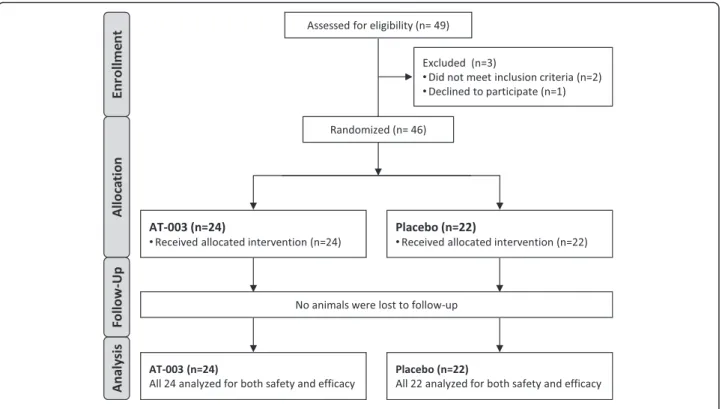
Three (3) investigative sites screened and enrolled cases. There were forty-nine (49) dogs screened and forty-six (46) dogs enrolled in the study over the period April 2014 to September 2014 and the study concluded when the target number of dogs was enrolled. All forty-six (46) dogs enrolled in the study were included in both the efficacy and safety evaluation (see flow diagram, Fig. 1). Twenty-four (24) dogs were treated with AT-003 and twenty-two (22) dogs with saline. The mean (range) age was 7.47 years (2.1–13.3) for the AT-003 group and 6.71 years (1.0–10.4) for the saline placebo group. Group characteristics are summarized in Table 1.
CMPS-SF scores
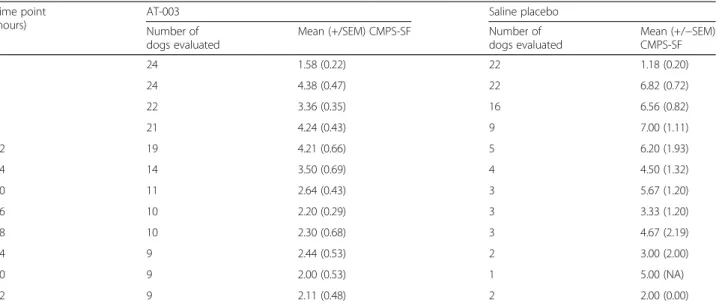
The mean total CMPS-SF scores (+/−SEM) at the base-line (pre-surgery) evaluation were 1.58 (0.22) and 1.18 (0.20) for AT-003 and saline placebo, respectively. Fol-lowing surgery, total CMPS-SF scores (Table 2) were consistently lower at all post-operative time points (ex-cept for 72 h) for the AT-003 treated dogs compared to saline placebo treated dogs, with a significant overall treatment effect (p= 0.0027) in favor of AT-003. At 72 h, the scores were similar, but only two dogs remained in the saline placebo group (note: at 60 h data were missing from one placebo dog). There was no treatment by time effect (p= 0.8041), however there were only a small number of subjects remaining in the saline placebo group after 12 h. When site effect and treatment by site interaction were entered into the model, the overall treatment effect was again statistically signifi-cant (p= 0.0036), with lower CMPS-SF scores in the AT-003 group.
Surgical site manipulation scores
Success/Failure analysis
Dogs receiving AT-003 were more likely to remain in the study (that is, not be rescued due to insufficient pain relief ) following the surgical procedure than dogs receiv-ing the saline placebo. At 72 h post-operatively, 9 of 24 AT-003 dogs and 2 of 22 placebo dogs remained in the study. Overall treatment success at each time period was statistically significantly different between the groups (p= 0.0001 for 0-24 h; p= 0.0349 for 0–48 h; and p= 0.0240 for 0–72 h) with more dogs being designated treatment successes in the AT-003 treatment group compared to the saline placebo group in each time period (Table 4). The odds of success were almost 13 times greater in the AT-003 group compared to the placebo group in the first 24 h; 4.5 times greater
over the 0–48 h period, and 6 times greater over the 0–72 h period.
Adverse events
AT-003 appeared to be well tolerated. Adverse events were reported in 5 dogs during the study, three in the AT-003 group and two in the saline placebo group, all from a single site. All were classified with an “unlikely” or “unknown” relationship to study treatment. One dog in the AT-003 treatment group had mild bradycardia (heart rate was 56 beats per minute, as compared to 96 beats per minute at the pre-enrollment physical examin-ation) detected 4 hours after surgery (at time of rescue). Another dog in the AT-003 treatment group vomited on a single occasion, and this resolved with no treatment. A third dog in the AT-003 group was found to have a small excoriated patch on its nose, considered unlikely to be treatment related, and rather resulting from trying to exit the cage. In the saline placebo group, a flea was found on one dog, and another had an episode of diar-rhea with fresh blood, which resolved without treatment.
Discussion
The study hypothesis was supported, with the results indicating measurable analgesic effects of AT-003 (bupivacaine liposome injectable suspension) compared to placebo, over a 72-h period following surgical site tis-sue infiltration in 46 dogs undergoing cranial cruciate ligament (CCL) surgery. The odds of success (in terms
Table 1Per protocol population demographics of enrolled dogs in the AT-003 and saline placebo groups
Characteristic AT-003 (n= 24) Saline placebo (n= 22)
Age (years) Mean 7.47 6.71
Min, Max 2.08, 13.33 1.00, 10.42
Weight (kg) Mean 26.54 22.57
Min, Max 3.2, 79.3 2.4, 44.8
Sex Female 0 0
Female spayed 13 11
Male 1 0
Male castrated 10 11
of not needing rescue) were dramatically greater in the AT-003 group than the placebo group. It is possible that some dogs may have been inappropriately designated as comfortable when in fact pain was present, potentially due to the carry-over effects of the acepromazine sed-ation in the early postoperative period, or due to a lack of sensitivity of the pain assessment tool. However, in these respects, both groups should have been equally af-fected, making the comparison valid.
Pain is difficult to measure, and although the assess-ment tool used in the present study has been widely used, it has never undergone criterion validation. How-ever, one measure of the success in measuring pain in placebo-controlled studies is the rescue rate in the
placebo group. In the current study, it was 77 % within 24 h, and 91 % over the 72 h of the study, suggesting in-adequate pain relief was being detected, and giving one further confidence that AT-003 provided clinically meas-urable pain relief. If one assumes surgery is associated with pain, then the lack of rescue of 2/22 dogs in the placebo group would be considered a failure of the as-sessment system. However, the approach to asas-sessment and rescue in our study appears to have been compara-tively successful when looked at other published studies. In a study of dogs undergoing cruciate surgery [11], only 11 % (1 of 9 dogs) was rescued in the 24 h following sur-gery. In a study of dogs undergoing soft tissue surgery [12], only 9 of 16 dogs were rescued over a 72-h period
Table 2Total mean (SEM) CMPS-SF scores by treatment group and time point
Time point (hours)
AT-003 Saline placebo
Number of dogs evaluated
Mean (+/SEM) CMPS-SF Number of
dogs evaluated
Mean (+/−SEM) CMPS-SF
0 24 1.58 (0.22) 22 1.18 (0.20)
2 24 4.38 (0.47) 22 6.82 (0.72)
4 22 3.36 (0.35) 16 6.56 (0.82)
8 21 4.24 (0.43) 9 7.00 (1.11)
12 19 4.21 (0.66) 5 6.20 (1.93)
24 14 3.50 (0.69) 4 4.50 (1.32)
30 11 2.64 (0.43) 3 5.67 (1.20)
36 10 2.20 (0.29) 3 3.33 (1.20)
48 10 2.30 (0.68) 3 4.67 (2.19)
54 9 2.44 (0.53) 2 3.00 (2.00)
60 9 2.00 (0.53) 1 5.00 (NA)
72 9 2.11 (0.48) 2 2.00 (0.00)
NANot Applicable
Table 3Total Mean (SEM) Surgical Site Manipulation Scores by Treatment Group & Time Point
Time point (hours)
AT-003 Saline Placebo
Number of dogs evaluated
Mean surgical site manipulation (SEM)
Number of dogs evaluated
Mean surgical site manipulation (SEM)
0 24 0.42 (0.10) 22 0.68 (0.21)
2 24 1.13 (0.31) 22 2.32 (0.30)
4 22 0.95 (0.27) 16 2.56 (0.32)
8 21 1.33 (0.30) 9 2.11 (0.45)
12 19 1.47 (0.30) 5 1.40 (0.51)
24 14 1.43 (0.39) 4 1.50 (0.50)
30 11 0.82 (0.33) 3 1.67 (0.67)
36 10 0.70 (0.30) 3 1.00 (1.00)
48 10 0.90 (0.35) 3 1.00 (1.00)
54 9 0.67 (0.37) 2 0.00 (0.00)
60 9 0.33 (0.24) 1 0.00 (NA)
72 9 0.67 (0.29) 2 0.00 (0.00)
postoperatively. The lack of intra-operative analgesia provision (beyond preoperative hydromorphone, which all dogs received) was very deliberate due to how difficult pain is to measure. Given how insensitive our current as-sessment tools are, the more background treatments that are administered, the more difficult it becomes to assess whether a novel analgesic provides any benefit. Future work, hopefully with more sensitive, and ideally objective, outcome assessments, could evaluate the effect size of this product versus other treatments.
There are few data as to how long post-surgical pain persists in animals, and this time period will vary with the type of surgical procedure performed. The recom-mended time period for administration of analgesics post-operatively varies from days to weeks, depending on the surgery performed, but expert opinion empha-sizes the first 72 h following surgery as a critical time period when analgesics should be administered [13]. Post-surgical pain can generally be well controlled while an animal is hospitalized using injectable opioids, keta-mine, cyclooxygenase inhibiting NSAIDs and local anes-thetics. However, with most veterinary patients being discharged from the veterinary hospital the same day, or within 24 h following surgery, there is a need to bridge between analgesics provided in the hospital and effective pain relief in the home environment. Currently in the United States, only oral cyclooxygenase inhibiting NSAIDs and transdermal fentanyl liquid3 have been approved for post-surgical analgesia in dogs. Beyond these options, there are unapproved fentanyl patches manufactured for human use, which have been sug-gested to be efficacious [14] and tramadol is widely used, despite little evidence of efficacy [15–18].
Overall, there is a clear unmet need for effective anal-gesic products that can be administered in the clinic, and provide pain relief for the crucial first few days following surgery in the home environment. This pilot study suggests that bupivacaine liposome injectable sus-pension may directly address this unmet need, providing up to 72 h of analgesia. Though statistically greater than placebo, not all of the AT-003 dogs were successes out to 72 h. In this study, surgeons were not instructed to infiltrate around the anchor points of the suture
material. In future studies, infiltration into all the tissue layers as well as around the anchor points for suture or around implants will be performed. Bupivacaine lipo-some injectable suspension will need to be administered as part of a multimodal approach as the anesthetic wears off, and indeed, this is consistent with the current rec-ommendations for the treatment of postoperative pain [19, 20]. The prolonged duration of continuous action may also prevent episodes of breakthrough pain.
The current study was a pilot study, performed in dogs undergoing a single type of surgery, lateral retinacular suture placement for cruciate insufficiency. As such, the generalizability of these results to the larger population of dogs undergoing a variety of orthopedic surgeries and other surgical procedures is unknown. However, given the demonstrated efficacy in human clinical studies in both orthopedic [21] and soft tissue [22] surgery, it is highly likely that AT-003 will prove efficacious in dogs undergoing a wide variety of surgical procedures.
The current study employed direct injection of bupiva-caine liposome injectable suspension into the surgical wound, and this may raise concerns about wound heal-ing and wound infection. While there is some evidence that local anesthetics alter the cellular events of early tis-sue healing, there does not appear to be a clinically sig-nificant impact on wound healing or mechanical wound strength in preclinical animal studies [23] or humans. Infection rates following continuous local anesthetic in-stallation into wounds found that reported wound infec-tion rates were similar between active (0.7 %) and control groups (1.2 %) in humans undergoing surgery [24]. In the present study, no wound related adverse ef-fects were seen, which mirrors the extensive pre-clinical work in dogs that has been performed with this product. In a dog model of inguinal hernia repair, bupivacaine liposome injectable suspension was infiltrated into the surgical site at doses ranging from 9 to 25 mg/kg and a mild granulomatous inflammatory response was seen histologically, that had not resolved by 2 weeks following infiltration, but was not considered indicative of any adverse effect on wound healing and the wound healing findings were similar to control (saline or bupivacaine HCL) treated animals [9]. In the present study, one dog
Table 4Summary results of the success/failure analysis. Dogs deemed failures in one time period were carried forward into the next time period, where they were also categorized as failures. The Odds of success (and 95 % Confidence Interval, CI) are tabulated
Time interval AT-003 Saline placebo Chi-squarep-value Odds ratio
0–24 h Success 19 (79.2 %) 5 (22.7 %) 0.0001 12.92 (3.18, 52.48)
Failure 5 (20.8 %) 17 (77.3 %)
0–48 h Success 10 (41.7 %) 3 (13.6 %) 0.0349 4.52 (1.05, 19.54)
Failure 14 (58.3 %) 19 (86.4 %)
0–72 h Success 9 (37.5 %) 2 (9.1 %) 0.0240 6.0 (1.13, 31.94)
was found to have bradycardia 4 h following administra-tion of AT-003. In previous work, repeated doses of bupivacaine liposome injectable suspension were admin-istered to dogs and the dogs evaluated for cardiotoxicity [25]. Doses of 9, 18 and 30 mg/kg bupivacaine liposome injectable suspension, 9 mg/kg bupivacaine HCl, or a volume-equivalent dose of saline, were administered into the subcutaneous tissue over the scapulae twice weekly for 4 weeks. No clinical signs consistent with central nervous system toxicity were seen and no electrocar-diogram abnormalities were detected [25].
Dilution in this study was allowed based on the human experience and volumes used in previous canine knee surgery studies. Dilution does not impact efficacy in humans [26], and that appeared to be the case in this study as well. Most surgeons administered the drug in the undiluted state. The one surgeon who did dilute did so such that the total volume was divisible by four, facili-tating a 25, 50 and 25 % tissue infiltration distribution.
Conclusions
Further work is indicated to develop this product for clinical use. This product has significant potential to address an important clinical need - the provision of extended duration local wound analgesia.
Methods
Design
The study was a masked, randomized, placebo-controlled, multi-center pilot field study, conducted under Good Clinical Practice Guidelines. The study was performed as part of the development program of AT-003 for FDA approval in dogs. The study was conducted according to the protocol and in compliance with Good Clinical Practice (VICH) Guideline GL9, International Cooper-ation on HarmonizCooper-ation of Technical Requirements for Registration of Veterinary Medicinal Products (VICH), June 2000, and the FDA Center for Veterinary Medicine (CVM) Guidance for Industry #85, May 2001. The study protocol was approved by Aratana’s internal review board. Each owner gave written informed consent prior to dogs being enrolled into the study, and best practices for veterinary care and patient management were followed throughout the study.
Study population
Owned pet dogs of any breed or gender, greater than 5 months of age, deemed to require surgery for cruciate ligament insufficiency, were recruited to the study.
Inclusion criteria
Dogs were required to have been diagnosed with cranial cruciate ligament insufficiency within the previous 4 months, and not to have received systemic
anti-inflammatories within 7 days of the surgical procedure. Dogs of a fractious demeanor, or who had an uncon-trolled endocrine or systemic disorder, or who had had surgery within the previous 14 days were not eligible.
Study protocol overview
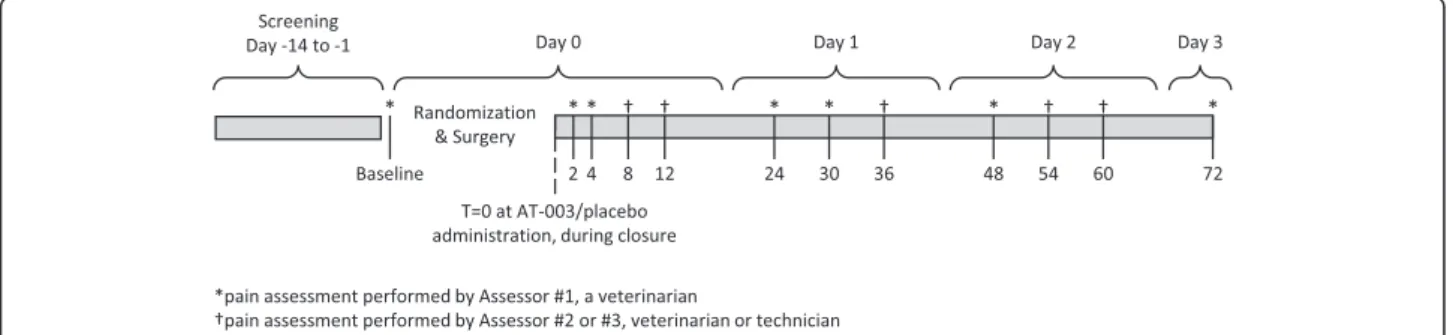
The study evaluated the post-operative analgesia pro-vided by AT-003 at a dose of 5.3 mg/kg administered by tissue infiltration just prior to closure following unilat-eral cranial cruciate ligament (CCL) surgery in dogs. The study protocol is outlined in Fig. 2. Dogs were ran-domly assigned to one of the two treatment groups and AT-003 (5.3 mg/kg) or saline placebo (1.0 mL/kg) was administered into the wound bed at the end of surgery, prior to and during closure of the wound. Both AT-003 and saline were injected directly into tissues, using a moving needle technique.
All dogs underwent the lateral retinacular suture procedure, including stifle arthrotomy. The primary outcome measure was the Glasgow Composite Meas-ure Pain Scale (CMPS-SF). Assessments were per-formed prior to premedication/surgery following a 2-h acclimation period, and at 2, 4, 8, 12, 24, 30, 36, 48, 54, 60 and 72 h following surgery by veterinarians and veterinary technicians trained on the use of the CMPS-SF. After the CMPS-SF assessment was com-pleted, a Surgical Site Manipulation Score (secondary outcome measure) was assessed by standardized ma-nipulation of the stifle joint that had undergone
sur-gery (Table 5). Dogs were administered rescue
analgesia (choice of rescue was at the discretion of the veterinarian) if the CMPS-SF score was greater than 8 or if the assessors felt additional analgesia was needed. Following either of these, dogs were removed from the study. Everyone involved in the assessments was trained in the use of the assessment tools through explanation and discussion of the tools dur-ing a sdur-ingle ‘classroom’ style training session run by the Contract Research Organization, and the docu-ment describing the definitions of expressions used in the CMPS-SF. All assessors had prior experience of using the CMPS-SF in clinical studies. No more than 3 assessors were permitted to do the assessments on any one dog. Different sites were not calibrated on the use of the CMPS-SF, and nor were any measures put in place to confirm consistency of scoring.
following surgery to capture any adverse events that oc-curred following discharge.
Anesthetic protocol
Acepromazine (0.05 mg/kg) was administered intraven-ously (IV) or intramuscularly (IM) with a maximum total dose of 3.0 mg regardless of body weight. The doses of acepromazine used in the study were based on our experience with the drug. At least 15 min after ace-promazine administration, hydromorphone (0.1 mg/kg) was administered IV. Anesthesia was induced with pro-pofol, and maintained on isoflurane carried in oxygen, delivered via an endotracheal tube and a rebreathing cir-cuit. Additional local/regional anesthesia (epidural, nerve block, intra-articular etc.) was not permitted, nor were any other analgesics. Fluids were administered intraven-ously during anesthesia.
Randomization to treatment groups
Dogs were randomly assigned to one of the two treat-ment groups and treated post-CCL surgery with AT-003 (5.3 mg/kg, equivalent to 0.4 mL/kg) or saline (1.0 mL/ kg). Surgeons were allowed to dilute AT-003 up to 15 times, if needed, in order to cover the surgical area, with a recommended volume of 0.4–1.0 mL/kg based on pre-vious studies. Randomization was performed using the Prelude Dynamics VISION™ electronic data capture
(EDC) system. The VISION randomization framework generated each random treatment from a pre-computed table of treatments for each site. The randomization cal-culation maintained equal size groups per site and was calculated based on the current patient population. Sub-jects were randomized in blocks of two, stratified by site.
Masking procedures
One individual at each site was designated the Dispenser, and they documented the assignment of dogs to treat-ment group and kept the related docutreat-mentation in a se-cure site, away from all other personnel. The Dispenser and the veterinarian performing the surgery had know-ledge of which treatment group each dog was assigned. Blinded personnel were not given access to the treat-ment or randomization forms. The veterinarian or trained technician performing the assessments, sponsor, statistician and any other personnel involved in clinical evaluations and observations remained blinded to treat-ment during the study and until data base lock. The Owners were also blinded to treatment.
Tissue infiltration procedure
AT-003 or saline was injected slowly into the tissues using a 1–1.5 in. long needle, using a ‘moving needle technique’, in which the needle is inserted to near the hub and the material is injected as the needle is pulled out. The needle is inserted at varying angles depending on how the tissue is best approached in order to deposit the injectate within the tissues. In general, this means inserting the needle approximately parallel to the surface of the skin. The injections are repeated to create an area of infiltrated tissue around the whole wound, and at all levels of the wound. Approximately 25, 50 and 25 % of the AT-003 or saline was injected into the tissues around the joint capsule, the fascial tissue, and the sub-cuticular tissue, respectfully. The injections were performed such that the whole wound, at all levels, was infiltrated with AT-003 or saline. Dilution of AT-003 with normal saline was permitted and was utilized for 12 of the AT-003 treated dogs, all at one site, with a maximal dilution of 1:1 AT-003 to saline.
Fig. 2Study Protocol Outline
Table 5Surgical Site Manipulation scoring system. At each relevant assessment time point, the joint was gently palpated around the surgical incision, and then the joint was put through a passive range of motion, flexing and extending the joint Manipulate the joint through a normal range of motion, and score the patient as per below:
Score Response
0 Does not notice manipulation.
1 Orients to site on manipulation, does not resist.
2 Orients to site, may lick, slight objection to manipulation
3 Withdraws from manipulation, may vocalize, excessive licking
Outcome measures
The primary outcome measure was the Glasgow Com-posite Measure Pain Scale (Short Form) (CMPS-SF), and secondary outcome measures were a Surgical Site Ma-nipulation Score and an evaluation of adverse events.
CMPS-SF
The Glasgow Composite Measure Pain Scale-Short Form (CMPS-SF), (http://www.newmetrica.com/acute-pain-measurement/download-short-form-painquestion naire-for-dogs/) is a subjective clinical metrology in-strument used by animal caretakers to evaluate peri-operative pain in a practice setting that was developed at the University of Glasgow, UK [27, 28]. The expressions used in the CMPS-SF were defined in order to assist in training of sites, and are detailed in Additional file 1. Data were captured electronically, and thus the electronic ver-sion of the CMPS-SF differed from the published paper version. The layout of the electronic version is illustrated in Additional file 2: Figure S1.
Surgical site manipulation score (SSMS)
A simple descriptive scale, scored on a 0–4 scale (Table 5) was used for the assessment of surgical site pain associated with cruciate surgery. The scale was con-structed by one of the authors, and is similar to wound palpation scoring systems used previously [7].
Adverse events
An adverse event was defined as any observation, un-desirable experience, reaction or side effect in animals that was unfavorable and unintended and occurred after the use of AT-003 or placebo, whether or not considered to be treatment related. A serious adverse event was de-fined as any adverse event that resulted in death, was life-threatening, or resulted in persistent or significant disability/incapacity, although no serious adverse event occurred during this study.
Rescue analgesia
Dogs were removed from the study and administered rescue analgesia if the CMPS-SF score at a designated assessment time point was greater than 8 or at any time (assessment time point or at any time in between) if the assessing veterinarian felt additional analgesia was needed. The intervention score of 8 was based on one investigator’s (BDXL) experience with the CMPS-SF, and a lack of data to substantiate the suggestion of an interven-tion score of 6 (http://www.newmetrica.com/acute-pain- measurement/download-short-form-painquestionnaire-for-dogs/). No dog in the study was removed for a reason other than rescue analgesia.
Data capture
Most data were captured electronically using an elec-tronic data capture (EDC) system VISION developed and supported by Prelude Dynamics, LLC.
Power analysis and statistical analysis
The enrollment target was at least 40 evaluable cases (20 AT-003 and 20 placebo) per the study randomization schedule across all sites. An evaluable sample size of 20 AT-003 and 20 placebo cases was determined to be able to provide more than 90 % power (alpha = 0.05, 2-sided) to detect a difference between treatment groups of 0.37 (pooled standard deviation = 0.30) in the CMPS-SF as-sessment at 24 h post-administration. These calculations were based on results from a preliminary laboratory study to assess the analgesic properties of AT-003 fol-lowing tissue infiltration around the site of stifle arthrot-omy in beagle dogs.
To be eligible for the statistical analysis, each site must have enrolled and completed a minimum of 2 evaluable cases (at least 1 of each treatment). For total CMPS-SF and Surgical site manipulation scores, repeated measures analysis of variance were utilized to test for possible differences between treatment groups. SAS/STAT Proc MIXED were implemented with the model containing terms for treatment group, time point and the interaction of treatment by time point. The baseline value was included in the model as a covariate. If the treatment group by time point interaction was found to be statistically signifi-cant, then treatment effects were evaluated for each time point. The covariance structure that provided the smallest Akaike’s Information Criterion value was used. Covariance structures that were tested include Compound Symmetry (CS), heterogeneous CS (CSH), first-order autoregressive [AR(1)] and heterogeneous autoregressive [ARH(1)]. Additionally, exploratory analysis used a repeated measures analysis of variance that included site effect and treatment by site interaction in the model.
A success/failure analysis was also employed, with suc-cess defined as no pain intervention over the intervals of 0–24 h, 0–48 h and 0–72 h. The number and percentage of dogs that were a success were presented for each time interval by treatment group. The chi-square test was uti-lized to test for possible differences between treatment groups, and odds ratios described.
Endnotes 1
Exparel, Pacira Pharmaceuticals, Inc., Parsippany, NJ.
2
Nocita, Aratana Therapeutics, Inc., Leawood, KS.
3
Additional files
Additional file 1:Definitions of the expressions used in the CMPS-SF.
In order to facilitate consistency in the way the CMPS-SF was used, the expressions used in the CMPS-SF were defined, and this file contains those definitions. (DOCX 102 kb)
Additional file 2: Figure S1.Layout of the electronic version CMPS-SF.
The electronic version CMPS-SF differed from the published paper version, and the layout of the electronic version is shown in this Additional file. (TIFF 5625 kb)
Acknowledgements
The authors wish to acknowledge AlcheraBio LLC, the Contract Research Organization that ran the study, and the individual site investigators: Dr. Sam Geller, Dr. Guy DeNardo, Dr. Matthew Barnhart, Dr. Shawn Kennedy, Dr. Roger Sifferman and Dr. Bert Shelley. Statistical analysis was performed by Margie Huebner, Biometrics, ClinData Services, Inc.
Funding
The study was funded by Aratana Therapeutics.
Availability of data and materials
The original raw data has been made available to the FDA but is not available for download due to the drug used (AT-003) currently going through the approval process.
Authors’contributions
BDXL and LR-D designed the study; BDXL, LR-D and JAW drafted the manuscript. LR-D and JAW were responsible for overseeing the study. MH performed the statistical analysis. All authors reviewed and edited the manuscript. All authors read and approved the final manuscript.
Authors’information
The corresponding author (BDXL) is Professor of Surgery and Pain Management at North Carolina State University College of Veterinary Medicine, where he heads the Comparative Pain Research Laboratory, and is Associate Director of the Comparative Medicine Institute. He is actively involved in the Center for Pain Research and Innovation at the UNC Chapel Hill Medical School, and the Center for Translational Pain Medicine at Duke University Medical School.
Competing interests
Financial competing interests: The study was funded by Aratana Therapeutics, Inc., which own the rights to development of AT-003 for ani-mals. BDXL is a paid consultant for Aratana; LR-D and JAW are both em-ployees of Aratana. Non-financial competing interests: The authors declare that they have no other non-financial competing interests.
Consent for publication
Not applicable.
Ethics and consent to participate
The study was conducted according to the protocol and in compliance with Good Clinical Practice (VICH) Guideline GL9, International Cooperation on Harmonization of Technical Requirements for Registration of Veterinary Medicinal Products (VICH), June 2000, and the FDA Center for Veterinary Medicine (CVM) Guidance for Industry #85, May 2001. The study protocol was approved by Aratana’s internal review board. Each owner gave written informed consent prior to dogs being enrolled into the study, and best practices for veterinary care and patient management were followed throughout the study.
Author details
1Department of Clinical Sciences, Comparative Pain Research Laboratory,
College of Veterinary Medicine, North Carolina State University, Raleigh, NC, USA.2Department of Clinical Sciences, Comparative Medicine Institute, College of Veterinary Medicine, North Carolina State University, Raleigh, NC 27606, USA.3Center for Pain Research and Innovation, Dental School, UNC Chapel Hill, Chapel Hill, NC, USA.4Department of Anesthesiiology, Center for Translational Pain Medicine, Duke University,
Durham, NC, USA.5Aratana Therapeutics, Inc., Leawood, KS 66211, USA. 6ClinData Services, Inc., 6716 Holyoke Court, Fort Collins, CO 80525, USA.
Received: 8 February 2016 Accepted: 10 August 2016
References
1. Slingsby LS, Waterman-Pearson AE. Analgesic effects in dogs of carprofen and pethidine together compared with the effects of either drug alone. Vet Rec. 2001;148:441–4.
2. Hunt JR, Knowles TG, Lascelles BDX, Murrell JC. Prescription of perioperative analgesics by UK small animal veterinary surgeons in 2013. Vet Rec. 2015;176:493.
3. Sakonju I, Maeda K, Maekawa R, Maebashi R, Kakuta T, Takase K. Relative nerve blocking properties of bupivacaine and ropivacaine in dogs undergoing brachial plexus block using a nerve stimulator. J Vet Med Sci. 2009;71:1279–84.
4. Feldman HS, Arthur GR, Covino BG. Comparative systemic toxicity of convulsant and supraconvulsant doses of intravenous ropivacaine, bupivacaine, and lidocaine in the conscious dog. Anesth Analg. 1989;69:794–801.
5. Lemke KA, Dawson SD. Local and regional anesthesia. Vet Clin North Am Small Anim Pract. 2000;30:839–57.
6. Davis KM, Hardie EM, Lascelles BDX, Hansen B. Feline fibrosarcoma: perioperative management. Compend Contin Educ Vet. 2007;29:712–4. 716–20–722–9 passim.
7. Hardie EM, Lascelles BDX, Meuten T, Davidson GS, Papich MG, Hansen BD. Evaluation of intermittent infusion of bupivacaine into surgical wounds of dogs postoperatively. Vet J. 2011;190:287–9.
8. Adams DH, Joyce G, Richardson VJ, Ryman BE, Wiśniewski HM. Liposome toxicity in the mouse central nervous system. J Neurol Sci. 1977;31:173–9. 9. Richard BM, Ott LR, Haan D, Brubaker AN, Cole PI, Nelson KG, Ross PE,
Rebelatto MC, Newton PE. The safety and tolerability evaluation of DepoFoam bupivacaine (bupivacaine extended-release liposome injection) administered by incision wound infiltration in rabbits and dogs. Expert Opin Investig Drugs. 2011;20:1327–41.
10 Richard BM, Newton P, Ott LR, Haan D, Brubaker AN, Cole PI, Ross PE, Rebelatto MC, Nelson KG. The safety of EXPAREL ® (Bupivacaine Liposome Injectable Suspension) administered by peripheral nerve block in rabbits and dogs. J Drug Deliv. 2012;2012:962101–10.
11 Moak P, Hosgood G, Rowe E, Lemke KA. Evaluation of intra-articular and subcutaneous administration of meloxicam for postoperative analgesia following stifle surgery in dogs. Vet Comp Ortho Traumatol. 2011;24:32–8.
12 Bienhoff SE, Smith ES, Roycroft LM, Roberts ES. Efficacy and safety of deracoxib for control of postoperative pain and inflammation associated with soft tissue surgery in dogs. Vet Surg. 2012;41:336–44.
13 Mathews K, Kronen PW, Lascelles D, Nolan A, Robertson S, Steagall PV, Wright B, Yamashita K. Guidelines for Recognition, Assessment and Treatment of Pain. J Sm An Pract. 2014;55:E10–68.
14 Kyles AE, Hardie EM, Hansen BD, Papich MG. Comparison of transdermal fentanyl and intramuscular oxymorphone on post-operative behaviour after ovariohysterectomy in dogs. Res Vet Sci. 1998;65:245–51.
15 Rialland P, Authier S, Guillot M, del Castillo JRE, Veilleux-Lemieux D, Frank D, Gauvin D, Troncy E. Validation of orthopedic postoperative pain assessment methods for dogs: a prospective, blinded, randomized, placebo-controlled study. PLoS One. 2012;7:e49480.
16 Benitez ME, Roush JK, McMurphy R, KuKanich B, Legallet C. Clinical efficacy of hydrocodone-acetaminophen and tramadol for control of postoperative pain in dogs following tibial plateau leveling osteotomy. Am J Vet Res. 2015;76:755–62.
17 Davila D, Keeshen TP, Evans RB, Conzemius MG. Comparison of the analgesic efficacy of perioperative firocoxib and tramadol administration in dogs undergoing tibial plateau leveling osteotomy. J Am Vet Med Assoc. 2013;243:225–31.
19 Tomas A, Bledsoe D, Wall S, Davidson G, Lascelles BDX. Initial evaluation of a canine stifle arthrotomy post-operative pain model. The Vet J. 2015;204(3): 293–8.
20 Epstein ME, Rodanm I, Griffenhagen G, Kadrlik J, Petty MC, Robertson SA, Simpson W. AHAA, AAFP: 2015 AAHA/AAFP pain management guidelines for dogs and cats. J Fel Med Surg. 2015;2015:251–72.
21 Golf M, Daniels SE, Onel E. A phase 3, randomized, placebo-controlled trial of DepoFoam® bupivacaine (extended-release bupivacaine local analgesic) in bunionectomy. Adv Therapy. 2011. doi:10.1007/s12325-011-0052-y. 22 Gorfine SR, Onel E, Patou G, Krivokapic ZV. Bupivacaine extended-release
liposome injection for prolonged postsurgical analgesia in patients undergoing hemorrhoidectomy: a multicenter, randomized, double-blind, placebo-controlled trial. Dis Colon Rectum. 2011;54:1552–9.
23 Abrão J, Fernandes CR, White PF, Shimano AC, Okubo R, Lima GB, Bachur JA, Garcia SB. Effect of local anaesthetic infiltration with bupivacaine and ropivacaine on wound healing: a placebo‐controlled study. Int Wound J. 2014;11:379–85.
24 Liu SS, Richman JM, Thirlby RC, Wu CL. Efficacy of continuous wound catheters delivering local anesthetic for postoperative analgesia: a quantitative and qualitative systematic review of randomized controlled trials. J Am Coll Surg. 2006;203:914–32.
25 Richard BM, Rickert DE, Newton PE, Ott LR, Haan D, Brubaker AN, Cole PI, Ross PE, Rebelatto MC, Nelson KG. Safety evaluation of EXPAREL (DepoFoam Bupivacaine) administered by repeated subcutaneous injection in rabbits and dogs: species comparison. J Drug Deliv. 2011;2011:467429. 26 Hadzic A, Abikhaled JA, Harmon WJ. Impact of volume expansion on the
efficacy and pharmacokinetics of liposome bupivacaine. Local Reg Anesth. 2015;8:105–11.
27 Reid J, Nolan AM, Hughes J, Lascelles D, Pawson P, Scott EM. Development of the short-form Glasgow Composite Measure Pain Scale (CMPS-SF) and derivation of an analgesic intervention score. Anim Welf. 2007;16(S):97–104. 28 Morton CM, Reid J, Scott EM, Holton LL, Nolan AM. Application of a scaling model to establish and validate an interval level pain scale for assessment of acute pain in dogs. Am J Vet Res. 2005;66:2154–66.
• We accept pre-submission inquiries
• Our selector tool helps you to find the most relevant journal
• We provide round the clock customer support
• Convenient online submission
• Thorough peer review
• Inclusion in PubMed and all major indexing services
• Maximum visibility for your research
Submit your manuscript at www.biomedcentral.com/submit