Online Learning for Monitoring and Evaluation: A Report Prepared for MEASURE Evaluation
by
Christina Bernadotte
A paper presented to the faculty of The University of North Carolina at Chapel Hill
Gillings School of Global Public Health,
in partial fulfillment of the requirements for the degree of Master of Public Health in the Department of Maternal and Child Health.
Chapel Hill, North Carolina April 18, 2011
Approved by:
Advisor:
Reader:
ABSTRACT
Objective: MEASURE Evaluation works to increase the Monitoring and Evaluation (M&E) capacity of the global public health workforce and is expanding their online
learning portfolio. This study aims to identify background characteristics of those
who have completed MEASURE Evaluation‟s first online course M&E
Fundamentals; determine satisfaction with- and future interest in online M&E
courses; establish accessibility and identify barriers to online learning; and provide
recommendations as MEASURE Evaluation expands their online learning portfolio.
Methods: An online survey was sent to 2,225 people who completed the online M&E Fundamentals course using Qulatrics survey software. Data was collected over
three weeks, and results were analyzed.
Results: The majority of the respondents are young professionals with some graduate education, have consistent internet access, and respond positively to
future online M&E courses. Barriers were limited, but include frequent internet
“time-outs”. Recommendations include developing courses at different learning levels,
providing content area certificates, updating courses regularly, providing printable
materials, increasing use of case studies, and developing feedback systems
between students and instructors.
Table of Contents
Abstract ii
Abbreviations iv
Problem Statement 1
Research Questions 2
Background and Literature Review 3
MEASURE Evaluation 3
Capacity Building and Training Unit 4
MEASURE Evaluation Online Courses 6
Monitoring & Evaluation Fundamentals Online Course 7
Literature Review 8
Methods 15
Results 17
Discussion & Limitations 30
Recommendations 33
Conclusion 36
References
Appendices
Appendix A:
Survey on MEASURE Evaluation‟s online learning for M&E
Appendix B:
ABBREVIATIONS
CBT Capacity Building and Training
CBTU Capacity Building and Training Unit
CoP Community of Practice
CPC Carolina Population Center
CPE Continuing Professional Education
FSNs Foreign Service Nationals
GHeL Global Health e-Learning
IRB Institutional Review Board
M&E Monitoring and Evaluation
MCH Maternal and Child Health
MEASURE Monitoring and Evaluation to ASsess and Use Results
MENTOR Monitoring and Evaluation Network of Training Online Resources
MSH Management Sciences for Health
PHNs Population, Health and Nutrition Officers
UNC-CH University of North Carolina at Chapel Hill
PROBLEM STATEMENT
Online learning is becoming an increasingly important component of training
and knowledge sharing for the global public health workforce. This is especially true
as training and travel costs increase, budgets tighten, technology improves and
internet access becomes more readily available. MEASURE Evaluation‟s Capacity
Building and Training Unit (CBTU) is working to increase Monitoring and Evaluation
(M&E) competency among public health professionals working with maternal and
child health (MCH) populations around the world, in part by expanding online M&E
course offerings. The purpose of the survey described in this report was to identify
characteristics of individuals who have participated in MEASURE Evaluation‟s first
online course Monitoring & Evaluation Fundamentals and to learn what barriers and
facilitators exist in providing online M&E training to global public health
professionals. The survey also aimed to determine participant‟s access to online
courses, satisfaction with previously taken online courses and interest in future
distance learning courses. Finally, the survey intended to solicit participant feedback
to help guide recommendations for MEASURE Evaluation as future M&E online
courses are developed. The survey population consisted of people who completed
the online M&E Fundamentals course through MEASURE Evaluation‟s Monitoring
and Evaluation Network of Training Online Resources (MENTOR) website before
February 2011 and who responded to the online survey emailed to them that month.
This report serves as the first assessment of participants‟ access to and
opinions of distance learning as a strategy for improving M&E capacity. The report
provides background information about the MEASURE Evaluation project, the
now referred to as MEASURE Evaluation‟s online courses, and the M&E
Fundamentals online course. A brief review of the literature about online training and
distance learning as a strategy for building public health capacity, especially in low
resource settings, is followed by survey methods, results, discussion and
recommendations. The report will be submitted to the CBTU for consideration as
they advance MEASURE Evaluation‟s distance-learning portfolio. Between the
implementation of this survey and the time this report was written, MEASURE
Evaluation stopped using the acronym MENTOR for its online training resources.
The report uses the new terminology, however some residual references to
MENTOR remain in the survey results of this report.
RESEARCH QUESTIONS
Monitoring and Evaluation skills are increasingly important for public health
professionals working with maternal and child health populations. As an
internationally recognized leader in M&E capacity building MEASURE Evaluation is
taking an important step in increasing access to M&E competencies by developing
free online courses. It is important to examine participants‟ satisfaction with
MEASURE Evaluation‟s current online course to determine how MEASURE
Evaluation can improve future online courses. The following research questions
were developed to guide the literature review and survey development for this
report.
(1) What are the characteristics of people who have completed MEASURE
(2) What interests do those who have taken the M&E Fundamentals course have in
future online continuing education in M&E?
(3) What accessibility do those who have taken the M&E Fundamentals course have
to future online courses, and what are existing barriers?
(4) What can MEASURE Evaluation do to address barriers to online M&E learning
and improve satisfaction amongst users for future online M&E courses?
BACKGROUND AND LITERATURE REVIEW
MEASURE Evaluation
MEASURE Evaluation is a project funded by the United States Agency for
International Development (USAID), dedicated to supporting and improving M&E in
population, health and nutrition, and HIV/AIDS programs globally. Since its inception
in 1997, MEASURE Evaluation has consisted of three phases. In phases I
(1997-2003) and II (2003-2009) MEASURE Evaluation‟s work focused primarily on
providing technical assistance to, and collaborating with, public health professionals
at local, national and international levels to improve local capacity for M&E activities,
particularly in Asia, Africa, and Latin America. These activities included, but are not
limited to, increasing demand for data for health decision making, improving the
quality of new and available data, improving capacity and processes for data
collection and analysis, improving usage of data for policy formulation and program
planning, and increasing the quality of data used for monitoring program processes
and evaluating program impacts.(1) This work was based on the principle that
nutrition programs and policy will improve health systems and thus improve health
outcomes.
In phase III (2009-present) MEASURE Evaluation continues to work under
the same principle in an atmosphere where increased demands have been placed
on public health professionals and policy makers around the world to produce and
use high quality health information for program and policy implementation. The
global health field is increasingly
emphasizing the use of quantitative
measures for evaluating programs to assure
accountability. The objective of MEASURE
Evaluation under phase III is “improved
collection, analysis and presentation of data
to promote better use of data in planning,
policy making, managing, monitoring and
evaluating population health and nutrition
programs.”(1) Box 1 shows the vision and
mission of MEASURE Evaluation as they
achieve this objective.
Capacity Building and Training Unit (CBTU)
A major component of MEASURE Evaluation‟s work in improving M&E
worldwide is increasing the M&E capacity of local public health workers and
organizations to identify data needs collect and analyze quality data and use quality
data for evidence based decision making for population, health, nutrition and
HIV/AIDS program design and implementation as well as health policy making. Box 1. Vision and Mission Statement of
MEASURE Evaluation
Vision: Institutions and people empowered to identify, collect, analyze, and use technically sound information to improve global health and well being.
Mission: MEASURE Evaluation provides technical leadership through collaboration at local, national and global levels to advance the field of global health monitoring and evaluation. We build the sustainable capacity of individuals and organizations to identify data needs, collect and analyze technically sound data, and use that data for health decision-making. We create, implement and facilitate state of the are methods for and approaches to improving monitoring and evaluation, health information systems, and data use. We collect, share and disseminate
information, knowledge, and best practices in order to support evidence-based
Capacity building activities at MEASURE Evaluation include four main components
as indicated in Box 2.(2)
MEASURE Evaluation‟s CBTU works with selected regional universities and
institutional training partners in Asia, Africa and Latin America to design and
implement masters level M&E concentrations in masters of public health programs
and provide fellowships to qualified students in these M&E masters degree
programs. They also work with in-country partners to administer regional and
country level M&E workshops in at least eight countries including South Africa,
Ethiopia, Ghana, Nigeria, Senegal, Burkina Faso, India and Mexico.(3) Partnerships
currently exist with Instituto Nacional de Saluda Publica (INSP) in Mexico, Centre
Africain Edudes Superieures en Gestion (CESAG) in Senegal, University of Pretoria
(UP) in South Africa, the Public Health Foundation of India (PHFI) in India and Addis
Ababa University (AAU) in Ethiopia. From 1999 – 2009, MEASURE Evaluation also
partnered with the Institute for Population and Social Research at Mahidol University
in Thailand to provide masters programs and workshops in Asia.(4) Field-based
technical assistance to national and sub-national organizations is continuous across
MEASURE Evaluation‟s program activities and includes ongoing communication and
follow-up with workshop and masters program graduates. The CBTU has also taken
advantage of online media for furthering capacity building by making materials for
trainers available free of charge on the MEASURE Evaluation website. These Box 2. MEASURE’s four main components of Capacity Building:
1. Field based technical assistance to strengthen capacity of national and sub-national organizations responsible for M&E.
2. Partnerships with selected regional universities and training centers in developing countries for offering workshops and masters level courses on M&E topics and strengthening their capacity to conduct M&E activities.
3. Production of learning materials and online courses on M&E, made available for public use. 4. Participation in working groups, which seek to harmonize capacity building strategies,
training materials, some of which are translated into Spanish, Portuguese and
French, include learning modules on Basic M&E Concepts, Data Analysis, M&E of
HIV/AIDS programs, Routine Health Information Systems, M&E of Population,
Health and Nutrition Programs, M&E of Tuberculosis Programs, M&E of
Constructive Men‟s Engagement Programs, and M&E of Gender-Based Violence
Prevention and Mitigation Programs.(5) Publications and Toolkits are also made
available free of charge on the MEASURE Evaluation website. In 2011, MEASURE
Evaluation included the Virtual Leadership Development Program and Virtual
Strategic Planning Program, which provide public health organizations and teams
the opportunity for blended online and remote onsite learning opportunities to
increase their collective M&E capacity. These blended capacity building training
programs are still very new and warrant future assessment.
MEASURE Evaluation’s Online Courses
A growing component of the capacity building portfolio at MEASURE
Evaluation is online learning. Originally called the Monitoring and Evaluation
Network of Training Online Resources (MENTOR),(6) MEASURE Evaluation offers
free online courses to anyone who registers on MEASURE Evaluation‟s online
course website. In February 2007, MEASURE Evaluation launched its flagship
e-learning course titled M&E Fundamentals. Since then, additional online, interactive
mini-courses have been developed including a French translation of the M&E
Fundamentals course and a course titled Geographic Approaches to Global Health.
Each of these offers a certificate upon completion of the course. Non-Certificate
courses created by the Carolina Population Center (CPC) have also been added to
include The PLACE course, Multiple Decrement Life Tables, and Population
Analysis for Planners. MEASURE Evaluation‟s online course website also links
users to the Global Health e-Learning Center, as many of the M&E related courses
available at the Global Health e-Learning Center were developed in collaboration
with MEASURE Evaluation staff. Multiple translations of the M&E Fundamentals
course and additional online courses are being developed with the intention to
launch these additional online courses in late 2011.
MEASURE Evaluation’s M&E Fundamentals Online Course
The purpose and objectives of the M&E Fundamentals online course are
presented in Box 3.The course
is an interactive self-instructional
mini course with concise
information on the basics of
M&E, which was launched in
February 2007.It is divided into
distinct modules, each of which
includes pre- and post-session
quizzes, interactive exercises, a
glossary of terms, resources and
references for additional
information.(7) To participate in
the course, one must first create an account login name and password, providing
MEASURE Evaluation with a list of participant names and email addresses. At the Box 3. Overview of M&E Fundamentals
Online Course (last updated: January 2007) Purpose:
Monitoring and Evaluation (M&E) is an essential component of any intervention, project, or program. This mini-course covers the basics of program monitoring and evaluation in the context of population, health and nutrition programs. It also defines common terms and discusses why M&E is essential for program management.
Objectives:
At the end of this course, you will be able to: Identify the basic purposes and scope of M&E Differentiate between monitoring functions and
evaluation functions
Describe the functions of an M&E plan Identify the main components of an M&E plan Identify and differentiate between conceptual
frameworks, results frameworks, and logic models Describe how frameworks are used for M&E
planning
Identify criteria for the selection of indicators Describe how indicators are linked to frameworks Identify types of data sources
end of the course, and upon completion of the final exam, participants scoring 80%
or higher are eligible to download and print a course certificate.
As of February 2011, more than 2,000 people have completed the online
M&E Fundamentals course. This paper is the first assessment of the participants
who have completed the course and provided their email addresses to MEASURE
Evaluation in order to access their course certificate.
The exact same course is also available in French and English on CD-Rom
and on the Global Health e-Learning website as of 2007. Access to the course via
the Global Health e-Learning site however, is not monitored by MEASURE
Evaluation. Surveying participants who completed the course via any mechanism
other than the MEASURE Evaluation website is not possible at this time.
Literature Review
A review of the literature was conducted keeping the initial study questions in
mind. Since the study questions focus specifically on MEASURE Evaluation‟s M&E
online trainings, the literature review was conducted looking specifically for
examples of online learning for public health professionals related to M&E. The goal
of the literature review was to find examples of studies that assessed satisfaction
with online learning and identify recommendations to improving online learning as
well as identify barriers to online learning for public health professionals. The Global
Health e-Learning Center was also reviewed as an example of e-learning for global
public health professionals.
Review of Online Learning Surveys and Recommendations
In the past decade, online learning has been shown to be an effective method
During a review of the literature, however, no specific studies were found that
examined online training methodologies or satisfaction for public health
professionals in developing countries with a specific focus on transferring M&E skills.
Some studies were identified that more generally examined online learning for public
health professionals, and many of them provided recommendations to improve
online learning satisfaction.
One such study in the United States evaluated online learning used to train
maternal and child health professionals in increasing skills for data collection, and
using data for program monitoring and evaluation.(8) The researchers found,
through an “end-of-tool” survey, that participants in the online training courses found
the training useful and planned to use their newly gained, or refreshed, skills in their
future work. The majority of their respondents said that the tools had improved their
knowledge and increased their confidence in using the skills they had learned in the
online trainings. They also “expressed appreciation for the activities, quizzes and
examples that were part of each tool.”(8) An Australian continuing professional
education program (CPE) for health care professionals was assessed and found that
online learning was an effective means for increasing healthcare professionals‟
knowledge and improving their practice performance.(9) Participants of the study
indicated that “web-based education will be effective when the course allows the
learner the opportunity to apply the new knowledge to clinical or question-type
responses.” They also indicated that breaking information into “learner managed
components” was favorable, that web-based education is more effective when
immediate feedback is provided and that self-pacing is beneficial for learning.(9)
healthcare company money in terms of training and continuing education costs;
however they also recognized that employees using the e-learning strategies
needed protected time for e-learning. They found that blended learning strategies
where students learned online but also had access to face-to-face meetings were
the most successful training strategies, and also found that virtual communities of
practice (CoPs) were useful to help e-learners receive answers to their
questions.(10)
Barriers to Online Learning
Much has been written about the barriers to online and distance learning.
Some of these barriers include student characteristics, enrollment trends, retention
rates, time to devote to online learning, instructors familiarity with online teaching
(11) and access to adequate computers and internet. Although traditional students,
when given the choice, would rather opt for classroom learning instead of online
courses, current university structures around the world cannot accommodate the
demand for higher education. In low resource settings, where the options are either
no education or online education, people will opt for the online option. Distance
learning is student centered, and therefore knowing the characteristics of online
learners is extremely important for online course development.(12) Especially in free
access courses, the previous education of participants can vary drastically;
therefore, developers of online courses must walk a fine line of providing basic
enough background information without being too basic and thus uninformative.(12)
Another well-documented barrier is online courses scheduling and timing. While
distance learning is generally something that can be done on a person‟s own time,
students who opt for online courses are generally working full time and therefore
have limited time to spend on online education. Retention rates for extended online
courses or degree programs are also lower than those for more traditional degree
programs. Additionally, online learning requires faculty members and instructors to
adapt to new technologies, teaching methods and goals as well as figure out new
ways to prompt interactions between students and with instructors.(11) A challenge
of online learning is that tutoring and identifying students in need of additional help
can be a significant challenge.(12) Alienation and lack of feeling part of a group can
also take away from the learning experience for online learners. By the nature of the
learning being „distant‟ much of the social interaction is taken away from the learning
experience.(12) Furthermore, there is an increased emphasis in competency
building rather than course completion; however online competency measurement is
still difficult.(11) The final challenge found in much of the literature on distance
learning is in keeping information presented in distance learning courses fresh and
up to date.(12) Because so much time and energy goes into developing and
integrating online course materials into online platforms, updating information
presented in these courses can be burdensome. Thus many courses are left without
being updated longer than they should.
While distance and online learning has been shown to be effective in the
United States and other highly developed countries where internet access is
ubiquitous, the question remains how useful these technological advances are for
providing information to health care professionals in developing countries, where
access to information through the internet seems less feasible. Additional concerns
more common for clinical training in developing countries; however, consistent
internet access is often a problem for many health care professionals in middle and
low-income countries. Many of the articles written about other barriers for distance
learning in international settings focus on clinical distance learning programs, but
some of the lessons also apply to global public health. When considering distance
learning for global health, an added challenge in developing course content for
international audiences is the challenge of not making the information too context
specific.(13) A balance is needed in providing specific contextual examples with
providing examples that can be broad enough to provide learning opportunities to
people in a wide variety of contexts. Cultural competency is also an important value
of public health; however, cultural competence differs in different parts of the world.
When developing distance learning courses, cultural and language barriers must
also be considered.
Despite Barriers e-Learning is Promising
The Bulletin of the World Health Organization published a Policy and Practice
brief in December 2007 stating that free and open-source materials available on the
internet have the potential to improve public health capacity in low and
middle-income countries around the world.(14) It has been well publicized that the global
public health workforce is facing a serious shortage of educated public health
practitioners in low and middle-income countries. Public Health Universities in
developing countries are simply unable to provide education to all of the people in
need of Public Health training. For example, it has been estimated that India needs
10,000 people with MPH degrees each year for the next ten years, but the resources
programs.(14) Geographic, financial and logistical barriers prevent in person training
for all of these workers, so alternatives are desperately needed.
Despite the aforementioned barriers, distance learning is a viable option for
those needing access to continuing education. Through new technologies like
e-learning, many students can gain access to much needed education. New
technologies also pose promising solutions to many of the barriers previously
identified. For example, through online meeting platforms and discussion boards,
students in online courses have the ability to meet in virtual face-to-face modes
through audio and video conferencing, providing opportunities to discuss ideas with
each other or with professors in real time.(12) Additionally, online communities of
practice (CoPs) have become more common, providing new platforms for social or
work-related interactions between individuals in an online setting. These new
technologies help to circumvent some of the alienation and lack of personal
immediate interactions that are common complaints about distance learning
programs. Online learning will continue to grow and the Global Health e-Learning
Center is a great example of online learning tailored to the global health workforce.
E-Learning for Global Health
The Global Health eLearning Center (GHeL) is one example of the efforts
USAID and specifically the Bureau of Global Health is putting forward to increase
access to technical information to USAID Population, Health and Nutrition officers
(PHNs) and Foreign Service Nationals (FSNs) in the field.(15) According to USAID,
PHNs and FSNs had expressed interest in remaining current in global public health
topics, however because of time and resource constraints have found it difficult to
Management Sciences for Health (MSH), USAIDs Bureau of Global Health has
developed the Global Health eLearning Center to fill this gap between access to and
need for continuing education and “provide timely continuing education for health
professionals; offer state of the art technical content on key public health topics; and
serve as a practical resource for increasing public health knowledge.”(15) The site
now has 40 global health and development related courses with more than 53,000
registered users. The Global Health
e-Learning Center also makes nine
certificates available to users who
complete a series of online courses in a
specific topic area. This helps learners
focus their course choices to gain
deeper understanding of specific topics.
The GHeL Center online courses use Bloom‟s Taxonomy as a foundational learning
theory and include checkpoints throughout the courses at which students take
pre-and post-tests. The courses all end with a final exam to test comprehension pre-and
knowledge gained during the one to two hour courses. Case studies and country
examples are provided whenever applicable to help learners see how course
principles are applied in the field. The courses are each separated into sections, and
participants have the ability to print the course content in sections or in their entirety.
To date, the most popular of the 40 courses available include HIV Basics, M&E
Fundamentals, Malaria, Antenatal Care and Diarrheal Disease.(16) MEASURE
Evaluation staff regularly contribute to courses that appear on the Global Health
MEASURE Evaluation staff have contributed technical content include: M&E
Fundamentals, Geographic Approaches to Global Health, Data Quality, Data Use for
Program Managers, Economic Evaluation Basics, M&E Frameworks for HIV/AIDS
Programs, and PEPFAR Next Generation Indicator Guidance.(17)
METHODS
The study was submitted to the Public Health and Nursing-Institutional
Review Board (IRB) at the University of North Carolina at Chapel Hill and was
deemed exempt from requiring IRB approval as study number #11-0114.
The survey was developed by the author of this paper, a student in the
Department of Maternal and Child Health at the University of North Carolina at
Chapel Hill, Gillings School of Global Public Health. After reviewing current literature
about distance learning for continuing education of public health professionals with a
focus on developing countries, the survey tool was built. No sample surveys on the
topic, specifically related to distance learning for M&E professionals or public health
professionals in developing countries were found in the literature. Therefore, the
student developed most questions specifically for this survey. Previous reports
written for MEASURE Evaluation on other capacity building functions were
consulted. Some applicable questions from previous surveys were used in this
survey in order to make future comparisons between study groups possible.
The survey questions were organized into sections related to participant
background characteristics, educational experiences and country, access to
computers and internet connectivity, including audio, video and flash player
capabilities, considerations for future continuing education, previous online learning
student and approved by staff in the CBTU at MEASURE Evaluation. A complete
copy of the survey questions is available in Appendix A of this report.
After the final survey questions were developed and inputted into the online
survey software Qualtrics, four staff members at MEASURE Evaluation and five
graduate students pilot tested the survey and provided feedback on clarity of
wording and functionality of the online survey. The backgrounds of those in the pilot
test were varied. One was a psychology PhD candidate who specializes in survey
development and the remaining four were Masters of Public Health candidates, two
of whom were Nigerian clinicians.
The survey was emailed to 2,225 potential respondents using Qualtrics‟ panel
data function on February 10, 2011. Participants were identified based on their
completion of the online M&E Fundamentals course on MEASURE Evaluation‟s
MENTOR website. Participation in the online course requires participants to create a
login account by which they provide MEASURE Evaluation with their current e-mail
address. These e-mail addresses are stored in a database available to the CBTU at
MEASURE Evaluation. As such, the CBTU has an e-mail list for all participants who
completed the course. The e-mail database was cleaned to remove duplicate,
incomplete and obviously incorrect addresses. A census was taken of all participants
in the M&E Fundamentals e-mail database. A census was done because previous
follow-up activities in the CBTU at MEASURE Evaluation indicated that response
rates to an online survey might be low, especially considering that the participants
taking the online course have no continuous contact with MEASURE Evaluation staff
An initial e-mail with the survey link was emailed to all participants with valid
e-mail addresses on Thursday, February 10, 2011. The initial e-mail requested the
survey be completed by Friday, February 25, 2011. This time frame of two weeks
was thought to provide enough time to allow everyone who would complete the
survey enough time to access and complete it before the survey closed. Reminder
e-mails were sent through Qualtrics‟ panel data function on Tuesdays and
Thursdays to any participants who had not yet completed the survey. While the
participants were told that the survey data collection ended on February 25th, some
participants continued to e-mail the survey administrator after the end date indicating
that they had just accessed their e-mails for the first time and requesting permission
to compete the survey despite being late. The data reflected in this report includes
data from those participants, provided they responded to the survey by the extended
data collection close date of Friday, March 4, 2011. This was an extension of one
week. The data was analyzed by the author of this report and is provided in the
following results section.
RESULTS
The response rate for the survey was approximately 39%. Of the 2,200
people eligible to take the online survey, 868 people agreed to complete the survey
by the end of the extended data collection period. Only four refused to participate
after reading the informed consent.
Sixty seven percent
(67%) of the respondents
identified themselves as
Male and more than half
(54%) reported being
between 25-34 years of
age. Table 1 presents the
age distribution of the participants. Respondents came from all over the world;
however, the most commonly cited country of current residence was Nigeria with
120 participants, representing 14% of the respondents. Other countries commonly
cited were Kenya (14%,n=114), United States (8%,n=65,), Uganda (8%n=64),
Tanzania (7%,n=56), Ethiopia (6%,n=47), Zambia (4%,n=31), India (3%, n=23) and
South Africa (2%, n=20).
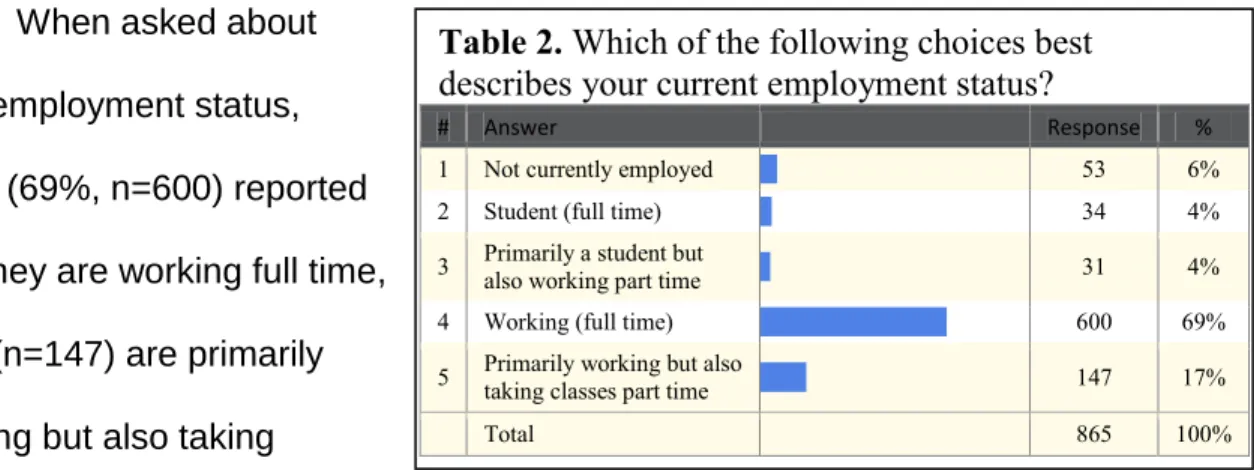
When asked about
their employment status,
many (69%, n=600) reported
that they are working full time,
17% (n=147) are primarily
working but also taking
classes part time, 6% (n=53) are not currently employed, 4% (n=34) are full time
students, and the remaining 4% (n=31) are primarily students but also working part
time. The majority (32%) of the respondents work for international
Non-Governmental Organizations (NGOs). Others work for local NGOs (14%), National
Governments (11%), United Nations Organizations (9%), Academic Institutions Table 1: Participant Age Distribution: What is your age?
# Answer Response %
1 younger than 18 0 0%
2 18 - 24 34 4%
3 25 - 34 472 54%
4 35 - 44 262 30%
5 45 - 54 75 9%
6 55 - 64 21 2%
7 65 or older 4 0%
Total 868 100%
Table 2. Which of the following choices best describes your current employment status?
# Answer Response %
1 Not currently employed 53 6% 2 Student (full time) 34 4%
3 Primarily a student but also working part time 31 4%
4 Working (full time) 600 69%
5 Primarily working but also taking classes part time 147 17%
(7%), USAID cooperating agencies (6%), or Research/Policy Institutions (5%). The
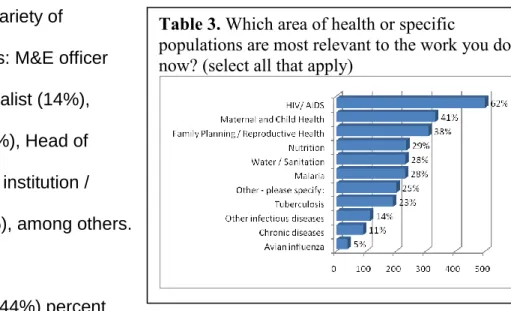
respondents‟ work focused on a variety of populations, particularly HIV/AIDS, MCH
and Family Planning/Reproductive Health populations as depicted in Table 3. They
also represent a variety of
employment levels: M&E officer
(18%), M&E specialist (14%),
General Staff (12%), Head of
department for an institution /
organization (11%), among others.
Education
Forty-four (44%) percent
reported their highest level of completed education as a masters degree, while 28%
held an undergraduate degree, 19% had completed some graduate school, and 6%
held a doctorate degree.
Interestingly, when participants
were asked where their highest level
of education was completed, the
number of participants who reported
completing their degrees in one
country differed from the number of respondents who reported current primary
residence in that same country. This points toward the well-documented tendency
for professionals in developing countries to seek education in more developed
countries due to limited educational opportunities at home. For example, 5% (n=44)
respondents reported completing their highest level of education in the UK, however 0%
3% 28% 19% 44%
6% Table 4. Please indicate your highest
level of completed education
Less than High-school High-school degree Undergraduate degree Some Graduate school Masters degree Doctorate degree
Table 3. Which area of health or specific
only 1% (n=6) reported the UK as their primary residence. For the US and South
Africa, similar trends were seen where 10% of respondents (n=88) reported
completing their education in the US and 4% (n= 33) in South Africa, while only 8%
(n=65) were currently residing in the US and 2% (n=20) counted of South Africa as
their primary residence. Kenya (n=108), Tanzania (n=43), Uganda (n=58) all saw
fewer participants reporting receiving their education in the country compared to the
number who reported each of those countries as their primary residence.
Continuing Education
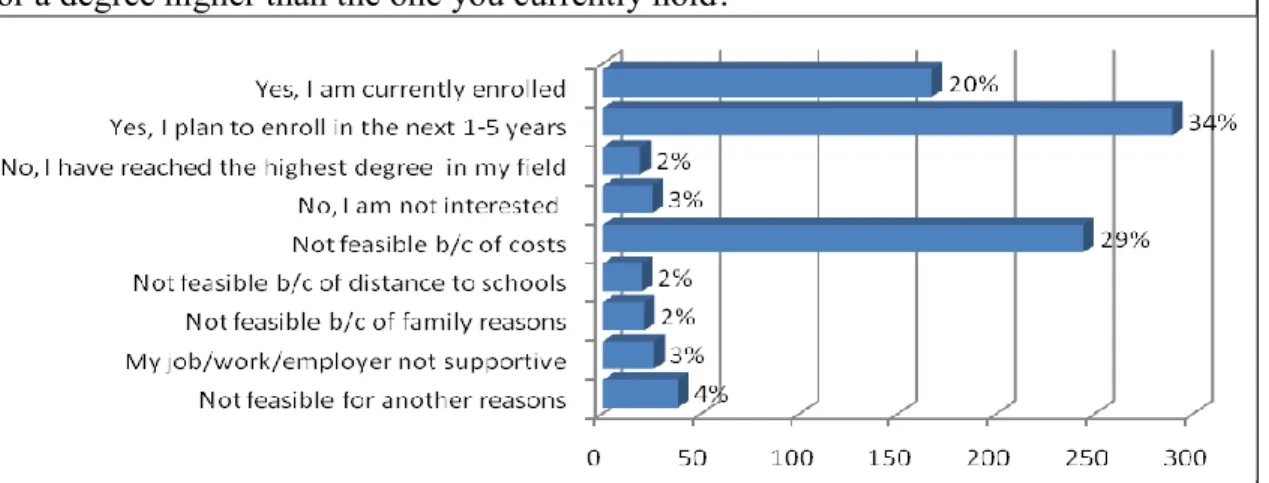
When asked, “Since receiving our highest degree, have you considered
returning to school for a degree higher than the one you currently hold?”, 20%
replied “Yes, I am currently enrolled” and 34% responded “Yes, I plan to enroll in the
next 1-5 years”. (Table 5) Twenty nine percent, however, responded that they would
like to, but it is not feasible because of costs. Others reported that it was not feasible
because their job/employer is not supportive (3%). Some reported that it is not
feasible because of distance to schools (2%) and still others responded that it is not
feasible because of family reasons (2%). Four percent (4%) of participants reported
that there were other reasons as to why continuing their education would not be
feasible. These included combinations of two or more of the previously mentioned
barriers (i.e. costs and distance) as well as other specific barriers. Comments
included “The current economy and earning power in Nigeria”; “I am working in
Somalia where there is no good education”; “I would have to figure out what I‟d like
to study”; “Lack of an M&E masters course in Kenya”; “I did but was not able to finish
on time”; “I tried to enroll but declined by the University” and “My work requires me to
travel very often”.
Participants were given the option to provide their top three reasons for what
would encourage them to enroll in a higher degree program. Eighty two percent
(82%) of respondents chose “to improve professional competency”, 80% chose “to
expand knowledge and skills”, and 43% chose “if I could receive a scholarship”. Only
two percent (2%) selected “dissatisfaction with previous professional practice”.
Most respondents (73%) indicated that if an online degree program were
available to them, they would consider getting their next degree through an online
program. Only ten percent (10%) said they would not be likely or would definitely not
be likely to apply for an online degree program.
People responded even more positively to online continuing education credits
or professional workshops in M&E. Eighty four percent (84%) said they would be
very likely to take M&E continuing education credits or professional workshops (not
related to a degree program) through an online program. An additional 14% said
they would be somewhat likely to take these types of online courses, while only 2%
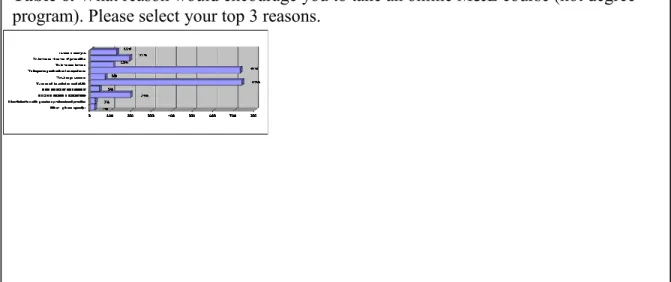
said they would not be likely to do so. When given the same option to provide their
top three reasons for what would encourage them to enroll in an online (non degree)
to apply for higher degree programs (Table 6). Eighty six percent (86%) of
respondents chose “to improve professional competency” 87% chose “to expand
knowledge and skills”. A smaller percentage (23%) chose “if I could receive a
scholarship” and 23% also selected “to increase chances for a promotion”. This
latter option had received 21% of the respondents‟ motivations in the previous
question. Only 13% of the participants selected “to increase income” as a motivation
for taking online M&E courses, while 28% of the participants selected “to increase
income” as a motivation for in choosing higher education programs. Other reasons
people indicated that might encourage them to take an online M&E course included:
“to apply updated knowledge for the M&E systems that I am currently working on”; “if
and only if [it were] impossible to enroll for a degree directly”; “to recommend to my
staff”; “to perfect my skills in M&E”; “allows one to work and study without having to
be away from work”; “free of charge, so I can afford it”, “to stay aware of the latest
methods and keep learning”. Overall, 99% of the respondents indicated that they
would participate in short courses or workshop trainings in M&E in the future if they
were available online.
Internet and Computer Access
Of the 822 respondents who answered the question, 96% indicated that they
had access to a computer with internet at work, while 79% said they do at their
home, 56% on a mobile device, 27% at school, 50% at internet cafes and 24% at
libraries. When asked where people access a computer with internet most often, on
average respondents reported using the internet at work 60% of the time and at
home 25% of the time. Other places where people access the internet are at the
gym, with friends, and while traveling at airport lounges. The majority of the
respondents (84%) use the internet on a daily basis, while 15% use it 4-6 times per
week. Only one percent (1%) uses it once per week, and almost nobody reported
accessing a computer less often than once per week. Of those using the computer,
46% reported that, on a
regular day, they usually
spend about eight hours or
more at the computer and
35% said they use the
computer between four and
eight hours a day. Only
18% reported using a
computer less than four
hours per day on a regular basis. Table 7 shows how often people reported being
away from their computers for more than four days in a row. However, the majority
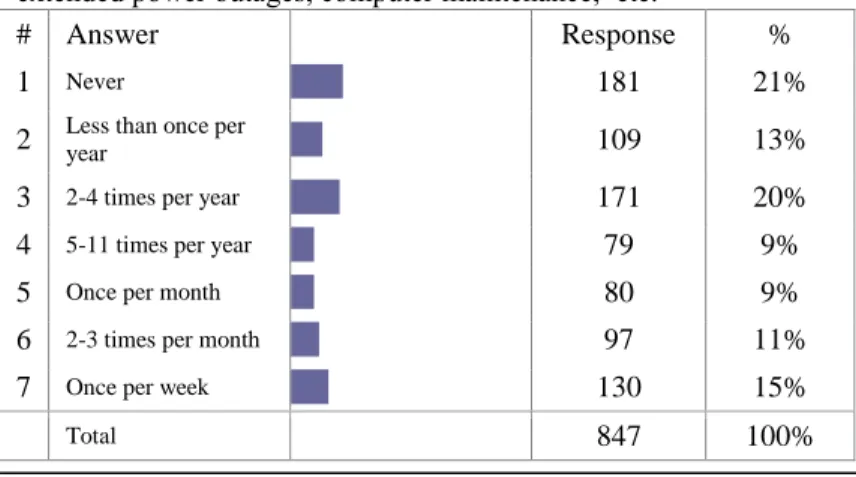
(78%) said that they usually bring a computer with them when they travel. As the Table 7.How often are you away from your computer for more than 4 days in a row? This can include any reason that you might not be able to use your computer including but not limited to travel, extended power outages, computer maintenance, etc.
# Answer Response %
1 Never 181 21%
2 Less than once per year 109 13%
3 2-4 times per year 171 20%
4 5-11 times per year 79 9%
5 Once per month 80 9%
6 2-3 times per month 97 11%
7 Once per week 130 15%
responses show, these respondents are usually at their computers, but 36% are
away from their computers at least once per month.
When asked about the internet connection used most often, the most
commonly used type of internet connection reported by users was a Digital
Subscriber Line (DSL) (28%). Satellite (15%), Fiber optic (13%), Dial-up, (10%),
Cable (10%), and Cell/Mobile Phone (8%) connections are also somewhat
frequently used.
As is expected in developing countries, respondents did report that the
internet connection is not always reliable. Twenty three percent (23%) reported that
their connection times out between two and three times per day. Nine percent (9%,
n=83) reported that their internet connection times out at least one time per hour and
61% of those said it was four or more times per hour. It would be important to
determine the differences in this connectivity between developed and developing
countries, as those in developing countries likely have less consistent internet
connectivity but also are likely in greater need of online courses due to barriers in
accessing in person workshops. The majority of participants (91%) do have audio
abilities on their computer. Fewer, but still a majority have video (84%) and Flash
media (80%) abilities on their computers. Internet speed is also an important
Table 8. Download Speed (n=809) Upload Speed (n=746)
05.01 - 10.00 Mb/s 13% 10.01 - 20.00 Mb/s
10% 20.01 Mb/s or m ore
18% The site did not work
3%
I do not k now 20%
01.01 - 05.00 Mb/s 18% Le ss than 1 Mb/s
18% Less than 1 Mb/s
24%
01.01 - 05.00 Mb/s 15%
05.01 - 10.00 Mb/s 11% 10.01 - 20.00 Mb/s
10% 20.01 Mb/s or more
15% The site did not work
3%
consideration when it comes to e-learning functionality. Of the 809 participants who
responded to the question, less than one fifth had internet download speed of slower
than one megabyte per second and less than one fifth had faster than 20 megabytes
per second internet speed (Table 8). Participants reported being satisfied with their
internet speed, as more than 53% rated their level of satisfaction as a seven or
higher on a scale of 0-10 and only 13% rated their level of satisfaction as three or
lower on the same scale.
Exposure to Continuing Education Courses in Classrooms vs. Online
The majority of the respondents (71%, n=604) reported having taken a
continuing education/professional development courses in a classroom since their
highest level of education. Sixty nine percent (69%) of those respondents
participated in classroom workshops related to M&E and 28% said their classroom
continuing education was not related to M&E. Topics covered in continuing
education which happened in classrooms/ in person formats ranged and included
such varied topics as: Social Work, project management, data management,
Masters in Business Administration, MIS – Prevention of Mother to Child
Transmission of HIV, policy development, proposal writing, marketing, Socio
Economic and Gender Analysis (SEAGA), appreciative inquiry, training of trainers,
computer packages, statistical software packages, and much more. Many of the
courses were specific to M&E including topics like, M&E of HIV/AIDS, Project M&E,
Implementing and Evaluating Health Projects. Many of MEASURE Evaluation‟s in
person regional workshops were mentioned when people indicated which trainings
Less than half (45%, n=381) of the respondents have taken any continuing
education or professional development courses or workshops (not including the
MENTOR M&E fundamentals course). Of those who had, many of the respondents
(58%, n=223) said that the online course they took was related to M&E. The Global
Health e-Learning courses were mentioned as a common source for access to
online courses related to M&E. M&E Frameworks, Project Design, Project
Management, M&E Frameworks for HIV programs, M&E in the NGO Sector, Results
Focused Project Design, Monitoring Framework Approach and USAID PEPFAR
were some of the M&E related topics covered in M&E online courses that were
listed.
A majority of the participants
(88%) were satisfied or very satisfied
with online learning in general (Table 9)
and many suggestions were given for
improving the quality of online learning
through MEASURE Evaluation. Some
comments are highlighted it Box 4, and a full listing of these comments are available
in Appendix B.
When asked to rank the following components of learning in order of most
important to least important for continuing education, the respondents ordered the
components in the following manner: (1) course content, (2) instructor‟s experience,
(3) interaction with an instructor, (4) interaction with fellow students, (5)
entertainment/presentation quality, (6) technical support, and (7) other. Other
components that were considered important included: Cost, learning environment,
28% 60%
11%
1% 0%
Very Satisfied Satisfied Neutral Dissatisfied Very Dissatisfied
availability of reading and training
materials, handouts and reference
materials, duration of study, frequency
and flexibility of trainings, self
assessments and quizzes, frequently
asked questions, instructor feedback,
follow up mentorship for students,
current information, field experiences,
completion certificates, audio and
video, and hearing about other
people‟s experiences.
The things that were
considered most important to participants when learning were, in order of most
important to somewhat important were: See lecture slides, Print module with all
lecture notes, print lecture slides, ask questions in real time, hear the instructor, and
read what the instructor is saying (when lecture is in an audio format). Less
important, but still important were being able to view videos related to course
materials, moving at one‟s own pace, communicating (online) with other students,
and being able to see the instructor in a video format. Less important was having a
picture of the professor. Other comments on factors important to students as they
learn included: receiving feedback and critiques from the instructor, share practical
experiences in M&E with the instructors, access to a tutor (online or in person),
being able to ask questions, having better internet connection, availability of a CD or
DVD, relevant real life examples, illustration points, working examples, as well as
Box 4.What Comments or suggestions do you have
for improving the quality of online learning on MENTOR in the future?
More updates needed
Advanced level should be added for upgrading new knowledge and skills
Include application and offer advanced courses Provide a larger variety in courses
Option for questions to be asked or clarified via email Give more case studies
Increase learners interactions with each other It was too short
Combine media, audio, visual etc.
Include a learning module to learn about statistical packages like Epi Info
I am very satisfied with the mentor online course. I suggest more detailed reference materials be presented I suggest the program can better be enhanced by allowing high profile universities award certificate for the program. I mean the awarding institution should find its name on the certificate or diploma that may be awarded at the completion of course
materials that can be used to teach the concepts to other colleagues. In regards to
logistics, many participants made the point that it is important to be able to start back
where one has left of if internet connection is interrupted or if one needs to stop and
come back to a learning module for some other reason. People also expressed the
need to receive course materials in advance to be able to preview information. Other
factors that were expressed as concerns were the timing of online workshops or
online real time meetings because of differences in time zones. People also brought
up the need for accredited certification or internationally accepted recognition for
completing online courses or workshops so as to be able to add these courses to
one‟s Resume or Curriculum Vitae.
M-Learning, Virtual Worlds and Online Meetings
About half (46%) of the participants had heard of M-Learning (described in
the question as: Mobile Learning referring to learning using mobile devices like hand
held computers, mobile phones, MP3 players etc.) but had never used M-Learning.
Approximately the other half (46%) had never heard of M-Learning at all. Only eight
percent (8 %,n=62) reported using M-Learning and described very varied
experiences including: Medical quick reference for primary care attention, Rosetta
Stone on laptops and I-phone language courses, data collection using remote
sensing PDAs, using phones to read notes and exam questions or browse the
internet, to receive school or other lectures on an MP3 player or I-pod/phone, in
USAID education projects to relay digital messages to remote schools, Voxiva
service used in a clinical trial through which SAE (serious adverse event) alerts were
transmitted and using laptops to receive instructional materials. Most (88%) of those
Similarly, about half (43%) of the participants had heard of Virtual Worlds in
learning which was described in the question as a strategy that uses concepts of
virtual gaming to teach information to students in an interactive format which would
otherwise be difficult to recreate due to cost, scheduling or location. Half of the
participants had never heard of this format for learning (50%). Of those who had
used it (7%), almost all (95%) found it an effective method for learning. Those who
used this strategy described their experiences in various ways. A few mentioned
using virtual class room for their highest education including online class
discussions, some said they were currently or had been enrolled in virtual
classrooms through eCornell and Freer United Kingdom and using satellite
classrooms while enrolled in other Universities. One person mentioned “Telehealth”
and video conferencing, another e-symposiums, and a few mentioned the Virtual
Leadership and Development Program where instructors and students interact using
a forum. Other participants mentioned e-learning, using the internet, Google and
Wikipedia and other search engines for research, or using compact discs (CDs) for
learning.
Many participants had some experience with various online meeting
platforms. Most people had used Skype, some had used Adobe Acrobat Connect
but only very few had used Microsoft Office Live Meeting, Eliminate Live, or GoTo
Meeting. In general those who had used Skype were satisfied with the meeting
platform, while those using Adobe Acrobat Connect were mixed between neutral and
satisfied. Other software that the participants mentioned having experience with
included Blackboard, Facebook, Yahoo, Google-Talk, Google-Docs, Google-Chat,
webinar, Liverpool Laurerate online and Implementing Best Practices (IBP)
Knowledge Gateway.
DISCUSSION & LIMITATIONS
This survey data has provided some important information about our study
questions. First, we know more about the background characteristics of the people
who have taken MEASURE Evaluation‟s online M&E Fundamentals course. A
majority of the participants are young, 25-34 year old, professionals who are working
full time, mostly for NGOs. Nigeria and Kenya were the two countries with the largest
proportion of respondents to this survey, and we found that some people were
educated in countries with elevated access to higher education, like the United
States and the UK, and moved to lower income countries to work, indicating a need
for better access to education. Additionally, we found that the respondents work
predominantly with HIV/AIDS, Maternal and Child Health and Reproductive Health
and Family Planning populations.
With regards to our second study question, we were able to determine that a
majority of those surveyed are interested in participating in additional online courses
in the future. Almost all (88%) of those surveyed were satisfied or very satisfied with
online learning. The large majority (84%) of respondents said they would be willing
to take online continuing education credits or workshops and almost three quarters
(73%) said that they would consider getting their next degree through an online
program if it were available to them. Overall, almost everyone (99%) said they would
participate in short courses or workshop trainings in M&E if they were provided
Additionally, with regard to the third question, we were able to determine that
for the most part, participants did indicate that they have regular access to the
internet. The majority of respondents access the internet at work (96%) and three
quarters (79%) access it at home. Half indicated that they are not away from their
computer for more than four days in a row or for more than four times each year.
This indicates good accessibility to online learning resources. As intended, the
survey also highlighted some barriers to online learning, such as the fact that
internet connections in developing countries time-out relatively frequently, and the
fact that the M&E fundamentals course was challenging for some but too basic for
others, indicating a need for online learning courses to vary in difficulty level.
Recommendations follow in the next section, but first a short discussion on the
limitations of this survey is necessary because some of the barriers to online
learning are likely under represented due to some of these study limitations.
One of the major limitations of this survey was due to the nature of the
participant recruitment and data collection. This survey only reflects the opinions and
experiences of those who have already accessed online information on M&E and
have been motivated to take the M&E Fundamentals course. It also only represents
those who were online, accessing email and able to respond to the survey when it
was emailed to them and within the allotted data collection period. The results are
therefore biased towards people who were at their computers and able to access the
internet regularly. We can assume that not all program staff that could benefit from
online M&E learning materials have as consistent access to internet connections
and computers as are reported in the survey findings. During the month between the
participants emailed the survey administrator indicating that they would like to
participate in the survey, but had not had access to their emails during the three
weeks of survey data collection. To get a better idea of the true barriers of access to
computers and feasibility of online learning for M&E staff in low resource settings, a
non-computer based data collection strategy would likely need to be employed.
Internet connectivity will continue to be a barrier to online learning in developing
settings.
Additionally, we only had a response rate of about 40%, and though a low
response rate was expected, it is impossible to know for sure all the factors that lead
to this low response rate. While it does not seem likely the survey was sent to any
incorrect email addresses (we received no bounce backs), we cannot know for sure
how many mail addresses were sent to inboxes that are no longer the primary
e-mail for our target audience. Another limitation is that this survey was only
administered to people who completed the M&E Fundamentals course online, and
therefore only gives responses from people who were motivated to complete the
course. It would have been interesting to compare the answers of those who
completed the online course to those who started M&E Fundamentals but did not
complete the course. This warrants further research.
A limitation that was uncovered in the literature review but not represented in
the survey was the issue of cost for distance learning. Respondents mentioned that
cost was a barrier to attending non-distance learning education, however no
question was asked about whether participants would be likely to pay for access to
courses, they do cost considerable resources to develop and maintain, so examining
costs may warrant future examination.
RECOMMENDATIONS
While some challenges exist with online learning, overall it presents an
exciting alternative to often logistically complex and expensive in-person training
options for public health professionals around the world. As almost half of the
respondents to this survey reported working with Maternal and Child Health,
HIV/AIDS and Reproductive Health and Family Planning populations, MEASURE
Evaluation‟s future impact on increasing M&E capacity for professionals in these
fields can be tremendous as the online learning options increase. Based on the
survey results, the following recommendations should be considered as MEASURE
Evaluation develops future online training courses for M&E professionals.
(1) Develop courses for varied levels of expertise and consider developing certificates for completing a series of related courses.
Participants of online courses have varied levels of background education
and English proficiency and therefore have different learning needs. It is important to
make courses rigorous enough to provide new information to those who need
advanced training and updates on best practices, but it is equally important to
provide training basic enough for those who have no former knowledge of M&E.
Based on the survey results, one way to approach this is to develop separate
courses for a variety of M&E experience levels, which can build on each other. The
Global Health e-Learning Center has implemented a certificate process whereby
specific topic area. They provide various levels of courses, which build on each other
to deepen the students understanding of course materials. This may be an example
for MEASURE Evaluation‟s future online courses to model. Certificates for
completing a series of courses on a specific subject matter can help online students
gain deeper understanding in specific subjects in a stepwise approach. Many
survey participants requested additional courses with more advanced M&E
techniques and even requested courses on more advanced data analysis and how
to use statistical software. Respondents also suggested that certificates are
important for their professional advancement, so certificates should be administered
for course or series completion. Though it was not addressed in this survey, course
offerings should be available in a variety of languages whenever possible to
increase access.
(2) Online course content recommendations: Updates, printable materials and expanded use of case studies and practical examples
Online course information must remain up to date and provide information on
current best practices. For this to happen, online courses must be refreshed and
updated on a regular basis. Self paced modules, quizzes, and final exams at the
ends of various learning modules are very useful and well liked by students.
Additionally, respondents expressed the need to be able to stop and save their
course at any time and return when they are able to, especially if they lose internet
connectivity. Respondents also indicated that course slides, lecture notes and other
reference materials should be printable and that access to tools, M&E guides and
survey respondents requested increased use of currently relevant case studies,
practical examples and exercises.
(3) Instructor and Student Feedback: E-mails, communities of practice, blended learning, online meetings
Along with the request for additional case studies, practical examples and
exercises in future online courses from MEASURE Evaluation, there was a request
for feedback from instructors and other students. Survey results showed that the
second most important aspect of continuing education (after course content) was
instructors‟ experience. The third most important was interaction with an instructor,
and the fourth was interaction with other students. Distance learning has the unique
problem of potentially being alienating and leaving students feeling that they have no
one to ask questions to if they have no direct contact with instructors or other
students. Many survey participants voiced the need for feedback from experts or
instructors when completing online courses. In the case of online workshops, this
could be done through web based live forums using audio or video conferencing or
scheduled online meetings. In the case of more static online web courses, some
considerations would be to include e-coaching by providing an e-mail address for
students to contact instructors for immediate e-mail correspondence. Online
communities of practice for students and instructors to post questions and answers
for everyone to see may be another approach. This would provide students with the
unique opportunity to see the questions that other students have asked and learn
though others interactions with instructors as well as through their own interactions.
Lack of instant feedback through online courses is an important challenge to
impact on how well students learn information. Blended learning strategies that mix
online static learning with more interactive face-to-face or virtual meetings may also
provide interesting opportunities for future online M&E learning communities.
CONCLUSION
MEASURE Evaluation is well positioned to increase capacity in M&E through
distance learning because of its vast experience in developing M&E training
materials and implementing short and long-term M&E training programs using
traditional methods. As budgets shrink, traditional methods of training alone are not
able to fill the gap between need for continuing education and access to training for
M&E professionals around the world. Online and distance learning is a proven
strategy for increasing knowledge and improving performance in developed
contexts. With additional attention to providing training in various languages and with
country specific examples that are adaptable to a variety of country and cultural
contexts, e-learning for M&E will play a crucial part in filling this gap. Addressing the
barriers discussed in this paper and providing solutions to concerns expressed by
survey participants will be important as MEASURE Evaluation moves forward with
REFERENCES
(1) MEASURE Evaluation Phase III-Monitoring and Assessment for Results: Year 3 Work Plan: (July 1, 2010 – June 30, 2011)
(2) MEASURE Evaluation Capacity Building. [Online]. [cited 2011 Mar 19]; Available from: URL: https://www.cpc.unc.edu/measure/our-work/capacity-building
(3) MEASURE Evaluation Regional Workshops. [Online]. [cited 2011 Mar 19]; Available from: URL:
https://www.cpc.unc.edu/measure/training/workshops
(4) MEASURE Evaluation Training Partners. [Online]. [cited 2011 Mar 19]; Available from: URL: https://www.cpc.unc.edu/measure/training/training-partners
(5) MEASURE Evaluation Materials for Trainers. [Online]. [cited 2011 Mar 19]; Available from: URL:
http://www.cpc.unc.edu/measure/training/materials
(6) MEASURE Evaluation MENTOR Training Resources. [Online]. [cited 2010 June 30]; Available from: URL:
http://www.cpc.unc.edu/measure/training/mentor
(7) MEASURE Evaluation MENTOR M&E Fundamentals. [Online]. [cited 2011 Mar 20]; Available from: URL:
http://www.cpc.unc.edu/measure/training/mentor/me_fundamentals
(8) Farel A, Pfau S, Paliulis S, Umble K. Online Analytic and Technical Training. JPUblic Health Management Practice. 2003.9(6) 513-521
(9) Darren L P, An Evaluative Case Study of Online Learning for Healthcare Professionals. The Journal of Continuing Education in Nursing. Sep/Oct 2006. Vol. 37 (5). P225-231.
(10) Clarke A, Lewis D, Cole I, Ringrose L. A strategic approach to developing e-learning capability for healthcare. Health Information and Libraries journal, 22 (2) p33-41.