
Emily S. Jack. Worth a Thousand Words: Art and the User in the Public Library. A Master’s Paper for the M.S. in L.S degree. April, 2007. 100 pages. Advisor: Deborah Barreau
This paper presents the results of a study investigating the interactions between public library users, art, and library buildings. Drawing upon the results of an art inventory, user observations, a user survey, and staff interviews, the study addresses the extent of users’ interactions with art in two public libraries, and the possible effects of art on users’ library experiences. The research was driven by the question: Do public libraries in which the art displayed is perceived favorably draw more recreational users than public libraries in which the art displayed is unnoticed or perceived unfavorably? The study finds no relationship between patrons’ activities and their tendency to view art, but finds that patrons are engaged by art, and suggests that users may spend more time in a library in which the art displayed is perceived favorably.
Headings:
IN THE PUBLIC LIBRARY
by Emily S. Jack
A Master’s paper submitted to the faculty of the School of Information and Library Science of the University of North Carolina at Chapel Hill
in partial fulfillment of the requirements for the degree of Master of Science in
Library Science.
Chapel Hill, North Carolina April 2004
Approved by
OUTLINE
1. Introduction 2. Literature Review
2.1. Public Libraries as Community Spaces 2.2. Retail Interiors and Consumer Responses 2.3. Library Design and the User
2.4. Libraries and Atmospherics 2.5. Art in Public Libraries
2.6. Conclusion
3. Methodology
4. Operational Definitions
5. Building Descriptions and Art Inventory 6. Observations
6.1. Method
6.2. Limitations of Observation Methodology 6.3. Observation Results
6.4. Analysis of Observation Results 7. Surveys
7.1. Method
7.2. Limitations of Survey Methodology 7.3. Survey Results
7.4. Analysis of Survey Results 8. Interviews
8.1. Method
8.2. Interview Results
1. INTRODUCTION
Public libraries have long served as community spaces all over the United States. As publicly funded institutions, they offer citizens of every age and socio-economic class a venue for solitary study or social interaction. As non-commercial public spaces, they also serve the greater good by providing a space for free assembly and by fostering strong community ties. By providing programs and responding to local concerns, public
libraries facilitate connections between community members. By providing technology, resources, and information, they cultivate connections to the world beyond the local community.
But while the public library seems to be innately positioned to operate as a community space, in recent years many writers have expressed concern about its continuing ability to fulfill this role. The rise of the big chain book store – a place in which customers are allowed, and indeed encouraged, to spend hours at a time reading and socializing, with seemingly no pressure to buy anything – has presented a challenge to the traditional perception of the library as a center for community discourse and leisure.
Bookstore proprietors have endeavored to promote their establishments as
behavior. Like all retail domains, bookstores provide evidence for the success of “atmospherics,” the art of manipulating aspects of the physical environment – lighting, smell, color, and interior decoration – in order to achieve desired effects. (Kotler, 1973)
Their strategies have succeeded in affecting customers’ perceptions of both bookstore and library spaces. Studies comparing libraries and bookstores have found that libraries are perceived widely as places to study or conduct research, while bookstores are commonly perceived as places to relax and socialize. Perhaps not surprisingly, these studies have induced many writers to express concern that bookstores are getting better and better at doing what public libraries have always done best. (Cartwright, 2004; OCLC, 2005)
Fortunately, the simple passage of time has stripped much of the immediacy of this debate, as many alarmists have conceded that big chain book stores pose less of a threat than previously thought: Behemoth book stores have existed for decades now, yet, by and large, public libraries continue to thrive. Clearly, there is enough room the world for both types of establishment. Clearly each has found its own niche.
If the public library is to become an experience, rather than simply a place to use resources, such seemingly minor details of the library’s interior must not be overlooked. While building design has long been an important topic in the library world, a review of library design literature indicates that only relatively recently has the focus been placed squarely on the ways interior library environments can affect the emotions and
experiences of patrons. And although the proliferation of articles and books about the designed environment of the library is encouraging, few attempts have been made to isolate individual elements of library interiors in an effort to determine their effects on users. As a result, library directors and planners have little empirical research upon which to draw when making decisions about such details as the arrangement of furniture, the selection of a color scheme, and the display of art.
The display of art, in particular, is one facet of the library atmosphere that
deserves more attention than it has traditionally been paid. Art can play an important role in the creation of a welcoming environment in any building. It can cultivate
communication by stimulating discussion within the community while linking it to the world outside its borders. And, perhaps more than any other individual element of a building’s interior, the display of art offers an avenue for unique expression, providing a purposeful departure from the excessively branded, vanilla environment of chain retail stores. Unfortunately, while many (if not most) public libraries display art in some quantity, there seems to be no empirical research on the interface between art and public library users.
inventory, user observations, a user survey, and staff interviews, the study addresses the extent of users’ interactions with art in two public libraries, and the possible effects of art on users’ library experiences. The research was driven by the question: Do public libraries in which the art displayed is perceived favorably draw more recreational users than public libraries in which the art displayed is unnoticed or perceived unfavorably?
2. LITERATURE REVIEW
The basis for this study draws upon three primary areas of scholarship: First, ideas about the necessity for and characteristics of community space, and the potential for public libraries to fulfill this role; second, research on retail interiors as they influence consumers’ emotions and behaviors; and finally, historical and current thought on the intersection between library design and users’ experiences, with particular attention to the role of art in library environments. Therefore, it will be important to examine the
literature from all three of these areas.
2.1. Public Libraries as Community Spaces
In Ray Oldenburg’s The Great Good Place, he describes the characteristics of what he calls a “third place” – a place, neither home nor work, where people spend a significant amount of time. He lists cafes, coffee shops, bars, and hair salons among typical third places. According to Oldenburg, these spaces are essential elements of any community, providing “the core settings of informal public life.” (Oldenburg, 1989)
grass-roots political participation, venues for free assembly, and the collective benefits to society from providing a place for people to “let off steam.” (Oldenburg, 1989)
To these benefits, Kevin Harris adds that community spaces have the potential to “minimize inequalities, to maximize learning opportunities, and to stimulate both
diversity and cohesion within local communities.” (Harris, 2003) Citing Oldenburg’s research, he suggests that public libraries are uniquely situated to be third places for many people. Although typically less interactive than the prototypical third places described by Oldenburg, Harris emphasizes the importance of public libraries in
providing support and fostering trust in local communities. Mats Lieberg sees a need for different kinds of third places, and distinguishes between “places of retreat” and “places of interaction.” (Lieberg, 1995) Harris suggests the public library can be both of these – a place of retreat and a place of interaction.
Additionally, libraries are optimally situated to contribute to the “greater good” because
As William David Davies (1974) reminds us, ideas about public libraries as community spaces are hardly new. Davies traces the origins of non-literary uses of public libraries in Britain and the United States, beginning in the late 1800s. He finds evidence that in late 19th-century Britain, “non-book” activities – serving food, offering classes, and staging plays – were used regularly to attract people to libraries. Over time, these kinds of activities came to be viewed as a natural part of the function of libraries, and contributed to the now common conception of libraries as social, cultural, and recreational centers. (Davies, 1974)
Although the notion of libraries as community spaces is an enduring one, in recent years many writers have voiced concern about the present and future state of libraries in this role. A great deal of this concern is aimed at the recent rise of the big chain
bookstore, which many have accused of usurping the public library’s role as a “third place.” Indeed, over the past several years, bookstores have gained a reputation in news media as community centers. To cite just one example, a 2000 article in the Las Vegas Review-Journal claims, “Today the bookstore has become… yet another urban location that social-minded Americans have adopted as a surrogate community center.” (Przybys, 2000)
focused research, information and education, the bookstore is in contrast associated with browsing, casual use and recreational reading.” (Cartwright, 2004)
While this study was conducted in the U.K., similar studies in the U.S. have supported Cartwright’s results, finding that American library users echo the sentiments of their British counterparts. A 2005 OCLC study asking respondents to compare libraries with bookstores found that most favor libraries for certain things, like free internet access. On the other hand, however, they favor bookstores for “coffee shops, current materials and meeting their friends.” (OCLC, 2005) These results suggest that libraries tend to be used as information centers, while bookstores tend to be used as social and community centers.
The OCLC study suggests that libraries and bookstores serve different needs, which raises the question of the importance of these recreational users to the public library: If the library’s primary function is to provide information, is it necessary for it to also serve as a community space? Jeannette Woodward responds to this question by pointing out that “to be there when needed, the library must become a lifelong habit. Only the customer who checks out travel books or mystery novels month after month will turn naturally to the library for information.” (Woodward, 2005) In other words, in order for the library to be seen as an information center, it must also be seen as a community center.
2.2. Retail Interiors and Consumer Responses
environments. A store’s atmosphere “represents the interface between the user or
customer and the organization and is directly related to the feeling that people have about an organization.” In the case of Barnes and Noble, the atmosphere is intentional and consciously conceived. Leonard Riggio, the chain’s founder, has masterminded a combination of elements that contribute to the familiar Barnes and Noble environment: “enough woody, traditional, soft-colored library atmosphere to please the book lovers, … sophisticated modern architecture and graphics… [and] plenty of welcoming public space.” (Sannwald, 1998)
A vast body of empirical evidence stands behind this formula, suggesting that the elements of a building’s interior play a significant role in consumer attitudes and
behaviors. In 1973, Philip Kotler introduced the term “atmospherics” into marketing science, theorizing that retail environments have the power to influence behavior in customers. He defines the term as “the conscious designing of space to create certain effects in buyers. More specifically, atmospherics is the effort to design buying
environments to produce specific emotional effects in the buyer that enhance his purchase probability.” (Kotler, 1973)
R. J. Donovan and J. R. Rossiter (1982) tested Kotler’s theory using an
supported in subsequent studies by numerous researchers, including Grewal and Baker (1994), Babin and Darden (1996), and Babin and Attaway. (2000)
Baker, Levy, and Grewal’s 1992 study extended the work of Donovan and Rossiter by proposing that the retail environment is composed of a variety of distinct elements, including design, ambient, and social factors, each of which has an independent effect on consumers’ emotions. (Baker, Levy, & Grewal, 1992) Their research isolated two ambient factors (music and lighting) and two social factors (number and affability of salespeople), and provided a precedent for subsequent studies examining individual elements of retail environments.
Retail scientist Paco Underhill (1999) has built a lucrative career on such research and their impact on the marketing world. His work highlights the excruciatingly detailed planning that contributes to the creation of an ideal retail environment. Decisions that were once made arbitrarily on a case by case basis (e.g. the placement of an in-store sign), have been studied extensively to determine optimum practices. One of the
consequences of these carefully manipulated retail spaces is that most Americans are now accustomed to spending time in buildings that have been meticulously designed to
maximize their pleasure and arousal. In short, consumer expectations have evolved with marketing science.
As a result, public libraries neglect their interior spaces at their own peril. While public libraries have an obvious cost advantage over bookstores, free resources alone do not constitute a sufficient draw for today’s heavily catered-to consumers. As Woodward writes, “Free or not, people won’t spend time in a library unless the experience
places of extended study, places from where books didn’t circulate. “People came to the library to read and often stayed for hours… Since ‘a place to be’ is an important function of the library, it should be an inviting, enjoyable place… In short, it should be a place that gives pleasure to the senses.” (Woodward, 2005)
OCLC’s 2005 studies demonstrate that patrons notice when buildings fail to meet their expectations. One study, which measured users’ positive and negative associations with libraries, found that one of the most frequently cited negative associations (at 26%) relates to facilities and the environment. Another study found that “poor signage, inhospitable surroundings, unfriendly staff, lack of parking, dirt, cold, hard-to-use systems and inconvenient hours were mentioned many, many times by respondents.” The study concludes that “the overall message is clear: improve the physical experience of using libraries.” (OCLC, 2005)
2.3. Library Design and the User
The new generation of librarians and architects must rise up with a mighty resolution to crush this evil tradition in design, this false attempt at a heavy dignity and copying of outworn patterns, and produce new libraries which will be the liveliest and most inviting buildings in their communities, full of color, action, and interest, where all will delight to come.
However, while this passage acknowledges the importance of creating pleasing libraries, the text largely steers clear of advising designers on precisely how to create such lively and inviting interiors. Apart from a few brief mentions of maximizing natural light, the authors’ emphasis rests firmly upon more practical, structural guidelines. (Wheeler & Githens, 1941)
Rolf Myller’s 1966 The Design of the Small Public Library approaches library design in a similar fashion. Myller describes the entire process of planning a new library building, beginning with surveying the site. His attention to the combined effect of a building’s ceiling, windows, and floors recognizes the importance of creating an interior aesthetic. (Myller, 1966) However, like Wheeler and Githens, Myller’s focus is chiefly functional and structural. Neither devotes attention to the experiences of potential library users.
A survey of Library Journal’s annual design issue as it has changed through the years illustrates how thinking about library design has evolved over time. The first annual issue to feature library buildings appeared in 1937, and included four building profiles. Each article primarily focuses on the physical layout of the building it describes, including its dimensions, storage capacity, security features, and component materials. (Le Fevre, 1937; Gooding & Noyes, 1937; Craigie, 1937; Douglass, 1937.)
work, rather than what the library looks like. And certainly no consideration is made for how patrons are expected to respond to the library environment. In fact, Douglass’ profile of the University of Oregon Library emphasizes the planners’ explicit concern for function over aesthetics: “After analyzing the library needs of the University of Oregon, and studying over a term of years practices and trends in library buildings, the library staff and the faculty library committee arrived at several conclusions and convictions.” Among these are “that the library building, although attractive, should be planned as a place essentially for service rather than display.” (Douglass, 1937)
Published ten years later, Library Journal’s 1947 design issue shows a greatly expanded effort to document library design, including over 20 pages of new library buildings and expansions. (Ellsworth, 1947) Still, however, the emphasis is on numerical data and building functionality. The 1957 design issue includes 69 pages of building profiles, and its writers reveal an increasing concern for aesthetically pleasing buildings. Words such as “atmosphere” and “attractiveness” appear in the articles. (Foote, 1957; Robinson, 1957) Although the inclusion of aesthetical descriptions marks a move away from earlier, purely functional concerns, the writers do not extend their consideration to the impact of an attractive building on those who enter it.
By 1987, the conversation surrounding library buildings had clearly moved beyond the cut-and-dried structural approach to thinking about design. The introduction to the 1987 Library Journal design issue, while still prioritizing functionality, explicitly links the attractiveness of library buildings to the experience of the people who use them:
An emphasis on energy-efficient design, the norm recently, is now coupled with the desire to create beautiful, functional buildings that enhance and harmonize with the natural environment of the area. Use of natural products and materials… allows the libraries to segue into their surroundings, offering visual consistency and intellectual resonance for the patrons. (Fox, 1987)
In recent years, design has emerged even more as a hot topic, and libraries that break new ground aesthetically draw a great deal of attention in professional publications as well as in the mainstream press. More attention has been paid to the notion that library buildings can affect their users, and many recent articles describing new and redesigned libraries focus on the feelings the buildings invoke in patrons. In 1998, a Bottom Line article described a new branch of the St. Louis Public Library in emphatic terms, noting that the renovation had transformed an ugly building into one that “delighted” users, an improvement that translated into heavy use patterns. The article calls for a proliferation of such “libraries that delight,” with “classy, distinctive, retail interiors.” (Holt, 1998)
The opening of the Seattle Public Library in May 2004 marked a watershed moment in library design, and has been featured in numerous articles in American and European publications – again with a focus on how the building makes people feel. Brian Kenney (2005) writes, “Seattle’s Living Room is entirely different. It’s not about
Shortly thereafter, Philippa Harper (2006) declared that the field was witnessing “a sea change in the nature of top library design.” Harper’s article outlines current library design trends in the U.K., noting a turn toward “high design values” and “artistry in design.” Indeed, photographs in Library Journal’s 2006 design issue reveal libraries that have kept abreast with design trends, featuring high ceilings, expansive entryways, clean lines, natural light, and warm colors. (Fox, 2006) According to Harper, this reflects a growing recognition among librarians that “good design is not a costly luxury… [It] delivers better value for money.” (Harper, 2006)
2.4. Libraries and Atmospherics
Although the concept of “atmospherics” in marketing was developed in 1979, it was not until many years later that the concept was invoked in conjunction with library design. Sannwald (1998) drew upon this body of marketing research when he wrote,
In order for libraries to achieve the optimal atmospheres – that is, those
atmospheres that are conducive to library user satisfaction as well as stimulating use of the library – librarians must first identify the determinants of atmosphere, with related feelings on library image, and then incorporate such knowledge into their strategy and planning.
Sannwald recognizes that atmospheric variables can be modified to influence library users’ behavior. But notwithstanding this acknowledgment of the importance of
atmospherics, and despite the field’s longstanding interest in buildings and design, very little empirical research has been done to attempt to establish a relationship between library interiors and users’ experiences, and such research as exists has been concentrated in academic libraries.
used three different methods to measure this relationship. The study concluded that only tentative inferences could be drawn, because the library was studied in isolation, and no comparison data from other buildings was gathered. Despite this caveat, however, Campbell and Shlechter concluded that the library’s physical environment did, in fact, have a significant impact on student behavior and satisfaction. (Campbell & Shlechter, 1979).
Drawing on Campbell and Shlechter’s research, Clee and Maguire (1993)
conducted a study in another university library in an attempt to establish the influence of the library environment on its patrons. Their research addressed the question: “Do students regard the library… as a place in which to spend constructive time, or as a place to visit when necessity dictates?” Like Campbell and Shlechter, the researchers used three different measurements to conduct their inquiry, but unlike Campbell and Schlecter, Clee and Maguire attempted to isolate various elements of the library environment, such as lighting, noise, color scheme, and ornamentation. The study concluded that, “although individual factors in the library do affect a user’s perception, it is the total environment that has the greatest effect.” (Clee & Maguire, 1993)
2.5. Art in Public Libraries
While a great deal has been written on art libraries in academic institutions, scant literature discusses the role and presence of art in the context of public libraries,
enumerates ten reasons for incorporating integrated art into a building, and although “enhanc[ing] the beauty of the building’s design” appears on this list, he makes no direct mention of the effect integrated art might have on a library’s users. (McClarren, 1967)
Davies (1974) describes a continuous history of art exhibits in public libraries throughout the 20th century, but he, too, does not address users’ responses to the art displayed. David Liddle (1988) advocates for public libraries to serve as places where the public can encounter art in a non-threatening context. His emphasis, however, is not on art as a way to enhance the library environment for users, but rather as a way to increase the visibility of art for its own sake. Karhunen (1996) notes that works of art play an integral role in most Finnish library buildings, but again, no mention is made of any interaction between the art and the library’s users.
The lack of literature linking art in libraries to library patrons offers a challenge, but also provides an opportunity. The display of art is one area in which public libraries may have an advantage over the carefully constructed environment of the big bookstore. Large bookstore chain designs, like those of any major retail chain, are predicated on the notion of consistency and similarity. A Borders bookstore in Colorado looks, feels, and smells almost exactly like a Borders bookstore in Florida. This inter-store consistency is just as intentional as any other aspect of retail store interiors.
area of the model store with “a boutique feel with sisal-like carpeting and decorative and elegant ceiling hangings.” (Carlton, 2004)
A public library, by contrast, is unique: Decisions made about interiors come from within the library, or from the regional system to which it belongs – not from a corporate headquarters in another state. (Barton & Jones, 1997). When it comes to selecting art, chain bookstores are constrained by the dictations of corporate policy
regarding the store prototype. Public libraries, on the other hand, are constrained only by the imaginations of their leadership and staff (and, to some extent, by the approval of the community.) The world of art, of course, lends itself more to the ground-up approach than to the top-down approach. Therefore, the selection of art is one area in which public libraries can and should maximize their freedom of choice.
2.6. Conclusion
As bookstores and other retail stores have made great strides in providing attractive in-store environments, public library interiors have noticeably lagged behind. Public expectations of buildings have changed with the times, and the research reviewed has shown that libraries have suffered an image problem as a result. The literature of atmospherics clearly establishes the demonstrable effects of building interiors on consumers. However, despite the validity of atmospherics research in retail environments, it has yet to be adequately applied to public library buildings.
public libraries. Finally, the glaring absence of literature about the effects of art in public libraries points to a necessity for research in this area. Many (if not most) public libraries display art in some quantity, but there seems to be no empirical research on the interface between art and library users.
This study draws upon atmospherics research and applies it to public libraries, isolating the element of art. The research challenges Clee & Maguire’s conclusion that the “individual factors” of a library’s environment are not as important as the library’s “total environment.” From a designer’s standpoint, this conclusion is not very useful. The “total environment” is, in fact, made up of such individual factors, each of which must be addressed as discrete choices when planning a library building. This study investigates whether the presence of art in public libraries influences users’ experiences, and whether it might contribute to community members’ use of the library as a “third place.” By examining the interface between art and public library patrons, it also seeks to provide the basis for further research upon which library designers might draw when making decisions about art.
3. METHODOLOGY
This study was conducted to examine the interactions between public library users and the art displayed in library buildings. It was expected that:
• users would report more favorable opinions of art in a public library where art is an explicit focal point than in a library where it is not;
• when presented with a choice between using a library with more favorably perceived art and one with less favorably perceived art, recreational library users would elect to use the former;
• users would tend to view art more frequently and for longer periods of time in a library where the art displayed is perceived more favorably than in a library where the art is perceived less favorably; and
A combination of quantitative and qualitative methodologies was employed to test these expectations. The study was conducted in the winter of 2007, using a purposive sample that included two public libraries: the Greendale Branch Library and the Hartwood Branch Library, which are part of the same public library system in a mid-sized city in North Carolina. [Note: To protect the anonymity of the libraries and library staff, both library names and all staff member names are aliases created by the author.]
At Hartwood, art is the library’s focal point and, as such, is very visible. The library’s resources and programs support and emphasize the display and creation of art. At Greendale, the art displayed is somewhat less visible and primarily supports the library’s mission of serving the neighborhood’s multicultural community.
These libraries were selected for several reasons. Because both are neighborhood branches operating under the same system, they can be assumed to be comparable in several aspects, including administration, funding, and approaches to collections and public service. Furthermore, because the libraries are geographically close to one another (within five miles of each other), it can be assumed that the populations they serve share at least some similar characteristics.
While these similarities facilitate comparisons, the libraries’ different approaches to displaying art provide an opportunity to study the effects of these distinct approaches. The proximity of the branches also allows the study to address the question: Do some patrons have a choice between using one library as opposed to the other, and, if so, does the display of art in either library affect that decision?
the libraries being studied, with particular attention to the art displayed therein. Each library’s art was documented in writing and in photographs. Because aesthetic quality is an entirely subjective judgment, no attempt was made during the inventory to categorize any of the art displayed as “good” or “bad.” The inventory did, however, enable a discussion of factors affecting the visibility of the art in each library, in terms of placement, contrast, and dimensions.
Following the inventory, data was gathered in both libraries. Using the methodologies of both Campbell & Schlecter (1979) and Clee & Maguire (1993) as a model, this study employed three different data-collecting methods in an effort to form a comprehensive picture of user behavior as it overlaps with library buildings. Like Campbell & Schlecter, this study combined solicitation of feedback from users with observation of users’ interactions with library interiors.
The methods employed were observations of public library patrons, patron surveys, and interviews with library staff. The population being studied consisted of the adult patrons of the Greendale and the Hartwood libraries, and for each data collection method, a different sampling technique was used.
Patron observations were undertaken to determine the extent to which users in each library interact with the art displayed, and to ascertain whether the majority of patrons tend to use the library for recreational purposes or as a place to complete tasks. The observations made use of a systematic sampling method, whereby the first five adults to enter the library each hour were observed, with a sample size of 30 patrons at each library. The systematic sample was used in an attempt to minimize selection bias.
Greenland and McGoldrick noted in their research, consumers are frequently unaware of their emotional responses to atmospheric elements on a conscious level, even while these elements may significantly influence their behavior. (Greenland & McGoldrick, 1994). Because patrons were observed engaging in their natural library activities, the
observations enabled the unfettered study of users’ behaviors.
A survey of patrons at each library was then conducted, with a sample size of 25 patrons at each library. Because the majority of the questionnaires were picked up by patrons at the libraries’ circulation desks, the survey made use of a self-selected sample. Additional questionnaires were collected by requesting patron participation. The
questionnaire was designed to elicit information regarding opinions about art in the library, the length of travel time it took for users to reach the library, the amount of time spent in the library, areas of the library used, and activities in which patrons engaged. While the observations provided an objective measure of patrons’ behaviors, the survey allowed for the direct study of users’ opinions and self-reported behaviors.
Interviews with library staff were also conducted, using a purposive sample of two staff members at each library. Because the interview questions were designed to elicit staff insights on patrons’ opinions and behaviors, interview participants were selected on the basis of the amount of time spent working in public areas of the library. Each staff member was asked the same series of questions.
the use of some qualitative measurement: A user’s question or comment to a staff member about a specific piece of art is capable of communicating aesthetic opinion in a way that cannot be coded by a multiple-choice questionnaire. The interviews also offered the potential of validating the data gathered by other means. Staff members are well-positioned to understand the daily patterns of library use, removed from any
idiosyncrasies of methodology or timing that may have affected the other means of data collection. Finally, staff members hear from users who make comments or pose
questions about art without being prompted by a survey. Because such remarks by patrons are unsolicited, they may therefore be construed as less biased and perhaps more reliable than survey responses.
4. OPERATIONAL DEFINITIONS
For the purposes of this study, the term “public libraries” includes the two public library branches in which the research was conducted. The word “art” is used to denote the paintings, mobiles, photographs, decorative posters, ceramics, dioramas, murals, sculptures, decorative woven items, and quilts that were displayed in the libraries observed during the time of the study. Due to time constraints, the study’s scope
excluded the art displayed in children’s reading rooms. It should be noted, however, that some interview participants discussed art in the children’s sections during their
interviews.
“Extremely unsatisfactory.”) Patrons were also considered to hold “favorable” opinions of art if they provided positive feedback about the art to library staff.
Patrons were classified as “recreational library users” if their use of the library extended beyond deliberate information searching, or if they used the library as a venue for engaging in social and/or leisure activities. Patrons were classified as “task-oriented” if they used the library for deliberate information searching (or if they were obviously completing tasks that may have been unrelated to the library’s resources, such as stopping in to pick up children.)
While determinations of which activities belonged in the “recreational” and “task-oriented” categories were somewhat subjective, the researcher’s categorizations were independently corroborated by two unbiased coders. Furthermore, patrons’ self-reported classifications of their own activities into these categories on survey questionnaires generally correlated with the researcher’s.
Because it was impossible to determine whether patrons using the library’s computers were using them for recreational or task-based purposes, computer users were grouped in a category of their own (“computer users.”) While this appeared at first to be a limitation of the methodology, it ultimately facilitated a more nuanced analysis of the data collected.
5. BUILDING DESCRIPTIONS and ART INVENTORY
Due to time constraints, the scope of the study excluded the art displayed in the children’s reading rooms in either branch. For the sake of providing a more thorough impression of each library’s atmosphere, a brief overview of the art displayed in the children’s sections of both branches is included. However, a detailed description of art displayed in the children’s reading rooms is not provided. The inventory is also limited to art displayed inside the libraries, and excludes any art displayed outside the buildings on the library grounds.
Greendale Library
Much of the art displayed in the building, too, presents an image of a library focused on cultural diversity and support for the community. The branch’s art consists of:
- A series of eight tall, colorful paintings made by a library patron. Seven hang on the walls of the large meeting room; one hangs in the vestibule between two sets of doors. Each painting portrays a specific culture or region of the world through an assemblage of symbols, most of which are plants and animals representative of the culture or region. Regions and cultures represented are the U.S., the Middle East, the South Pacific/Oceania, Asia, Europe, Latin America, Africa, and Native American cultures. The paintings measure approximately 4 x 9 feet, and occupy nearly the entire height of the walls on which they hang. - A series of four framed posters hanging above a computer bank near the
front entrance, entitled “Everybody’s Ethnic: A Multi-cultural Alphabet.” Each letter of the English alphabet is represented by a photograph of a cultural tradition or piece of art that begins with that letter. (e.g. “E” is “Easter Egg,” “P” is “Piñata.”) A caption below each photograph explains the cultural tradition. Each poster is approximately 2 x 2½ feet.
- A wire and enamel mobile hanging above the center of the main area of the library.
- A framed color drawing of the mobile, which sits on a windowsill behind the circulation/reference desk. The drawing gives the title of the mobile (Soaring) and the artist’s name. It is approximately 22 x 8½ inches, and sits about four feet above the floor.
- A framed poster hanging on a brick pillar in the main area of the library. The poster says “I Love My Library” in English and about 20 other languages, against a backdrop of a sepia photograph of books on a shelf. The poster is approximately 11 x 17 inches, and hangs at eye level. - A diorama on the windowsill in the Multicultural Resource Center,
portraying an East Asian landscape scene with trees and pagodas. It is approximately 2 x 1 feet, and sits just below eye level.
- A colorful woven bag hanging on the wall between the windows in the Multicultural Resource Center; it appears to be Central or South American. It is approximately 2½ feet x 10 inches, and hangs slightly above eye level.
- A framed poster of cartoon watercolor cows flying, with the Spanish phrase “A la Orilla del Viento,” (“To the Edge of the Wind” in English) hanging on a wall in the Multicultural Resource Center.
- Two posters hanging on the opposite wall in the Multicultural Resource Center:
One is published by Immigration and Refugee Services of America, and is entitled “Coming to America as a Refugee.” It describes aspects of refugees’ experiences in text and images. The poster is approximately 36 x 11 inches, and hangs at eye level.
The other is part of a series entitled “Women of Hope: African Americans Who Made a Difference,” and depicts a black astronaut and physician. It is approximately 16 x 22 inches, and hangs directly below the “Refugee” poster.
- Art displayed in the children’s reading room consists of a number of pieces made by children and mounted on construction paper, hanging on most of the walls in the room.
Hartwood Library
The Hartwood Branch is an art-themed library located in a 15,000 square foot building less than five miles away from the Greendale Branch. The building is somewhat newer than Greendale, having been completed in 2004. According to the library’s self-description, it “strives to nurture reading, inspire creative expression and foster lifelong learning through the experience of art.” As a result of its partnership with a local non-profit art gallery and art center, Hartwood is home to an art studio for children and rotating art exhibits in the library’s gallery and main reading areas. The building is also home to several permanent pieces of art.
At the time of this inventory, the art in the library consisted of:
- A series of five black and white photographs of scenes from Mexico by North Carolina photographer David Spear. They are exhibited in the gallery, a hallway which connects the adult reading room to a meeting room, and span the length of an approximately 14 foot wall. [Note: during the course of the study, the photographs were removed and replaced by an exhibit of art by local students.]
- Dolls and woven bags from Colombia displayed in three glass cubes standing on wooden bases just inside the library’s front entrance. The cubes are approximately 2½ x 2½ feet, and the bases on which they stand are about 2½ feet tall. [Note: during the course of the study, the art in these cases was removed and replaced by an exhibit of art by local students.]
approximately 2½ x 2½ feet, and the bases on which they stand are about 2½ feet tall. [Note: during the course of the study, the art in these cases was removed and replaced by an exhibit of art by local students.] - An oil painting, entitled Saturday Morning – Piazza Della Republica –
Cortona, by children’s book illustrator Virginia Wright-Frierson,
depicting a bustling Italian piazza. The painting is approximately 12 x 4 feet, and hangs about 6 feet high on the wall above the video shelves near the library’s front entrance.
- A mobile entitled Garden for the Floating Life, consisting of nine blue boats and one building painted with golden letters. The mobile hangs from the high ceiling over the adult reading room. While most of the boats hang close to the front of the building, one stray boat is suspended in the rear of the reading room, resulting in the mobile occupying a great deal of the overhead space in the room.
- A series of four paintings entitled Four Seasons, representing a landscape from each season in North Carolina. Each painting is
approximately 4 x 6 feet. The series hangs high on the wall in the adult reading room – perhaps nine or ten feet, and spans two-thirds of one wall.
- Two colorful quilts illustrating the story of a boy who is afraid to read out loud in class. The quilts are approximately 6 x 4 feet. They hang above the periodicals shelves along the wall toward the rear of the adult collections area, about 6 feet off the floor.
- An arrangement of colorful painted tiles hung in geometrical patterns above the water fountains, between the men’s and women’s restrooms in the front of the adult collections area. The piece is about 5 x 3 feet, and hangs at eye level.
paper mâché dragon sitting on top of a bookshelf, and a life-sized sculpture of a hollow tree in which children can sit and read.
Although Greendale displays a greater number of individual pieces overall, the art displayed in the Hartwood Branch appears to be more visible for several reasons. First, the pieces in Hartwood tend to be larger and occupy more space than the pieces in Greendale. In addition, many of Hartwood’s pieces hang higher on the wall than Greendale’s, and therefore can be seen from further away.
The physical layout of the libraries also affects the visibility of the art in both branches. Greendale’s main public area comprises the central reference area, the children’s section, the Multicultural Resource Center, the Non-profit Resource Center, and a room containing the fiction and non-fiction stacks. The central reference area extends from the entrance to the back wall, and includes the circulation/reference desk, a small computer bank, and several reading tables. Each of the other rooms is accessible from the central reference area, which sits under a higher ceiling than the other areas. The boundaries separating the areas from each other are demarcated by brick pillars. In contrast, the adult reading room in Hartwood consists of one large room, all under one high ceiling. [Floor plans of both libraries appear in Appendix A.]
These differences in the branches’ physical attributes contribute to differences in the natural lines of sight in each: While the separations between the rooms and the different ceiling heights in Greendale constrain a viewer’s ability to see art from certain perspectives, the open floor plan and high ceiling in Hartwood renders most of the art visible from various vantage points.
more of a contrast with the art than do the dark brick walls. As a result, art hanging on Hartwood’s walls tends to stand out more than art hanging on Greendale’s. Furthermore, the darker walls of Greendale tend to absorb more light than the lighter walls of
Hartwood. Although both libraries contain many windows which infuse the buildings with natural light, the color of the walls causes Hartwood’s interior to appear brighter than Greendale’s. Consequently, the art in Hartwood is simply easier to see than the art in Greendale.
The characteristics of the windows, too, contribute to differences in the visibility of art. Hartwood has high frosted windows spanning the walls along the ceiling, which let in natural light but obscure the view of the outside. Six tall windows line the back wall, but the presence of blinds also serves to partially hide the outdoors. In Greendale, on the other hand, the back wall facing the entrance is almost entirely composed of a large window, through which the trees outside the building can be seen. The windows along the other walls are also large, and unobstructed by window treatments. The overall effect is that the view of the outdoors is much more apparent at Greendale, while the windows at Hartwood serve to let in light but emphasize the building’s interior. As a result, the art in Hartwood seems more immediately eye-catching than Greendale’s.
In contrast, because of the distinct mission of the Greendale Branch, its literature and signage draw patrons’ attention to the specific resources and programs available to non-profit organizations and members of the neighborhood’s multicultural community. While Greendale does display art, the pieces seem to merge with the overall atmosphere of the building, supporting the library’s multicultural theme.
6. OBSERVATIONS
6.1. Method
The study began with a series of user observations conducted at each library. The purpose of the observations was to gain insight into whether library patrons noticeably viewed or interacted with the art, and whether patrons tended to use the library for recreation or to complete tasks. While the research as a whole attempted to gauge patrons’ opinions of the art and use of the library, the observation process was specifically designed to provide an unfettered snapshot of patrons’ day-to-day
interactions with the library space, eliminating the testing bias inherent in directly asking users’ opinions.
The unit of analysis for the observations was the individual library patron, with a sample size of 30 patrons at each library. The use of a data collection form facilitated the standardization of data for each user, and enabled the comparison of the aggregated data from the two branches. [The data collection form appears in Appendix B.] Each patron’s gender and apparent age were recorded, as were answers to the following questions:
- Does the patron look at the art displayed in the library?
o For how much time?
o Does the user react visibly?
If yes: What is the patron’s apparent reaction? - Where does the patron choose to sit/stand/put personal belongings? - What activities does the patron engage in?
- Do the patron’s activities appear to be task-oriented or recreational? Observations of Greendale were conducted from the rear of the building, facing the entrance. Observations of Hartwood were conducted from various positions facing the library entrance. The difference in approach in Hartwood was due to the presence of columns in the center of the reading room which obstructed the line of sight from the rear of the library to the entrance. As a result, time spent observing was divided between the three most effective vantage points within the library.
Observations were conducted on the same days of the week (a Saturday and a Tuesday) and at the same times of day at each library, in an effort to minimize selection bias. The observations took place in the main adult reading room at each library. For each observation session, a systematic sample was used, whereby the first five adults to enter the library each hour were observed.
6.2. Limitations of Observation Methodology
The methods employed during the observations presented a few obvious
results. The columns in the reading room also caused some viewers to temporarily move from sight, which caused temporal gaps in some observations. Furthermore, from any given vantage point, one or two pieces of art were inevitably difficult to see.
A further limitation was the ability to only observe patrons’ initial activities in the library. Because patrons were observed during their first moments in the building, the possibility exists that the researcher may have missed a later encounter between the patron and a piece of art. Finally, the subjective nature of the categorization of patron activities placed a constraint on data analysis, which was addressed by the previously mentioned use of two independent coders.
6.3. Observation Results
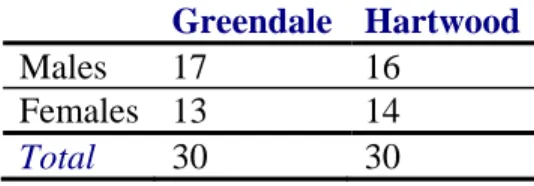
In each library, 30 patrons were observed. The number of males and females observed were roughly even at each library, and patrons’ ages were fairly evenly
distributed. Tables 1 and 2 show gender and age data for each library. There was only a slight difference between the numbers of people viewing art at the two branches: At Greendale, six people were observed looking at art; and eight were observed viewing art at Hartwood. In both branches, the number of art-viewing patrons was evenly divided between men and women.
Table 1: Observation subjects by gender
Greendale Hartwood
Males 17 16
Females 13 14
Table 2: Observation subjects by age
Greendale Hartwood
18-29 years old 6 5 30-39 years old 10 9 40-49 years old 9 8 50-59 years old 2 4 60-69 years old 3 4 70 years old + 0 0
Total 30 30
No noticeable difference was recorded in the length of time users spent viewing art. [See table 3.] At Greendale, art-viewing patrons looked at art for an average of 5.67 seconds; the longest time spent viewing art was 15 seconds. At Hartwood, average art-viewing time was 5.87 seconds; the longest time was 20 seconds. No patron reacted visibly when viewing art.
Table 3: Time spent viewing art (in seconds)
Greendale Hartwood
Total 34 47
Average 5.67 5.87 Median 3.5 4.5 Longest 15 20
At Greendale, only one piece of art was viewed; at Hartwood three different pieces were viewed. Of the Greendale users who were observed viewing art, all six looked at the multicultural alphabet posters above the computer bank at the front of the library. Of the eight art viewing patrons at Hartwood, three looked at the mobile that hangs from the ceiling in the front of the adult reading room, three looked at the
at the Four Seasons paintings that hang on the wall above the reference/circulation desk. In each library, every piece viewed hangs in the front of the adult reading room.
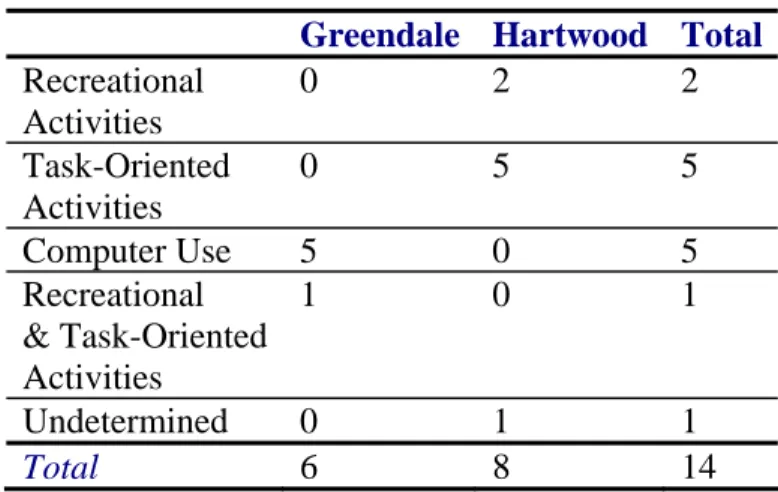
The activities of users who viewed art varied greatly by library branch. [See table 4.] At Greendale, nearly all the art-viewing patrons (five out of six) were computer users. They looked at the multicultural alphabet posters above the computer bank while
approaching the computers, or while waiting to use the computers. By contrast, most art-viewing patrons at Hartwood (five out of eight) used the library to complete a task – usually consulting with a librarian at the reference/circulation desk. These patrons looked at one of three art pieces while physically moving through the library, or while waiting to complete their task.
Table 4: Activities of art-viewing observation subjects: Greendale vs. Hartwood
Greendale Hartwood Total
Recreational Activities
0 2 2 Task-Oriented
Activities
0 5 5
Computer Use 5 0 5
Recreational & Task-Oriented Activities
1 0 1
Undetermined 0 1 1
Total 6 8 14
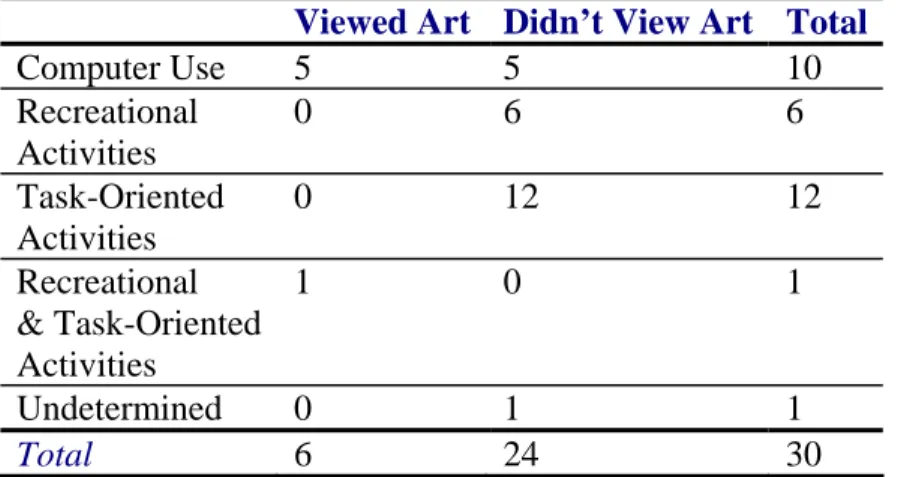
computer users: five of the six used computers, and the remaining one engaged in both recreational and task-oriented activities.
Table 5: Observation subjects’ activities and art-viewing behavior, Greendale
Viewed Art Didn’t View Art Total
Computer Use 5 5 10
Recreational Activities
0 6 6
Task-Oriented Activities
0 12 12
Recreational & Task-Oriented Activities
1 0 1
Undetermined 0 1 1
Total 6 24 30
Table 6: Observation subjects’ activities and art-viewing behavior, Hartwood
Viewed Art Didn’t View Art Total
Computer Use 0 10 10
Recreational Activities
2 4 6
Task-Oriented Activities
5 7 12
Recreational & Task-Oriented Activities
0 1 1
Undetermined 1 0 1
Total 8 22 30
In both libraries, the area within the building where users spent time depended primarily on the activities in which they were engaged, and seemed to be independent of the presence of art. At Greendale, patrons were observed in twelve distinct locations. Users involved in completing tasks generally spent time at the reference/circulation desk, or at a shelf that held income tax forms. Patrons engaged in recreational activities tended to spend time at the tables in the middle of the adult reading room, or sitting in the chairs in the back of the room near the magazine racks. Computer users spent time at the computer bank at the front of the library or in the ESOL computer lab. Most art-viewing patrons (four out of six) sat at the computer bank at the front of the library.
At Hartwood, patrons were observed at eleven distinct locations. Task-oriented users generally spent time at the circulation/reference desk. Patrons engaged in
recreational activities were more widely distributed than at Greendale, but mostly browsed at the new book shelves, fiction shelves, or video section; or read in the chairs along the back wall of the adult reading room. Computer users sat at the computer bank at the front of the library. The distribution of art-viewing patrons at Hartwood also varied more than at Greendale. Four of the eight spent time at the circulation/reference desk, and one each spent time at the new books shelves at the front of the library, at the fiction shelves in the middle of the adult reading room, at the video section at the front of the reading room, and in the middle of the floor near the front entrance.
6.4. Analysis of Observation Results
Patron behavior
Greendale. Instead, the observations revealed only a slight difference in the numbers of art viewers. Six out of 30 patrons at Greendale (20% of the patrons observed) looked at art; while eight of 30 at Hartwood (26.7% of patrons observed) viewed art. In neither library were visible reactions to art observed.
Similarly, the data revealed no noticeable difference in the time spent viewing art in the two branches. No patron at either library was observed looking at art for longer than 20 seconds. In fact, 20 seconds was a relatively long time, compared to the median times of 3.5 seconds at Greendale and 4.5 seconds at Hartwood. Also, contrary to expectations, no patron purposefully approached a piece of art in order to gain a better vantage point, and no patron reacted noticeably to a piece of art.
It is notable that, upon entering the library, the vast majority of the patrons observed walked directly to the area of library they used first. This suggests these patrons had used the library before. Therefore, if these patrons held an interest in the library’s art, it is likely that they had already viewed it on a previous visit. For repeat users, the art in the library may have become a part of the familiar background.
Characteristics of art viewed
The study was undertaken with the expectation that a wider variety of pieces would be viewed at Hartwood than at Greendale, due to the wider variety of art
bias built into the methodology: Only the first few moments of library use were observed, so it is possible that patrons could have viewed other pieces later, as their activities brought them into different areas of the building.
A consideration of the pieces of art that drew the most attention reveals some interesting results. At Greendale, the series of multicultural alphabet posters hung above the computer bank was the only piece viewed. At Hartwood, users viewed the Four Seasons paintings hung above the circulation/reference desk, the Garden for the Floating Life mobile hung above the front of the adult reading room, and the Colombian crafts displayed in the cubical display cases.
Notably, all of these pieces are displayed in the front of the buildings. Again, this may be a function of the observer’s vantage point, and the fact that only users’ first movements in the library were observed. However, it is likely due to fact that the front of the building was the most heavily trafficked areas in both libraries. The resources used by 83% of all users – including computer banks, the circulation/reference desks, and the “new books” shelves – occupy space in the front of the libraries.
The vast majority of art-viewing patrons in both libraries tended to view art when it was in their line of sight as they walked through the building, or when they stood and waited to use a resource. Users who were not moving through the building and were not waiting for a resource were engaged in activities. No patron who was seated and engaged in activities was observed viewing art.
Areas of library used
in which users chose to spend time corresponded entirely to the task in which users engaged – and, consequently, to the resources available nearby. Of the recreational users, many stood at the new books shelves and browsed. Most others sat and read; these patrons tended to congregate at spacious tables or in comfortable chairs. The users who tended to view art were actually moving through library, or standing and waiting. In either case, those who viewed art were in transition, and not nestled into a comfortable spot as had been expected.
Commonalities of art-viewing patrons
It was expected that a relationship would exist between recreational users and users who viewed art. While the observations did reveal a strong correlation between a patron’s activities and his/her tendency to view art, the nature of the activities which correlated to art-viewing differed for each library. Contrary to expectations, recreational patrons in both libraries were least likely to look at art. At Greendale, a strong
relationship existed between patrons using computers and patrons viewing art: Five of the six art-viewing patrons used computers. At Hartwood, a close relationship was found between task-oriented users and art-viewing users: Five of the eight art-viewing patrons used the library to complete tasks.
Generally, the task these users engaged in involved speaking to a librarian at the desk. As at Greendale, many of these patrons spent some amount of time waiting, and during this time they looked at the nearby art. [Appendix E lists more detailed descriptions of the art-viewing patrons in both libraries.]
So, while there seemed to be no objective relationship between art-viewing and whether a patron was using the library to complete a task, use computers, or for
recreation; a correlation did emerge between time spent waiting to engage in an activity and the presence of art in the vicinity.
7. SURVEYS
7.1. Method
The second phase of data collection entailed the use of a user survey in both libraries. For approximately two weeks in February, a self-administered questionnaire was left at the circulation/reference desk in each library. A recruitment sign posted next to the questionnaires invited patrons to participate in a survey for a library science student’s project, which sought opinions about the library. Because the survey was designed to gauge users’ unbiased opinions, the recruitment sign did not specify the study’s particular focus on art. Respondents were asked to complete the questionnaire anonymously and return it to the desk.
Response rates for the two branches differed slightly: At Greendale, 20
missing page. After eliminating these surveys, Hartwood’s response rate was reduced to 14 questionnaires. To increase response rates to 25 surveys at each library, five random patrons at Greendale were approached, and their participation was requested. At
Hartwood, eleven random patrons were solicited to reach the target sample size. The survey instrument was an eleven-question questionnaire, which appears in Appendix C. The survey included three questions addressing respondents’ opinions of specific facets of the library. To minimize potential bias caused by respondents’ awareness of the study’s focus, these included questions about various aspects of the library – lighting and collections, as well as the displayed art. Questions asking for patrons’ opinions made use of a five-point Likert scale, asking respondents to register opinions ranging from “Excellent” to “Extremely unsatisfactory.” The questionnaire also provided space for respondents to submit comments to supplement their opinions.
The questionnaire also asked each respondent the length of time it took to arrive at the library, the means by which s/he traveled, and whether s/he knows of another public library closer to where s/he works or lives. Because the two libraries studied are within five miles of each other, these questions sought to discover whether some users might prefer to use one over the other because of its interior environment.
Each respondent was also asked to report the kinds of activities in which s/he had engaged during his/her visit to the library (“Work/Research,” “Computer use,”
opinion about art, the questions were also included to provide an indication of whether his/her experience of the library’s interior might influence the length of a user’s visit.
Finally, the questionnaire asked two sets of open questions about the library space: “Which area of the building is your favorite? Why?” and “Which area of the building do you spend the most time in? Why?” These questions were included in an effort to discover the factors that influence users to spend time in particular areas within the library.
7.2. Limitations of Survey Methodology
The sampling method used in the survey’s collection places a constraint on the methodology. Because the questionnaires and recruiting signs were left at the
circulation/reference desk, they were more likely to be noticed by patrons who
approached the desk. The observations conducted revealed that many patrons of both libraries come to use the computers or other resources and leave without ever
approaching the desk. Analysis of the data, however, reveals a fairly even distribution of respondents who reported using computers, engaging in recreational activities, and completing tasks. The gender and age distribution of respondents, however, did prove to be slightly uneven. At both libraries, females and patrons between the ages of 36 and 45 were the demographic groups most likely to complete and return the questionnaire.
afterward. There was also a brief period of time between the two exhibits during which no art was displayed in the cases.
The difference in the response rate at the two libraries resulted in a different number of directly recruited survey respondents – patrons who were approached by the researcher as opposed to patrons who completed the survey after seeing the recruitment sign. At Greendale, five respondents were recruited via this face-to-face method; at Hartwood, eleven respondents were directly recruited.
A further limitation is presented by the survey’s sample size. Time constraints prevented a longer survey collection period, which resulted in a relatively small sample (25 respondents at each library.) A higher number of respondents would have conferred more validity on the data gathered.
Finally, the possibility exists that the questionnaire might have elicited different responses if it had specified what constituted “art” for the purposes of the survey. One or two respondents at each library reported that they did not notice any art, or that there was minimal art displayed. These comments suggested that some respondents may have conceived of art narrowly, perhaps including only paintings. However, because part of the survey’s purpose was to gauge patrons’ individual perceptions of art, an explicit definition of “art” on the questionnaire may have elicited biased responses.
7.3. Survey Results
In both branches, considerably more females than males completed
Respondents’ ages, while uneven, were more regularly distributed. In both branches, most respondents reported ages in the 36-45 year range. The age distribution of survey respondents closely resembled that of observation subjects, suggesting that the samples used in both methods may represent typical library user populations. Tables 8 and 9 show the gender and age breakdown of survey respondents.
Table 8: Survey respondents by gender
Greendale Hartwood
Males 6 8
Females 18 14
Unspecified 1 3
Total 25 25
Table 9: Survey respondents by age
Greendale Hartwood
18-25 7 1
26-35 6 4
36-45 8 8
46-55 1 4
56-65 0 5
66-75 2 2
75+ 1 0
Unspecified 0 1
Total 25 25
17 out of 25 patrons answered “excellent” or “satisfactory,” with 5 answering “excellent” and 12 answering “satisfactory.” Two Hartwood respondents answered “no opinion/not applicable,” while seven Greendale respondents provided this response.
Table 10: Survey respondents’ opinions of art
Greendale Hartwood
Excellent 5 12
Satisfactory 12 11
No Opinion / Not Applicable 7 2
Unsatisfactory 1 0
Extremely Unsatisfactory 0 0
Total 25 25
Figure 1: Bar chart – survey respondents’ opinions of art
Opinion of Art in Library
0 2 4 6 8 10 12 14 Extremely Unsatisfactory
Unsatisfactory No Opinion / Not Applicable Satisfactory Excellent Rating N um b e
r of r
A roughly equal number of respondents supplemented their opinions of art with comments: Seven Greendale patrons made comments about the library’s art, and eight Hartwood patrons commented. Appendix F lists all respondents’ comments about art. Respondents who commented about Greendale’s art were rather stratified in their ratings. Comments were made by two who said the art was “excellent,” two who said the art was “satisfactory,” two who answered “no opinion / not applicable,” and one who reported the art was “unsatisfactory.” The respondent who answered “unsatisfactory” wrote “Not enough detail. Minimum of art displayed.” One of the respondents who rated the art as “excellent” made a comment that seemed to be unrelated to the library’s art. (“Very nice customer service.”)
Comments about Hartwood’s art were made by four patrons who rated the art as “excellent,” three who answered “satisfactory,” and one who answered “no opinion/not applicable.” This latter respondent commented that the art “could be better.”
Interestingly, one of the respondents who rated the art as “satisfactory” wrote, “the art is few and far between. Could be more ‘local artist’ pieces of work.” As at Greendale, one respondent who reported a “satisfactory” opinion made a comment that seemed to be unrelated to art. (“Should have more reading areas for elementary students.”)
In each library, only two respondents commented about specific pieces of art. At Greendale, the children’s art displayed in the children’s section was mentioned by one respondent. The other commented on the series of paintings in the large meeting room. One user simply commented, “multicultural.”



![Table 12: Survey respondents’ activities: Greendale vs. Hartwood [Note: Because many respondents reported engaging in more than one activity, the numbers add up to more than 25 patrons for each library.]](https://thumb-us.123doks.com/thumbv2/123dok_us/8339065.2214341/53.918.329.642.401.554/respondents-activities-greendale-hartwood-respondents-reported-engaging-activity.webp)
