Reliable multi-product multi-vehicle multi-type link logistics network
design: A hybrid heuristic algorithm
Davood Shishebori
1*
1Department of Industrial Engineering, Faculty of Engineering, yazd university, Iran
Abstract
This paper considers the reliable multi-product multi-vehicle multi-type link logistics network design problem (RMLNDP) with system disruptions, which is concerned with facilities locating, transshipment links constructing, and also allocating them to the customers in order to satisfy their demand with minimum expected total cost (including locating costs, link constructing costs, and also expected transshipment costs in normal and disruption conditions). The motivating application of this class of problem is in product, vehicle, and multi-type link logistics network design regarding to system disruptions simultaneously. In fact, the decision makers in this area are not only concerned with the facility locating costs, link constructing costs, and logistical costs of the system but also by focusing on the several system disruption states in order to be able to provide a reliable sustainable multi configuration logistic network system. All facility location plans, link construction plans and also link transshipment plans of demands in the problem must be efficiently determined while considering the several system disruptions. The problem is modeled as a mixed integer programming (MIP) model. Also, a hybrid heuristic, based on linear programming (LP) relaxation approach, is proposed. Computational experiments illustrate that the provided algorithm will be able to substantially outperform the proposed integer programming model in terms of both finding and verifying the efficient optimal (or near optimal) solution at a reasonable processing time.
Keywords: Multi-product, multi-type transshipment links, multi-vehicles, logistic network design, disruptions, reliability, two stage decomposing heuristic, LP relaxation, heuristic algorithm.
1- Introduction
Since the supply chain network design (SCND) is known as a long term strategic decision problem, considering various practical factors can help to get more efficient solutions for the problem under study. Disruption is known as a key factor in this context. Recently, this topic in the SCND has been a challenging issue for the most companies in trade globalization world.
*Corresponding author.
ISSN: 1735-8272, Copyright c 2016 JISE. All rights reserved.
Journal of Industrial and Systems Engineering
Vol. 9, No. 1, pp 92-108
Winter (January) 2016
In a glance, supply chains are the subject to several potential sources of disruptions, where disruptions are unplanned and unanticipated events and disrupt the normal flow of products and materials within a supply chain. The disruption at one member of a supply chain (SC) can result in a significant influence over the entire chain. SCs are subject to several potential sources of disruptions. Some of them are external sources (e.g., natural disaster, terrorist attack, power outages, and supplier discontinuities) and some of them are internal sources (e.g. industrial accidents, labor strikes). Although these disruptive events may only lead to short-term facility contingencies, they can also cause not only serious operational consequences, such as higher transportation costs, order delays, inventory shortages, loss of market shares, and so on, but also extended negative financial effects. This paper studies the problem of designing a supply chain network, subject to system disruptions (including facility disruptions and transshipment link disruptions). Once such a SC infrastructure is built, it will be very difficult and costly to modify the design. Therefore, it is much worthy to design a SC that achieves continuity and efficiency in the presence of all sorts of disruptions from the start. The main contributions of this study are arranged as follows: (i) the reliable product multi-vehicle multi-type link SCND problem is studied regarding to facility disruptions and transshipment link disruptions simultaneously. (ii) An efficient heuristic algorithm, a hybridization of the LP relaxation, and a two stage decomposing heuristic, is proposed to solve the problem by near-optimal solutions in a reasonable time. To the best of our knowledge, a study such as this is not conducted till now.
The remainder of this paper is organized as follows: Section 2 provides a relatively comprehensive literature review in three main steams. The problem definitions and the proposed mathematical programming model are proposed in Section 3. Then, in Section 4, a hybrid heuristic algorithm, a hybridization of the LP relaxation, and a two stage decomposing heuristic, are described with detail. In Section 5, analysis of solving the test problems, computational results and discussions about the efficiency of the proposed Hybrid Heuristic Based on Linear Programming Relaxation (HHBLP) algorithm are presented. Finally, conclusions and guides for future research are discussed in Section 6.
2- Literature review
In the SCND and logistics literature, system disruptions are known as a special issue of supply uncertainty. These disruptions are introduced as random events that cause a supplier or other elements of the supply chain to stop functioning, either completely or partially, for a (typically random) amount of time. Several robust strategies and approaches have been proposed to mitigate the effects of supply chain disruptions and improve the efficiency of SC and its logistics at disruption conditions. For more study, the reader is referred to the review by (Snyder and Daskin, 2006) and (Snyder et al. 2012).
In order to place our contribution in the right perspective, three main streams of the literature can be reviewed that may be of interest for comparison: (i) the literature on SCND subject to facility disruptions (ii) the literature on SCND subject to transshipment link disruptions (iii) the literature on multi-product multi-vehicle multi-type link SCND. It is noted that in this study, the system disruptions are defined as facility disruptions and transshipment link disruptions.
2-1- Facility disruptions
The literature related to facility disruptions demonstrates that as one of the first studies, Drezner (1987) proposed some mathematical models for facility location with unreliable suppliers and studied the unreliable p-median and (p,q)-center location problems, in which a facility has a specified probability of becoming passive. In the following studies, (Snyder, 2003), (Snyder and Daskin, 2005) and (Snyder and Daskin, 2007) developed several mathematical programming formulations for the reliable p-median and fixed charge problems based on different level assignments, in which the candidate sites are subject to random disruptions with equal probability. Several approaches have been considered to address the facility disruptions within mathematical formulations (Snyder et al. 2012). Scenarios are a known approach related to uncertain conditions. In most of the stochastic programming models, there are disruption scenarios in which all (or sometimes a sample of) the disruption scenarios are enumerated. This approach is intuitive and allows for statistical dependence among disruptions, but as the problem size grows exponentially with the number of facilities, it becomes non-practical. Models using this approach are proposed by (Shen, 2009), (Snyder and Daskin, 2006). (Peng et al., 2011) studied the effect of considering reliability in logistic network design problems with facility disruptions as several scenarios. They demonstrated that applying a reliable network design is often possible with negligible increases in total location and allocation
costs. In their study, they considered open/close decisions on nodes but not on links of the commodity production/delivery system. By applying the p-robustness criterion (which bounds the cost in disruption scenarios), they simultaneously minimize the nominal cost (the cost when no disruptions occur) and reduce the disruption risk. Moreover, Jabbarzadeh et al. (2012) studied a SC design problem in which distribution centers may have partial and complete disruptions. The problem was formulated as a mixed-integer non-linear program (MINLP) which maximizes the total profit of the system while taking into account different disruption scenarios at facilities. Aydin and Murat, (2013) studied the capacitated reliable facility location problem (CRFLP) in the presences of facility disruptions as scenarios. They proposed an efficient algorithm as hybridization of particle swarm intelligence (PSO) and sample average approximation (SAA) methods. Garcia-Herreros et al. (2014) developed a two-stage stochastic program in order to design resilient SCs in which the distribution centers are subject to the risk of disruptions at candidate locations. The problem involves selecting distribution center locations, determining storage capacities for multiple commodities, and establishing the distribution strategy in scenarios that explain disruptions at potential distribution centers. The objective is to minimize the sum of investment cost and expected distribution cost during a finite time horizon. Cardona-Valdes et al., (2014) formulated a two-stage stochastic problem in order to minimize total cost and total service time, simultaneously for designing a two echelon production distribution network with multiple manufacturing plants, distribution centers and a set of candidate warehouses. They proposed a scenario based approach in order to consider the effects of the uncertainty. Ivanov et al. (2014) formulated a multi-period and multi-commodity distribution (re)planning problem for a multi-stage centralized upstream network with structure dynamics considerations is proposed. Their approach allows considering different execution scenarios and developing suggestions on (re)planning in the case of disturbances. Also, the graph of structural reliability allows identify the optimistic and pessimistic scenarios. Shishebori and Yousefi (2015) proposed an efficient mixed integer linear programming model for a robust and reliable medical service center location network design problem, which simultaneously considers uncertain parameters, system disruptions, and investment budget constraint. The presented model was modeled according to an efficient robust optimization approach to protect the network against uncertainty.
Probability distribution terms are another approach in which the probability distributions of the uncertain conditions are known for decision makers and the related terms can be applied in proposing of mathematical modeling. Berman et al. (2007) formulated a p-median problem with disruptions that relaxes the equal-probability assumption made by Snyder and Daskin (2005). They focused on structural properties and special cases of their non-linear model. Shen (2009) presented two formulations for the reliable facility location problem (RFLP) model of Snyder and Daskin (2005) with site-specific disruption probabilities. One model applies a scenario approach within a stochastic programming framework, while the other one involves computing the expected travel costs endogenously using highly non-linear multiplicative terms in a manner similar to Berman et al. (2007). They developed a heuristic based on sample average approximation of Kleywegt et al. (2002), for the first model and two greedy –adding– type heuristics for the latter. Computational results mentioned that one of the greedy-adding methods is superior to the other two heuristics. Also, a non-linear formulation for the problem with site-specific disruption probabilities was developed by Cui et al. (2010). They reformulated their model using the reformulation-linearization technique (RLT) of Sherali and Alameddine (1992), resulting in a model that is both linear in the decision variables and polynomial in the problem size. They also introduce a continuum approximation (CA) model that requires simulation and regression but may be solved in closed form to allow for managerial insights. In another study, Aboolian et al. (2012) reformulated the MINLP model of Cui et al. (2010) by an approximate model in which the probability that a customer is assigned to a given facility is calculated assuming that all closer facilities are open. They proved that this approximate model provides a lower bound on the optimal objective value. Hatefi and Jolai (2015) developed a reliable model for an integrated forward–reverse logistics network design, which can cope with both partial and complete facility disruptions. Their model is formulated as a stochastic robust programming whose objective function is to minimise the fixed opening costs of facilities and the expected cost of disruption scenarios, including processing costs, transportation costs, and penalty costs for non–satisfied demands.
By comparing two scenarios and probabilistic approaches, one can observe that in the probabilistic approach, for each event, a probability distribution is considered and its related probability is proposed in the calculations. Although it tends to provide a better perspective of the problem, applying this
approach generally leads to a considerable complexity of solving the problem and finding an appropriate and effective response for the problem is faced with several difficulties. In contrast, the
scenarios approach assigned a specified numerical value to each event and this value is used in calculating. Although applying these approaches may be lead to reduce the application of the obtained solution, using SAA approach, the solving procedure and the complexity of the mathematical formulation will be significantly reduced even in large sizes, and subsequently, the efficient solutions can be achieved at the logical time.
2-2- Link disruptions
Some studies, related to link disruptions, were performed. Most of them are extensively discussed in the literature on the design of survivable telecommunication networks (Soni 2000). Ferris (2000) developed a robust two- stage flow model where the policy determines the amount of flow to be sent to the static optimal route and the amount of rerouted flow according to the probability of having a disruption. Waller (2002) dealt with disruptions by using online-recourse models where ones real-time information become available, the remaining path till the destination is re-evaluated. They proposed the algorithms for the online shortest path problems with limited link-cost dependencies. Sever et al. (2013) considered networks in which a number of links are vulnerable to disruptions leading to a significantly larger travel time on these links. For these vulnerable links, they considered known link disruption probabilities and knowledge of transition probabilities for recovering from or getting in to a disruption. They developed a framework based on dynamic programming in which they formulated and evaluated different known online and offline routing policies. For more review, we refer to Soni (2000), Klibi (2009) and Esmaeilikia et al. (2014) review studies. Shishebori et al. (2013) considered facility disruptions via a constraint on the maximum allowable disruption cost of the system in the context of a facility location–network design problem (FLNDP) with disruptions. They proposed an MINLP model for the problem and illustrated it by a case study. Shishebori et al. (2014) consider a similar FLNDP and propose an LP-based heuristic to solve it.
As a remarkable point, it should be mentioned that survivable networks are defined as networks that are still functional after failure in certain components of the network. The flow and cost structures of these networks, however, significantly differ from those in supply chains. The focus of survivable communication networks is to ensure the connectivity of the network in case of failure, which is generally not considered as a major objective in supply chain problems.
2-3- Multi-product multi-vehicle multi-type link supply chain network design
Considering several possible aspects of the proposed problem can cause to find more practical solutions. This can help decision makers to have several alternatives for the proposed SCND and logistics. The several possible aspects can include multi-product, multi-type link, and multi-vehicle.
Several studies were done at the SCND and logistics regarding to the mentioned topic. Chen and Lee (2004) proposed a multi-product multi-stage multi-period model with multiple incompatible goals of a multi-echelon SCN as a MINLP, where fuzzy sets were considered to describe the uncertainties involved in market demands and product prices. Park et al. (2007) proposed a period multi-product SC model, including supplier, factory, and distribution center to minimize the total cost and presented a genetic algorithm (GA) to solve the problem. You and Grossmann (2008) proposed the optimization of a bi-criteria multi-echelon supply chain under demand uncertainty with the goals of maximizing the net present value and minimizing the expected lead time. Ferrio and Wassick (2008) considered a multi-product chemical supply network including production sites, an arbitrary number of DCs, and customers and formulated the problem as a MILP model for redesigning and optimizing of the network. The problem was analyzed using the GAMS/CPLEX mathematical programming solver. Also, El-Sayed et al. (2010) considered a multi-period three-echelon forward-reverse logistics network design in the presence of demand uncertainty in the forward direction and deterministic customer demand in the reverse direction with subject to maximizing the total expected profits. Mirzapour Al-E-Hashem et al. (2011) modeled a multi-site, multi-period, multi-product three echelon SC under uncertainties of cost parameters and demand fluctuations. They proposed the LP-metric method to solve the proposed bi-objective problem as a single-objective mixed integer programming (MIP). Amrani et al. (2011) presented a multi-commodity production–distribution network with alternative facility configuration. The problem was formulated as a MIP model and solved using a variable neighborhood search (VNS) method. Bashiri et al. (2012) presented a new multi-product mathematical model with strategic and tactical planning and different time resolution decisions for a
multi-echelon network. This model was categorized in small, medium, and large scales and was solved by the CPLEX solver for small and medium size problems, and by some heuristics to decrease solution time of solving large scale problems. Jamshidi et al. (2012) modeled a bi-objective multi-echelon SCN design problem that in which several transportation options at each level of the chain are considered with different costs and a capacity constraint. Badri et al. (2013) developed a new multi-commodity SCND model with different time resolutions for strategic and tactical decisions. The objective function was to maximize the total net income over the time. In addition, a mathematical technique based on the Lagrangian relaxation method was developed to solve the problem. Moreover, Song et al. (2014) modeled a manufacturing SC problem with multiple suppliers under multiple uncertainties such as uncertain material supplies, stochastic production times, and random customer demands. Recently, Pasandideh et al. (2014) proposed a mathematical model for a bi-objective optimization of a multi-product multi-period three-echelon SC network problem with considering of several system uncertainties. The goal is to minimize the total summation of production costs, supply and warehouse costs, transportation costs, inventory costs, and shortage costs such that both the expected and the variance of the total cost are minimized. Sarrafha et al. (2014) studied a SCND involving suppliers, factories, DCs, and retailers. They proposed a multi-period structure such that a flow-shop scheduling model in manufacturing part of the SC, and also, the shortage in the form of backorder in each period is integrated. Their main goals are minimizing the total SC costs as well as minimizing the average tardiness of product to distribution centers (DCs). Soleimani and Kannan (2015) proposed an effective solution methodology for the closed-loop supply chain regarding to the environmental legislation, customer awareness, and the economical motivations of the organizations. Also, they studied improving closed-loop supply chain network optimization processes through dealing with mathematical programming tools; developing a deterministic product, multi-echelon, multi-period model.
2-4- Research gap and the contribution
Some of the previous works have studied the SCND and logistics with facility disruptions and regarding to link disruptions separately. However, in some manufacturing industries, there are some SC and logistics systems in which a variety of disruptions (failures) may happen; i.e., there are numerous examples of practical problems in which simultaneously considering supply chain, logistics systems, network design, and variety of disruptions (failures) is critical in improving the efficiency, usefulness, and security of the system. These examples include pipelines for gas and water, infrastructure for airline and railroad networks, and systems for delivering services such as health care and education. As a concluding point, the most obvious examples are SC of different spare parts, food products manufacturing, petrochemicals, and etc.
In contrast to previous works in this constitution, this paper investigates the problem of designing a SC network, which consists of suppliers, DCs, and demand nodes as well as some transshipment links. They are potential and it should be decided that which potential nodes and links should be built. It is obvious that modifying the SCND and its related logistics will be very difficult and costly. Therefore, it is important to design a reliable SC that reaches to suitable stability and efficiency in the presence of several kinds of disruptions from the start.
3- Problem definition and formulation
The working conditions of the RMLNDP can be described as follows. Suppose that there is a SC network GG = (G , A). Let GS, GT , and GD signify the sets of supply, transshipment, and demand
nodes, respectively. Also, the G0is defined as the set of all supply and transshipment nodes (G0 = GS ∪ GT), which are the nodes for which open/close decisions are necessary. The set G0 can be called
‘‘facilities’’. Let S be the set of scenarios, each of which specifies a set of facilities and transshipment links that are simultaneously disrupted. Suppose s=0 as the nominal scenario in which no disruptions happen. The set P illustrates several types of products that should be produced and transshipped to the demand nodes. The set L presents different kinds of transshipment links. For example, for each link, it is assumed those three different levels of quality (i.e., |L| = 3) can be considered; each of which is defined as following: the dirt road (type 3), the paved road with low quality (type 2) and the paved road with the standard quality (type 1). As it should be expected, if a link with type 1 quality is constructed, its construction cost will be more than the other types while, its capacity is more and its transshipment cost is lower than the other types of connecting links. Here, links (roads) with three quality types are defined; however, several quality types can be defined for the problem. The set V
shows several types of transportation vehicles. The best type of the vehicle has the highest cost of investment, but the lowest cost of transportation and the worst type is vice versa.
In order to avoid the infeasible situations, a penalty fee is ordained for the demands of nodes that cannot feasibly be met. It can be denoted that these demands are fulfilled from some outside suppliers as emergency facilities but with high transportation costs. Also, it can be interpreted that the demand of a node can be not to serve if the penalty is smaller than the cost of serving the demand of the node. In this paper, this contingency is considered by assuming that NS contains an ‘‘emergency facility’’
that has no fixed cost and it is never disrupted, and also has infinite capacity. Obviously, it is always open in the optimal solution and doesn’t have any disruptions. For each transshipment link, from the emergency facility to other nodes, the unit transportation cost is equal to the unmet-demand penalty fee. Assumptions, sets and parameters of the problem are defined as follows:
Assumptions:
1. Each node of network denotes a demand node.
2. Each node can be a supply center or demand center; i.e., at each demand center, a supply center can be opened.
3. At most one new supply center can be located at each node. 4. All travel costs are symmetric.
5. All network links are directed.
6. All supply centers and network links are unreliable and may have some disruptions with a failure probability.
7. The disruption probability of supply centers and network links are determined as scenarios by professional experts.
8. For each link, three different levels of quality can be considered; each of which is defined as following: the dirt road (type 3), the paved road with low quality (type 2) and the paved road with the standard quality (type 1).
9. If a link with type 1 quality is constructed, its construction cost will be more than the other types while, its capacity is more and its transshipment cost is lower than the other types of connecting links.
Sets:
G: set of nodes (G = GS∪GT∪GD),
G0: set of "facilities" nodes (G0 = GS∪GT), P: set of products (P=1, 2, 3, …)
L: set of several quality types of transshipment links (L=1, 2, 3, …)
V: set of several types of transportation vehicles (V=1, 2, 3, …)
A: set of potential transshipment links
S: set of scenarios. All possible scenarios; each scenario illustrates the facilities and also link disruptions
Parameters:
fj = fixed cost of locating of facility j∈G0 πs = probability of happening of scenario s∈S
cijl = construction cost of link (i, j) ∈A with quality type l (l∈L)
tijplv= unit transportation cost of product p (p∈P) on link (i, j) ∈A with quality type l (l∈L) by
vehicle v (v∈V)
γijv = investment cost of vehicle v (v∈V) at link (i, j) ∈A
Uijmax = maximum number of vehicle types that can be used at link (i, j)∈A
bjp = bjp≥ 0 if j∈Gs, representing the supply of product p (p∈P); bjp = 0 if j∈GT, representing the
transshipment of product p (p∈P); and bjp≤ 0 if j∈GD, representing the demand of product p(p∈P)
Φjs = 1 if facility at node j ∈N0 is disrupted in scenario s∈S , 0 otherwise 97
Ωijs = 1 if link (i, j) ∈A is disrupted in scenario s∈S , 0 otherwise
Δijlvs = 1 if vehicle v (v∈V) at link (i, j) ∈A with quality type l (l∈L) is disrupted in scenario s∈S
, 0 otherwise
Although the Φjs, Ωijs, and Δijlvs are defined as binary parameters, the proposed mathematical
programming model has good functionality if these parameters may also be fractional, representing partial disruptions.
Decision variables:
Zj = 1 if a facility is located at nodej∈G0 , 0 otherwise
Xijl = 1 if link (i , j) ∈A is constructed with quality type l (l∈L) , 0 otherwise Wijv = 1 if vehicle v (v∈V) is established at link (i , j) ∈A , 0 otherwise
Yijplvs = amount of flow of product p (p∈P) on link (i ,j) ∈A with quality type l (l∈L) by vehicle v
(v∈V) in scenario s∈S
Therefore, we propose the following MIP model for the RMCLNDP.
(1)
0 ( , ) ( , )
( , )
l l v v
j j ij ij ij ij j G i j A v V i j A
plv plvs ij s ij p P l L v V i j A s S
min ETC
f Z
c X
W
t
Y
γ
π
∈ ∈ ∈ ∈ ∈ ∈ ∈ ∈ ∈=
+
+
+
∑
∑
∑ ∑
∑ ∑∑ ∑
∑
.
.
t
s
(2);
;
Sj
G
s
S
p P
∀ ∈
∈
∈
( , ) ( , )
plvs plvs p
ji ij j
l L v V j i A l L v V j i A
Y
Y
b
∈ ∈ ∈ ∈ ∈ ∈
−
≤
∑∑ ∑
∑∑ ∑
(3);
;
Tj
G
s
S
p P
∀ ∈
∈
∈
( , ) ( , )
0
plvs plvs
ji ij
l L v V j i A l L v V j i A
Y
Y
∈ ∈ ∈ ∈ ∈ ∈−
=
∑∑ ∑
∑∑ ∑
(4);
;
Dj
G
s
S
p P
∀ ∈
∈
∈
( , ) ( , )
plvs plvs p
ji ij j
l L v V j i A l L v V j i A
Y
Y
b
∈ ∈ ∈ ∈ ∈ ∈
−
=
∑∑ ∑
∑∑ ∑
(5);
Sj
G
s
S
∀ ∈
∈
(
)
( , )
1
plvs sij j j
p P l L v V i j A
Y
Z
∈ ∈ ∈ ∈
≤ − Φ
∑∑∑ ∑
(6) ( , )
(1
)
(
)
( , )
;
plv s l l
ij ij ij ji
p P l L v V i j A l L
Y
X
X
j i
A
s S
∈ ∈ ∈ ∈ ∈
≤
− Ω
+
∀
∈
∈
∑∑∑ ∑
∑
(7)
( , )
i j
A l
;
L v V
;
;
s S
∀
∈
∈
∈
∈
(1
)
plvs lvs v
ij ij ij
p P
Y
W
∈
≤
− ∆
∑
(8)( , )
i j
A
∀
∈
(
ijl jil) 1
l LX
X
∈+
≤
∑
(9)( , )
i j
A
∀
∈
max v ij ij v VW
U
∈≤
∑
(10)( , )
i j
A
;
v V
∀
∈
∈
(
)
v l l
ij ij ji l L
W
X
X
∈
≤
∑
+
(11) 0j G
∀ ∈
{0 ,1}
jZ
∈
(12)( , )
i j
A
;
v V
∀
∈
∈
{0 ,1}
v ijW
∈
(13)( , )
i j
A
;
l
L
∀
∈
∈
{0 ,1}
l ijX
∈
(14)0
plvs ijY
≥
∀
( , )
i j
∈
A
;
p
∈
P l
;
∈
L v V s S
;
∈
;
∈
The objective function (1) minimizes the expected total costs (ETC), including fixed location costs, link construction costs, vehicle establishment costs, and also the expected transportation costs for all possible scenarios with respect to their probabilities. Constraints (2)–(4) are known as the flow conservation constraints. Constraints (2) emphasize that, for supply nodes, the flow out should be less than or equal to the supply. Also, constraints (3) enforce that for transshipment nodes, the flow in should be to equal the flow out. Sequentially, for demand nodes, constraints (4) ensure that the flow in will be to equal the demand. It is noted that each of supplier, DCs and demand nodes can be applied as transshipment nodes, i.e., the demands can be imported and exported from each of supplier, DCs and demand nodes. Constraints (5) ensure that the demands can be allocated in any scenarios when a facility at node j is opened (i.e. Zj=1), and prevent any flow when it is closed or disrupted. Moreover,
constraints (6) emphasize that the flow through the link (i , j) ∈A can be established when it is constructed (i.e., Xijl+Xjil=1) and is fully functional in scenario s ∈S, and prevent any flow when it is
closed or disrupted. Constraints (7) guarantee that the summation of weights of the flow, transshipped by vehicle v through the link (i , j) ∈A with type l, can be opened when it is established (i.e., Wijv=1)
and is fully functional in scenario s ∈S, and prevent any flow when it is closed or disrupted. Constraints (8) prevent links from being opened in both directions with several quality types at once. Constraints (9) limit the maximum number of vehicle type that can be used through the link (i ,j) ∈ A.
Constraints (10) guarantee that the vehicle establishing at link (i ,j) ∈A can be happed when the link, with at least one of the quality type, is opened. Constraints (11)-(13) declare the binary variables and finally, constraints (14) guarantee that the variable Yijplvs will be non-negative.
Proposition 1 below says that the RMLNDP is NP-hard, since it can be reformulated as an extension of the p-LNDP, which is itself NP-hard.
Proposition 1. The RMLNDP is NP-Hard.
Proof. In the p-LNDP, introduced by Peng et al. (2011), let p, the desired robustness level, equal infinity; therefore, the p-robust constraint in the p-LNDP is inactive. Moreover, let ps = 1 for the
nominal scenario s=0 and
p
s=
0
∀ ∈
s
S
\ {0}
. Also, assume that the disruption scenarios do not include any link disruptions and all of the links are uncapacitated. Moreover, assume that there is just only one kind of product which is produced and transshipped, there is only one quality type link can be opened, and there is only one type of vehicle that can be used though the links. Then RMLNDP reduces to the p-LNDP, which is NP-hard Peng et al. (2011); therefore, the RMLNDP is NP-hard. □4- Solution procedure
Since, the RMLNDP belongs to the NP-hard class of combinatorial optimization problems, it is very hard to solve even medium-size test instances with the conventional methods practically especially when the number of scenarios considerably grows. Accordingly, proposing an efficient solution approach can be necessary and helpful. At the following, the proposed HHBLP algorithm is presented. The HHBLP algorithm integrates a heuristic strategy inspired by LP-relaxation to improve the solution quality and efficiency.
4-1- Hybrid heuristic based linear programming relaxation (HHBLP) algorithm
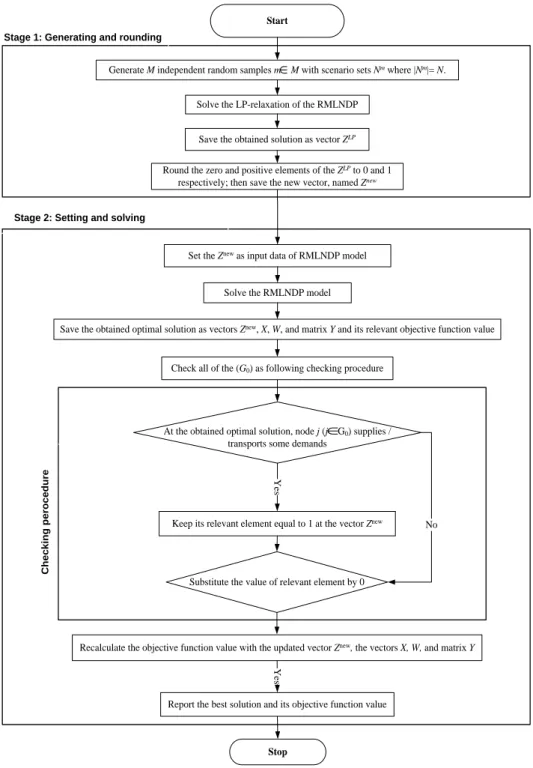
The proposed algorithm, as an efficient approach, is a hybridization of the LP-relaxation and a two stage decomposing heuristic. We consider the combination of the implementation of the LP-relaxation in the context of the proposed heuristic and using all of the obtained information of the solutions together. This combining approach works as follows.
At first, the LP-relaxation is applied such that for all of the scenarios, the LP-relaxation of the RMLNDP is solved and the vector ZLP is obtained.
The elements of vector ZLP are not necessarily binary, because we solve the LP-relaxation of the RMLNDP. Therefore, the non-zero elements of vector ZLP (called ZLP) are changed to 1 at the new vector Z (Znew).
At the following, the Znew is used as an input data (initial solution) to the stage 2 of the
algorithm (Stage 2: Setting and solving at Fig. 3). In fact, the overall logic of the algorithm is organized such that the original problem is decomposed into two sub-problems. At the
first stage, as the first sub-problem, the LP-relaxation of the RMLNDP is solved and the
Znew is obtained.
Then, the Znew is set as the input matrix data to the second stage and the main model
(RMLNDP) is solved by applying the input matrix data. Accordingly, the complexity of the model of RMLNDP is reduced by fixing of some integer variables (i.e., vector Z).
It is mentioned that the HHBLP solves the sample problems to optimality. The main steps of HHBLP algorithm are presented graphically in Figure 1.
Substitute the value of relevant element by 0
Stop
Yes
Report the best solution and its objective function value
Start
Set the Znew as input data of RMLNDP model
Check all of the (G0) as following checking procedure
Checking perocedure
At the obtained optimal solution, node j (j G0) supplies /
transports some demands
Keep its relevant element equal to 1 at the vector Znew
Yes
No
Save the obtained optimal solution as vectors Znew, X, W, and matrix Y and its relevant objective function value
Solve the RMLNDP model
Recalculate the objective function value with the updated vector Znew, the vectors X, W, andmatrix Y
∈
Stage 1: Generating and rounding
Stage 2: Setting and solving
Solve the LP-relaxation of the RMLNDP
Round the zero and positive elements of the ZLPto 0 and 1
respectively; then save the new vector, named Znew
Generate M independent random samples m M with scenario sets Nm where |Nm|= N.
Save the obtained solutionas vector ZLP ∈
Figure 1. The main procedure of the HHBLP algorithm
5- Results and discussions
Numerous test data are generated and solved by the CPLEX 12.1 solver in software GAMS 23.5.1. Then, the proposed algorithm is coded in MATLAB R2011a. All computations are carried out on a PC with Windows 7 professional, with 2.67 GHz dual core processor and 4 GB of RAM. Also, the CPU solution time was limited to 20000 seconds for CPLEX solver and the proposed heuristic algorithms.
5-1- Design of experiments
In order to verify the performance of the proposed heuristic algorithms, we solved several test problems with different sizes of the test problems which were randomly generated in a manner similar to that described in the literature Peng et al. (2011). In more details, the random test problems with different size were generated. The number of supply nodes, transshipment nodes and demand nodes the number of scenarios at S are varied from 5 to 25. Also, the edge density was chosen from 20%, 30% and 50%. At the beginning, the number of supplier, DCs and demand nodes was selected and then the constructed transshipment links between nodes based on the predetermined probability were specified by the edge density. The links between the ‘‘emergency’’ facility and the demand nodes were constructed with probability 1.
The fixed costs fj of suppliers and DCs are drawn uniformly from [25000, 30000] and [5000, 10000],
respectively. Also, the unit transportation costs tijplv are drawn uniformly from [1 , 500]. The
unmet-demand penalty (i.e., the per-unit transportation cost from the emergency facility to each unmet-demand node) is set to 1500. At each demand node, the parameter bjp (representing the negative of the demand
of product p) is drawn uniformly from [-110 , -50]. At each supply node, the supply bjp is determined
as follows. To ensure the feasibility of the model under most of the data sets, we first calculate the average required supply of product p, s , by:
.
D
p p
S
G
s d
G
= (33)
Where
d
p is the average demand of product p, which is set to 50, 60, and 70 respectively in our case. Each bjp is then drawn uniformly from 1.5 s p, 2.5s p .The capacity of the emergency facility is always set to infinity. We generate disruption scenarios randomly, where each facility may be disrupted with probability q={0.01, 0.03, 0.05, 0.1, 0.15} where
q presents the set of probability of facility disruptions. Several probabilities are intentionally chosen in order to demonstrate the impact of disruptions and the performance of the model when disruption is a significant factor. If this process generates duplicate scenarios, then the duplicates are removed and the procedure is repeated till the |S| unique scenarios is obtained.
5-2- Algorithm performance
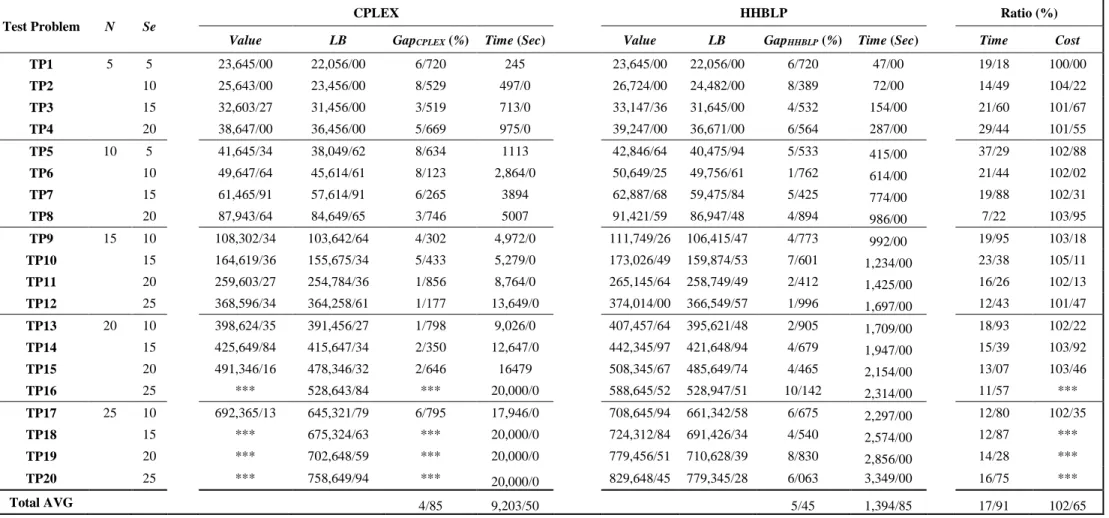
Table 1 summarizes the performance of the proposed heuristic algorithm with that of CPLEX. For each algorithm, the table represents the run time (“Time”) and objective value (“Cost”). The run time for the heuristic includes the time required to solve the LP-relaxation in step 1, which is then used as an input for the main step of the algorithm. The table reports the lower bound from CPLEX (“CLB”) and from the heuristic (“HHBLP”), where the latter represents the objective value of the LP-relaxation solved in step 1 of the heuristic, and the percentage gap between the objective value of the best solution found and the corresponding lower bound:
(%) CPLEX 100 ; (%) HHBLP 100
CPLEX HHBLP
CPLEX HHBLP
Cost CLB Cost HLB
Gap Gap
Cost Cost
− −
= × = ×
Finally, the last two columns give the ratio between the computation times (solution costs, respectively) of the two methods:
(%) HHBLP 100 ; (%) HHBLP 100
Time Cost
CPLEX CPLEX
Time Cost
Ratio Ratio
Time Cost
= × = ×
Values less than 100% in the “Time (%)” and “Cost (%)” columns indicate that our heuristic outperformed CPLEX with respect to CPU time and solution cost, respectively. (CPLEX may find sub-optimal solutions because of our termination settings, as described above.) Our heuristic was faster than CPLEX for all instances. In addition, the notation “n/a” in the table indicates that no feasible solution could be obtained for that instance in the allowed time (20000 seconds).
The solutions returned by our heuristic were, on average, 2.65% more expensive than those returned by CPLEX (across all instances), and it was able to find the same solutions than CPLEX for some test problems. The heuristic is also much faster: it required only 17.91% of CPLEX’s time, on average, and failed to find solutions within the time limit for only one of the instances, whereas CPLEX failed to do so for 4 of the 20.
Fig. 2 illustrates the run times of the proposed HHBLP algorithm and CPLEX graphically. Each data point represents the related run time value of the instance for each test problem. From Fig. 6, it can be concluded that the run time of CPLEX increases sharply as the number of nodes increases; moreover, CPLEX cannot solve the instances with more than 25 nodes and 25 scenarios to 10% optimality. In contrast, the proposed HHBLP can obtain the same or better solutions in a reasonable time compared with CPLEX.
In Fig. 3, the percentage gap (between the objective value of the best solution found and the corresponding lower bound) of CPLEX and the HHBLP are compared graphically. From the figure, it can be concluded that the proposed HHBLP has smaller gaps, and also more stability, compared with CPLEX. This provides further evidence of the efficiency of our HHBLP.
6- Conclusions and future research
In this paper, the reliable multi-product multi-vehicle multi-type link logistic network design problem (RMLNDP) is investigated in the presence of several system disruptions. System disruptions include facility and transshipment link disruptions. The problem is formulated as a MILP model. It is proved that the proposed problem is categorized as a NP-hard problem. Therefore, an efficient hybrid heuristic algorithm is proposed which is a hybrid of the LP relaxation, and a two stage decomposing heuristic. The results of a detailed comprehensive computational analysis illustrate that the proposed algorithm is able to substantially outperform the proposed integer programming model in terms of both finding and verifying the efficient optimal (or near optimal) solution at a reasonable processing time. Some directions for future research can be organized as follows. Instead of scenario states, the system disruptions can be considered as some probability distributions and the RMLNDP can be reformulated again. It may lead to a more accurate view of the RMLNDP and sequentially more practical solution for the proposed problem. Another contribution of this paper is the testing of other hybrid heuristic (meta-heuristic) or approximation algorithms in order to obtain more efficient solutions. It can help and guide decision makers in order to make more accurate and practical decisions for the proposed logistic networks.
Table 1. Comparison of performance of heuristic vs. CPLEX
Test Problem N Se
CPLEX HHBLP Ratio (%)
Value LB GapCPLEX (%) Time (Sec) Value LB GapHHBLP (%) Time (Sec) Time Cost
TP1 5 5 23,645/00 22,056/00 6/720 245 23,645/00 22,056/00 6/720 47/00 19/18 100/00
TP2 10 25,643/00 23,456/00 8/529 497/0 26,724/00 24,482/00 8/389 72/00 14/49 104/22
TP3 15 32,603/27 31,456/00 3/519 713/0 33,147/36 31,645/00 4/532 154/00 21/60 101/67
TP4 20 38,647/00 36,456/00 5/669 975/0 39,247/00 36,671/00 6/564 287/00 29/44 101/55
TP5 10 5 41,645/34 38,049/62 8/634 1113 42,846/64 40,475/94 5/533 415/00 37/29 102/88
TP6 10 49,647/64 45,614/61 8/123 2,864/0 50,649/25 49,756/61 1/762 614/00 21/44 102/02
TP7 15 61,465/91 57,614/91 6/265 3894 62,887/68 59,475/84 5/425 774/00 19/88 102/31
TP8 20 87,943/64 84,649/65 3/746 5007 91,421/59 86,947/48 4/894 986/00 7/22 103/95
TP9 15 10 108,302/34 103,642/64 4/302 4,972/0 111,749/26 106,415/47 4/773 992/00 19/95 103/18
TP10 15 164,619/36 155,675/34 5/433 5,279/0 173,026/49 159,874/53 7/601 1,234/00 23/38 105/11
TP11 20 259,603/27 254,784/36 1/856 8,764/0 265,145/64 258,749/49 2/412 1,425/00 16/26 102/13
TP12 25 368,596/34 364,258/61 1/177 13,649/0 374,014/00 366,549/57 1/996 1,697/00 12/43 101/47
TP13 20 10 398,624/35 391,456/27 1/798 9,026/0 407,457/64 395,621/48 2/905 1,709/00 18/93 102/22
TP14 15 425,649/84 415,647/34 2/350 12,647/0 442,345/97 421,648/94 4/679 1,947/00 15/39 103/92
TP15 20 491,346/16 478,346/32 2/646 16479 508,345/67 485,649/74 4/465 2,154/00 13/07 103/46
TP16 25 *** 528,643/84 *** 20,000/0 588,645/52 528,947/51 10/142 2,314/00 11/57 ***
TP17 25 10 692,365/13 645,321/79 6/795 17,946/0 708,645/94 661,342/58 6/675 2,297/00 12/80 102/35
TP18 15 *** 675,324/63 *** 20,000/0 724,312/84 691,426/34 4/540 2,574/00 12/87 ***
TP19 20 *** 702,648/59 *** 20,000/0 779,456/51 710,628/39 8/830 2,856/00 14/28 ***
TP20 25 *** 758,649/94 *** 20,000/0 829,648/45 779,345/28 6/063 3,349/00 16/75 ***
Total AVG 4/85 9,203/50 5/45 1,394/85 17/91 102/65
Figure 2. Run times of proposed HHBLP vs. CPLEX
Figure 3. Performance of the proposed heuristic vs. CPLEX with respect to the percentage gap between the objective value of the best solution found and the corresponding lower bound
Vitae:
Davood Shishebori is an Assistant Professor of industrial engineering at Yazd University, Yazd, Iran. He received his Ph.D. from Iran University of Science and Technology. Also, he was a Pre-doctoral Research Associate at Lehigh University in Bethlehem, Pennsylvania, USA. His research interests include operations research, facility location and allocation models, and heuristic and meta-heuristic algorithms.
0 2000 4000 6000 8000 10000 12000 14000 16000 18000
TP1 TP2 TP3 TP4 TP5 TP6 TP7 TP8 TP9 TP10 TP11 TP12 TP13 TP14 TP15
T
im
e (
S
ec)
Nodes
CPLEX Heuristic
0.000 1.000 2.000 3.000 4.000 5.000 6.000 7.000 8.000 9.000 10.000
G
a
p
(
%)
Nodes
CPLEX Heuristic
References
Aboolian, R., Cui, T., and Shen, Z.-J. M. (2012). "An Efficient Approach for Solving Reliable Facility Location Models." INFORMS Journal on Computing, 25(4), 720-729.
Ahmed, S., and Shapiro, A. (2002). "The sample average approximation method for stochastic programs with integer recourse." Optimization Online, http://www.optimization-online.org.
Amrani, H., Martel, A., Zufferey, N., and Makeeva, P. (2011). "A variable neighborhood search heuristic for the design of multicommodity production-distribution networks with alternative facility configurations." OR Spectrum, 33(4), 989-1007.
Aydin, N., Murat, A. (2013). "A swarm intelligence based sample average approximation algorithm for the capacitated reliable facility location problem." International Journal of Production Economics, 145(1), 173-183.
Azizi, N., Chauhan, S., Salhi, S., and Vidyarthi, N. (2014). "The impact of Hub failure in Hub-and-spoke Networks: Mathematical Formulations and solution techniques." Computers & Operations Research, In press.
Badri, H., Bashiri, M., and Hejazi, T. H. (2013). "Integrated strategic and tactical planning in a supply chain network design with a heuristic solution method." Computers & Operations Research, 40(4), 1143-1154.
Bashiri, M., Badri, H., and Talebi, J. (2012). "A new approach to tactical and strategic planning in production-distribution networks." Applied Mathematical Modelling, 36(4), 1703-1717.
Berman, O., Krass, D., and Menezes, M. B. C. (2007). "Facility reliability issues in network p-median problems: Strategic centralization and co-location effects." Operations Research, 55(2), 332.
Berman, O., Krass, D., and Menezes, M. B. C (2010). "Location problems with two unreliable facilities on a line allowing correlated failures." Working Paper, Rotman School of Management, University of Toronto, Toronto, Ontario, Canada.
Cachon, G. (1999). "Competitive and cooperative inventory management in a two-echelon supply chain with lost sales." Fuqua School of Business, Duke University, Durham, NC.
Caldentey, R., and Wein, L. M. (2003). "Analysis of a decentralized production-inventory system."
Manufacturing & Service Operations Management, 5(1), 1-17.
Cardona-Valdes, Y., Alvarez, A., and Pacheco, J. (2014). "Metaheuristic procedure for a bi-objective supply chain design problem with uncertainty." Transportation Research Part B: Methodological, 60, 66-84.
Chen, C.-L., and Lee, W.-C. (2004). "Multi-objective optimization of multi-echelon supply chain networks with uncertain product demands and prices." Computers & Chemical Engineering, 28(6), 1131-1144.
Cui, T., Ouyang, Y., and Shen, Z. J. M. (2010). "Reliable facility location design under the risk of disruptions." Operations Research, 58(4-Part-1), 998-1011.
Daskin, M. S., Snyder, L. V., and Berger, R. T. (2005). "Facility location in supply chain design." Logistics systems: Design and optimization, Springer, 39-65.
Drezner, Z. (1987). "Heuristic solution methods for two location problems with unreliable facilities."
Journal of the Operational Research Society, 38(6), 509-514.
Duan, Q., and Liao, T. W. (2013). "Optimization of replenishment policies for decentralized and centralized capacitated supply chains under various demands." International Journal of Production Economics, 142(1), 194-204.
El-Sayed, M., Afia, N., and El-Kharbotly, A. (2010). "A stochastic model for forward-reverse logistics network design under risk." Computers & Industrial Engineering, 58(3), 423-431.
Esmaeilikia, M., Fahimnia, B., Sarkis, J., Govindan, K., Kumar, A., and Mo, J. (2014). "Tactical supply chain planning models with inherent flexibility: definition and review." Annals of Operations Research, 1-21.
Ferrio, J., and Wassick, J. (2008). "Chemical supply chain network optimization." Computers & Chemical Engineering, 32(11), 2481-2504.
Ferris, M. C., Ruszczynski, A. (2000). "Robust path choice in networks with failures." Networks, 35:200–18.
Garcia-Herreros, P., Wassick, J. M., and Grossmann, I. E. (2014). "Design of Resilient Supply Chains with Risk of Facility Disruptions." Industrial & Engineering Chemistry Research, 53(44), 17240-17251.
Gupta, D., and Selvaraju, N. (2006). "Performance evaluation and stock allocation in capacitated serial supply systems." Manufacturing & Service Operations Management, 8(2), 169-191.
Haldar, A., Ray, A., Banerjee, D., and Ghosh, S. (2014). "Resilient supplier selection under a fuzzy environment." International Journal of Management Science and Engineering Management, 9(2), 147-156.
Hatefi, S. M., Jolai, F., Torabi, S. A., and Tavakkoli-Moghaddam, R. (2014). "A credibility-constrained programming for reliable forward-reverse logistics network design under uncertainty and facility disruptions." International Journal of Computer Integrated Manufacturing, 28(6), 664-678. Hatefi, S. M., & Jolai, F., (2015). Reliable forward–reverse logistics network design under partial and complete facility disruptions. International Journal of Logistics Systems and Management, 20(3), 370-394.
Hennet, J.-C., and Arda, Y. (2008). "Supply chain coordination: A game-theory approach."
Engineering Applications of Artificial Intelligence, 21(3), 399-405.
Ivanov, D., Pavlov, A., and Sokolov, B. (2014). "Optimal distribution (re) planning in a centralized multi-stage supply network under conditions of the ripple effect and structure dynamics." European Journal of Operational Research, 237(2), 758-770.
Jabbarzadeh, A., Jalali Naini, S. G., Davoudpour, H., and Azad, N. (2012). "Designing a Supply Chain Network under the Risk of Disruptions." Mathematical Problems in Engineering, 12, DOI:10.1155/2012/234324.
Jamshidi, R., Fatemi Ghomi, S. M. T., and Karimi, B. (2012). "Multi-objective green supply chain optimization with a new hybrid memetic algorithm using the Taguchi method." Scientia Iranica, 19(6), 1876-1886.
Jemai, Z., and Karaesmen, F. (2007). "Decentralized inventory control in a two-stage capacitated supply chain." IIE transactions, 39(5), 501-512.
Kleywegt, A. J., Shapiro, A., and Homem-de-Mello, T. (2002). "The sample average approximation method for stochastic discrete optimization." SIAM Journal on Optimization, 12(2), 479-502.
Klibi, W., Martel, A., Guitouni, A.,. (2009). "The design of robust value-creating supply chain networks: a critical review." Working paper, CIRRELT, Center interuniversitaire de recherche.
Liberatore, F., Scaparra, M. P., and Daskin, M. S. (2012). "Hedging against disruptions with ripple effects in location analysis." Omega, 40(1), 21-30.
Lim, M., Daskin, M.S., Bassamboo, A., and Chopra, S. (2009). "Facility location decisions in supply chain networks with random disruption and imperfect information." Working paper,” Department of Business Administration, University of Illinois.
Magnanti, T. L., and Wong, R. T. (1984). "Network Design and Transportation Planning: Models and Algorithms." Transportation Science, 18(1), 1-55.
Mahajan, J., Radas, S., and Vakharia, A. J. (2002). "Channel Strategies and Stocking Policies in Uncapacitated and Capacitated Supply Chains" Decision Sciences, 33(2), 191-222.
Meixell, M. J., and Gargeya, V. B. (2005). "Global supply chain design: A literature review and critique" Transportation Research Part E: Logistics and Transportation Review, 41(6), 531-550. Mirzapour Al-E-Hashem, S. M. J., Malekly, H., and Aryanezhad, M. B. (2011). "A multi-objective robust optimization model for multi-product multi-site aggregate production planning in a supply chain under uncertainty." International Journal of Production Economics, 134(1), 28-42.
Nepal, B., Murat, A., and Babu Chinnam, R. (2012). "The bullwhip effect in capacitated supply chains with consideration for product life-cycle aspects" International Journal of Production Economics, 136(2), 318-331.
O’Hanley, J. R., and Church, R. L. (2011). "Designing robust coverage networks to hedge against worst-case facility losses" European Journal of Operational Research, 209(1), 23-36.
Owen, S. H., and Daskin, M. S. (1998). "Strategic facility location: A review" European Journal of Operational Research, 111(3), 423-447.
Park, B. J., Choi, H. R., and Kang, M. H. (2007). "Integration of production and distribution planning using a genetic algorithm in supply chain management" Analysis and Design of Intelligent Systems using Soft Computing Techniques, Springer, 416-426.
Pasandideh, S. H. R., Niaki, S. T. A., and Asadi, K. (2014). "Bi-objective optimization of a multi-product multi-period three-echelon supply chain problem under uncertain environments: NSGA-II and NRGA" Information Sciences.
Peng, P., Snyder, L. V., Lim, A., and Liu, Z. (2011). "Reliable logistics networks design with facility disruptions" Transportation Research Part B: Methodological, 45(8), 1190-1211.
Sarrafha, K., Rahmati, S. H. A., Niaki, S. T. A., and Talab, A. Z. (2014). "A Bi-objective integrated procurement, production, and distribution problem of A multi-echelon supply chain network design: A new tuned MOEA" Computers & Operations Research, 54(2015), 35-51.
Schutz, P., Tomasgard, A., and Ahmed, S. (2009). "Supply chain design under uncertainty using sample average approximation and dual decomposition" European Journal of Operational Research, 199(2), 409-419.
Sever, D., Dellaert, N., van Woensel, T., and de Kok, T. (2013). "Dynamic shortest path problems: Hybrid routing policies considering network disruptions" Computers & Operations Research, 40(12), 2852-2863.
Shen, Z.-J. M., Zhan, R. L., and Zhang, J. (2011). "The reliable facility location problem: Formulations, heuristics, and approximation algorithms" INFORMS Journal on Computing, 23(3), 470-482.
Sherali, H. D., and Alameddine, A. (1992). "A new reformulation-linearization technique for bilinear programming problems" Journal of Global Optimization, 2(4), 379-410.
Shishebori, D., Jabalameli, M. S., and Jabbarzadeh, A. (2013). "Facility Location-Network Design Problem: Reliability and Investment Budget Constraint." Journal of Urban Planning and
Development,DOI: 10.1061/(ASCE)UP.1943-5444. 0000187.
Shishebori, D., Snyder, L. V., and Jabalameli, M. S. (2014). "A reliable budget- constrained facility location/network design problem with unreliable facilities." Networks and Spatial Economics, DOI 10.1007/s11067-014-9254-6.
Shishebori, D., and Yousefi Babadi, A., (2015). "Robust and reliable medical services network design under uncertain environment and system disruptions", Transportation Research: Part E: Logistics and transportation review. 77 :268–288.
Sitompul, C., Aghezzaf, E.-H., Dullaert, W., and Landeghem, H. V. (2008). "Safety stock placement problem in capacitated supply chains." International Journal of Production Research, 46(17), 4709-4727.
Snyder, L. V. (2003). "Supply chain robustness and reliability: Models and algorithms (PHD Thesis)," Northwestern University, Evanston, IL,.
Snyder, L. V., Atan, Z., Peng, P., Rong, Y., Schmitt, A. J., and Sinsoysal, B. (2012). "OR/MS models for supply chain disruptions: A review." SSRN eLibrary.
Snyder, L. V., and Daskin, M. S. (2005). "Reliability models for facility location: The expected failure cost case." Transportation Science, 39(3), 400-416.
Snyder, L. V., and Daskin, M. S. (2007). "Models for reliable supply chain network design." Critical Infrastructure : Reliability and Vulnerability, A.T. Murray and T.H. Grubesic, , Chapter 13, 257-289. Snyder, L. V., Scaparra, M.P., and Daskin, M. S., Church, R.L. (2006). "Planning for disruptions in supply chain networks." Tutorials in Operations Research: Models, Methods, and Applications for Innovative Decision Making, ISBN: 13 978-1-877640-20-9(DOI 10.1287, 234–257.
Soleimani, H., & Kannan, G. (2015). "A hybrid particle swarm optimization and genetic algorithm for closed-loop supply chain network design in large-scale networks" Applied Mathematical Modelling, 39(14), 3990-4012.
Song, D.-P., Dong, J.-X., and Xu, J. (2014). "Integrated inventory management and supplier base reduction in a supply chain with multiple uncertainties." European Journal of Operational Research, 232(3), 522-536.
Soni, S., Pirkul, H. (2000). "Design of survivable networks with connectivity requirements."
Telecommunication Systems 20 (1–2), 133–149.
Toktas-Palut, P., Fusun., U. (2011). "Coordination in a two-stage capacitated supply chain with multiple suppliers." European Journal of Operational Research, 212(1), 43-53.
Waller, S. T., Ziliaskopoulos, A.K. (2002). "On the online shortest path problem with limited arc cost dependencies." Networks;40(4):216–27.
You, F., and Grossmann, I. E. (2008). "Design of responsive supply chains under demand uncertainty." Computers & Chemical Engineering, 32(12), 3090-3111.