Dengue Virus Envelope Dimer Epitope Monoclonal Antibodies
Isolated from Dengue Patients Are Protective against Zika Virus
J. A. Swanstrom,aJ. A. Plante,aK. S. Plante,bE. F. Young,a,cE. McGowan,cE. N. Gallichotte,a,cD. G. Widman,aM. T. Heise,b,c A. M. de Silva,cR. S. Barica,c
Department of Epidemiology, University of North Carolina at Chapel Hill, Chapel Hill, North Carolina, USAa; Department of Genetics, University of North Carolina at Chapel Hill, Chapel Hill, North Carolina, USAb; Department of Microbiology and Immunology, University of North Carolina at Chapel Hill, Chapel Hill, North Carolina, USAc
J.A.S. and J.A.P. contributed equally to this work.
ABSTRACT
Zika virus (ZIKV) is a mosquito-borne flavivirus responsible for thousands of cases of severe fetal malformations
and neurological disease since its introduction to Brazil in 2013. Antibodies to flaviviruses can be protective, resulting in lifelong
immunity to reinfection by homologous virus. However, cross-reactive antibodies can complicate flavivirus diagnostics and
pro-mote more severe disease, as noted after serial dengue virus (DENV) infections. The endemic circulation of DENV in South
America and elsewhere raises concerns that preexisting flavivirus immunity may modulate ZIKV disease and transmission
po-tential. Here, we report on the ability of human monoclonal antibodies and immune sera derived from dengue patients to
neu-tralize contemporary epidemic ZIKV strains. We demonstrate that a class of human monoclonal antibodies isolated from DENV
patients neutralizes ZIKV in cell culture and is protective in a lethal murine model. We also tested a large panel of
convalescent-phase immune sera from humans exposed to primary and repeat DENV infection. Although ZIKV is most closely related to
DENV compared to other human-pathogenic flaviviruses, most DENV immune sera (73%) failed to neutralize ZIKV, while
oth-ers had low (50% effective concentration [EC
50],
<
1:100 serum dilution; 18%) or moderate to high (EC
50,
>
1:100 serum
dilu-tion; 9%) levels of cross-neutralizing antibodies. Our results establish that ZIKV and DENV share epitopes that are targeted by
neutralizing, protective human antibodies. The availability of potently neutralizing human monoclonal antibodies provides an
immunotherapeutic approach to control life-threatening ZIKV infection and also points to the possibility of repurposing DENV
vaccines to induce cross-protective immunity to ZIKV.
IMPORTANCE
ZIKV is an emerging arbovirus that has been associated with severe neurological birth defects and fetal loss in
pregnant women and Guillain-Barré syndrome in adults. Currently, there is no vaccine or therapeutic for ZIKV. The
identifica-tion of a class of antibodies (envelope dimer epitope 1 [EDE1]) that potently neutralizes ZIKV in addiidentifica-tion to all four DENV
sero-types points to a potential immunotherapeutic to combat ZIKV. This is especially salient given the precedent of antibody
ther-apy to treat pregnant women infected with other viruses associated with microcephaly, such as cytomegalovirus and rubella
virus. Furthermore, the identification of a functionally conserved epitope between ZIKV and DENV raises the possibility that a
vaccine may be able to elicit neutralizing antibodies against both viruses.
Received24 June 2016Accepted28 June 2016 Published19 July 2016
CitationSwanstrom JA, Plante JA, Plante KS, Young EF, McGowan E, Gallichotte EN, Widman DG, Heise MT, de Silva AM, Baric RS. 2016. Dengue virus envelope dimer epitope monoclonal antibodies isolated from dengue patients are protective against Zika virus. mBio 7(4):e01123-16. doi:10.1128/mBio.01123-16.
EditorW. Ian Lipkin, Columbia University
Copyright© 2016 Swanstrom et al. This is an open-access article distributed under the terms of theCreative Commons Attribution 4.0 International license. Address correspondence to R. S. Baric, [email protected].
This article is a direct contribution from a Fellow of the American Academy of Microbiology. External solicited reviewers: Shee Mei Lok, Duke-NUS GMS; Anna Durbin, Johns Hopkins Bloomberg School of Public Health.
Z
ika virus (ZIKV) is an arbovirus in the
Flaviviridae
family,
which includes important human pathogens such as Japanese
encephalitis virus (JEV), West Nile virus (WNV), yellow fever
virus (YFV), and dengue viruses 1 to 4 (DENV-1 to -4) (1).
Flavi-viruses are traditionally classified as neurovirulent (WNV and
JEV) or hemorrhagic (DENV and YFV). ZIKV infection has
his-torically been characterized by self-limiting febrile illness,
includ-ing mild fever, rash, arthralgia, and conjunctivitis, and was not
considered to be a pathogen of major public health concern (2, 3).
However, ZIKV caused a large outbreak in Micronesia in 2007 and
then throughout Polynesia and the Pacific Islands in 2013 to 2014
(4). In 2015, the first ZIKV outbreak in the Americas was reported
in Brazil, where there was no previous evidence of circulation (5).
Since then, 46 countries have reported novel outbreaks and
ongo-ing transmission (4). Followongo-ing the onset of the 2015 outbreak,
several groups have identified an association between ZIKV
infec-tion and fetal malformainfec-tions, including spontaneous aborinfec-tion,
intrauterine growth restriction caused by placental insufficiency,
and blindness, and a causative link has been associated with
mi-crocephaly (2, 4, 6–8). The World Health Organization has also
reported an increase in Guillain-Barré syndrome and
meningoen-cephalitis associated with ZIKV (4, 9, 10). The underlying
molec-ular mechanisms driving these severe outcomes remain largely
unknown (11).
The emergence of ZIKV overlaps geographically with regions
in which DENV is endemic, and ZIKV shares approximately 60%
sequence identity with DENV (12). Moreover, multiple dengue
vaccine candidates are in phase II and III clinical trials, including a
tetravalent vaccine that is currently approved for use in regions
where ZIKV is emerging (13–15). Thus, a significant portion of
the population in ZIKV outbreak areas has DENV-reactive
anti-bodies, which has complicated ZIKV diagnostics due to
cross-reactivity (16). Given the extent to which DENV antibodies are
present in the population, is it important to evaluate the
possibil-ity of cross-protective neutralizing epitopes that could protect
against ZIKV infection. By screening a panel of monoclonal
anti-bodies (MAbs), we found that a class of dengue virus serotype
cross-neutralizing MAbs isolated from dengue patients, known as
the envelope dimer epitope 1 (EDE1) MAbs, neutralize ZIKV in
cell culture and protect from disease in a murine model. A few
convalescent-phase immune sera from dengue patients also
cross-neutralized ZIKV, further demonstrating the presence of epitopes
conserved between ZIKV and DENV that are recognized by
hu-man neutralizing antibodies.
RESULTS
Neutralization of ZIKV by human, nonhuman primate, and
mouse MAbs.
To better understand antibody cross-reactivity and
functionality between DENV and ZIKV, we tested a large panel of
well-characterized human and mouse MAbs for binding and
neu-tralization of two strains of ZIKV: a French Polynesian 2013 strain
representing the Asiatic lineage (H/PF/2013) and a strain
circulat-ing in the Americas in 2015 (PRVABC59). As expected, human
and nonhuman primate type-specific MAbs that strongly
neutral-ize DENV-1 (1F4), DENV-2 (2D22), DENV-3 (5J7), and DENV-4
(5H2) did not neutralize ZIKV (Fig. 1A) (17–20).
DENV-cross-reactive MAbs that weakly or moderately neutralized two or more
DENV serotypes (4G2, 1N5, and 1M7) also failed to neutralize
ZIKV (21, 22). In stark contrast, the potent DENV
cross-neutralizing MAbs EDE1 C8 and EDE1 C10 strongly neutralized
ZIKV infection of human monocytic cells expressing DC-SIGN
(23). ZIKV neutralization by EDE1 C8 and ECE1 C10 was
con-firmed in Vero cells (Fig. 1B). EDE1 C8 and C10 neutralization of
the high-passage-number 1947 Ugandan isolate ZIKV MR766 was
also confirmed in Vero cells, with 50% effective concentrations
(EC
50s) of 8.9
⫻
10
⫺4and 3.4
⫻
10
⫺4
g/ml, respectively.
Inter-estingly, EDE2 B7 (23), which strongly neutralized all four DENV
serotypes, bound but did not neutralize ZIKV (Fig. 1C). Of note,
the contact residues of EDE2 B7 are all part of the EDE1 epitope,
except for residues 153 to 157, which were too disordered to
re-solve structurally when bound to DENV-2 (see Table S1 and
Fig. S1 in the supplemental material) (24).
Recent studies indicate that flavivirus antibodies that
neutral-ize virus
in vitro
may not necessarily be protective
in vivo
(25). To
determine if EDE MAbs protect against ZIKV
in vivo
, a study was
performed in type I/II interferon receptor-knockout mice, which
develop ZIKV-induced morbidity and mortality (26, 27). The
mice were treated with either 10
g EDE1 C10 or
phosphate-buffered saline (PBS) at 1 day preinfection and again at 9 days
postinfection and challenged with 10
2focus-forming units (FFU)
of ZIKV H/PF/2013 or PBS in the footpad. The PBS-treated mice
experienced 60% mortality following challenge (Fig. 2A), while
the EDE1 C10-protected mice all survived (
P
⬍
0.05). The EDE1
C10-treated, infected mice largely exhibited no signs of illness,
and their weight gain was more than that of mice that were
in-fected with ZIKV and mock antibody but less than that of the mice
that were not infected (Fig. 2B).
Neutralization of ZIKV by convalescent-phase dengue
im-mune sera.
People exposed to dengue and other flavivirus
infec-tions develop antibodies that change in magnitude and quality
over time (28). The ZIKV cross-neutralizing and protective EDE1
C8 and C10 MAbs were derived from plasmablasts collected from
individuals a few days after recovery from DENV infections (23).
We tested whether convalescent-phase immune sera collected
from DENV patients several years after primary or secondary
in-fection contained antibodies that cross-neutralized ZIKV. We
tested a panel of 17 serum samples with neutralization profiles
consistent with previous exposure to primary DENV-1 (
n
⫽
5),
DENV-2 (
n
⫽
4), DENV-3 (
n
⫽
5), and DENV-4 (
n
⫽
3)
infec-tions for cross-neutralization of ZIKV (see Table S2 in the
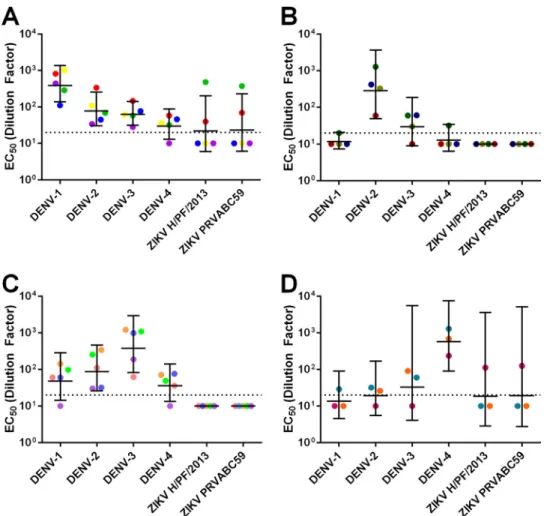
supple-mental material). Most of the primary sera failed to
cross-neutralize ZIKV. In fact, with primary DENV immune sera, we
observed lower levels of ZIKV cross-neutralization than of DENV
cross-neutralization (Fig. 3; see also Fig. S2). Notable exceptions
to this trend were two primary DENV-1 immune sera and one
primary DENV-4 immune serum that contained moderate to
high levels of ZIKV-neutralizing antibodies.
A hallmark of secondary DENV infections is the induction of
dengue virus serotype cross-neutralizing antibodies which reduce
the risk of disease from subsequent DENV infections (29). We
tested whether convalescent-phase sera from people exposed to
secondary DENV infections years previously also
cross-neutralized ZIKV. All of the secondary serum samples tested
neu-tralized DENV-1, DENV-2, and DENV-3, and 15 of 16 samples
neutralized DENV-4 (Fig. 4; see also Fig. S3 in the supplemental
material). There were no statistically significant differences
be-tween the DENV serotypes. In contrast, secondary DENV
im-mune sera usually had low or undetectable levels of ZIKV
cross-neutralizing antibodies. Six of the 16 sera (38%) had measurable
neutralization titers against ZIKV. Five of these six individuals had
modest ZIKV neutralization (EC
50s between 1:20 and 1:100), and
only one individual had strong ZIKV neutralization (EC
50,
⬎1:
100). Overall, secondary DENV immune sera poorly neutralized
ZIKV compared to cross-neutralization phenotypes noted among
other DENV serotypes, and only one individual (6%) strongly
cross-neutralized ZIKV.
Antigenic cartography.
The fact that convalescent-phase
DENV immune human sera displayed low cross-neutralization of
ZIKV suggests that ZIKV is antigenically distantly related to
DENV. To examine the antigenic relationships between ZIKV and
DENV, we used antigenic cartography to calculate the Euclidean
distances between sera, and metric multidimensional scaling was
used to render the data in three dimensions (see Movies S1 and S2
in the supplemental material). Cartography supports the
hypoth-esis that ZIKV is antigenically more distant from DENV-1 to -4
than each DENV serotype is from the others. Moreover,
ZIKV-neutralizing sera did not have universally higher
DENV-neutralizing titers than ZIKV-nonDENV-neutralizing sera. Indeed,
car-tography suggests that neutralization titers of primary and
secondary sera across all four DENV strains do not predict
neutralization outcomes with ZIKV, suggesting that these
cross-neutralizing antibodies represent a rare subset of anti-DENV
an-FIG 2 EDE1 C10 protects ZIKV-susceptible mice from infection. Five-week-old type I/II interferon receptor-knockout mice on a C57BL/6 backbone re-ceived either EDE1 C10 (n⫽5) or mock (n⫽5) treatment and were chal-lenged with 102FFU of ZIKV H/PF/2013. A mock cohort (n⫽2) was also included. Survival (A) and weight loss (B) were monitored, and differences between the mock-treated and EDE1 C10-treated cohorts are shown.
tibodies that develop in a subset of individuals within a
population.
DISCUSSION
Because ZIKV cocirculates with other flaviviruses, especially the
four DENV serotypes, an understanding of the antigenic
relation-ships between ZIKV and other flaviviruses and how these
interac-tions modulate ZIKV replication, disease, and transmission is
im-perative. Among the pathogenic human flaviviruses, ZIKV is most
closely related to DENV, and the goal of this study was to identify
any shared epitopes between DENV and ZIKV targeted by
cross-protective human antibodies (12). Primary DENV infections
in-duce serotype-specific neutralizing and protective antibody
re-sponses, whereas repeat DENV infections lead to the induction of
serotype cross-neutralizing and cross-protective responses (28,
30). We assessed the long-term immunological cross-reactivity of
DENV sera with ZIKV using panels of MAbs and immune sera
from people exposed to DENV. Neutralization assays with
multi-ple type-specific and cross-reactive MAbs identified a single set of
MAbs in our panel that could neutralize ZIKV and protect against
lethal infection
in vivo
: EDE1 C8 and EDE1 C10. While we
recog-nize that a broader set of human MAbs might identify novel
cross-neutralizing epitopes conserved in ZIKV and DENV, the EDE1
FIG 3 Neutralization of DENV and ZIKV by DENV primary sera. Geometric mean titers of DENV-1 primary sera (A), DENV-2 primary sera (B), DENV-3 primary sera (C), and DENV-4 primary sera (D). Colored points represent individual sera, and horizontal lines represent the geometric mean titers of all sera with upper and lower 95% confidence intervals. The dotted line indicates the limit of detection for the assay. Nonneutralizing sera were assigned a value of one-half of the limit of detection for visualization and calculation of the geometric means and confidence intervals.
antibodies potently neutralized a French Polynesian 2013 strain
representing the Asiatic lineage (H/PF/2013) and, importantly, a
strain circulating in the Americas in 2015 (PRVABC59). Indeed,
the dose of EDE1 C10 administered to protect
in vivo
(two doses of
10
g) is far less than the 500
g required for the fusion
loop-targeting mouse MAb 2A10G6 (31). Thus, it seems likely that
these EDE1 MAbs will prove efficacious against multiple ZIKV
strains
in vivo
. Consonant with this hypothesis, an alignment of
the EDE1 contact residues on DENV as previously identified by
X-ray crystallography and ZIKV reveals considerable
conserva-tion among contact residues between all four DENV serotypes and
ZIKV, readily explaining the cross-neutralization phenotypes
noted in our studies (24).
The EDE2 B7 MAb did not neutralize ZIKV despite significant
epitope overlap with the EDE1 antibodies. EDE2 B7 is reported to
be sensitive to the glycan at position 153 of the DENV envelope
protein; ZIKV has a glycan at position 154, but the amino acid
insertion in the glycan loop may alter the presentation of the
gly-can (23, 32). Moreover, EDE1 antibodies reach further into
do-mains I and III, providing an additional structural framework for
robust binding that may not be as strongly impacted by the
inser-tion in the glycan loop. These data suggest that the EDE1 epitope
may be critical to eliciting antibodies that protect against both
DENV and ZIKV and that efforts to develop vaccines and
thera-peutics should emphasize this population of antibodies.
The initial description of EDE antibodies reported that they
were immunodominant in nearly half of the study’s subjects
(in-cluding one individual with a primary DENV infection), but there
are several important caveats: the study had a small cohort (
n
⫽
7)
and the frequency of EDE antibodies was not broken down into
EDE1 versus EDE2 (23). Additionally, the EDE antibodies were
isolated from circulating plasmablasts elicited early during the
first couple of weeks following a confirmed DENV infection in
Southeast Asia. It is unclear whether these EDE-expressing
plas-mablasts are frequently elicited across the global population,
whether they are dependent on select sequential strain infection
serotype patterns, and whether these plasmablasts mature into
long-lived memory B cells or are lost. Nor is it known whether the
level of EDE antibody expression in the circulating short- and
long-term serological repertoire is sufficiently robust to protect
from repeat infections. For example, while highly
cross-neutralizing monoclonal antibodies can be elicited against the
GII.4 human epidemic noroviruses, only a few percent of the
hu-man population actually produces these potent antibodies (33).
Clearly, new diagnostic metrics such as epitope swap viruses,
an-tibody depletion assays, and blockade of binding assays are needed
to evaluate the levels of EDE antibodies in polyclonal sera after
primary and secondary infection (34–37).
Some, but not all, DENV primary and secondary immune sera
are capable of neutralizing ZIKV. The limited
cross-neutralization of ZIKV by DENV primary sera is likely attributed
to the mostly type-specific long-term response that follows a
sin-gle DENV infection (28). After secondary infection,
DENV-elicited antibody responses are thought to maintain the
type-specific response while simultaneously generating more broadly
neutralizing antibodies that typically protect from further DENV
infection with any serotype (30). Surprisingly, we observed no
cross-neutralization of ZIKV in many individuals who had
broadly cross-neutralizing antibodies to three or more DENV
se-rotypes. We conclude that, despite the close phylogenetic
relation-ship of DENV and ZIKV, durable long-lived antibody immune
responses that broadly cross-neutralize DENV serotypes are
usu-ally not effective against ZIKV. What we did observe were clear
cases of ZIKV cross-neutralization in a minority of subjects with
DENV type-specific or cross-neutralizing antibody responses.
The molecular basis of why some dengue-immune individuals
cross-neutralize ZIKV is currently not known. Possible
explana-tions for cross-neutralization include previous exposure to both
DENV and ZIKV or the presence of EDE1 or related antibody
classes in a subset of individuals. We propose that EDE1-like
an-tibodies are, at least in part, responsible for cross-neutralizing
ac-tivity in immune sera.
Gamma globulin treatment of pregnant women infected with
rubella virus is associated with a reduction in harmful outcomes in
the fetus (38). Similar therapies have had mixed success in
pre-venting cytomegalovirus-driven birth defects, and
immunother-apeutic human monoclonal antibody clinical trials are still
ongo-ing (39–41). Thus, it is reasonable to assume that human
monoclonal antibody therapy may be a viable treatment option to
protect the developing fetus in pregnant women infected with
ZIKV. Although additional therapeutic studies during infection
and pregnancy will be required, the identification of an epitope
that neutralizes ZIKV
in vitro
and
in vivo
represents a significant
first step toward preventing ZIKV-driven fetal malformation and
loss. Furthermore, the fact that the same antibodies targeting
EDE1 are able to strongly neutralize both DENV and ZIKV is
highly desirable, as diagnostic tests cannot always rapidly and
re-liably differentiate between the two infections. The strongly
cross-neutralizing phenotypes of EDE1 C8 and EDE1 C10 should
re-duce the likelihood that a DENV patient who has been
misdiagnosed with a ZIKV infection would experience disease
en-hancement after treatment with an EDE1 therapeutic antibody. In
some individuals, the EDE1-like antibody may also be elicited by
the existing tetravalent dengue vaccines already in late-stage
clin-ical trials or available on the market. Further testing is required to
determine the frequency of this antibody in the population
fol-lowing both natural infection and vaccination.
MATERIALS AND METHODS
Cells and viruses.All viruses were propagated in C6/36Aedes albopictus cells as previously described. C6/36 cells were grown in minimal essential medium (Gibco, Grand Island, NY) at 32°C. Vero-81 cells were grown in Dulbecco’s modified Eagle’s medium (Gibco, Grand Island, NY), and U937⫹DC-SIGN cells were maintained in RPMI 1640 (Gibco, Grand Island, NY) at 37°C. All media were supplemented with 10% (Vero-81) or 5% (C6/36 and U937⫹DC-SIGN) fetal bovine serum (HyClone, Logan, UT), 0.1 mM nonessential amino acids (Gibco, Grand Island, NY), and 100 U/ml penicillin and 100 mg/ml streptomycin (Gibco, Grand Island, NY). U937⫹DC-SIGN medium was additionally supplemented with 2 mM GlutaMAX (Gibco, Grand Island, NY), 10 mM HEPES (Cellgro, Manassas, VA), and 2-mercaptoethanol (Sigma, St. Louis, MO). All cells were incubated in the presence of 5% CO2.
ZIKV H/PF/2013 viral stocks were obtained from Michael S. Diamond (Washington University, St. Louis, MO). ZIKV PRVABC59 viral stocks were obtained from the Centers for Disease Control and Prevention (At-lanta, GA). DENV strains used in the polyclonal neutralization panel (DENV-1 WestPac74, DENV-2 S-16803, DENV-3 CH-53489, and DENV-4 TVP-376) were obtained from natural isolates maintained in the laboratory of Aravinda M. de Silva. DENV strains used in the monoclonal antibody panel (DENV-1 WestPac74, DENV-2 S-16803, DENV-3 UNC3001, and DENV-4 SriLanka 92A) were obtained from infectious clones in the laboratory of Ralph S. Baric (34, 35).
Serum and antibodies.Deidentified human DENV immune sera and plasma were collected from individuals with naturally acquired DENV infections confirmed via serology. All donations were collected in com-pliance with the Institutional Review Board of the University of North Carolina at Chapel Hill (protocol 08-0895). Deidentified human immune sera previously collected from the Pediatric Dengue Vaccine Initiative were also used.
Monoclonal antibodies were purified from hybridomas (1M7 and 1N5) or synthetically generated by Lake Pharma (Belmont, CA) from published sequences (1F4, 2D22, 5J7, 5H2, 4G2, EDE1 C8, EDE1 C10, and EDE2 B7); the latter are available upon request.
In vitroneutralization.Human sera or monoclonal antibodies were serially diluted 3-fold and mixed with sufficient virus to cause 15% infec-tion in U937⫹DC-SIGN cells. Dilution medium contained reduced (2%) fetal bovine serum and was supplemented with 2 mM CaCl2and MgCl2.
The virus-antibody mixtures were incubated for 45 min in a 96-well plate at 37°C. Following this incubation, 5⫻104cells were added and the
infection was allowed to proceed for 2 h at 37°C. The volume of medium in each well was increased to 200l, and the cells were returned to 37°C for a total of 24 h. After 24 h, the cells were fixed in paraformaldehyde, permeabilized, blocked with normal mouse serum in permeabilization buffer, and stained with Alexa Fluor 488-conjugated (Molecular Probes, Eugene, OR) 4G2 antibody. Unbound antibody was washed off, and cells were resuspended in Hanks’ buffered salt solution (Gibco, Grand Island, NY) supplemented with 2% fetal bovine serum. Assays were performed twice and in duplicate. Samples were read on a Guava easyCyte 5HT flow cytometer (Millipore) as previously described by our group (42).
Neutralization in Vero-81 cells was assessed by serially diluting the monoclonal antibodies 10-fold and mixing with approximately 150 focus-forming units of virus. Dilution medium contained reduced (2%) fetal bovine serum. The virus-antibody mixtures were incubated for 1 h in a 96-well plate at 37°C and then transferred to a monolayer of Vero-81 cells in a 96-well plate. Following a further 1-h incubation at 37°C, the monolayers were overlaid with Opti-MEM (Gibco, Grand Island, NY) containing 2% fetal bovine serum and 1% (wt/vol) carboxymethyl cellu-lose (Sigma, St. Louis, MO). Infected plates were incubated for 2 days at 37°C with 5% CO2, at which time they were fixed with paraformaldehyde,
permeabilized, blocked with normal goat serum (Sigma, St. Louis, MO) in permeabilization buffer, stained with 4G2 primary antibody followed by secondary horseradish peroxidase (HRP)-conjugated anti-mouse IgG (KPL, Gaithersburg, MD), washed again, and developed with TrueBlue peroxidase substrate (KPL, Gaithersburg, MD).
Binding assays.High-binding Microlon 600 96-well plates (VWR, Radnor, PA) were coated with 100 ng of 4G2 and 2H2 antibody in 0.1 M carbonate buffer, pH 9.6, overnight at 4°C. Unbound antibody was rinsed with wash buffer (Tris-buffered saline [TBS] plus 0.2% Tween), and wells were coated with blocking buffer (TBS plus 0.05% Tween) for 1 h at 37°C. Virus was diluted in blocking buffer at a concentration sufficient to result in approximately equal reactivity with a human cross-reactive control serum and was added to the plate for 1 h at 37°C. Unbound virus was rinsed in wash buffer, and 1g of each primary antibody (or the control serum) diluted in blocking buffer was added to the plate for 1 h at 37°C. Unbound primary antibody was rinsed in wash buffer, and alkaline phosphatase-conjugated goat anti-human IgG antibody (Sigma, St. Louis, MO) at 1:2,500 in blocking buffer was added to the plate for 1 h at 37°C. Unbound secondary antibody was rinsed in wash buffer, the plate was developed with SigmaFastp-nitrophenyl phosphate tablets (Sigma, St. Louis, MO), and signal was read at 405 nm.
Animal studies.Cohorts of five (virus only and virus with antibody) or two (mock) 5-week-old type I/II interferon receptor-knockout mice (Ifnar⫺/⫺and Ifngr⫺/⫺) on a C57BL/6 backbone were used in a single
experiment. On days⫺1 and 9 postinfection, mice received either PBS (mock and virus only) or 10g EDE1 C10 antibody (virus with antibody) in a 100-l dose delivered intraperitoneally. On day 0, mice received ei-ther PBS (mock) or 100 FFU of ZIKV H/PF/2013 (virus only and virus
with antibody) in a 10-l dose delivered subcutaneously in the hind left footpad (27). Mice were monitored daily for 14 days postinfection for weight loss and signs of illness. Mice were humanely euthanized if they became moribund and counted as deceased for that day. All work was performed in adherence to theGuide for the Care and Use of Laboratory Animals(43).
Antigenic cartography.Antigenic cartography was performed using the EC50s generated from the neutralization assays with DENV-1, -2, -3,
and -4 in U937⫹DC-SIGN cells. The data were normalized as described in the work of Cai et al. (44). Euclidean distances between sera were calcu-lated, and metric multidimensional scaling was used to render the data in three dimensions (45). All calculations and images were generated in R Studio, version 0.99.467 (RStudio Inc., Boston, MA). Movie files were rendered using Adobe Photoshop software (Adobe, San Jose, CA).
Statistical analysis.When analyzing neutralization assays, antibody and serum concentrations were log10transformed. Next, the EC50s were
calculated using the sigmoidal dose response (variable slope) equation of Prism 6 (GraphPad Software, La Jolla, CA). Reported values were required to have: at least 5,000 recorded events per data point (in the case of the U937⫹DC-SIGN assay), anR-squared value of greater than 0.75, a Hill slope value of at least 0.7 for monoclonal antibodies and 0.5 for sera, and an EC50within the range of the assay. Variation between groups was
measured by one-way analysis of variance (ANOVA) with a Bonferroni post hoctest.Pvalues of less than 0.05 were considered statistically signif-icant.
Absorbance signals for each virus group in the binding assay were multiplied or divided such that the signal for that virus against the com-mon control serum was set to 1. Each assay was run singly with technical duplicates. Means and standard deviations were calculated in Prism 6 (GraphPad Software, La Jolla, CA).
Survival rates in the animal experiment were analyzed using the log rank (Mantel-Cox) test in Prism 6 for Windows (GraphPad Software, La Jolla, CA). The with-antibody cohort was compared to the virus-only cohort.
SUPPLEMENTAL MATERIAL
Supplemental material for this article may be found athttp://mbio.asm.org/ lookup/suppl/doi:10.1128/mBio.01123-16/-/DCSupplemental.
Figure S1, TIF file, 2.8 MB. Figure S2, TIF file, 0.1 MB. Figure S3, TIF file, 0.1 MB. Movie S1, MP4 file, 0.1 MB. Movie S2, MP4 file, 0.1 MB. Table S1, DOCX file, 0.1 MB. Table S2, DOCX file, 0.1 MB.
ACKNOWLEDGMENTS
We thank Vineet D. Menachery for sharing his knowledge of immuno-therapies, Alex Sette and Daniela Weiskopf for providing dengue immune sera, and John G. Haughie for his expert assistance with generating videos. This work was funded by a supplement to R.S.B. from the NIH NIAID (U19 AI 100625), a grant and supplement to A.M.D.S. from the NIH NIAID (R01 AI 107731), and a research agreement with the Gates Foun-dation (IDEA grant; principal investigator, Anna Durbin). K.S.P. was funded by a training grant from the NIH NIAID (T32 AI 007151-36A1). The funders had no role in study design, data collection and interpreta-tion, or the decision to submit the work for publication.
FUNDING INFORMATION
This work, including the efforts of Eileen McGowan, Jesica A. Swanstrom, Ellen F. Young, Emily N. Gallichotte, Aravinda de Silva, and Ralph S. Baric, was funded by HHS | National Institutes of Health (NIH) (R01 AI 107731). This work, including the efforts of Mark T. Heise, Ralph S. Baric, and Kenneth S. Plante, was funded by HHS | National Institutes of Health (NIH) (U19 AI 100625). This work, including the efforts of Kenneth S. Plante, was funded by HHS | National Institutes of Health (NIH) (T32 AI 007151-36A1). This work, including the efforts of Jessica Plante, Eileen McGowan, Aravinda de Silva, Ralph S. Baric, Jesica A. Swanstrom, Ellen F. Young, Emily N. Gallichotte, and Doug G. Widman, was funded by Bill and Melinda Gates Foundation (Bill & Melinda Gates Foundation) (Idea Grant).
REFERENCES
1.Lazear HM, Diamond MS. 2016. Zika virus: new clinical syndromes and its emergence in the western hemisphere. J Virol90:4864 – 4875.http:// dx.doi.org/10.1128/JVI.00252-16.
2.Brasil P, Pereira JP, Jr, Raja Gabaglia C, Damasceno L, Wakimoto M, Ribeiro Nogueira RM, Carvalho de Sequeira P, Machado Siqueira A, Abreu de Carvalho LM, Cotrim da Cunha D, Calvet GA, Neves ES, Moreira ME, Rodrigues Baião AE, Nassar de Carvalho PR, Janzen C, Valderramos SG, Cherry JD, Bispo de Filippis AM, Nielsen-Saines K. 2016. Zika virus infection in pregnant women in Rio de Janeiro— preliminary report. N Engl J Med http://dx.doi.org/10.1056/ NEJMoa1602412.
3.Brasil P, Calvet GA, Siqueira AM, Wakimoto M, de Sequeira PC, Nobre A, Quintana Mde S, Mendonca MC, Lupi O, de Souza RV, Romero C, Zogbi H, Bressan CDS, Alves SS, Lourenco-de-Oliveira R, Nogueira RM, Carvalho MS, de Filippis AM, Jaenisch T. 2016. Zika virus outbreak in Rio de Janeiro, Brazil: clinical characterization, epidemiological and virological aspects. PLoS Negl Trop10:e0004636. http://dx.doi.org/ 10.1371/journal.pntd.0004636.
4.World Health Organization. 2016. Zika virus, microcephaly and Guillain-Barré syndrome. World Health Organization, Geneva, Switzerland. 5.Zanluca C, Melo VC, Mosimann AL, Santos GI, Santos CN, Luz K.
2015. First report of autochthonous transmission of Zika virus in Brazil. Mem Inst Oswaldo Cruz110:569 –572.http://dx.doi.org/10.1590/0074 -02760150192.
6.Cavalheiro S, Lopez A, Serra S, Da Cunha A, da Costa MD, Moron A, Lederman HM. 2016. Microcephaly and Zika virus: neonatal neuroradio-logical aspects. Childs Nerv Syst32:1057–1060.http://dx.doi.org/10.1007/ s00381-016-3074-6.
7.Mlakar J, Korva M, Tul N, Popovic´ M, Poljšak-Prijatelj M, Mraz J, Kolenc M, Resman Rus K, Vesnaver Vipotnik T, Fabjan Vodušek V, Vizjak A, Pižem J, Petrovec M, Avšicˇ Županc T. 2016. Zika virus asso-ciated with microcephaly. N Engl J Med374:951–958.http://dx.doi.org/ 10.1056/NEJMoa1600651.
8.Rasmussen SA, Jamieson DJ, Honein MA, Petersen LR. 2016. Zika virus and birth defects—reviewing the evidence for causality. N Engl J Med
374:1981–1987.http://dx.doi.org/10.1056/NEJMsr1604338.
9.Araujo LM, Ferreira ML, Nascimento OJ. 2016. Guillain-Barre syn-drome associated with the Zika virus outbreak in Brazil. Arq Neuropsiqui-atr74:253–255.http://dx.doi.org/10.1590/0004-282X20160035. 10. Brasil P, Sequeira PC, Freitas AD, Zogbi HE, Calvet GA, de Souza RV,
Siqueira AM, de Mendonca MCL, Nogueira RMR, de Filippis AMB, Solomon T. 2016. Guillain-Barre syndrome associated with Zika virus infection. Lancet 387:1482. http://dx.doi.org/10.1016/S0140 -6736(16)30058-7.
11. Beckham JD, Pastula DM, Massey A, Tyler KL. 2016. Zika virus as an emerging global pathogen: neurological complications of Zika virus. JAMA Neurolhttp://dx.doi.org/10.1001/jamaneurol.2016.0800. 12. Ye Q, Liu Z, Han J, Jiang T, Li X, Qin C. 2016. Genomic characterization
and phylogenetic analysis of Zika virus circulating in the Americas. Infect Genet Evol43:43– 49.http://dx.doi.org/10.1016/j.meegid.2016.05.004. 13. Pitisuttithum P, Bouckenooghe A. 2016. The first licensed dengue
vaccine: an important tool for integrated preventive strategies against den-gue virus infection. Expert Rev Vaccines15:795–798http://dx.doi.org/ 10.1080/14760584.2016.1189331.
14. Sirivichayakul C, Barranco-Santana EA, Esquilin-Rivera I, Oh HM, Raanan M, Sariol CA, Shek LP, Simasathien S, Smith MK, Velez ID,
Wallace D, Gordon GS, Stinchcomb DT. 2016. Safety and immunoge-nicity of a tetravalent dengue vaccine candidate in healthy children and adults in dengue-endemic regions: a randomized, placebo-controlled phase 2 study. J Infect Dis213:1562–1572.http://dx.doi.org/10.1093/ infdis/jiv762.
15. Vannice KS, Durbin A, Hombach J. 2016. Status of vaccine research and development of vaccines for dengue. Vaccine34:2934 –2938http:// dx.doi.org/10.1016/j.vaccine.2015.12.073.
16. Lanciotti RS, Kosoy OL, Laven JJ, Velez JO, Lambert AJ, Johnson AJ, Stanfield SM, Duffy MR. 2008. Genetic and serologic properties of Zika virus associated with an epidemic, Yap state, Micronesia, 2007. Emerg Infect Dis14:1232–1239.http://dx.doi.org/10.3201/eid1408.080287. 17. Fibriansah G, Tan JL, Smith SA, de Alwis AR, Ng TS, Kostyuchenko
VA, Ibarra KD, Wang J, Harris E, de Silva A, Crowe JE, Lok SM. 2014. A potent anti-dengue human antibody preferentially recognizes the con-formation of E protein monomers assembled on the virus surface. EMBO Mol Med6:358 –371.http://dx.doi.org/10.1002/emmm.201303404. 18. Fibriansah G, Ibarra KD, Ng TS, Smith SA, Tan JL, Lim XN, Ooi JS,
Kostyuchenko VA, Wang J, de Silva AM, Harris E, Crowe JE, Jr, Lok SM. 2015. Dengue virus. Cryo-EM structure of an antibody that neutral-izes dengue virus type 2 by locking E protein dimers. Science349:88 –91.
http://dx.doi.org/10.1126/science.aaa8651.
19. Fibriansah G, Tan JL, Smith SA, de Alwis R, Ng TS, Kostyuchenko VA, Jadi RS, Kukkaro P, de Silva AM, Crowe JE, Lok SM. 2015. A highly potent human antibody neutralizes dengue virus serotype 3 by binding across three surface proteins. Nat Commun6:6341.http://dx.doi.org/ 10.1038/ncomms7341.
20. Cockburn JJ, Navarro Sanchez ME, Goncalvez AP, Zaitseva E, Stura EA, Kikuti CM, Duquerroy S, Dussart P, Chernomordik LV, Lai CJ, Rey FA. 2012. Structural insights into the neutralization mechanism of a higher primate antibody against dengue virus. EMBO J31:767–779.
http://dx.doi.org/10.1038/emboj.2011.439.
21. Henchal EA, Gentry MK, McCown JM, Brandt WE. 1982. Dengue virus-specific and flavivirus group determinants identified with monoclo-nal antibodies by indirect immunofluorescence. Am J Trop Med Hyg31:
830 – 836.
22. Smith SA, de Alwis AR, Kose N, Harris E, Ibarra KD, Kahle KM, Pfaff JM, Xiang X, Doranz BJ, de Silva AM, Austin SK, Sukupolvi-Petty S, Diamond MS, Crowe JE. 2013. The potent and broadly neutralizing human dengue virus-specific monoclonal antibody 1C19 reveals a unique cross-reactive epitope on the bc loop of domain II of the envelope protein. mBio4:e00873-13.http://dx.doi.org/10.1128/mBio.00873-13.
23. Dejnirattisai W, Wongwiwat W, Supasa S, Zhang X, Dai X, Rouvinski A, Jumnainsong A, Edwards C, Quyen NTH, Duangchinda T, Grimes JM, Tsai W-Y, Lai C-Y, Wang W-K, Malasit P, Farrar J, Simmons CP, Zhou ZH, Rey FA, Mongkolsapaya J, Screaton GR. 2015. A new class of highly potent, broadly neutralizing antibodies isolated from viremic pa-tients infected with dengue virus. Nat Immunol16:170 –177.http:// dx.doi.org/10.1038/ni.3058.
24. Rouvinski A, Guardado-Calvo P, Barba-Spaeth G, Duquerroy S, Vaney MC, Kikuti CM, Navarro Sanchez ME, Dejnirattisai W, Wongwiwat W, Haouz A, Girard-Blanc C, Petres S, Shepard WE, Desprès P, Arenzana-Seisdedos F, Dussart P, Mongkolsapaya J, Screaton GR, Rey FA. 2015. Recognition determinants of broadly neutralizing human antibodies against dengue viruses. Nature520:109 –113.http://dx.doi.org/10.1038/ nature14130.
25. Sabchareon A, Wallace D, Sirivichayakul C, Limkittikul K, Chantha-vanich P, Suvannadabba S, Jiwariyavej V, Dulyachai W, Pengsaa K, Wartel TA, Moureau A, Saville M, Bouckenooghe A, Viviani S, Torn-ieporth NG, Lang J. 2012. Protective efficacy of the recombinant, live-attenuated, CYD tetravalent dengue vaccine in Thai schoolchildren: a ran-domised, controlled phase 2b trial. Lancet380:1559 –1567.http:// dx.doi.org/10.1016/S0140-6736(12)61428-7.
26. Rossi SL, Tesh RB, Azar SR, Muruato AE, Hanley KA, Auguste AJ, Langsjoen RM, Paessler S, Vasilakis N, Weaver SC. 2016. Characteriza-tion of a novel murine model to study Zika virus. Am J Trop Med Hyg
94:1362–1369http://dx.doi.org/10.4269/ajtmh.16-0111.
27. Lazear HM, Govero J, Smith AM, Platt DJ, Fernandez E, Miner JJ, Diamond MS. 2016. A mouse model of Zika virus pathogenesis. Cell Host Microbe19:720 –730.http://dx.doi.org/10.1016/j.chom.2016.03.010. 28. De Alwis R, Smith SA, Olivarez NP, Messer WB, Huynh JP, Wahala
epitopes on dengue virions. Proc Natl Acad Sci USA109:7439 –7444.
http://dx.doi.org/10.1073/pnas.1200566109.
29. Olkowski S, Forshey BM, Morrison AC, Rocha C, Vilcarromero S, Halsey ES, Kochel TJ, Scott TW, Stoddard ST. 2013. Reduced risk of disease during postsecondary dengue virus infections. J Infect Dis208:
1026 –1033. doihttp://dx.doi.org/10.1093/infdis/jit273.
30. Wahala WM, Silva AM. 2011. The human antibody response to dengue virus infection. Viruses 3:2374 –2395.http://dx.doi.org/10.3390/ v3122374.
31. Dai L, Song J, Lu X, Deng YQ, Musyoki AM, Cheng H, Zhang Y, Yuan Y, Song H, Haywood J, Xiao H, Yan J, Shi Y, Qin CF, Qi J, Gao GF. 2016. Structures of the Zika virus envelope protein and its complex with a flavivirus broadly protective antibody. Cell Host Microbe19:696 –704.
http://dx.doi.org/10.1016/j.chom.2016.04.013.
32. Kostyuchenko VA, Lim EX, Zhang S, Fibriansah G, Ng TS, Ooi JS, Shi J, Lok SM. 2016. Structure of the thermally stable Zika virus. Nature
533:425– 428.http://dx.doi.org/10.1038/nature17994.
33. Lindesmith LC, Donaldson EF, Beltramello M, Pintus S, Corti D, Swanstrom J, Debbink K, Jones TA, Lanzavecchia A, Baric RS. 2014. Particle conformation regulates antibody access to a conserved GII.4 no-rovirus blockade epitope. J Virol88:8826 – 8842.http://dx.doi.org/ 10.1128/JVI.01192-14.
34. Messer WB, Yount BL, Royal SR, de Alwis R, Widman DG, Smith SA, Crowe JE, Jr, Pfaff JM, Kahle KM, Doranz BJ, Ibarra KD, Harris E, de Silva AM, Baric RS. 2016. Functional transplant of a dengue virus sero-type 3 (DENV3)-specific human monoclonal antibody epitope into DENV1. J Virol90:5090 –5097.http://dx.doi.org/10.1128/JVI.00155-16. 35. Gallichotte EN, Widman DG, Yount BL, Wahala WM, Durbin A,
Whitehead S, Sariol CA, Crowe JE, Jr, de Silva AM, Baric RS. 2015. A new quaternary structure epitope on dengue virus serotype 2 is the target of durable type-specific neutralizing antibodies. mBio6:e01461-15.http:// dx.doi.org/10.1128/mBio.01461-15.
36. de Alwis R, Williams KL, Schmid MA, Lai CY, Patel B, Smith SA, Crowe JE, Wang WK, Harris E, de Silva AM. 2014. Dengue viruses are enhanced by distinct populations of serotype cross-reactive antibodies in human immune sera. PLoS Pathog10:e1004386. http://dx.doi.org/10.1371/ journal.ppat.1004386.
37. Lindesmith LC, Donaldson EF, Lobue AD, Cannon JL, Zheng DP, Vinje
J, Baric RS. 2008. Mechanisms of GII.4 norovirus persistence in human p o p u l a t i o n s . P L o S M e d 5 :e 3 1 . h t t p : / / d x . d o i . o r g / 1 0 . 1 3 7 1 / journal.pmed.0050031.
38. Young MK, Cripps AW, Nimmo GR, van Driel ML. 2015. Post-exposure passive immunisation for preventing rubella and congenital rubella syn-drome. Cochrane Database Syst Rev9:CD010586.http://dx.doi.org/ 10.1002/14651858.CD010586.pub2.
39. Revello MG, Lazzarotto T, Guerra B, Spinillo A, Ferrazzi E, Kuster-mann A, Guaschino S, Vergani P, Todros T, Frusca T, Arossa A, Furione M, Rognoni V, Rizzo N, Gabrielli L, Klersy C, Gerna G, CHIP Study Group. 2014. A randomized trial of hyperimmune globulin to pre-vent congenital cytomegalovirus. N Engl J Med370:1316 –1326.http:// dx.doi.org/10.1056/NEJMoa1310214.
40. Nigro G, Adler SP, La Torre R, Best AM, Congenital Cytomegalovirus Collaborating Group. 2005. Passive immunization during pregnancy for congenital cytomegalovirus infection. N Engl J Med353:1350 –1362.
http://dx.doi.org/10.1056/NEJMoa043337.
41. Nigro G, Adler SP, Parruti G, Anceschi MM, Coclite E, Pezone I, Di Renzo GC. 2012. Immunoglobulin therapy of fetal cytomegalovirus in-fection occurring in the first half of pregnancy—a case-control study of the outcome in children. J Infect Dis205:215–227.http://dx.doi.org/ 10.1093/infdis/jir718.
42. de Alwis R, Smith SA, Olivarez NP, Messer WB, Huynh JP, Wahala WM, White LJ, Diamond MS, Baric RS, Crowe JE, de Silva AM. 2012. Identification of human neutralizing antibodies that bind to complex epitopes on dengue virions. Proc Natl Acad Sci U S A109:7439 –7444.
http://dx.doi.org/10.1073/pnas.1200566109.
43. National Research Council. 2011. Guide for the care and use of laboratory animals, 8th ed. National Academies Press, Washington, DC.
44. Cai Z, Zhang T, Wan XF. 2010. A computational framework for influ-enza antigenic cartography. PLoS Comput Biol6:e1000949.http:// dx.doi.org/10.1371/journal.pcbi.1000949.