Modeling, Analysis, and Hard Real-time Scheduling
of Adaptive Streaming Applications
Jiali Teddy Zhai, Sobhan Niknam, and Todor Stefanov,
Member, IEEE
Abstract—In real-time systems, the application’s behavior has to be predictable at compile-time to guarantee timing constraints. However, modern streaming applications which exhibit adaptive behavior due to mode switching at run-time, may degrade system predictability due to unknown behavior of the application during mode transitions. Therefore, proper temporal analysis during mode transitions is imperative to preserve system predictabil-ity. To this end, in this paper, we initially introduce Mode Aware Data Flow (MADF) which is our new predictable Model of Computation (MoC) to efficiently capture the behavior of adaptive streaming applications. Then, as an important part of the operational semantics of MADF, we propose the Maximum-Overlap Offset (MOO) which is our novel protocol for mode transitions. The main advantage of this transition protocol is that, in contrast to self-timed transition protocols, it avoids timing interference between modes upon mode transitions. As a result, any mode transition can be analyzed independently from the mode transitions that occurred in the past. Based on this tran-sition protocol, we propose a hard real-time analysis as well to guarantee timing constraints by avoiding processor overloading during mode transitions. Therefore, using this protocol, we can derive a lower bound and an upper bound on the earliest starting time of the tasks in the new mode during mode transitions in such a way that hard real-time constraints are respected.
I. Introduction
T
O handle the ever-increasing computational demands and meet hard real-time constraints in streaming applications, where the huge amount of streaming data should be processed in a short time interval, embedded systems have relied on Multi-Processor System-on-Chip (MPSoC) platforms to benefit from parallel processing. To efficiently exploit the computational capacity of MPSoCs, however, streaming applications must be expressed primarily in a parallel fashion. The common practice for expressing the parallelism in an application is to use parallel Models of Computation (MoCs) [1]. Within a parallel MoC, a streaming application is modeled as a directed graph, where graph nodes represent actors (i.e., tasks) and graph edges represent data dependencies. Actors are executed concurrently and communicate data explicitly via FIFOs. For example, Synchronous Data Flow (SDF) [2] and Cyclo-Static Data Flow (CSDF) [3] are two popular parallel MoCs because of their compile-time analyzability. Due to the static nature of SDF and CSDF MoCs, the actors are restricted to produce andThis article was presented in the International Conference on Embedded Software 2018 and appears as part of the ESWEEK-TCAD special issue.
The authors contributed to the paper equally. The authors are with the Leiden Institute of Advanced Computer Science, Leiden University, Leiden, The Netherlands, Email: [email protected], {s.niknam,t.p.stefanov}@liacs.leidenuniv.nl. This research is supported by the Dutch Technology Foundation STW under the Robust Cyber Physical Systems program (Project 12695).
consume data with fixed rates per firing or, in case of CSDF, with fixed periodic patterns.
Nowadays, many modern streaming applications, in the do-main of multimedia, image, and signal processing, increasingly show adaptive behavior at run-time. For example, a computer vision system processes different parts of an image continuously to obtain information from several regions of interest depending on the actions taken by the external environment. This adaptive behavior, however, cannot be effectively expressed with an SDF or CSDF model due to their limited expressiveness. As a result, more expressive models, e.g., Scenario-Aware Data Flow (SADF) [4], Finite State Machine (FSM)-based Scenario-Aware Data Flow (FSM-SADF) [5], Variable-rate Phased Data Flow (VPDF) [6], and Mode-controlled Data Flow (MCDF) [7], have been proposed and deployed as extensions of the (C)SDF model. These MoCs are able to capture the behavior of an adaptive streaming application as a collection of different static behaviors, called scenarios or modes, which are individually predictable in performance and resource usage at compile-time. Moreover, to guarantee tight timing constraints in modern streaming applications with adaptive behavior nature, proper temporal analysis for application execution during mode transitions, when the application’s behavior is switching from one mode to another mode, is imperative at compile-time. However, such analysis can be difficult due to the fact that different actors in different modes are concurrently executing during mode transitions. This difficulty comes directly from the protocol adopted for the mode transitions. In the existing adaptive MoCs, like MCDF [7] and FSM-SADF [5], a protocol, referred as self-timed transition protocol, has been adopted which specifies that actors are scheduled as soon as possible not only in each mode individually, but also during mode transitions. This protocol, however, introduces interference of one mode execution with another one, as explained in Section IV-C1. As a consequence, the temporal analysis of a mode transition is tightly dependent on the mode transitions that occurred in the past. Another consequence of the incurred interference between modes is the high time complexity of analyzing mode transitions, as the mode transitions cannot be analyzed independently, e.g., see the state-space exploration approach proposed in [5].
Therefore, to overcome the aforementioned interference issue and consequent problems caused by the self-timed transition protocol, in this paper, we propose a new MoC called Mode Aware Data Flow (MADF) to model adaptive streaming applications, that is armed by a novel transition protocol called Maximum-Overlap Offset. This transition protocol enables an independent analysis for mode transitions. The specific novel contributions of this paper are the following:
• We propose a new MoC, Mode-Aware Data Flow (MADF), that has the advantages of SADF [4] and VPDF [6]. Inspired by SADF, we characterize the behavior of adaptive streaming applications with individual modes and transitions between them. Similar to VPDF, the length of production/consumption sequences for an actor varies from one mode to another. The length is only fixed when the mode is known. Then, based on the clear distinction between modes and transitions, we define analyzable operational semantics for MADF;
• As an important part of the operational semantics of
MADF, we propose the Maximum-Overlap Offset (MOO) which is our novel protocol for mode transitions. The main advantage of this transition protocol is that, in contrast to the self-timed transition protocol, adopted in [5], [7], it avoids timing interference between modes upon mode transitions. As a result, this transition protocol enables an independent analysis for mode transitions. This means, the analysis of any mode transition is independent from the mode transitions that occurred in the past. This independent analysis significantly reduces the complexity of the analysis as the complexity merely depends on the number of allowed transitions. This is crucial for applications with a large number of modes and possible transitions;
• Based on the novel MOO transition protocol, we propose
a hard real-time analysis approach to guarantee the timing constraints by avoiding processor overloading, i.e., avoiding that the total utilization of allocated tasks on a processor exceeds its capacity, during mode transi-tions. Our analysis is much simpler and faster than the computationally intensive state-of-the-art timing analysis approaches such as [5].
The remainder of this paper is organized as follows: Section II gives an overview of the related work. Section III introduces the background needed for understanding the contributions of this paper. Our novel adaptive MoC and transition protocol are then introduced in Section IV. Based on the novel transition protocol, in Section V, we present our hard real-time analysis approach to guarantee the timing constraints during mode transitions. In Section VI, two case studies are presented to illustrate the practical applicability of our proposed MADF mode, transition protocol, and real-time analysis. Finally, Section VII ends the paper with conclusions.
II. RelatedWork
To model the adaptive behavior of modern streaming applica-tions while having certain degree of compile-time analyzability, different MoCs such as Scenario-Aware Data Flow (SADF) [4], Finite State Machine (FSM)-based Scenario-Aware Data Flow (FSM-SADF) [5], Variable-rate Phased Data Flow (VPDF) [6], Mode-controlled Data Flow (MCDF) [7], and Parameterized SDF (PSDF) [8] have been already proposed in the literature.
In SADF [4] and FSM-SADF [5], detector actors are
introduced to parameterize the SDF model. All valid scenarios and their possible order of occurrence, which is shown either by using a Markov chain [4] or finite state machine [5], must
be predefined at compile-time. Each scenario consists of a set of valid parameter combination that determines a scenario of SADF. This guarantees the consistency of SADF in individual scenarios, therefore, no run-time consistency check is required. In a scenario, the SADF model behaves the same way as the SDF model. Therefore, an SADF graph can be seen as a set of SDF graphs. In the initial FSM-SADF definition, all the production and consumption rates of the data-flow edges are constant within a graph iteration of a scenario.
For the FSM-SADF MoC [5], the authors proposed an approach to compute worst-case performance among all mode transitions, assuming the self-timed transition protocol. Although it is an exact analysis, the approach has inherently exponential time complexity. Moreover, this approach leads to timing interference between modes upon mode transitions. In contrast, our approach does not introduce interference between modes due to the novel MOO transition protocol proposed in Section IV-C2. The timing behavior of individual modes and during mode transitions can be analyzed independently. In addition, our approach considers allocation of actors on processors, which by itself is a harder problem than the one addressed in [5].
In [9], the author proposes to use a linear model to capture worst-case transition delay and period during scenario transi-tions of FSM-SADF. Our transition protocol is conceptually similar to the linear model. However, we obtain the linear model in a different way, specifically simplified for the adopted hard real-time scheduling framework. For instance, finding a reference schedule is not necessary in our case, but being crucial in the tightness of the analysis proposed in [9]. Moreover, our approach solves the problem of changing the application graph structure during mode transitions, which was not studied in [9].
For VPDF [6], the analysis has been limited to computing buffer sizes under throughput constraints so far. The execution of a VPDF graph on MPSoC platforms under hard real-time constraints has not been studied. In particular, the allocation of actors and how to switch from one mode to another one are not discussed. Moreover, delay due to mode transitions has not been investigated. Our approach, on the other hand, takes these important factors into account. Therefore, our analysis results are directly reflected in a real implementation.
reflected in the final implementation. In this sense, our analysis is exact in the timing behavior of mode transitions.
In [8], a meta-modeling technique is proposed to augment the expressive power of wide range of existing data-flow models which have the graph iteration concept. In [8], the proposed technique is especially applied to the SDF model which is called Parameterized SDF (PSDF). In PSDF, separate initand
sub-init graphs are proposed to reconfigure the body graph
in a hierarchical manner. In this model, functional properties can only be partially decided at compile-time, and thus run-time verification is needed. To this end, for all configurations, computing a schedule and verifying consistency for both graphs and specifications need to be fulfilled at run-time which is pretty complex procedure. In addition, temporal analysis to find the worst-case system reconfiguration delay to preserve model predictability is not proposed. In contrast, our MADF model does not require run-time consistency check as every mode in our model is predefined at compile-time and represented as a CSDF graph. In addition, our MADF provides the temporal analysis of the mode transitions at compile-time using the MOO transition protocol.
In [10], [11], an analysis is proposed to reason about worst-case response time of a task graph in case of a mode change. However, the task graph has very limited expressiveness and is not able to model the behavior of adaptive streaming applications. Instead, in our paper, we define a more expressive MoC that is amenable to adaptive application behavior and real-time analysis.
In [12], [13], the authors focus on timing analysis for mode changes of real-time tasks. The starting times of new mode tasks need to be delayed to avoid overloading of processors during mode changes. In [12], [13], however, it is assumed that tasks are independent. The proposed algorithms are thus not applicable to adaptive MoCs, since the starting times of tasks in adaptive MoCs depend on each other due to data dependencies. Moreover, the algorithms in [12], [13] involve high computational complexity because fixed-point equations must be solved at every step in the algorithms. In contrast, in our paper, we propose an adaptive MoC and analysis for applications with data-dependent tasks, which is more realistic and applicable to wider range of real-life streaming applications. Moreover, our analysis is simpler with low computational and time complexity.
III. Background
In this section, we provide a brief overview of our system model, the CSDF MoC, and the scheduling framework pre-sented in [14]. This background is needed to understand the novel contributions of our work.
A. System Model
The considered MPSoC platforms in this work are homo-geneous, i.e., they may contain multiple, but the same type of programmable Processing Elements (PEs) with distributed memories. Moreover, the platform must be predictable, which means timing guarantees are provided on the response time of hardware components and OS schedulers. The precision-timed
(PRET) [15] platform is such an example. On the software side, we assume partitioned scheduling algorithms, i.e, no migration of tasks between PEs is allowed. The considered scheduling algorithms on each PE include Fixed-Priority Preemptive Scheduling (FPPS) algorithms, such as RM [16], or dynamic scheduling algorithms, such as EDF [16].
B. Cyclo-Static Data Flow (CSDF)
An application modeled as a CSDF [3] is defined as a directed graph G = (A,E) that consists of a set of actors
A which communicate with each other through a set of
edgesE. Actors represent computation while edges represent data dependency due to communication and synchronization. In CSDF, every actor Ai ∈ A has an execution sequence
Ci=[c1,c2, . . . ,cφi] of length φi. This means, the x−th time
that actor Ai is fired, it performs the computationCi(((x−1)
modφi)+1). Similarly, production and consumption of data
tokens are also sequences of length φi in CSDF. The token
production of actorAi to edgeEj is represented as a sequence
of constant integers PRDj = [prd1,prd2, . . . ,prdφi], called
production sequence. Analogously, token consumption from
every input edge Ek of actor Ai is a predefined sequence
CNSk=[cns1,cns2, . . . ,cnsφi], calledconsumption sequence.
Thex−th time that actorAiis fired, it produces PRDj(((x−1)
modφi)+1) tokens to channelEjand consumesCNSk(((x−1)
modφi)+1) tokens from channelEk.
An important property of the CSDF model is the ability to derive a schedule for the actors at compile-time. In order to derive a valid static schedule for a CSDF graph at compile-time, it has to be consistent and live.
Theorem 1 (From [3]). In a CSDF graph G, a repetition
vector~q=[q1,q2,· · ·,q|A|]T is given by
~q= Θ·~r with Θj,i=
(φ
i i f j=i
0 otherwise (1)
where~r = [r1,r2, ...,r|A|]T is a positive integer solution of the balance equationΓ·~r=~0and where the topology matrix
Γ∈Z|E|×|A|is defined by
Γj,i=
Pk=φi
k=1 PRDj(k) i f actor Ai produces to edge Ej
−Pk=φi
k=1 CNSj(k) i f actor Ai consumes f rom edge Ej
0 otherwise.
A CSDF graphGis said to be consistent if a positive integer solution~r=[r1,r2, ...,r|A|]T exists for the balance equation in
Equation (1). If a deadlock-free schedule can be found,Gis said to be live. Each consistent CSDF graph has a non-trivial repetition vector~q=[q1,q2,· · ·,q|A|]T∈N|A|. An entry qi∈~q
denotes how many times an actorAi∈ Ahas to be executed
in every graph iteration ofG. For more details, we refer the reader to [3].
C. Strictly Periodic Scheduling of CSDF
A1 [1[1], 1[0]] A2 A3 A5
OP1:
[p2[1]]
A4
IP2:
[1[0], 1[p6]]
IP1:
[1[p5], 1[0]]
[1[0], 1[p1]]
Ac
OP1:
[1[1], 1[0]] IP1:
[p2[1]]
E1
[1[p4]]
OP1:
[1[p4]]
[1[1]] [1[1]]
IP3:
[1[0], 1[1]]
IC
E22
E2 E3
E4 E5
E6
E44 E11
E55
IC5
IC2
Fig. 1. An example of MADF graph (G1).
parameters, namely periodT and earliest starting timeS, where the deadline of the task is equal to its period (i.e., implicit deadline). The minimum periodTi [14] of any actor Ai∈ A
under SPS can be computed as:
Ti= lcm(~q)
qi
maxA
i∈A{µiqi}
lcm(~q)
, (2)
where qi is the number of repetitions of actor Ai per graph
iteration, andµi is the worst-case execution time (WCET) of
actor Ai. In general, the derived period vector T~ must satisfy
the condition q1T1 = q2T2 = · · ·= qnTn = H, where H is
the iteration period, also called hyper period, that represents the duration needed by the graph to complete one iteration. The minimum period of the sink actor for a CSDF graph determines the maximum throughout that this graph can achieve. In addition, the utilization of any actor Ai∈ A, denoted byui,
can be computed as ui=µi/Ti, where ui∈(0,1].
To sustain a strictly periodic execution with the period derived by Equation (2), the earliest starting time Si [14]
of any actor Ai∈ A can be obtained as:
Si=
0 i f prec(Ai)=∅
maxAj∈prec(Ai)(Sj→i) otherwise,
(3)
where prec(Ai) represents the set of predecessor actors of Ai
andSj→iis given by:
Sj→i= min t∈[0,Sj+H]
n
t: Prd
[Sj,max{Sj,t}+k) (Aj,Eu)
≥ Cns [t,max{Sj,t}+k]
(Ai,Eu), ∀k∈[0,H],k∈No
(4)
where Prd[ts,te)(Aj,Eu) is the total number of tokens pro-duced by Aj to edge Eu during the time interval [ts,te) and
Cns[ts,te](Ai,Eu) is the total number of tokens consumed byAi from edge Eu during the time interval [ts,te]. Equation (4)
considers the dependency between actors Aj and Ai, over
directed channel Eu. It calculates the earliest starting time Sj→i such that Ai is never blocked on reading data tokens
from Eu during its periodic execution. This is ensured by
checking that at each time instant, actor Ai can be fired such
that the cumulative number of tokens produced by Ajover Eu
is greater than or equal to the number of tokens Aiconsumes
from Eu. Start timesSj→i are computed for each actor Aj in
the predecessor set of Ai, i.e., Aj∈prec(Ai). Then, when actor Ai has several predecessors, the earliest starting time Si has
to be set to the maximum of starting times Sj→i considering
each predecessor in isolation, as captured by Equation (3). For more details, we refer the reader to [14].
A11 [1, 0] A21 [1, 1] A31 [2, 0] A51
Ac
[0, 1] [1, 0] [1, 1]
A41 [0] [0]
[1] [1]
[0, 0] [0, 0]
(a) CSDF graphG11 of modeSI1.
A12 [1, 0] A22 A32 A52
A42
[0, 1] [1, 0] [0, 1]
Ac
[0, 1] [1, 0]
[1] [1]
[1] [1]
[1] [1]
(b) CSDF graphG21of modeSI2.
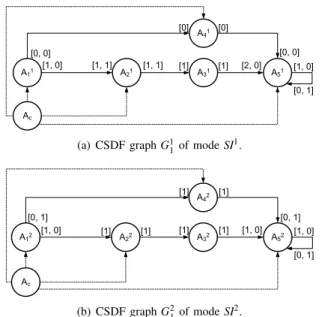
Fig. 2. Two modes of the MADF graph in Fig. 1.
IV. Mode-AwareDataFlow(MADF)
In this section, we introduce our new MoC called Mode-Aware Data Flow (MADF). MADF can capture multiple modes associated with an adaptive streaming application, where each individual mode is a CSDF graph [3]. Details and formal definitions of the MADF model and its operational semantics are given later in this section. Here, we explain the MADF intuitively by an example. Throughout this paper, we use graph
G1 shown in Fig. 1 as the running example to illustrate the definition of MADF and the hard real-time scheduling analysis related to MADF. This graph consists of 5 computation actors
A1 to A5 that communicate data over edges E1 to E5. Also, there is an extra actorAcwhich controls the switching between
modes through control edges E11, E22, E44, and E55 at run-time. Each edge contains a production and a consumption pattern, and some of these production and consumption patterns are parameterized. Having different values of parameters and worst-case execution times (WCET) of the actors determine different modes. For example, to specify the consumption pattern with variable length on edge E1 in graph G1, the parameterized notation [p2[1]] is used on edge E1 that is interpreted as a sequence of p2 elements with integer value 1, e.g., [2[1]]=[1,1]. Similarly, the notation [1[p4]] on edgeE4 is interpreted as a sequence of 1 element with integer value
p4, e.g., [1[2]]=[2]. Assume in this particular example that parameter vector (p1,p2,p4,p5,p6) can take only two values (0, 2, 0, 2, 0) and (1, 1, 1, 1, 1). Then, Ac can switch the
application between two corresponding modesSI1 and SI2 by setting the parameter vector to value (0, 2, 0, 2, 0) and (1, 1, 1, 1, 1), respectively, at run-time. Fig. 2(a) and (b) show the corresponding CSDF graphs of modeSI1 andSI2.
A. Formal Definition of MADF
Definition 1 (Mode-Aware Data Flow (MADF)).
TABLE I
Mapping relationM2for actorA2
inFig. 1.
~
p2=[p2] φ C¯2
2 2 [c1,c2]
1 1 [c3]
TABLE II
FunctionMC5defined for actor
A5inFig. 1.
S N2
SI1 [2,0]
SI2 [1,1]
• A={A1, . . . ,A|A|}is a set of dataflow actors;
• Ac is the control actor to determine modes and their
transitions;
• E is the set of edges for data/parameter transfer;
• Π ={~p1, . . . , ~p|A|}is the set of parameter vectors, where
each ~pi∈Πis associated with a dataflow actor Ai.
For G1, A = {A1,A2,A3,A4,A5} is the set
of dataflow actors. Ac is the control actor.
E = {E1,E2,E3,E4,E5,E6,E11,E22,E44,E55} is the set of edges. For actor A5, ~p5=[p5,p6] is the parameter vector. The input port IP1 of actor A5 has a consumption sequence [1[p5],1[0]], which can be interpreted as [p5,0].
Definition 2(Dataflow Actor).A dataflow actor Aiis described
by a tuple (Ii, ICi, Oi,Ci,Mi), where
• Ii={IP1, . . . ,IP|Ii|}is the set of data input ports of actor
Ai;
• ICi is the control input port that reads parameter vector ~
pi for actor Ai;
• Oi={OP1, . . . ,OP|Oi|}is the set of data output ports of
actor Ai;
• Ci={c1, . . . ,c|C|}is the set of computations. When actor
Ai fires, it performs a computation ck∈ Ci;
• Mi : ~pi→ {φ,C¯i} is a mapping relation, where ~pi∈Π,
φ ∈ N+, and C¯i ⊆ Ci is a sequence of computations
[ ¯Ci(1), . . . ,C¯i(k), . . . ,C¯i(φ)]withC¯i(k)∈ Ci,1≤k≤φ.
Actor A2 in Fig. 1 has a set of one input portI2={IP1}, a set of one output port O2={OP1} as well as a control input port IC2. A set of computationsC2={c1,c2,c3}is associated withA2. The mapping relationM2is given in Table I. It can be interpreted as follows: If p2 =2, actorA2repetitively performs computations according to sequence ¯C2=[c1,c2] every time when firingA2. When p2 =1, firing A2 performs computation
c3.
Definition 3(Control Actor). The control actor Acis described
by a tuple (IC,Oc,S,Mc), where
• S ={SI1, . . . ,SI|S|} is a set of mode identifiers, each of
which specifies a unique mode;
• IC is the control input port which is connected to the
external environment. Mode identifiers are read through the control input port from the environment;
• Oc ={OC1, . . . ,OC|A|} is a set of control output ports.
Parameter vector~piis sent through OCi∈ Oc to actor Ai;
• Mc={MC1, . . . ,MC|A|}is a set of functions defined for
each actor Ai∈ A. For each MCi∈ Mc, MCi : S →N|~pi|
is a function that takes a mode identifier and outputs a vector of non-negative integer values.
ForG1in Fig. 1, we have two mode identifiersS={SI1,SI2}. At run-time, control actor Ac reads these mode identifiers
through control port IC (black dot in Fig. 1). For actor A5,
MC5∈ Mc is given in Table II. As explained previously, the
parameter vector for actorA5 is ~p5=[p5,p6]. Therefore,MC5 takes a mode identifier and outputs a 2-dimensional vector as shown in the second column in Table II. For instance, mode
SI1 results in a non-negative integer vector [2,0].
To further define production/consumption sequences with variable length, we use the notationn[m] for a sequence ofn
elements with integer valuem, i.e.,
n[m]=[
ntimes
z }| {
m, . . . ,m].
Definition 4 (Input Port). An input port IP of an actor is
described by a tuple (CNS, MIP), where
• CNS = [φ1[cns1], . . . , φK[cnsK]] is the consumption
se-quence with φ phases, where φ = PK
i=1φi is deter-mined by the mapping relation M in Definition 2, and
cns1, . . . ,cnsK ∈N;
• MIP : ~pi→ψIP is a mapping relation, where~pi∈Πand
ψIP={φ1, . . . , φK,cns1, . . . ,cnsK}. (5)
Definition 5 (Output Port). An output port OP of an actor is
described by a tuple (PRD,MOP), where
• PRD = [φ1[prd1], . . . , φK[prdK]] is the production
se-quence with φ phases, where φ = PK
i=1φi is deter-mined by the mapping relation M in Definition 2, and
prd1, . . . ,prdK∈N.
• MOP : ~pi→ψOP is mapping relation, where ~pi∈Πand
ψOP={φ1, . . . , φK,prd1, . . . ,prdK}. (6)
The consumption/production sequence defined here is a generalization of that for the CSDF MoC (see Section III-B). We can see that a CSDF actor has a constantφ phases in its consumption/production sequences, whereas the length of the phase of an MADF actor is parameterized byφ=PK
i=1φi. In
addition, the mapping relation MIP/MOP must be provided by
the application designer. Consider the two input portsIP1 and
IP2of actorA5in Fig. 1. The mapping relationsMIP1 andMIP2
are represented as follows:
MIP1 : ~p5 =[p5,p6]→ψIP1 ={φ1, φ2,cns1,cns2}={1,1,p5,0},
(7)
MIP2 : ~p5 =[p5,p6]→ψIP2 ={φ1, φ2,cns1,cns2}={1,1,0,p6}.
(8) It can be seen that parameter p5 is mapped to cns1 of IP1, parameter p6 is mapped tocns2 ofIP2, andφ1 and φ2 both are constant equal to 1. Therefore, the consumption sequence ofIP1 is CNS =[1[p5],1[0]] =[p5,0] and the consumption sequence of IP2 is CNS = [1[0],1[p6]] = [0,p6]. Similarly considering output portOP1 of actor A4, its mapping relation
MOP1 is given as:
MOP1 : ~p4=[p4]→ψOP1={φ1,prd1}={1,p4}. (9)
In this case, parameter p4 is mapped to prd1 and φ1 = 1. Therefore, production sequence PRD = [1[p4]] = [p4] is obtained forOP1 of A4.
Definition 6 (Edge). An edge E ∈ E is defined by a tuple
(Ai,OP),(Aj,IP)
Actors
5 10 15 SI1
L1 H1
S21
S31
S51 Time
A11
A21
A31
A41
A51
20 H1
H1
H1
(a) ModeSI1in Fig. 2(a).
Actors
5 10 15
SI2
L2
S22
S32
S42
S52 Time
A22
A12
A32
A42
A52
20
H2
H2
H2
H2
H2
(b) ModeSI2in Fig. 2(b).
Fig. 3. Execution of two iterations of both modesSI1andSI2under self-timed
scheduling.
• actor Ai produces a parameterized number of tokens to
edge E through output port OP;
• actor Ajconsumes a parameterized number of tokens from
E through input port IP.
Considering edge E5 in Fig. 1, it connects output port OP1 of actor A4 to input portIP2 of actor A5.
Definition 7 (Mode of MADF). A mode SIi of MADF is a
consistent and live CSDF graph, denoted as Gi, obtained by
setting values of Πin Definition 1 as follows:
∀~pk∈Π : ~pk=MCk(SIi), (10)
where function MCk is given in Definition 3.
Definition 8(Mode of MADF Actor). An actor Akin mode SIi,
denoted by Ai
k, is a CSDF actor obtained from Ak as follows: ~
pk=MCk(SIi). (11)
Fig. 2(a) shows the CSDF graph of mode SI1 and Fig. 2(b) shows the CSDF graph of mode SI2. Consider function MC5 for actor A5 in Table II with parameter vector ~p5 =[p5,p6]. For instance, mode SI1 results in ~p5 =[p5,p6]=[2,0], where parameter values p5=2 and p6 =0. Consequently, according to mapping relations MIP1 and MIP2 given in Equation (7) and
Equation (8),cns1= p5=2 can be obtained for input portIP1 and cns2=p6=0 forIP2. This determines actorA15 shown in Fig. 2(a) for mode SI1.
Definition 9 (Inactive Actor). An MADF actor Aki is inactive
in mode SIk if the following conditions hold:
1) ∀IP∈ Ii : CNS=[0, . . . ,0];
2) ∀OP∈ Oi : PRD=[0, . . . ,0].
Otherwise, Ak
i is called active in mode SI k.
For actor A1
4 shown in Fig. 2(a), it has consumption and production sequence [0]. Therefore, actor A4 is said to be inactive in mode SI1.
B. Operational Semantics
During execution of a MADF graph, it can be either in a steady-state or mode transition.
Definition 10 (Steady-state). A MADF graph is in a
steady-state of a mode SIi, if it satisfies Equation(10)with the same SIifor all its actors.
TABLE III
Actor parameter forG1inFig. 1.
Mode SI1 SI2
Actor A1
1 A12 A13 A15 A 2
1 A22 A23 A24 A25
WCET (µi) 1 4 1 1 1 8 1 3 1
period (Ti) 2 4 4 4 4 8 8 8 4
starting time (Si) 0 2 6 14 0 4 12 8 20
utilization (ui) 12 1 14 41 14 1 18 38 14
Definition 11(Mode Transition). A MADF graph is in a mode
transition from mode SIo to SIl, where o,l, if some actors
have SIo for Equation(11) and the remaining active actors
have SIl for Equation(11).
In the steady-state of a MADF graph, all active actors execute in the same mode. As defined previously in Definition 7 and shown in Fig. 2(a) and Fig. 2(b), the steady-state of the MADF graph has the same operational semantics as a CSDF graph. We use hAk
i,xi to denote the x-th firing of actor Ai in mode SIk. AthAk
i,xi, it executes computation ¯Ci ((x−1) modφ)+
1, where ¯C
i is given in Definition 2. The number of tokens
consumed and produced are specified according to Definitions 4 and 5, respectively. For instance, thex-th firing ofAk
i produces PRD((x−1) modφ)+1tokens through an output portOP. In
each modeSIk, the MADF graph is a consistent and live CSDF graph and thus has the notion of graph iterations with a non-trivial repetition vector~qk∈N|A| resulting from Equation (1).
Next, we further define mode iterations.
Definition 12(Mode Iteration). One iteration Itk of a MADF
graph in mode SIk consists of one firing of control actor A
c and qk
i ∈~q
k firings of each MADF actor Ak
i.
Consider the two modes shown in Fig. 2(a) and Fig. 2(b). Repetition vectors~q1 and~q2 are:
~
q1=[4,2,2,0,2], ~q2=[2,1,1,1,2]. (12) For any mode of a MADF graph, i.e., a live CSDF graph, underanyvalid schedule, it has (eventually) periodic execution in time. This holds for CSDF graphs under self-timed schedule [17], K-periodic schedule [18], and SPS [14]. The length of the periodic execution, callediteration period, determines the minimum time interval to complete one graph iteration (cf. Definition 12). The iteration period, denoted by
Hk, is equal for any actor in the same mode SIk. During a periodic execution, the starting time of each actor Aki, denoted bySki, indicates the time distance between the start of source actorAk
srcand the start of actorAki in the same iteration period.
Based on the notion of starting times, we define iteration
latency Lk of a MADF graph in modeSIk as follows:
Lk=Sksnk−Ssrck , (13)
whereSk
snk andS
k
Actors
A1
A2
A3
A5
5 10 15
A4
20 25 30 35 40 Time
L1 Δ1→2=L2
Δ2→1
Quiescent points for A1 t MCR2 tMCR1
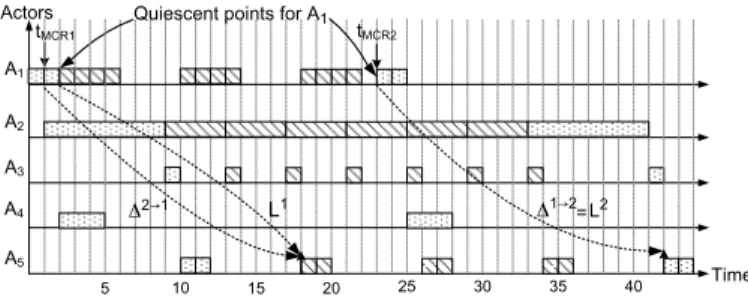
Fig. 4. An execution ofG1 in Fig. 1 with two mode transitions under the
ST transition protocol.MCR1at timetMCR1 denotes a transition request from
modeSI2 toSI1, andMCR2at timetMCR2denotes a transition request from
modeSI1 toSI2.
we obtain iteration latenciesL1 =S1 5−S
1
1=10−0=10 and
L2=S2 5−S
2
1=10−0=10 as shown in Fig. 3.
C. Mode Transition
While the operational semantics of a MADF graph in steady-state are the same as that of a CSDF graph, the transition of MADF graph from one mode to another is the crucial part that makes it fundamentally different from CSDF. The protocol for mode transitions has strong impact on the compile-time analyzability and implementation efficiency. In this section, we propose a novel and efficient protocol of mode transitions for MADF graphs.
During execution of a MADF graph, mode transitions may be triggered at run-time by receiving a Mode Change Request (MCR) from the external environment. We first assume that a MCR can be only accepted in the steady-state of a MADF graph, not in an ongoing mode transition. This means that any MCR occurred during an ongoing mode transition will be ignored. Consider a mode transition from SIo toSIl. The transition is accomplished by the control actor reading mode identifier SIl from its control input port (see the black dot in Fig. 1) and writing parameter values of ~pi to the control
output port connected to each dataflow actor Al
i according
to function MCi given in Definition 3. Then, Ali reads new
parameter values ~pi from its control input port and sets the
sequence of computations according to mapping relation Mi
in Definition 2. The production and consumption sequences are obtained in accordance with MIP and MOP in Definition 4
and Definition 5, respectively. We further define/require that mode transitions are only allowed at quiescent points [19].
Definition 13 (Quiescent Point of MADF). For mode SIl, a
quiescent point of MADF actor Ai is firing hAli,xi in mode iteration Itl that satisfies
¬∃hAli,yi ∈Itl : y<x. (14)
Definition 13 simply refers to the first firing of actor Ai
in each iteration Itl of mode SIl. Recall that each iteration of mode SIl consists of ql
i firings of actor Ai. Therefore, our
requirement that a mode transition is only allowed at a quiescent point implies that a transition from mode SIl to SIo of actor
Ai happens when all firings of actor Ai are completed in the
iteration of SIl when MCR occurs. Fig. 4 shows an execution ofG1 in Fig. 1 with two mode transitions. For instance, the
MCR at timetMCR1 =1 denotes a transition request from mode
SI2 toSI1. The mode transition of actorA1 happens when all firings of actorA1 are completed, that is at time 2 in Fig. 4 in this particular example.
Definition 13 defines mode transitions of MADF graphs as partially ordered actor firings. However, it does not specify at which time instance a mode transition actually starts. Therefore, below, we focus on the transition protocol that defines the points in time for occurrences of mode transitions. To quantify the transition protocol, we introduce a metric, called transition
delay, to measure the responsiveness of a protocol to a MCR.
Definition 14 (Transition Delay). For a MCR at time tMCR
calling for a mode transition from mode SIoto SIl, the transition
delay ∆o→l of a MADF graph is defined as
∆o→l=σo→l
snk −tMCR, (15)
whereσosnk→l is the earliest starting time of the sink actor in the new mode SIl.
In Fig. 4, we can compute the transition delay for MCR1
occurred at timetMCR1 =1 as ∆2→1=18−1=17.
1) Self-timed Transition Protocol: In the existing adaptive
MoCs like FSM-SADF [5], a protocol, referred here as
Self-Timed (ST) transition protocol, is adopted. The ST protocol
specifies that actors are scheduled in the self-timed manner not only in the steady-state, but also during a mode transition. For FSM-SADF upon a MCR, a firing of a FSM-SADF actor in the new mode can start immediately after the firing of the actor completes the old mode iteration. The only possible delay is introduced due to availability of input data. One reason behind the ST protocol is that the ST schedule for a (C)SDF graph (steady-state of FSM-SADF1) leads to its highest achievable throughput. However, the ST protocol generally introduces interference of one mode execution with another one. The time needed to complete mode transitions also fluctuates as the transition delay of an ongoing transition depends on the transitions that occurred in the past. We consider this as an undesired effect because mode transitions using the ST protocol become potentially slow and unpredictable. Another consequence of the incurred interference between modes using the ST transition protocol is the high time complexity of analyzing transition delays, because transition delays cannot be analyzed independently for each mode transition. The analysis proposed in [5] uses an approach based on state-space exploration, which has the exponential time complexity.
Consider G1 in Fig. 1 and an execution of G1 with the two mode transitions illustrated in Fig. 4. The execution is assumed under the ST schedule for both steady-state and mode transitions of G1. After MCR1 at time tMCR1, the transition from modeSI2 toSI1 introduces interference to execution of the new modeSI1 from execution of the old mode SI2. The interference increases the iteration latency of the new mode
SI1 toL1=S15−S11=18−2=16 from initially 10 as shown in Fig. 3(a) whenG1 is only executed in the steady-state of
1The steady-state of SADF is defined similarly to that of MADF. The only
Actors
A12
5 10 15
S22
S52
S32
S31
S51
Time H2
H2
H1
S21
H1
H1
H2
H1
H2
A11
A22
A21
A32
A31
A52
A51
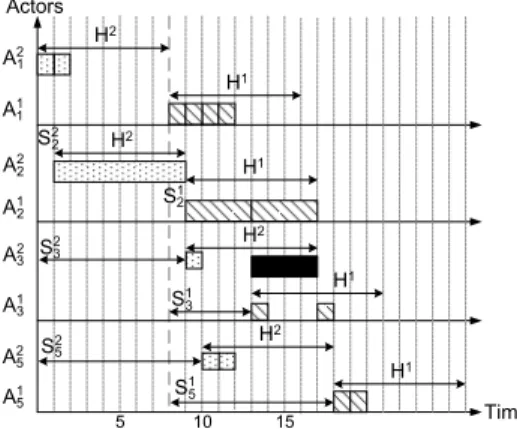
Fig. 5. An illustration of the Maximum-Overlap Offset (MOO) calculation.
modeSI1. Even worse, the interference is further propagated to the second mode transition after MCR2at timetMCR2. In this case, the iteration latency L2 =S52−S21 =42−23=19 is increased from initially 10 as shown in Fig. 3(b) when
G1 is only executed in the steady-state of mode SI2. This example thus clearly shows the problem of the ST protocol. That is, it introduces interference between the old and new modes due to mode transitions, thereby increasing the iteration latency of the new mode in the steady-state after the transition. Furthermore, the increase of iteration latency also potentially increases transition delays as it will be shown in the next section.
2) Maximum-Overlap Offset Transition Protocol: To address
the problem of the ST transition protocol explained above, we propose a new transition protocol, called Maximum-Overlap Offset(MOO).
Definition 15 (Maximum-Overlap Offset (MOO)). For a
MADF graph and a transition from mode SIo to SIl,
Maximum-Overlap Offset (MOO), denoted by x, is defined as
x=
maxAi∈Ao∩Al(S
o i −S
l
i) if maxAi∈Ao∩Al(S
o i −S
l i)>0
0 otherwise,
(16)
where Ao∩ Al is set of actors active in both modes SIo and SIl.
Basically, we first assume that the new mode SIl starts immediately after the source actor Ao
src of the old mode SI
o
completes its last iteration Ito. All actorsAl
i of the new mode
execute according to the earliest starting timesSl
iand iteration
period Hl in the steady-state. Under this assumption, if the execution of the new mode overlaps with the execution of the old mode in terms of iteration periodsHoandHl, we then need to offset the starting time of the new mode by the maximum overlap among all actors. In this way, the execution of the new mode will have the same iteration latency as that of the new mode in the steady-state, i.e., no interference between the execution of both old and new modes.
Consider MCR1at timetMCR1 shown in Fig. 4. Obtaining MOO xis illustrated in Fig. 5. We first assume that the new modeSI1starts at the time when the source actorA21 completes the last iteration at time 8 (see bold, dashed line in Fig. 5). Actors A1i in the new mode start as if they executed in the
Actors
A1
A2
A3
A5
5 10 15
A4
20 25 30
x=4
35 Time
L1 L2
Start of mode SI1
H2 H1
Start of mode SI2
Δ2→1 Δ1→2
tMCR1 tMCR2
Fig. 6. The execution ofG1 with two mode transitions under
Maximum-Overlap Offset (MOO) protocol.
steady-state of modeSI1. Then, we can see that, for actorA3, the execution ofA1
3in the new modeSI
1according toS1
3in Fig. 3(a) overlaps 4 time units (solid bar in Fig. 5) with the execution ofA2
3in the old modeSI
2in terms of iteration periods H2and
H1. This is also the maximum overlap between the execution of actors in modesSI2 and SI1. According to Definition 15, x
can be obtained through the following equations:
S21−S11 =0−0=0, S22−S12=1−1=0,
S23−S13 =9−5=4, S25−S15=10−10=0. Therefore, it results in an offset x = max(0,0,4,0) = 4 to the start of mode SI1 and is shown in Fig. 6. The starting time of the new modeSI1, namely the source actorA1
1, must be first delayed to the time when A1
2 completes the iteration period H2 in the last iteration, namely time 8 shown as the first bold dashed line in Fig. 6. In addition, the MOO x=4 must be further added to the starting time of A1
1 (the second bold dashed line in Fig. 6). Fig. 6 also shows another transition from modeSI1toSI2with a MCR occurred at timetMCR2=23. The starting time of the source actorA21 in the new modeSI2
must be first delayed to the time 28 (the third bold dashed line in Fig. 6), namely the time when A11 completes the last iteration in the old modeSI1. To calculate the MOO xfor this transition, the following equations hold:
S11−S21=0−0=0, S12−S22=1−1=0,
S13−S23=5−9=−4, S15−S25=10−10=0. Thus, the equations above result in x=max(0,0,−4,0)=0. For this transition, the new modeSI2starts at time 28 as shown in Fig. 6.
The MOO protocol offers several advantages over the ST protocol. Essentially, the MOO protocol retains the iteration latency of the MADF graph in the new mode the same as the initial value, thereby avoiding the interference between the old and new modes. For instance, afterMCR1andMCR2in Fig. 6, modeSI1 andSI2 still have the initial iteration latency
Concerning the transition delay, it may be the case that the MOO protocol results in initially longer transition delay than the ST protocol does due to the offset given in Definition 15. ForMCR1occurred at time tMCR1, the transition delay of the MOO protocol is ∆2→1 = 22−1 = 21 as shown in Fig. 6, whereas the transition delay of the ST protocol is equal to
∆2→1 =18−1=17 as shown in Fig. 4. On the other hand, let us consider the same transition requestMCR2 occurred at time tMCR2 =23 shown in Fig. 4 and Fig. 6. ForMCR2, the ST protocol results in transition delay ∆1→2=42−23=19 as shown in Fig. 4. In contrast, the transition delay for the MOO protocol is∆1→2=38−23=16 as shown in Fig. 6. The MOO protocol could provide shorter transition delay than the ST protocol, thereby faster responsiveness to a mode transition.
V. HardReal-TimeAnalysis andScheduling ofMADF
Based on the proposed MOO protocol for mode transitions, in this section, we propose a hard real-time analysis and scheduling framework for MADF. More specifically, we propose an analysis technique for mode transitions in MADF to reason about transition delays, such that timing constraints can be guaranteed. The hard real-time scheduling framework for MADF graphs is an extension of the SPS [14] framework initially developed for CSDF graphs.
As explained in Section III-C, the key concept of the SPS framework is to derive a periodic taskset representation for a CSDF graph. Since the steady-state of a mode can be considered as a CSDF graph according to Definitions 7 and 10, it is thus straightforward to represent the steady-state of a MADF graph as a periodic taskset and schedule the resulting taskset using any well-known hard real-time scheduling algorithm. Using the SPS framework, we can derive the two main parameters for each MADF actor in mode SIk, namely the period (Tk
i in
Equation (2)) and the earliest starting time (Sk
i in Equation (3)).
Under SPS, the iteration period in mode SIk is obtained as
Hk =qk iT
k i, ∃A
k
i ∈ A. Below, we focus on determining the
earliest starting time of each actor in the new mode upon a transition. From the earliest starting time, we can reason about the transition delay to quantify the responsiveness of a transition.
Upon a MCR, a MADF graph can safely switch to the new mode if all of its actors have completed their last iteration in the old mode upon synchronous protocol. In this case, the firings of MADF actors in the new mode do not overlap with the firings of actors in the old mode. This is called synchronous protocol [12] in real-time systems with mode change. One of its advantages is the simplicity, i.e., the synchronous protocol does not require any schedulability test at both compile-time and run-time. However, other protocols lead to earlier starting times than the synchronous protocol. Therefore, the synchronous protocol sets an upper bound on the earliest starting time for each MADF actor in the new mode.
Lemma 1. For a MADF graph G under SPS and a MCR from
mode SIo to SIlat time tMCR, the earliest starting time of actor Ali,σˆoi→l, is upper bounded by
ˆ
σo→l
i =F
o src+S
o snk+S
l
i, (17)
Actors
A1
A2
A3
A5
A4
SI2 SI1
H2
8 13 18 23 28 33 38 42 47 52 Time
Δ2→1
⌃ S
21
S31
S51
S52
tMCR
Fig. 7. Upper bounds of earliest starting times for transition from modeSI2
toSI1.
where Fo
src indicates the time when the source actor Aosrc
completes its last iteration Ito of the old mode SIo and is
given by
Fsrco =tSo+
tMCR−to S Ho
Ho. (18)
to
S is the starting time of mode SI
o and Ho is the iteration period of mode SIo.
Proof. As explained previously for a transition from modeSIo
toSIl, the upper bound of the earliest starting time for each actor Ali is computed in such a way that no firings of actors
Aoi and Ali occur simultaneously. This means, the start of an actor Ali must be later than all actors Aoi have completed the last iteration Ito of the old mode SIo. Given that mode SIo
starts at time to
S, the completion time of all actorsA o i in the
last iterationIto can be thus computed as
Fosnk=toS +
tMCR−to S Ho
Ho+Sosnk+Ho. (19)
where Fo
snk is the time when the old modeSI
o completes the
last iterationIto. It is assumed that the sink actorAosnk is the last actor to complete the iteration, i.e.,∀Aoi ∈ A,Soi ≤Sosnk. Given Equation (18), Equation (19) can be rewritten as
Fosnk=toS +
tMCR−to S Ho
Ho+Sosnk=Fosrc+Sosnk.
Now, starting the source actorAl
src at any time later than Fsnko is valid without introducing simultaneous execution of actors
Ao
i andA
l
i. Therefore, the earliest starting time of source actor Al
src is ˆσosrc→l = Fsnko . For any actor A
l
i ∈ A \A l
src, its earliest starting times must satisfy Equation (3) imposed by the SPS framework. That is, the earliest starting time ˆσo→l
i of actor A l i
can be obtained by addingSl i to ˆσ
o→l
src .
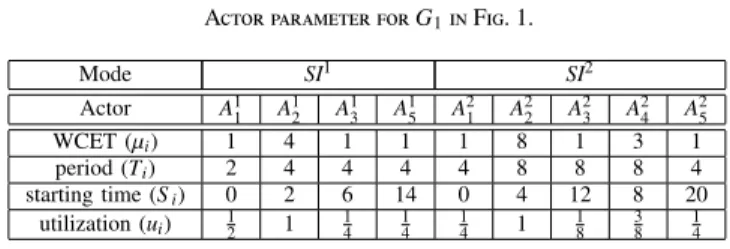
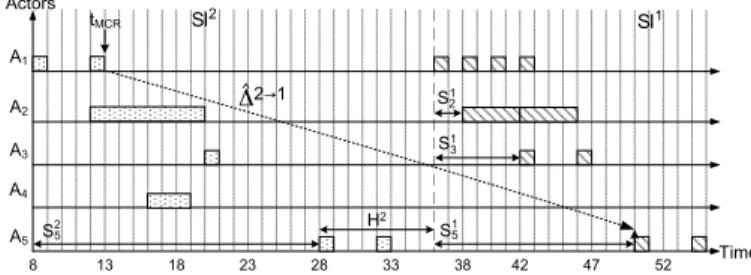
Let us consider the actor parameters given in Table III forG1 in Fig. 1. The third row shows the WCET for each actor in modes SI1 and SI2. Based on WCETs, the period (fourth row in Table III) and the earliest starting time (fifth row in Table III) for each actor in the steady-state of both modes are obtained according to Equation (2) and Equation (3), respectively. Given~q2 in Equation (12), we can also compute iteration period H2 = q2
1T 2
1 = 2×4= 8. Now consider the mode transition from modeSI2toSI1shown in Fig. 7. Assume that the MCR occurs at timetMCR =13 and modeSI2 starts at timet2S =8. The completion time of the last iterationIt2 is equal to the completion time of the sink actor A25 computed as
F2snk=t2S +
tMCR−t2 S H2
H2+S25=8+
13−8
8
Actors
A1
A2
A3
A5 A4
SI1 SI2
8 13 18 23 28 33 38
x
Time
tMCR
S51 S31 S21
Fig. 8. Earliest starting times for transition from modeSI2 toSI1with the MOO protocol.
In Fig. 7, F2
snk corresponds to the earliest starting time of the source actor A11 (bold dashed line). Finally, we can compute the earliest starting time for each actor in the new modeSI1
by adding S1i. Considering for instance the sink actor A15 in the new mode with S15 =14, the upper bound of its earliest starting time can be obtained as
ˆ
σ2→1
5 =F 2 src+S
2 5+S
1 5=F
2 snk+S
1
5=36+14=50. We can thus compute the transition delay (cf. Definition 14) as
ˆ
∆2→1=σˆ2→1
5 −tMCR=50−13=37.
Although the upper bound of the earliest starting times is easy to obtain for MADF actors in the new mode, it does not provide a responsive mode transition. Therefore, here we aim at deriving a lower bound of the earliest starting times with the proposed MOO protocol.
Lemma 2. For a MADF graph under SPS and a MCR from
mode SIo to SIlat time t
MCR, the earliest starting time of actor Al
i using the MOO protocol is lower bounded byσˇ
o→l
i given
as
ˇ
σo→l
i =F
o
src+x+Sli, (20)
where Fo
src is given in Equation (18) and x is given in
Equation(16).
Proof. Under the MOO protocol, the start of actor Ali must be later than the time when Aoi, if any, completes its last iteration in the old modeSIo. We assume that the source actorAlsrcis the first actor to start in the new mode SIl, i.e.,∀Al
i∈ A,S l i≥S
l
src. Thus, the starting time of the source actorAl
src is at least equal to the completion time of the last iteration of Ao
src, denoted by
Fo
src. Given Fosrc in Equation (18), it thus holds ˇσosrc→l ≥Fosrc. Then, the offset x because of the MOO protocol given in Equation (16) must be taken into account. Consequently, the earliest starting time ofAl
srcis lower bounded by ˇσo
→l
src =Fsrco +x. For any actor Al
i ∈ A \A l
src, its earliest starting times must satisfy Equation (3) imposed by the SPS framework. Hence, the earliest starting time ˇσoi→l of actorAli can be obtained by
addingSli to ˇσosrc→l.
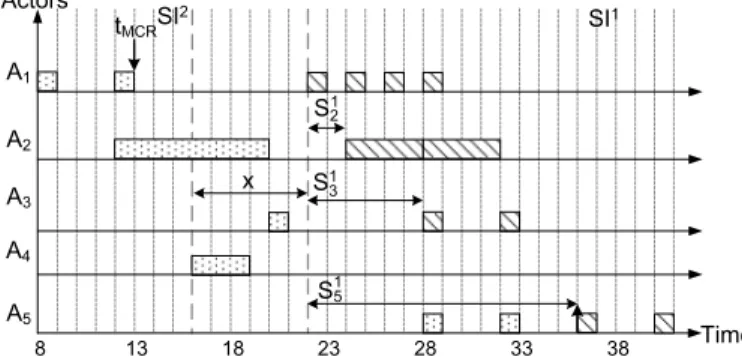
Let us consider again the transition from modeSI2 toSI1. With the MOO protocol, the mode transition is illustrated in Fig. 8. Upon the MCR at time tMCR=13 and t2S =8, source
actorA21 completes its last iteration It2 in the old modeSI2 at the time (cf. Equation (18)) given as
Fsrc2 =F 2 1=t
2
S +
tMCR−t2 S H2
H2=8+
13−8
8
8=16.
This is the earliest possible time at which mode transition
is allowed. For MOO, x can be computed according to
Equation (16). Therefore, the following equations hold:
S21−S11=0−0=0, S22−S12 =4−2=2,
S23−S13=12−6=6, S25−S15=20−14=6. It thus yields x=max(0,2,6,6)=6, i.e., an offset x=6 is added to Fsrc2 . It can be seen in Fig. 8 that the source actorA11 starts at timeFsrc2 +x=16+6=22. Finally, the earliest starting times of actors in modeSI1 can be determined by adding S1
i.
Considering for instanceA1
5 in the new mode, the lower bound of its earliest starting time can be obtained as:
ˇ
σ2→1
5 =F 2
src+x+S15=16+6+14=36.
Now, the transition delay (cf. Definition 14) can be obtained as
ˇ
∆2→1=σˇ2→1
5 −tMCR=36−13=23.
A. Scheduling Analysis under a Fixed Allocation of Actors
During a mode transition of a MADF graph according to the MOO protocol, actors execute simultaneously in the old and new modes. The derived starting time in Lemma 2 for each actor is only the lower bound because the allocation of actors on PEs is not taken into account yet. That means, the derived starting times according to Lemma 2 can be only achieved during mode transitions when each actor is allocated to a separate PE. In a practical system where multiple actors are allocated to the same PE, the PE may be potentially overloaded during mode transitions. To avoid overloading of PEs, the earliest starting times of actors may be further delayed.
Lemma 3. For a MADF graph under SPS, a MCR from mode
SIo to SIl, and a m-partition of all actors Ψ ={Ψ1, . . . ,Ψm}, where m is the number of PEs, the earliest starting time of an actor Ali without overloading the underlying PE is given by
σo→l
i =F
o src+δ
o→l+Sl
i, (21)
where Fsrco is computed by Equation (18)andδo→lis obtained as
δo→l= min
t∈[x,So snk]
{t:Uj(k)≤UB, ∀k∈[t,Sosnk]∧∀Ψj∈Ψ}. (22)
UB denotes the utilization bound of the scheduling algorithm
used to schedule actors on each PE. Ψj contains the set of
actors allocated to PEj. Uj(k) is the total utilization of PEj
at time k demanded by both mode SIo and SIlactors, and is
given by
Uj(k)= X
Ao d∈Ψj
uod−h(k−Sod)·uod
| {z } Uo
j(k)
+ X
Al
d∈Ψj
h(k−Sdl −t)·uld
| {z } Ul
j(k)
,
A1
A2
A3
A5
PE1 PE2
A4
Ac
PE3
Fig. 9. Allocation of all MADF actors in Fig. 1 to 3 PEs.
Ao
d∈Ψj is an actor active in the old mode SI
o and allocated
to PEj. Ald ∈Ψj is an actor active in the new mode SIl and allocated to PEj. h(t) is the Heaviside step function.
Proof. Lemma 2 shows the lower bound of the earliest starting
time for actor Ali in the new modeSIl. However, starting Aliat time ˇσoi→lmay overload PEj, i.e., the resulting total utilization
of PEj, denoted byUj( ˇσoi→l), exceedsUB. Therefore, in this
case, the earliest starting timeσo→l
i must be delayed byδ
o→l
such that Uj(σoi→l) ≤ UB holds. From Equation (21) and
Equation (20), we can see that δo→l is lower bounded by x
which corresponds to the MOO protocol. In addition, δo→l
is upper bounded by So
snk if we consider Equation (21) and Equation (17).
δo→lof interest is the minimum timetin the bounded interval
[x,Sosnk] that satisfies two conditions.
Condition 1: For each PEj, the total utilization cannot exceed UB at time t, i.e., Uj(t)≤UB. The total utilizationUj(t) in
Equation (23) consists of two parts, namely Uo
j(t) and U l j(t). Uo
j(t) denotes the PE capacity occupied by the actors in mode SIothat are not completed yet. Additional PE capacityUlj(t) is demanded by the already released actors in the new mode SIl.
Condition 2: We need to check all time instantsk>tin the interval [t,So
snk], such thatUj(k)≤UB, to guarantee that each
PEj is not overloaded during the mode transition.
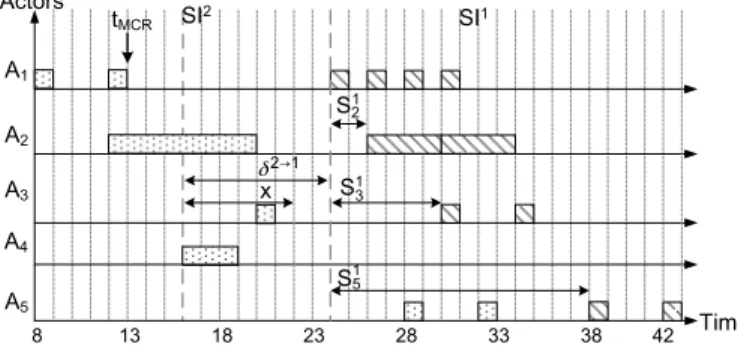
Fig. 9 shows all actors ofG1in Fig. 1 allocated to 3 PEs and let us assume that the actors allocated to each PE are scheduled using the EDF scheduling algorithm [16]. The utilization bound of EDF is given in [16] asUB=1. Given this allocation and the transition from mode SI2 to SI1 shown in Fig. 8, the lower bound of the earliest starting time ˇσ2→1
1 = 22 for actor A
1 1 cannot be achieved. At time 22, only actor A2
1 has completed the last iterationIt2 on PE1. Starting the new modeSI1 at time 22 corresponds toδ2→1=x=6. The total utilization of PE1 demanded by the actors in the old mode SI2 at time 22, i.e.,
U2
1(6), can be computed as follows:
U12(6)= X
A2
d∈Ψ1
u2d−h(6−S2d)·u2d, d∈ {1,3,4,5}
=u21−h(6)·u21+u23−h(−6)·u23+u24−h(−2)·u24+u25−h(−14)·u25 =0+u23+u24+u25=1
8+ 3 8+
1 4=
3 4.
Enabling A1
1 in the new mode SI
1 at time 22 would yield
U1(6)=U12(6)+u 1 1=
3 4+
1
2 >UB=1,
Actors
A1
A2
A3
A5 A4
8 13 18 23 28 33 38 42
x δ
SI1 SI2
Time tMCR
2→1
S21
S31
S51
Fig. 10. Earliest starting times for transitionSI2toSI1on 3 PEs shown in Fig. 9.
thereby leading to being unschedulable on PE1. In this case, the earliest starting times of all actors in mode SI1 must be delayed by δ2→1=8 to time 24 as shown in Fig. 10. At time 24, the total utilization demanded by modeSI2 actors is
U21(8)= X
A2
d∈Ψ1
u2d−h(8−S2d)·u2d, d∈ {1,3,4,5}
=u21−h(8)·u21+u23−h(−4)·u23+u24−h(0)·u24+u25−h(−12)·u25 =0+u23+0+u25=1
8+ 1 4=
3 8.
Now, enabling A1
1 in the new mode at time 24 results in the total utilization of PE1 as
U1(8)=U21(8)+u11= 3
8+ 1 2 <1.
Next, assuming that the new mode SI1 starts at time 24, we need to check that the remaining actors in the new mode
SI1, namely A13 andA51, can start with S31 andS15 respectively without overloading PE1. For instance, enablingA13 at time 24 results in starting timeσ23→1=24+S13=24+6=30. At time 30, the total utilization of PE1 can be obtained according to Equation (23) as follows:
U12(8+6)= X
A2
d∈Ψ1
u2d−h(14−S2d)·u2d, d∈ {1,3,4,5}
=u21−h(14)·u21+u23−h(2)·u23+u24−h(6)·u24+u25−h(−6)·u25 =0+0+0+u25=1
4,
U11(8+6)= X
A1d∈Ψ1
h(14−S1d−8)·ud1, d∈ {1,3,5}
=h(6)u11+h(0)u31+h(−8)u15=1
2+ 1 4=
3 4,
U1(8+6)=U21(8+6)+U
1
1(8+6)=1=UB.
Hence, actors A25, A11, andA13 are schedulable on PE1 using EDF. Similarly, starting A15 at timeσ52→1=24+S15=38 still keeps the resulting set of actors schedulable on PE1.
Using Lemma 3, we can quantify the maximum and minimum transition delays for any transition from modeSIo
toSIl.
Theorem 2. For a MADF graph under SPS, a fixed allocation
of all MADF actorsΨ ={Ψ1, . . . ,Ψm} to m PEs, and a MCR from mode SIoto SIl, the minimum transition delay is given by
∆o→l
min =δ
o→l+Sl
snk (24)
and the maximum transition delay is given by
∆o→l
max =δ
o→l+Sl snk+H
Read
Wave DFT AddCosWin Rec2Polar Unwrap
Spec2Env male2female
Polar2Rec InvDFT
Write Wave
Ac
IC
[1[128dl]]
[1[256]][1[256]] [128[dl]] [128[dl]] [128[dl]]
[1[256]] [1[256]] [1[128dl]] [128[dl]] [128[dl]] [128[dl]]
[128[dl]] [128[dl]]
[128[dl]] [128[dl]]
[128[dl]]
[128[dl]] [128[dl]]
[128[dl]]
[128[dl]] [128[dl]] [128[dl]]
[128[dl]]
Fig. 11. MADF graph of Vocoder.
PE1 PE2
Read Wave
DFT
AddCosWin Rec2Polar Unwrap
Spec2Env male2female
Polar2Rec InvDFT Write Wave
PE3
PE4
Ac
Fig. 12. Allocation of dataflow actors of Vocoder to 4 PEs. The control edges are omitted to avoid cluttering.
where δo→l is computed by Lemma 3, Slsnk is the starting time of the sink actor in the new mode SIl, and Ho is the iteration period of the old mode SIo.
Proof. For a MCR from modeSIo toSIl, the transition delay
∆o→l of a MADF graph is given in Definition 14 as ∆o→l= σo→l
snk −tMCR, where the earliest starting time of the sink actor is calculated as σosnk→l=Fosrc+δo→l+Slsnkaccording to Lemma 3. Therefore, ∆o→l can be rewritten as ∆o→l = Fo
src+δo→l+
Sl
snk−tMCR. Essentially,∆o→l is composed of three parts. In the first part, the MOO transition protocol together with a fixed allocation of the MADF actors determine δo→l. The second
partSl
snkresults from the SPS framework. These two parts thus can be determined at compile-time. The third part Fo
src−tMCR depends on when the MCR occurs, namely attMCR, which can only be determined at run-time. In the following, we distinguish two cases fortMCR:
Case 1: Assume that the MCR occurs at the end of an iteration of the source actor in the old modeSIo, i.e.,tMCR=
Fsrco . Then, the source actor shall be only delayed by δo→l to start in the new modeSIl according to Lemma 3, thereby guaranteeing the fastest possible start of the new modeSIl. As a consequence, it results in the minimum possible transition delay. Therefore, substituting tMCR=Fosrc, we obtain
∆o→l
min =F
o
src+δ
o→l+Sl
snk−F
o
src=δ
o→l+Sl
snk. Case 2: Assume that the MCR occurs at the beginning of an iteration of the source actor in the old modeSIo, i.e.,t
MCR=
Fo
src−Ho. Then, the source actor cannot start in the new mode before it completes the whole iteration in the old mode SIo
followed by the delay δo→l according to Lemma 3. Therefore,
the maximum transition delay is computed as follows:
∆o→l
max =F
o
src+δ
o→l+
Slsnk−(Fsrco −H
o)=δo→l+
Slsnk+Ho.
It can be seen from Theorem 2 that the maximum and minimum transition delays solely depend on the allocation of MADF actors and the old and new modes in question, irrespective of the previously occurred transitions. The old and new modes determineHo andSl
snk, respectively, while the allocation of MADF actors determines the value ofδo→l. Here,
the offset xdue to our MOO protocol is captured in δo→l and
can be considered as performance overhead if x,0. The other
parts, namely Ho and Sl
snk, in the maximum and minimum transition delays cannot be avoided as they will be present in any transition protocol.
VI. CaseStudies
To evaluate our proposed MADF MoC and MOO protocol, in this section, we present two case studies. In the first case study, we model a real-life adaptive streaming application, called Vocoder, with our MADF MoC proposed in Section IV and apply the hard real-time analysis proposed in Section V. With this case study, we show that the MADF MoC is capable of capturing different application modes and the transitions between them. Then, in the second case study, we model another real-life adaptive streaming application, called MP3decoder, with MADF and we focus on analyzing the transition delays and demonstrating the effectiveness of our MADF model armed with the proposed MOO transition protocol compared to the well-known FSM-SADF model [5] which also can capture modes/scenarios. In this case study, we adopt self-timed scheduling for both our MADF and FSM-SADF models in the steady-state. The major difference between these models in this case study is their transition protocol which is the MOO protocol in our MADF model and the self-timed protocol in FSM-SADF. Another example of the application of our MOO protocol can be found in [20].
A. Case Study 1
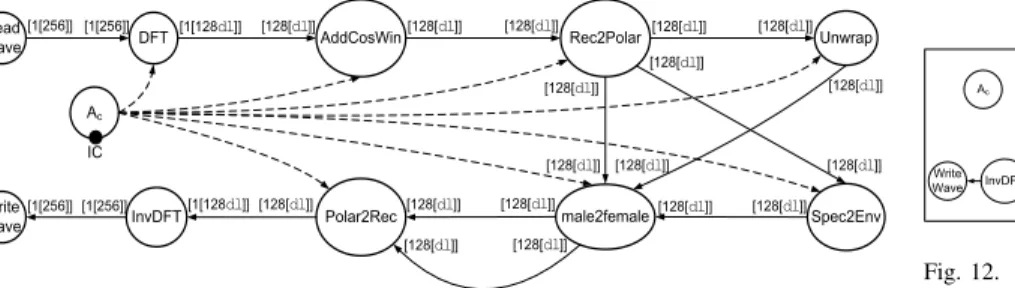
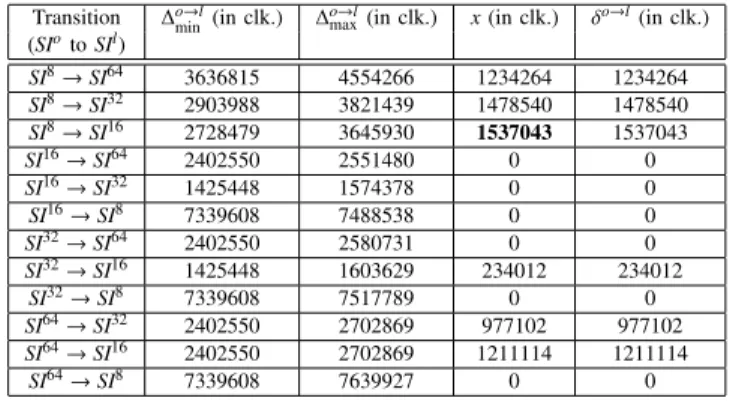
In this section, we consider a real-life adaptive application from the StreamIT benchmark suit [21], called Vocoder, which implements a phase voice encoder and performs pitch transposition of recorded sounds from male to female. We modeled Vocoder using a MADF graph with 4 modes, which capture different workloads. The MADF graph of Vocoder is shown in Fig. 11. Depending on the desired quality of audio encoding and various performance requirements, the resource manager as a middle-ware or OS-like component for the MPSoC may switch between four different modes of Vocoder at run-time. The four modesS={SI8,SI16,SI32,SI64}specify different lengths of the Discrete Fourier Transform (DFT), denoted by dl∈ {8,16,32,64}. ModeSI8 (dl=8) requires the least amount of computation at the cost of the worst voice encoding quality among all DFT lengths. ModeSI64 (dl=64) produces the best quality of voice encoding among all modes, but is computationally intensive. The other two modesSI16and