Dr Todkar S.L. et al JMSCR Volume 07 Issue 12 December 2019 Page 774
A Study of Knowledge, Attitude and Practice of Generic Drugs among
General population of Pune Region
Authors
Dr Todkar S.L.
1, Dr Tiwari S.A
21
Assistant Professor Department of Pharmacology Government Medical College and Hospital Baramati, Pune (Maharashtra) – India
2
Assistant Professor Department of Pharmacology B. J. Govt. Medical College and SGH, Pune (Maharashtra) – India
*Corresponding Author Dr Smita Tiwari
Abstract
Objective: Increasing expenses of health care burden, as regards to drugs especially is a growing concern. The stark variations in the prices of same medicines of different companies, is attributed the brand price quoted by the company. Medical council of India has made it mandatory that; drugs should be prescribed by their generic names only. However, perceptions of general populations about generic medications governs the use of generic medicines. This study provides an insight to the knowledge, attitude and practice of generic medicines use among the general population of Puneregion.
Methods: This cross-sectional, questionnaire-based study was conducted in general population (n = 170) in Pune region. The sample was heterogenous as regards to educational and working status. They were interviewed using validated, structured questionnaire of 20 multiple choice questions, in two vernacular languages, to obtain information about knowledge, attitude and practice of generic drugs.
Results: Correct meaning of generic medicine was known by only25% of the participants yet a large proprtion of them (87%) were aware of its low cost. 65% of the participants opined that improvement in quality control methods may boost the use of these drugs. Newspaper (58%) and internet (43%) were the most common source of information about generic drugs.
Conclusion: Particpants had an idea but lacked detailed knowledge of generics which hindered the use of these drugs as against branded ones. Adequate and appropriate of information about these drugs provided by health care professionals may benefit the society at large.
Keywords:Generic drug, Knowledge, Attitude and Practice.
Introduction
Generic medicines provide cost-effective alternatives to branded medicines, resulting in considerable savings to healthcare budgets. A generic drug is identical, or bioequivalent, to a brand name drug as regards to dosage form, safety, strength, route of administration, quality,
performance characteristics, and intended use.(1) They are identical or within an acceptable bioequivalent range to the brand-name counterpart with respect to pharmacokinetic and pharmacodynamics properties. The journey of a generic drug begins where the patent on innovator drugs expires i.e one xpiration of the originator
Dr Todkar S.L. et al JMSCR Volume 07 Issue 12 December 2019 Page 775 product’s patent term protection, other
manufacturing companies may file submissions to regulatory authorities for approval to market generic versions of the originator medicine. Generic drugs may be marketed either under the non-propriety name or as a branded generic. Branded generic drugs have names derived from a combination of the manufacturer’s name and the non-proprietary name. This enables the manufacturer to market the product in a way similar to the proprietary product(2).The optimistic side of generic drugs is that the drugs are cost-effective as compared to branded ones. The control on costs is a result of marginal requirement to invest in research and development unlike that of innovative molecules. The predominant vicious competition also constrains the manufacturers to offer drugs at low prices(3) The “Generic Drug” undertaking is gaining ground and is one of the methods to minimize pressure on drug budgets, and they are now building up an increasing percentage of dispensed drugs(4), as generic formulations provide similar therapeutic effect as branded medicines at a much more economical price.(5) The end user acceptance of any product governs its market importance hence the acceptability of generic medicines by patients is a crucial factor in implementing generic drug movement.
The down-side of the generic medicine implementation is that numerous doctors and pharmacists hold negative views about generics. (6
7)
As a matter of fact many doctors resist brand substitution with the fear that generic medicines may be inferior to their branded counterparts.(7) A glimpse at the global scenario highlights that, there was strong opposition in a developed country like UK, when plans were proposed to introduce generic substitution into UK primary care.(8)Also there was controversy about substitution of branded by generic for indications like epilepsy drugs(9) and for pain control (especially generic pregabalin).(10)
This negative opinion is not only restricted to prescribers but is also noticed in patients too. A
number of surveys have also shown sizeable proportions of patients have expressed negative views about generics. They believe them to be less effective, of inferior quality and unsuitable for treatment of major illnesses, as compared to their branded equivalents.(11–14) Consideration of such negative views of generic medicines is important as they are likely to be associated with lower adherence, increased rate of adverse effect reporting and poorer health outcomes(15)
The advancement of internet technology has opened up the world of pharmaceutical information to patients worldwide. This has resulted in a patient pool that insists for branded drugs which are widely publicized on media. Therefore, there is a dire need of a study that will assess the understanding about generic drugs .Such a study may help to identify potential barriers which prevent the greater generic medication use.
Materials & Methods
Dr Todkar S.L. et al JMSCR Volume 07 Issue 12 December 2019 Page 776 The study questionnaire consisted of varied
pattern of questions- mix of structured and closed ended Yes/No type of questions. Some multiple response type questions to be answered as either Yes, No, or don’t know, some question was a direct response question. Thus the questionnaire was designed to assess attitudes toward cost, quality, effectiveness; personal and family use. Inclusion Criteria
1) General populations visiting OPD either patients or relatives with them
2) Participants who was willing to participate study or answer the questionnaire
3) General populations (households) in Pune region.
Exclusion Criteria
All participants, not willing to consent, or answer the questionnaire.
Statistical Analysis
The data in study was recorded and analyzed using Microsoft Excel 2013® and results expressed as percentages of whole. Some answers (for
example, strongly agree and agree, strongly disagree and disagree) was combined for ease of analysis
Results
The standard validated questionnaire was answered by 170 general population, amongst which65 were females (38%) and 105 were male participants (62%) (Figure-1)
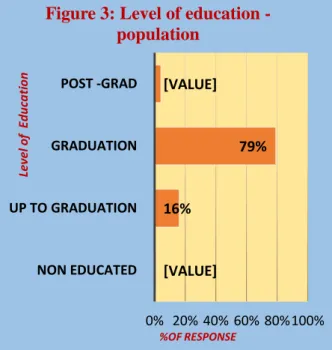
A major chunk of the participant pool (78%) belonged to working group (which included farmers-2% and businessmen-76%), whereas the non-working group i.e housewives and students comprised up to 7% and 15 % respectively of the study population. (Figure-2) Majority of participants (79%) were educated upto a minimum graduation level and only 1% people were non educated and couldn’t answer questionnaire themselves they were just interviewed and answer from them were noted down (Figure-3). On further analysis about their education level most of population (83%) were having education from Non science background (Figure-4)
62% 38%
Figure 1: -Gender wise distribution
MALE
FEMALE
Farmer 2%
Housewife 7%
Students 15%
Jobs/Buisn
ess 76%
Dr Todkar S.L. et al JMSCR Volume 07 Issue 12 December 2019 Page 777
Responses to assess to knowledge
Only a small proportion i.e. 25 % of the participants had the knowledge that generics of a certain medicine could be prepared by other pharmaceutical companies, strictly after the expiry of the patent of that drug. A majority of participants (87%) were aware about low cost of generic medicines but only 42 % of the participants had the knowledge of the real reasons for the branded drugs to be expensive. Similarly 49% of the study population was not aware that there exists a difference in prices of branded generics too (Figure-5-Q.no 18). Around55%of the participants opined that generic drugs were not
as efficacious their branded counterparts or alteast they could not say so. A still few number of participants (25%) believed that the generic drugs were as safe as branded ones. (Figure-5)
Interesting observation was that 79 % participants belonged to post-graduation level (Figure-3) and influence of brand names and also were exposed to internets and advertisements frequently.
A good proportion of participants i.e 62% were quite aware about the “Jan AushadhiYojana”. Around 52% had the knowledge about locations of generic store in their neighbourhood or town. (Figure-5-Q.no 15).
Figure No.-5 Response to knowledge type of questions [VALUE]
16%
79% [VALUE]
0% 20% 40% 60% 80% 100% NON EDUCATED
UP TO GRADUATION GRADUATION POST -GRAD %OF RESPONSE Level o f E d u ca ti o n
Figure 3: Level of education - population
17%
83%
0% 20% 40% 60% 80% 100%
SCIENC BAFGROUND NON SCIENCE
BAGROUND
Figure 4 : Scienence / Non science baground 25% 87% 42% 25% 44% 62% 52% 42% 75% 13% 58% 75% 55% 38%
47% 49%
Q.no- 1 True about generic
drug
Q.no-3 low cost of genric
Q.no-4 Reason for high cost of brand
medicines
Q.no-5 Safety of generics
Qno- 6 About efficacy
Q.no-15 "JAN AUSHADHI
YOJANA"
Q.no-16 Generic drug store
Q.no-18 Price diffrence in different brands of
same drug p e rc e n tage o f r e sp o n se
Dr Todkar S.L. et al JMSCR Volume 07 Issue 12 December 2019 Page 778 Responses to Assesses Attitude
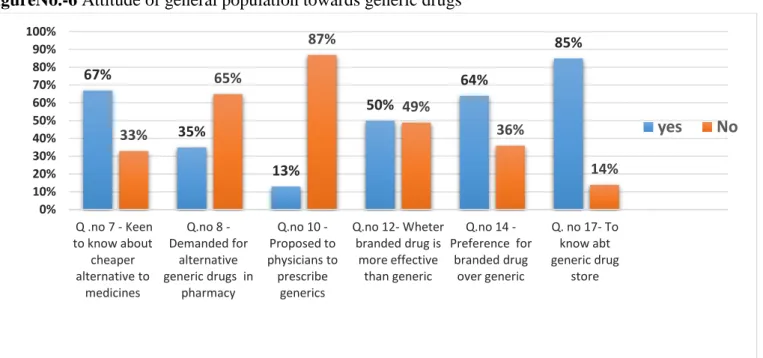
FigureNo.-6 Attitude of general population towards generic drugs
A majority proportion of the participants’ i.e 67% were keen to know if there is any cheaper alternative to drug they were using and similarly 85% of the population was keen to know about generic drug stores in town. Despite of these facts, it was astonishing to note that majority of the participants (65%) never demanded for generic formulation/alternatives, for any of prescribed medicines in the pharmacy and also 87% of the participants never proposed their physician to prescribe generic drugs.
The attitude of the participants was also tested with specific examples like that of paracetamol
and its branded congener. About 51% were agreed that branded formulation of paracetamol is more effective than its generic counterpart and 64% were preferred branded formulation of paracetamol over the generic one.
Responses to Assesses Practice
About only 25% of the participants were definitely using generic drugs but the rest 75% were using branded medicines or were not aware of whether their drug was generic or branded (Figure No.-7).
Figure No.- 7 Percentage of participants using generic drug for themselves
67%
35%
13%
50%
64%
85%
33%
65%
87%
49%
36%
14%
0% 10% 20% 30% 40% 50% 60% 70% 80% 90% 100%
Q .no 7 - Keen to know about
cheaper alternative to
medicines
Q.no 8 - Demanded for
alternative generic drugs in
pharmacy
Q.no 10 - Proposed to physicians to prescribe
generics
Q.no 12- Wheter branded drug is
more effective than generic
Q.no 14 - Preference for
branded drug over generic
Q. no 17- To know abt generic drug
store
yes No
yes , 25%
Dr Todkar S.L. et al JMSCR Volume 07 Issue 12 December 2019 Page 779 As per one of the closed ended question, options
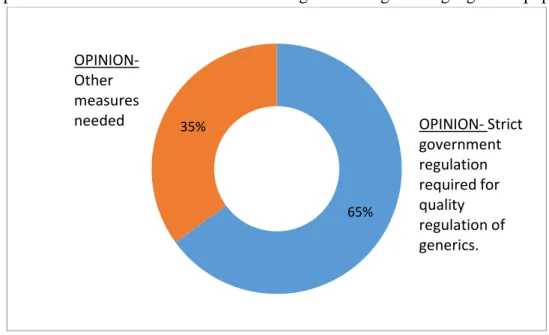
were given for methods to increase the use of generic drugs amongst general population. According to this assessment, 65% of the
participants opined that improving the quality of generic drugs by strict government regulations may assure to increase the use of generic formulations. (Figure No.-8)
Figure No.- 8 Options for methods to increase the use of generic drugs amongst general population
News Paper (44%) and internet (32%) were the two most common source of information accessed
by general population as regards to generic formulations. (Figure 9)
Figure No.- 9 Sources of information about generics for the general population
Discussion
This study was conducted in the view to find analyze the different factors that could influence the generic medicines consumption and especially the attitude of the general population including patients visiting OPD.
The study was carried out among 170 participants that belonged to a mixed population representing varied classes- students, working / non-working
and mixed education levels. It also included patients visiting the government hospitals as they belong to a bigger pool that covers urban, semi-urban and sometimes rural areas too.
The average age of participants was in the range of 31 and 50 years old .Almost 62% of the participants were males but this finding was in contrast to study done by Gimeno Mar et al(16) which reported that females respondents were a
65%
35% OPINION- Strict
government regulation required for quality regulation of generics. OPINION-
Dr Todkar S.L. et al JMSCR Volume 07 Issue 12 December 2019 Page 780 majority. The difference may be attributed to the
fact that the latter study was done exclusively on patients visiting hospital. More than 75% in the current study; had an education level of graduation and on further analysis, most participants were educated in non-science background. A study done by Ahire K et al(17) included participants only from science background. Despite of the difference in participants' education background in the two studies ; it was interesting to note that in both the sets majority of the participants (87%) had the knowledge that cost of generic medicines was lower than their branded counterparts. Despite of knowing this fact almost half of the participants (49%) did not know the price difference between different brands available in the market for the same drug. As regards to the attitude about efficacy of generic drugs - 55% of the participants were skeptical that they are not equally efficacious and 75% believed that they are not as safe as their branded counterparts. The magnitude of negative perception about generics was in accordance with that reported by Nardi et al(18 ). This negative perception maybe an outcome of lack of knowledge on generics especially, as regards to standards of manufacturing practices or information about bioequivalence. As it has been suggested that negative perception about generic medicine are major barrier to acceptance and widespread usage as like in Alrasheedy A et al(19), Interestingly majority of the participants relied on news paper (44%) & internet (32%) as source of information ,whereas a meager 13 % of them received information from doctors. This emphasizes the fact that there is a need to provide reliable source of information about bioequivalence and manufacturing procedures to lay people in order to encourage promotion of generic drug use. Majority of the participants were quite aware about various government policies like “Jan Aushadhi Yojana” & Generic Drug stores which highlights the fact that people from all walks of life are eager to find affordable healthcare options.
In order to assess the attitude of the participants -they were presented with an example about their preference to use paracetamol over its branded counterpart. Astonishingly despite of their positive attitude and keenness for cheaper alternative; most of the participants opted for the branded drug. This unravels the fact that manufacturers’ marketing campaigns makes an conscious/ unconscious impact of the brand name and leads people to believe that more costly drug products are better. Waber R et al(20), MedGuide India,2013(21)
As regards practices about generics - majority of participants (75%) were unaware whether they were using generic or branded medicines and his was in accordance with study by Mehul Y et al(22). It was observed that patients communication with physicians has a strategic role to promote the use of generic medicines, as their preferences are a powerful cheerleader to the physicians’ prescribing & counselling behavior (4). However, patients barely ever communicate with their physicians about medication choices and out-of-pocket costs of medications(7)analogous were noted in the present study that most of the participants never asked their doctor (65%) to prescribe or pharmacist (85%) to distribute generic medicines. Correspondence study Tripathi S et al(23)
Creating public awareness regarding quality control of generic medicines by regulatory authorities, safety /efficacy data and right of patient to opt for generics (when available) is current need of the hour. However, the consequences are not encouraging regarding the future of generic prescribing policy in the nation and directing towards challenging to pursue its full implementation.
Conclusion
Dr Todkar S.L. et al JMSCR Volume 07 Issue 12 December 2019 Page 781 hurdle is the in confidence of the users about its
efficacy, The other factor contributing to this effect is the limited knowledge amongst lay person as regards the quality control regulations of these drugs. The major source of this meager information is from newspapers and internet .Therefore creating public awareness regarding quality control of generic medicines by regulatory authorities regarding safety /efficacy data using series of write-ups in news papers and internet interface is currently need of the hour .This may also create awareness about the right of patient to opt for generics (when available) and gain momentum for affordable health care.
References
1. World Health Organization (WHO). Generic drugs. Geneva: WHO; 2015. http://www.who.int/trade/glossary/story03 4/en/index.html. Accessed 21 June 2019 2. Dunne et al.: A review of the differences
and similarities between generic drugs and their originator counterparts, including economic benefits associated with usage of generic medicines, using Ireland as a case study. BMC Pharmacology and Toxicology 2013 14:1.
3. Dadhich A, Upadhyaya M. A review: exploring branded generic drugs by Indian pharmaceutical multinational companies as a new prospect. Pharmacophore 2011; 2 (6): 271-275.
4. Babar ZU, Grover P, Stewart J et al. Evaluating pharmacists’ views, knowledge, and perception regarding generic medicines in New Zealand. Res Social Adm Pharm 2011;7:294–305. 10.1016/j.sapharm.2010.06.004 [PubMed] [CrossRef] [Google Scholar]
5. Howland RH. What makes a generic medication generic? J Psychosoc Nurs Ment Health Serv 2009;47:17–20. 10.3928/02793695-20091103-99
[PubMed] [CrossRef] [Google Scholar]
6. Pharmacists’ views on generic medicines: a nationwide study from Malaysia. Int J Clin Pharm 2011;33:124–31
7. Shrank WH, Liberman JN, Fischer MA, et al. Physician perceptions about generic drugs. Ann Pharmacother 2011;45:31–8. 8. Ferner R, Lenney W, Marriott J, et al.
Controversy over generic substitution. British Medical Journal 2010;340:c1341– 3.
9. Shaw SJ, Hartman AL. The controversy over generic antiepileptic drugs. J Pediatr Pharmacol Ther 2010;15:81–93
10.Wise J. Doctors are warned not to prescribe generic pregabalin for pain control. British Medical Journal 2015;350 11.Choulera MY, Dashputra AV, Borkar AS,
Date AP. Knowledge and perception about generic drugs in patients coming to OPD of tertiary care centre. Int J Basic Clin Pharmacol 2018;7:1024-7
12.Al Ameri MN, Whittaker C, Tucker A, et al. A survey to determine the views of renal transplant patients on generic substitution in the UK. Transpl Int 2011;24:770–9.
13.Himmel W, Simmenroth-Nayda A, Niebling W, et al. What do primary care patients think about generic drugs? Int J Clin Pharmacol Ther 2005;43:472–9. 14.Faasse K, Cundy T, Gamble G, et al. The
effect of an apparent change to a branded or generic medication on drug effectiveness and side effects. Psychosom Med 2013;75:90–6.
15.Håkonsen H, Eilertsen M, Borge H, et al. Generic substitution: additional challenge for adherence in hypertensive patients? Curr Med Res Opin 2009;25:2515– 21.2015;350.
Dr Todkar S.L. et al JMSCR Volume 07 Issue 12 December 2019 Page 782 2250-3013, (p)-ISSN: 2319-4219. Volume
6, Issue 8PP. 01-08
17.Ahire K, Shukla M, Gattani M, Singh V, Singh M. A survey-based study in current scenario of generic and branded medicines. Int J Pharm Pharm Sci. 2013;5:705–11. [Google Scholar] 18.Nardi EP, Ferraz MB, Pinheiro GR, et
alPerceptions of the population regarding generic drugs in Brazil: a nationwide survey. BMC Public Health 2015;15:117. 19.Alrasheedy AA, Hassali MA, Stewart K et
al. Patient knowledge, perceptions, and acceptance of generic medicines: a comprehensive review of the current literature. Patient Intell 2014;6:1–29. 20.Waber RL, Shiv B, Carmon Z, Ariely D
(2008). Commercial features of placebo and therapeutic efficacy. JAMA 299:1016-1017.
21.MedGuide India. (2013). Paracetamol Price [Internet]. Available from: http://www.medguideindia.com/
search\discretionary-brand.phpAccessed 21 Oct 2019
22.Choulera MY, Dashputra AV, Borkar AS, Date AP. Knowledge and perception about generic drugs in patients coming to OPD of tertiary care centre. Int J Basic Clin Pharmacol 2018;7:1024-7
23.Tripathi S, Bhattacharya S. Patient perception about generic vs. branded medicines prescribed in a tertiary Care Hospital in Northern India -a descriptive study. Indian J Pharm Pract. 2018;11 (2):
91–5 Available at