Mathematical and Software Engineering, Vol. 3, No. 1 (2017), 57-66. Varεpsilon Ltd, varepsilon.com
Development of Sales and Inventory Workflow
Management Information System Web Portal for
Petrospan Integrated Services, Eket, Akwa Ibom
State, Nigeria
Adanna Ngozi Ezeonwumelu
1, Akinloye Bolanle Eunice
2, and
Isaac A.
Ezenugu
3**Corresponding Author: [email protected]
1,2
Department of Electrical/Electronic and Computer Engineering, University of Uyo, Akwa Ibom, Nigeria.
3
Department of Electrical Engineering, Imo State University (IMSU), Owerri, Nigeria.
Abstract
In this paper, the development of Sales and Inventory Workflow Management Information System (SIWfMS) web portal for Petrospan Integrated Services, Eket, Akwa Ibom state, Nigeria was presented. Rapid Application Development (RAP) methodology is used in the web application development. Three-tier architecture based on WAMP server configuration was adopted. The WAMP server was made up of Windows Operating system; Apache web server, MySQL database system and PHP server-side scripting langue. The SIWfMS web application developed had five modules, namely, the Administrator Module, the Inventory Module, the Sales Officer Module, the Customer Module and the About Us. The system included activity or transaction log that enabled the implementation of audit trail mechanism. The SIWfMS web application was hosted locally and tested with some sample users and user-generated contents.
Keywords: Web Portal; Workflow; Sales Process; Inventory Process; Process Map;
Workflow Management System
1. Introduction
According to Ibrahim [9] web portals can be used to improve document management, communication and collaboration, information access, sharing, and reporting [9.10]. Also, a portal is a gateway to the Web that allows organized information to the users through a single entry point [10]. The e-portal is designed to present only the information and tools that each user needs, without the clutter of information and tools he/she does not use. It is designed to be easily incorporated into a corporate website thereby enabling company’s data to be accessed by the public. They can be personalized for different types of users, such as students, teachers, parent, government agencies, and other sectors of business. A good e-portal knows the individual using it and it changes with the individual [10]. It acts as an individual’s personal assistant, ready to act on his behalf. Portal system is now being incorporated in business, making it easier for both employees and stakeholders to conduct their businesses efficiently to meet the global changes in ICT. Big and corporate organizations have these facilities with sophisticated audit software to track their businesses.
Consequently, this paper presents the development for Sales and Inventory Workflow Management Information System (SIWfMS) web portal for Petrospan Integrated Services (PIS), Eket, Akwa Ibom state, Nigeria is presented. Petrospan Integrated Services is a medium scale biscuit distribution company operating at Eket in Akwa Ibom state, Nigeria. PIS Eket has been using paper–based manual approach to conduct its day-to-day business transaction. However, given the challenges of inefficiencies and inaccuracies of transaction records and lack of effective audit trail mechanism for the paper cum manual approach, PIS has opted for Web Portal automated transaction process. Rapid Application Development (RAP) methodology is used in the web application development [11,12,13]. It is built using 3-tier architecture based on WAMP server configuration that consists of Windows Operating system, Apache web server, MySQL database system and PHP server-side scripting langue [14,15,16].
2. Methodology
The work presented in this paper is the development of Sales and Inventory Workflow Management Information System (SIWfMS) Web Portal for Petrospan Integrated Services, Eket, Akwa Ibom state, Nigeria. Rapid Application Development (RAP) methodology is used in the web application development. RAD methodology is increment, allows parallel development and testing of small prototype modules and also allows user involvement in the application development process. In the RAD methodology, the initial user and system requirements elicitation was done through observations and study of the present system, interview, low fidelity prototyping, and focused group discussions to identify the lapses and the bottlenecks inherent in the “as-is” sales and inventory workflow management system at Petrospan Integrated Services.
Figure 1. Functional Decomposition of the proposed SIWfMS
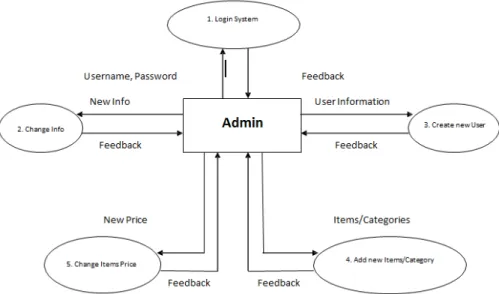
Figure 2. Functional Decomposition of Administrator Module
Figure 3. Activity Flow Diagram for Administrator Module.
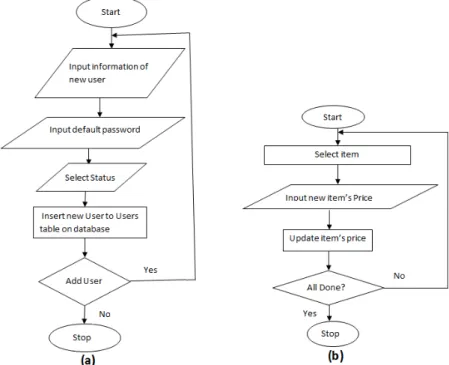
Figure 4. Flowchart for (a) the Add new User (b) Change Items’ Price.
The functional decomposition of the Sales Officer Module is given in figure 5. According to figure 5 the Sales officer’s module includes among other tasks; creating new customer, viewing items sold, viewing items in stock, inputting daily sales, printing invoice or receipt, etc.
Figure 5. Functional Decomposition of the Sales Officer Module
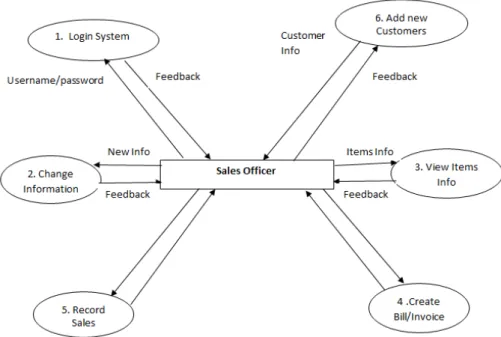
Figure 6. Activity Flow Diagram of the Sales Officer Module.
Figure 7 shows the flowchart of the daily sales performed by the sales officer. The sales officer inputs customer’s name checks his order and confirms if he is a debit customer (D) or not. If so, he records his order, else he collects money; send the order to the inventory manager. The sales officer packages the ordered goods from the inventory unit and prints invoice for the customer.
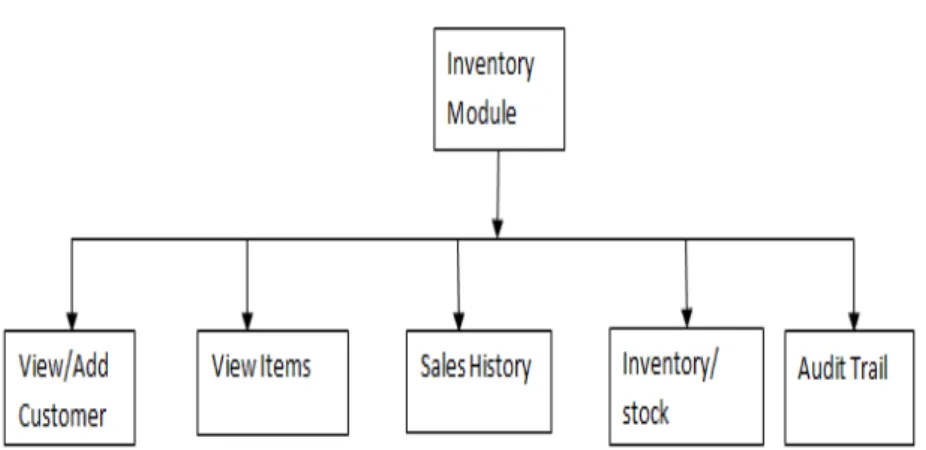
Figure 8. Functional Decomposition of the Inventory Module.
Figure 9. Activity Flow Diagram of the Inventory Module.
3. Results and Discussion
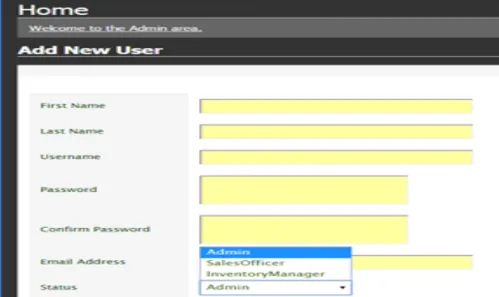
Figure 11, shows the input form used by the Administrator to create system users. The Administrator inputs the first name, the last name, the user name, the default password and confirmation of the password, corresponding email address and then assign the status to the particular user, which may be, sales office, Administrator, inventory manager and customer.
Figure 11. The screenshot of Create System Users form.
Figure 12 is the input form used by Administrator user to update any changes to the items or goods in terms of new order or price change. The Administrator user calls up the product name, puts the new price or item quantity.
Figure 12. The screenshot showing item/goods update form.
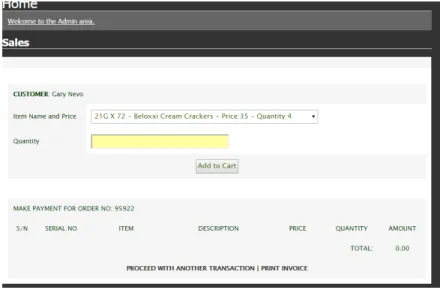
Figure 13. Screenshot input of sales by the sales officer
Figure 14 is the screenshot showing invoice ready to be printed by the sales officer. It contains information about the customer, the specific products bought along with their quantities and amount (cost) and a unique number invoice number automatically generated by the system.
Figure 14. Screenshot showing invoice for sales ready to be printed and issued to customer
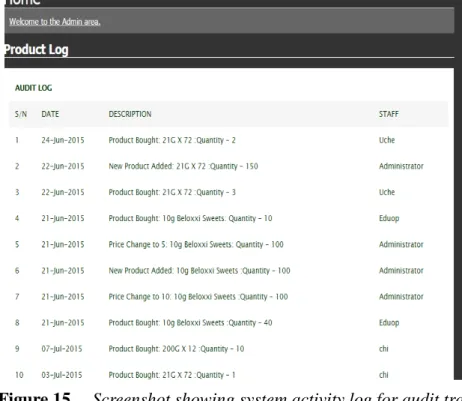
Figure 15 is the screenshot of transaction log or activity log for audit trail functionality in the system. It captures the activities carried out by the system users; it has the date, the description of the item changed and the system user that effected the change. This can be used to track any transaction that has taken place in the system.
4. Conclusion and Recommendation
4.1.
Conclusion
consists of five modules: the Administrator Module, the Inventory Module, the Sales Officer Module, the Customer Module and the About Us. These modules are also broken down to their different sub-modules and then developed, tested as well as integrated to for the complete system. Some design details and output screenshots of the functional SIWfMS are presented.
Figure 15. Screenshot showing system activity log for audit trail
4.2.
Recommendation for Further Studies
The research work focuses on the use of web application with transaction log for audit trail for SMBs in handling their daily sales and inventory activities hosted on the web for the biscuit distributor company in Eke, Nigeria. Further work is needed to design the mobile application version of the mobile system. This will make the accessibility of the system to be at the user’s convenience. Also the use of POS (Point Of Service) in paying for goods can also be incorporated in future works.
References
[1] Clemente, D. (2013). Cyber Security and Global Interdependence: What Is Critical?. Chatham House, Royal Institute of International Affairs.
[2] Lee, K. Robert (2009). Impacts of Information Technology on Society in the New Century. Available online: http://thedailyjournalist.com/wp-content/uploads/2014/01/ Konsbruck.pdf (accessed on 8 February 2016).
[3] Esselaar, S., Stork, C., Ndiwalana, A., & Deen-Swarray, M. (2006). ICT usage and its impact on profitability of SMEs in 13 African countries. In Information and Communication Technologies and Development, 2006. ICTD'06. International Conference on (pp. 40-47). IEEE.
[5] Malhotra, Y. (2005). Integrating knowledge management technologies in organizational business processes: getting real time enterprises to deliver real business performance. Journal of knowledge management, 9(1), 7-28.
[6] Lawlor, B. (2007). The age of globalization: Impact of information technology on global business strategies. Honors Projects in Computer Information Systems, 1. [7] Evans, D. S., Hagiu, A., & Schmalensee, R. (2006). Invisible engines: how software
platforms drive innovation and transform industries (p. 115). Cambridge, MA: MIT Press.
[8] Tyndale, P. (2002). A taxonomy of knowledge management software tools: origins and applications. Evaluation and program planning, 25(2), 183-190.
[9] Ibrahim, T. (2012). Design and Implementation of a University E-portal Application. Master project thesis entitled at Iraqi Commission for Computers and Informatics. [10] Van der Merwe, M., & Uden, L. (2007). Developing Online Learning Portals in Low
Bandwidth Communities. Available online: http://www.irma-international.org/ viewtitle/17875/ (accessed on 8 February 2016).
[11] Konstantinou, P. (2013). Rapid Application Development. ISAM 5635.
[12] Martin, J. (1991). Rapid application development. Macmillan publishing company, p. 736.
[13] Beynon-Davies, P., Carne, C., Mackay, H., & Tudhope, D. (1999). Rapid application development (RAD): an empirical review. European Journal of Information Systems, 8(3), 211-223.
[14] Agarwal, R., Chauhan, C. S., & Sharma, R. K. (2012). Decision Support and Database Management System “AroMed” on Commercially Exploited Medicinal and Aromatic Plants of India. International Journal of Advanced Agricultural Sciences and Technology, 1(1), pp. 17-22.
[15] Kaur, P., & Grover, D. (2012). Computer Based Payroll System Implementation for E-Governance at Punjab Agricultural University. International Journal of Engineering Research and Development, 5(3), 55-60.
[16] Kivaria, S., Tarimo, C., Hamad, O. F., & Marwala, T. (2011). Computerized fault monitoring and management subsystem with critical solutions archival capabilities in a satellite earth station. Recent Researches in Communications, Electrical & Computer Engineering, 210-220. ISBN: 978-960-474-286-8.