BIOTIC
CONCEPTS EXPLORED IN THIS LESSON
1) Introduction to Biotic Interactions
2) Types of Biotic Interactions
3) Symbiotic Relationships
INTRODUCTION TO BIOTIC INTERACTIONS
•
In an ecosystem, living (biotic) things have to _______ with one another as well as with the non-livingcomponents of their environment.
•
Interacting with other organisms can have THREE results: 1)2)
3)
It can ______ an organism.
It can _____ an organism.
It can have ________ on an organism. (the rarest case) benefit
harm
no effect
•
Biotic interactions deal with the ____ of relationships that occur between _____ things and the ______ this has for the participants.effects type
Biotic Interaction: A biotic interaction is any __________ between
two organisms.
interact
relationship
Types of Biotic Interactions
Competition
Herbivory Predation Symbiosis
Mutualism
Parasitism Commensalism
TYPES OF BIOTIC INTERACTIONS
•
There are FOUR main types of biotic interactions:We will
define
all of these
types of interactions and
examine many
examples
of
each one.
TYPES OF BIOTIC INTERACTIONS
What do all these interactions have in
common?
chameleon snares insect chameleon snares insect killer whale captures seal
killer whale captures seal
hawk captures fish
hawk captures fish fox catches rodentfox catches rodent snake traps
TYPES OF BIOTIC INTERACTIONS
1) PREDATION:
The biotic interaction where one organism,the _______ , _____ for living ____ and eats it.
•
The predator _______.•
The prey is _______.Who benefits? Who is harmed? Who is
unaffected?
predator hunts prey
harmed benefits
chameleon snares insect chameleon snares insect killer whale captures seal
killer whale captures seal
hawk captures fish
hawk captures fish fox catches rodentfox catches rodent snake traps
TYPES OF BIOTIC INTERACTIONS
1) PREDATION:
The biotic interaction where one organism,the _______ , _____ for living ____ and eats it.
•
The predator _______.•
The prey is _______.predator hunts prey
harmed benefits
lions and warthogs panther chameleon
great white shark bullfrog hunts
Who benefits? Who is harmed? Who is
unaffected?
Let’s see predatio
TYPES OF BIOTIC INTERACTIONS
water buffalo grazes on grass water buffalo grazes on grass
caterpillar munches leaf caterpillar munches leaf rabbit nibbles flower
rabbit nibbles flower
monkey bites coconut monkey bites coconut
deer chomps on leaves deer chomps
on leaves
The biotic interaction where an organism, a
________ (or omnivore), eats a _____.
TYPES OF BIOTIC INTERACTIONS
2) HERBIVORY:
•
The herbivore _______.•
The plant is _______.herbivore plant
harmed benefits
water buffalo grazes on grass water buffalo grazes on grass
caterpillar munches leaf caterpillar munches leaf rabbit nibbles flower
rabbit nibbles flower
monkey bites coconut monkey bites coconut
deer chomps on leaves deer chomps on
leaves
Who benefits? Who is harmed? Who is
unaffected?
Herbivores at the San Diego Zoo
Let’s see herbivor
TYPES OF BIOTIC INTERACTIONS
hawk and owl face off hawk and owl face off
eagle and fox both want
bird
eagle and fox both want
bird various plants all need light
various plants all need light
two male sheep butt heads two male sheep butt heads
two male stag beetles fight
two male stag beetles fight
The biotic interaction where two organisms of the _____ or ________
species fight for the same _________.
TYPES OF BIOTIC INTERACTIONS
3) COMPETITION:
•
Both competitors are _______. resourcesdifferent same
harmed
hawk and owl face off hawk and owl face off
eagle and fox both want bird eagle and fox both want bird various plants all need light
various plants all need light
two male sheep butt heads two male sheep butt heads
two male stag beetles fight
two male stag beetles fight
The biotic interaction where two organisms of the _____ or ________
species fight for the same _________.
TYPES OF BIOTIC INTERACTIONS
3) COMPETITION:
•
Both competitors are _______. resourcesdifferent same
harmed
Who benefits? Who is harmed? Who is
unaffected? Plants Compete
Bower Birds Compete Lions & Hyenas Compete
Let’s see competiti
and _____________ relationship
between
two ________ species.
TYPES OF BIOTIC INTERACTIONS
4) SYMBIOSIS:
different
The biotic interaction which is a _________long-term physically close
•
There are THREE different types of symbiotic relationships:i)
ii)
iii)
Parasitism
Mutualism
who is _______ in this interaction.
_______ from
interacting with another organism, the ____,
SYMBIOTIC RELATIONSHIPS
The symbiotic relationship where one organism,
the _______,
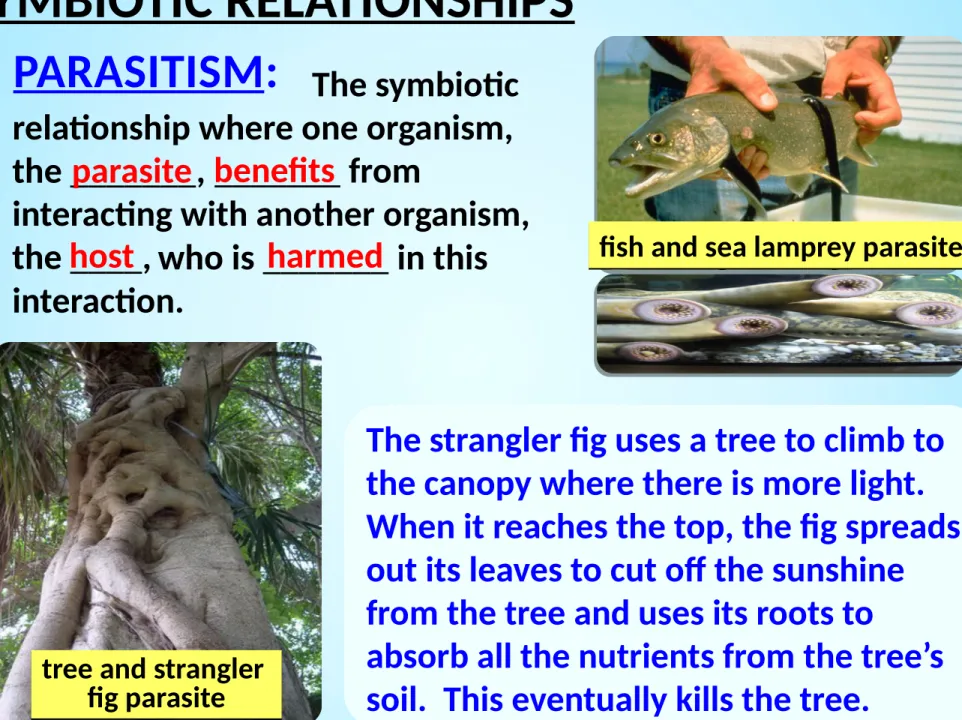
fish and sea lamprey parasite fish and sea lamprey parasite
i) PARASITISM:
parasite benefits
host harmed
Parasitic sea lampreys attach themselves to fish and suck nutrients from them.
who is _______ in this interaction.
_______ from
interacting with another organism, the ____,
SYMBIOTIC RELATIONSHIPS
The symbiotic relationship where one organism,
the _______,
i) PARASITISM:
parasite benefits
host harmed
tree and strangler fig parasite tree and strangler
fig parasite
The strangler fig uses a tree to climb to the canopy where there is more light. When it reaches the top, the fig spreads out its leaves to cut off the sunshine
from the tree and uses its roots to
absorb all the nutrients from the tree’s soil. This eventually kills the tree.
who is _______ in this interaction.
_______ from
interacting with another organism, the ____,
SYMBIOTIC RELATIONSHIPS
The symbiotic relationship where one organism,
the _______,
i) PARASITISM:
parasite benefits
host harmed fish and sea lamprey parasitefish and sea lamprey parasite
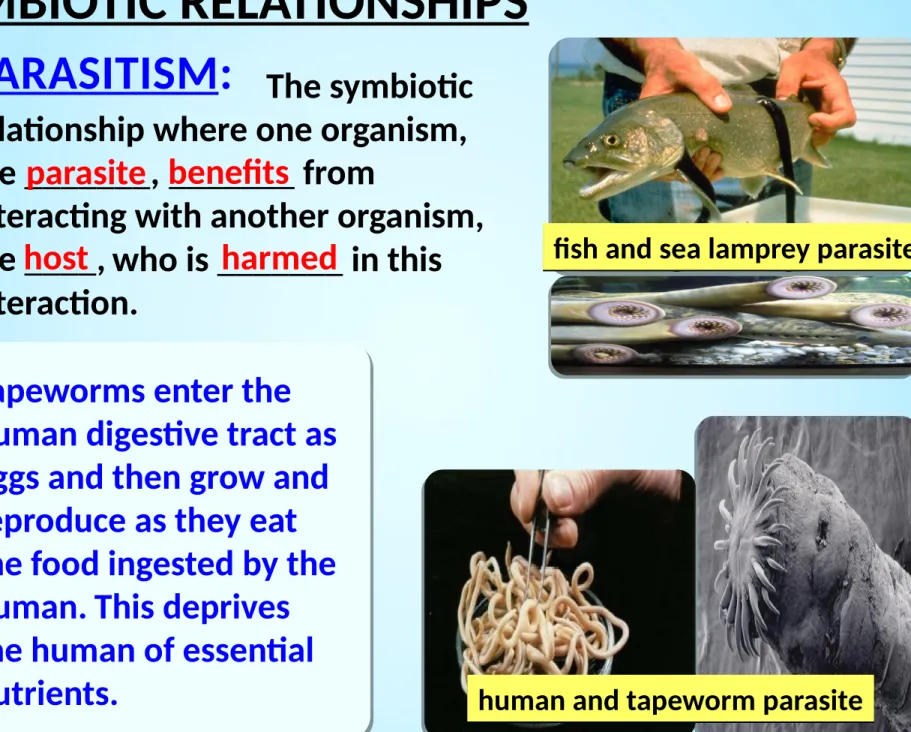
human and tapeworm parasite human and tapeworm parasite tree and strangler
fig parasite tree and strangler
fig parasite
Tapeworms enter the human digestive tract as eggs and then grow and reproduce as they eat the food ingested by the human.
who is _______ in this interaction.
_______ from
interacting with another organism, the ____,
SYMBIOTIC RELATIONSHIPS
The symbiotic relationship where one organism,
the _______,
i) PARASITISM:
parasite benefits
host harmed
Sea Lamprey
Zombie Snails Strangler Figs
Snapper’s Parasite Caterpillar’s Misfortune
Let’s see parasitis
The symbiotic relationship where ____ organisms
______ in the interaction.
ii) MUTUALISM:
both benefit
SYMBIOTIC RELATIONSHIPS
The plover enters the crocodile’s mouth to eat any parasites caught in between its
teeth and mouth tissue. This gives the
plover a nice meal and gives the crocodile a free visit to the dentist.
eel & cleaner shrimp eel & cleaner shrimp
The symbiotic relationship where ____ organisms
______ in the interaction.
ii) MUTUALISM:
both benefit
SYMBIOTIC RELATIONSHIPS
The same type of symbiotic relationship is exhibited between the eel and the cleaner shrimp.
eel & cleaner shrimp eel & cleaner shrimp
crocodile & plover crocodile & plover The symbiotic
relationship where ____ organisms
______ in the interaction.
eel & cleaner shrimp eel & cleaner shrimp
ii) MUTUALISM:
both benefit
SYMBIOTIC RELATIONSHIPS
monarch butterfly & milkweed monarch butterfly
& milkweed
crocodile & plover crocodile & plover The symbiotic
relationship where ____ organisms
______ in the interaction.
eel & cleaner shrimp eel & cleaner shrimp
ii) MUTUALISM:
both benefit
SYMBIOTIC RELATIONSHIPS
monarch butterfly & milkweed monarch butterfly
& milkweed ant & aphidsant & aphids
The aphids provide the ant with sap from the plants they consume.
The ant would not be able to get this sap for itself otherwise.
In return, the aphids get protection from the ant against any predators who would like to eat them.
The symbiotic relationship where ____ organisms
______ in the interaction.
ii) MUTUALISM:
both benefit
SYMBIOTIC RELATIONSHIPS
Caterpillar Protectors Friendly Goby & Shrimp
and the other one is __________ (it does not benefit nor is it harmed).
The symbiotic relationship where one organism ________ ,
cattle egret and water buffalo cattle egret and water buffalo
iii) COMMENSALISM:
benefits unaffected
SYMBIOTIC RELATIONSHIPS
As water buffalo walk through a field, they disturb the soil or muddy water.
This exposes insects which the cattle egret is more than happy to snap up.
The egret is happy and the water buffalo neither benefits nor is it harmed. (He’s not even
and the other one is __________ (it does not benefit nor is it harmed).
The symbiotic relationship where one organism ________ ,
cattle egret and water buffalo cattle egret and water buffalo
iii) COMMENSALISM:
benefits unaffected
SYMBIOTIC RELATIONSHIPS
An owl takes advantage of a hole in a tree to make a home.
The owl gets shelter,
and the tree is neither harmed nor does it benefit.
and the other one is __________ (it does not benefit nor is it harmed).
The symbiotic relationship where one organism ________ ,
cattle egret and water buffalo cattle egret and water buffalo
iii) COMMENSALISM:
benefits unaffected
SYMBIOTIC RELATIONSHIPS
owl and tree
owl and tree barnacles and whalebarnacles and whale
Barnacles attach themselves to
whales in order to gain access to
different feeding grounds.
The whales don’t
benefit from this, but nor are they harmed.
Let’s see commensali
and the other one is __________ (it does not benefit nor is it harmed).
The symbiotic relationship where one organism ________ ,
iii) COMMENSALISM:
benefits unaffected
SYMBIOTIC RELATIONSHIPS
Clown Fish & Anemone Bitterling & Mussel
Let’s see commensali
Types of Biotic Interactions
REVIEW OF BIOTIC INTERACTIONS
Competition
Herbivory Predation Symbiosis
Mutualism
Created by Anh-Thi Tang – Tangstar Science
Copyright © August 2014 Anh-Thi Tang (a.k.a. Tangstar Science)
All rights reserved by author.
This document is for personal classroom use only.
This entire document, or any parts within, may not be electronically
distributed or posted to any website including teacher or classroom blogs or websites.